The Cultural Landscape, 11e (Rubenstein)
Chapter 8 Political Geography
1) Conflicting claims to the Arctic are mostly due to
A) the potential for energy resources.
B) old Cold War grudges.
C) colonial expansion.
D) shifting sea ice formations.
E) the proximity of South American and African countries.
2) The most populous country that is not a member of the United Nations is
A) Taiwan.
B) South Korea.
C) Antarctica.
D) Vatican City.
E) Monaco.
3) The historically neutral country that recently joined the United Nations is
A) Switzerland.
B) Australia.
C) France.
D) Canada.
E) Monaco.
4) Over the past half century, the number of sovereign states in the world
A) has remained approximately the same.
B) has increased by a couple of dozen.
C) has decreased by a couple of dozen.
D) has increased by more than a hundred.
E) has increased by more than a thousand.
5) The world’s largest state is
A) China.
B) Canada.
C) Russia.
D) Alaska.
E) India.
6) The United Nations is primarily what kind of cooperative effort?
A) political
B) military
C) economic
D) cultural
E) environmental
7) In 2002 the Organization of African Unity was replaced by
A) the African Union.
B) the African National Party.
C) the African Treaty Organization.
D) the Organization of African OPEC States.
E) the Organization for African Economic Cooperation.
8) During his presentation at the United Nations, then-Secretary of State Colin Powell used what
geographic tool to make the case for war?
A) air photos of alleged chemical weapons bunkers
B) documents linking Iran and Afghanistan to yellowcake uranium
C) photos and recordings linking U.S. military leaders to Saddam Hussein
D) air photos showing troop movements and territorial disputes with Kuwait
E) falsified recordings linking Saddam Hussein to al-Qaeda
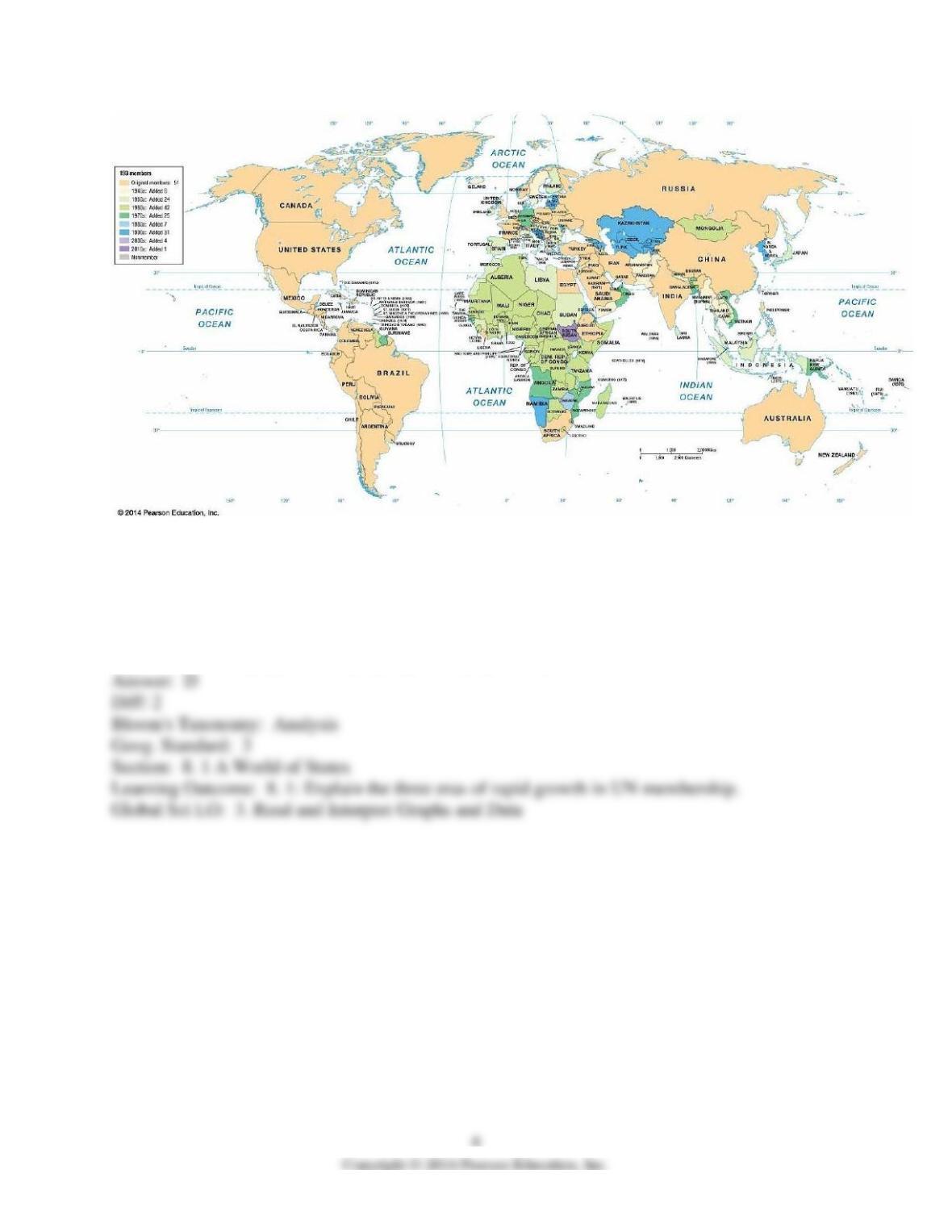
9) The map concerning United Nations membership indicates that most African countries
A) left the UN in the 1990s but joined again in the early 2000s.
B) have not yet joined the United Nations as independent states.
C) became UN members in the 1940s and 1950s.
D) became UN members in the 1960s and 1970s.
E) joined the UN in the 1950s but left the UN in the 1980s.
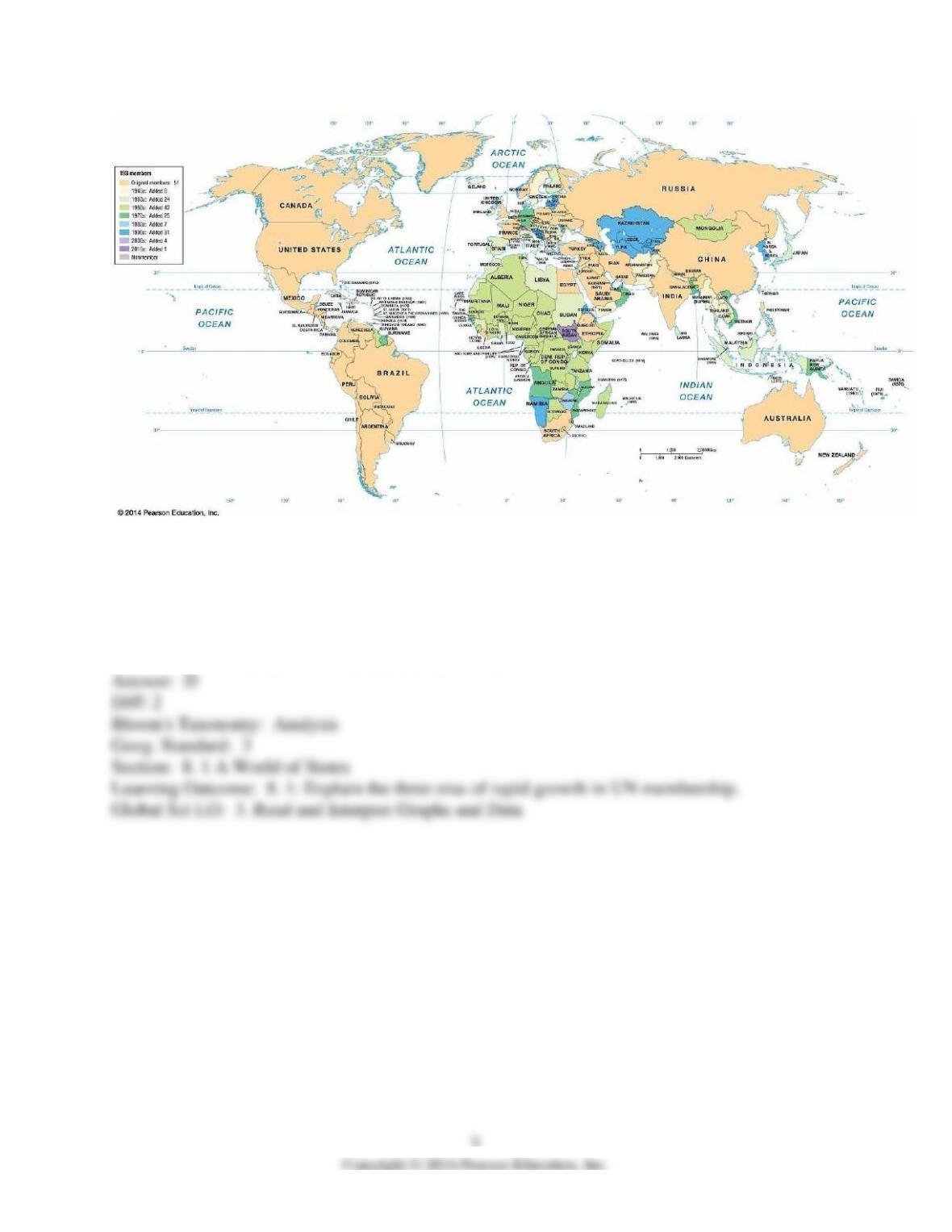
10) The map concerning United Nations membership indicates that Ethiopia
A) left the UN in the 1990s but joined again in the early 2000s.
B) has not yet joined the United Nations as an independent state.
C) became a UN member in the 1950s.
D) became a UN member in the 1940s.
E) joined the UN in the 1950s but left it in the 1980s.
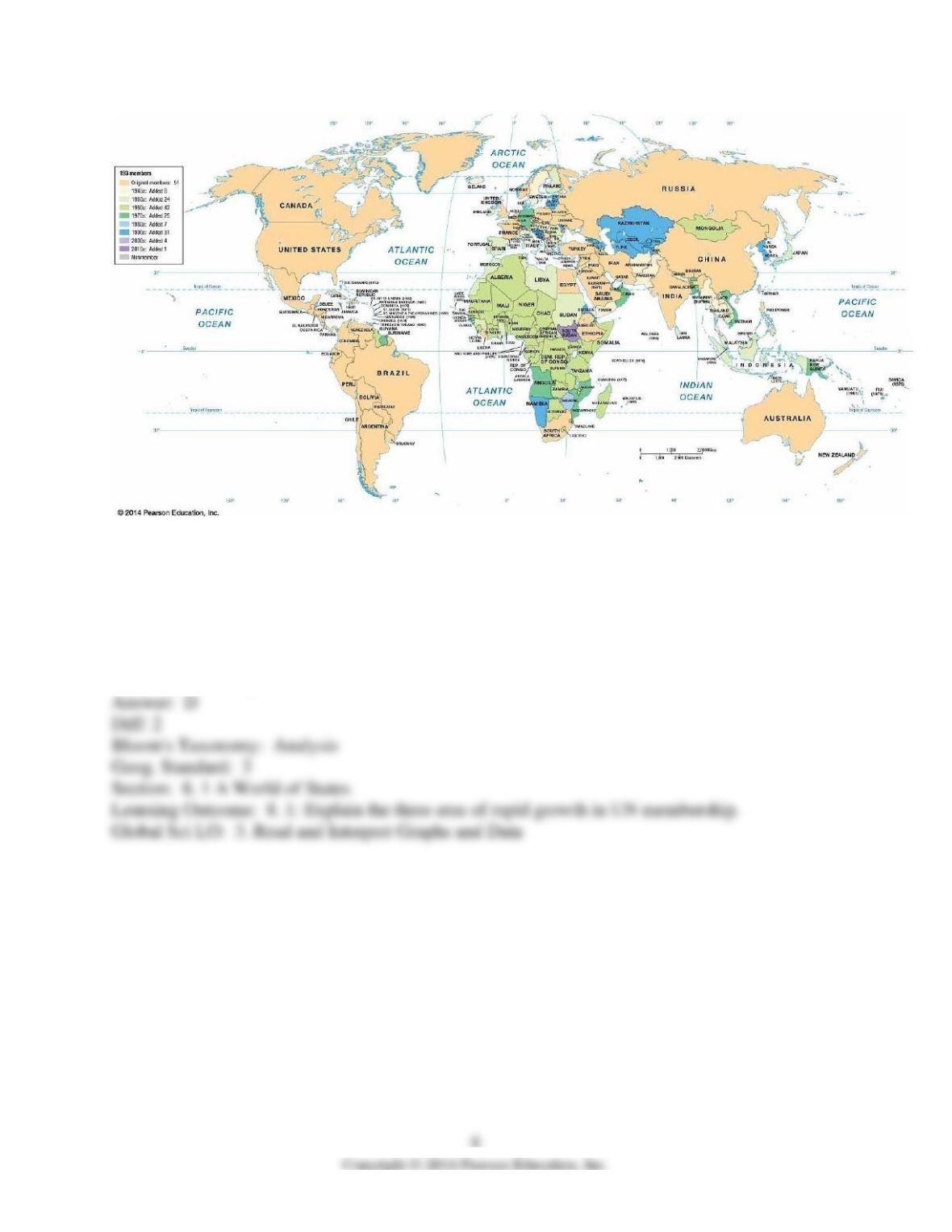
11) As indicated on the map of United Nation membership, Namibia joined the United Nations
in the
A) early 20th century.
B) early 21st century.
C) mid 20th century.
D) late 20th century.
E) late 19th century.
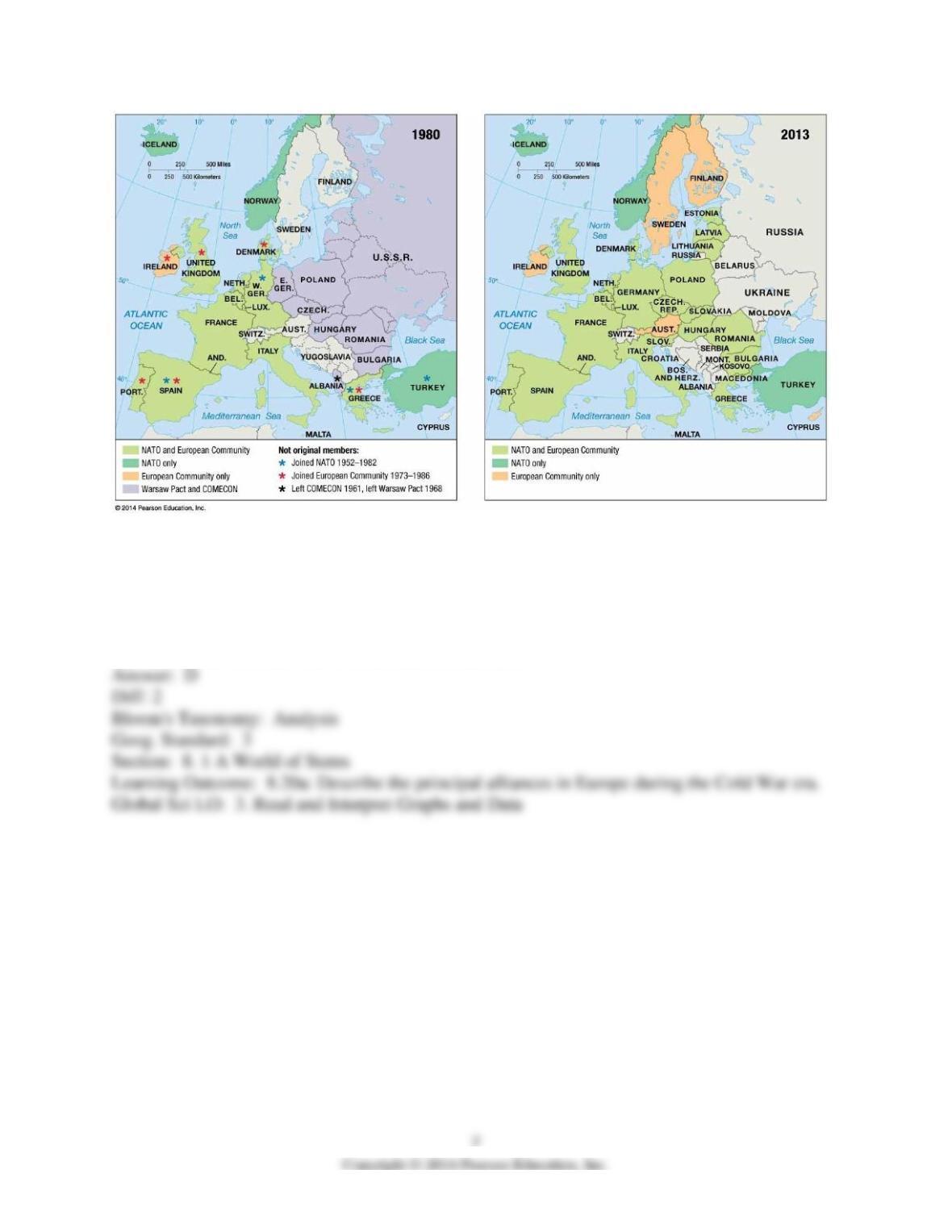
12) As indicated on the maps of economic and political alliances, in the late 20th century Austria
A) was a member of NATO and the European Community.
B) was a member of NATO but not the European Community.
C) was a member of the European Community but not NATO.
D) remained nonaligned with either NATO or the Warsaw Pact.
E) was a member of the Warsaw Pact and COMECON.
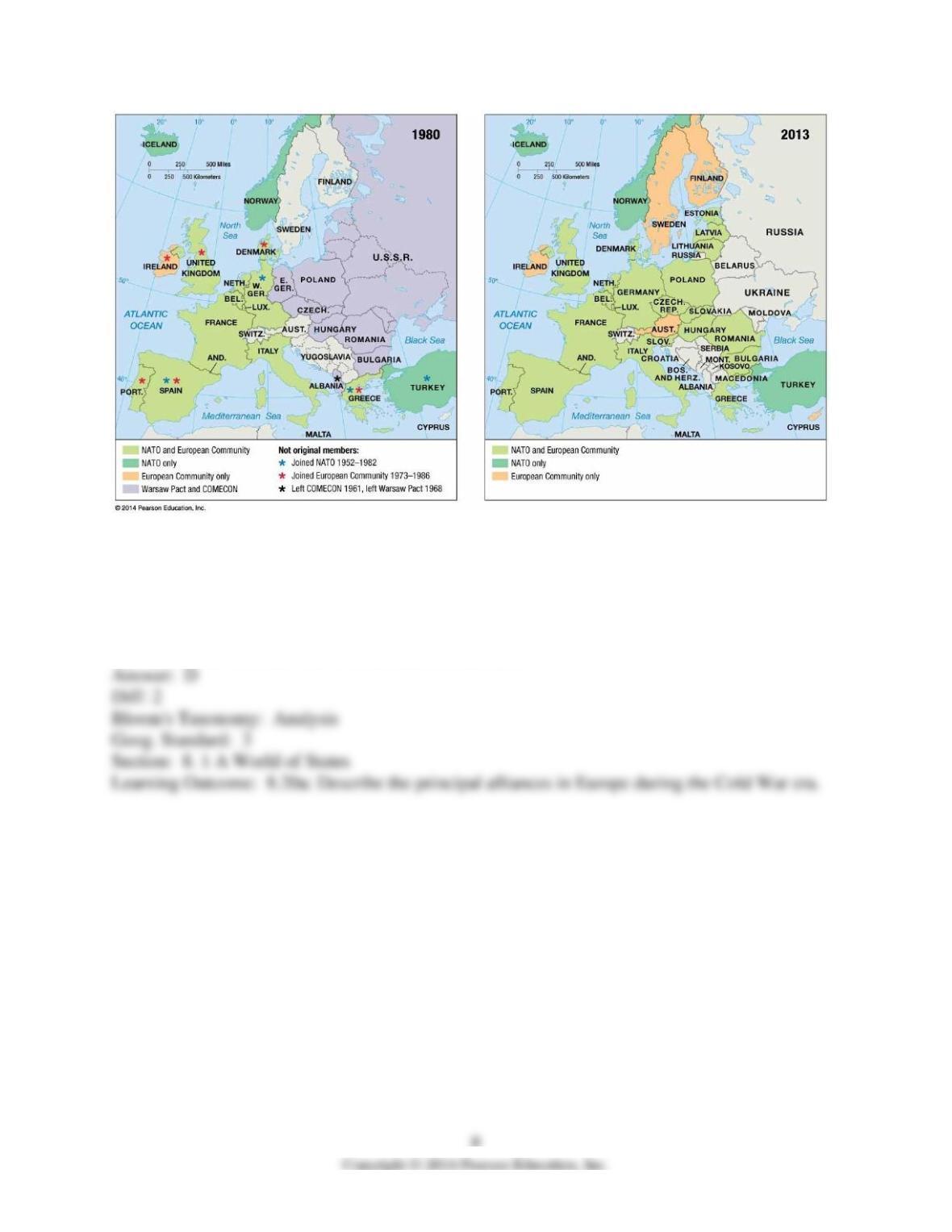
13) As indicated on the maps of economic and political alliances, in 1980 Sweden
A) was a member of NATO and the European Community.
B) was a member of NATO but not the European Community.
C) was a member of the European Community but not NATO.
D) remained nonaligned with either NATO or the Warsaw Pact.
E) was a member of the Warsaw Pact and COMECON.
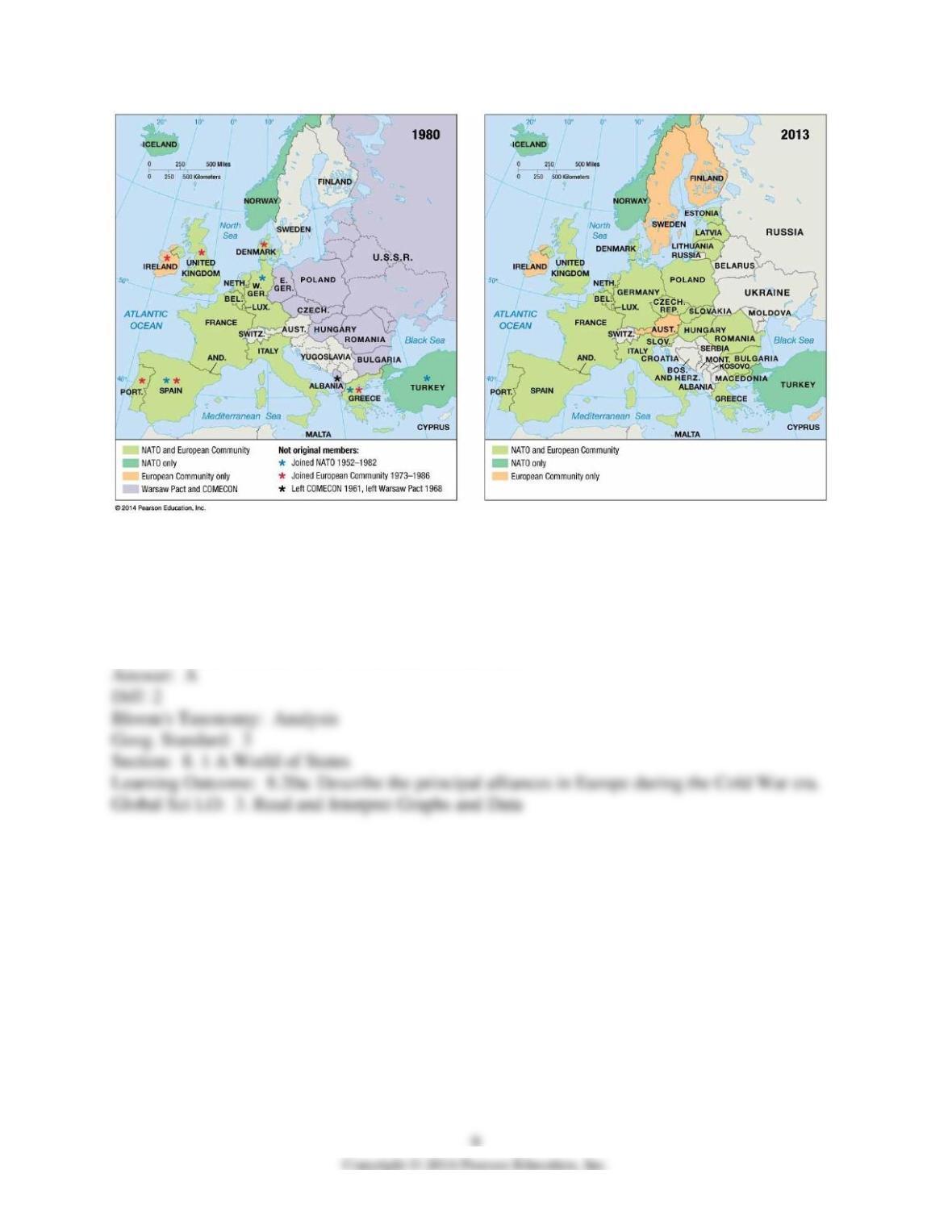
14) As indicated on the maps of economic and political alliances, in 1980 Belgium
A) was a member of NATO and the European Community.
B) was a member of NATO but not the European Community.
C) was a member of the European Community but not NATO.
D) remained nonaligned with either NATO or the Warsaw Pact.
E) was a member of the Warsaw Pact and COMECON.
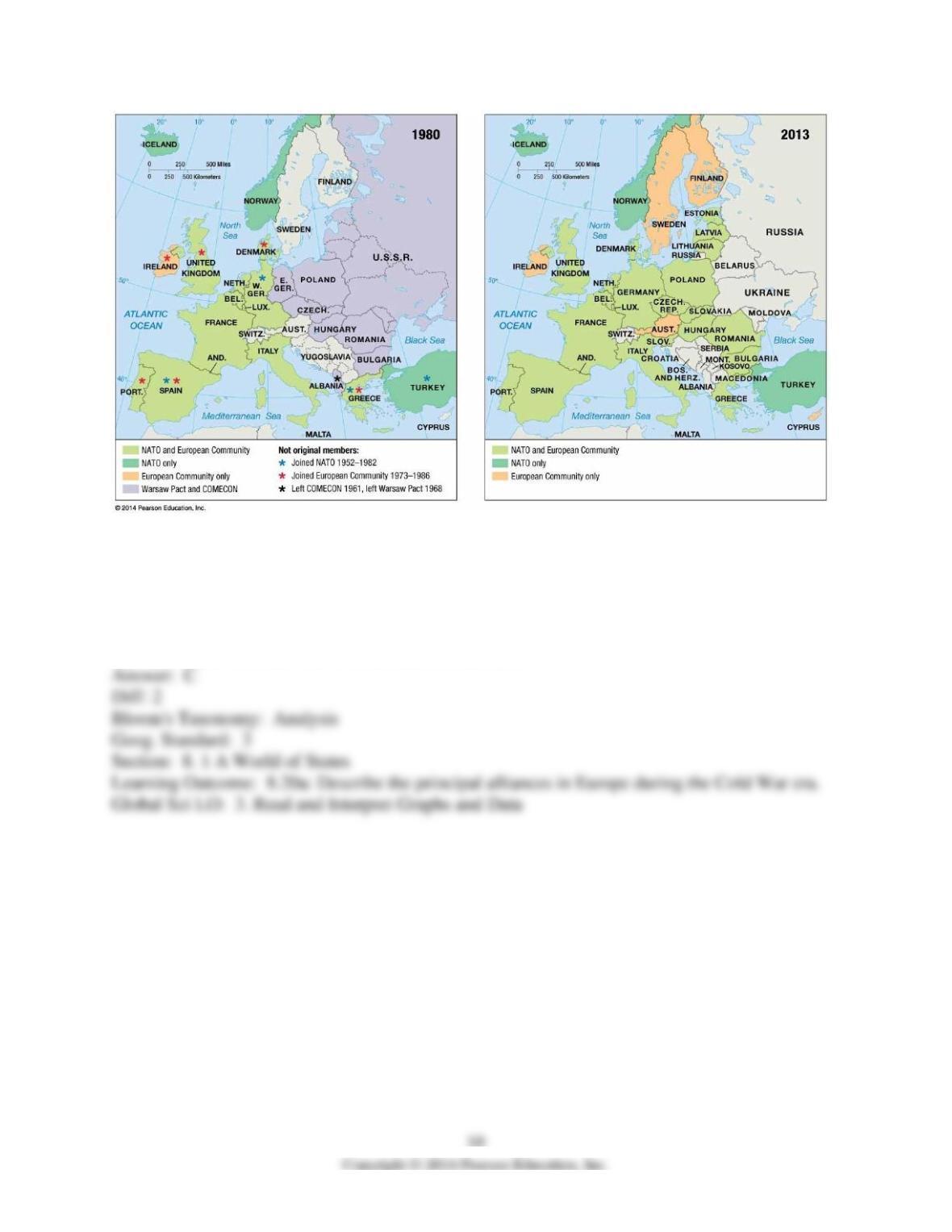
15) As indicated on the maps of economic and political alliances, in 1980 Ireland
A) was a member of NATO and the European Community.
B) was a member of NATO but not the European Community.
C) was a member of the European Community but not NATO.
D) remained nonaligned with either NATO or the Warsaw Pact.
E) was a member of the Warsaw Pact and COMECON.
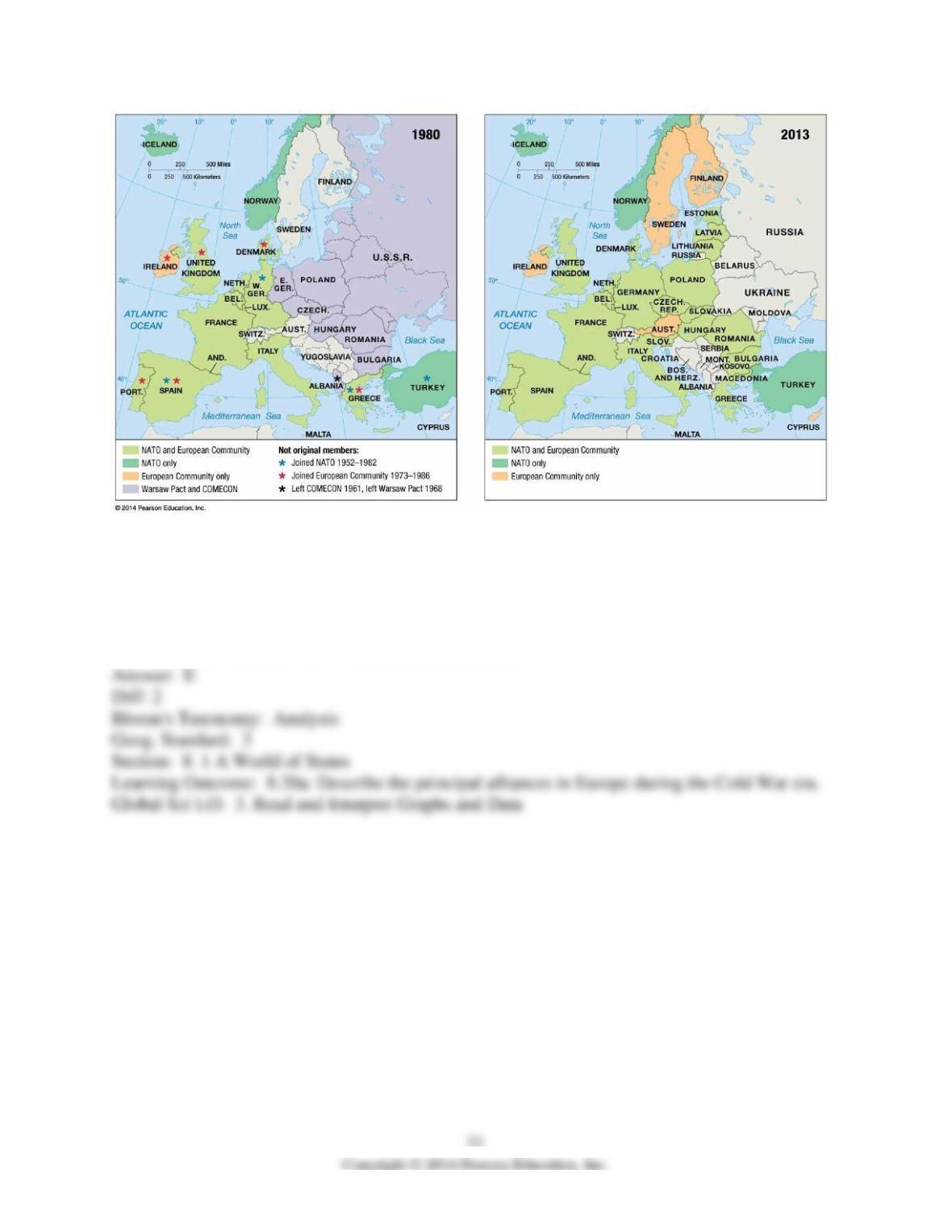
16) As indicated on the maps of economic and political alliances, in 1980 Bulgaria
A) was a member of NATO and the European Community.
B) was a member of NATO but not the European Community.
C) was a member of the European Community but not NATO.
D) remained nonaligned with either NATO or the Warsaw Pact.
E) was a member of the Warsaw Pact and COMECON.
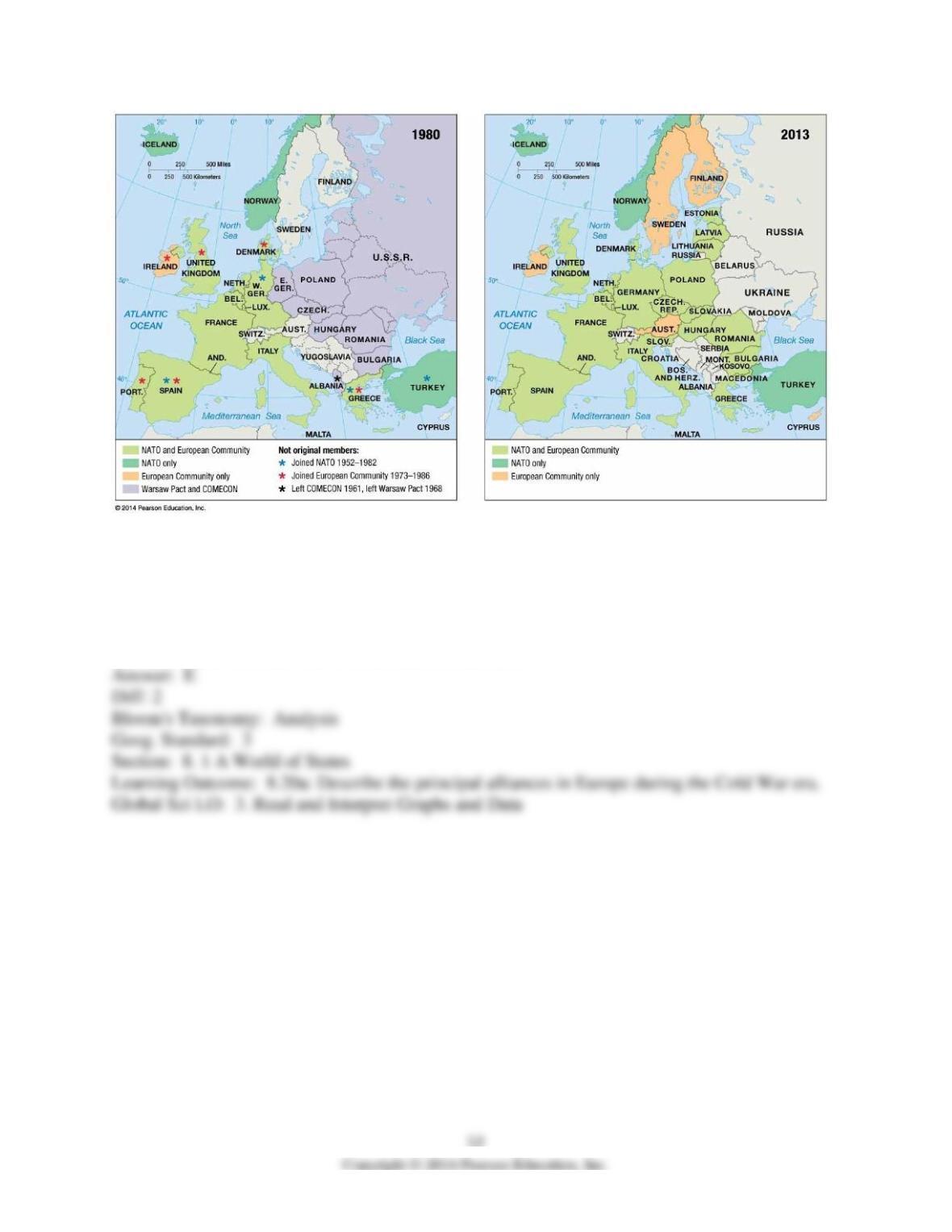
17) As indicated on the maps of economic and political alliances, in 1980 Hungary
A) was a member of NATO and the European Community.
B) was a member of NATO but not the European Community.
C) was a member of the European Community but not NATO.
D) remained nonaligned with either NATO or the Warsaw Pact.
E) was a member of the Warsaw Pact and COMECON.
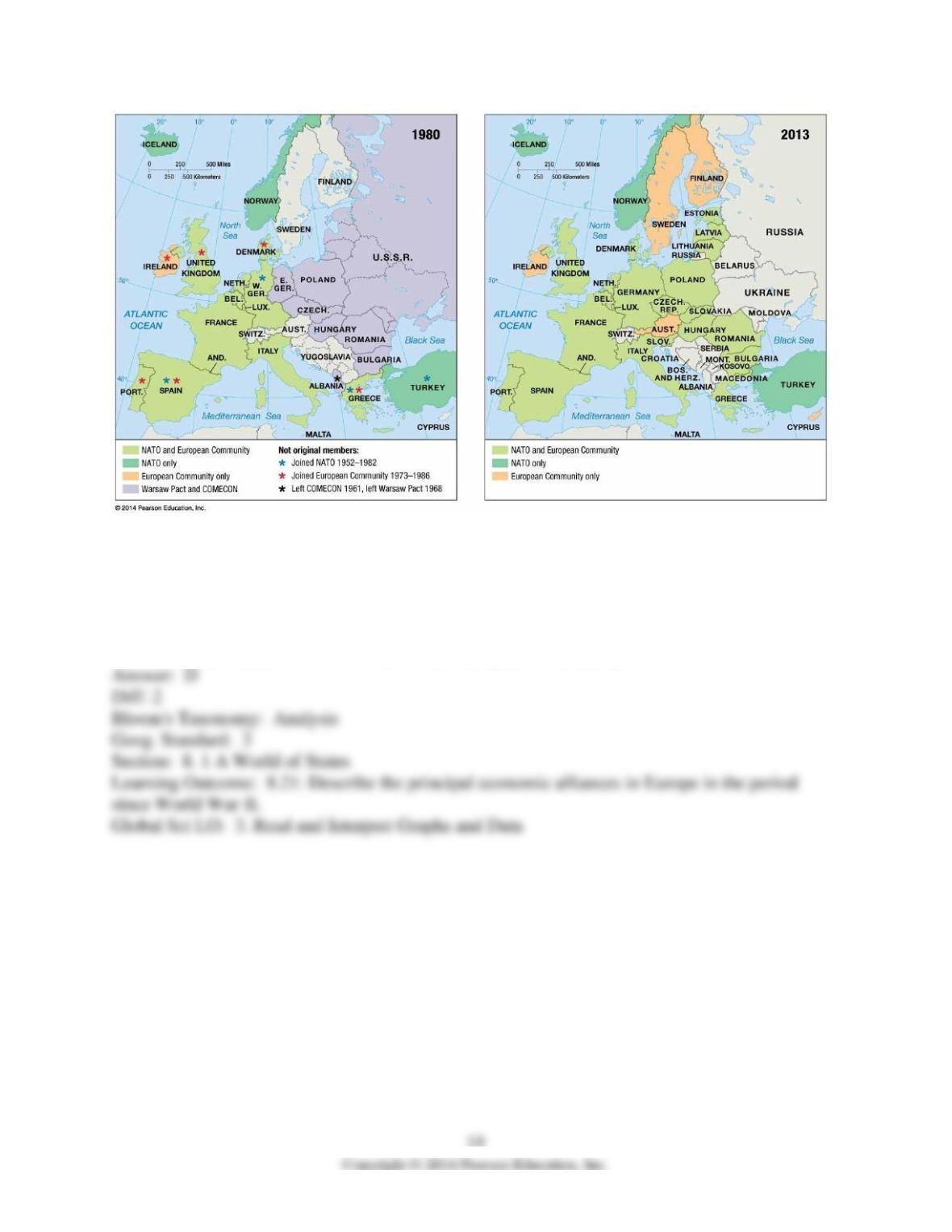
18) As indicated on the map of European economic and military alliances, in 2013 Ireland
A) was a member of NATO and the European Community.
B) was a member of NATO but not the European Community.
C) was a member of COMECON and NATO.
D) was a member of the European Community only.
E) was neither a member of NATO nor of the European Community.
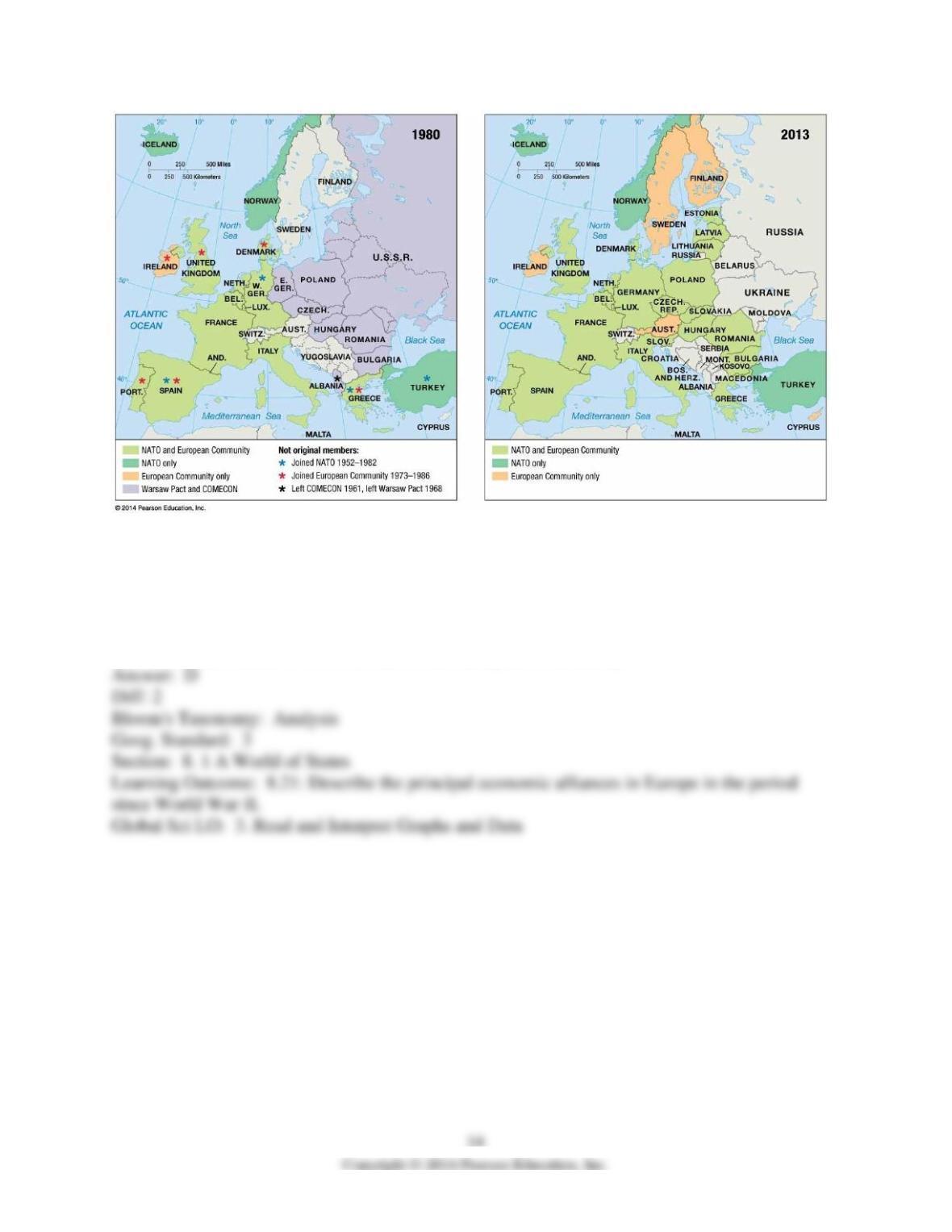
19) As indicated on the map of European economic and military alliances, in 2013 Austria
A) was a member of NATO and the European Community.
B) was a member of NATO but not the European Community.
C) was a member of COMECON and NATO.
D) was a member of the European Community only.
E) was neither a member of NATO nor of the European Community.
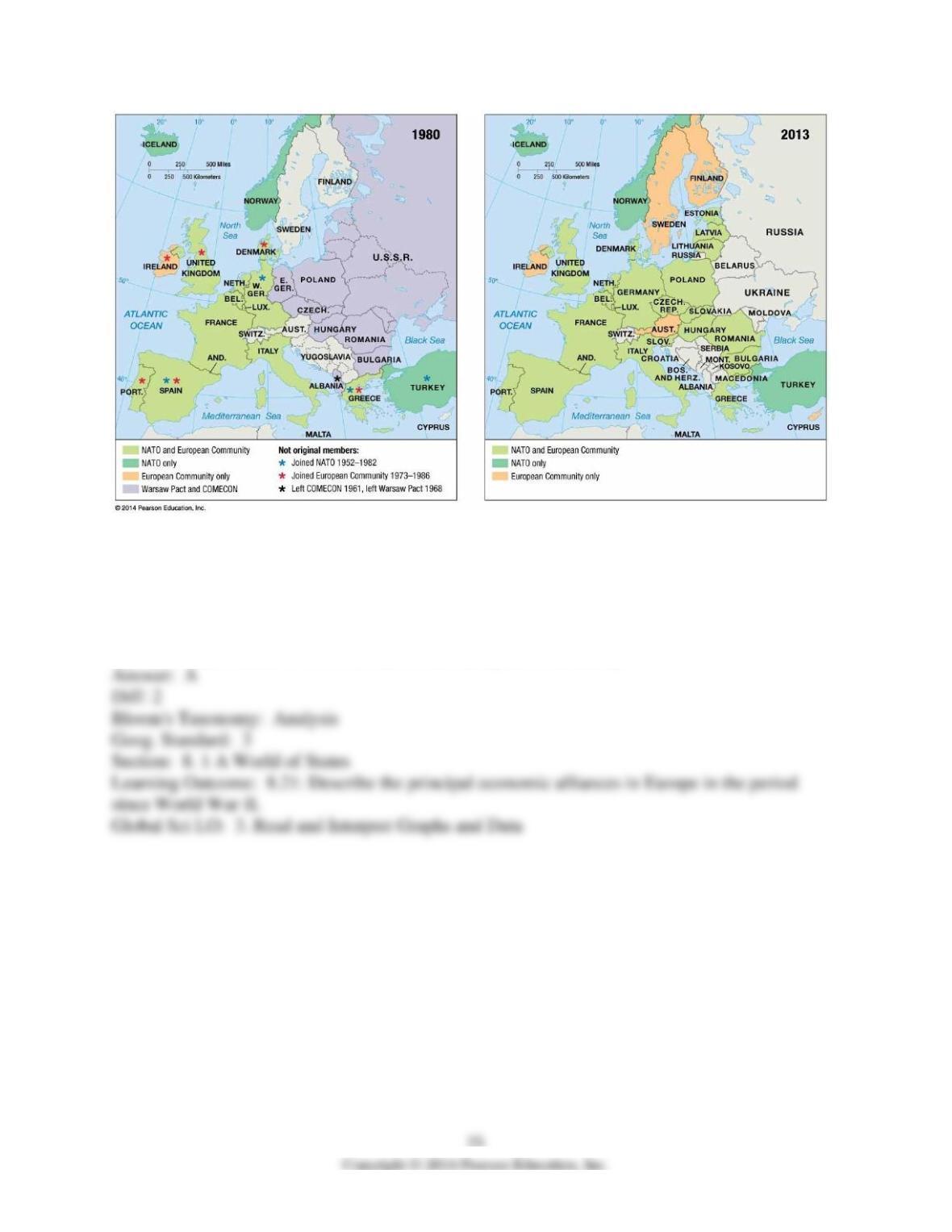
20) As indicated on the map of European economic and military alliances, in 2013 Latvia
A) was a member of NATO and the European Community.
B) was a member of NATO but not the European Community.
C) was a member of COMECON and NATO.
D) was a member of the European Community only.
E) was neither a member of NATO nor of the European Community.
21) An area organized into an independent political unit is a
A) colony.
B) nationality.
C) nation.
D) state.
E) territory.
22) The best example of a state among the following is
A) an island with a long history of self-rule and a homogeneous ethnic identity, although the
island has been under the control of a colonial power for the last 30 years.
B) a group of islands inhabited by a homogeneous ethnicity, although the westernmost islands
pertain to the territory of one country whereas the easternmost islands pertain to another country.
C) a mountainous region inhabited by heterogeneous ethnicities and divided up administratively
among various independent countries.
D) a mountainous region inhabited by heterogeneous ethnicities which share responsibility for
maintaining an independent government and a standing army.
E) a mountainous region inhabited by a mixture of peoples but recently colonized by a European
nation-state.
23) The best example of a nation among the following is
A) an island with a long history of self-rule and a homogeneous ethnic identity, although the
island has been under the control of a colonial power for the last 30 years.
B) a group of islands inhabited by a homogeneous ethnicity, although the westernmost islands
pertain to the territory of one country whereas the easternmost islands pertain to another country.
C) a mountainous region inhabited by heterogeneous ethnicities and divided up administratively
among various independent countries.
D) a mountainous region inhabited by heterogeneous ethnicities which share responsibility for
maintaining an independent government and a standing army.
E) a mountainous region inhabited by a mixture of peoples but recently colonized by a European
nation-state.
24) The Fertile Crescent
A) followed the Nile and Euphrates rivers.
B) was the key to the Roman Empire in classical times.
C) was the location of the first city-states in the Middle East and the first large-scale agricultural
projects of Sub-Saharan Africa.
D) is sometimes considered to have extended from the Nile Valley to the Atlas Mountains.
E) extended from the Persian Gulf to the Mediterranean Sea and was the location of the first city-
states in the Middle East.
25) The first states in ancient Mesopotamia were
A) city-states, which incorporated cities as well as their countryside.
B) colonies, which incorporated cities as well as their countryside.
C) empires, which incorporated dozens of unified colonies.
D) nation-states, which incorporated city-states, colonies, and empires.
E) patron-states ruled by sheiks.
26) Political unity in the ancient Mediterranean world reached its height in
A) the Fertile Crescent.
B) Egypt.
C) the Roman Empire.
D) Western Europe.
E) the Alexandrian Empire.
27) The first widespread use of the nation-state concept came in
A) Mesopotamia.
B) the Roman Empire.
C) Western Europe.
D) the United States.
E) Southeast Asia.
28) Among the world’s largest multinational states are
A) Russia and the United States.
B) Australia and New Zealand.
C) Japan and Denmark.
D) Mexico and Russia.
E) Mexico and Japan.
29) Korea is a good example of a(n)
A) sovereign state.
B) nation-state existing in a unified condition.
C) ethnicity divided between more than one state.
D) colony divided between more than one ethnicity.
E) patron-state.
30) The problems experienced by Cyprus during the past four decades include all but which of
the following?
A) a Greek-inspired military coup
B) a Turkish army invasion
C) a partition of the island by the British as part of independence
D) an increasing spatial segregation of Greeks and Turks
E) division of the capital city by a buffer zone patrolled by UN soldiers
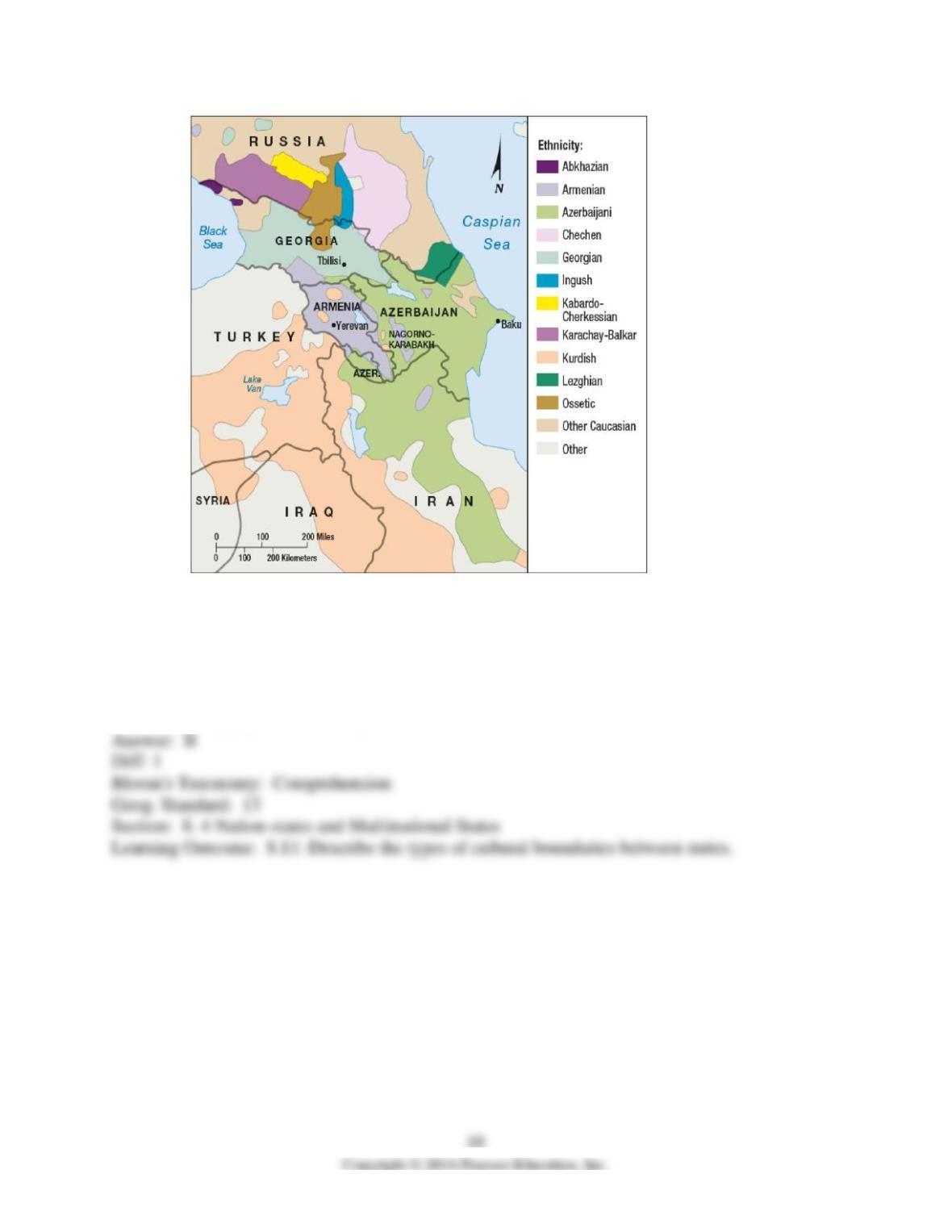
31) The Kurds are
A) a multinational state.
B) divided among more than one state.
C) a religious minority in the Middle East.
D) trying to unite with Turkey.
E) the majority population of Iraq.