1
Managerial Decision Modeling w/ Spreadsheets, 3e (Balakrishnan/Render/Stair)
Chapter 8 Decision Analysis
8.1 Chapter Questions
1) Determining the best payoff for each alternative and choosing the alternative with the “best of the
best” is the approach called:
A) maximax
B) maximin
C) Laplace
D) minimax regret
E) expected monetary value
2) Determining the worst payoff for each alternative and choosing the alternative with the “best of the
worst” is the approach called:
A) maximax
B) maximin
C) Laplace
D) minimax regret
E) expected monetary value
3) The approach that is used for analyzing decision trees is called:
A) maximax
B) maximin
C) Laplace
D) minimax regret
E) expected monetary value
4) Determining the average payoff for each alternative and choosing the one with the best payoff is the
approach called:
A) maximax
B) maximin
C) Laplace
D) minimax regret
E) expected monetary value
Use this information to answer the following questions.
Consider the following payoff table that represents the profits earned for each alternative (A, B, and C)
under the states of nature S1, S2, and S3.
S1 S2 S3
A $60 $145 $120 B $75 $125 $110
C $95 $85 $130
5) Refer to the payoff table. Using the maximax criterion, what would be the highest expected payoff?
A) $145
B) $124
C) $120
D) $110
E) $100
6) Refer to the payoff table. Using the maximin criterion, what would be the highest expected payoff?
A) $145
B) $125
C) $85
D) $75
E) $60
7) Refer to the payoff table. Using the Laplace criterion, what would be the highest expected payoff?
A) $103.3
B) $108.3
C) $120
D) $125
E) $145
8) Refer to the payoff table. Using the criterion of realism and an alpha value of 0.7, what would be the
highest expected payoff?
A) $127
B) $119.5
C) $98.5
D) $116
E) $145
9) Refer to the payoff table. Using the minimax regret criterion, which alternative would you choose?
A) A
B) B
C) C
D) A or B
E) B or C
10) Refer to the payoff table. Using the expected monetary value (EMV) criterion, what is the highest
attainable expected profit? Assume P(S1) = 0.5 and P(S2) = 0.25.
A) $101.25
B) $103.33
C) $108.33
D) $125
E) $145
11) Refer to the payoff table. What is the expected value under certainty? Assume P(S1) = 0.5 and P(S2)
= 0.25.
A) $101.25
B) $103.33
C) $108.33
D) $116.25
E) $136.25
12) Refer to the payoff table. What is the expected value of perfect information (EVPI)? Assume P(S1)
= 0.5 and P(S2) = 0.25.
A) $0
B) $11.25
C) $15
D) $20
E) $35
13) What is the correct equation for computing the expected value of perfect information (EVPI)?
A) EVPI = expected value under risk for best alternative – expected value under certainty.
B) EVPI = expected value under certainty – expected value under risk for best alternative.
C) EVPI = expected value with sample information – expected value without sample information.
D) EVPI = expected value without sample information – expected value with sample information.
E) none of the above
14) Which of the following statements concerning decision trees is FALSE?
A) Decision nodes are represented by a square.
B) Outcome nodes are represented by a circle.
C) EMV is calculated at each outcome.
D) The alternative is chosen with the highest EMV.
E) Decision trees are solved by starting at the first decision node and moving forward.
15) Which of the following statements the use of decision trees in multi-stage decision making problems
is FALSE?
A) Multi-stage decision making problems involve a sequence of decisions.
B) EVSI is an upper bound for the EVPI.
C) Multi-stage decision making problems using decision trees are solved moving backward.
D) EVSI measure the value of sample information.
E) The efficiency of sample information is a ratio of EVSI to EVPI.
16) The minimum guaranteed amount you are willing to accept to avoid the risk associated with a
gamble is referred to as the ________.
A) risk premium
B) certainty equivalent
C) EVPI
D) EMV
E) EVSI
17) The EMV that a person is willing to give up in order to avoid the risk associated with a gamble is
referred to as the ________.
A) risk premium
B) certainty equivalent
C) EVPI
D) EVwPI
E) EVSI
18) The maximin criterion is an optimistic approach to decision making.
19) In decision making under risk, probabilities associated with future events are usually unknown.
20) The maximin criterion approach selects the “best of the worst.”
21) If the coefficient of realism alpha equals 1, then the criterion of realism will yield the same result as
the maximax criterion.
22) The minimax regret criterion minimizes the maximum opportunity loss within each alternative.
23) The expected value of perfect information (EVPI) places a lower bound on how much a decision
maker should be willing to pay to obtain perfect information.
24) The expected opportunity loss (EOL) will always result in the same decision as the maximum
expected monetary value (EMV).
25) In a decision tree representation, round nodes represent decision alternatives.
26) The expected monetary value (EMV) approach allows you to incorporate your own attitude toward
risk.
27) An individual who is indifferent to risk would have a utility curve that is linear.
28) Decision trees are typically analyzed from right to left.
29) Opportunity loss is the difference between the optimal payoff and the actual payoff received.
30) In a payoff table, the payoff values must always be expressed as profits.
31) In multistage decision trees, it is not possible for one outcome to follow another.
32) Bayes’ theorem allows decision makers to incorporate additional information to revise their
probability estimates of various outcomes.
8
8.2 Excel Problems
Use this information to answer the following questions.
ABC Inc. must make a decision on its current capacity for next year. Estimated profits (in $000s) based
on next year’s demand are shown in the table below.
Next Year’s Demand
Alternative Low High
Expand $100 $200
Subcontract $50 $120
Do Nothing $40 $50
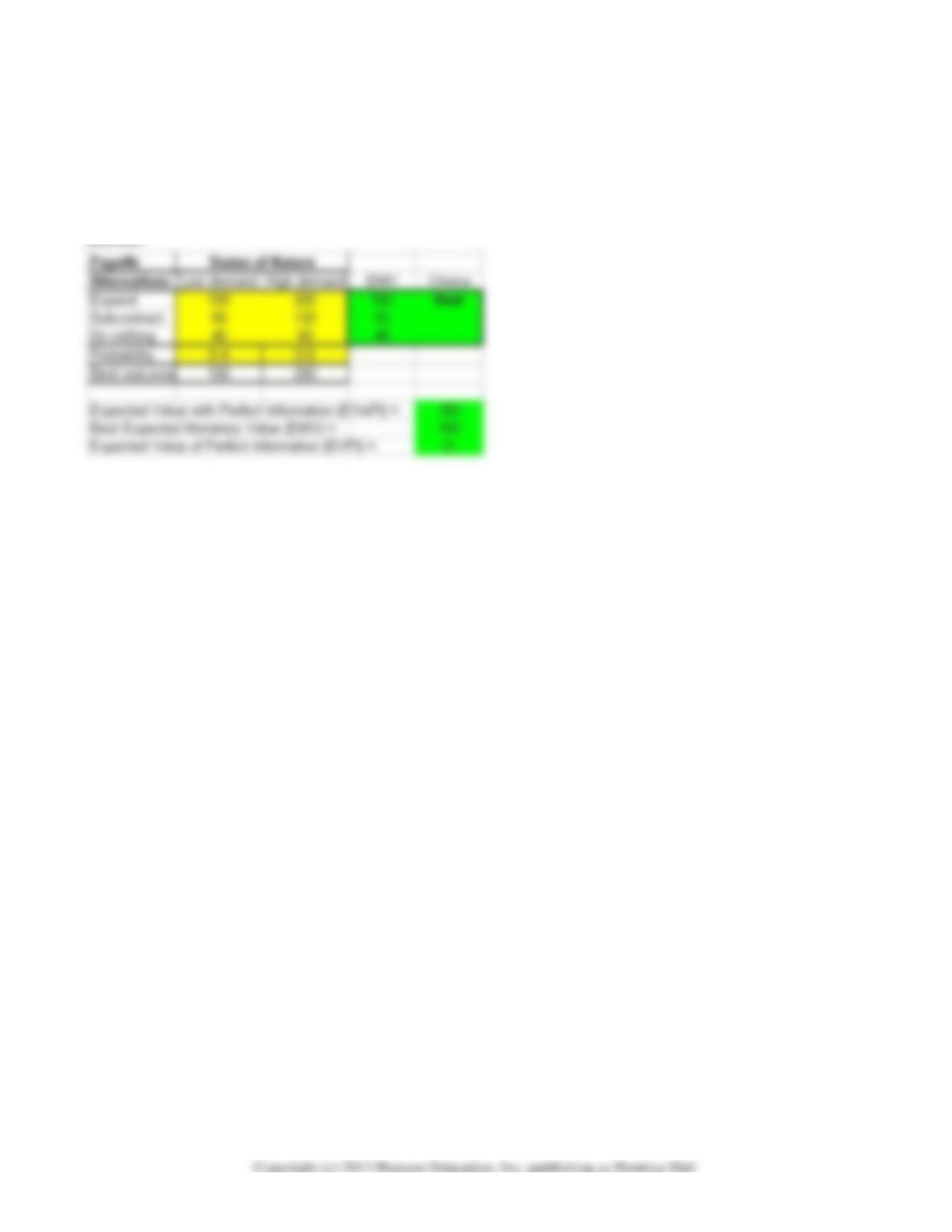
1) Refer to the information above.
a. Which alternative should be chosen based on the maximax criterion?
b. Which alternative should be chosen based on the maximin criterion?
c. Which alternative should be chosen based on the Lapalce criterion?
d. Which alternative should be chosen based on criterion of realism with alpha = 0.7?
e. Which alternative should be chosen based on the minimax regret criterion?
Answer:
9
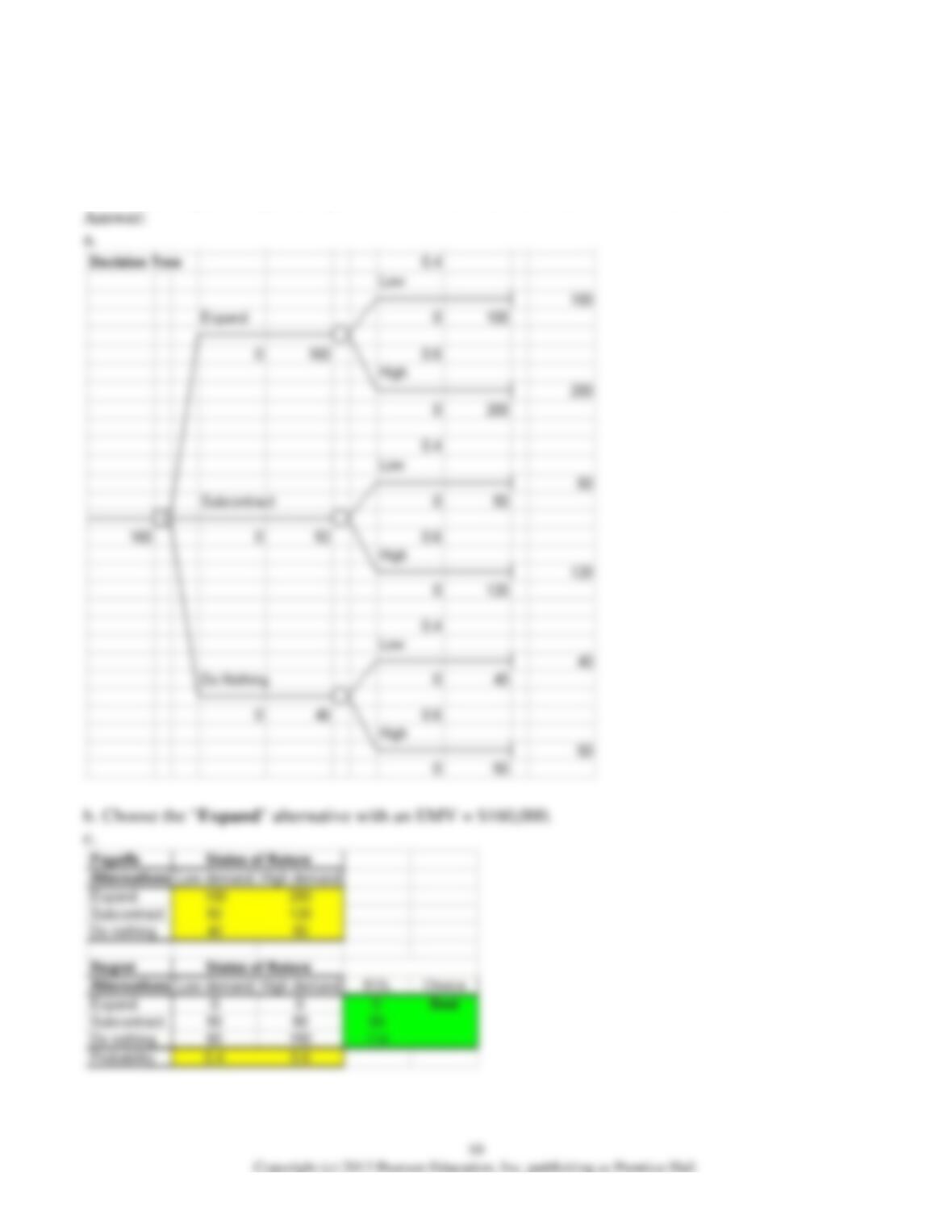
2) Refer to the information above. Assume that ABC Inc. has hired a marketing research firm that
provided additional information regarding next year’s demand. Suppose that the probabilities of low and
high demand are assessed as follows: P(Low) = 0.4 and P(High) = 0.6.
a. Which alternative should be chosen using the expected monetary value (EMV) criterion?
b. What is the expected value under certainty?
c. What is the expected value under perfect information (EVPI)?
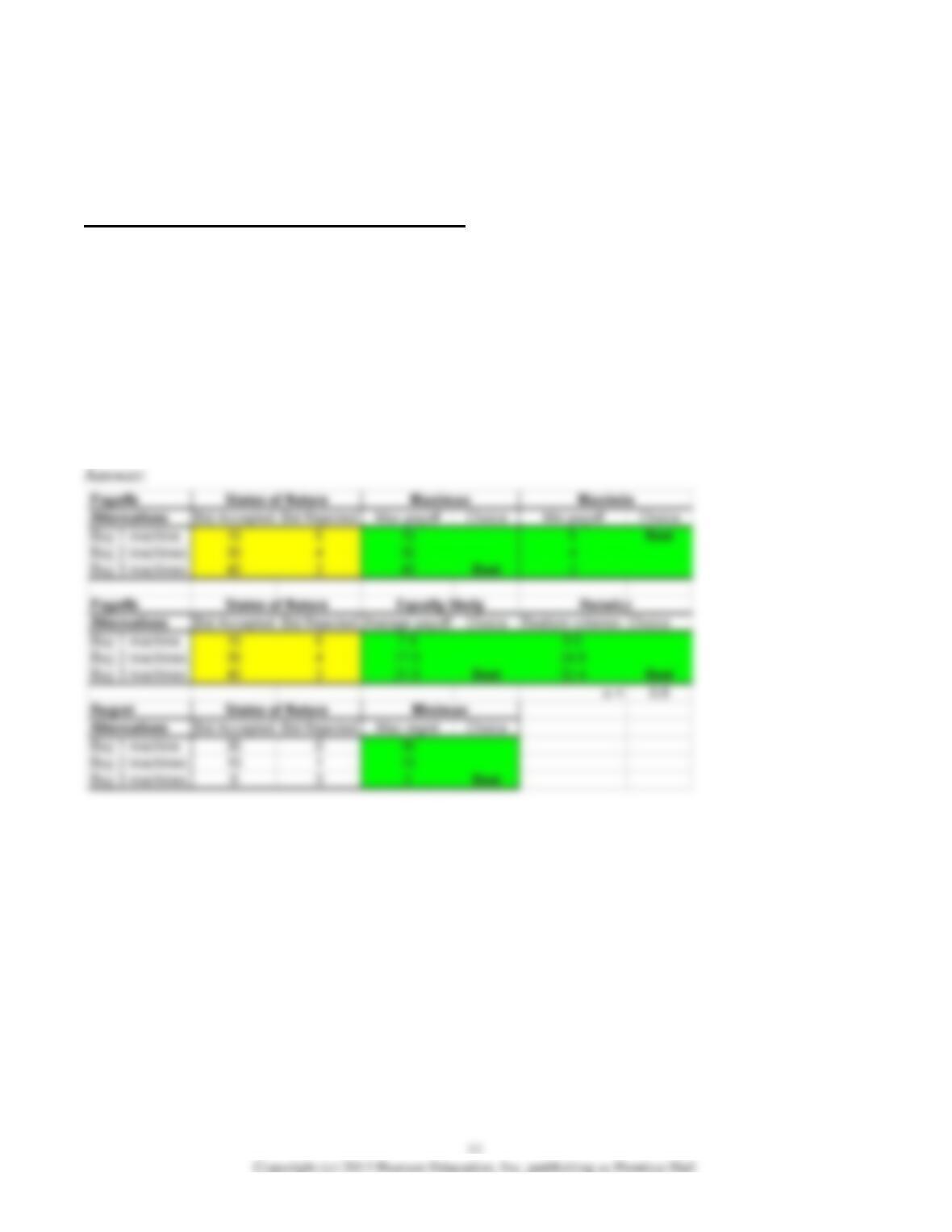
3) Refer to the information above. Assume that ABC Inc. has hired a marketing research firm that
provided additional information regarding next year’s demand. Suppose that the probabilities of low and
high demand are assessed as follows: P(Low) = 0.4 and P(High) = 0.6.
a. Develop a decision tree for this problem.
b. Analyze the decision tree and determine which alternative should be chosen.
c. Using the expected opportunity loss (EOL) criterion, which alternative should be chosen?
Use this information to answer the following questions.
A plant manager is considering buying additional stamping machines to accommodate increasing
demand. The alternatives are to buy 1 machine, 2 machines, or 3 machines. The profits realized under
each alternative are a function of whether their bid for a recent defense contract is accepted or not. The
payoff table below illustrates the profits realized (in $000’s) based on the different scenarios faced by the
manager.
Alternative Bid Accepted Bid Rejected
Buy 1 machine $10 $5
Buy 2 machines $30 $4
Buy 3 machines $40 $2
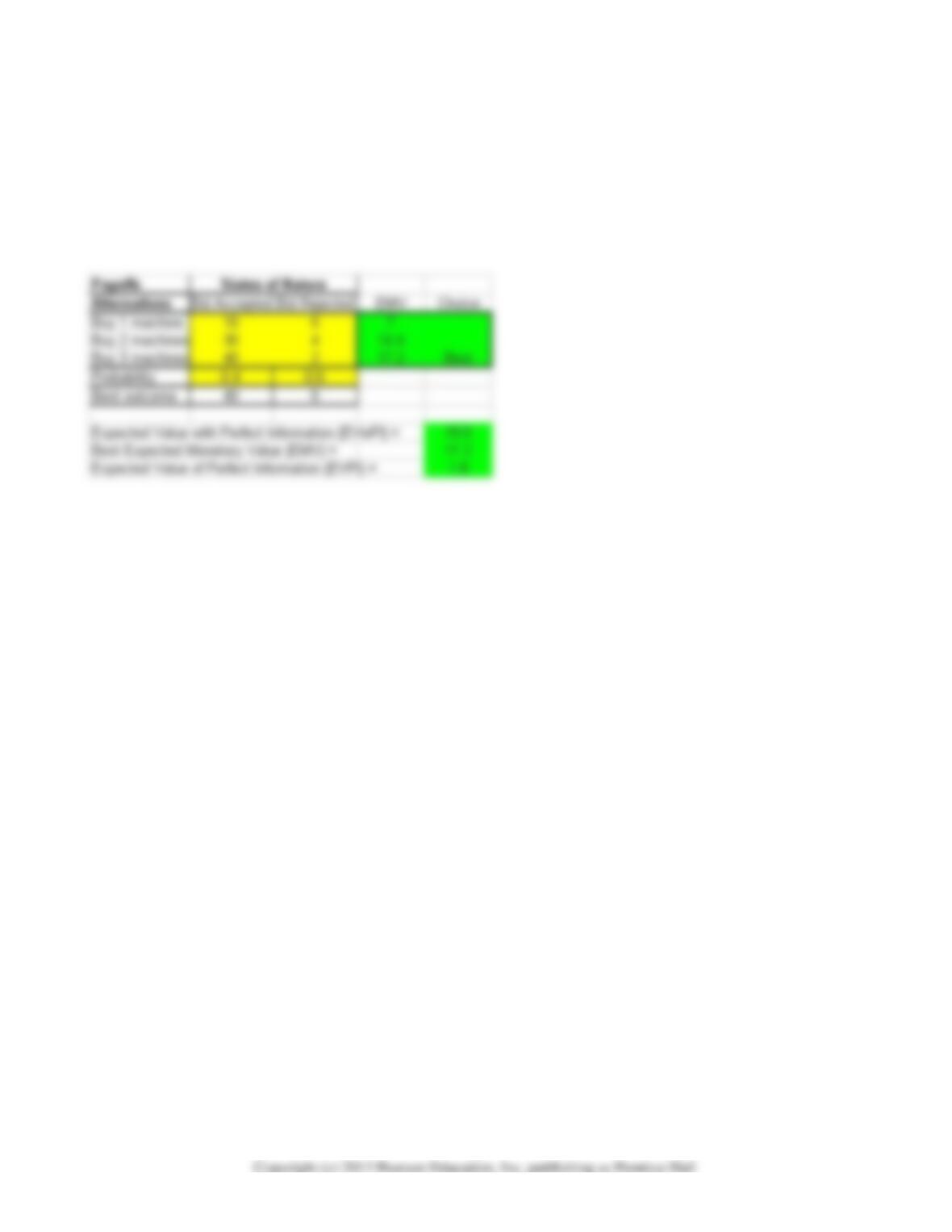
4) Refer to the information above.
a. Which alternative should be chosen based on the maximax criterion?
b. Which alternative should be chosen based on the maximin criterion?
c. Which alternative should be chosen based on the Lapalce criterion?
d. Which alternative should be chosen based on criterion of realism with alpha = 0.8?
e. Which alternative should be chosen based on the minimax regret criterion?
12
5) Refer to the information above. Assume that based on historical bids with the defense contractor, the
plant manager believes that there is a 65% chance that the bid will be accepted and a 35% chance that
the bid will be rejected.
a. Which alternative should be chosen using the expected monetary value (EMV) criterion?
b. What is the expected value under certainty?
c. What is the expected value under perfect information (EVPI)?
Answer:
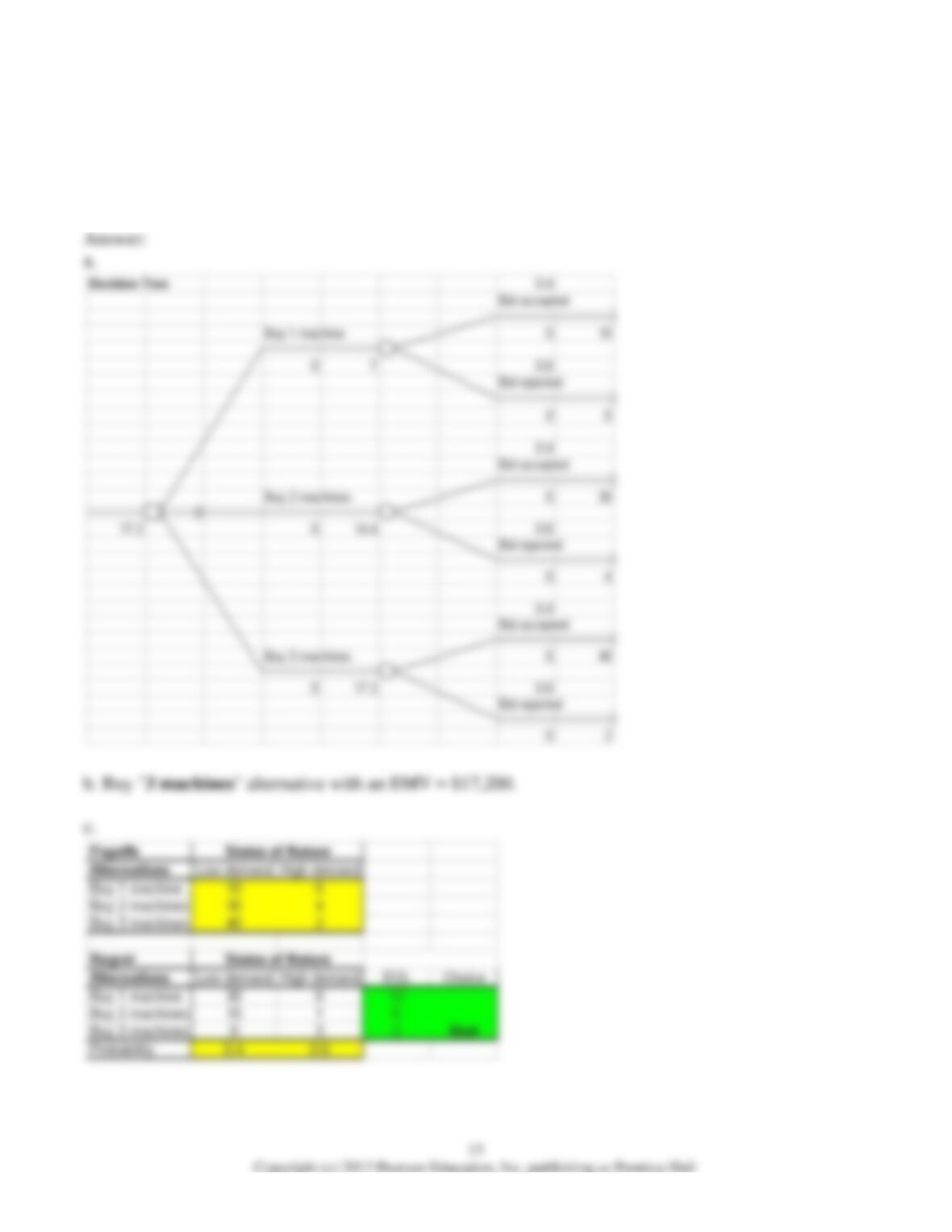
6) Refer to the information above. Assume that based on historical bids with the defense contractor, the
plant manager believes that there is a 65% chance that the bid will be accepted and a 35% chance that
the bid will be rejected.
a. Develop a decision tree for this problem.
b. Analyze the decision tree and determine which alternative should be chosen.
c. Using the expected opportunity loss (EOL) criterion, which alternative should be chosen?
Use this information to answer the following questions.
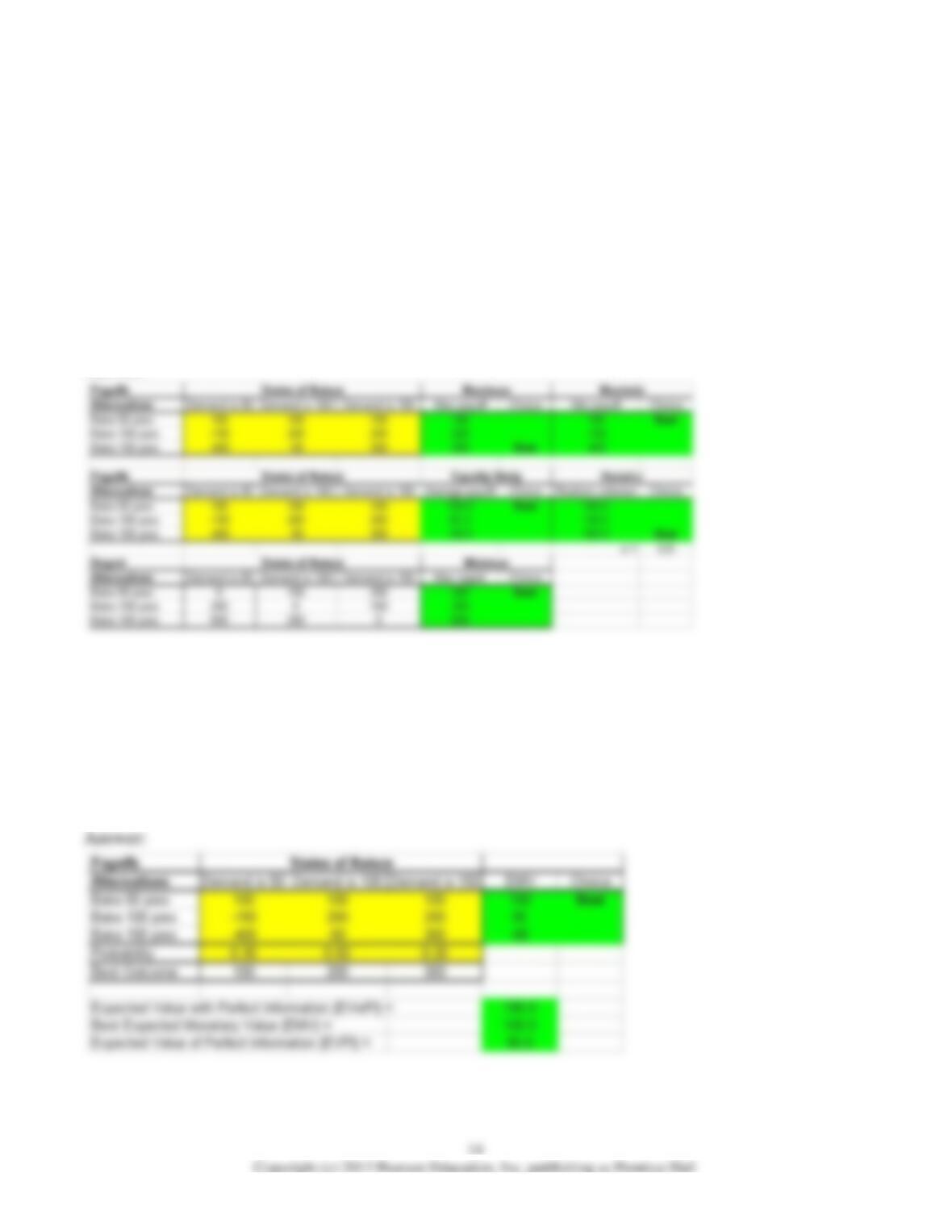
A bakery must decide how many pies to prepare for the upcoming weekend. The bakery has the option
to make 50, 100, or 150 pies. Assume that demand for the pies can be 50, 100, or 150. Each pie costs
$5 to make and sells for $7. Unsold pies are donated to a nearby charity center. Assume that there is no
opportunity cost for lost sales.
7) Refer to the information above.
a. Which alternative should be chosen based on the maximax criterion?
b. Which alternative should be chosen based on the maximin criterion?
c. Which alternative should be chosen based on the Lapalce criterion?
d. Which alternative should be chosen based on criterion of realism with alpha = 0.8?
e. Which alternative should be chosen based on the minimax regret criterion?
Answer:
8) Refer to the information above. Assume that the bakery (see problem 7) has obtained the following
probability information regarding demand for the pies: P(50) = 0.3, P(100) = 0.5, and P(150) = 0.2.
a. Which alternative should be chosen using the expected monetary value (EMV) criterion?
b. What is the expected value under certainty?
c. What is the expected value under perfect information (EVPI)?