Chapter 08 Ethical Leadership and Decision-Making in Accounting
Answer Key
Multiple Choice Questions
1.
It can be said that ethical leaders exhibit each of the following traits except for:
2.
The statement about leadership attributed to John Maxwell is:
3.
With respect to leadership in the accounting profession, it might be said that:
4.
Trevino et al. believe ethical leaders possess each of the following two traits:
5.
To be an ethical leader, executives must also:
6.
To hold employees accountable to ethical standards, moral managers:
7.
In accounting, building a reputation for ethical leadership means to:
8.
An authentic leader:
9.
Transformational leaders:
10.
It can be said about followership that:
11.
Servant leaders:
12.
Followership, servant leaders, and authenticity all share the following common
characteristic:
13.
De Cremer and Tenbrunsel characterize ethical leadership in part as:
14.
Social Learning Theory holds that:
15.
Leaders who engage in unethical behaviors create a context supporting:
16.
A good example of antisocial behavior is:
17.
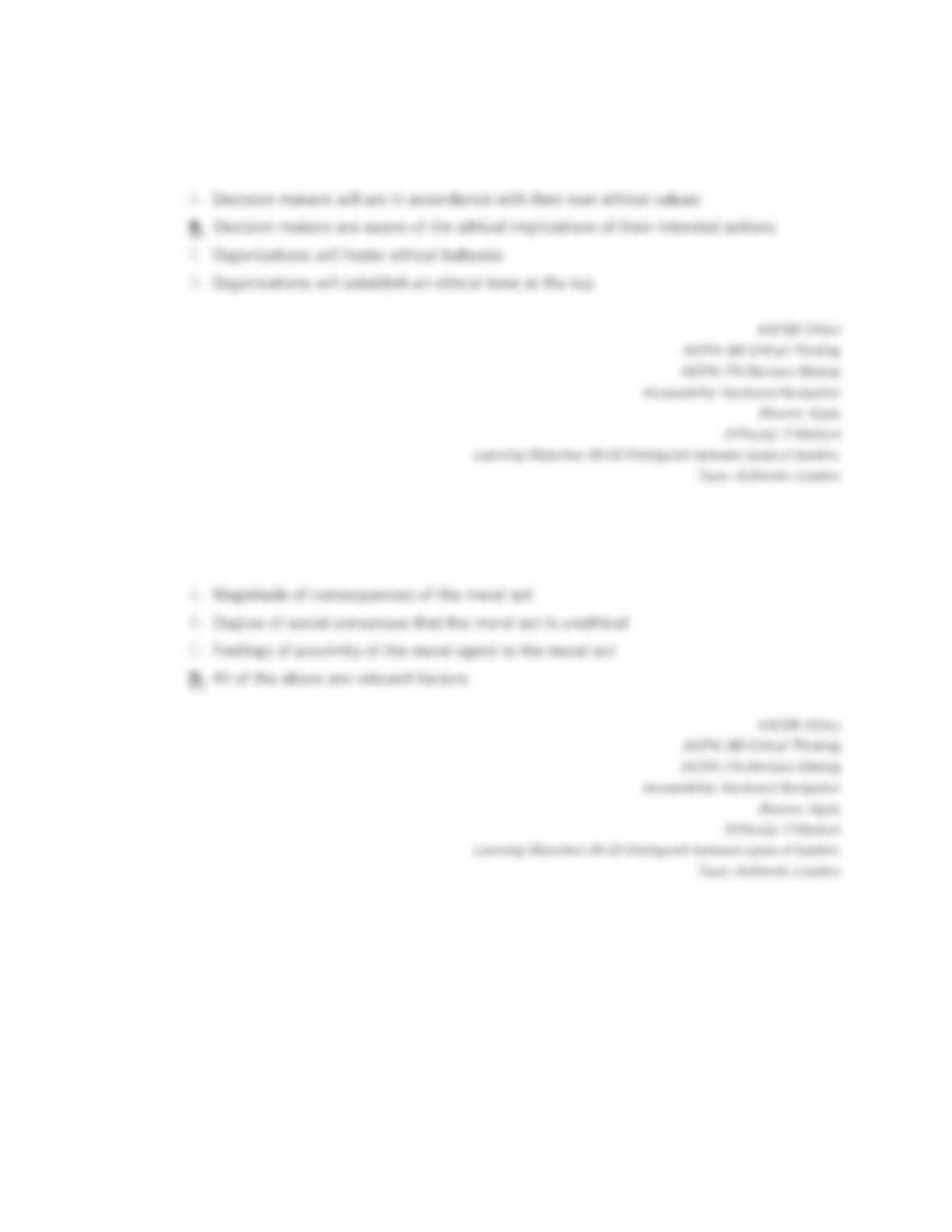
The more intense the ethical issues, the more likely:
18.
Each of the following is a factor that needs to be evaluated for moral intensity except:
19.
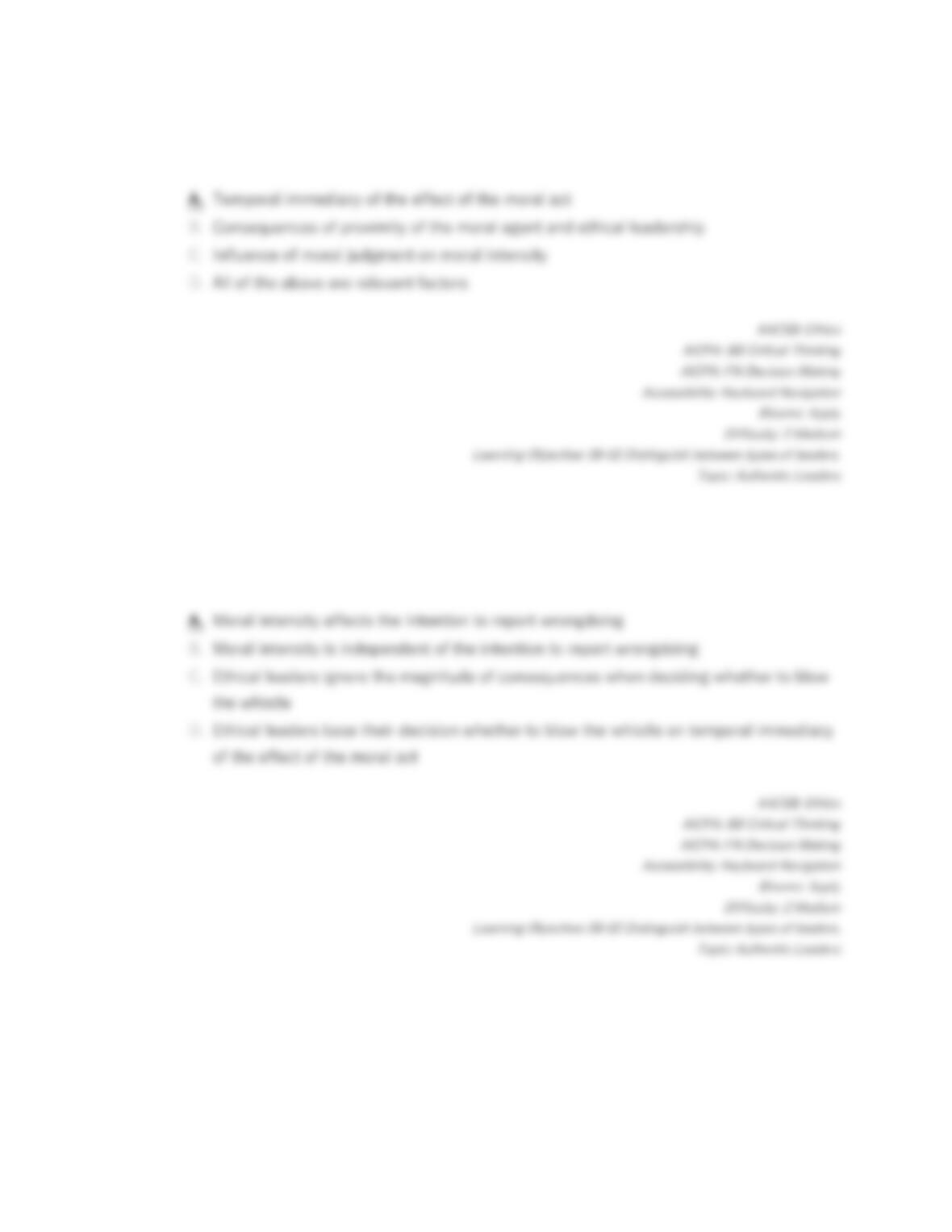
An important factor in evaluating moral intensity is:
20.
Taylor and Curtis found from their study of whistleblowing among public accounting
seniors that:
21.
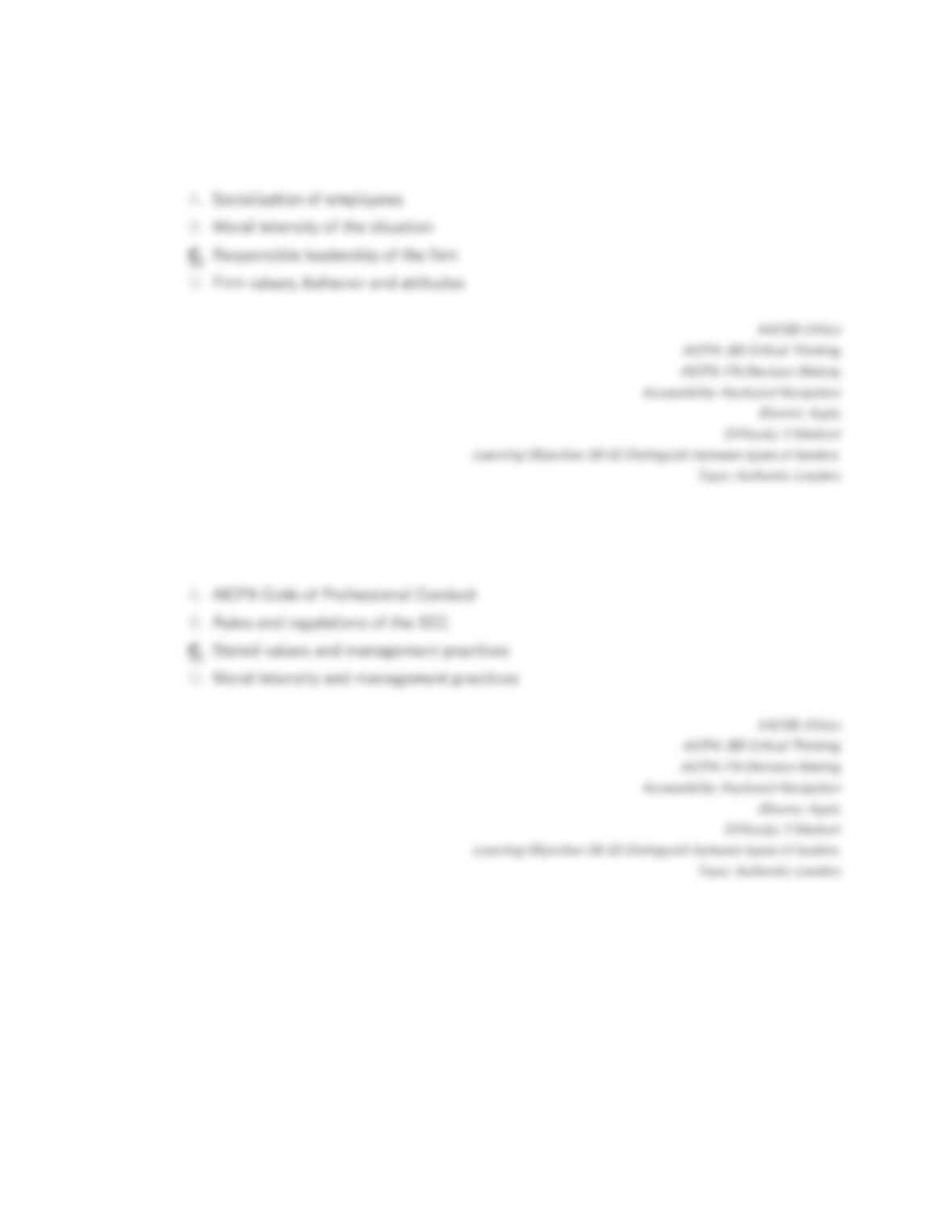
An essential element in creating an ethical environment in an audit firm is:
22.
The ethical environment within an accounting firm is created through adherence to the:
23.
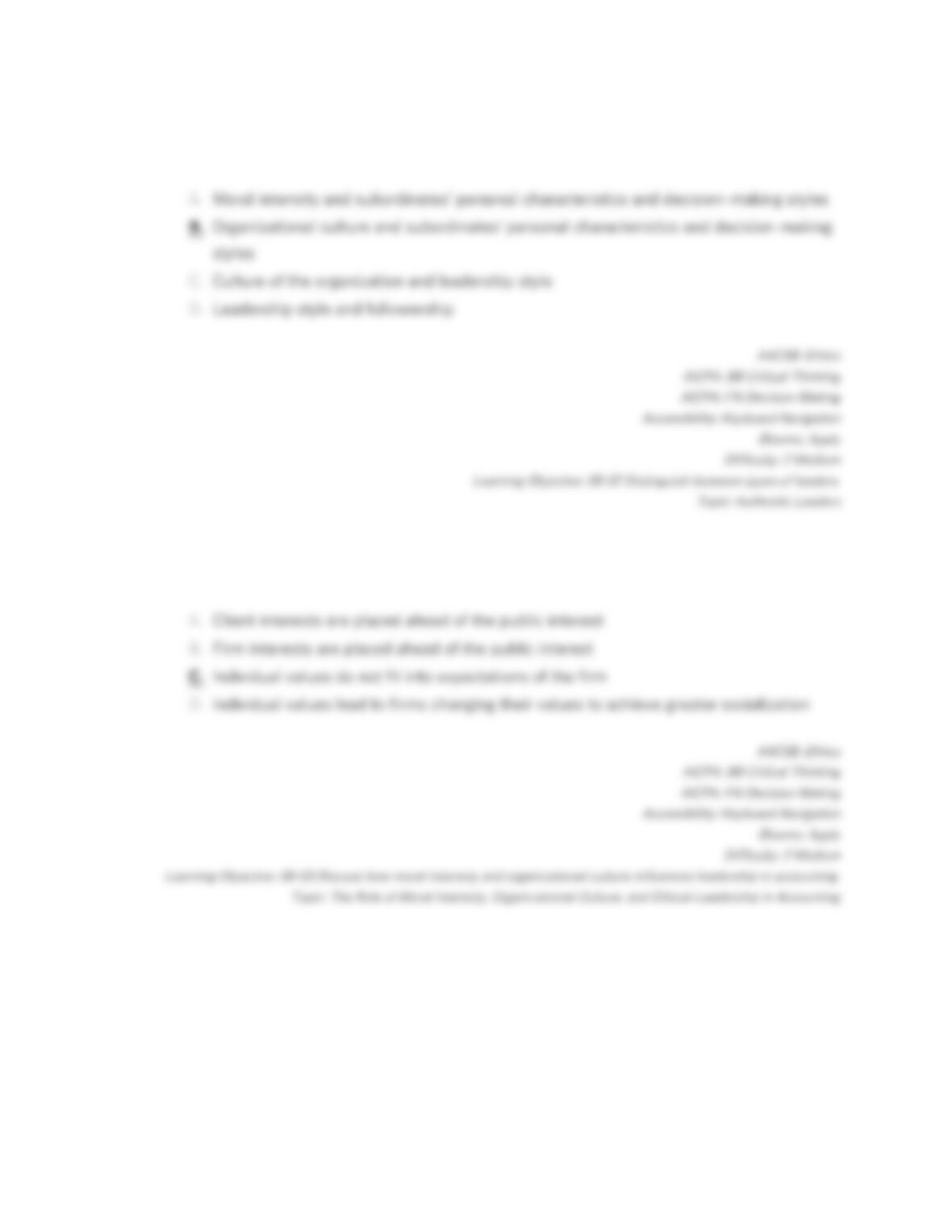
Ponemon hypothesized that there is a correlation between:
24.
Organizational dissidence in audit firms is created when:
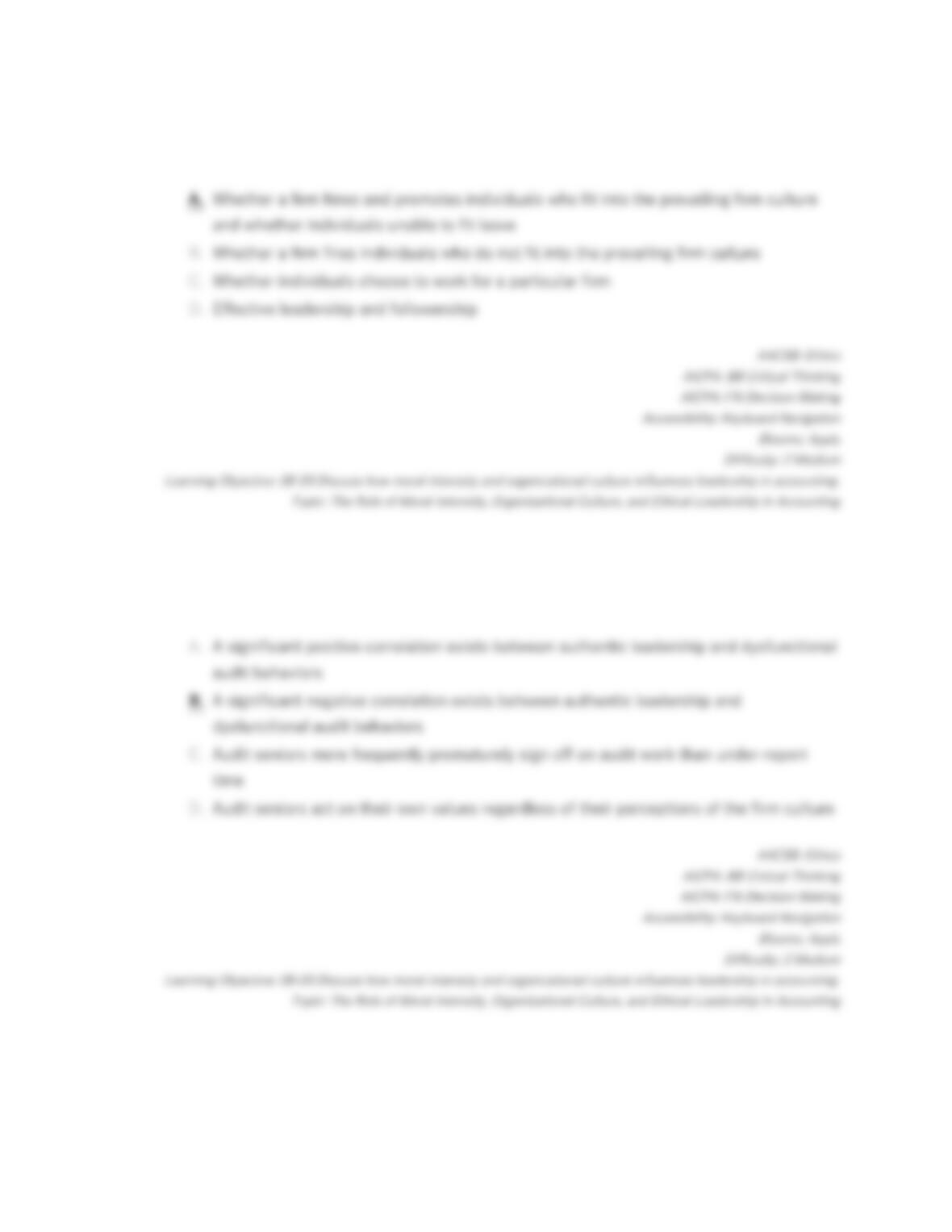
25.
Selection-socialization bias in audit firms pertains to:
26.
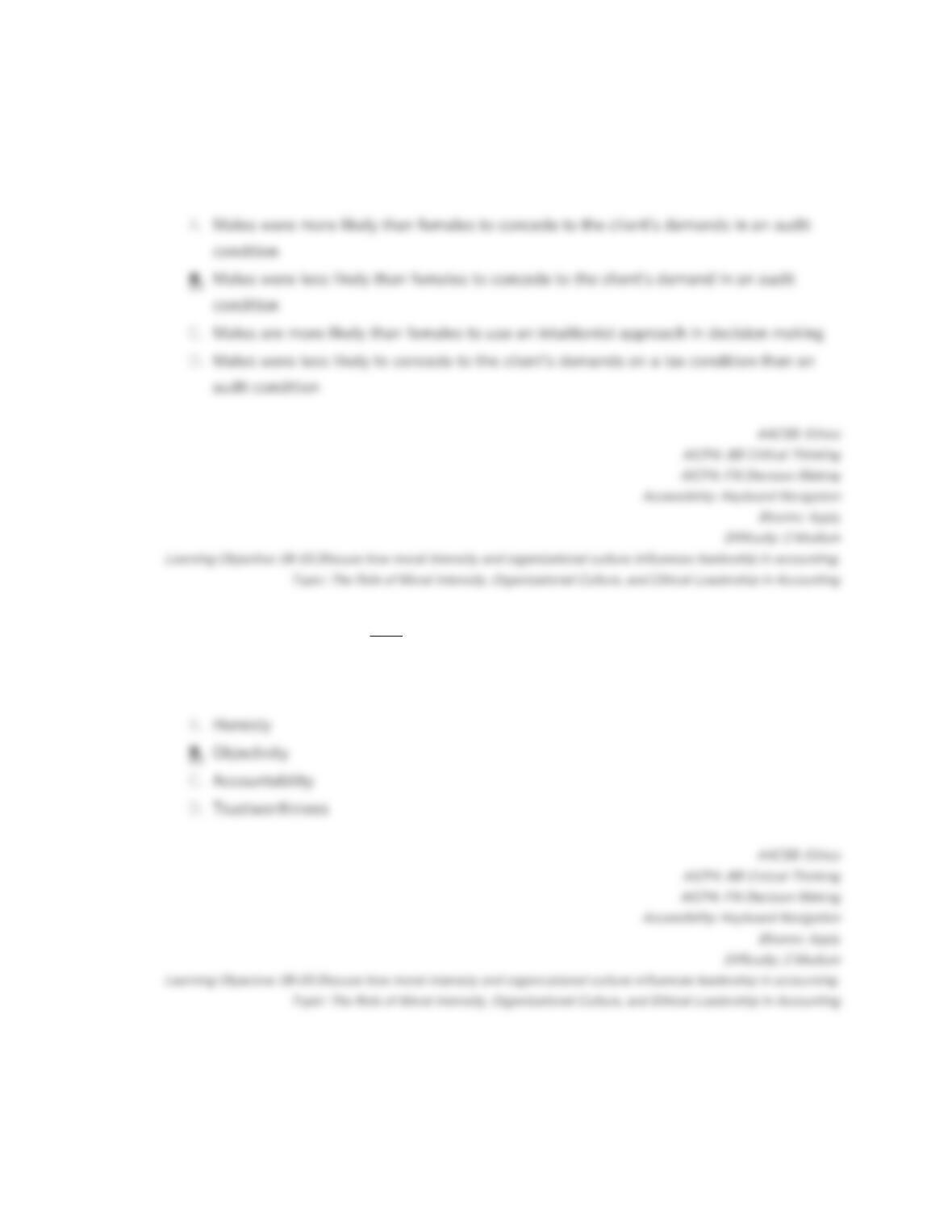
The results of Morris’ study of the influence of authentic leadership and ethical firm
culture on auditor behavior is:
27.
In Bobek’s study of the effect of gender on decision-making of public accounting
professionals, it was found that:
28.
Which of the following is NOT an attribute of internal audit leadership according to
Chambers?
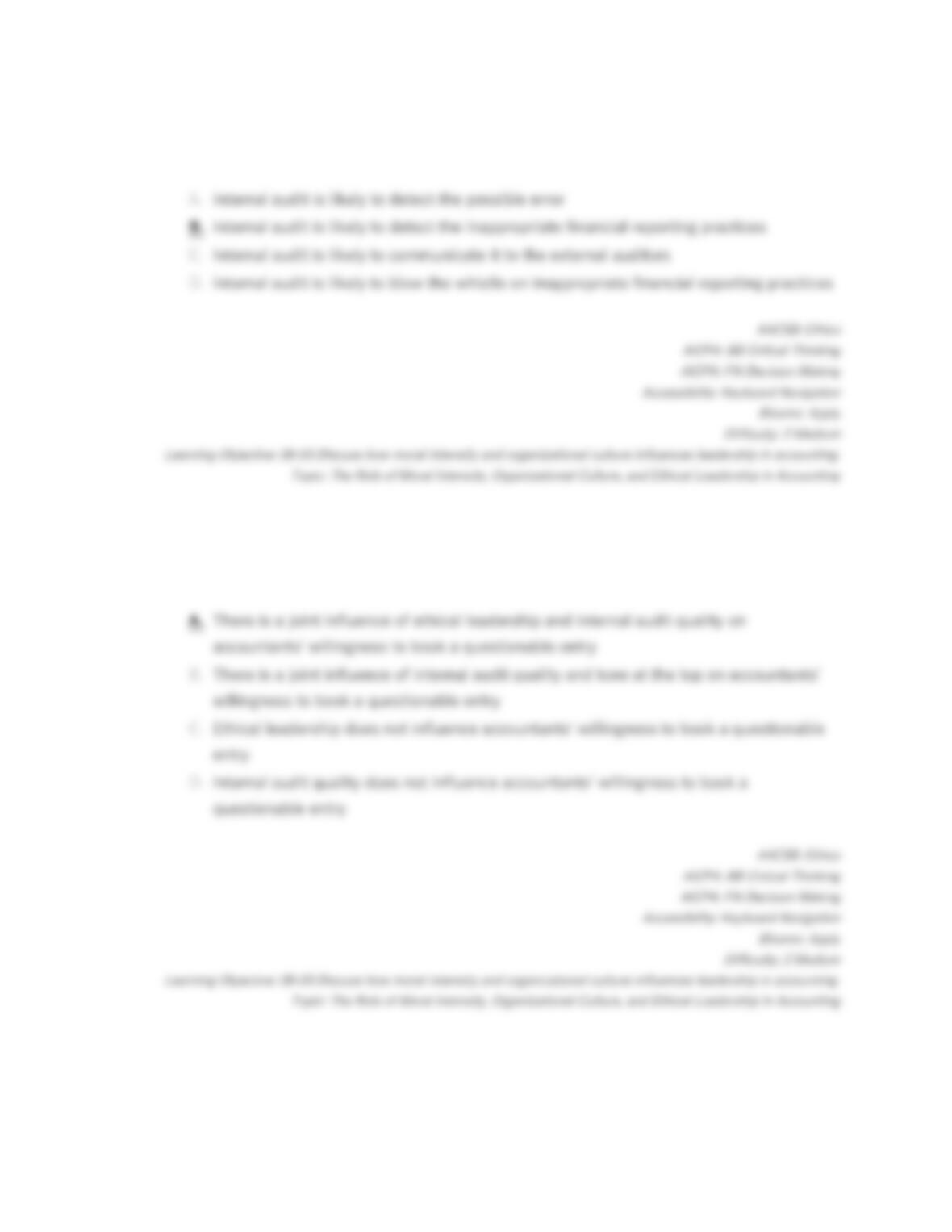
29.
Accountants may hesitate to record a questionable entry if they know:
30.
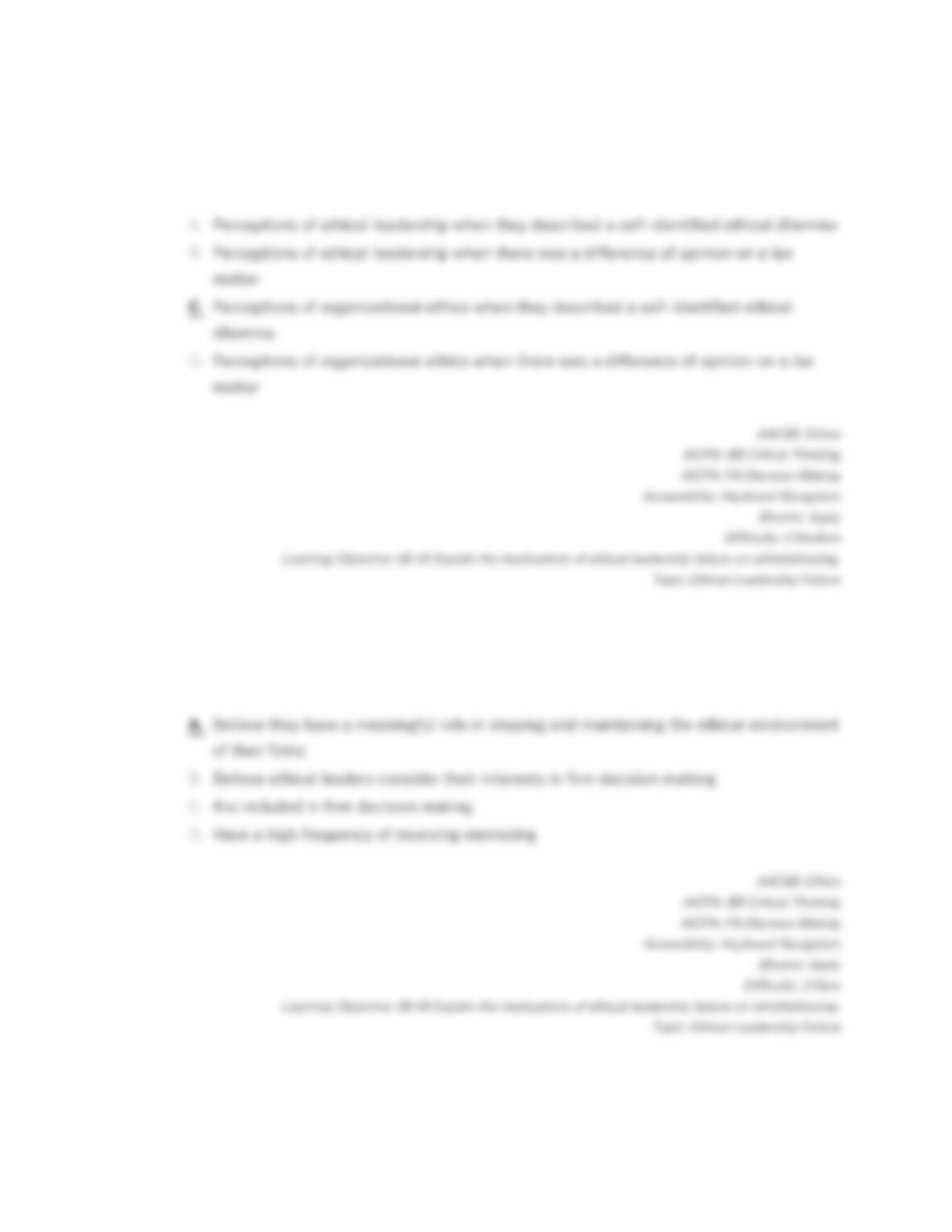
Arel et al. in their study of ethical leadership, the internal audit function, and moral
intensity on a decision to record a questionable entry found that:
31.
Bobek et al. found a disconnect between tax partners and nonpartner tax practitioners
with respect to:
32.
Bobek et al. found that nonpartners are more likely to perceive the ethical environment of
their firm as strong when they:
33.
The fraud at HealthSouth at the structural level of the company was more intense
because:
34.
Ethical leadership failure can be caused by:
35.
Price believes that ethical failures in leaders are:
36.
According to Mesmer-Magnus and Viswesvaran, organizational employees have three
options to address an unsatisfactory situation faced within an organization. These
include:
37.
Taylor and Curtis studied the complex relationships in accounting firms that influence an
individual’s decision to report an ethical violation and found at the center of these
potentially conflicting layers of commitment lies:
38.
In Brennan and Kelly’s study of the factors that influence propensity or willingness to blow
the whistle among audit trainees, the authors identified each of the following factors
except:
39.
Leadership in accounting is different than leadership in most other organizations
because:
40.
A unique aspect of the story of ethical leadership illustrated by Diem-Thi Le is that: