Chapter 8
Chapter Focus
Professionals working with students who require special education services are concerned with
how those students perform on educational measures. The norm-referenced achievement test is
one such measure. Of all standardized tests, individually administered achievement tests are the
most numerous (Anastasi & Urbina, 1998).
This chapter dicusses several commonly used norm-referenced individual achievement tests. The
information presented will enable you to apply your knowledge about reliability and validity to
these instruments. You will learn some basic scoring methods that can be generalized to other
instruments.
Check Your Understanding
Activity 8.1
1. How many parallel forms are included in the Woodcock–Johnson III Tests of
Achievement? What is the advantage of having different forms of the same instrument?
2. For what age range is the WJ III intended?
3. What populations were included in the norming process of the third edition?
4. What new school level is included in the WJ III? Why has it been included?
Apply Your Knowledge
Refer to the WJ III subtest descriptions in your text. Which subtests would not be appropriate for
a student to complete in the standard fashion if the student had a severe fine-motor disability and
could not use a pencil or keyboard? What adaptations would be appropriate? Explain the ethical
considerations that should be addressed in making such adaptations.
Activity 8.2
1. How is the starting point for the Reading Recognition subtest determined?
2. How is the Reading Comprehension start point determined?
3. What response mode is used on many of the items in this test?
4. How does this response mode impact scores?
5. Using the information provided on the portion of the PIAT–R protocol (Figure 8.1),
determine the Total Reading raw score. Add the Reading Recognition and the Reading
Comprehension raw scores. To determine the Total Test raw score, add all subtest raw
scores. Write the sums in the appropriate spaces.
6. Using the raw score data, look up the standard scores on the following table and write the
scores in the appropriate spaces on the protocol sheet.
Apply Your Knowledge
Make a general statement regarding the student’s academic functioning based on the standard
scores you determined on the PIAT–R. According to these scores, does the student have any
academic strengths or weaknesses?
Activity 8.3
1. You are concerned about a student who is having difficulty answering questions about
reading passages. In addition to assessing the student’s ability with curriculum materials,
you decide to assess the student’s skills using a norm-referenced test. Which subtest of
the K–TEA–II assesses a student’s ability to answer literal and inferential comprehension
questions?
2. Most of your kindergarten students have been making adequate progress in their ability to
match sounds, blend sounds, segment sounds, and delete sounds. The data you have
collected using CBMs indicate that one student has not made adequate progress. You
decide to assess this student using the K–TEA–II. Which subtests will you use?
3. What is the difference between an item-level error analysis and a within-item error
analysis?
Activity 8.4
A third-grade boy, age 8 years, 7 months, answered the items on a math calculation subtest in the
following manner.
1. 11. 21. 1 31. 1
2. 12. 22. 1 32. 0
3. 13. 23. 1 33. 0
4. 14. 24. 0 34. 0
5. 15. 1 25. 1 35. 0
6. 16. 1 26. 1 36. 0
7. 17. 1 27. 0 37.
8. 18. 1 28. 0 38.
9. 19. 1 29. 0 39.
10. 20. 0 30. 0 40.
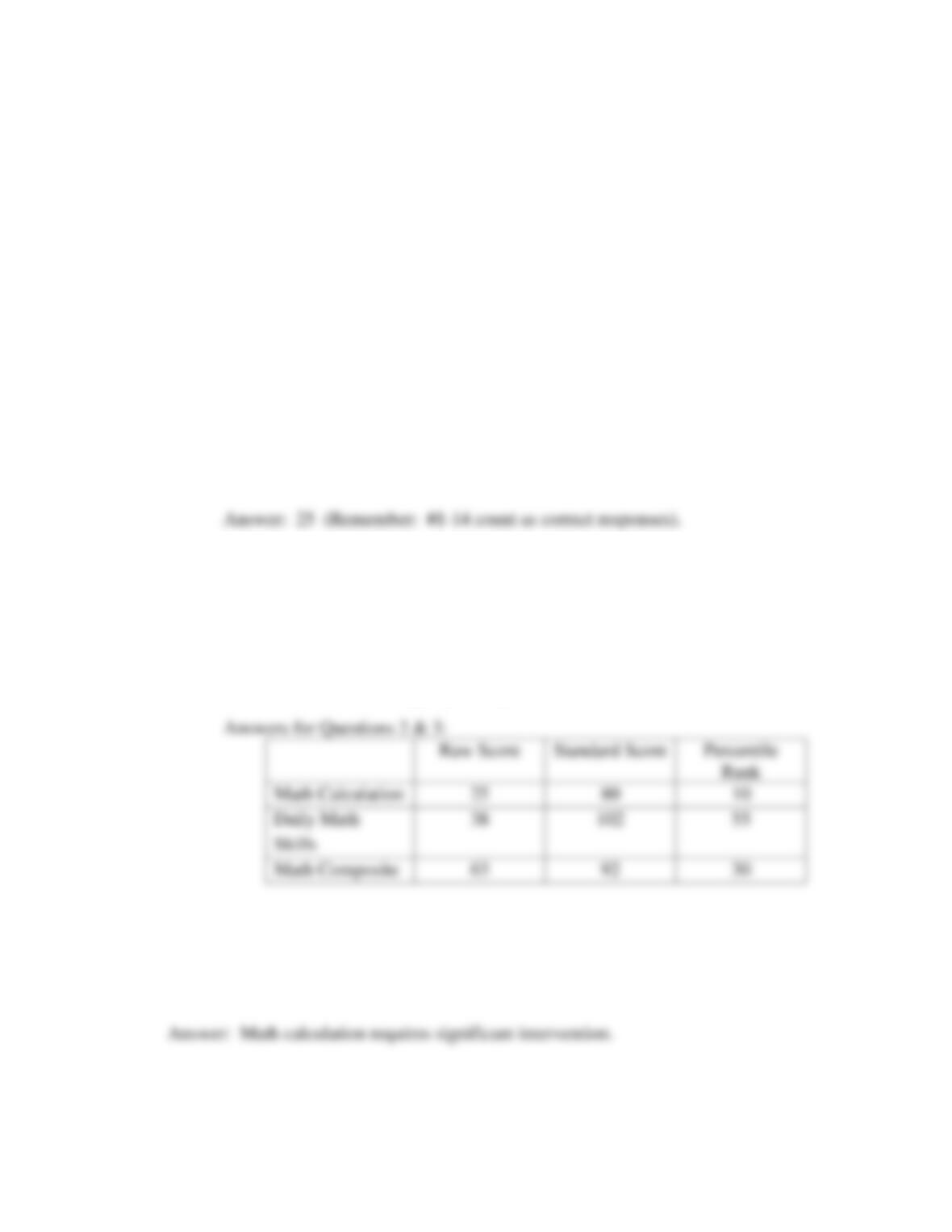
1. The basal for this subtest is 5 consecutive items correct and the ceiling is 5 consecutive
items incorrect. What is this student’s raw score?
2. The Daily Math Skills subtest has already been scored. The obtained raw score for the
Daily Math Skills subtest was 38. Write the appropriate scores in the spaces provided on
the sample protocol.
3. Add the raw scores and place the sum in the raw score box for the math composite score.
Look at the norm table below. Locate the standard scores and percentile ranks for this
student. Write the scores in the appropriate spaces.
Apply Your Knowledge
With the average standard score of 100 and the median percentile rank of 50, in what area(s)
does this third-grade student appear to need intervention?
Activity 8.5
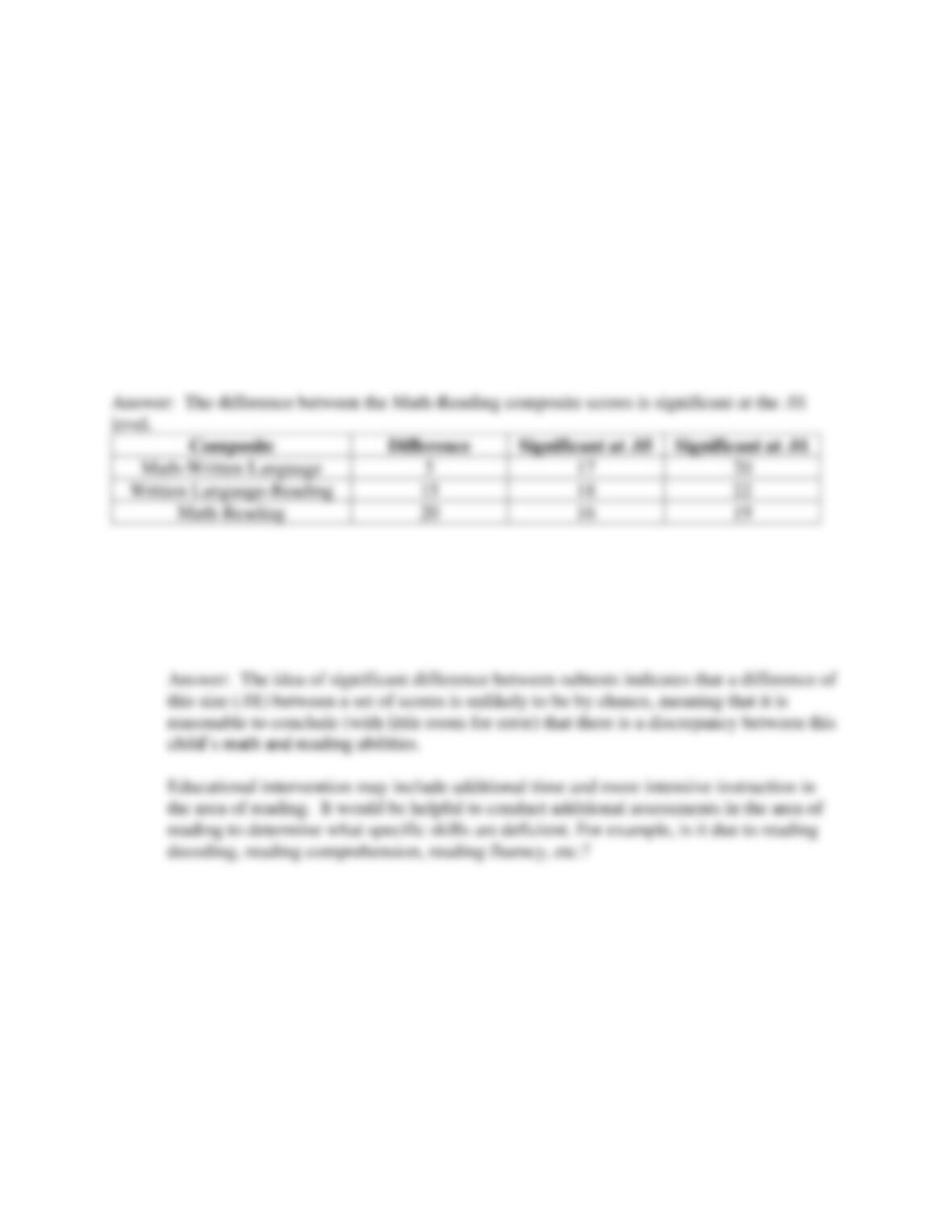
On the test presented in Activity 8.4, an examiner can determine if there are any significant
differences between composite scores. Look at the composite scores listed below. Subtract the
scores to determine the amount of difference between the composite scores.
Math Composite 92
Written Language Composite 87
Reading Composite 72
On the following table, write the differences in the appropriate spaces. Examine the table and
determine if any of the differences between composite scores are significant.
Apply Your Knowledge
How would you explain the significant difference concept to the parents of this child? How
might this significant difference impact educational interventions?
Activity 8.6
1. The portion of this error analysis includes the student’s performance on items 35–50.
Based on this section of the error analysis, which short vowel sounds seem to be
problematic?
2. In which categories did the student have no errors?
3. How many errors were made that were considered entire-word mistakes?
4. How many types of vowel errors were made by this student?
5. What is meant by the term misordered sounds?
Apply Your Knowledge
Give examples of words with insertion and omission errors.
Activity 8.7
1. Which subtest includes items that assess phonemic awareness?
2. Which subtest includes vocabulary and sentence comprehension?
3. A student who scores significantly below the levels expected on the subtests of word
reading, reading comprehension, spelling, and pseudoword decoding but was within the
range expected on other subtests might be referred for additional assessment. What will
assessment help to determine?
4. A student in your class seems to take longer to respond in writing on tasks he is asked to
do during class time. He also writes much briefer responses and often uses very short,
simple words. His reading level is at the range expected. With what skill might this
student be struggling?
Apply Your Knowledge
Which subtests of the WIAT–III would you analyze closely for a student in your class who is
struggling in math?
Activity 8.8
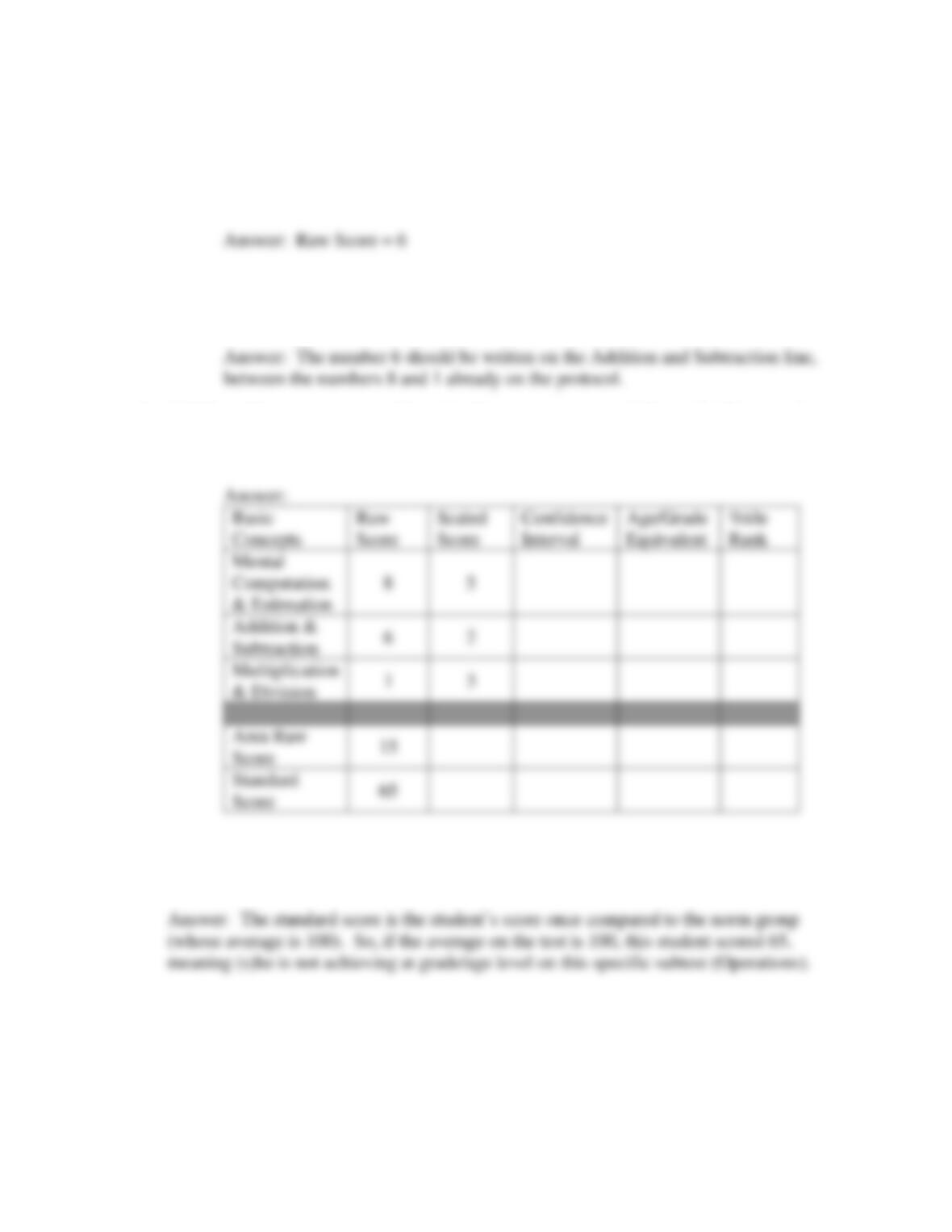
1. One student’s responses for the Addition and Subtraction subtest are shown on the
KeyMath–3 DA protocol in Figure 8.6A below. Calculate the raw score and then write
your answer on the protocol.
2. This student’s other raw scores for the Operations subtests have been entered in Figure
8.6B. Write the raw score calculated in problem 1 in the appropriate space in Figure
8.6B.
3. Add the subtest raw scores to determine the area raw score and then write this score in
the figure. Use the portions of the tables (Figures 8.6C and 8.6D) to locate scale scores
and standard scores. Write these in the appropriate spaces.
Apply Your Knowledge
How would you interpret this student’s standard scores for his parents? Write your explanation.
Activity 8.9
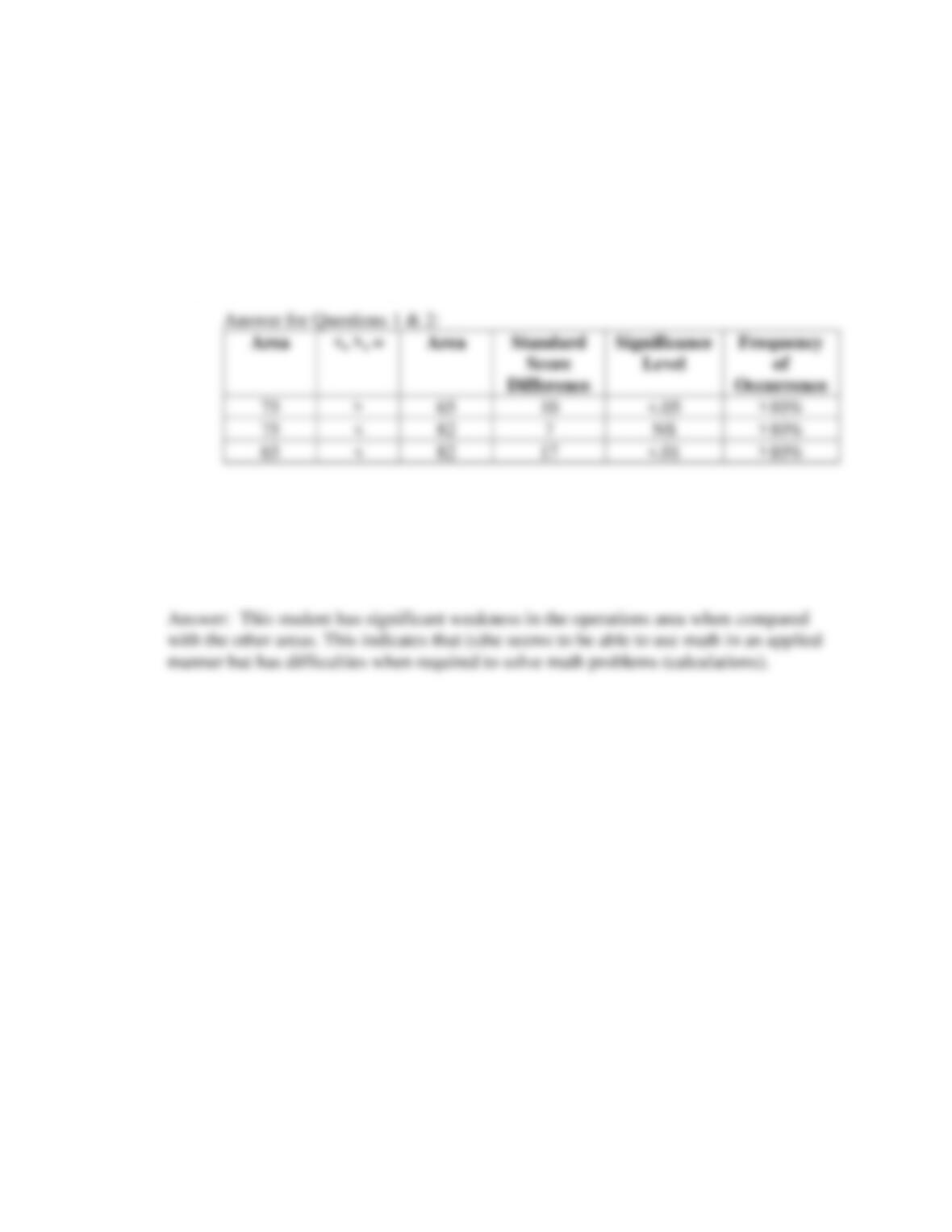
1. A third-grade student obtained the KeyMath–3DA area standard scores shown at the
bottom of Figure 8.7B. Write the standard scores in the appropriate spaces in Figure
8.7A. Indicate whether the comparisons are >, <, or = and determine the differences.
2. Using the information provided in Figures 8.7B and 8.7C, determine whether the
differences found in problem 1 are significant. Write the significance level and the
frequency of occurrence in Figure 8.7A.
Apply Your Knowledge
Identify this student’s strengths and weaknesses based on your understanding of significant
differences. How would you explain this information to the student’s parents?
Activity 8.10
1. This student’s scaled scores and confidence intervals have been entered below on the
score profile sheet. Complete the sheet by shading in the profile in Figure 8.8. Complete
the profile of the area scores at the bottom of the profile. How would you interpret these
scores for parents?
2. What are the areas and skills of concern?
Activity 8.11
1. On the WJ III DRB, which subtests assess decoding skills?
2. A student who has difficulty with decoding skills may have underlying weaknesses in
what areas?
3. What factors contribute to reading comprehension?
Apply Your Knowledge
Even though the WJ III DRB and other diagnostic tests measure academic skills, what other
factors may influence academics that are not measured on academic achievement tests?
Activity 8.12
1. One of the subtests of the PAL tests the student’s ability to repeat sequences with their
fingers. What is the name of this subtest?
2. Which subtest assesses a student’s ability to select the correct spellings of words?
3. On which subtests are phonemic awareness and early prereading skills assessed?
4. Which complex subtest requires the student to be able to understand concepts such as
position placement in a sequence of letters in order to respond to the task?
Think Ahead Exercises
Part I
1. Indicates the amount of chance occurrence of the difference between two scores.
2. Statewide assessment instruments are one form of __.
Answer: C. Group achievement test
3. Reading passages from the basal text are used to assess students’ reading levels at the end
of each chapter. This is a form of ___.
4. When one student is compared with a national sample of students of the same age, it is
called ___.
5. Reading decoding and reading comprehension scores on a test will yield an overall
reading score. In this example, reading decoding and reading comprehension are ___.
6. The K–TEA–II and the PIAT–R are individually administered ___.
7. A broad-based instrument that samples a few items across the domains of a curriculum is
called a(n) ___.
8. A student’s classroom performance in reading is inconsistent. Her teacher is not certain
that he has identified where her performance is breaking down. In order to obtain more
specific and in-depth information about this student’s reading skills, he might use a
different ___.
9. When informal methods and classroom interventions do not seem to have effective
results, a teacher may need additional assessment information. This information can be
provided by using _____ to compare the student to national average performance.
10. Are designed to measure strength, talent, or ability in a particular domain or area.
Part II
1. This diagnostic mathematics test is normed for students through the grade skill levels of
twelfth grade.
2. This test, which provides a model of performance in reading, offers a diagnostic look at
reading without necessitating the administration of an entire achievement battery.
3. This test has standard and supplemental batteries.
4. This diagnostic test may be used in the very early grades to assess the cognitive abilities
and functions required for reading.
5. This diagnostic test would not be used to assess complex calculus skills or other college-
level math.
6. This test provides cluster scores and individual subtest scores.
7. These academic achievement instruments were co-normed with their cognitive
assessment instruments.
8. This achievement test includes a Language Composite that measures both expressive
language and receptive listening skills.
9. This academic achievement test includes many multiple-choice items that may encourage
guessing.
10. This test includes measures for rapid naming.
11. This vocabulary assessment asks the student to name pictures or provide synonyms.
12. This vocabulary test was co-normed with the PPVT–4.
Chapter 8 Test Bank
True and False
1. Screening tests are appropriate to use for placement and eligibility decisions.
2. One of the problems incurred when attempting to assess content subject areas such as
social studies with norm-referenced instruments is that the content of the instrument may
not match the curriculum to which the student has been exposed.
3. Expressive language skills are used in speaking and writing.
4. When using diagnostic assessment instruments, it is important to keep in mind that
research has indicated that grade level equivalencies may not be consistent with grade
placement in school.
5. Aptitude tests are designed to measure what a student has learned.
6. When administering a norm-referenced test, all subtests must be administered according
to the standardized directions.
7. The Peabody Picture Vocabulary Test is a measure of expressive language.
8. The WIAT provides two ways of determining disabilities (1) traditional ability-
achievement discrepancy and (2) evaluating patterns of strengths and weaknesses.
9. Many assessments have multiple versions (e.g., A and B) in order to allow students to be
assessed multiple times in a fairly short amount of time.
10. Composite scores are the scores that are used to compare a student against a grade/age
norm.
Multiple Choice
1. These tests are used to obtain further information about a specific skill or area of
academic achievement.
A. Diagnostic test
B. Achievement test
C. Aptitude test
D. Screening test
2. These tests are designed to measure what the student has learned.
A. Diagnostic test
B. Achievement test
C. Aptitude test
D. Screening test
3. Brief tests containing items that survey a range of skill levels, domains, or content areas.
They are typically used to determine weak areas.
A. Diagnostic test
B. Achievement test
C. Aptitude test
D. Screening test
4. Evaluating the types of items answered correctly with the types of items answered
incorrectly.
A. Item-level error analysis
B. Within-item error analysis
C. Diagnostic analysis
D. Screening analysis
5. Evaluates the types of errors students made while attempting to complete a task.
A. Item-level error analysis
B. Within-item error analysis
C. Diagnostic analysis
D. Screening analysis
6. What term refers to a student using inner language concepts and applying them to what is
heard? A. Receptive language
B. Expressive language
C. Written language
D. Spoken language
7. What term defines utilizing language skills in speaking or writing?
A. Receptive language
B. Expressive language
C. Written language
D. Spoken language
8. These tests measure how well students adapt to different environments.
A. Adaptive behavior scales
B. Achievement tests
C. Aptitude tests
D. Diagnostic tests
9. This score is used as another measure to determine ongoing progress.
A. Grade equivalent
B. Age equivalent
C. Growth scale value
D. Significant level
10. Area of cognitive development or ability thought to be evidenced by certain behaviors or
skills. A. Domain
B. Subtest
C. Achievement test
D. Aptitude test
11. Which of the following assessments is aligned to the NCTM standards?
A. Test of Mathematical Abilities
B. Key Math
C. Peabody Individual Achievement Test
D. Kaufmann Test of Educational Achievement
12. Which of the following assessments compares a student’s performance to that of same
age/grade peers?
A. Curriculum-Based Measurement
B. Curriculum-Based Assessment
C. Norm-Referenced Assessment
D. Standardized Assessment
13. In determining significant difference between scores, a significant difference at the .05
level indicates which of the following?
A. There is a 5% chance that the difference is significant.
B. There is a 95% chance that the difference is due to error.
C. There is a 5% chance that the difference is due to error.
D. There is a difference of 5% between the scores.
14. When a student who has had significant difficulty has been assessed and it is determined
that the level of curriculum is too difficult, the student may have been receiving
instruction at which of the following levels?
A. Mastery
B. Instructional
C. Failure
D. Achievement
15. Which of the following indicates when diagnostic instruments may be used?
A. Once every three years
B. Before each annual review
C. To determine if exit criteria are met
D. When additional information is needed about a student’s skills
16. The percentile ranking of a student on a standardized diagnostic test indicates which of
the following?
A. The student has been ranked according to the performance of other students in
the national norm group
B. The student performed as well as the percentile group
C. The student is below the percentile stated
D. The student has performed in the expectancy range
17. The most important step for teachers learning new diagnostic instruments is which of the
following? A. Careful planning of the testing session.
B. Meeting with the parents before the testing.
C. Becoming familiar with the correct responses.
D. Becoming familiar with the test manual and test.
18. This is the first score to be calculated and is used to determine standard scores.
A. Raw score
B. Percentile rank
C. Scaled score
D. Composite score
19. This tests the processes used in initial and emerging reading and writing skills as well as
the skills expected during the intermediate grades in school.
A. Oral Grey Reading Test—4
B. Test of Reading Comprehension—3
C. Test of Written Language—4
D. Test of Written Spelling—4
20. This test assesses areas of math functioning typically not addressed by other instruments.
A. Test of Mathematical Abilities
B. Key Math
C. Peabody Individual Achievement Test
D. Kaufmann Test of Educational Achievement
21. This test consists of subtests taken from the Woodcock-Johnson Tests of Achievement III
that measure the skills required for reading
A. Woodcock-Johnson III Diagnostic Reading Battery
B. Process Assessment of the Learner: Test Battery for Reading and Writing
C. Oral Grey Reading Test—4
D. Test of Reading Comprehension—3
22. Measures a student’s vocabulary by asking the student to name a picture or to provide a
synonym for a picture.
A. Peabody Picture Vocabulary Test
B. Expressive Vocabulary Test
C. Test of Language Development
D. Written Language Test
23. This test assesses the prerequisite and requisite skills needed to read, write, and take notes
in school.
A. Woodcock-Johnson III Diagnostic Reading Battery
B. Process Assessment of the Learner: Test Battery for Reading and Writing
C. Peabody Individual Achievement Test-4
D. Kaufman Test of Educational Achievement-II
24. This test allows teachers to make comparisons between scores.
A. Woodcock-Johnson III Test of Achievement
B. Peabody Individual Achievement Test-4
C. Kaufman Test of Educational Achievement-II
D. Wechsler Individual Achievement Test, 3rd ed.
25. This test assesses overall writing, contrived writing and spontaneous writing.
A. Oral Grey Reading Test—4
B. Test of Reading Comprehension—3
C. Test of Written Language—4
D. Test of Written Spelling—4
Short Answer
1. Discuss the reasons why practice and mastery of a standardized instrument are necessary
before actual administration.
2. What are the reasons for using basal and ceiling levels in the administration of a
comprehensive standardized instrument?
3. Describe the primary similarities and differences between norm-referenced assessments
and curriculum-based assessments.
4. Describe the circumstances under which a teacher might make the decision to use a
specific diagnostic instrument.
5. Describe what criteria you would consider when selecting a diagnostic instrument for
your use.
6. Discuss the difference between an ability and achievement test?
7. Explain the difference between an item-level error analysis and a within-item error
analysis.
8. Explain when a teacher might use a screening measure.
9. The WIAT-3 provides two ways for determining learning disabilities. Discuss each.
10. Identify some domains that are evaluated through achievement testing. What specific
skills would be evaluated in each domain?
11. Identify the standard and extended achievement batteries in the Woodcock-Johnson III
Test of Achievement-III.
12. Identify the subtests in the Peabody Individual Achievement Test-4.
Chapter 8 Test Bank Answer Key
True and False

Multiple Choice
Short Answer