KEYWORDS:
BLOOM’S: Knowledge
64. The task of creating an economic union is:
a.
difficult
b.
relatively easy
c.
similar to creating a customs union
d.
None of the above
65. Suppose that Canada has domestic firms that could supply its entire market for radios at a price of $50, while U.S.
firms could supply radios at $40 and Mexico at $30. Suppose that Canada initially has a 50 percent tariff on imports of
radios and then forms a free trade area with the United States. As a result, Canada realizes:
a.
Trade creation, no trade diversion, and overall welfare gains
b.
Trade creation, no trade diversion, and overall welfare losses
c.
Trade diversion, no trade creation, and potential overall welfare losses
d.
Trade diversion, trade creation, and potential overall welfare gains
ANSWER:
POINTS:
DIFFICULTY:
Challenging
United States – BPROG: Reflective Thinking – BPROG: Analysis
TOPICS:
Effects of a Regional Trading Arrangement
KEYWORDS:
BLOOM’S: Comprehension
66. Suppose that Canada has domestic firms that could supply its entire market for radios at a price of $50, while U.S.
firms could supply radios at $40 and Mexico at $30. Suppose that Canada initially has a 50 percent tariff on imports of
radios and then forms a free trade area with Mexico. As a result, Canada realizes:
a.
Trade creation, no trade diversion, and overall welfare gains
b.
Trade creation, no trade diversion, and overall welfare losses
c.
Trade diversion, no trade creation, and potential overall welfare losses
d.
Trade diversion, trade creation, and potential overall welfare gains
ANSWER:
a
POINTS:
DIFFICULTY:
Challenging
United States – BPROG: Reflective Thinking – BPROG: Analysis
Finance
TOPICS:
Effects of a Regional Trading Arrangement
KEYWORDS:
BLOOM’S: Comprehension
ANSWER:
a
POINTS:
DIFFICULTY:
Easy
United States – BPROG: Reflective Thinking – BPROG: Analysis
TOPICS:
Types of Regional Trading Agreements
KEYWORDS:
BLOOM’S: Comprehension
67. As of 2002, members of the European Monetary Union agreed to replace their currencies with the:
a.
mark
b.
dollar
c.
franc
d.
euro
68. The formation of the European Monetary Union is expected to entail benefits for member countries which include all
of the following except:
a.
Greater certainty for investors within the EMU
b.
Lower costs of transactions within the EMU
c.
Independent monetary policies run by the central bank of each member country
d.
Enhanced competition among companies in member countries
c
Moderate
United States – BPROG: Reflective Thinking – BPROG: Analysis
Finance
Economic Costs and Benefits of a Common Currency: The European Monetary Union
69. According to the theory of optimum currency areas, a currency area has the least chance for success when:
a.
Countries of the currency area have differing business cycles
b.
Workers have a high degree of mobility across borders of the currency area
c.
Prices and wages can be adjusted in response to economic disturbances
d.
A single monetary policy affects all member countries in the same manner
a
Moderate
United States – BPROG: Reflective Thinking – BPROG: Analysis
Finance
Economic Costs and Benefits of a Common Currency: The European Monetary Union
70. A main disadvantage of the European Monetary Union is that:
a.
Each member country loses the use of monetary policy as to tool to combat recession
b.
There is a high degree of labor mobility among the member countries
Moderate
United States – BPROG: Reflective Thinking – BPROG: Analysis
Finance
Economic Costs and Benefits of a Common Currency: The European Monetary Union
BLOOM’S: Knowledge
c.
Prices are highly flexible in response to changing economic conditions
d.
Wages are highly flexible in response to changing economic conditions
71. World welfare under a customs union
a.
Increases due to a trade creation effect
b.
Decreases due to a trade diversion effect
c.
Depends on the relative strength of the trade creation effect and the trade diversion effect
d.
All of the above
United States – BPROG: Reflective Thinking – BPROG: Analysis
Types of Regional Trading Arrangements
BLOOM’S: Comprehension
72. A common market
a.
Allows the imposition of common external trade barriers against non-members
b.
Represents less economic integration than a free trade area
c.
Does not permit free movement of goods among member nations
d.
Does not allow free movement of factors of production among nations
United States – BPROG: Reflective Thinking – BPROG: Analysis
Types of Regional Trading Arrangements
BLOOM’S: Comprehension
73. The gains from having an optimum currency include
a.
Price differentiation
b.
Lower competition
c.
Lower transaction costs
d.
Both b and c
United States – BPROG: Reflective Thinking – BPROG: Analysis
Economic Costs and Benefits of a Common Currency: The European Monetary Union
BLOOM’S: Comprehension
74. Luxembourg is a member of:
a.
a free trade area
b.
a monetary union
c.
Benelux
d.
Both a and c
Easy
United States – BPROG: Reflective Thinking – BPROG: Analysis
Finance
Types of Regional Trading Agreements
BLOOM’S: Knowledge
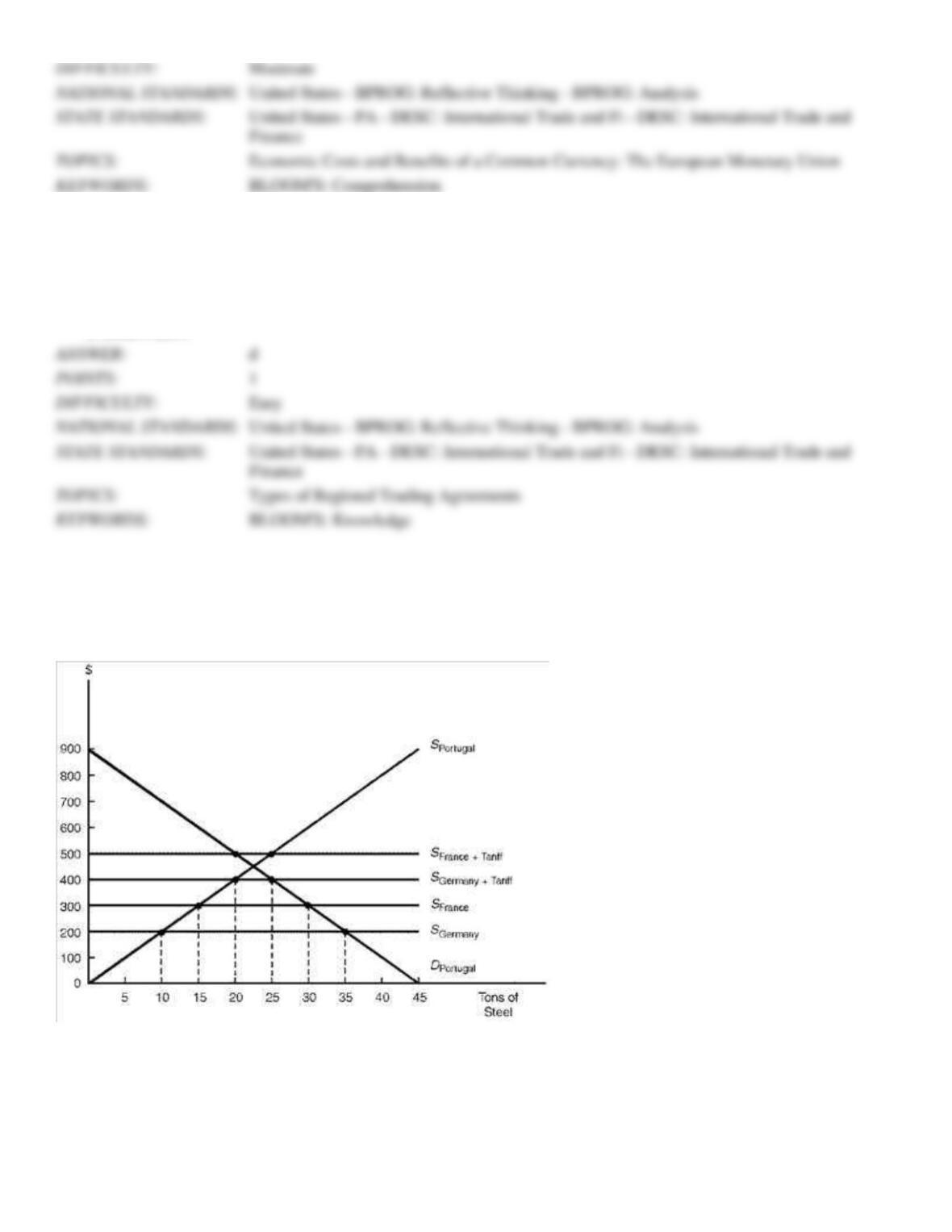
The figure below depicts the steel market for Portugal, a small nation that is unable to affect the world price. Assume that
Germany and France can supply steel to Portugal at a price of $200 and $300 respectively.
Figure 8.2. Portugal’s Steel Market
75. Consider Figure 8.2. With free trade Portugal will
a.
import 0 tons of steel for Germany and 15 tons of steel from France at $300 per ton
b.
import 25 tons of steel from Germany at $200 per ton and 15 tons of steel from France at $300 per ton
c.
import 15 tons of steel from Germany at $200 per ton and 10 tons of steel from France at $200 per ton
d.
import 25 tons of steel from Germany at $200 per ton and 0 tons from France
Moderate
United States – BPROG: Reflective Thinking – BPROG: Analysis
Economic Costs and Benefits of a Common Currency: The European Monetary Union
BLOOM’S: Comprehension
76. Consider Figure 8.2. With free trade Portugal will
a.
produce 10 tons of steel, consume 35 tons of steel and import 25 tons of steel
b.
produce 15 tons of steel, consume 30 tons of steel and import 15 tons of steel
c.
produce 0 tons of steel, consume 35 tons of steel and import 35 tons of steel
d.
produce 15 tons of steel, consume 35 tons of steel and import 20 tons of steel
a
Challenging
United States – BPROG: Analytic
The European Union
BLOOM’S: Analysis
77. Consider Figure 8.2. With free trade, Portugal will import 25 tons of steel from Germany at a price of $200 per ton.
a.
True
b.
False
True
Challenging
United States – BPROG: Analytic
graphs
The European Union
BLOOM’S: Analysis
78. Consider Figure 8.2. With free trade, Portugal produces 15 tons of steel, consumes 30 tons of steel, and imports 15
tons of steel.
a.
True
b.
False
False
Challenging
graphs
The European Union
BLOOM’S: Analysis
Challenging
United States – BPROG: Analytic
BLOOM’S: Analysis
79. Consider Figure 8.2. If Portugal levies a 100 percent nondiscriminatory tariff on its steel imports, it will purchase 5
tons of steel from France at a price of $500 per ton.
a.
True
b.
False
80. Consider Figure 8.2. If Portugal forms a customs union with France, the resulting trade-creation effect equals $500.
a.
True
b.
False
True
Challenging
81. Consider Figure 8.2. If Portugal forms a customs union with France, the resulting trade-diversion effect equals $400.
a.
True
b.
False
False
Challenging
82. Consider Figure 8.2. As a result of a customs union formed with France, Portugal’s overall welfare rises by $900.
a.
True
b.
False
False
Challenging
graphs
False
Challenging
83. Consider Figure 8.2. If Portugal had formed a customs union with Germany, Portugal’s welfare would have decreased
by $500.
a.
True
b.
False
False
Challenging
84. The European Union protects its agricultural producers from import competition by the use of tariff rates that vary
directly with world prices.
a.
True
b.
False
False
Moderate
85. Under the variable levy system of the European Union, EU farmers are protected against import competition by tariffs
that vary inversely with the world price.
a.
True
b.
False
True
Moderate
86. Trade creation tends to more than offset trade diversion for a home country forming a customs union with partner
countries when: (1) the tariff rate in the home country is high prior to the formation of the customs union; (2) there are a
large number of countries forming the customs union.
a.
True
b.
False
87. If Chile and Mexico form a free-trade agreement, the welfare of the two countries will necessarily increase.
a.
True
b.
False
False
Moderate
Finance
88. If Chile and Mexico abolish all tariffs on each other’s products while maintaining their own tariffs against other
countries, these two countries have formed a customs union.
a.
True
b.
False
False
Moderate
89. With a preferential trading arrangement, a group of countries agrees to unilaterally reduce tariffs applied to imports
from all countries of the world.
a.
True
b.
False
False
Moderate
True
Moderate
90. Economic integration is the process of eliminating restrictions on international trade, payments, and factor mobility.
a.
True
b.
False
91. When a group of countries establish a free-trade area, they achieve the highest stage of economic integration.
a.
True
b.
False
False
Moderate
92. A free-trade area is an association of trading countries whose members agree to remove all trade restrictions among
themselves, while each member country imposes identical trade restrictions against nonmember countries.
a.
True
b.
False
False
Moderate
93. If the United Kingdom and Italy eliminate all tariffs on each other’s goods and all restrictions to factor movements
between them, and implement a uniform system of import restrictions against the rest of the world, these countries have
formed a common market.
a.
True
b.
False
True
Moderate
True
Moderate
Finance
94. The highest stage of economic integration is a monetary union.
a.
True
b.
False
True
Moderate
95. Trade creation would occur if Canada and the United States form a free-trade area, and Canadians then import less
steel from the United States while importing more steel from Japan.
a.
True
b.
False
False
Moderate
96. Suppose that Mexico and Canada form a free-trade area. The Mexicans then decrease refrigerator manufacturing and
increase imports of refrigerators from Canada, while the Canadians decrease auto manufacturing and import more autos
from Mexico. This is an example of trade creation.
a.
True
b.
False
True
Moderate
97. Trade creation and trade diversion refer to the short run (static) effects of economic integration while economies of
scale, stimulus to investment, and effects on competition refer to the long run (dynamic) effects.
a.
True
b.
False
Finance
98. For countries forming a customs union, the trade-creation effect represents a welfare loss and the trade-diversion
effect represents a welfare gain.
a.
True
b.
False
False
Moderate
99. In the short run, Mexico would realize overall welfare gains from becoming a member of the North American Free
Trade Agreement if the resulting diseconomies of scale effect more than offset the competition effect.
a.
True
b.
False
False
Moderate
Finance
100. Trade creation occurs when imports from a low-cost supplier outside of a customs union are replaced by purchases
from a higher-cost supplier within the union.
a.
True
b.
False
False
Moderate
Finance
True
Challenging
101. If a customs union includes the low-cost supplier of the world, there would be no adverse trade-diversion effect that
would counteract the positive trade-creation effect.
a.
True
b.
False
102. The potential for trade diversion is smaller when a custom union’s external tariff is lower rather than higher.
a.
True
b.
False
True
Moderate
103. If a customs union included all of the countries in the world, there could exist only trade creation, not trade diversion.
a.
True
b.
False
True
Moderate
104. The larger the size and the greater the number of countries in a customs union, the greater will be the trade-diversion
effect.
a.
True
b.
False
False
Moderate
False
Moderate
105. Over the long run, the formation of a customs union may yield welfare gains due to economies of scale, greater
competition, and stimulus to investment.
a.
True
b.
False
True
Moderate
106. By the mid-1990s, the European Union had essentially achieved the common market stage of economic integration.
a.
True
b.
False
True
Moderate
107. At the Maastricht Summit of 1991, members of the European Union expressed the goal of achieving the common
market stage of economic integration.
a.
True
b.
False
False
Moderate
108. To protect its farmers from foreign competition, the European Union has utilized variable import levies and export
subsidies.
a.
True
b.
False
True
Finance
109. To protect its farmers from imports of agricultural goods, the European Union has implemented tariff rates that vary
directly with world prices.
a.
True
b.
False
False
Moderate
Finance
110. As of 1992, the European Union had achieved the monetary union stage of economic integration.
a.
True
b.
False
False
Moderate
111. The Maastricht Treaty of 1991 established a blueprint for economic union and monetary union for European Union
members.
a.
True
b.
False
True
Moderate
112. It is generally agreed that completing the common market stage of integration for the European Union contributed to
Moderate
overall welfare losses due to trade diversion exceeding trade creation.
a.
True
b.
False
113. Government procurement liberalization permits a country to realize cost savings resulting from the trade effect,
competition effect, and economies-of-scale effect.
a.
True
b.
False
True
Moderate
114. During the 1980s and 1990s, the United States negotiated free-trade agreements with Israel, Mexico, and Canada.
a.
True
b.
False
True
Moderate
115. Forming a free-trade agreement with the United States provided Canadian producers a danger and an opportunity.
The danger was that U.S. producers might be more price competitive than Canadian producers; the opportunity was that
longer production runs for Canadian producers, made possible by a free-trade agreement, would result in cost reductions
due to economies of scale.
a.
True
b.
False
True
Moderate
False
Moderate
Finance
116. Some trade creation was expected to occur as a result of the U.S.-Canada free-trade agreement, since Canadian
exports to the United States and U.S. exports to Canada were expected to expand at the expense of imports from Germany
and Japan that faced trade restrictions.
a.
True
b.
False
True
Moderate
117. Negotiating the North American Free Trade Agreement was relatively easy since it involved meshing two large
industrial countries with a developing country.
a.
True
b.
False
False
Moderate
118. Critics of the North American Free Trade Agreement maintained that it would result in manufacturing firms fleeing
Mexico’s stringent pollution-control policies and relocating in the United States and Canada.
a.
True
b.
False
False
Moderate
119. U.S. labor unions argued against the North American Free Trade Agreement on the grounds that it would result in
U.S. companies relocating in Mexico in order to take advantage of lower wage rates.
a.
True
b.
False
120. The North American Free Trade Agreement was expected to provide proportionately smaller benefits to Mexico than
to the United States or Canada.
a.
True
b.
False
False
Moderate
121. All welfare consequences of a regional trading arrangement are dynamic
a.
True
b.
False
False
Moderate
Finance
122. All welfare effects of a regional trading agreement are static.
a.
True
b.
False
False
Moderate
True
Moderate
123. Within a customs union, broader markets may also promote greater competition among producers.
a.
True
b.
False
124. Following World War II, Western European nations suffered from balance-of-payments deficits due to
reconstruction.
a.
True
b.
False
True
Moderate
125. When Western European democracies removed trade barriers and began to form the European Community, one of
their hopes was that their economic and financial ties would bind them together so that it would not be in their interest to
go to war again.
a.
True
b.
False
True
Moderate
126. The EU has abolished restrictions on agricultural products traded internally.
a.
True
b.
False
True
Moderate
True
Moderate
Finance
127. What is meant by economic integration?
128. What factors influence the extent of trade creation and trade diversion?
129. Explain the theory of optimum currency areas.
130. Who were the losers in the U.S. as a result of NAFTA?