Cost Accounting: A Managerial Emphasis, 6e
Chapter 8 – Flexible Budgets, Variances, and Management Control: II
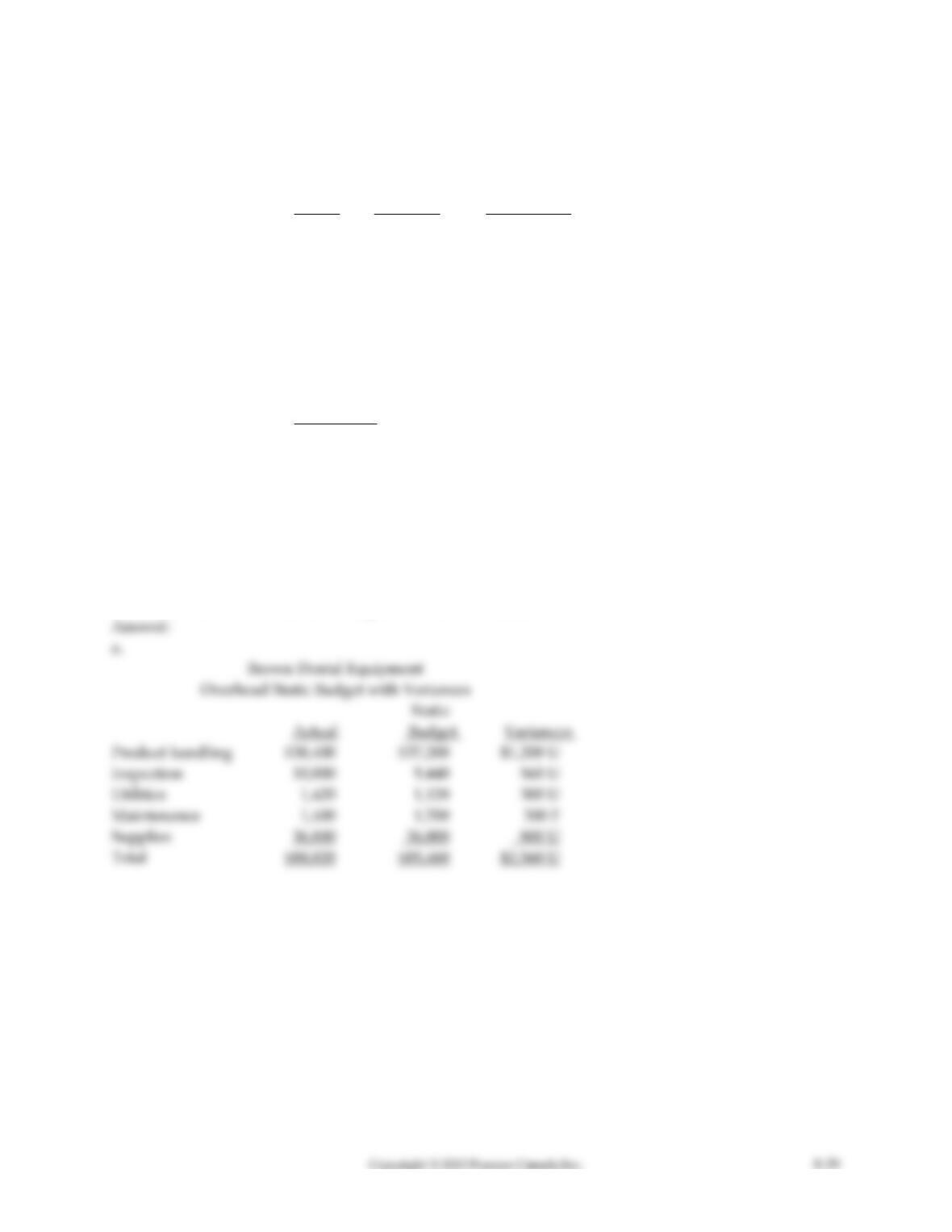
13) Brown Dental Equipment uses a flexible budget for its indirect manufacturing costs. For 2012 the
company anticipated that it would produce 36,000 components with 7,000 machine hours and 14,400
employee days. The costs and cost drivers were to be as follows:
Fixed Variable Cost driver
Product handling $30,000 $0.20 per unit
Inspection 8,000 4.00 per 100 unit batch
Utilities 400 2.00 per 100 unit batch
Maintenance 1,000 0.10 per machine hour
Supplies 2.50 per employee day
During the year the company processed 40,000 units, worked 15,000 employee days, and had 8,000
machine hours. The actual costs for 2012 were:
Actual costs
Product handling $38,400
Inspection 10,000
Utilities 1,420
Maintenance 1,400
Supplies 36,800
Required:
a. Prepare an overhead static budget for 2012 with variances.
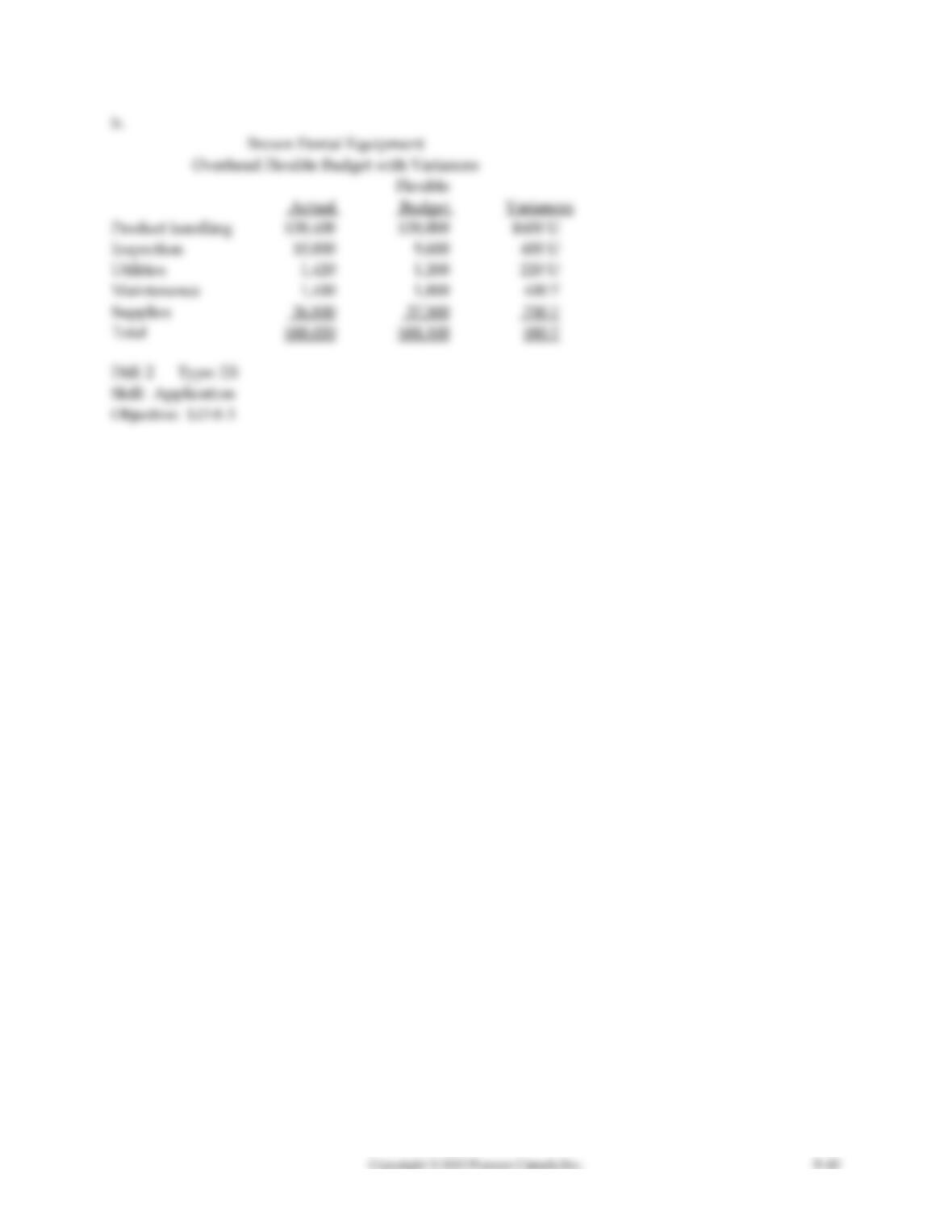
b. Prepare an overhead flexible budget for 2012 with variances.
Cost Accounting: A Managerial Emphasis, 6e
Chapter 8 – Flexible Budgets, Variances, and Management Control: II
Cost Accounting: A Managerial Emphasis, 6e
Chapter 8 – Flexible Budgets, Variances, and Management Control: II
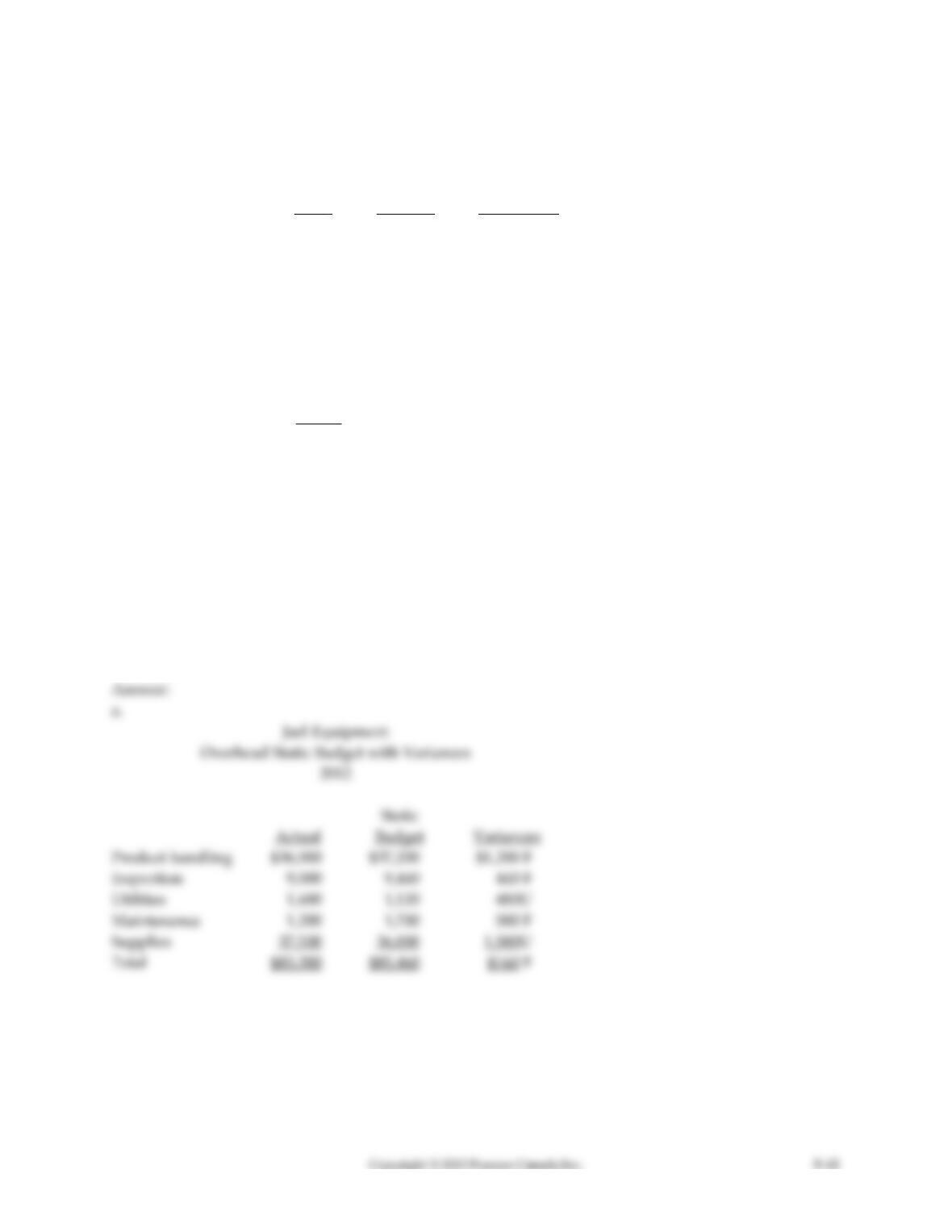
14) Jael Equipment uses a flexible budget for its indirect manufacturing costs. For 2012 the company
anticipated that it would produce 18,000 units with 3,500 machine-hours and 7,200 employee days. The
costs and cost drivers were to be as follows:
Fixed Variable Cost Driver
Product handling $30,000 $0.40 per unit
Inspection 8,000 8.00 per 100 unit batch
Utilities 400 4.00 per 100 unit batch
Maintenance 1,000 0.20 per machine-hour
Supplies 5.00 per employee day
During the year, the company processed 20,000 units; worked 7,500 employee days; and, had 4,000
machine hours. The actual costs for 2012 were:
Actual
Product handling $36,000
Inspection 9,000
Utilities 1,600
Maintenance 1,200
Supplies 37,500
Required:
a. Prepare the static-budget using the overhead items above and then compute the static-budget
variances.
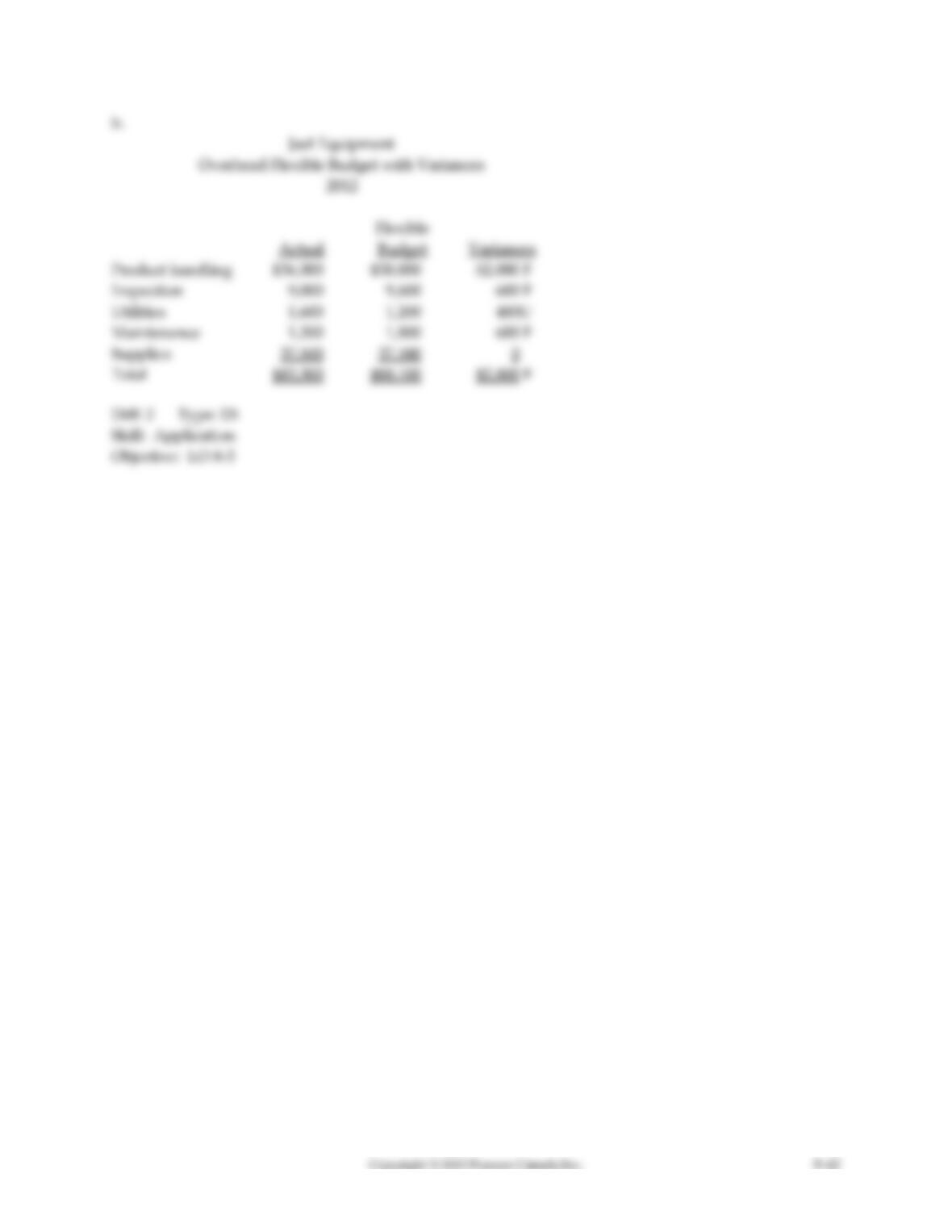
b. Prepare the flexible-budget using the overhead items above and then compute the flexible-budget
variances.
Cost Accounting: A Managerial Emphasis, 6e
Chapter 8 – Flexible Budgets, Variances, and Management Control: II
Cost Accounting: A Managerial Emphasis, 6e
Chapter 8 – Flexible Budgets, Variances, and Management Control: II
15) Casey Corporation produces a special line of basketball hoops in batches. To manufacture a batch of
the basketball hoops Casey Corporation must setup the machines and moulds. Setup costs are batch–level
costs because they are associated with batches rather than individual units of products. A separate Setup
Department is responsible for setting up machines and moulds for different styles of basketball hoops.
Setup overhead costs consist of some costs that are variable and some costs that are fixed with
respect to the number of setup hours. The following information pertains to January 2012.
Static-budget Actual
Amounts Amounts
Basketball hoops produced and sold 30,000 28,000
Batch size (number of units per batch) 200 250
Setup hours per batch 5 4
Variable overhead cost per setup hour $10 $9
Total fixed setup overhead costs $22,500 $21,000
Required:
a. Calculate the efficiency variance for variable setup overhead costs.
b. Calculate the rate variance for variable setup overhead costs.
c. Calculate the flexible-budget variance for variable setup overhead costs.
d. Calculate the rate variance for fixed setup overhead costs.
e. Calculate the production-volume variance for fixed setup overhead costs.
8.4 Integrate the fixed and variable overhead cost variance analyses to reconcile the
actual overhead incurred with overhead allocated.
1) Identifying the reasons for variances is important because it helps managers plan for corrective action.
Cost Accounting: A Managerial Emphasis, 6e
Chapter 8 – Flexible Budgets, Variances, and Management Control: II
2) Effective planning of variable overhead costs means that a company performs those variable overhead
costs that primarily add value
A) for the current shareholders.
B) for the customer using the products or services.
C) for plant employees.
D) for major suppliers of component parts.
E) for management.
3) Two of the primary ways to manage variable-overhead costs include
A) eliminating non-value-added costs and reducing the consumption of cost drivers.
B) eliminating non-value-added costs and increasing fixed overhead expenses.
C) reducing the consumption of cost drivers and increasing variable costs.
D) using more energy-efficient equipment and planning for appropriate capacity levels.
E) increasing variable costs and eliminating non-value added costs.
4) The difference between the actual amount of variable overhead incurred and the budget amount
allowed for actual output achieved is
A) the flexible budget variance.
B) the variable overhead rate variance.
C) the price variance.
D) the sales-volume variance.
E) the efficiency variance.
5) A favourable variable manufacturing overhead efficiency variance may be interpreted as meaning
which of the following?
A) Employees used too much electricity during production.
B) Less maintenance was required than expected.
C) Excess supplies were used.
D) Too much of the cost driver was used.
E) The cost driver is inappropriate.
Cost Accounting: A Managerial Emphasis, 6e
Chapter 8 – Flexible Budgets, Variances, and Management Control: II
6) Fixed overhead costs must be unitized for
A) financial reporting purposes.
B) planning purposes.
C) for utilization in activity-based-costing.
D) to calculate the static-budget variance.
E) to analyze the efficiency variance.
7) The rate and efficiency variances are subcomponents of
A) a flexible-budget variance.
B) the fixed overhead static-budget variance.
C) a production-volume variance.
D) a variable overhead volume variance.
E) the fixed overhead rate variance.
Cost Accounting: A Managerial Emphasis, 6e
Chapter 8 – Flexible Budgets, Variances, and Management Control: II
Use the information below to answer the following question(s).
Michelle Inc. uses a level 4-variance analysis of its manufacturing overhead costs, and has the following
results for April.
A. Budgeted direct labour-hours per unit is used to allocate variable manufacturing overhead.
Fixed overhead is allocated on a per unit basis.
B. Budgeted amounts for April 2012 are:
Direct labour-hours
0.30/unit
Variable labour-hour overhead rate
$20.00 /DLH
Fixed manufacturing overhead
$600,000
Budgeted output (denominator level output)
30,000 units
C. Actual amounts for April 2012 are:
Variable manufacturing overhead
$340,000
Fixed manufacturing overhead
$590,000
Direct labour-hours
16,000 hours
Actual output
40,000 units
8) What is the variable production-volume variance?
A) $13,500 unfavourable
B) $6,000 unfavourable
C) $6,000 favourable
D) $0
E) There is never a variable production-volume variance.
9) What is the fixed manufacturing overhead rate variance?
A) $10,000 favourable
B) $10,000 unfavourable
C) $13,500 unfavourable
D) $13,500 favourable
E) $14,625 favourable
Cost Accounting: A Managerial Emphasis, 6e
Chapter 8 – Flexible Budgets, Variances, and Management Control: II
10) What are the fixed manufacturing overhead efficiency and production-volume variances,
respectively?
A) 0; $200,000 favourable
B) 0; $200,000 unfavourable
C) $50,500 favourable; $199,998 unfavourable
D) $50,500 unfavourable; $199,998 favourable
E) There is no efficiency variance; $200,000 favourable.
11) What is the variable manufacturing overhead rate variance?
A) $30,000 unfavourable
B) $28,500 favourable
C) $20,000 unfavourable
D) $16,000 favourable
E) $16,000 unfavourable
12) What is the variable manufacturing overhead efficiency variance?
A) $80,000 favourable
B) $80,000 unfavourable
C) $101,200 favourable
D) $101,200 unfavourable
E) $181,200 favourable
Cost Accounting: A Managerial Emphasis, 6e
Chapter 8 – Flexible Budgets, Variances, and Management Control: II
13) Which of the following journal entries is correct with respect to actual variable overhead costs?
A)
Variable Manufacturing Overhead Allocated
340,000
Variable Rate Variance
10,000
Variable Efficiency Variance
10,000
Variable Manufacturing Overhead Control
320,000
B)
Work in Process Control
340,000
Variable Manufacturing Overhead Allocated
340,000
C)
Variable Manufacturing Overhead
340,000
Variable Manufacturing Overhead Control
340,000
D)
Variable Manufacturing Overhead Control
340,000
Variable Manufacturing Overhead
340,000
E)
Variable Manufacturing Overhead Control
340,000
Accounts Payable and other accounts
340,000
Cost Accounting: A Managerial Emphasis, 6e
Chapter 8 – Flexible Budgets, Variances, and Management Control: II
14) Which of the following journal entries is correct with respect to recording the fixed overhead cost
variances for April?
A)
Fixed Overhead Control
600,000
Accounts Payable and other accounts
600,000
B)
Fixed Overhead Allocated
800,000
Fixed Overhead Rate Variance
10,000
Fixed Overhead Production-Volume Variance
200,000
Fixed Overhead Control
590,000
C)
Work-in-Process Control
590,000
Fixed Overhead Allocated
590,000
D)
Fixed Overhead Allocated
590,000
Fixed Overhead Rate Variance
10,000
Fixed Overhead Efficiency Variance
40,000
Fixed Overhead Control
800,000
E)
Fixed Overhead Allocated
803,500
Fixed Overhead Rate Variance
13,500
Fixed Overhead Production-Volume Variance
200,000
Fixed Overhead Control
590,000
Cost Accounting: A Managerial Emphasis, 6e
Chapter 8 – Flexible Budgets, Variances, and Management Control: II
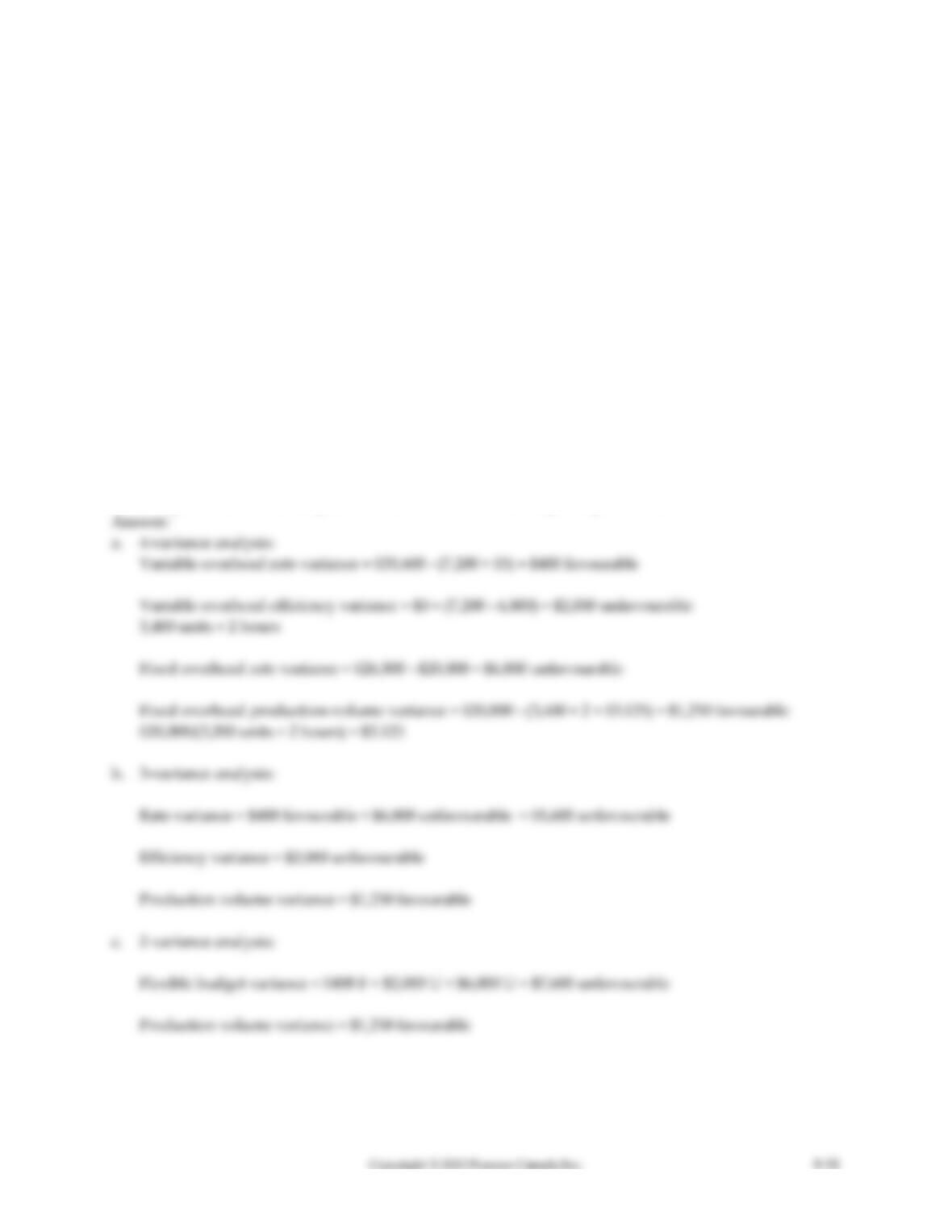
15) Ever-Sharp Lawnmowers Ltd. controls variable manufacturing overhead costs with assembly–line
hours as the denominator. Fixed manufacturing overhead costs are applied on a unit–of-output basis.
Each lawnmower is allowed 10 assembly-line hours and standard variable manufacturing overhead totals
$650 per unit. Budgeted fixed manufacturing overhead totals $29,400 for 420 lawnmowers. During July
4,200 assembly-line hours were incurred and 400 lawnmowers were produced. Actual manufacturing
overhead costs for July were $260,400 for variable expenses and $32,300 for fixed expenses.
Required:
a. Compute a 4-variance analysis for the month of July.
b. Compute a 3-variance analysis for the month of July.
c. Compute a 2-variance analysis for the month of July.
Cost Accounting: A Managerial Emphasis, 6e
Chapter 8 – Flexible Budgets, Variances, and Management Control: II
16) Different management levels in Bates Inc. require varying degrees of managerial accounting
information. Because of the need to comply with the managers’ requests, four different variances for
manufacturing overhead are computed each month. The information for the September overhead
expenditures is as follows:
Budgeted output units 3,200 units
Budgeted fixed manufacturing overhead $20,000
Budgeted variable manufacturing overhead $5.00 per direct labour hour
Budgeted direct manufacturing labour hours 2 hours per unit
Fixed manufacturing costs incurred $26,000
Direct manufacturing labour hours used 7,200
Variable manufacturing costs incurred $35,600
Actual units manufactured 3,400
Required:
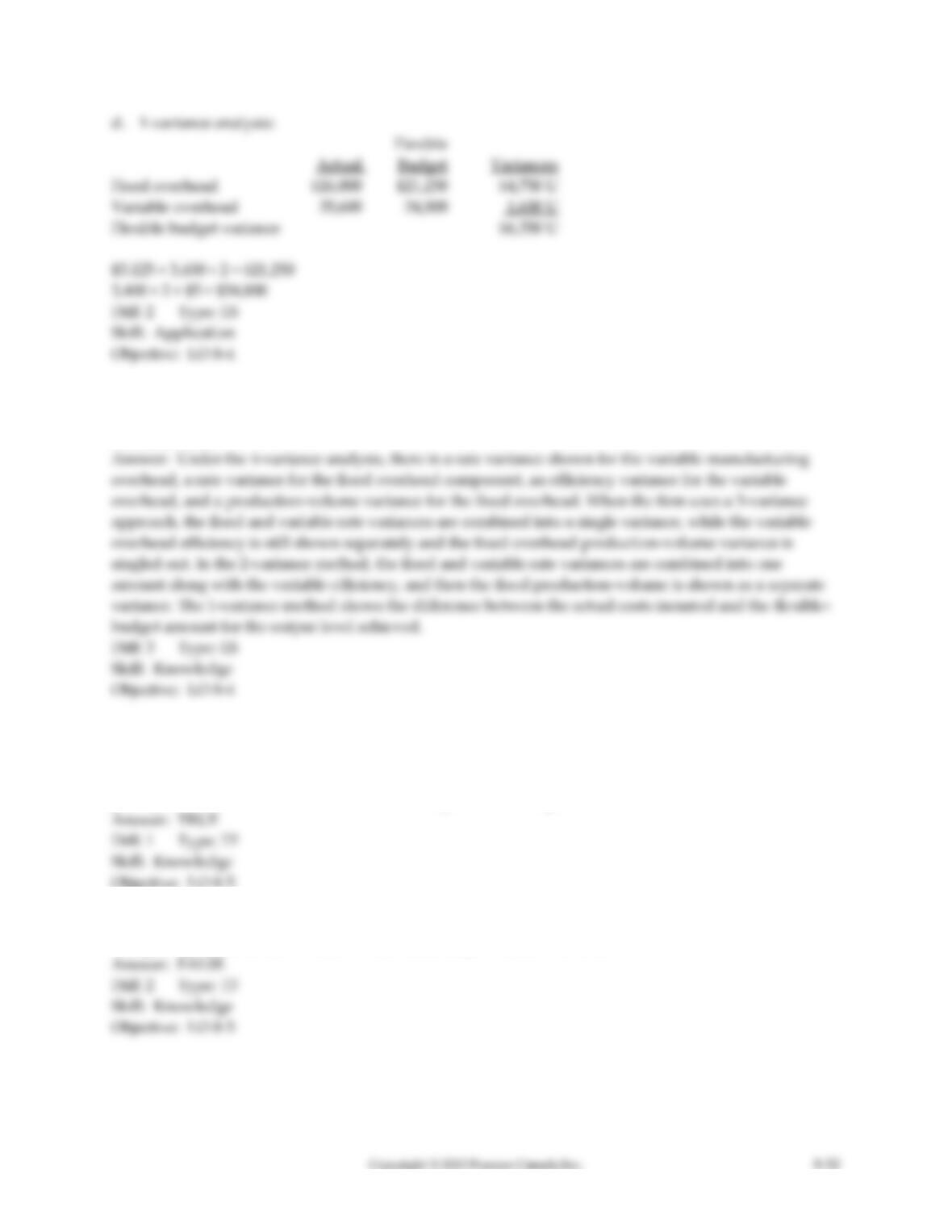
a. Compute a 4-variance analysis for the plant controller.
b. Compute a 3-variance analysis for the plant manager.
c. Compute a 2-variance analysis for the corporate controller.
d. Compute the flexible-budget variance for the manufacturing vice-president.
Cost Accounting: A Managerial Emphasis, 6e
Chapter 8 – Flexible Budgets, Variances, and Management Control: II
17) The chapter shows that variance analysis of overhead costs can be presented in 4–, 3–, 2-, and 1-
variance analysis. Explain what each of the variances presented under each method shows about
overhead costs.
8.5 Analyze non-manufacturing variances.
1) Variance analysis of variable nonmanufacturing as well as variable manufacturing costs is used for
pricing decisions and for decisions about which products to emphasize.
2) For planning and control purposes, actual energy usage per machine hour compared with budgeted
energy usage per machine hour, is a valid financial performance measure.
Cost Accounting: A Managerial Emphasis, 6e
Chapter 8 – Flexible Budgets, Variances, and Management Control: II
3) Managers have found that non-financial measures provide useful information for their planning and
control decisions.
4) Both financial and nonfinancial performance measures are key inputs when evaluating the
performance of managers.
5) One of the primary differences between overhead costs in non-manufacturing settings and
manufacturing settings is
A) that non-manufacturing variable and fixed costs are inventoriable for financial reporting in non–
manufacturing companies.
B) GAAP requires different treatment of non-manufacturing costs for both manufacturing and non–
manufacturing companies.
C) only non-manufacturing companies must include overhead costs as inventoriable costs for financial
reporting.
D) overhead is typically negligible in a non-manufacturing setting.
E) only manufacturing companies are required to include overhead costs in their inventoriable costs for
financial reporting.
6) Non-financial performance measures
A) vary from industry to industry.
B) include variable cost but not fixed cost variances.
C) include both variable and fixed cost variances.
D) are used for performance evaluation, but not for planning and control.
E) deal with personnel matters.
Cost Accounting: A Managerial Emphasis, 6e
Chapter 8 – Flexible Budgets, Variances, and Management Control: II
7) Financial measures of performance include
A) operating income.
B) market share.
C) on-time delivery performance.
D) customer acquisition rate.
E) order time to completion.
8) Delivering value to the customer requires executing activities important to the value proposition.
Many of the activities cannot be evaluated by financial measures of performance. List five non-financial
measures of performance applicable to the hospitality industry.
9) All-Green Company has traditionally used only financial accounting for its decision making purposes.
The president recently attended a seminar for small-business executives where the importance of
managerial accounting was stressed as a way to improve operating decisions. The president was very
interested in the use of managerial accounting as a way of planning the company’s manufacturing
overhead. It seems that the managers have always been at odds over how to best control the overhead
accounts.
Required:
Explain how the planning of variable and fixed manufacturing overhead can improve the company’s
decision making process.
Cost Accounting: A Managerial Emphasis, 6e
Chapter 8 – Flexible Budgets, Variances, and Management Control: II
10) Mediquip International is a manufacturing firm that has many assembly lines, numerous heavy duty
machines and highly skilled machine operators. It has used very complex variance analysis in planning
and controlling it operations during the last few years. Everything always appeared to be satisfactory
until an economic recession tightened the competition and cost control became critical to the company’s
success. The operating managers believe that the traditional managerial accounting variance measures do
not provide all the information they need during times of economic difficulties.
Required:
Discuss what additional information could be provided to the managers.