Chapter 8 – Receivables
127. List at least three indicators that a receivable may be uncollectible.
128. Discuss the two methods for recording bad debt expense. What type of company uses each method?
Chapter 8 – Receivables
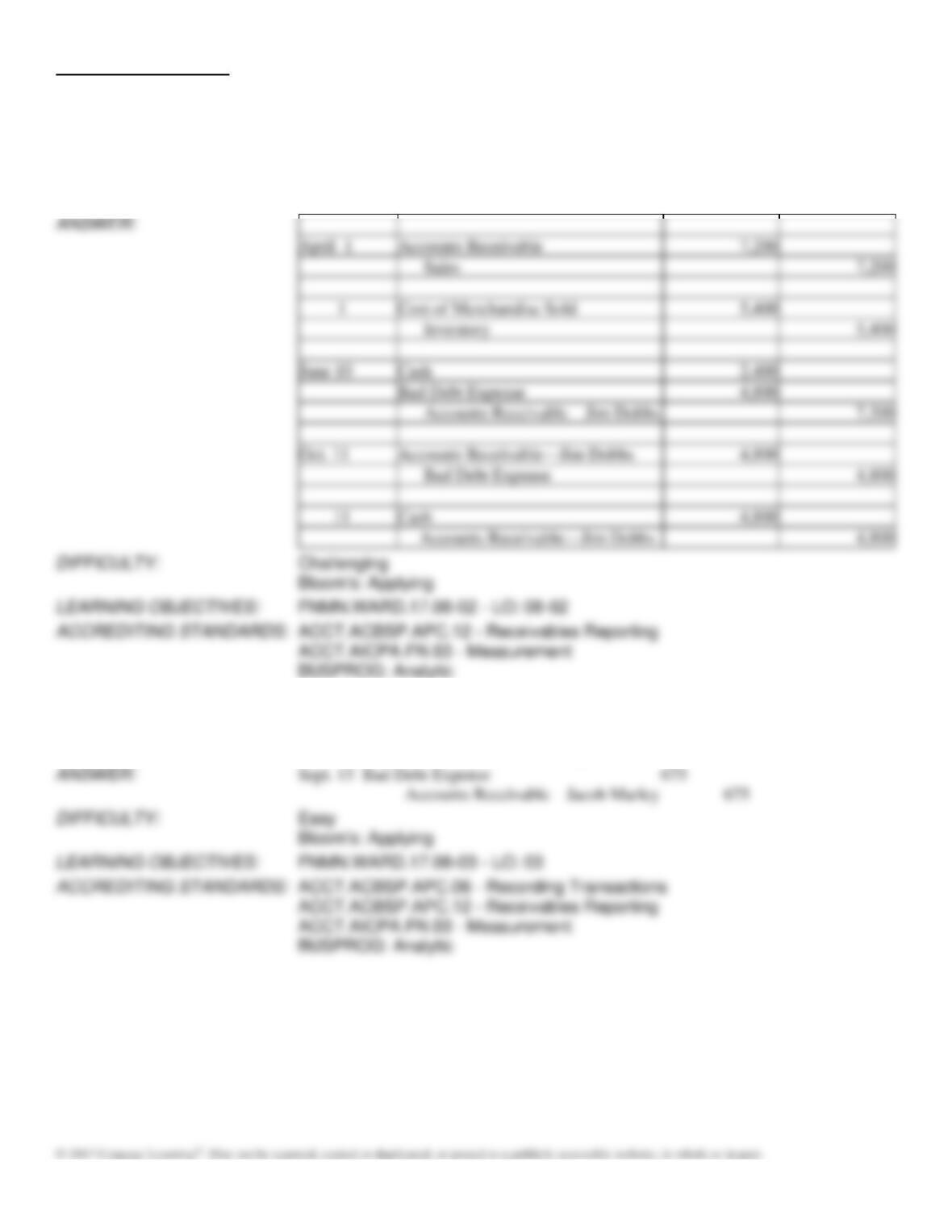
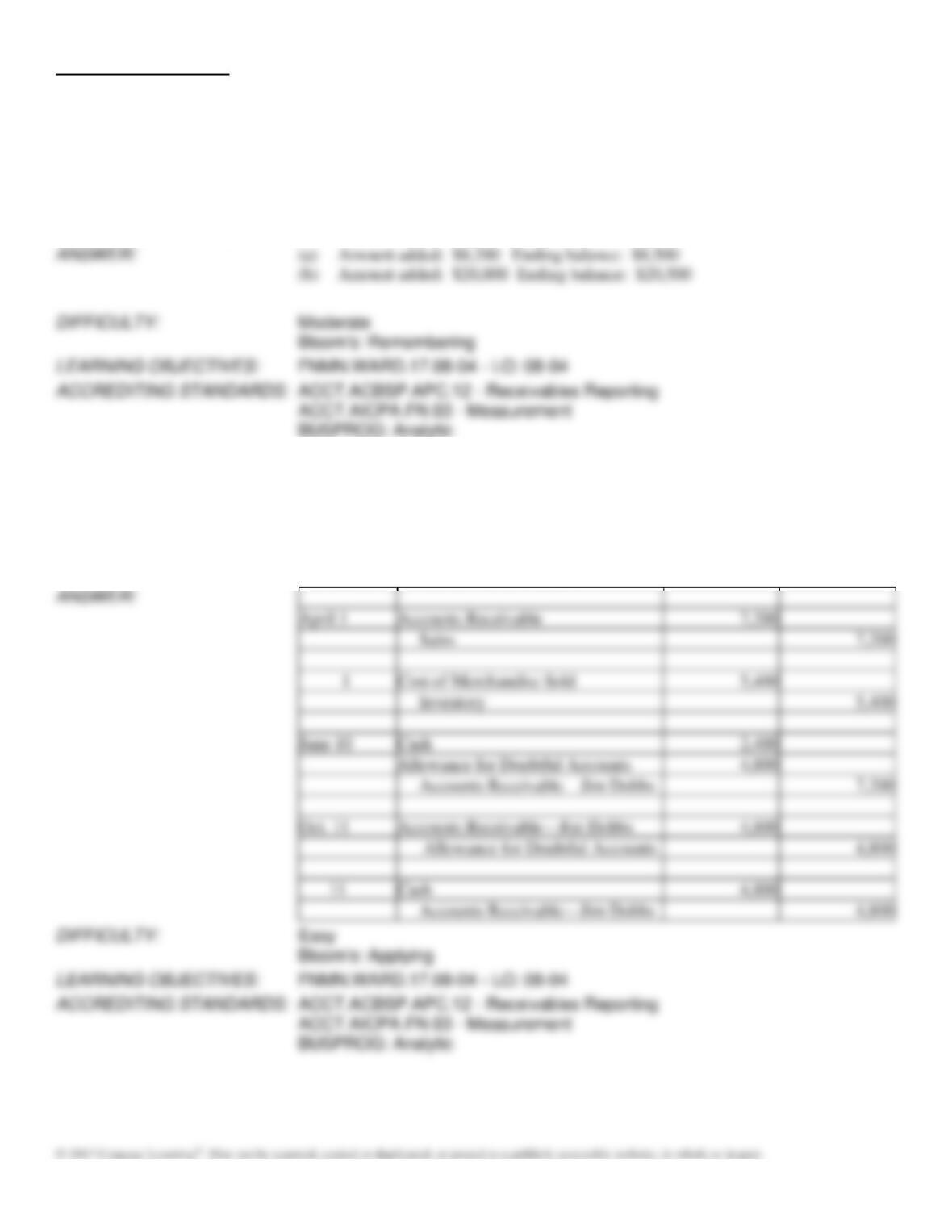
129. Journalize the following transactions using the direct write-off method of accounting for uncollectible receivables.
April 1 Sold merchandise on account to Jim Dobbs, $7,200. The cost of the merchandise is $5,400.
June 10 Received payment for one-third of the receivable from Jim Dobbs and wrote off the remainder.
Oct. 11 Reinstated the account of Jim Dobbs and received cash in full payment.
130. Roe’s Renovations utilizes the direct write-off method of accounting for uncollectible receivables. On September 15
the company is notified by the attorneys for Jacob Marley that Jacob Marley is bankrupt and no cash is expected in the
liquidation. Write off the $675 of accounts receivable due from Jacob Marley.
Chapter 8 – Receivables
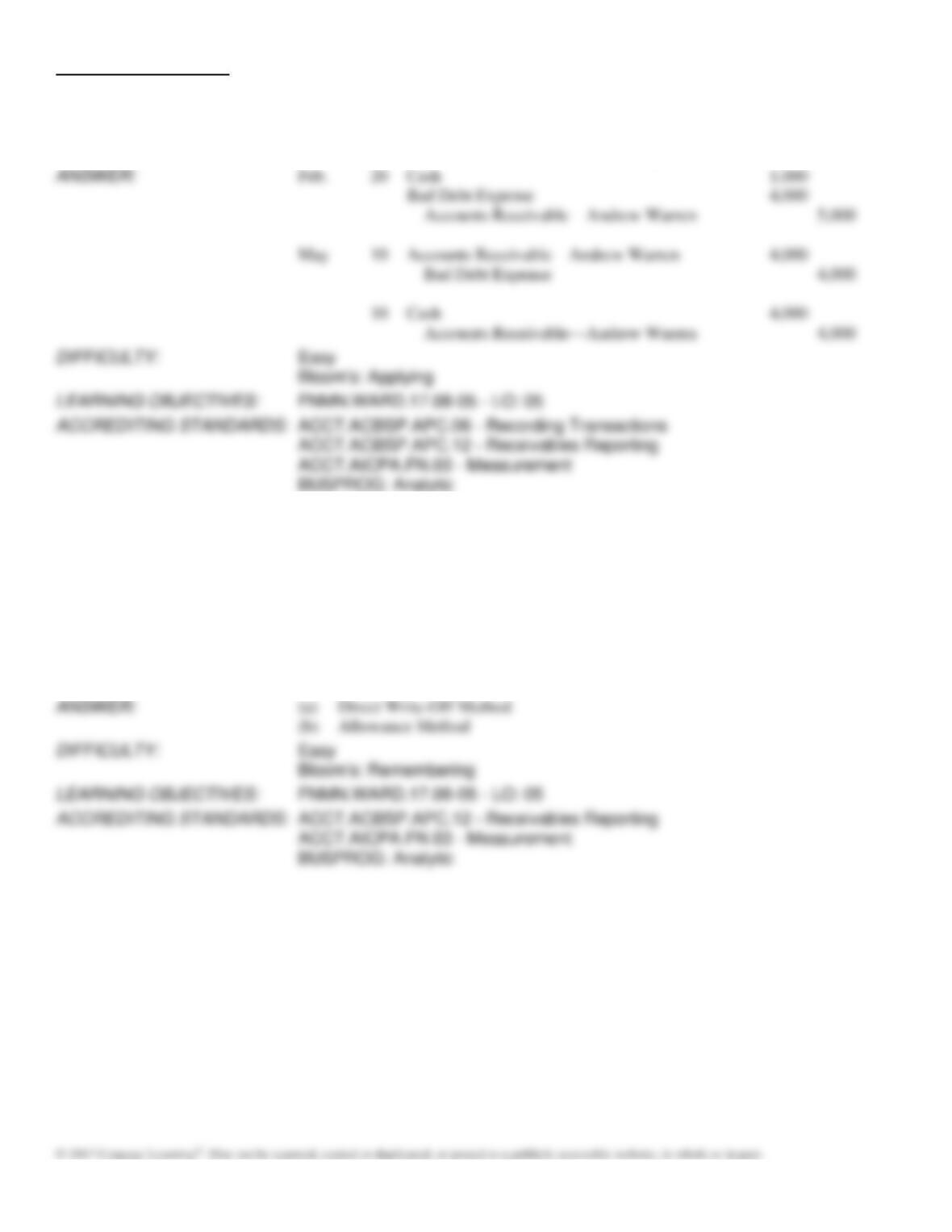
131. Journalize the following transactions using the direct write-off method of accounting for uncollectible receivables:
Feb. 20 Received $1,000 from Andrew Warren and wrote off the remainder owed of $4,000 as uncollectible.
May 10 Reinstated the account of Andrew Warren and received $4,000 cash in full payment.
20
Bad Debt Expense
Accounts Receivable—Andrew Warren
10
Accounts Receivable—Andrew Warren
Bad Debt Expense
10
Accounts Receivable—Andrew Warren
132. The following journal entries would be used in one of the two methods of accounting for uncollectible
receivables. Identify each.
(a)
Bad Debt Expense
900
Accounts Receivable—Billings
900
(b)
Allowance for Doubtful Accounts
900
Accounts Receivable—Grover
900
Direct Write-Off Method
Allowance Method
Chapter 8 – Receivables
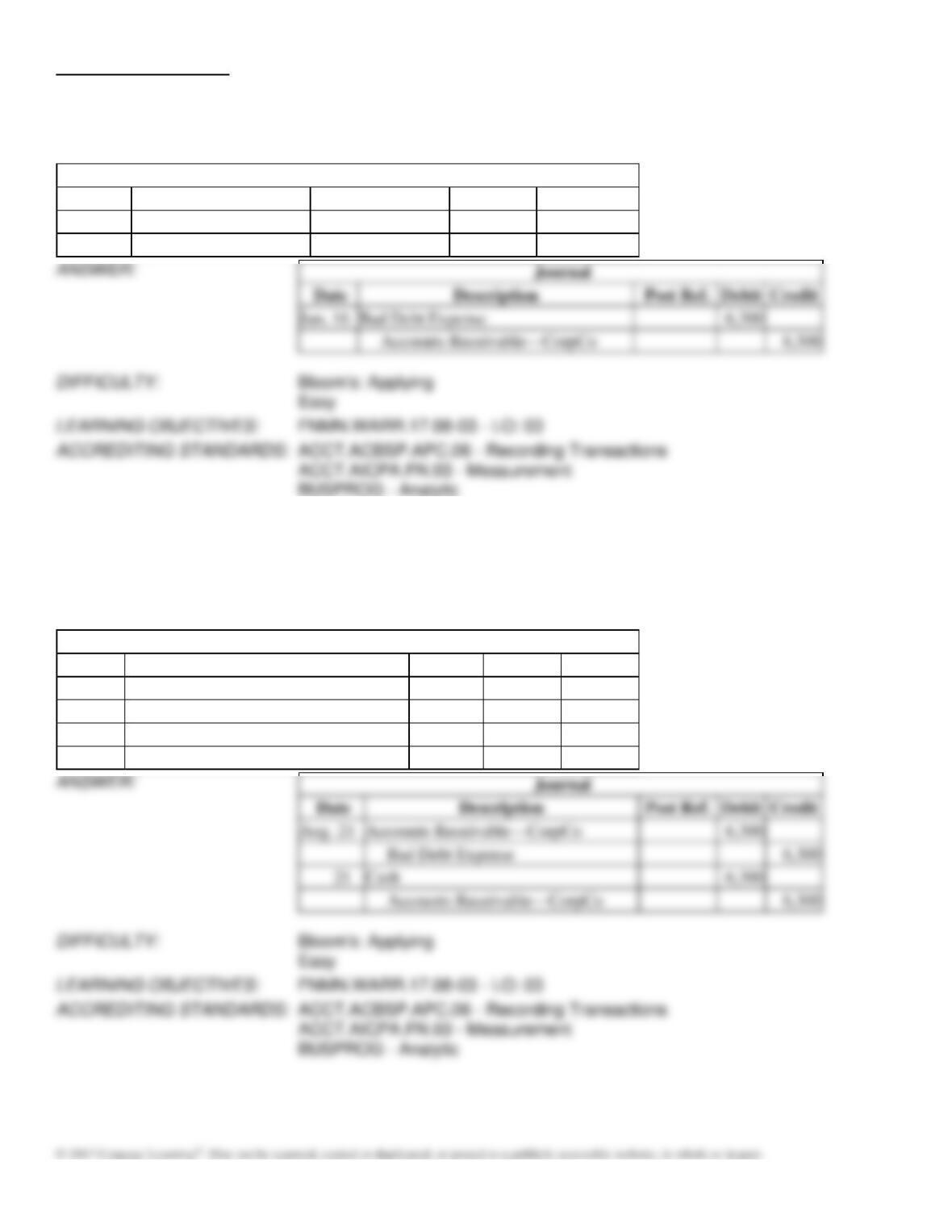
133. Theta Company determines that a $6,300 account receivable from CorpCo is uncollectible and writes off the account
using the direct write-off method on June 16. Journalize the entry to write off the account. You may omit posting
references.
Journal
Date
Description
Post Ref.
Debit
Credit
Jun. 16
Bad Debt Expense
Accounts Receivable—CorpCo
134. Theta Company determines that a $6,300 account receivable from CorpCo is uncollectible and writes off the account
using the direct write-off method on June 16. On August 21, CorpCo pays the $6,300 to Theta Company.
Journalize the entry for the reinstatement of the account receivable and receipt of cash on August 21. You may omit
posting references.
Journal
Date
Description
Post Ref.
Debit
Credit
Aug. 21
Accounts Receivable—CorpCo
Bad Debt Expense
21
Accounts Receivable—CorpCo
Chapter 8 – Receivables
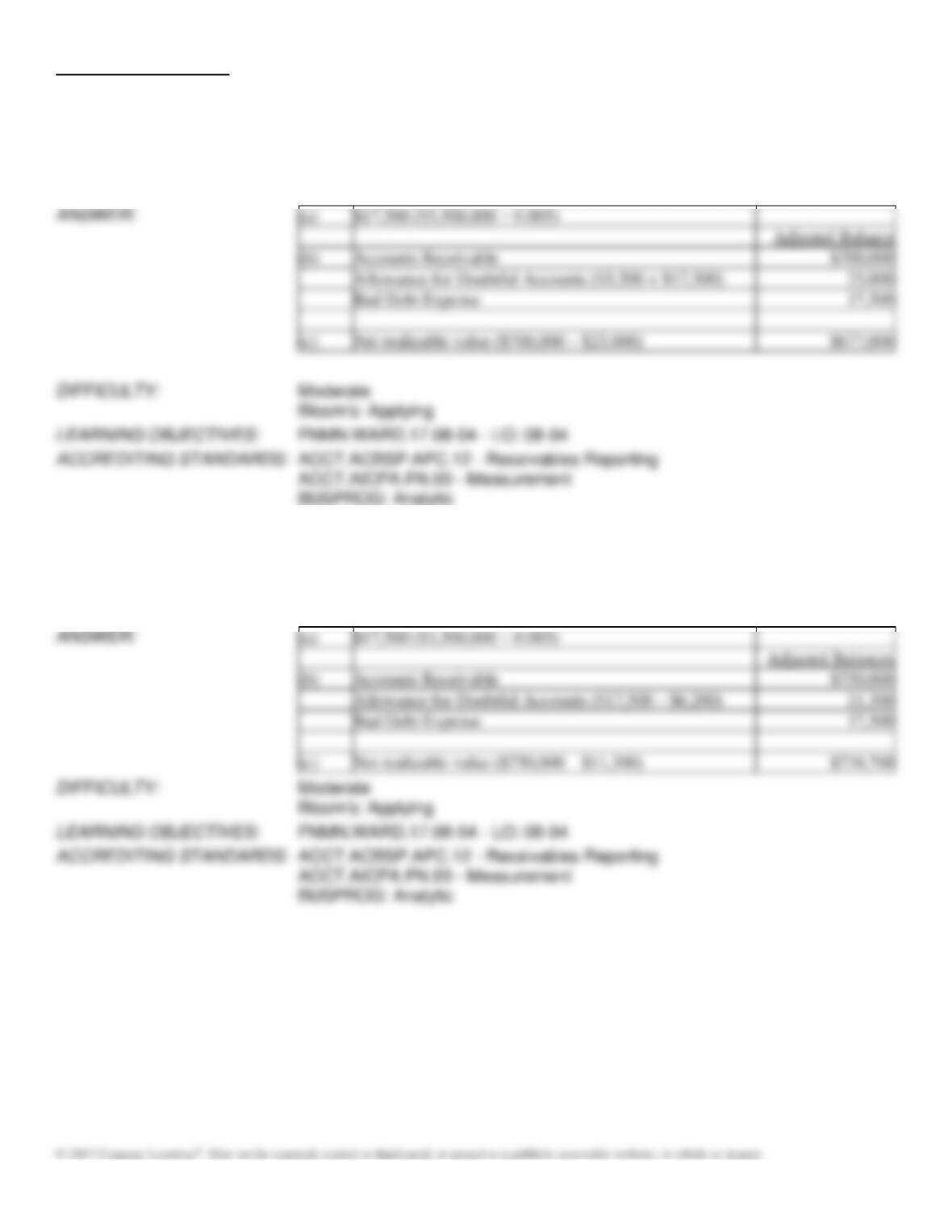
135. Determine the amount to be added to Allowance for Doubtful Accounts in each of the following cases and indicate
the ending balance in each case.
(a)
Credit balance of $300 in Allowance for Doubtful Accounts just prior to
adjustment. Analysis of Accounts Receivable indicates uncollectible receivables of $8,500.
(b)
Credit balance of $500 in Allowance for Doubtful Accounts just prior to
adjustment. Uncollectible receivables are estimated at 2% of credit sales, which totaled
$1,000,000 for the year.
136. Journalize the following transactions using the allowance method of accounting for uncollectible receivables.
April 1 Sold merchandise on account to Jim Dobbs, $7,200. The cost of the merchandise is $5,400.
June 10 Received payment for one-third of the receivable from Jim Dobbs and wrote off the remainder.
Oct. 11 Reinstated the account of Jim Dobbs and received cash in full payment.
Chapter 8 – Receivables
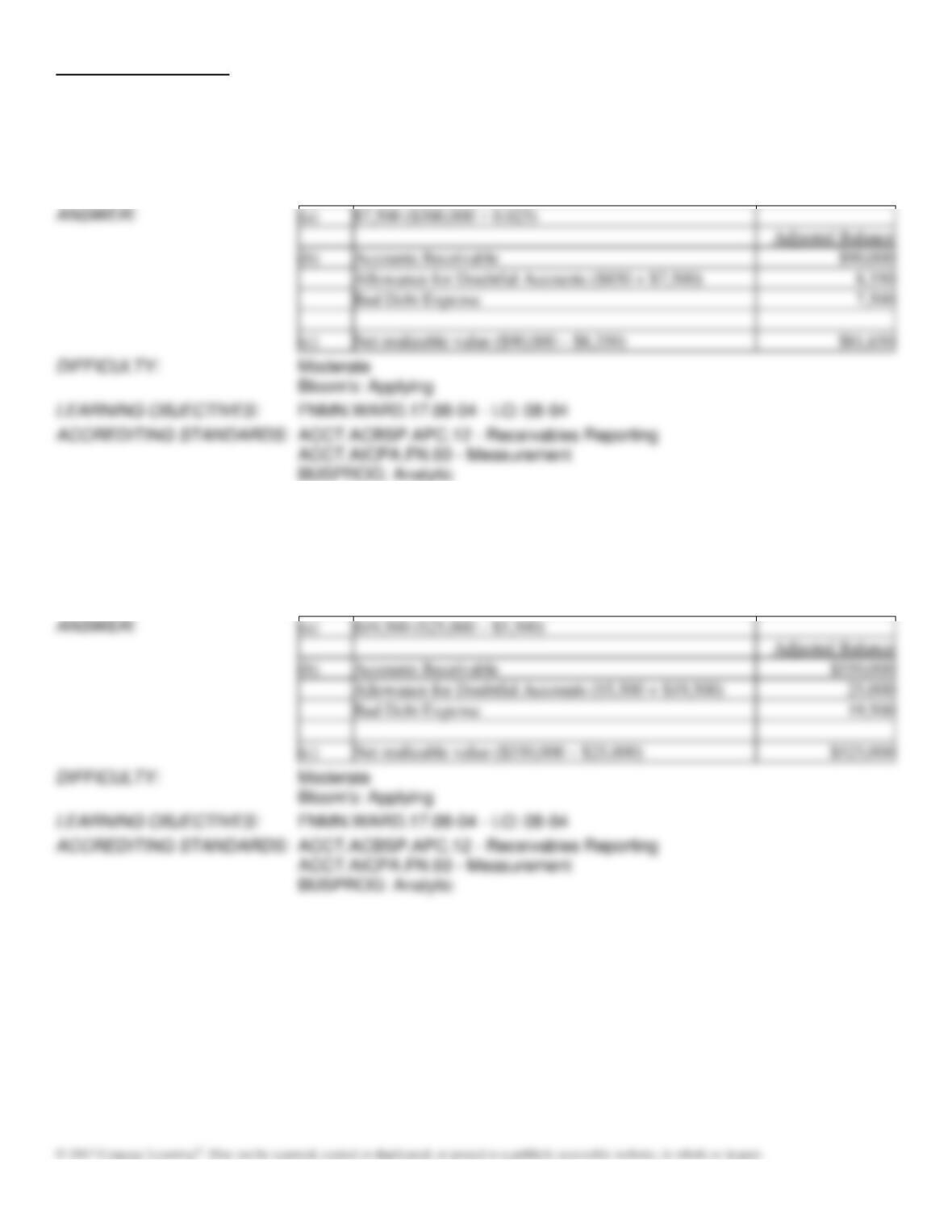
137. At the end of the current year, Accounts Receivable has a balance of $700,000; Allowance for Doubtful Accounts
has a credit balance of $5,500; and sales for the year total $3,500,000. Bad debt expense is estimated at 1/2 of 1% of net
sales.
Determine (a) the amount of the adjusting entry for bad debt expense; (b) the adjusted balances of Accounts Receivable,
Allowance for Doubtful Accounts, and Bad Debt Expense; and (c) the net realizable value of accounts receivable.
138. At the end of the current year, Accounts Receivable has a balance of $750,000; Allowance for Doubtful Accounts
has a debit balance of $6,200; and sales for the year total $3,500,000. Bad debt expense is estimated at 1/2 of 1% of sales.
Determine (a) the amount of the adjusting entry for bad debt expense; (b) the adjusted balances of Accounts Receivable,
Allowance for Doubtful Accounts, and Bad Debt Expense; and (c) the net realizable value of accounts receivable.
Chapter 8 – Receivables
139. At the end of the current year, Accounts Receivable has a balance of $90,000; Allowance for Doubtful Accounts has
a credit balance of $850; and sales for the year total $300,000. Bad debt expense is estimated at 2.5% of sales.
Determine (a) the amount of the adjusting entry for uncollectible accounts; (b) the adjusted balances of Accounts
Receivable, Allowance for Doubtful Accounts, and Bad Debt Expense; and (c) the net realizable value of accounts
receivable.
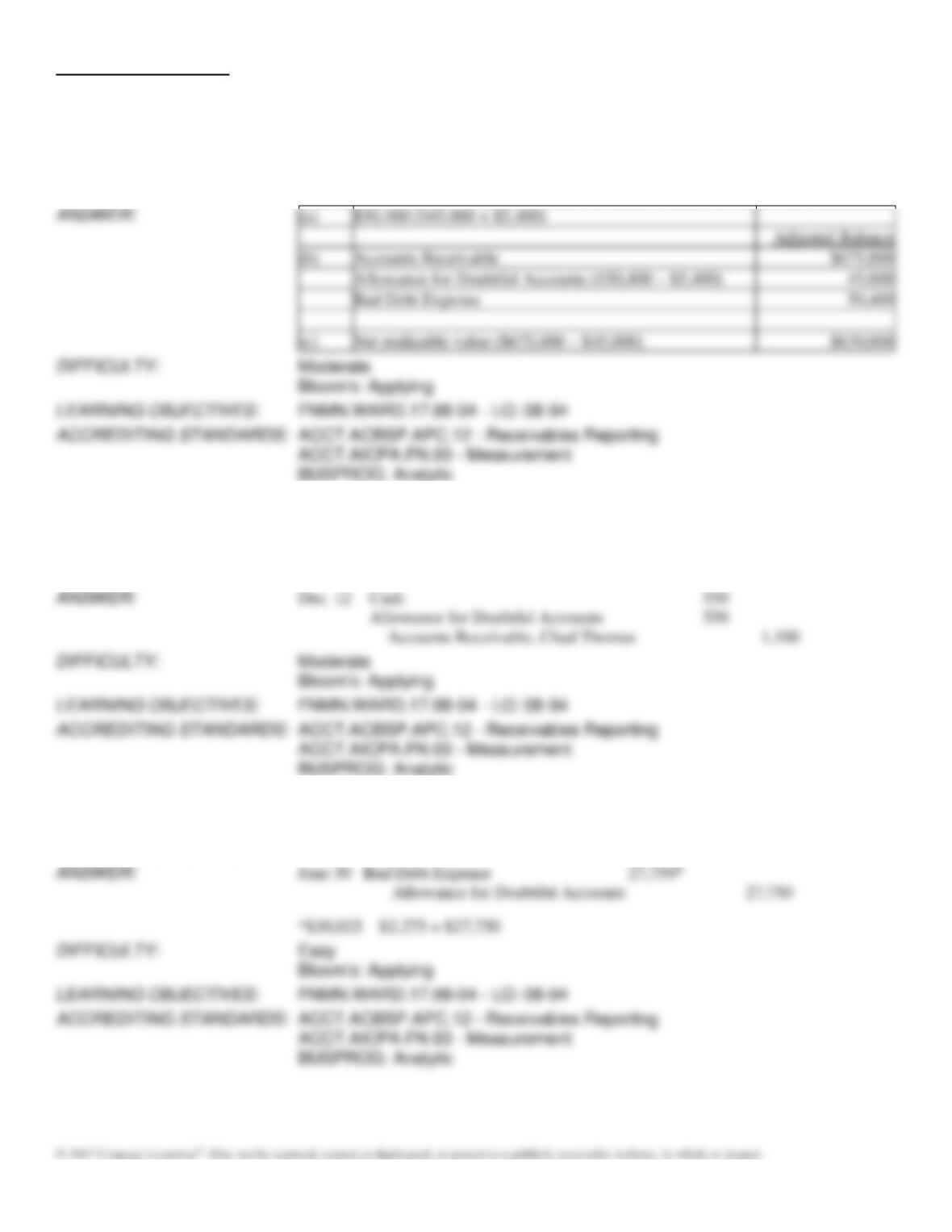
140. At the end of the current year, Accounts Receivable has a balance of $550,000; Allowance for Doubtful Accounts
has a credit balance of $5,500; and sales for the year total $2,500,000. An analysis of receivables estimates uncollectible
receivables as $25,000.
Determine (a) the amount of the adjusting entry for bad debt expense; (b) the adjusted balances of Accounts Receivable,
Allowance for Doubtful Accounts, and Bad Debt Expense; and (c) the net realizable value of accounts receivable.
Chapter 8 – Receivables
141. At the end of the current year, Accounts Receivable has a balance of $675,000; Allowance for Doubtful Accounts
has a debit balance of $5,400; and sales for the year total $3,000,000. An analysis of receivables indicates the
uncollectible receivables are estimated to be $45,000.
Determine (a) the amount of the adjusting entry for bad debt expense; (b) the adjusted balances of Accounts Receivable,
Allowance for Doubtful Accounts, and Bad Debt Expense; and (c) the net realizable value of accounts receivable.
142. Discount Mart utilizes the allowance method of accounting for uncollectible receivables. On December 12 the
company receives a $550 check from Chad Thomas in settlement of Thomas’s $1,100 outstanding accounts receivable.
Due to Thomas’s failing health he is closing his company and is expecting to make no further payments to Discount Mart.
Journalize this declaration.
143. On June 30 (the end of the period), Brown Company has a credit balance of $2,275 in Allowance for Doubtful
Accounts. An evaluation of accounts receivable indicates that the proper balance should be $30,025. Journalize the
appropriate adjusting entry.
Chapter 8 – Receivables
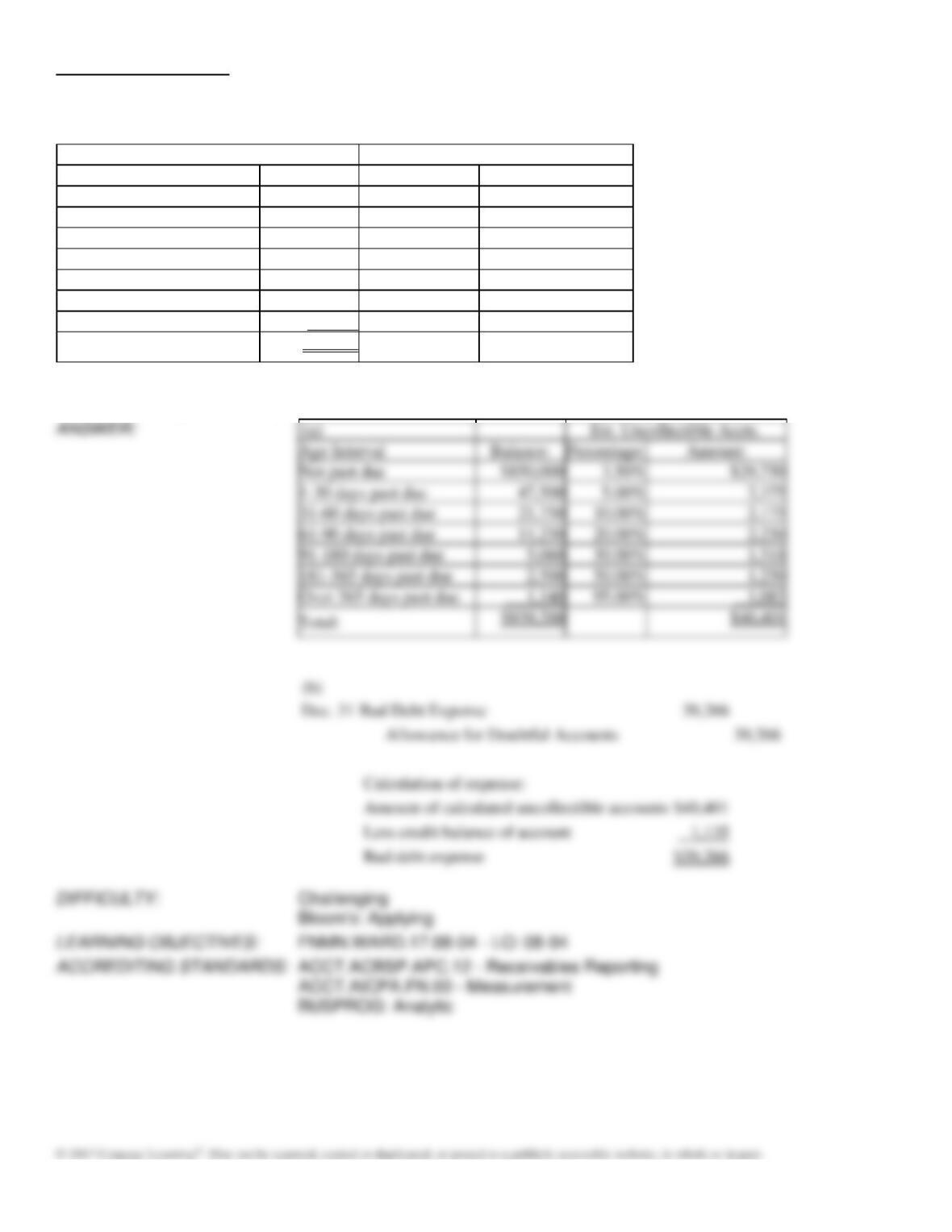
144. (a) The aging of Torme Designs’ accounts receivable is shown below. Calculate the amount of each periodicity range
that is deemed to be uncollectible.
Est. Uncollectible Accts.
Age Interval
Balance
Percentage
Amount
Not past due
850,000
3.50%
1-30 days past due
47,500
5.00%
31–60 days past due
21,750
10.00%
61–90 days past due
11,250
20.00%
91-180 days past due
5,060
30.00%
181-365 days past due
2,500
50.00%
Over 365 days past due
1,140
95.00%
Total
939,200
(b) If the Allowance for Doubtful Accounts has a credit balance of $1,135, record the adjusting entry for
the bad debt expense for the year.
(a)
Age Interval
Percentage:
Not past due
1-30 days past due
47,500
31–60 days past due
21,750
61–90 days past due
11,250
91-180 days past due
181-365 days past due
Over 365 days past due
Total:
Chapter 8 – Receivables
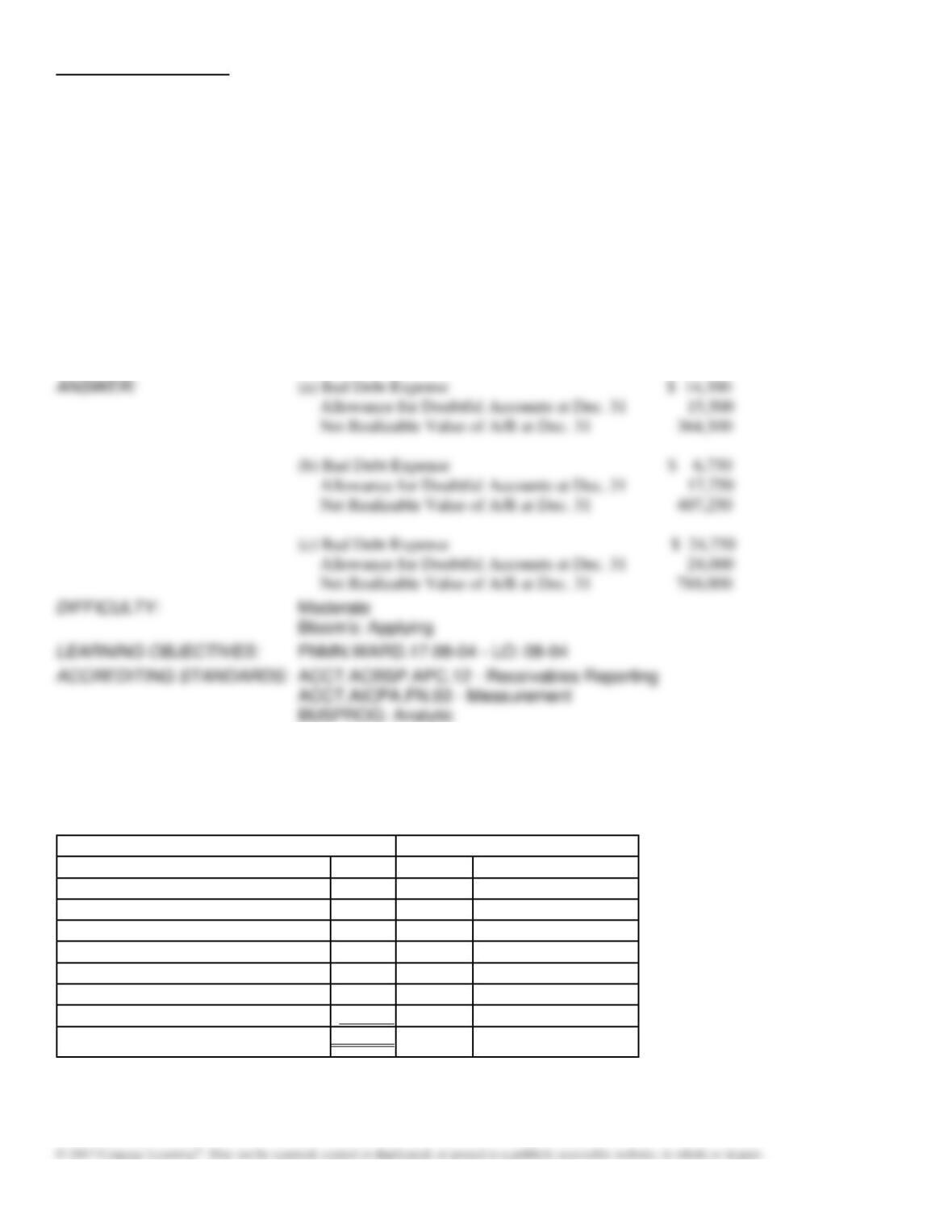
145. For each of the following scenarios, indicate the amount of the adjusting journal entry for bad debt expense to be
recorded, the balance in Allowance for Doubtful Accounts after adjustment at December 31, and the net realizable value
of accounts receivable at December 31.
(a) Based on an analysis of Simmon’s Company’s $380,000 balance in Accounts Receivable at December 31, it was
estimated that $15,500 will be uncollectible. There is a credit balance of $1,200 in Allowance for Doubtful Accounts
before adjustment.
(b) Blake Company had credit sales of $900,000 at year-end, and has an Accounts Receivable balance of $425,000 at
December 31, and an Allowance for Doubtful Accounts credit balance of $11,000 before adjustment. Blake estimates bad
debt expense as 3/4 of 1% of credit sales.
(c) Hidgon Inc. has a balance of $812,000 in Accounts Receivable at December 31. An analysis of those receivables
shows $24,000 will probably not be collected. Before adjusting entries are prepared, the Allowance for Doubtful
Accounts has a debit balance of $750.
146. A partially completed aging of receivables schedule for Lindy Designs is shown below. Calculate the amount that is
estimated to be uncollectible.
(a) Determine the amount estimated to be uncollectible by completing the aging of receivables schedule. Round
calculations to the nearest dollar.
Est. Uncollectible Accounts
Age Interval
Balance
Percentage
Amount
Not past due
$550,000
2.50%
1—30 days past due
96,500
4.00%
31—60 days past due
43,750
9.50%
61—90 days past due
22,250
16.00%
91—180 days past due
5,600
31.00%
181—365 days past due
3,100
60.00%
Over 365 days past due
1,250
95.00%
Total
$722,450
Chapter 8 – Receivables
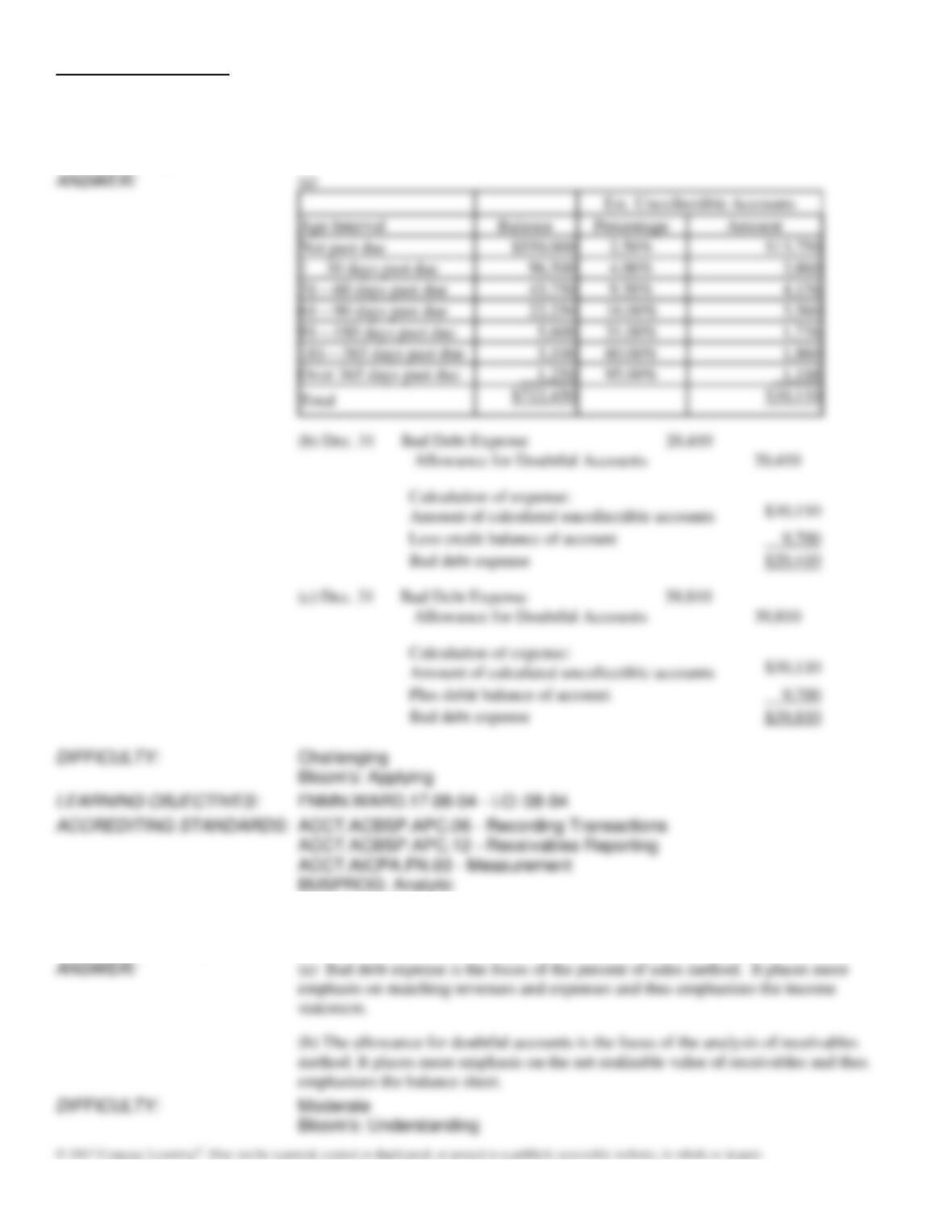
(b) If the Allowance for Doubtful Accounts has a credit balance of $9,700, record the adjusting entry for the bad debt
expense for the year.
(c) If the Allowance for Doubtful Accounts has a debit balance of $9,700, record the adjusting entry for the bad debt
expense for the year.
147. Discuss the (a) focus and (b) financial statement emphasis of the percent of sales and the analysis of receivables
methods of estimating bad debts.
Chapter 8 – Receivables
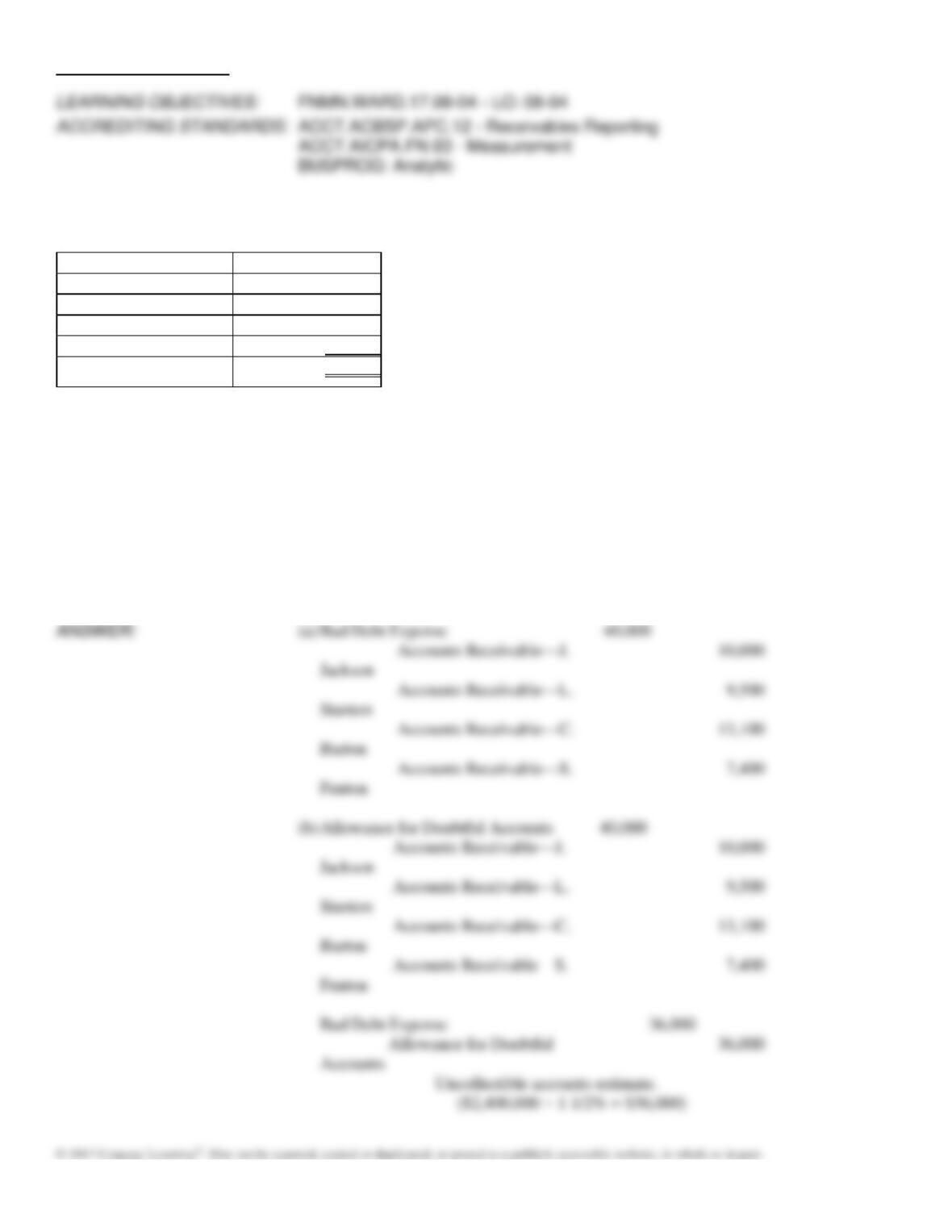
148. Morry Company wrote off the following accounts receivable as uncollectible for the first year of its operations
ending December 31:
Customer
Amount
J. Jackson
$10,000
L. Stanton
9,500
C. Barton
13,100
S. Fenton
7,400
Total
$40,000
Required:
(a)
Journalize the write-offs for the current year under the direct write-off method.
(b)
Journalize the write-offs for the current year under the allowance method. Also,
journalize the adjusting entry for uncollectible receivables assuming the company made
$2,400,000 of credit sales during the year and the industry average for uncollectible
receivables is 1.50% of credit sales.
(c)
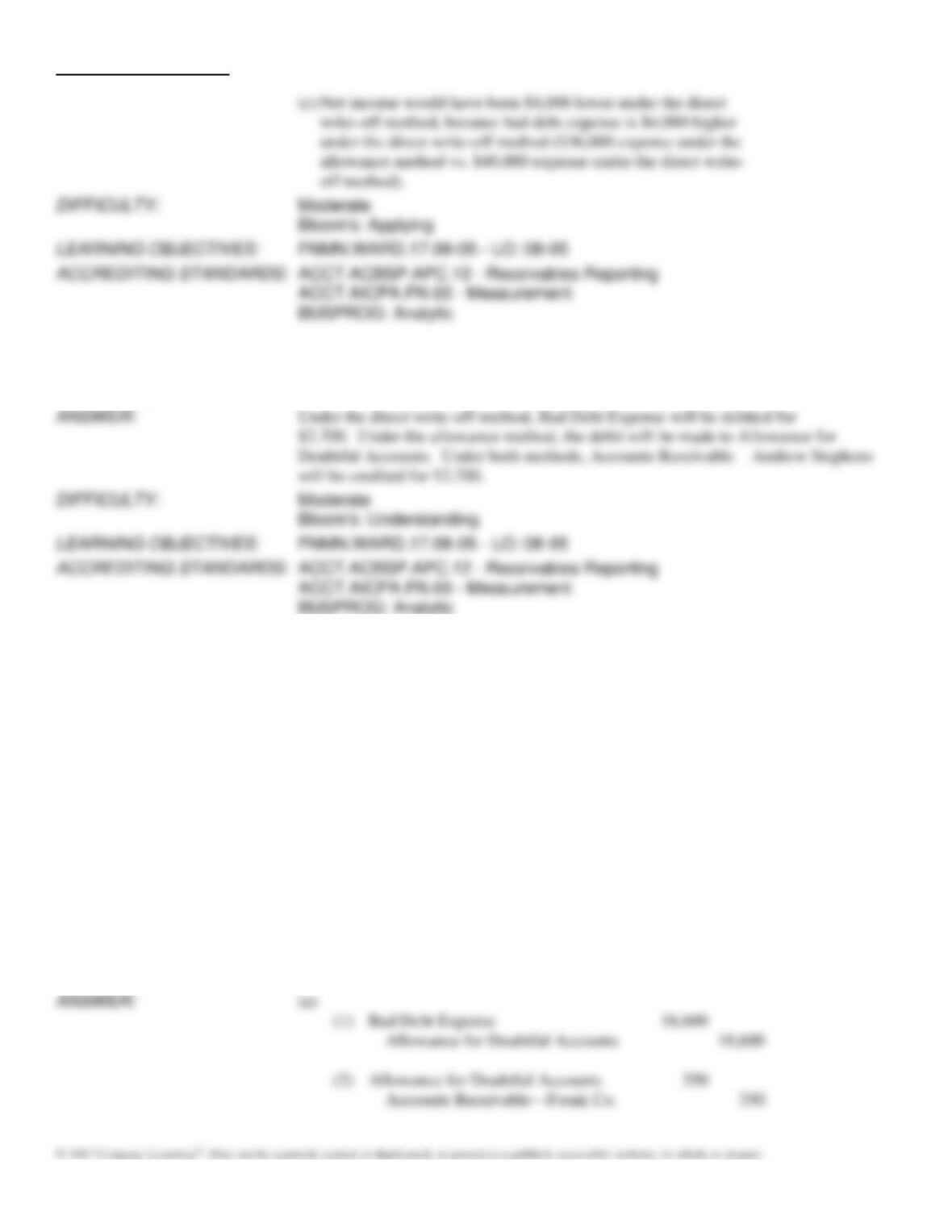
How much higher or lower would Morry Company’s net income have been under the
direct write-off method than under the allowance method?
(a)
Bad Debt Expense
Accounts Receivable—J.
Accounts Receivable—L.
Accounts Receivable—C.
Accounts Receivable—S.
(b)
Allowance for Doubtful Accounts
40,000
Accounts Receivable—J.
Accounts Receivable—L.
Barton
Accounts Receivable—S.
Bad Debt Expense 36,000
Allowance for Doubtful
Uncollectible accounts estimate.
($2,400,000 × 1 1/2% = $36,000)
Chapter 8 – Receivables
149. Fellows Corporation has determined that the $2,700 accounts receivable due from Andrew Stevens is
uncollectible. Compare the journal entry that is required under the direct write-off method to the journal entry that is
required using the allowance method.
will be credited for $2,700.
150. For a business that uses the allowance method of accounting for uncollectible receivables:
(a)
Journalize the entries to record the following:
(1)
Record the adjusting entry at December 31, the end of the first fiscal year, to record
the bad debt expense. The accounts receivable account has a balance of $800,000,
and the contra asset account before adjustment has a debit balance of $600. Analysis
of the receivables indicates uncollectible receivables of $18,000.
(2)
In March of the next year, the $350 owed by Fronk Co. on account is written off as
uncollectible.
(3)
In November of the next year, $200 of the Fronk Co. account is reinstated and
payment of that amount is received.
(4)
In December of the next year, $400 is received on the $600 owed by Dodger Co. and
the remainder is written off as uncollectible.
(b)
Redo the entries in steps (2), (3), and (4) assuming the company uses the direct write-off
method.
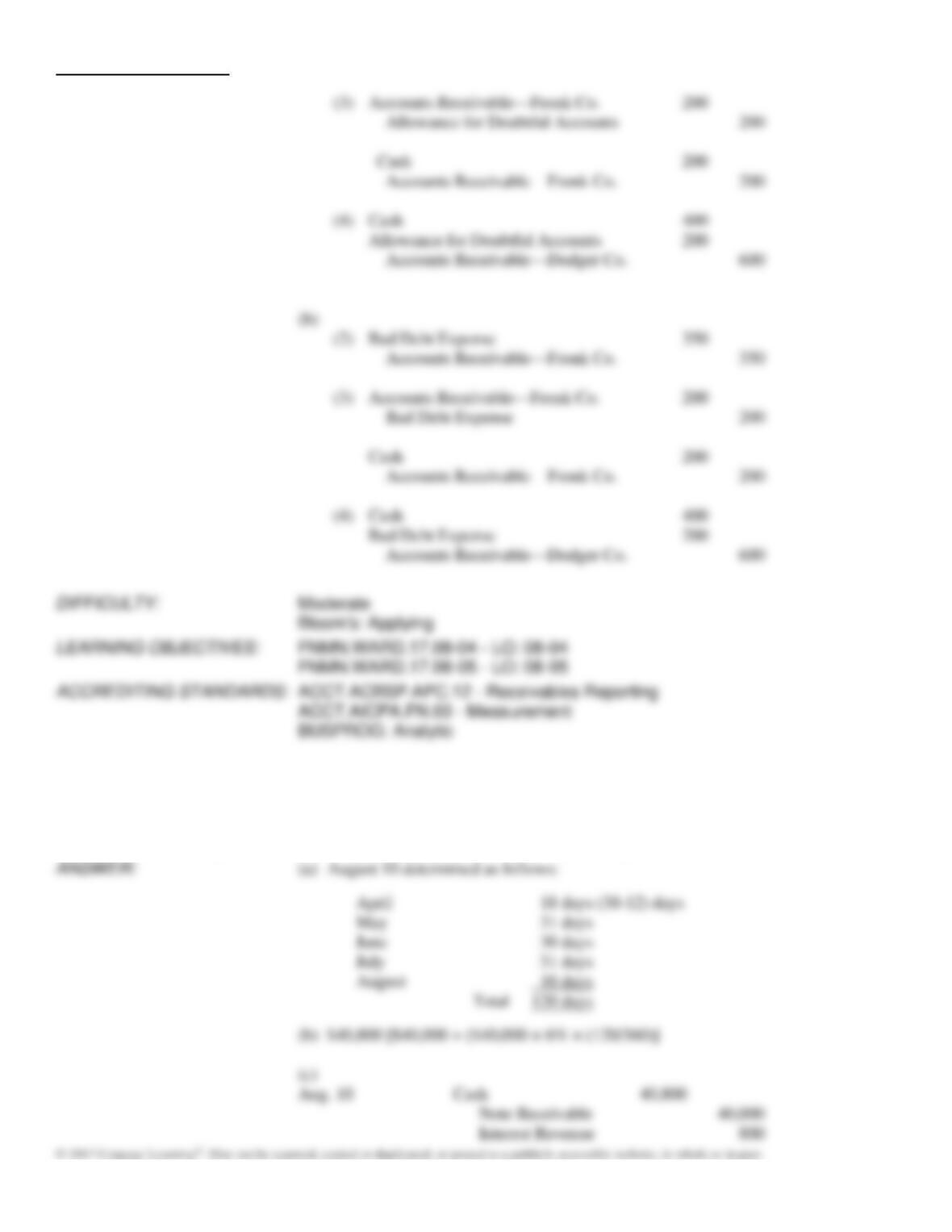
(a)
(1)
Bad Debt Expense
(2)
Allowance for Doubtful Accounts
allowance method vs. $40,000 expense under the direct write-
off method).
Chapter 8 – Receivables
151. Sunshine Service Center received a 120-day, 6% note for $40,000, dated April 12 from a customer on account.
(a)
Determine the due date of the note.
(b)
Determine the maturity value of the note.
(c)
Journalize the entry to record the receipt of the payment of the note at maturity.
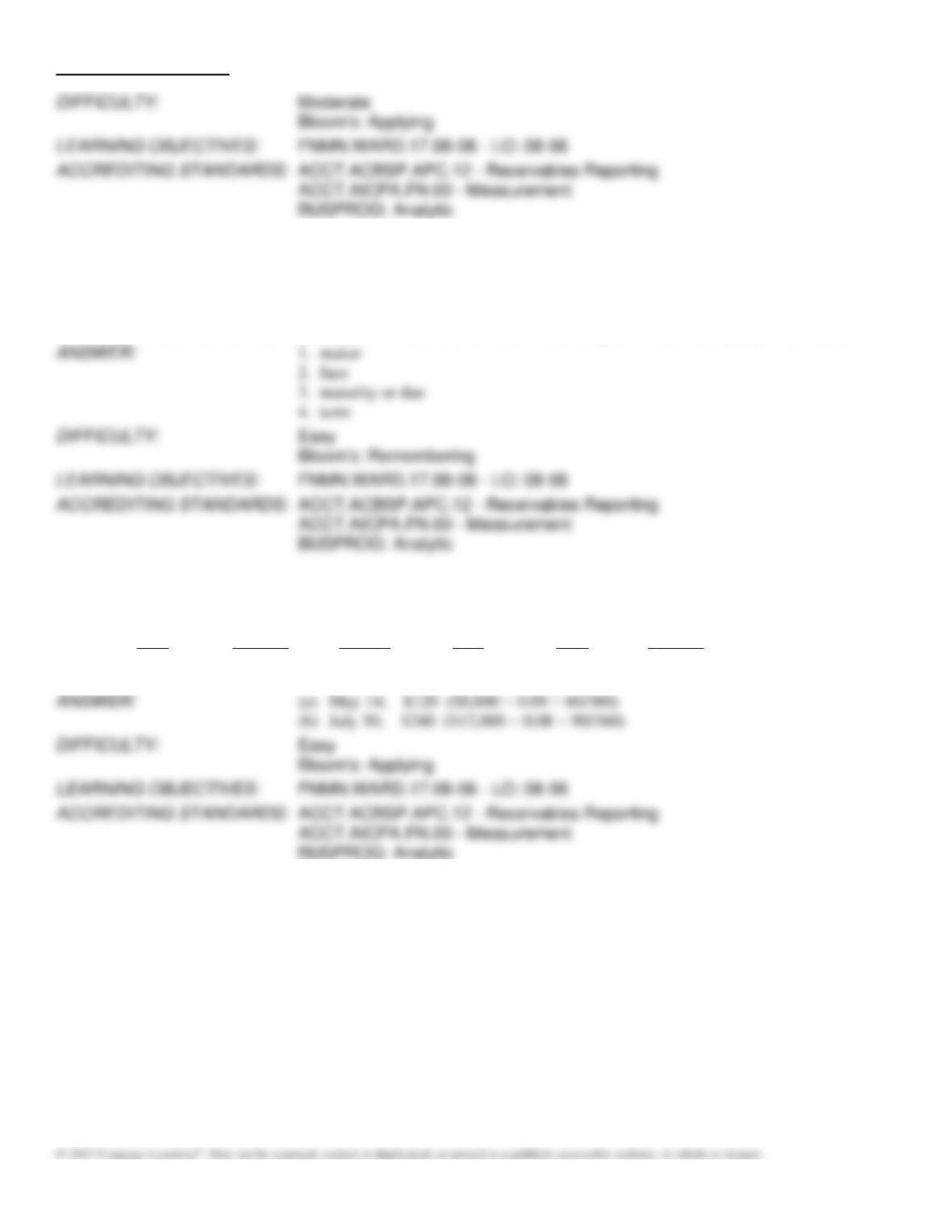
(a)
August 10 determined as follows:
April
May
June
July
August
Total
Aug. 10
Cash
(3)
Accounts Receivable—Fronk Co.
(4)
Cash
Allowance for Doubtful Accounts
(b)
(2)
Bad Debt Expense
(3)
Accounts Receivable—Fronk Co.
Cash
(4)
Cash
Bad Debt Expense
Accounts Receivable—Dodger Co.
Chapter 8 – Receivables
152. Fill in the blanks related to the characteristics of a promissory note.
1.
The party promising to pay the note is called the ________.
2.
The amount for which the note is written is called the _______ amount.
3.
The date the note is to be paid is the _______ date.
4.
The time between the date when a note is written and the time it must be paid is called the _____ of the note.
4. term
153. Determine the due date and amount of interest due at maturity on the following notes:
Origination
Face
Term
Interest
Maturity
Interest
Date
Amount
of Note
Rate
Date
Amount
(a)
Mar. 15
$8,000
60 days
9%
_______
_______
(b)
May 1
$12,000
90 days
8%
_______
_______
(a)
May 14; $120 ($8,000 × 0.09 × 60/360)
(b)
July 30; $240 ($12,000 × 0.08 × 90/360)