
Chapter 8
Alternative Investments
Note: In the sixth edition of Global Investments, the exchange rate quotation symbols differ from previous
editions. We adopted the convention that the first currency is the quoted currency in terms of units
of the second currency.
For example, €:$ = 1.4 indicates that one euro is priced at 1.4 dollars. In previous editions we used
the reversed convention $/€ = 1.4, meaning 1.4 dollars per euro.
All problems in this test bank still use the old convention and have not been adapted to reflect the
new quotation symbols used in the 6th edition.
◼ Questions and Problems
1. An investor is considering the purchase of Tata International Equity Fund (TIEF) for his portfolio.
Like many U.S.-based mutual funds today, TIEF has more than one class of shares. Although all
classes hold the same portfolio of securities, each class has a different expense structure. This
particular mutual fund has three classes of shares: A, B, and C. The expenses of these classes are
summarized in the following table:
Expense Comparison for Three Classes of TIEF
Class A
Class B
Class C
Sales Charge (load) on
Purchases
4%
None
None
Deferred Sales Charge
(load) on Redemptions
None
5% in the first year, declining
by 1 percentage point each
year thereafter
1% for the initial
two years
Annual Expenses:
Distribution Fee
0.10%
0.50%
0.75%
Management Fee
0.75%
0.75%
0.75%
Other Expenses
0.50%
0.50%
0.50%
1.35%
1.75%
2.00%
The time horizon associated with the investor’s objective in purchasing TIEF is three years; he
decides to specify it as just over three years. He expects equity investments with risk characteristics
similar to TIEF to earn 10% per year, and he decides to make his selection of fund share class based
on an assumed 10% return each year, gross of any of the expenses given in the table above.
Based on only the above information, determine the class of shares that is most appropriate for this
investor. Assume that expense percentages given will be constant at the given values. Assume that
the deferred sales charges are computed on the basis of net asset value (NAV).

92 Solnik/McLeavey • Global Investments, Sixth Edition
2. An investor is considering the purchase of CHECK Fund for his portfolio. Like many U.S.-based
mutual funds today, CHECK has more than one class of shares. Although all classes hold the same
portfolio of securities, each class has a different expense structure. This particular mutual fund
has three classes of shares: A, B, and C. The expenses of these classes are summarized in the
following table:
Expense Comparison for Three Classes of CHECK
Class A
Class B
Class C
Sales Charge (load) on
Purchases
3%
None
None
Deferred Sales Charge
(load) on Redemptions
None
5% in the first year, declining by
1 percentage point each year
thereafter
1% for the initial
two years
Annual Expenses:
Distribution Fee
0.25%
0.50%
0.75%
Management Fee
0.75%
0.75%
0.75%
Other Expenses
0.25%
0.25%
0.25%
1.25%
1.50%
1.75%
The time horizon associated with the investor’s objective in purchasing CHECK is five years. He
expects equity investments with risk characteristics similar to CHECK to earn 8% per year, and he
decides to make his selection of fund share class based on an assumed 8% return each year, gross of
any of the expenses given in the table above.
a. Based on only the above information, determine the class of shares that is most appropriate for
this investor. Assume that expense percentages given will be constant at the given values.
Assume that the deferred sales charges are computed on the basis of NAV.

Chapter 8 Alternative Investments 93
b. Suppose that, as a result of an unforeseen liquidity need, the investor needs to liquidate his
investment at the end of the first year. Assume an 8% rate of return has been earned. Determine
the relative performance of the three fund classes, and interpret the results.
Solution
3. Exchange traded funds (ETFs) are usually considered to have many interesting properties. In the list
below, indicate which statements DO NOT apply to ETFs:
a. ETFs allow to invest in a diversified portfolio.
b. ETFs are cost effective.
c. ETFs will never drop in value.
d. ETFs benefit from some attractive tax characteristics.
e. ETFs can be traded at any time during market opening.
f. ETFs are designed to take advantage of the manager’s stock picking ability.

94 Solnik/McLeavey • Global Investments, Sixth Edition
4. There are several ETFs listed on the American Stock Exchange (AMEX). One of them is iShares—
Switzerland. This ETF tracks the Morgan Stanley Capital International (MSCI)—Switzerland index,
which is based on several stocks that trade on the Swiss Exchange. The Swiss Exchange is open from
9 A.M.to 5:30 P.M. Swiss time and the AMEX is open from 9:30 A.M. to 4 P.M. U.S. Eastern Standard
Time (EST). The U.S. EST lags the Swiss time by six hours. Discuss whether the ETF price and its
NAV would fluctuate or stay the same during the time period when the AMEX is open.
5. A real estate company has prepared a simple hedonic model to value houses in a specific downtown
area. A summary list of the houses’ characteristics that can affect pricing are:
• The number of main rooms.
• The surface of the garden (if any).
• The construction material (wood or brick).
• The distance to a subway station.
A detailed statistical analysis of a large number of recent transactions in the area allowed to derive the
following slope coefficients:
Characteristics
Units
Slope Coefficient in
Euros per Unit
Number of Rooms
Number
30,000
Surface of the Garden
Square meters
200
Construction Material (bricks)
0 or 1
30,000
Distance to Subway Station
In meters
−100
A typical house in the area has 5 main rooms, a garden of 500 square meters, constructed with bricks,
and a distance of 300 meters to the nearest subway station. The transaction price for a typical house
was €250,000.
a. You wish to value a house that has 7 rooms, a small garden of 100 square meters, constructed in
wood, and a distance of 100 meters to the nearest subway station. What is the appraisal value
based on this sales comparison approach of hedonistic price estimation?
b. You wish to value a house that has 7 rooms, a garden of 1,000 square meters, constructed in
brick, and a distance of 1 kilometer to the nearest subway station. What is the appraisal value
based on this sales comparison approach of hedonistic price estimation?

Chapter 8 Alternative Investments 95
6. An investor wants to evaluate an apartment building using the income approach. She gathers the
following data on the apartment complex; all income items are on an annual basis.
Investment under Consideration
Gross Potential Rental Income
$100,000
Estimated Vacancy and Collection Losses
5%
Insurance and Taxes
$ 8,000
Utilities
$ 5,000
Repairs and Maintenance
$ 12,000
Depreciation
$ 15,000
Interest on Proposed Financing
$ 6,000
Two apartment buildings have recently been sold in the area. Building A had a sales price of $5 million
with an annual net operating income of $500,000. Building B had a sales price of $1 million with an
operating income of $95,000. Except for size, both buildings have characteristics (location, age,
quality, . . .) similar to that of the apartment building under consideration.
According to the income approach, what is the value of the apartment complex?

96 Solnik/McLeavey • Global Investments, Sixth Edition
7. An analyst is evaluating a real estate investment project using the discounted cash flow approach.
The net purchase price is $10 million, which is financed 20% by equity and 80% by a five-year
mortgage loan. The loan carries an interest rate of 7%. Annual interest expenses on the $8 million
loan are $560,000 and the loan is repaid in full after the fifth year.
The net operating income for the first year is estimated at $800,000 and is expected to grow annually
at a 3% growth rate. Using straight-line depreciation over 50 years, the annual tax depreciation of the
real estate project is equal to $200,000. It is expected that the property will be sold in five years
(just after the end of the fifth year) at a net price of $11 million.
The marginal income tax rate for this project is 30%. The capital gains tax rate is 20%.
The investor’s cost of equity for projects with level of risk comparable to this real estate investment
project is 15%.
a. Compute the after-tax cash flows resulting from the operating income for each of the first
five years.
b. Compute the after-tax cash flow for the fifth year, taking into account the resale value.
c. Compute the expected net present value (NPV) of the project and its internal rate of return (IRR).
d. State whether the investor should decide to invest in the project.
e. Compute the expected NPV and IRR of the project if the resale price is expected to be only
$10 million.
f. State whether the investor should decide to invest in this project under this new scenario.

Chapter 8 Alternative Investments 97
8. An investor estimates that investing €5 million in a particular venture capital project can return
$40 million at the end of five years if it succeeds; however, she realizes that the project may fail at
any time between now and the end of the fifth year. The investor is considering an equity investment
in the project and her cost of equity for a project with this level of risk is 15%. In the table below are
the investor’s estimates of certain probabilities of failure for the project. First, 0.30 is the probability
of failure in year one. The probability that project fails in the second year, given that it has survived
through year one, is 0.25; and so forth:
Year
1
2
3
4
5
Failure Probability
0.30
0.25
0.20
0.20
0.20
a. Determine the expected net present value of the project.
98 Solnik/McLeavey • Global Investments, Sixth Edition
b. Recommend whether the project should be undertaken.
Solution
9. A hedge fund currently has assets of $500 million. The annual fee structure of this fund consists of a
fixed fee of 1% of portfolio assets plus a 20% incentive fee. The fund applies the incentive fee to the
gross return each year in excess of the portfolio’s previous high watermark, which is the maximum
fund value in the past two years. The fund is closed to new investors and the maximum value that the
fund has achieved in the past two years was $520 million. Compute the fee that the manager will
earn, in dollars, if the return on the fund in the coming year turns out to be:
a. 30%
b. 2%
c. −2%

Chapter 8 Alternative Investments 99
10. A hedge fund has a capital of €100 million and invests in a market neutral long/short strategy on the
European equity market. Shares can be borrowed from a primary broker. The arrangement with the
primary broker is that the hedge fund deposits as guarantee securities with an equivalent market value
at time of lending, plus an additional cash margin deposit equal to 10% of the value of the shares. The
primary broker keeps any interest earned on the margin and charges a fee equal to an annual rate of
0.5% of the value of the shares borrowed. The hedge fund believes that European value stocks will
outperform European growth stocks. The hedge fund expects that value stocks will outperform
growth stocks by 5% over the year. The hedge fund wishes to retain a cash cushion of €10 million
for unforeseen events. The short-term euro interest rate is 3%.
a. What market-neutral strategy would you suggest that would take full advantage of this scenario?
b. What is the expected return according to the funds’ expectations?
c. Assume now that the European stock index appreciates by 20% over the year, but that value stocks
underperform growth stocks by 10%. Compute a likely market value of the fund at year’s end.

100 Solnik/McLeavey • Global Investments, Sixth Edition
11. Survivorship bias is a serious potential problem in drawing conclusions from historical track records.
Show why the following statements can be misleading:
a. “There are today 100 Type-A hedge funds in operation. Their average return over the past two
years is 20%. Hence, they have outperformed the stock market (return of 15%)” [actually, some
50 funds disappeared during these two years].
b. “The Poupou commodity index has been back-calculated from 1970 to 1990 using the leading
commodity futures contracts; by leading we mean those that have been most active. The Poupou
commodity index had a remarkable performance from 1970 to 1995” [actually, several commodity
futures contracts have been removed from the commodity exchange or have experienced a drop
in trading activity].
12. The SOL Group specializes in hedge funds invested on the Paf stock market. Over the year 1999, the
Paf stock market index went up by 20%. The SOL Group had three hedge funds with very different
investment strategies. As expected, the 1999 returns on the three funds were quite different. Here are
the performances of the three funds before and after management fees set at 20% of gross profits:
Fund
Gross Return
Net Return
SOL A
50%
40%
SOL B
20%
16%
SOL C
−10%
−12%
The average gross performance of the three funds is exactly equal to the performance on the Paf stock
index. At year-end, most clients had left the third fund, and SOL C was closed. At the start of 2000,
the SOL group launched an aggressive publicity campaign among portfolio managers, stressing the
remarkable return on SOL A. If potential clients asked whether the SOL Group had other hedge funds
invested in Paf, the SOL Group mentioned the only other fund, SOL B, and claimed that their average
gross performance during 1999 was 35%.
What do you think of this publicity campaign?
13. Let’s assume that you are a U.S. investor who wants to invest $10,000 in gold. The current price of
gold is $400, and you expect it to go up by 10% in the very short-term. You consider buying shares of
gold mines; you are debating whether to invest in Bel Or or Schoen Gold. Your broker gives you the
following information:
Bel Or
Schoen Gold
Production Cost per Ounce
$147
$340
Gold beta (
)
1.6
6
Chapter 8 Alternative Investments 101
The gold
is obtained by running a regression of the percentage price movements in the gold mine
stock on the percentage price movements in gold bullion. It indicates the stock market price sensitivity
to gold.
a. Explain why a gold mine with a high production cost should have a value that is more sensitive
to gold price movements than a gold mine with low production costs.
b. Which mine would you buy and why?
c. What is your expected return, given this scenario?
14. G.O. Bug wants to invest $12,000 in gold. In December, the spot price of gold is $400 per ounce.
Bug is very confident that gold will appreciate by at least 10% before the end of January and is
willing to assume fairly risky positions to maximize the return on this forecast. Bug is considering
several alternatives:
• Gold bullion. Bug could buy 30 ounces, or roughly 1 kilogram.
• Gold futures. Bug could buy February futures. These contracts trade at $413 per ounce, with an
initial margin of $1,500 per contract of 100 ounces. Therefore, Bug could buy eight contracts
(12,000/1,500).
• Gold options. Bug considers two February call options with different strike prices. Each option
contract covers 100 ounces. The February 410 call quotes at $8 per ounce; the February 430 call
quotes at $4 per ounce. Therefore, Bug could buy fifteen contracts of the first option or thirty
contracts of the second option.
• Two gold mines. Mines A and B have the same stock price: $10 per share. A British broker has
estimated the gold
of both mines using a discounted cash flow model as well as historical
regression analysis. Mine A is a rich mine with a gold
equal to 2; mine B has much higher
production costs with a gold
equal to 5. Bug could buy 1,200 shares of one of the gold mines.
Bug quickly rules out investing directly in bullion, which does not offer enough leverage.
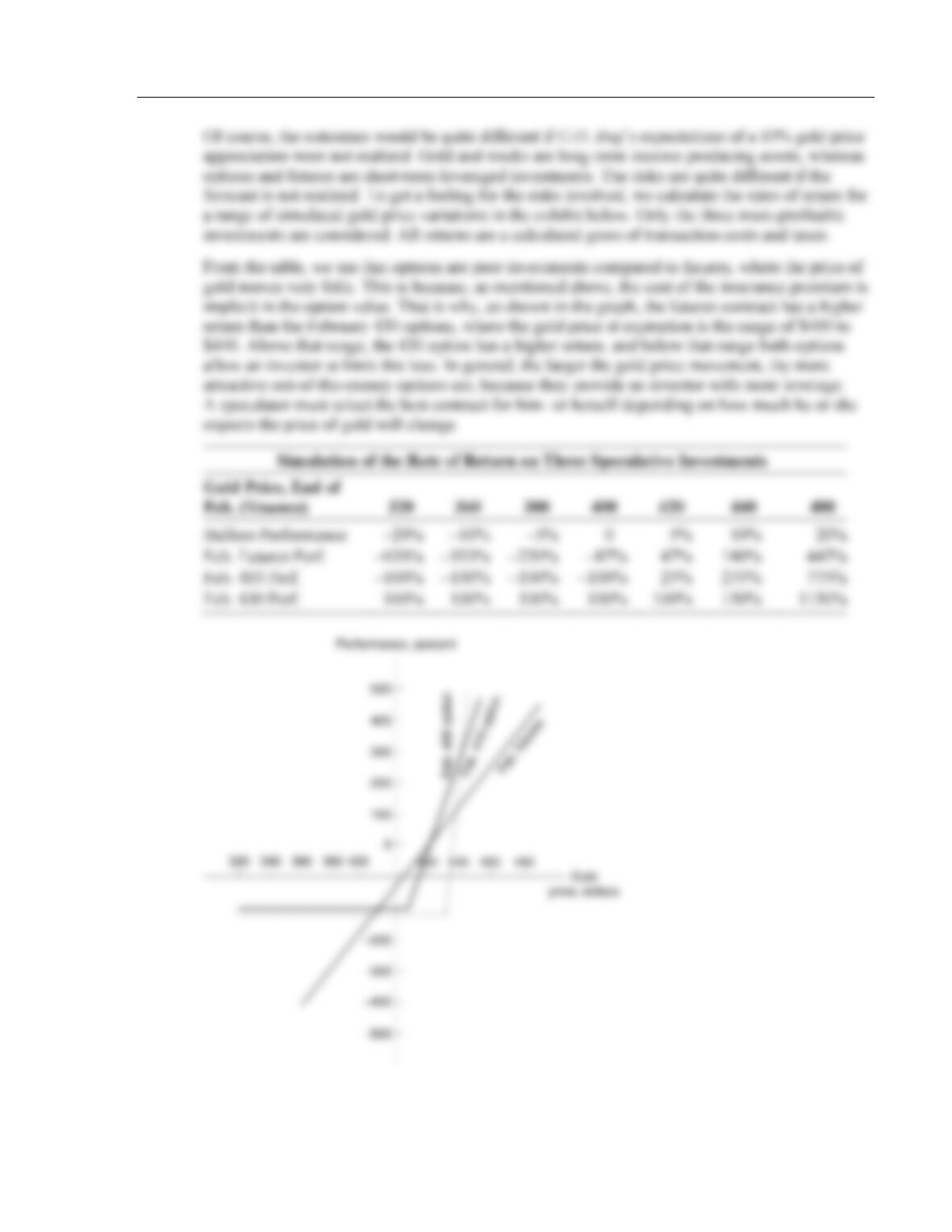
a. Assuming that Bug’s expectations are realized by the end of February, compute the realized
returns on the various alternative strategies considered. Simulate various values of the spot price
of gold in February (320, 360, 380, 400, 420, and 480).
b. Which investment strategy would you suggest to Bug?
102 Solnik/McLeavey • Global Investments, Sixth Edition
Chapter 8 Alternative Investments 103

104 Solnik/McLeavey • Global Investments, Sixth Edition
15. Bel Or Mine issues a five-year Eurobond with the following characteristics:
• Par value 100 gold ounces. Each bond is issued and repaid in dollars at the market value of
100 ounces of gold.
• Annual coupon payment of the dollar market value of 3 ounces of gold.
• Maturity of five years with no early redemption.
A few days after issue, the yield on straight dollar Eurobonds, for issuers of the quality of Bel Or
Mine, is 10%. The price of gold is $400 per ounce. The gold-linked bond sells for $35,000. What
can you say about the market expectations of gold prices?
Solution