CHAPTER 8—SUSTAINING BIODIVERSITY: THE SPECIES APPROACH
MULTIPLE CHOICE
1. The most important threat to survival of polar bears at this time is
a.
ocean currents delivering pollutants to the Arctic Ocean from oceans in more temperate
climate zones
b.
hunting by native populations
c.
tourism disruptions
d.
warming of the frozen Arctic, which has has caused the winter ice pack to shrink and
break up earlier, thus limiting hunting opportunities for the bears
e.
a normal population cycle that will result in their slow extinction
2. An increase in the number of polar bears seen visiting human settlements indicates that
a.
Polar bear populations are not actually declining.
b.
More limited hunting is driving the bears to seek food in human settlements more
frequently.
c.
Polar bear populations are on the increase.
d.
Human food is more appealing to polar bears than wild seals.
e.
Polar bear populations are on the increase and human food is more appealing to polar
bears than wild seals.
3. Which one of the following statements about polar bears is not true?
a.
In 2008, the U.S. Fish and Wildlife Service placed the Alaskan polar bear on its list of
threatened species.
b.
Alaskan state government officials are trying to have the polar bear delisted.
c.
Polar bear populations are a significant threat to wolf populations in Alaska
d.
Oil and coal industry leaders want the polar bear delisted in Alaska
e.
Less than 60% of the world population of polar bears lives in Alaska
4. The current rate of extinction is between _____ and _____ times the rate that existed before humans
arrived on Earth.
a.
5 and 10
b.
10 and 100
c.
100 and 1,000
d.
The rate is the same as it was before humans arrived on earth.
e.
There is no way to determine the extinction rate before humans arrived on earth, so these
numbers cannot be estimated or compared.
5. A biologist is most likely to say that the passenger pigeon is
a.
Endangered
b.
locally extinct
c.
ecologically extinct
d.
biologically extinct
e.
Threatened
6. An endangered species is any species that can
a.
undergo alteration of its genetic traits
b.
become rare within the next century
c.
soon become extinct in all or part of its range
d.
eventually become threatened or rare
e.
be considered economically important, but is rare
7. Geologic records indicate that the earth has experienced perhaps ________mass extinction(s) where up
to ______________percent of the species disappeared.
a.
1, 50
b.
5, 95
c.
1, 95
d.
3, 75
e.
3, 50
8. Philip Levin, Donald Levin and other biologist have cautioned us that speciation rates can increase for
opportunistic species such as
a.
Fish
b.
Birds
c.
reptiles and birds
d.
birds and weeds
e.
weeds, rodents and cockroaches
9. The species area relationship concept suggests that if 90% of a coral reef is lost
a.
90% of the species utilizing the reef will go extinct.
b.
100% of the species will go extinct.
c.
50% of the species will go extinct.
d.
35% will go extinct.
e.
There will be no loss of species.
10. _____ have estimated that up to 25% of the world’s current animal and plant species could be gone by
2050, and 50% could be gone by the end of the century.
a.
Edward O. Wilson and Stuart Pimm
b.
Philip Levin and Donald Levin
c.
Norman Myers and Aldo Leopold
d.
Donald Levin and Stuart Pimm
e.
Gas and oil company executives
11. Some biodiversity experts advise us to focus our efforts on
a.
slowing high rates of extinction in biodiversity hotspots
b.
slowing extinction in temperature deciduous forests
c.
saving single important species
d.
saving the polar bear which is the most endangered of all creatures
e.
saving fish populations because of their importance as a food source for humans
12. While the hide of a male lion in Kenya will bring in $1,000, if the same male lion lives to age seven,
he would bring in approximately ____ ecotourist dollars.
a.
$5,000
b.
$10,000
c.
$50,000
d.
$515,000
e.
The value of a male lion in ecotourist dollars cannot be estimated.
13. Wild species’ instrumental value includes their use as
a.
food crops
b.
fuelwood
c.
sources of medicine
d.
lumber
e.
food crops, lumber, fuelwood and sources of medicine
14. People who believe that wild species have an inherent right to exist generally believe in
a.
species’ economic value
b.
species’ extrinsic value
c.
a stewardship view
d.
a utilitarian view
e.
recreational value of species to humans
15. A bioprospector is most likely someone who
a.
searches for fuel produced by plants
b.
tests plants and animals in tropical forests, and other ecosystems, to find chemicals that are
potentially useful as medicinal drugs
c.
searches for truffles with the use of pigs to sniff out their partially hidden locations
d.
searches for oil and natural gas in areas below biologically rich ecosystems
e.
has a degree in biology but prospects for gold or other metals
16. In the year 1900, there were over 315,000 wild orangutans. What percentage of this number remains
in the wild, and where are the majority of them located?
a.
90%, Indonesia and Malaysia
b.
10%, Indonesia and Malaysia
c.
50%, Malaysia
d.
90%, Indonesia
e.
10%, Indonesia
17. Causes of extinction and reduction in wild species’ populations include all of the following except
a.
habitat loss
b.
human population growth
c.
sustainable development
d.
pollution
e.
invasive species
18. The greatest threat to most species is
a.
loss of habitat
b.
water pollution
c.
parasites
d.
sport hunting
e.
climate change
19. The greatest eliminator of species is habitat destruction of
a.
coral reefs
b.
Grasslands
c.
tropical forests
d.
Deserts
e.
temperate forests
20. National parks can be viewed as habitat islands surrounded by
a.
Logging
b.
industrial activity and mining
c.
mining and logging
d.
mining, logging and agriculture
e.
mining, logging, agriculture and industrial activity
21. Which of the following is not a factor in habitat fragmentation
a.
barriers that limit the ability of species to find food and mates
b.
blockage of migration routes
c.
the vulnerability of small populations
d.
barriers such as roads that limit the ability of some species to disperse and colonize new
areas
e.
conservation efforts by Pilai Poonswad
22. Japanese kudzu vine offers all of the following except
a.
starch used in Asian beverages and herbal remedies
b.
control of soil erosion
c.
toxic berries that deplete bird populations
d.
a source of tree-free paper
e.
herbal remedies for diseases
23. Argentina fire ants can be described by all of the following except:
a.
They attack with painful and burning stings.
b.
They have killed humans, pets, and livestock.
c.
Some success in controlling the ants has been achieved with predatory flies.
d.
Native ant species help to keep them in check.
e.
They have spread throughout much of the southern United States.
24. HIPPCO is
a.
an acronym that summarizes the Endangered Species Act goals
b.
an acronym to summarize the direct causes of extinction resulting from human activities
c.
the name of an ecotourism company in Africa that specializes in hippopotamus sightings
d.
an acronym to summarize the health care right to privacy act
e.
an trading company in Africa that sells hippopotamus hides
25. Poaching of exotic species for profit has depleted populations of
a.
Birds
b.
birds and mammals
c.
tropical fish and mammals
d.
orchids and redwood trees
e.
birds, mammals, tropical fish and orchids
26. All of the following statements about invasive species is true except
a.
Approximately 40% of species listed as endangered in the United States are on the list
because of threats from invasive species.
b.
Most successful invader species are specialists.
c.
Both the European wild boar and the Burmese python are problematic invasive species in
the state of Florida.
d.
Some invasive species have arrived in the ballast water in ships from distant ports.
e.
The African honeybee (killer bee) was deliberately introduced.
27. The ‘extinction capital’ of the United States is
a.
Florida with 63% of its species at risk
b.
Hawaii with 72% of its species at risk
c.
California with 63% of its species at risk
d.
Hawaii with 63% of its species at risk
e.
There is no ‘extinction capital’ in the U.S. at all, since the number of species at risk is
uniform across the 50 states.
28. A major factor in the population explosion of the zebra mussel in the Great Lakes region is
a.
the zebra mussel’s specialist ecological niche
b.
its rapid reproductive rate
c.
its lack of natural enemies that might control its population
d.
that it is a prey species of the sea lamprey
e.
its rapid reproductive rate and its lack of natural enemies that might control its population
29. The decline in approximately 70% of the world’s bird species is particularly alarming to scientists
because
a.
This is the first time any bird species have been threatened with declining numbers.
b.
It is not caused by any human activities that scientists can determine.
c.
Only land birds are affected, while water birds seem to be maintaining normal population
numbers.
d.
Birds are excellent environmental indicators.
e.
Birdwatching now generates a significant portion of tourist dollars in some countries.
30. All of the following actions will help to control invasive species except
a.
Do not remove wild plants from their natural areas.
b.
After each use, clean your mountain bike before heading for home.
c.
Do not dump the contents of an aquarium into a storm drain.
d.
Brush your dog after a hike before you bring the dog home.
e.
Collect only endemic plants if you tend to bring wild plants home.
31. The international illegal trade in wildlife brings in an average of
a.
$600,000 per year
b.
$600,000 per hour
c.
$1.1 million per year
d.
$500,000 per hour
e.
$100 million per year
32. In a biomagnification situation, assume that a dangerous chemical, called “X”is present in the water of
a small bay at a concentration of .00005 parts per million (ppm). Also assume there are three layers of
consumption between the water and a certain predatory bird that lives around the lake, and at each step
of consumption, chemical X gets magnified 1000 times. What is the final concentration of chemical X
in the predatory bird after eating 100 fish in a week?
a.
At the end of one week, the bird will have 50 ppm of chemical X
b.
At the end of one week, the bird will have 5 ppm of chemical X
c.
At the end of one week, the bird will have 100 ppm of chemical X
d.
At the end of one week, the bird will have 1,000 atoms of chemical X
e.
At the end of one week, the bird will have 10 ppm of chemical X
33. Which of the following is not true of the Endangered Species Act of 1973?
a.
it is one of the world’s most far-reaching environmental laws
b.
it is based on the Convention on International Trade in Endangered Species
c.
it authorizes identification of endangered species solely on a biological basis
d.
it makes it illegal to buy products made from threatened or endangered species
e.
it is very controversial
34. Which of the following statements is not true about the Convention on Biological Diversity?
a.
It has been ratified by 191 countries.
b.
It legally commits participating governments to reducing the rate of biodiversity loss.
c.
It focuses on ecosystems rather than individual species.
d.
It has been ratified by the United States.
e.
Implementation has been slow.
35. All of the following would strengthen the Endangered Species Act except
a.
establishing a core of survival habitats for listed species
b.
greatly increasing the funding for carrying out the ESA
c.
making the protection of endangered species on private land voluntary
d.
developing recovery plans for listed species more quickly
e.
emphasizing the protection of biological diversity and ecosystem functioning
36. Egg pulling refers to
a.
techniques used to extend the breeding span of captured birds
b.
collecting eggs from the wild and hatching them in zoos or research centers
c.
using fertility drugs to increase productivity
d.
production of hybrids in captive breeding programs
e.
collecting unfertilized eggs from ovaries of wild animals
37. Captive breeding programs in zoos
a.
eliminate the need to preserve critical habitats
b.
can be used for most species except mammals
c.
increase the genetic variability of species
d.
require the captive population to number between 100 and 500
e.
are very unsuccessful
38. Recent genetic research indicates that ____ or more individuals are needed for an endangered species
to maintain its capacity for biological evolution.
a.
10
b.
100
c.
1,000
d.
10,000
e.
100,000
39. A small orchid plant that is found only on a tiny island in the Atlantic Ocean, just off the coast of
Florida, has been listed as an endangered species. Which agency was responsible for listing this plant
as endangered?
a.
National Marine Fisheries Service
b.
U.S. Fish and Wildlife Service
c.
U.S. Botanical Survey
d.
International Commission on Rare Plants
e.
Convention on International Trade in Endangered Species
40. The Convention on International Trade in Endangered Species (CITES) addresses all of the following
except
a.
It restricts international trade of roughly 5,000 species of animals.
b.
It restricts international trade of roughly 28,000 species of plants.
c.
It focuses on ecosystems rather than individual species.
d.
It has helped to reduce international trade on elephant ivory.
e.
It has been signed by 174 member countries, including the United States.
41. Living just off the coast of California, a rare dolphin is listed as an endangered species. What agency
or group was responsible for studying the status of this animal, and subsequently listing it as
endangered?
a.
The animal would have been studied by the National Marine Fisheries Service, but would
have to be listed as endangered by the U.S. Fish and Wildlife Service.
b.
Because of its location in ocean waters, it would have been listed by CITES.
c.
The National Marine Fisheries Service would list it.
d.
The Convention on Biological Diversity would list it.
e.
The U.S. Fish and Wildlife Service would study and list it.
42. The International Whaling Commission moratorium on commercial whaling was imposed in 1986.
Following this:
a.
Worldwide commercial whaling was completely eliminated.
b.
There was no change in the number of whales killed outside U.S. waters.
c.
Whale killing declined, and only 1,400 whales were killed in 2008, compared to over
42,000 in 1970.
d.
Even Japan stopped commercial whaling.
e.
Commercial whaling actually increased in some areas outside the U.S.
43. Japan contends that current scientific estimates of _________________whales does not support a ban
on commercial whaling.
a.
sperm, pilot and minke
b.
blue
c.
sperm and minke
d.
pilot and minke
e.
grey and sperm
44. Which of the following is NOT a threat to endangered sea turtles?
a.
Use of their shells for tortoiseshell jewelry.
b.
Use of the turtles for food and medicinal ingredients.
c.
Use of their fins for fin soup that is considered an aphrodesiac.
d.
Discarded fishing lines and nets.
e.
Degradation or loss of beach habitat.
TRUE/FALSE
1. Gene banks, zoos, and aquariums are sanctuaries being used to protect wild species.
2. When a species has disappeared from the Earth, it is biologically extinct.
3. One of the causes of depletion of the environment is human population growth.
4. Pollution from human activities primarily affects human health; its effect on the environment is small.
5. Extinction can be the result of habitat fragmentation.
6. Alien species thrive in new ecosystems because they have long generation times.
7. The primary reason polar bear population are declining is the lack of food, since their prey species
(seals) habitat is declining.
8. A slow reproduction rate makes a species especially vulnerable to biological extinction.
9. The world’s wild species provide natural resources and natural services that keep us alive and support
human economies.
10. It is estimated that from one-fourth to one-half of the world’s plant and animal species will suffer
premature extinction during this century.
11. The primary threat to polar bears is pollution from oil spills in Arctic waters.
12. The African honeybee, or killer bee, is a deliberately introduced invasive species
13. Because of the lucrative ecotourism trade, both mature male lions and elephants bring in more money
as tourist attractions than if they are poached for their hide or ivory.
14. Ecosystems that do not undergo periodic fires are much more vulnerable to invader species.

15. The invasive kudzu vine has no useful properties.
16. There has been some success in the war against Argentine fire ants by using parasitic flies that make
the heads of the ants fall off.
17. The United States Endangered Species Act offers protection only for species located within United
States boundaries.
COMPLETION
1. ____________________ are environmental indicators because they live in every climate and biome,
respond quickly to environmental changes in their habitats, and are fairly easy to track and count.
2. By the end of this century, polar bears might be found only in ___________.
3. Any habitat surrounded by a different one can be viewed as a(n) ____________________.
4. Birds contaminated with ____________________ were unable to successfully reproduce because of
excessively fragile egg shells.

5. The United States has signed the international treaty called CITES but has not signed/ratified the treaty
called ____________________.
6. Biologists conservatively estimate that the current extinction rate is ____________________ times the
normal background extinction rate.
7. Scientists believe that human activities that cause ____________________ and climate change will
have a serious impact on premature extinctions.
8. ____________________ is a process by which chemicals entering the food chain in lower organisms
become concentrated as they move to animals at higher trophic levels.
9. ____________________ is a mysterious disease that causes adult bees to disappear from their hives
without a trace.
10. Most failed species reintroduction occurs because of lack of ____________________.

11. The two groups with the largest percentage of endangered species are the ____________ and the
_____________.
12. The United States currently has about ____________________ invasive species that were accidentally
or deliberately introduced.
13. It can be said that, of the species now listed under the Endangered Species Act, more than half have
populations that are either ____________________ or ____________________.
14. An introduced species of ____________that carries rat lungworm causes meninigitis.
15. The common sense thought of “better safe than sorry” when applied to preventing species extinction is
called the____________________.
16. Chemical warfare against the invasive fire ant, during the 1950s and 1960s, actually hastened the
advance of this ant by __________________native ant populations.
178
17. ____________________ is the best way to reduce threats from invasive species.
MATCHING
For the list of animals, select the characteristic that would most likely contribute to its possible
premature extinction.
a.
low reproductive rate
e.
rare
b.
specialized niche
f.
fixed migratory pattern
c.
narrow distribution
g.
commercially valuable
d.
feeds at a high trophic level
h.
large territory
1. African violet
2. snow leopard
3. giant panda
4. Florida panther
5. elephant seal
6. Everglades kite
7. bald eagle
8. whooping crane
9. sea turtle
Select the human activity or program that has proven to be the most effective for protecting each of the
listed species:
a.
international regulatory laws
b.
U.S. regulatory laws
c.
wildlife refuges
d.
botanical gardens
e.
captive breeding programs
10. gray wolf
11. peregrine falcon
12. butterflies
13. California condor
14. Florida’s key deer
179
15. whales
16. American bison
SHORT ANSWER
1. Would you support legislation that would allocate monetary compensation to land owners to help
protect endangered species that occur on their property? Why or why not?
2. List five things that you do that can contribute to the loss of the world’s wild species?
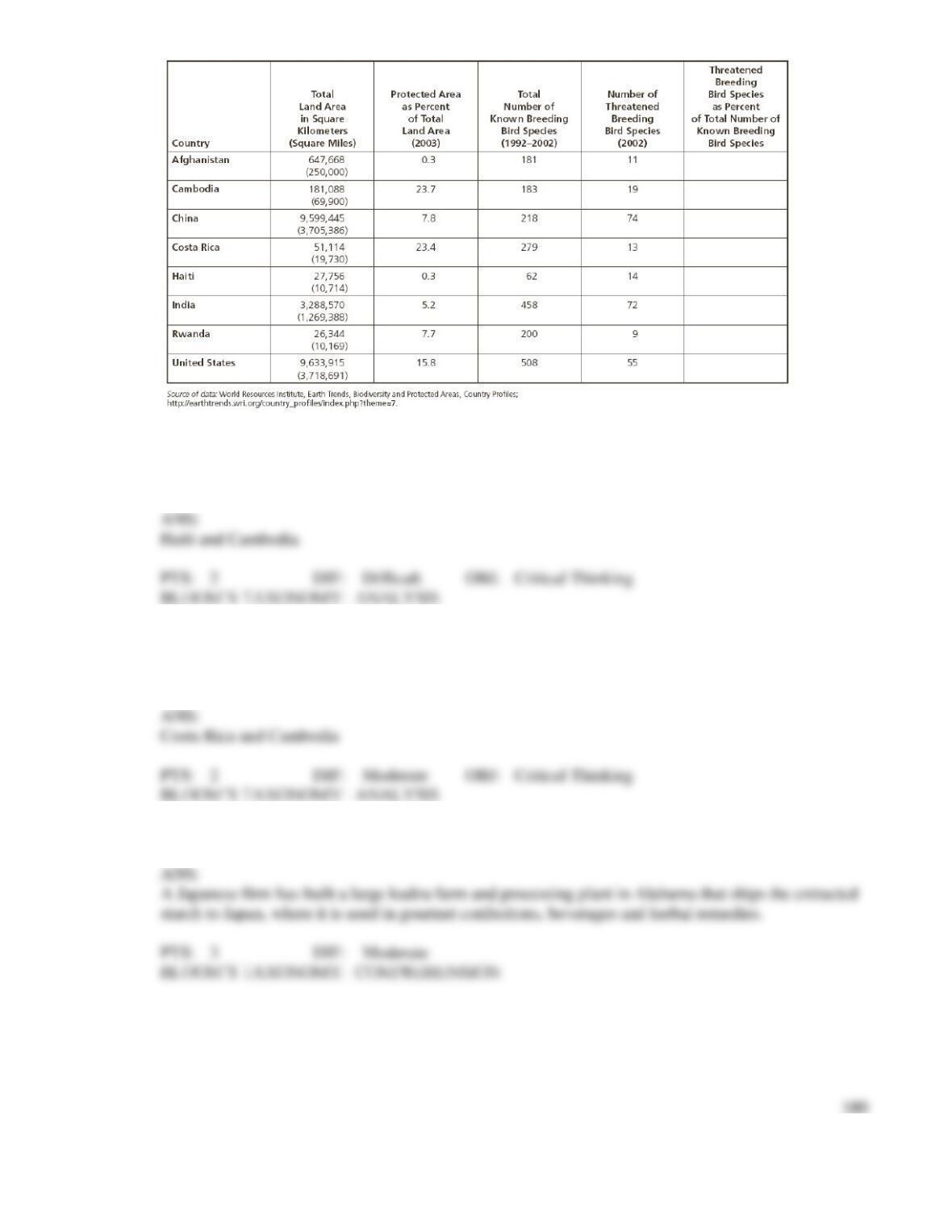
3. A biologist wishes to see threatened bird species on her vacation, assuming that these species may not
be around much longer. She decides to travel to the two countries with the highest density of
threatened species per square kilometer. Which countries will she be visiting?
4. The traveling biologist decides to contribute money to the two developing countries that seems to be
doing the most for its threatened bird species, based on the percentage of land area that is set aside for
conservation. What two countries will be recipients of her donations?
5. Briefly describe what a Japanese company has done in the U.S. state of Alabama with kudzu.
ESSAY
1. As an example of how individuals matter in the efforts to save wild species, describe how poachers in
Thailand became part of the ecotourism industry.
2. Explain the concept of a habitat island. In particular, discuss how a national park can be a habitat
island.
3. Protecting biodiversity is no longer simply a matter of passing and enforcing endangered species laws
and setting aside parks and preserves. It will also require slowing climate change, which will affect the
polar bear and many other species.
Consider the above quote from the chapter, and comment on the implications of this statement as it
applies to separate countries, and the world as a whole.
4. Briefly discuss the giant African snail scenario in Brazil.
5. If you take a driving vacation to an area in Mexico and then return to the United States in your car, you
will be stopped at the border while U.S. agents ask you if you are carrying such items as plants or
animals. If you are carrying such items, they may likely be confiscated. If you have any native plants
with soil on them, this will be confiscated. You probably have not committed a crime, but
nevertheless there is a benefit to this process. What is that benefit?