8-1
Chapter 08 Current Liabilities Answer Key
True / False Questions
1.
American, Delta, and United Airlines have all, at one time, filed for bankruptcy.
2.
In a classified balance sheet, we categorize all liabilities as current.
3.
Commonly, current liabilities are payable within one year, and long-term liabilities are
payable more than one year from now.
8-2
4.
Given a choice, most companies would prefer to report a liability as current rather than
long-term, because doing so may cause the firm to appear less risky.
5.
When a company borrows cash from a bank promising to repay the amount borrowed plus
interest, the borrower reports its liability as notes payable.
6.
Interest is stated in terms of an annual percentage rate to be applied to the face value of
the loan.
8-3
7.
We record interest expense in the period in which we pay it, rather than in the period we
incur it.
8.
A line of credit is an informal agreement that permits a company to borrow up to a
prearranged limit without having to follow formal loan procedures and paperwork.
9.
If a company borrows from another company rather than from a bank, the note is referred
to as commercial paper.
8-4
10.
Accounts payable are amounts the company owes to suppliers of merchandise or services
that it has bought on credit.
11.
Deductions from employee salaries in determining the amount of payroll checks include
withholdings for federal and state income taxes, FICA taxes, and the employee portion of
insurance and retirement contributions.
12.
All states impose a state income tax.
8-5
13.
Companies are required by law to withhold federal and state income taxes from
employees’ paychecks and remit these taxes to the government.
14.
The employer records amounts deducted from employee payroll as liabilities until it pays
them to the appropriate organizations.
15.
FICA taxes are paid only by the employee.
8-6
16.
The employer is required to match the amount of FICA taxes withheld for each employee,
effectively doubling the amount paid into Social Security.
17.
Additional employee benefits paid for by the employer are often referred to as fringe
benefits.
18.
When a company receives cash in advance, it debits Cash and credits a revenue account
called Deferred Revenue.
8-7
19.
Airlines do not record revenue when a ticket is sold, but wait to record revenue until the
actual flight occurs.
20.
All states impose a general state sales tax, and many areas include an additional local
sales tax.
21.
Companies selling products subject to sales taxes are responsible for collecting the sales
tax directly from customers and periodically remitting the sales taxes collected to the state
and local governments.
8-8
22.
When a company collects sales taxes, the debit is to Cash and the credit is to Sales Tax
Payable.
23.
Sales taxes collected from customers by the seller are not an expense, instead they
represent current liabilities payable to the government.
24.
Long-term obligations such as notes, mortgages, and bonds are reported as long-term
liabilities when they become payable within the upcoming year.
8-9
25.
Given a choice, most managers would choose to record an obligation as long-term rather
than current.
26.
A contingent liability is an existing, uncertain situation that might result in a loss.
27.
We record a contingent liability when the likelihood of the loss occurring is reasonably
possible and the amount is reasonably estimable.
8-10
28.
The journal entry to record a contingent liability requires a debit to a loss (or expense)
account and a credit to a liability.
29.
Regarding a contingent liability, when no amount within a range of potential losses
appears more likely than others, we record the maximum amount in the range.
30.
If the likelihood of a loss is reasonably possible rather than probable, we record no entry,
but make full disclosure in a footnote to the financial statements to describe the
contingency.
8-11
31.
If the likelihood of loss is remote, disclosure usually is not required.
32.
A contingent liability is recorded only if a loss is at least reasonably possible and the
amount is reasonably estimable.
33.
The balance in the Warranty Liability account is always equal to Warranty Expense.
8-12
34.
A gain contingency is an existing uncertain situation that might result in a gain, which
often is the flip side of loss contingencies.
35.
We record gain contingencies when the gain is probable and the amount is reasonably
estimable.
36.
A company is said to be liquid if it has sufficient cash to pay currently maturing debts.
8-13
37.
The current ratio is calculated by dividing current liabilities by current assets.
38.
The acid-test ratio, or quick ratio, is similar to the current ratio but is based on a more
conservative measure of current assets available to pay current liabilities.
39.
Quick assets include only cash, short-term investments, and accounts receivable.
8-14
40.
A lower current ratio or acid-test ratio generally indicates a greater ability to pay current
liabilities on a timely basis.
Multiple Choice Questions
41.
Which of the following is
not
a reason why a company might prefer to report a liability as
long-term rather than current?
8-15
42.
Given a choice, most companies would prefer to report a liability as long-term rather than
current because:
43.
Which of the following is not a current liability?
8-16
44.
In most cases, current liabilities are payable within ____ year(s), and long-term liabilities
are payable more than ____ year(s) from now.
45.
Which of the following is not a characteristic of a liability?
46.
Which of the following is not a liability?
8-17
47.
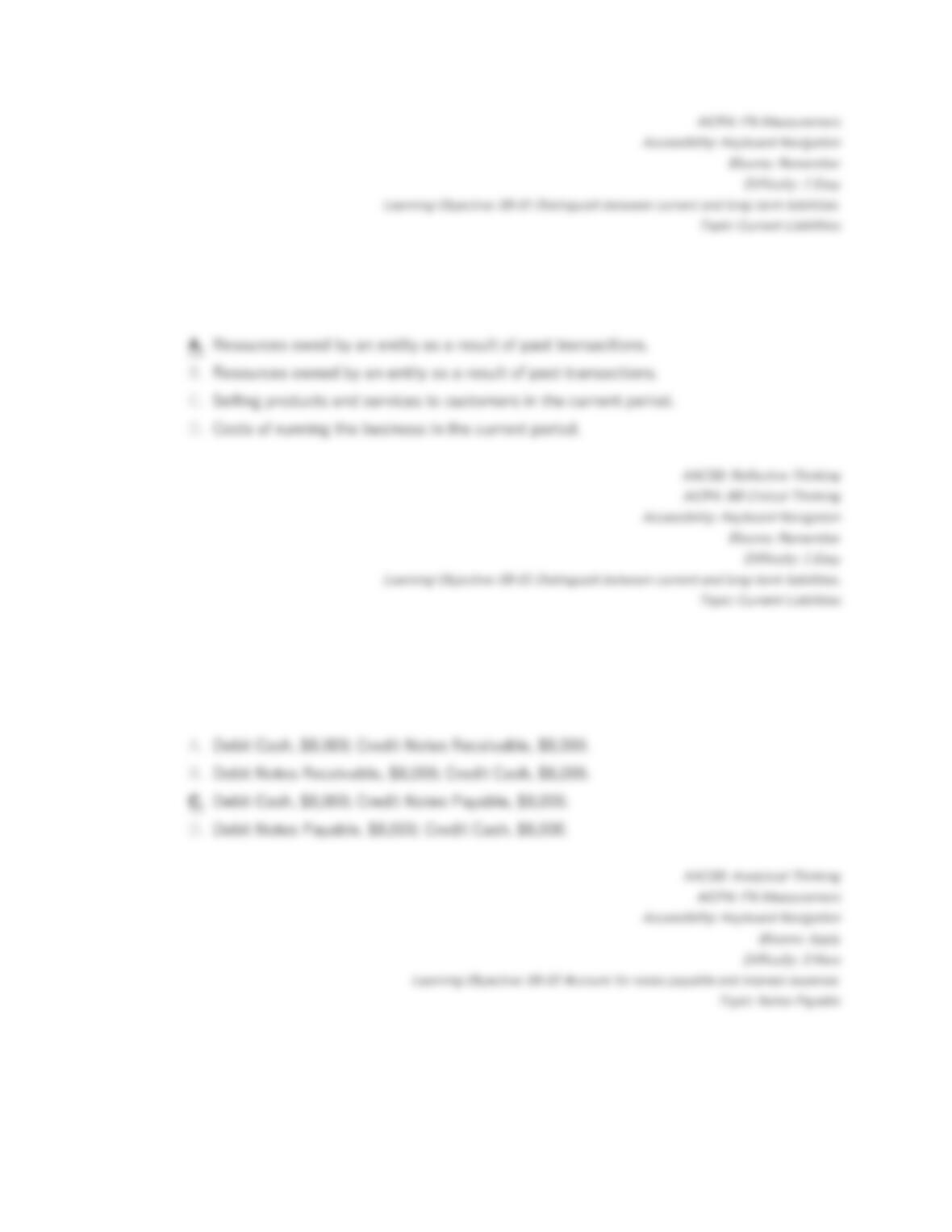
Liabilities are defined as:
48.
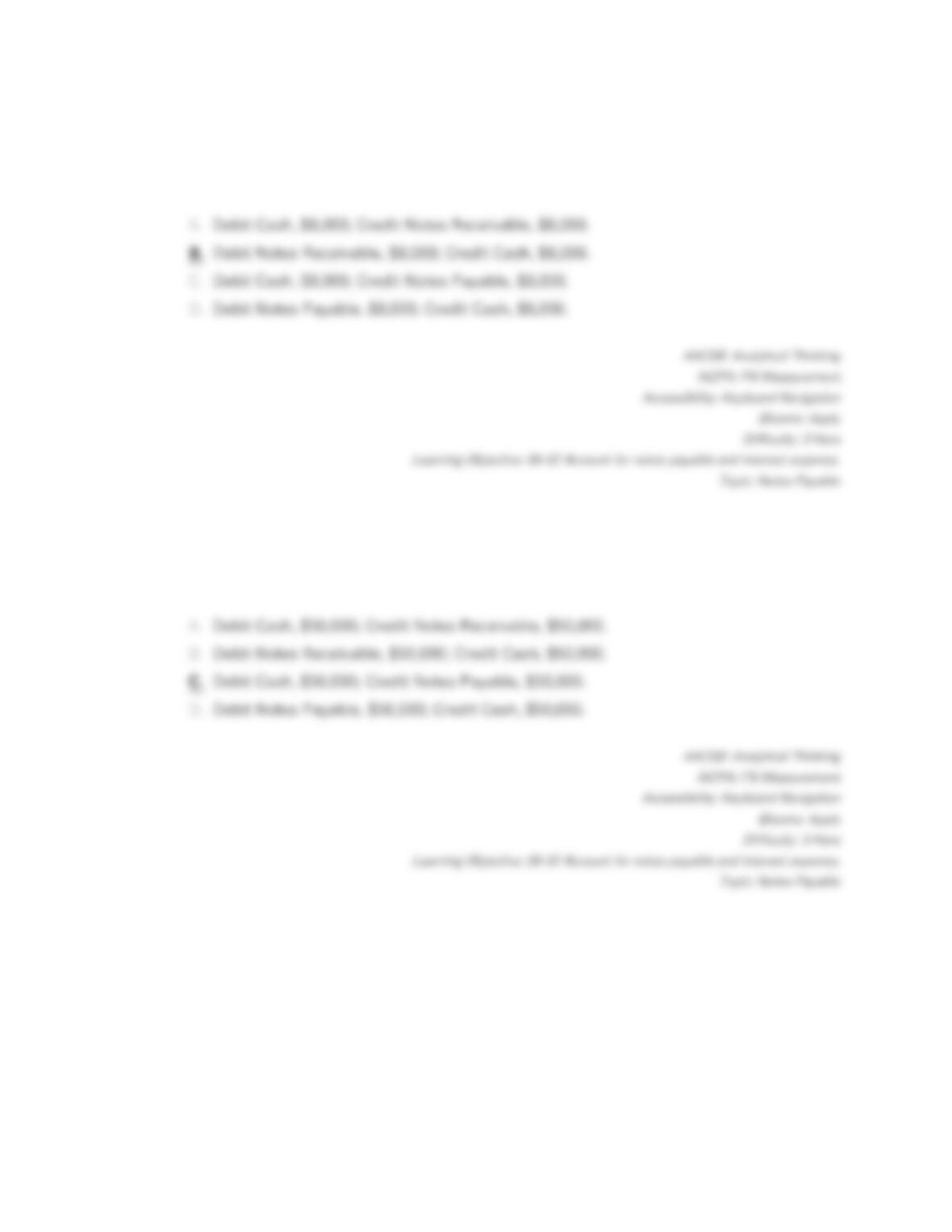
Brian Inc. borrowed $8,000 from First Bank and signed a promissory note. What entry
should Brian Inc. record?
8-18
49.
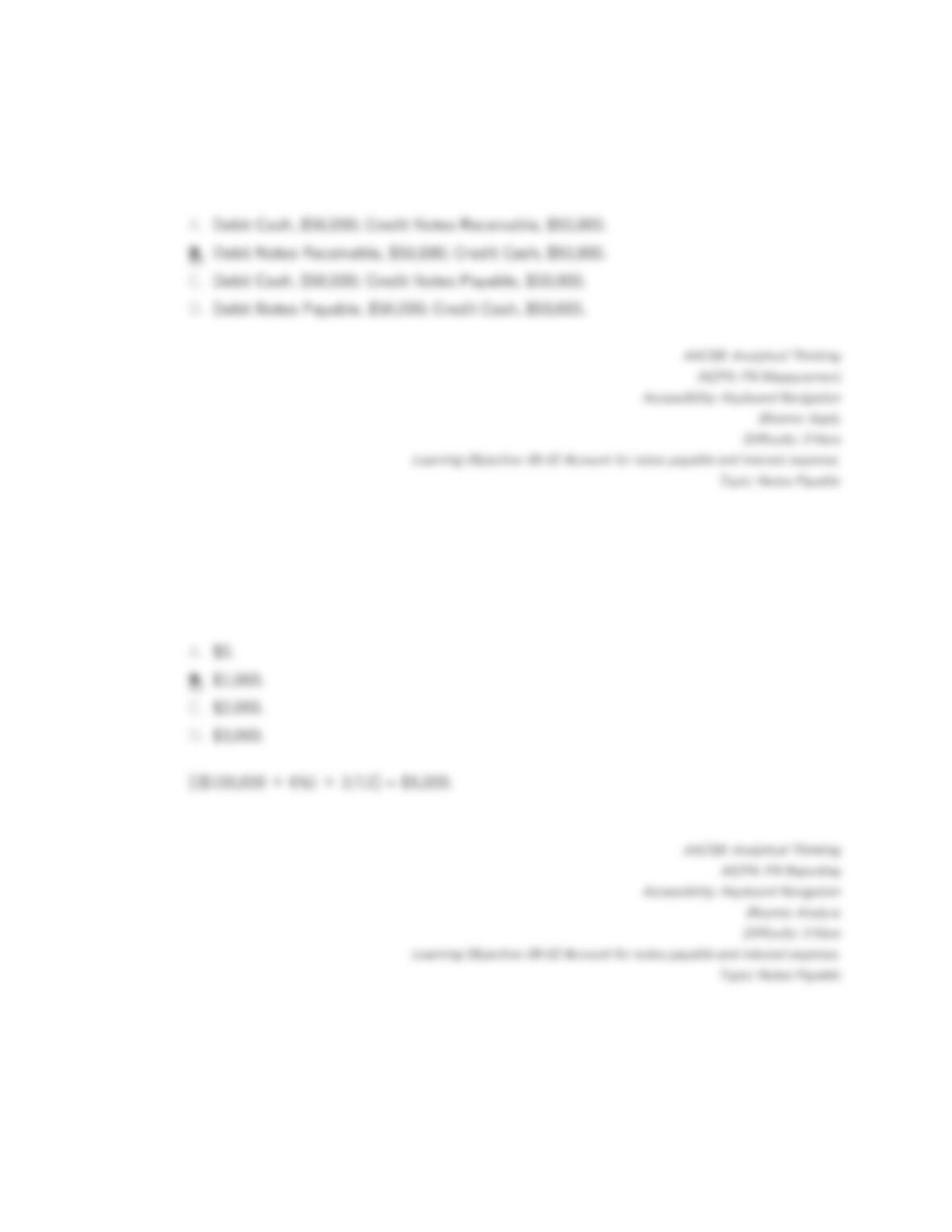
Brian Inc. borrowed $8,000 from First Bank and signed a promissory note. What entry
should First Bank record?
50.
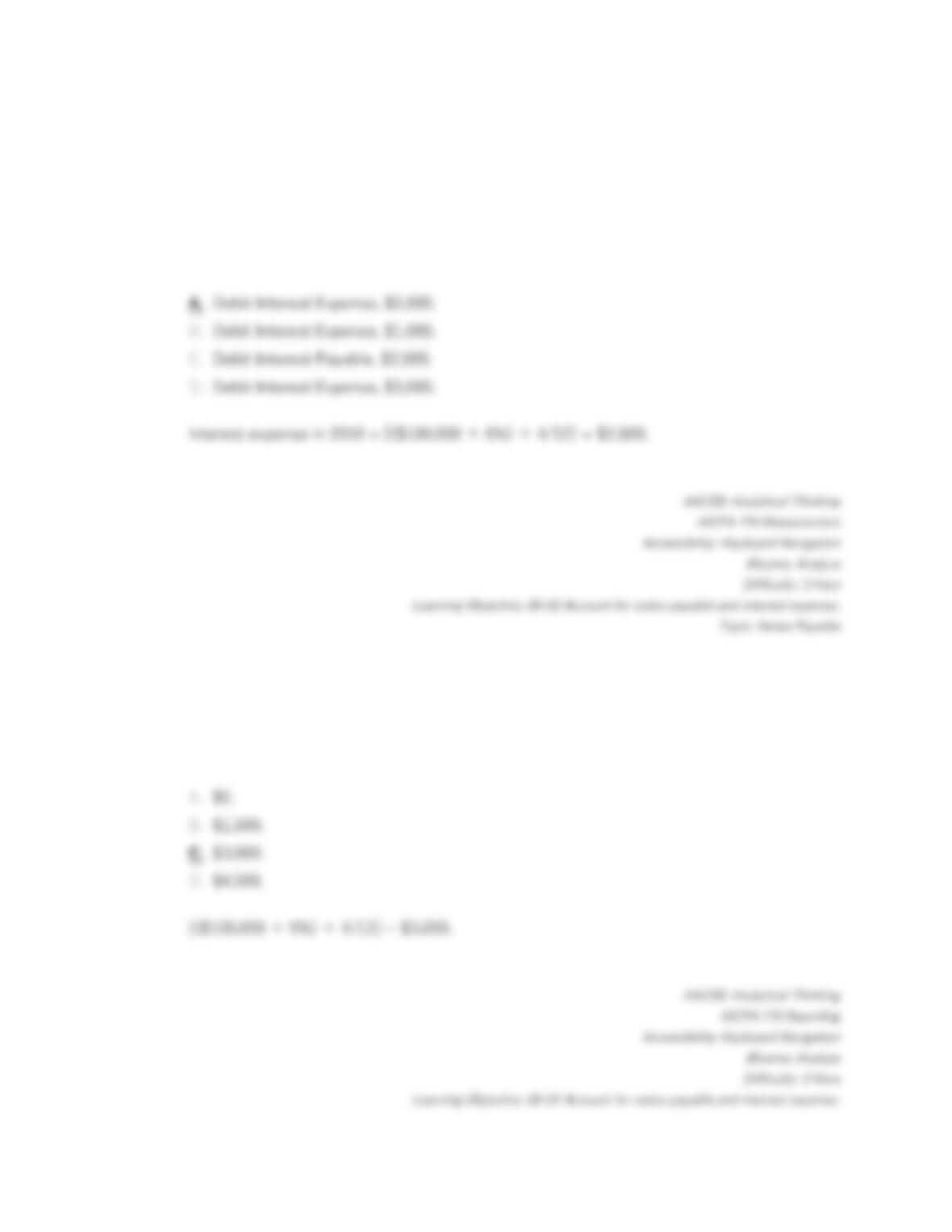
Bear Essentials borrowed $50,000 from Stacks Bank and signed a promissory note. What
entry should Bear Essentials record?
8-19
51.
Bear Essentials borrowed $50,000 from Stacks Bank and signed a promissory note. What
entry should Stacks Bank record?
52.
On November 1, 2018, The Bagel Factory signed a $100,000, 6%, six-month note payable
with the amount borrowed plus accrued interest due six months later on May 1, 2019. The
Bagel Factory should report interest payable at December 31, 2018, in the amount of:
8-20
53.
On November 1, 2018, The Bagel Factory signed a $100,000, 6%, six-month note payable
with the amount borrowed plus accrued interest due six months later on May 1, 2019. The
Bagel Factory records the appropriate adjusting entry for the note on December 31, 2018.
In recording the payment of the note plus accrued interest at maturity on May 1, 2019, The
Bagel Factory would
54.
On September 1, 2018, Daylight Donuts signed a $100,000, 9%, six-month note payable
with the amount borrowed plus accrued interest due six months later on March 1, 2019.
Daylight Donuts should report interest payable at December 31, 2018, in the amount of: