38) Suppose a monopolist has costs such that when output is 500 units per hour, average costs
are $3. If the monopolist is regulated by a policy of average-cost pricing, the monopolist will
charge a price of
A) $3.
B) $3 only if the quantity demanded is 500 units per hour at a price of $3.
C) $3 only if the quantity demanded is greater than 500 units at a price of $3.
D) $3 only if the quantity demanded is less than 500 units per hour at a price of $3.
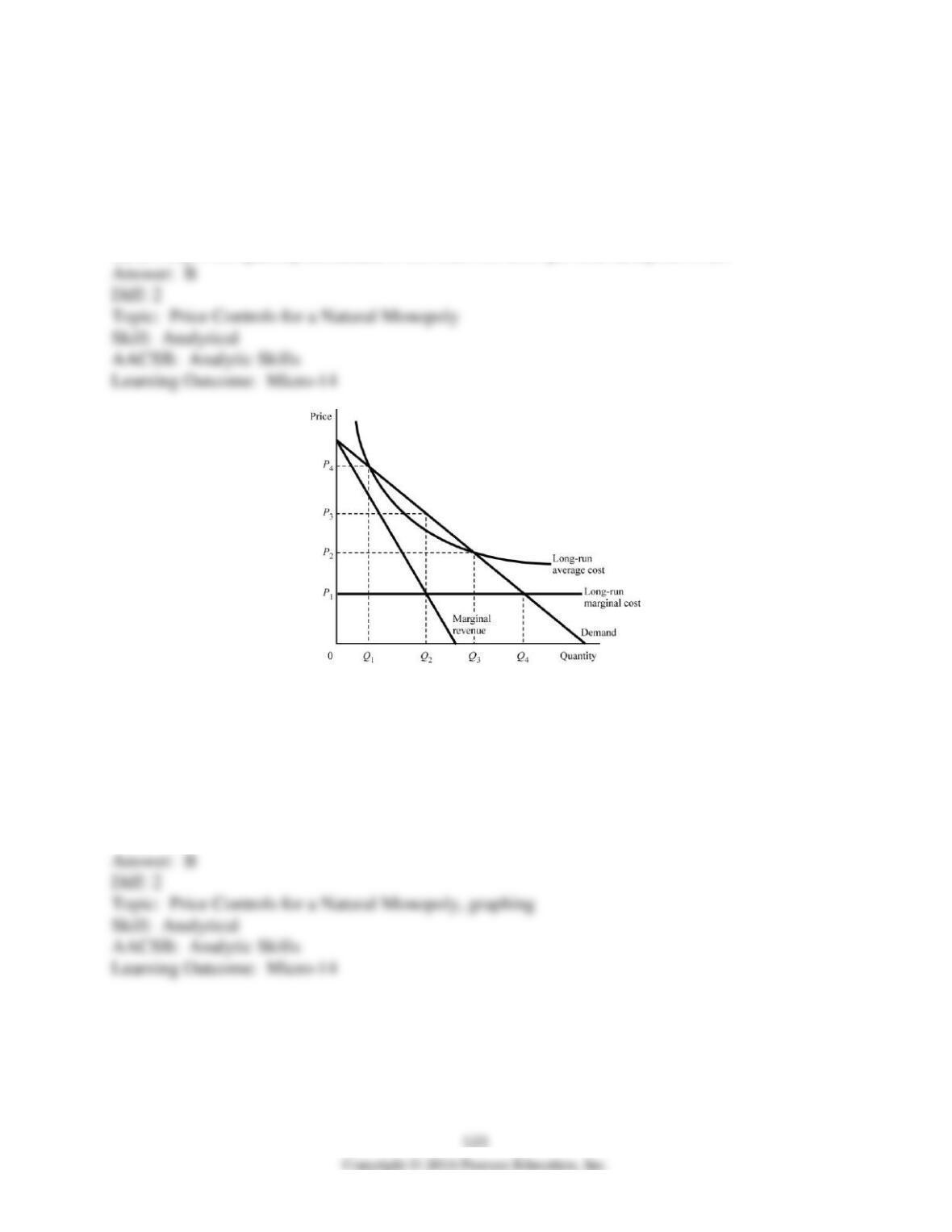
Figure 8.14
39) The natural monopoly in Figure 8.14 wants to produce
A) Q1.
B) Q2.
C) Q3.
D) Q4.
40) The natural monopoly in Figure 8.14 wants to charge a price of
A) P1.
B) P2.
C) P3.
D) P4.
41) Where it wants to produce the firm in Figure 8.14 would be
A) making a zero economic profit.
B) losing money.
C) making a positive economic profit.
D) breaking even.
42) With average cost pricing the firm in Figure 8.14 would be
A) making a zero economic profit.
B) losing money.
C) making a positive economic profit.
D) shut down.
43) If price were regulated to be equal to long-run marginal cost the firm in Figure 8.14 would be
A) making a zero economic profit.
B) losing money.
C) making a positive economic profit.
D) breaking even.
44) Consider the monopoly depicted in Figure 8.14. Relative to the cost of producing the
quantity the monopolist would choose under an average-cost pricing policy, the cost of
producing Q4 units is
A) less.
B) the same.
C) more.
D) twice as much.
Recall the Application about the British experience with private water companies in the
nineteenth century to answer the following question(s).
45) Recall the Application. The British Experience with water privatization showed that the
distribution of water is
A) a natural monopoly.
B) best left as a deregulated market.
C) best set up as a trust.
D) a classic example of price fixing.
46) Recall the Application. The British Experience with water privatization showed that
A) a single firm providing water will be profitable, but two firms will not.
B) two or more firms providing water will be profitable, but a single firm will not.
C) it does not matter how many firms provide water, as none will be profitable.
D) it does not matter how many firms provide water, as all will be profitable.
47) In the case of a natural monopoly, two firms can produce at lower average cost than one firm
can.
48) The conventional way to regulate a natural monopolist is to force it to charge a price equal to
marginal cost.
49) A natural monopoly is inevitable if the entry of a second firm shifts the demand curve facing
each individual firm entirely below the average cost curve.
50) Government regulation of a natural monopoly causes its average cost curve to shift
downward.
51) Under the average-cost pricing policy, a regulated monopolist is guaranteed a normal
economic profit even if there is a change in its cost of production.
52) The average-cost pricing policy provides a greater incentive for a regulated monopolist to
reduce its production cost.
53) Compared with average cost at the quantity that an unregulated monopolist would choose,
average costs are higher at the quantity chosen by a monopoly facing an average-cost pricing
policy.
54) When demand falls, the price charged by a monopoly under an average-cost pricing policy
will fall.
55) Suppose an unregulated monopoly faces a negatively-sloped and steep average cost curve. If
a second firm enters, what will happen to the first firm’s demand and average cost of production?
56) What is the disadvantage of average-cost pricing?
57) Why can’t the government force a natural monopolist to produce the competitive output?
8.9 Antitrust Policy
1) Which of the following is NOT a form of antitrust policy?
A) regulation of business practices
B) blocking mergers
C) breaking up monopolies
D) a price control
2) The purpose of antitrust policy is to
A) promote competition among firms.
B) increase profits to firms.
C) protect domestic firms from foreign trade.
D) achieve scale economies in production.
3) A trust is
A) an agreement among firms to charge the perfectly competitive price.
B) a compact between industry and government.
C) a creation of the Sherman Act.
D) an arrangement between firms whereby decision making is controlled by a board of trustees.
4) Firms in a trust
A) act as a single firm.
B) act in their own self interests.
C) trust each other.
D) do not allow a small number of trustees to make decisions for participating firms.
5) An arrangement between firms whereby decision-making is controlled by a board of trustees
is known as
A) a trust.
B) a compact between industry and government.
C) predatory pricing.
D) a merger.
6) Which of the following companies was NOT broken up by the government?
A) Standard Oil
B) AT&T
C) American Tobacco
D) Office Depot
7) Which of the following companies was broken up by the government?
A) Standard Oil
B) Office Depot
C) Wonder Bread
D) Southwest Airlines
8) Which of the following companies was broken up by the government?
A) American Tobacco
B) Office Depot
C) Wonder Bread
D) Southwest Airlines
9) In which of the following cases did the government break up a monopoly?
A) Staples/Office Depot
B) Interstate Bakeries and Continental Bakery
C) Xidex
D) AT&T
10) When two firms in an industry become one firm, they are engaged in
A) a trust agreement.
B) a merger.
C) predatory pricing.
D) none of the above
11) The government is likely to block a merger if
A) the firms remaining would all earn economic profit.
B) it can be established that the merger would substantially reduce competition.
C) the firms remaining would be able to charge a price above marginal cost.
D) the firms that are merging are producing different products.
12) In the Staples/Office Depot Case, the government
A) blocked a merger.
B) allowed a merger but regulated the resulting firm.
C) allowed a merger and did not regulate the resulting firm.
D) prosecuted the two firms for collusion.
13) In the Staples/Office Depot Case, the government
A) found that Staples had attempted to drive Office Depot out of the market, and so they
prosecuted them under the Clayton Act.
B) determined that the anticompetitive effects of a proposed merger between the two firms
outweighed the potential savings in production costs, and so they blocked the proposed merger.
C) found that Office Depot had illegally attempted to monopolize the market.
D) found that Staples had illegally attempted to monopolize the market by using tying contracts.
14) A key consideration in the government’s decision in the Staples/Office Depot case was that
A) Staples charged lower prices in locations that were close to an Office Depot store.
B) Staples charged higher prices in locations that were close to an Office Depot store.
C) Staples and Office Depot had engaged in explicit price fixing.
D) Staples and Office Depot would be a natural monopoly if they were allowed to merge.
15) In which of the following cases did the government successfully block a merger?
A) Staples and Office Depot
B) Interstate Bakeries and Continental Bakery
C) AT&T and Verizon
D) Standard Oil and Mobil
16) Suppose two firms produce close substitutes such that reducing the price of one product
reduces the quantity demanded of the other. If those two firms merge,
A) they can earn higher profits by continuing to sell both products if the profit gained from
increased sales of one product are greater than the lost profits from reduced sales of the other
product.
B) they will eliminate the less profitable product and sell only one.
C) they will raise prices on both products.
D) they will be unable to earn higher profits because the two products will compete against each
other.
17) In the case of Interstate Bakeries and Continental Bakery, the Justice Department concluded
that
A) the merger of two firms selling close substitutes may lead to higher prices.
B) Interstate Bakeries attempted to drive out Continental by using predatory pricing.
C) a merger between the two companies would save money in production costs, and so would be
good for consumers.
D) Continental attempted to drive out Interstate Bakeries by using predatory pricing.
18) The result of the Interstate Bakeries and Continental Bakery case was that the firms were
A) allowed to merge only if one of the firms sold off some of its divisions.
B) blocked from merging because a merger would have created a monopoly in some locations.
C) fined substantial amounts for engaging in a trust.
D) forced to split up into several smaller firms.
19) Which of the following is an example of a tie-in sale?
A) In order to buy Microsoft Windows, you must also purchase Internet Explorer.
B) Bus rides are cheaper for senior citizens than for other people.
C) Two companies merge to form one company.
D) Prices are set just low enough to prevent other firms from entering the market.
20) Which of the following is an example of predatory pricing?
A) In order to buy Microsoft Windows, you must also purchase Internet Explorer.
B) Bus rides are cheaper for senior citizens than for other people.
C) Prices are set low enough to drive other firms out of a market.
D) Prices are set just high enough to prevent other firms from entering the market.
21) A firm announces that in order to purchase a CD player, its customers must also purchase 10
CDs. This is an example of
A) a tie-in sale.
B) monopoly pricing.
C) price discrimination.
D) predatory pricing.
22) Microsoft requires persons who purchase its operating system to also purchase its web
browser. This is an example of
A) a tie-in sale.
B) competitive pricing.
C) price discrimination.
D) predatory pricing.
23) Suppose that Polaroid instant cameras had a guarantee that would be valid only if the camera
was used with Polaroid film. This would then be an example of
A) a tie-in sale.
B) monopoly pricing.
C) price discrimination.
D) predatory pricing.
24) A firm charges a price below its average total cost so that it drives out its competition. This is
an example of
A) a tie-in sale.
B) duopoly pricing.
C) price discrimination.
D) predatory pricing.
25) When a monopolist charges a low price to drive out competition, then charges a high price,
the monopolist is engaging in
A) a trust agreement.
B) a merger.
C) duopoly pricing.
D) predatory pricing.
26) Predatory pricing occurs when a monopolist charges a
A) price above average total cost.
B) price above average variable cost.
C) low price to drive out competition, then charges a high price.
D) high price to drive out competition, then charges a low price.
27) Antitrust laws are enforced by
A) the Department of Commerce.
B) the Federal Trade Commission.
C) the Federal Reserve.
D) the Department of Labor.