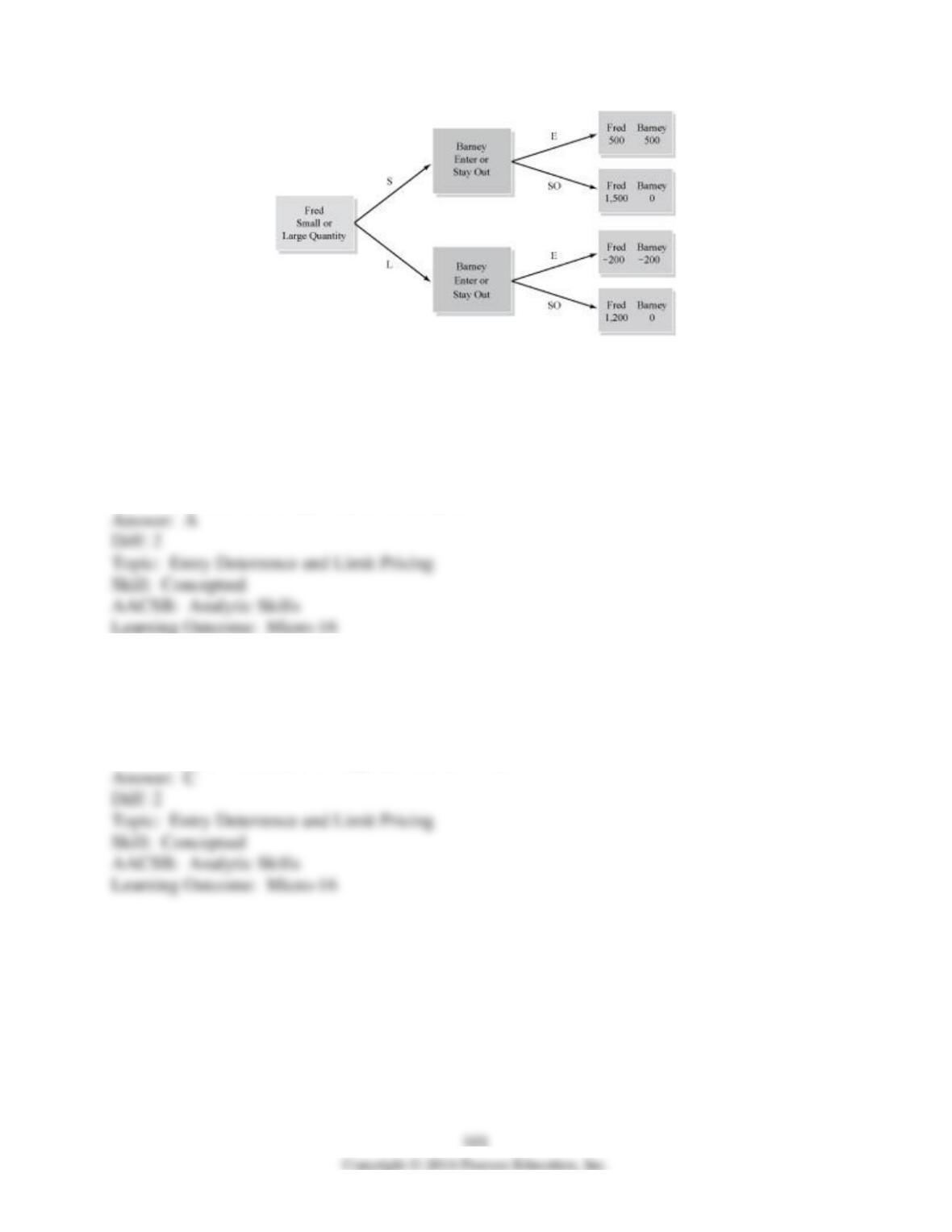
Figure 8.11
11) The path of the game in Figure 8.11 will be
A) Fred chooses a large quantity and Barney stays out.
B) Fred chooses a large quantity and Barney enters.
C) Fred chooses a small quantity and Barney stays out.
D) Fred chooses a small quantity and Barney enters.
12) Refer to Figure 8.11. Which of the following statements is true?
A) Both Fred and Barney have a dominant strategy.
B) Neither Fred nor Barney has a dominant strategy.
C) Fred has a dominant strategy but Barney does not.
D) Barney has a dominant strategy but Fred does not.
13) Refer to Figure 8.11. If Fred’s profit in the top rectangle were 1,300 instead of 500 then the
path of the game would be
A) Fred chooses a small quantity and Barney enters.
B) Fred chooses a large quantity and Barney enters.
C) Fred chooses a small quantity and Barney stays out.
D) Fred chooses a large quantity and Barney stays out.
14) Refer to Figure 8.11. If Fred’s profit in the second rectangle from the top were 1,600 instead
of 1,500 then the path of the game would be
A) Fred chooses a small quantity and Barney enters.
B) Fred chooses a large quantity and Barney stays out.
C) Fred chooses a large quantity and Barney enters.
D) Fred chooses a small quantity and Barney stays out.
15) Refer to Figure 8.11. If Barney got to move first instead of Fred, the path of the game would
be
A) Barney stays out and Fred chooses a large quantity.
B) Barney enters and Fred chooses a large quantity.
C) Barney stays out and Fred chooses a small quantity.
D) Barney enters and Fred chooses a small quantity.
16) In general the entry-deterrence game will generate a market price
A) higher than the monopoly price.
B) lower than the monopoly price but higher than the duopoly price.
C) the same as the monopoly price.
D) the same as the duopoly price.
17) A firm charges a price so low that it prevents other firms from entering the market. This is an
example of
A) a tying contract.
B) limit pricing.
C) price discrimination.
D) predatory pricing.
18) Which of the following is an example of limit pricing?
A) In order to buy Microsoft Windows, you must also purchase Internet Explorer.
B) Bus rides are cheaper for senior citizens than for other people.
C) Prices are set low enough to drive other firms out of a market.
D) Prices are set low enough to prevent other firms from entering the market.
19) Limit pricing occurs when a firm sets price
A) equal to marginal cost.
B) equal to average cost.
C) at different amounts for different groups of consumers.
D) so low that other firms are prevented from entering the market.
20) In the extreme case of a perfectly contestable market
A) profits will be the same as monopoly profits.
B) profits will be the same as cartel profits.
C) profits will be the same as duopoly profits.
D) profits will be zero.
21) If there is the legitimate threat of entry into a market, then the market is said to be
A) perfectly competitive.
B) contestable.
C) secure.
D) reactive.
22) A contestable market is one where
A) there is a threat of entry.
B) there are no firms that threaten to enter the market.
C) firms already in the market cannot leave the market.
D) only one firm at a time can serve the market.
23) A contestable market is one where
A) there are infinitely many firms.
B) entry necessarily occurs.
C) there is the legitimate threat of entry.
D) firms can maintain the monopoly price.
24) In a contestable market the costs of entering and leaving the market are very
A) high.
B) low.
C) low, but firms have no incentive to enter or leave.
D) high and firms have no incentive to leave.
Recall the Application about how Microsoft responds to the threat of potential competitors
to answer the following question(s).
25) Recall the Application. In an effort to deter entry into its key markets, Microsoft engages in
A) a grim-trigger strategy.
B) a tit-for-tat strategy.
C) price fixing.
D) limit pricing.
26) Recall the Application. Based on its strategy to deter entry into its key markets, Microsoft
would be considered
A) a pure monopolist.
B) a cartel monopolist.
C) an insecure monopolist.
D) a government-protected monopolist.
27) A secure monopolist charges a higher price than an insecure monopolist.
28) Entry deterrence is always the best strategy for a monopolist.
29) Deterrence quantity equals zero profit quantity less minimum entry quantity.
30) Deterrence quantity is always equal to the zero profit quantity.
31) A contestable market is one where there are few if any barriers to entry.
32) Under what circumstances would a monopolist price be as low as the price that would prevail
in a perfectly competitive market?
33) Does the threat of entry reduce the monopoly problem?
34) What is a contestable market?
8.8 Natural Monopoly
1) Which of the following is NOT an example of natural monopoly?
A) water systems
B) electricity transmission
C) local telephone services
D) farm products
2) Which of the following is an example of natural monopoly?
A) a market for cable TV services
B) a market for breakfast cereals
C) a market for cold medicines
D) a market for cigarettes
3) A natural monopoly arises when
A) economies of scale are so great that only one firm can exist in a market.
B) a firm acquires a patent.
C) two firms merge to become the only firm serving an entire market.
D) a single firm controls all of a natural resource.
4) A firm is more likely to have a natural monopoly when
A) the size of the market is small relative to the efficient scale of the firm.
B) the size of the market is large relative to the efficient scale of the firm.
C) the firms face no or low fixed costs.
D) the government grants the firm an exclusive license to operate.
5) The barrier to entry that sustains a natural monopoly is
A) economies of scale.
B) implicit price fixing agreements.
C) government regulation.
D) patent protection.
6) A public utility is a classic example of
A) a natural monopoly.
B) perfect competition.
C) an oligopoly.
D) monopolistic competition.
7) When a firm has decreasing average costs over the entire range of market demand it is
A) a natural monopoly.
B) an oligopoly.
C) rent seeking.
D) in a contestable market.
8) To maximize profit, an unregulated natural monopoly will produce at a level where
A) marginal revenue is greater than marginal cost.
B) marginal revenue is greater than average revenue.
C) marginal revenue is less than marginal cost.
D) marginal revenue is equal to marginal cost.
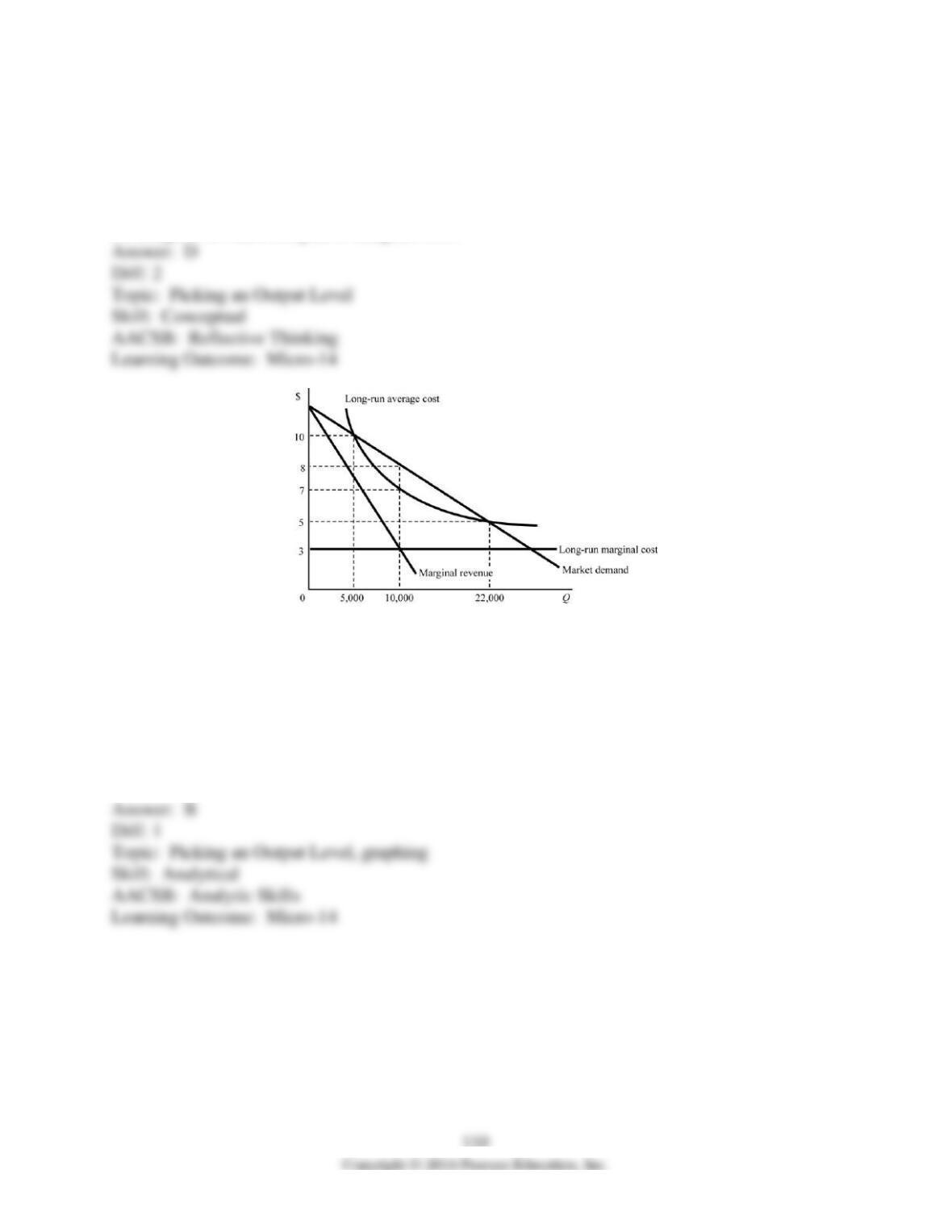
Figure 8.12
9) Figure 8.12 shows a demand and costs of an unregulated monopoly. At the profit
maximization output, the firm earns a profit of
A) $0.
B) $10,000.
C) $50,000.
D) $80,000.
10) Figure 8.12 shows a demand and costs of an unregulated monopoly. At the output level of
22,000 units,
A) the firm’s marginal revenue is smaller than its marginal cost.
B) the firm is earning a zero economic profit.
C) the firm is producing more than its profit maximizing level of output.
D) All of the above are correct.
11) Figure 8.12 shows a demand and costs of an unregulated monopoly. The negatively sloped
long-run average cost curve reflects that
A) the firm’s total cost of production decreases as its output increases.
B) the firm’s profit increases as its output increases.
C) there exist large economies of scale in production.
D) All of the above are correct.
12) Figure 8.12 shows a demand and costs of an unregulated monopoly. This firm must
A) be a natural monopoly.
B) have an exclusive government license.
C) be a monopoly because it has a patent.
D) be operating in a contestable market.
13) If a severe natural disaster reduced the population of a city, one would expect a natural
monopoly to
A) raise prices.
B) split into two firms.
C) increase sales.
D) merge with a competitor.
14) If a severe natural disaster reduced the population of a city, one would expect a natural
monopoly to
A) lower prices.
B) split into two firms.
C) merge with a competitor.
D) experience an increase in average costs.
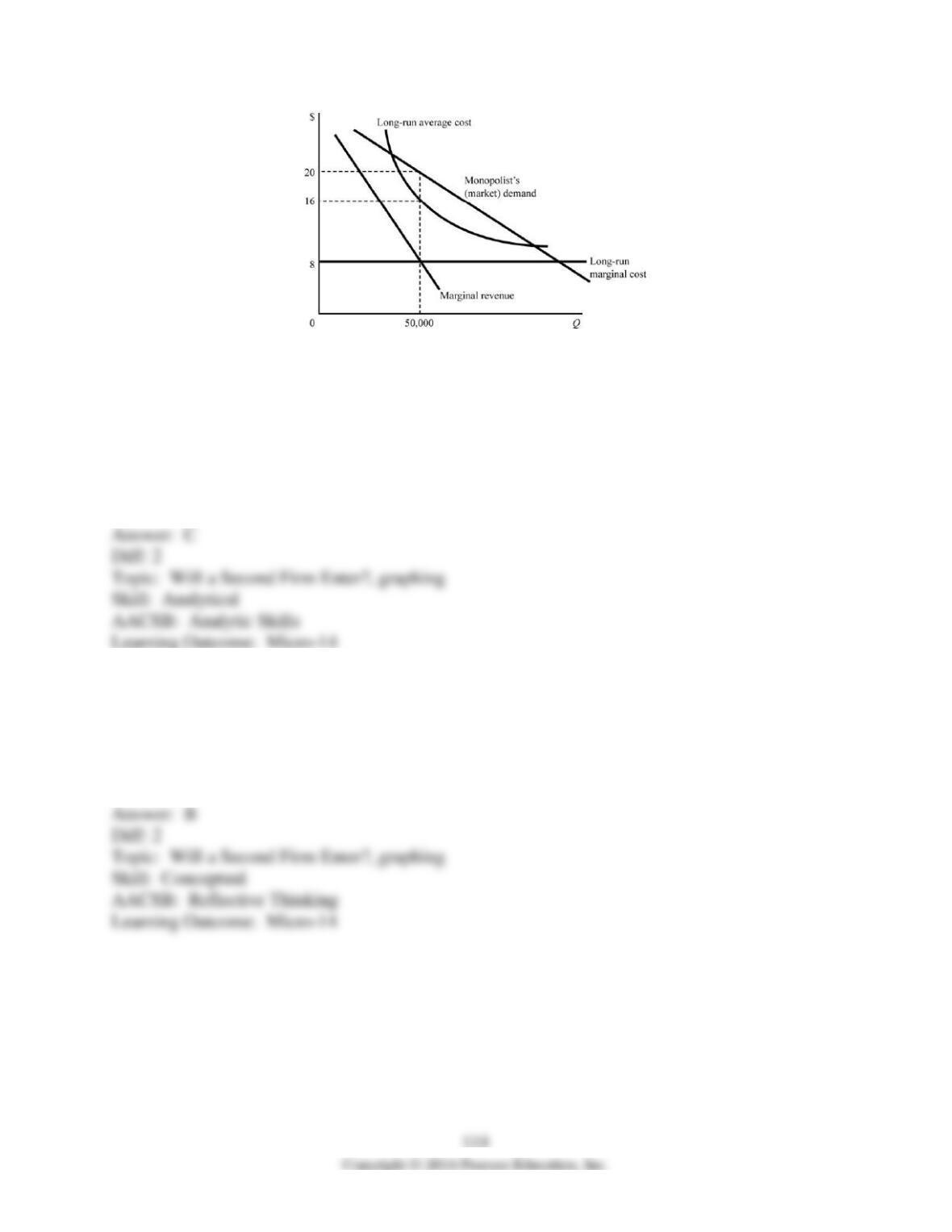
Figure 8.13
15) Consider an unregulated monopoly in Figure 8.13. The firm’s profit at the profit maximizing
output level is
A) $600,000.
B) $400,000.
C) $200,000.
D) $0.
16) Consider an unregulated monopoly in Figure 8.13. If a second firm enters the market, the
demand curve facing the first firm will
A) shift to the right.
B) shift to the left.
C) remain the same.
D) There is insufficient information.
17) Consider an unregulated monopoly in Figure 8.13. Suppose that a second firm enters the
market. As a result, if the demand curve facing each firm lies entirely below the long-run average
cost curve,
A) only one of the two firm can makes a positive economic profit.
B) both the first and the second firm make positive economic profits.
C) neither firm makes a positive economic profit.
D) There is not sufficient information.
18) Consider an unregulated monopoly in Figure 8.13. Suppose that a second firm enters the
market. As a result, if a natural monopoly is inevitable in this market,
A) the demand curve facing each firm lies entirely above the long-run average cost curve.
B) the demand curve facing each firm lies entirely below the long-run average cost curve.
C) the demand curve facing each firm touches the long-run average cost curve at one point.
D) none of the above
19) Consider an unregulated monopoly in Figure 8.13. If that monopoly set its price equal to it
marginal cost it would
A) earn negative profits.
B) earn maximum profits.
C) earn zero profits.
D) earn small, but greater than zero, profits.
20) When a monopoly is inevitable, the government often
A) forces it to break into smaller firms.
B) sets a minimum price for the monopolist.
C) sets a maximum price for the monopolist.
D) None of the above; monopoly is never inevitable.
21) Because unregulated natural monopolies earn economic profits greater than zero in the long
run, but cannot attract new entrants into the industry
A) government agencies often regulate the number of firms that compete against natural
monopolies.
B) government agencies often regulate the price natural monopolies can charge.
C) natural monopolies often go out of business.
D) natural monopolies are outlawed.
22) Government agencies often regulate the price natural monopolies charge because, if left
unregulated, natural monopolies will
A) charge a price greater than average cost.
B) charge a price less than average cost.
C) charge a price equal to average cost.
D) face too many competitors.
23) Under average-cost pricing, an increase in the monopolist’s production cost will
A) decrease its profit because its profit per unit decreases.
B) not affect its profit because the government adjusts the regulated price equal to the average
cost.
C) increase its profit because the monopolist can reduce the average cost at a greater output
level.
D) none of the above
24) A regulatory policy under which the government picks the point on the demand curve at
which price equals average cost is known as
A) average-cost pricing.
B) marginal-cost pricing.
C) average-revenue pricing.
D) competitive pricing.
25) Consider a cable TV company which is subject to an average-cost pricing regulation. If the
number of subscribers decreases,
A) the company will have to operate at a smaller profit unless it suffers an economic loss.
B) the company will have to charge a relatively low price as the demand curve facing the firm
shifts to the left.
C) the company will charge more per customer as its average cost increases.
D) none of the above
26) If a regulatory agency mandates that a natural monopoly charge a price equal to its average
cost
A) the firm will eventually exit the industry.
B) the firm will earn economic profits greater than zero.
C) other firms will find it profitable to enter this industry.
D) the firm will earn economic profits equal to zero.
27) Under an average-cost pricing policy
A) a regulatory agency picks a price equal to a natural monopoly’s marginal cost.
B) a regulatory agency picks a price equal to a natural monopoly’s average fixed cost.
C) a regulatory agency picks a price at which a natural monopoly’s demand curve intersects its
average cost curve.
D) firms earn economic profits greater than zero.
28) When compared to the profit maximizing price and quantity supplied, an average-cost
pricing policy for a natural monopoly causes the price the monopolist charges to ________ and
the quantity it sells to ________.
A) increase; decrease
B) decrease; decrease
C) decrease; increase
D) increase; increase
29) If a natural monopoly is forced to follow a policy of average-cost pricing, the monopolist
will
A) earn economic profits greater than zero.
B) charge a higher price than if the monopolist were not regulated.
C) charge a lower price than if the monopolist were not regulated.
D) decrease output below that in an unregulated pricing policy.
30) If a natural monopoly is forced to follow a policy of average-cost pricing, the monopolist
will
A) earn economic profits less than zero.
B) charge a higher price than if not regulated.
C) charge the same price as if it were not regulated.
D) increase output to an amount greater than what it would have produced if it were not
regulated.
31) Under a policy of average-cost pricing, a monopolist must charge the price at which its
________ cost curve intersects its ________ curve.
A) marginal; demand
B) average variable; demand
C) marginal; marginal revenue
D) average; demand
32) A likely consequence over time of an average-cost pricing policy for a natural monopoly is
A) an increase in the average cost curve.
B) an increase in profits.
C) no change in price.
D) a decrease in the average cost curve.
33) The quantity produced by a natural monopolist facing an average-cost pricing policy will be
A) less than the quantity produced by a marginal cost pricing policy.
B) that quantity at which average costs are at their minimum.
C) that quantity at which marginal costs are at their minimum.
D) the same as the quantity that would be produced in perfect competition.
34) Because a monopolist has no incentive to control costs under a policy of average-cost
pricing, we can expect
A) price to increase over time as costs rise.
B) price to fall over time as costs rise.
C) profits to increase over time as costs rise.
D) profits to decrease over time as costs rise.
35) Production costs are likely to rise after an average-cost pricing policy is mandated because
the monopolist will
A) increase output.
B) decrease output.
C) engage in new and inventive production methods.
D) have no incentive to control costs.
36) A policy of average-cost pricing will initially ________ price for a natural monopoly, but as
costs increase price will ________.
A) increase; not change
B) decrease; increase
C) decrease; not change
D) increase; decrease
37) Suppose a monopolist has costs such that when output is 1,000 units per hour, average cost is
$5. If the monopolist is regulated by a policy of average-cost pricing, the monopolist will charge
a price of
A) $5.
B) $5 only if the quantity demanded is 1,000 units per hour at a price of $5.
C) $5 only if the quantity demanded is greater than 1,000 units at a price of $5.
D) $5 only if the quantity demanded is less than 1,000 units per hour at a price of $5.