Solve the formula for the specified variable. Assume all variables represent nonnegative numbers. If possible, simplify
radicals and rationalize denominators.
272)
F =
Gm1m2
d2 for d
272)
A)
d =
Gm1m2F
F
B)
d =
Gm1m2
2F
C)
d =
Gm1m2
F
D)
d =Gm1m2F
Write a quadratic equation in standard form with the given solution set.
273)
{–1, 8}
273)
A)
x2– 8x + 7 = 0
B)
x2– 7x – 8 = 0
C)
x2+ 8x + 7 = 0
D)
x2+ 7x – 8 = 0
B
Sketch the graph of the quadratic function. Give the vertex and axis of symmetry.
274)
y +1=(x – 1)2
274)
93
A
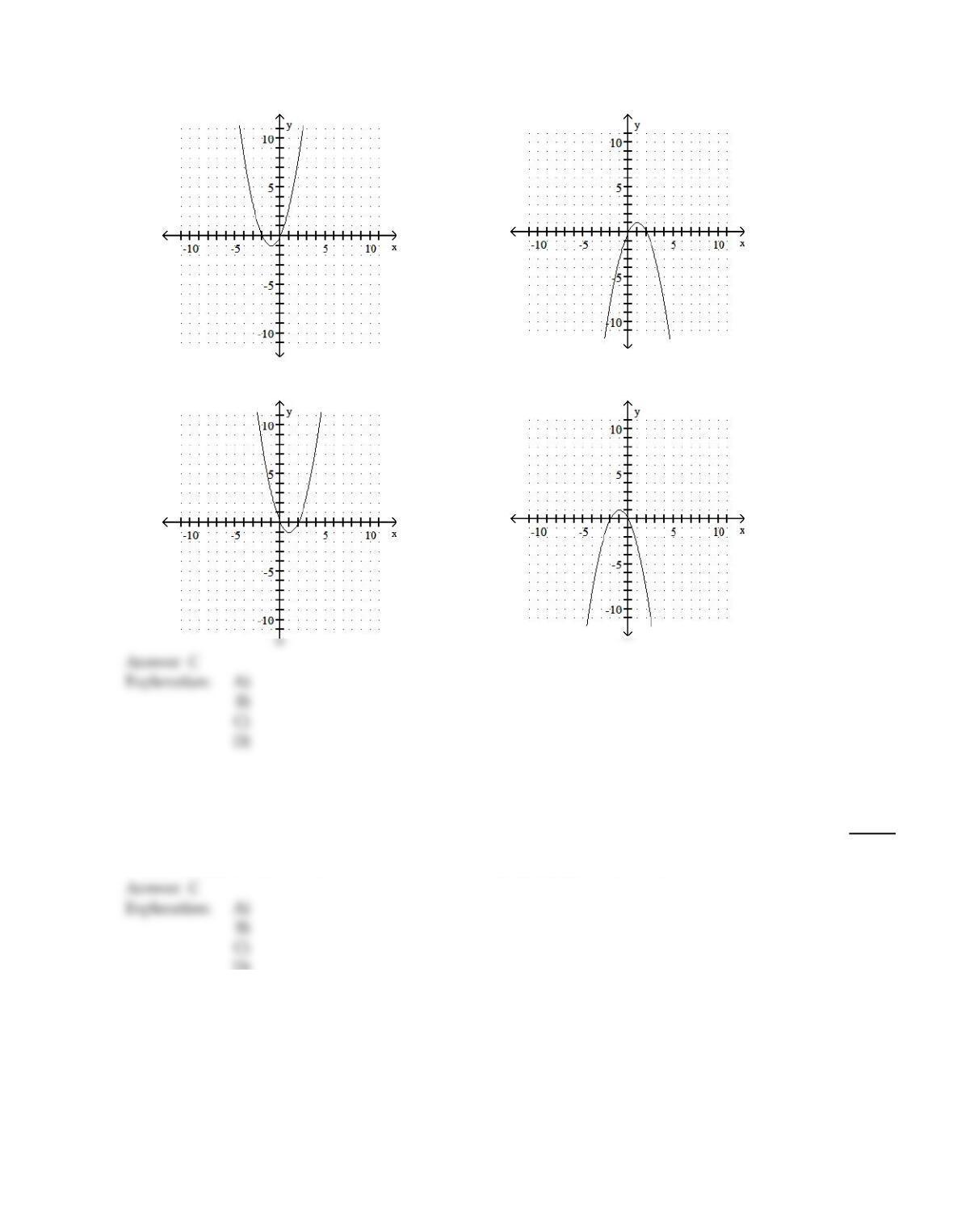
A)
vertex: (– 1, – 1)
axis of symmetry: x = – 1
B)
vertex: (1, 1)
axis of symmetry: x =1
C)
vertex: (1, – 1)
axis of symmetry: x =1
D)
vertex: (– 1, 1)
axis of symmetry: x = – 1
Determine whether the given quadratic function has a minimum value or maximum value. Then find the minimum or
maximum value and determine where it occurs.
275)
f(x) = x2– 2x – 2
275)
A)
Maximum is 1 at x = – 3.
B)
Minimum is 1 at x = – 3.
C)
Minimum is – 3 at x =1.
D)
Maximum is – 3 at x =1.
D)
Sketch the graph of the quadratic function. Give the vertex and axis of symmetry.
94
D)
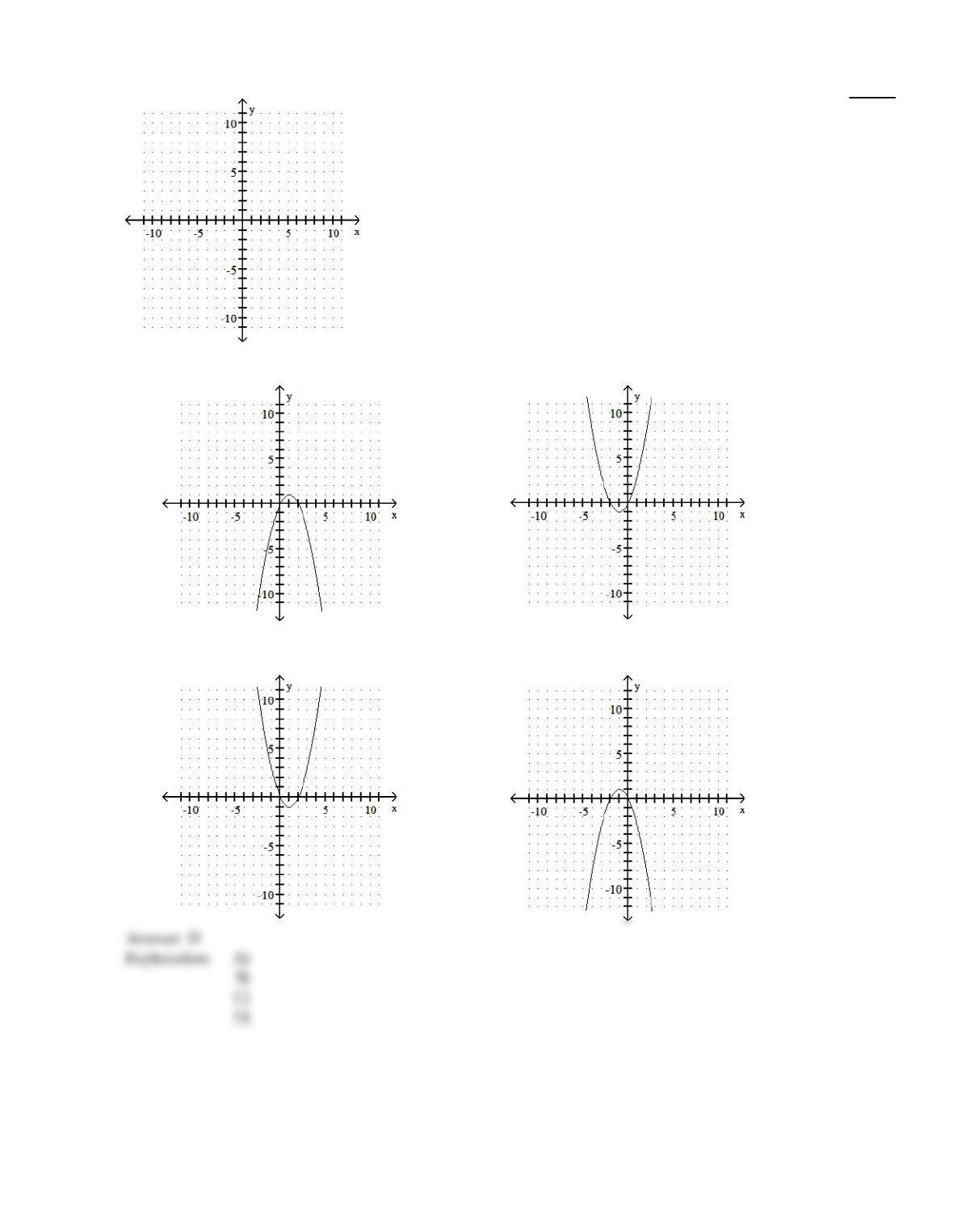
276)
f(x) =1– (x + 1)2
276)
A)
vertex: (1, 1)
axis of symmetry: x =1
B)
vertex: (– 1, – 1)
axis of symmetry: x = – 1
C)
vertex: (1, – 1)
axis of symmetry: x =1
D)
vertex: (– 1, 1)
axis of symmetry: x = – 1
95
Find the intercepts of the quadratic function.
277)
y +9=(x – 3)2
277)
A)
x–intercepts: (0, 0) and (6, 0)
y–intercept: none
B)
x–intercepts: (0, 0) and (6, 0)
y–intercept: (0, 0)
C)
x–intercepts: (0, 0) and (–6, 0)
y–intercept: (0, 0)
D)
x–intercepts: (0, 0)
y–intercept: (0, 0)
Complete the square for the binomial. Then factor the resulting perfect square trinomial.
278)
x2– 12x
278)
A)
144; x2– 12x +144 =(x – 12)2
B)
144; x2– 12x –144 =(x – 12)2
C)
36; x2– 12x –36 =(x –6)2
D)
36; x2– 12x +36 =(x –6)2
D
D)
Solve the equation by the square root property. If possible, simplify radicals or rationalize denominators. Express
imaginary solutions in the form a +
bi.
279)
3x2=45
279)
A)
{±15}
B)
{22.5}
C)
{16}
D)
{±15}
D
D)
Find the coordinates of the vertex for the parabola defined by the given quadratic function.
280)
f(x) = x2+ 8
280)
A)
(0, –8)
B)
(0, 8)
C)
(–8, 0)
D)
(8, 0)
B
D)
Write a quadratic equation in standard form with the given solution set.
281)
{6 + i, 6– i}
281)
A)
x2+12x –35 = 0
B)
x2+12x –37 = 0
C)
x2–12x +35 = 0
D)
x2–12x +37 = 0
D
96
B
D)
Solve the equation by the square root property. If possible, simplify radicals or rationalize denominators. Express
imaginary solutions in the form a +
bi.
282)
(x + 4)2=28
282)
A)
{±2 7}
B)
{–4± 2 14}
C)
{2 7±4}
D)
{–4± 2 7}
97
Answer Key
Testname: C8
Answer Key
Testname: C8
Answer Key
Testname: C8
Answer Key
Testname: C8
Answer Key
Testname: C8
Answer Key
Testname: C8