78) What are the key characteristics of an oligopoly?
79) List four examples of oligopolies in the United States.
80) What is a four-firm concentration ratio, and how is it used?
81) What is meant be strategic behavior?
82) What is a cartel?
83) Briefly explain why often two firms could both be made better off by cooperating, but they
fail to cooperate.
84) Joe and Steve are duopolists who each can follow two strategies: cooperate and jointly act
like a monopolist, or don’t cooperate (cheat) and act like duopolists. Their profits are as follows:
If both cooperate: both receive $1 million
If one cooperates: cooperator receives $200,000, cheater receives $1.2 million
If both cheat: both receive $500,000
What will they do?
85) What is meant by a dominant strategy?
8.6 Overcoming the Dupolists’ Dilemma
1) A firm announces that it will refund the difference between its price and any price of a
competitor that is lower. This is an example of
A) predatory pricing.
B) tying contracting.
C) marginal cost pricing.
D) guaranteed price matching.
2) A firm that faces the duopolists’ dilemma can avoid the dilemma by
A) telling customers that it will match any competitor’s price.
B) undercutting its competitor’s price.
C) agreeing to join a cartel.
D) always choosing its dominant strategy regardless of the other firm’s action.
3) If a firm engages in guaranteed price matching, that firm picks a
A) high price but instantly switches to a low price if its competitors choose a low price.
B) low price but instantly switches to a high price if its competitors choose a low price.
C) high price but instantly switches to a low price if its competitors choose a high price.
D) low price no matter what the competition does.
4) In a duopoly, one firm’s low-price guarantee
A) eliminates the other firm’s incentive to undercut the first firm’s price.
B) encourages the other firm to cut its prices.
C) guarantees that consumers will pay the lowest price possible.
D) is ineffective because firms always have an incentive to break their agreements.
5) One method firms can use to solve the duopolists’ dilemma is to engage in
A) predatory pricing.
B) tying contracting.
C) marginal cost pricing.
D) guaranteed price matching.
6) Suppose Kevin offers to match his competitors’ prices in an oligopoly market. This will have
the effect of
A) providing consumers with the lowest possible price.
B) decreasing his competitors’ incentive to reduce price.
C) driving out his competition.
D) triggering an antitrust investigation.
7) The rational outcome of a guaranteed price matching or “meet-the-competition” policy is that
A) both firms will sell at the low price.
B) one firm will sell at a low price and the competitor will sell at a high price.
C) both firms will sell at the high price.
D) consumers will be better off.
8) If firms follow a low-price guarantee strategy, the price that will prevail in the market will be
closest to
A) the price a monopolist will pick.
B) the price that a perfectly competitive firm would pick.
C) the duopoly price.
D) the price that would yield zero economic profits.
9) Price-fixing by firms in an oligopoly is
A) more likely when the firms play a game repeatedly.
B) more likely when firms must commit to a single pricing strategy for the lifetime of the firm.
C) more likely when neither firm chooses the low-price guarantee strategy.
D) never sustainable because firms have an incentive to underprice each other.
10) What makes a grim trigger strategy “grim” is
A) if one player overprices, then the other overprices to the point of zero quantity demanded.
B) if one player underprices, then the other player notifies the Federal Trade Commission.
C) if one player underprices, then the other player is driven out of the market.
D) if one player underprices, then the other player drops the price so far that profits for both
firms are zero.
11) Duopoly pricing, grim trigger strategy, and tit-for-tat all promote cartel pricing by
A) penalizing the underpricer.
B) making underpricing impossible.
C) increasing the chance of an underpricer being caught by the rest of the cartel.
D) making entry impossible.
12) Which one of the following is NOT a retaliation strategy that firms would apply to one that
cheated on a price-fixing scheme by selling at a price below the agreed-upon fixed price?
A) All other firms sell at the same low price as the cheating firm.
B) All other firms sell at a price that ensures zero economic profit for all firms.
C) Each period, all other firms sell at the price picked by the cheater in the previous period.
D) All other firms would reduce their output.
13) Which one of the following statements is NOT true?
A) A firm that chooses to cheat on a price-fixing scheme should consider the short-term gain in
profits from cheating versus the long-term loss in profits from being punished.
B) The duopoly-pricing strategy leads to negative economic profits.
C) Cartels may break down because of the incentive to cheat.
D) Price leadership arrangements are an implicit price-fixing scheme.
14) The duopoly price strategy provides ________ incentive to maintain cartel pricing as
compared to the grim trigger strategy.
A) a greater
B) less of an
C) the same
D) The answer depends on the firms’ average cost curves.
15) If two firms use a tit-for-tat scheme to maintain cartel pricing and one firm chooses a low
price in the current time period then
A) that firm will also choose a low price in the next time period.
B) that firm will also choose a high price in the next time period.
C) the other firm will choose a low price in the next time period.
D) the other firm will choose a high price in the next time period.
16) If two firms use a tit-for-tat scheme to maintain cartel pricing and one firm chooses a high
price in the current time period then
A) that firm will also choose a low price in the next time period.
B) that firm will also choose a high price in the next time period.
C) the other firm will choose a low price in the next time period.
D) the other firm will choose a high price in the next time period.
17) When one firm uses the same strategy as the other firm used in the previous time period, this
is known as a
A) tit-for-tat strategy.
B) grim trigger strategy.
C) dominant strategy.
D) predatory strategy.
18) Consider two people involved in a marriage or relationship. If, when one person is caught
cheating on their agreement, the other cheats once or goes on a one time spending spree, then
they are using a
A) tit-for-tat strategy.
B) grim trigger strategy.
C) dominant strategy.
D) predatory strategy.
19) Consider two people involved in a marriage or relationship. If, when one person is caught
cheating on their agreement, the other divorces or leave them, then they are using a
A) tit-for-tat strategy.
B) grim trigger strategy.
C) dominant strategy.
D) predatory strategy.
20) Which strategy has been shown to the most effective strategy to promote cooperation?
A) tit-for-tat
B) grim-trigger strategy
C) low-price guarantee
D) prisoners’ dilemma
21) The threat of punishment in a repeated game tends to
A) reduce the incentive to break a pricing agreement.
B) anger the other firms, resulting in a price war.
C) maintain prices at the duopoly price level.
D) deter entry.
22) Explicit price fixing
A) is illegal in the U.S. and in the European Union.
B) is illegal only in the United States.
C) is illegal only if the firms engage in punishment strategies.
D) has not occurred in recent years.
23) When firms discuss pricing strategies with each other
A) it is a violation of antitrust laws.
B) it is not a violation of antitrust laws because laws cannot restrict free speech.
C) it is a violation of antitrust laws only if the discussion includes punishment strategies.
D) it is a violation of antitrust laws only if some firms in the industry are excluded from the
discussion.
24) Suppose there are two firms maintaining a cartel agreement. If one firm suddenly drops its
price, the other firm could interpret this as signaling
A) a change in market conditions.
B) limit pricing.
C) cartel pricing.
D) cooperative pricing.
25) Oligopolists that follow the price leadership model
A) are engaging in implicit, but not explicit, price fixing.
B) are violating antitrust laws.
C) have chosen to follow the grim-trigger strategy.
D) will be unable to overcome the duopolists’ dilemma because firms will have an incentive to
underprice the firm that is the price leader.
26) Relative to explicit price fixing, with implicit price fixing
A) firms will find it more difficult to figure out why the price leader has set the price that it has.
B) the reasons for the price leader’s pricing strategy will be more clear and less ambiguous.
C) firms face a higher risk of prosecution for antitrust violations.
D) consumers will pay higher prices.
27) Suppose there are two firms maintaining a cartel agreement. If one firm suddenly drops its
price, the other firm could interpret this as signaling
A) under-pricing.
B) limit pricing.
C) cartel pricing.
D) cooperative pricing.
28) If a firm perceived that the other firm in an implicit pricing agreement dropped its price in
response to a change in market conditions, then its most likely response would be to
A) match the other firm’s price.
B) engage in a price war.
C) raise price to punish the other firm.
D) keep its price the same.
29) If a firm perceived that the other firm in an implicit pricing agreement dropped its price in an
attempt to gain market share then its most likely response would be to
A) merge with the other firm.
B) engage in a price war.
C) raise price to punish the other firm.
D) keep its price the same.
Recall the Application about low-price guarantees and the prices of tires to answer the
following question(s).
30) Recall the Application. A study of the retail tire market suggests that prices are ________ in
markets where firms offer low-price guarantees.
A) generally higher
B) generally lower
C) always lower
D) generally unchanged
31) Recall the Application. From a pricing standpoint, low-price guarantees seem to benefit
A) the buyer.
B) the seller.
C) both the buyer and the seller.
D) neither the buyer nor the seller.
32) In a grim trigger strategy, a firm responds to underpricing by choosing a price forever so low
that each firm makes zero profit forever.
33) The duopoly price provides a greater incentive to maintain cartel pricing than does the grim
trigger strategy.
34) Suppose that Bill and Ted use a tit-for-tat scheme to encourage cartel pricing and Bill
chooses the low price for a single month. Bill and Ted will deviate from cartel pricing for two
months.
35) If two firms expect to be in the market together for a long time, the benefit of underpricing
will be large relative to the cost.
36) Studies have shown that the tit-for-tat strategy is ineffective at maintaining a price fixing
agreement.
37) Cartels are unstable and will tend to fall apart due to cheating on the agreement.
38) It is less likely for oligopolists to maintain high prices in a repeated game than when the
firms must choose one strategy to follow for the entire lifetime of the firm.
39) Price fixing is illegal under the Sherman Act and subsequent legislation.
40) If two firms are engaging in price fixing, and one firm lowers its price, the other firm will
always interpret this as underpricing.
41) Implicit cooperation among firms to maintain prices is illegal under antitrust laws.
42) Price leadership is when one firm sets price for the industry and the others follow.
43) Explain what guaranteed price matching means. What are the consequences of such a policy?
44) Describe how if a price-fixing game is repeated over and over, the cooperative outcome
might be attained.
45) Describe a grim trigger strategy.
46) Describe a tit-for-tat strategy.
47) How might other firms in an oligopoly interpret your drop in price?
8.7 The Insecure Monopolist and Entry Deterrence
1) A monopoly faced with the possibility that another firm may enter is a(n)
A) natural monopoly.
B) competitive monopoly.
C) insecure monopoly.
D) oligopolistic monopoly.
2) An insecure monopoly is one where
A) a new patent has been granted.
B) the possibility of a second firm entering exists.
C) no other firms can enter.
D) price-fixing is illegal under the Sherman Act.
3) When a firm increases output and accepts a lower price to keep new firms from entering, it is
engaging in
A) limit pricing.
B) cartel behavior.
C) collusion.
D) price fixing.
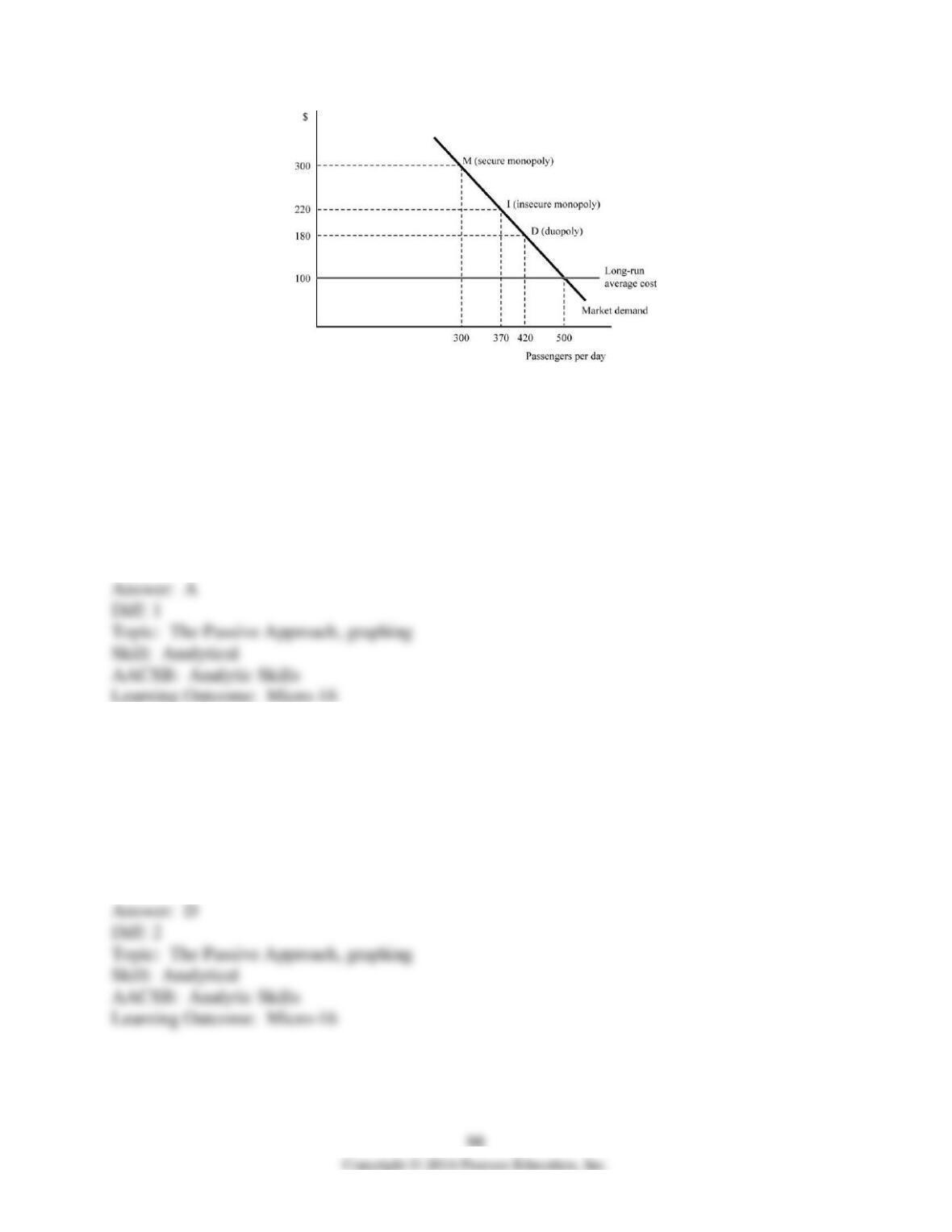
Figure 8.10
4) In Figure 8.10, airline Fly Smart is initially a secure monopoly between two cities X and Y at
point M, serving 300 passengers per day at the profit maximizing price of $300 per ticket. What
is Fly Smart’s profit per ticket?
A) $200
B) $120
C) $80
D) $0
5) In Figure 8.10, airline Fly Smart is initially a secure monopoly between two cities X and Y at
point M, serving 300 passengers per day at the profit maximizing price of $300 per ticket.
Suppose that Fly Smart discovers that a second airline is contemplating entering the market. If
Fly Smart accommodates the entry, what will its profit be?
A) $44,400
B) $33,600
C) $29,600
D) $16,800
6) In Figure 8.10, airline Fly Smart is initially a secure monopoly between two cities X and Y at
point M, serving 300 passengers per day at the profit maximizing price of $300 per ticket.
Suppose that Fly Smart discovers that a second airline is contemplating entering the market. If
the minimum market entry quantity is 130 passengers per day, Fly Smart’s entry-deterring
quantity is
A) 500 passengers per day.
B) 420 passengers per day.
C) 370 passengers per day.
D) 300 passengers per day.
7) In Figure 8.10, airline Fly Smart is initially a secure monopoly between two cities X and Y at
point M, serving 300 passengers per day at the profit maximizing price of $300 per ticket.
Suppose that Fly Smart discovers that a second airline is contemplating entering the market. If
the minimum market entry quantity is 130 passengers per day, what price should Smart Fly
charge to secure the entry-deterring quantity?
A) $300
B) $220
C) $180
D) $100
8) In Figure 8.10, airline Fly Smart is initially a secure monopoly between two cities X and Y at
point M, serving 300 passengers per day at the profit maximizing price of $300 per ticket.
Suppose that Fly Smart discovers that a second airline is contemplating entering the market. If
the minimum market entry quantity is 130 passengers per day, what is Fly Smart’s profit when it
commits to the entry-deterring quantity?
A) $60,000
B) $44,400
C) $33,600
D) $29,600
9) In Figure 8.10, airline Fly Smart is initially a secure monopoly between two cities X and Y at
point M, serving 300 passengers per day at the profit maximizing price of $300 per ticket.
Suppose that Fly Smart discovers that a second airline is contemplating entering the market. If
the minimum market entry quantity is 130 passengers per day, which is more profitable, entry
deterrence or the passive duopoly outcome?
A) entry deterrence outcome
B) passive duopoly outcome
C) Fly Smart would earn the same profit.
D) There is not sufficient information.
10) In Figure 8.10, airline Fly Smart is initially a secure monopoly between two cities X and Y at
point M, serving 300 passengers per day at the profit maximizing price of $300 per ticket.
Suppose that Fly Smart discovers that a second airline is contemplating entering the market. If
the minimum market entry quantity is zero passenger per day, what is Fly Smart’s profit when it
commits to the entry-deterring quantity?
A) $60,000
B) $44,400
C) $33,600
D) $0