17) The orbital hybridization on the carbon atom in S CN – is
A) sp.
B) sp2.
C) sp3.
D) sp3d2.
18) Which covalent bond is the most polar?
A) Cl—F
B) B—F
C) O—F
D) F—F
19) Which of the following should have the largest dipole moment?
A) H2(g)
B) CO2(g)
C) KCl(g)
D) CH3F(g)
20) Which of the following molecules does not have a dipole moment?
A) C2H4
B) NH3
C) CH3NH2
D) HCl
21) Which covalent bond is the most polar?
A) H—I
B) H—F
C) H—Cl
D) H—Br
22) Which has a dipole moment?
A) CF4
B) SiO32-
C) SO2
D) SO42-
23) Which of the following molecules does not have a dipole moment?
A) CBr2=CBr2
B) NCl3
C) CH3NH2
D) HCl
24) Which of the following should have the largest dipole moment?
A) F2(g)
B) SO2(g)
C) RbBr(g)
D) CH2I2(g)
25) Which compound, shown with its dipole moment, is expected to exhibit the smallest percent ionic
character?
A) CCl4
B) HBr
C) KCl
D) CH2Cl2
26) Which has the smallest dipole-dipole forces?
A) CH3Cl
B) KCN
C) I2
D) H2S
27) Which has the smallest dipole-dipole forces?
A) CH3F
B) HCl
C) N2
D) CO
28) Which of the following exhibits ion-dipole forces?
A) KBr(s)
B) NaF(aq)
C) Ag(s)
D) Cl2(g)
29) Which is expected to have the largest dispersion forces?
A) C2H4
B) C18H36
C) NBr3
D) Ba
30) Which is expected to have the largest dispersion forces?
A) C2H4
B) C8H16
C) Cl2
D) N2H4
31) Which of the following compounds exhibits hydrogen bonding?
A) CH3I
B) HI
C) CH3OCH3
D) CH3NH2
32) Which of the following compounds has the highest boiling point?
A) H2O
B) H2S
C) H2Se
D) H2Te
33) Which of the following compounds exhibits only dispersion and dipole–dipole intermolecular
interactions?
A) Na
B) HCl
C) BH3
D) CH3NHC4H9
34) In C3H7NHC3H7, which intermolecular forces are present?
A) Dispersion, hydrogen bonding and dipole-dipole forces are present.
B) Only dipole-dipole and ion-dipole forces are present.
C) Only dispersion and dipole-dipole forces are present.
D) Only hydrogen bonding forces are present.
35) In liquid pentanol, CH3CH2CH2CH2 , which intermolecular forces are present?
A) Dispersion, hydrogen bonding and dipole-dipole forces are present.
B) Only dipole-dipole and ion-dipole forces are present.
C) Only dispersion and dipole-dipole forces are present.
D) Only hydrogen bonding forces are present.
36) Which of the following compounds exhibits only dispersion and dipole-dipole intermolecular
interactions?
A) N2
B) HBr
C) CO2
D) H2O
37) The normal boiling point for H Br is higher than the normal boiling point for H Cl. This can be
explained by
A) larger dipole-dipole forces for H Br.
B) larger dispersion forces for H Br.
C) larger hydrogen-bond forces for H Br.
D) larger dipole-dipole forces, larger dispersion forces, and larger hydrogen-bond forces for H Br.
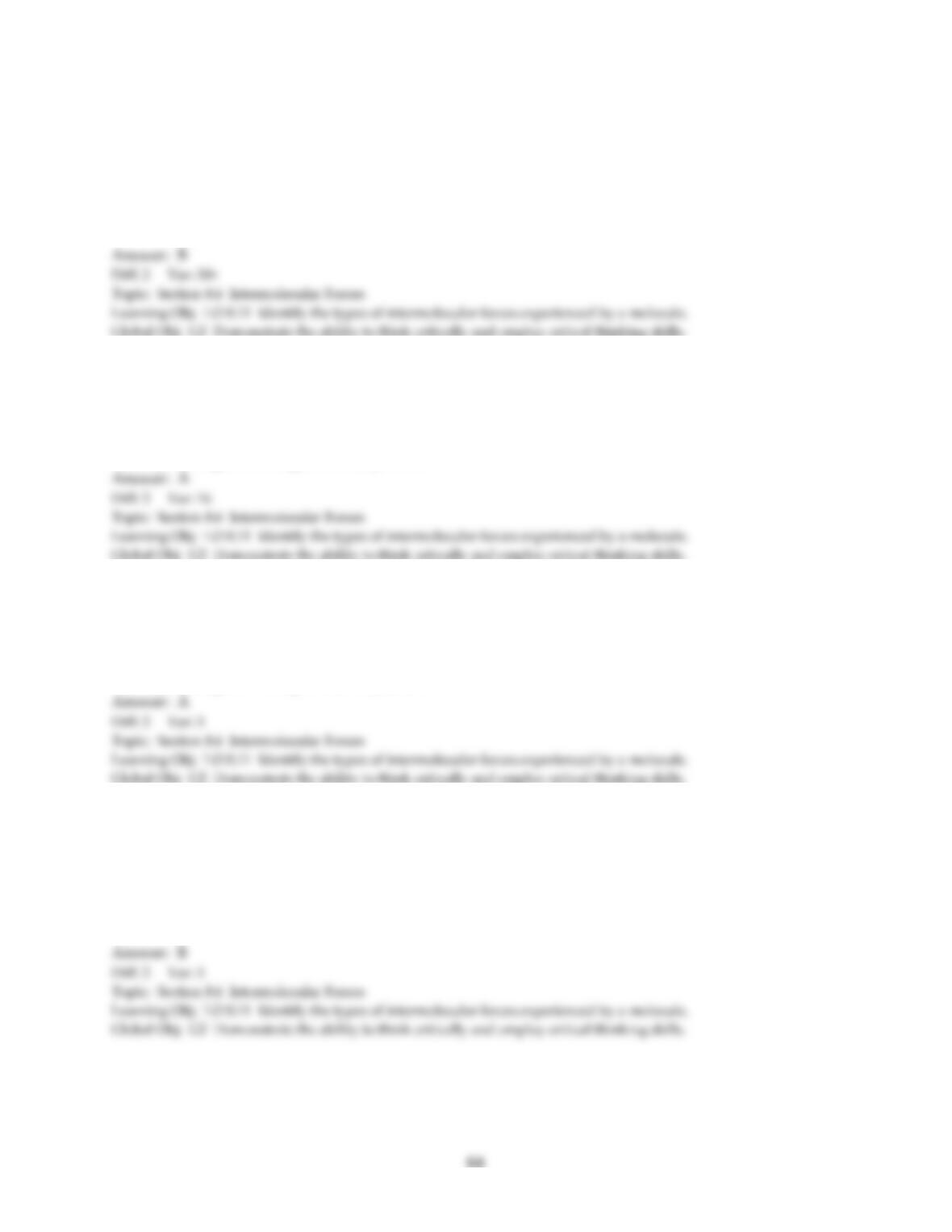
38) What is the geometry around the central atom in the following molecular model of BF3?
A) linear
B) bent
C) trigonal planar
D) trigonal pyramidal
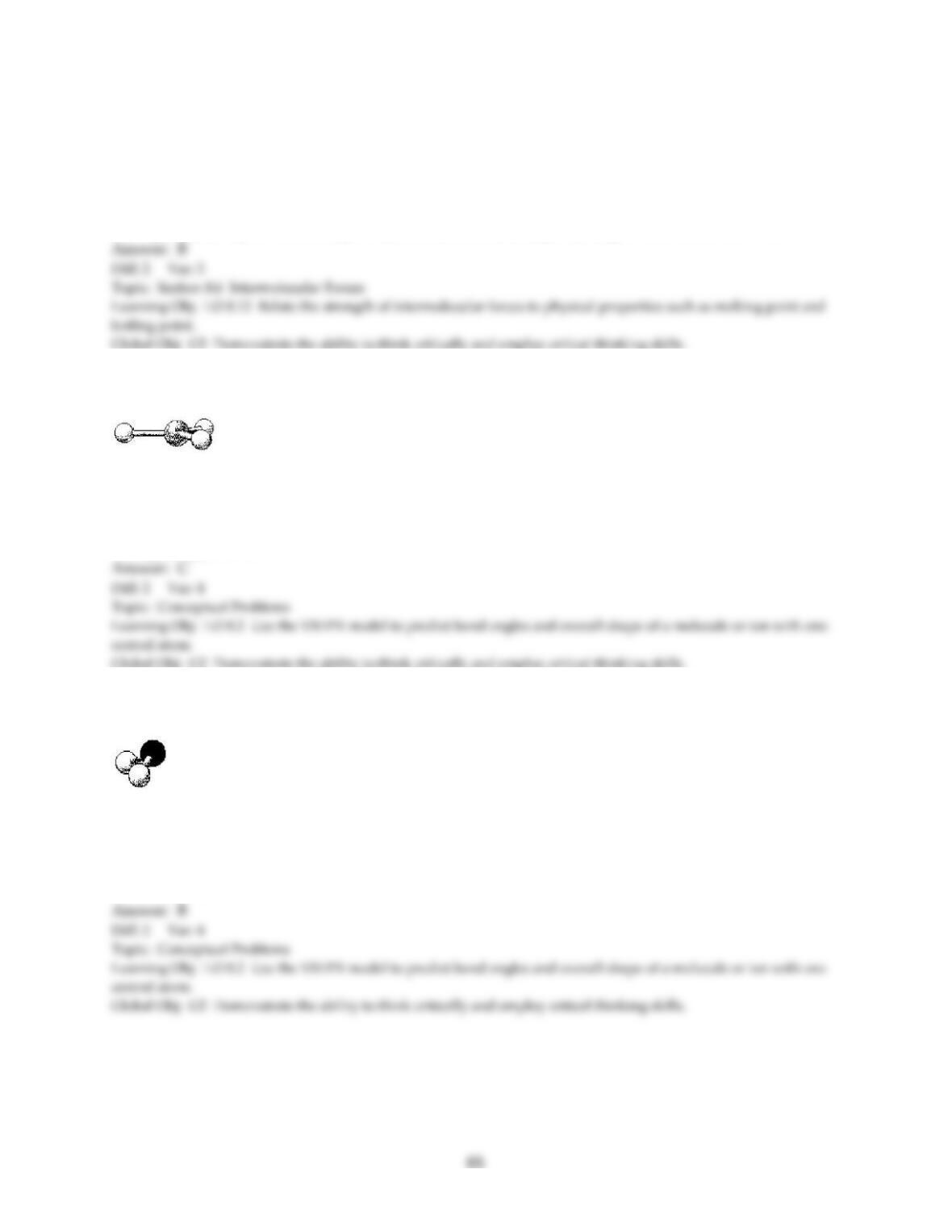
39) What is the geometry around the central atom in the following molecular model of H2Se?
A) linear
B) bent
C) trigonal pyramidal
D) tetrahedral
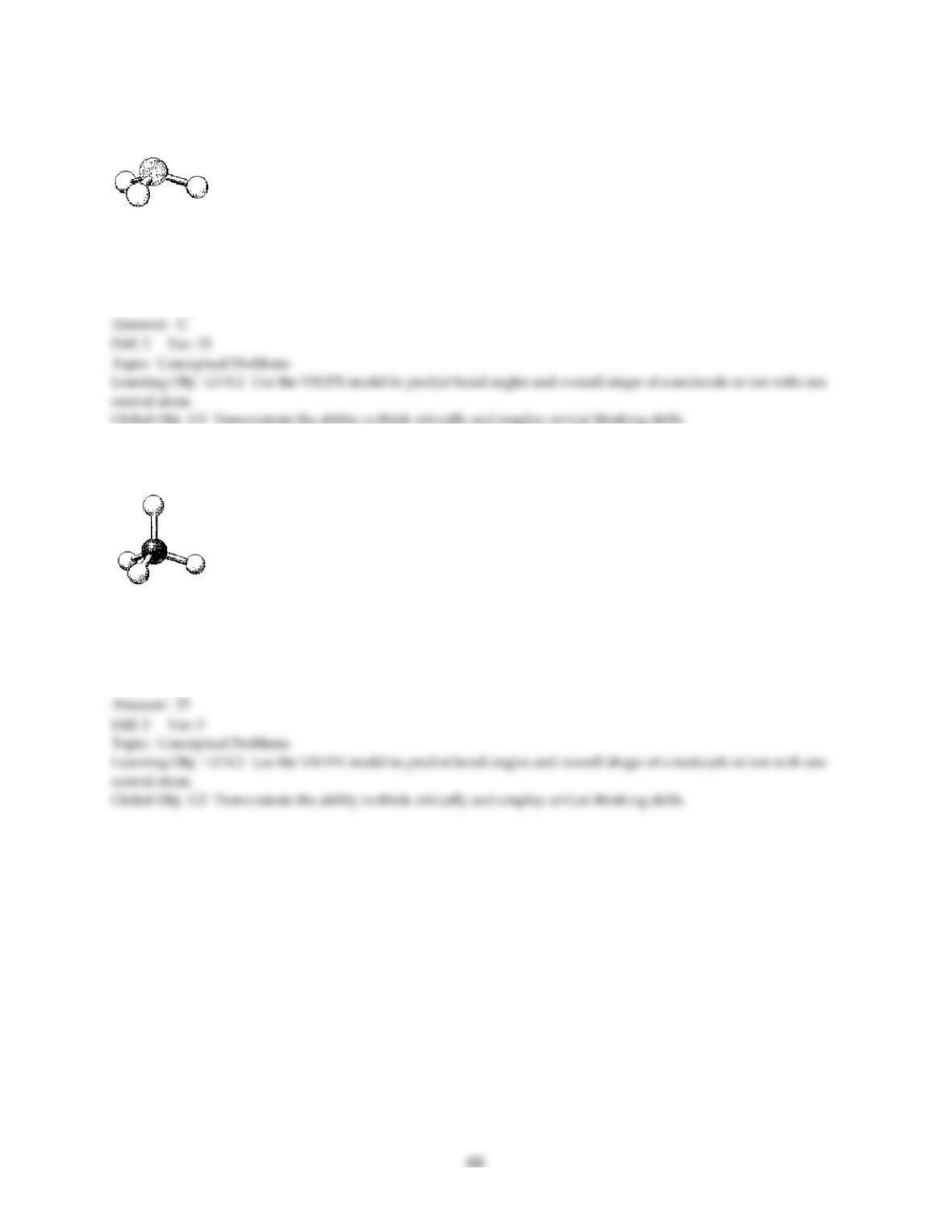
40) What is the geometry around the central atom in the following molecular model of PH3?
A) linear
B) bent
C) trigonal pyramidal
D) tetrahedral
41) What is the geometry around the central atom in the following molecular model of CCl4?
A) linear
B) bent
C) trigonal pyramidal
D) tetrahedral
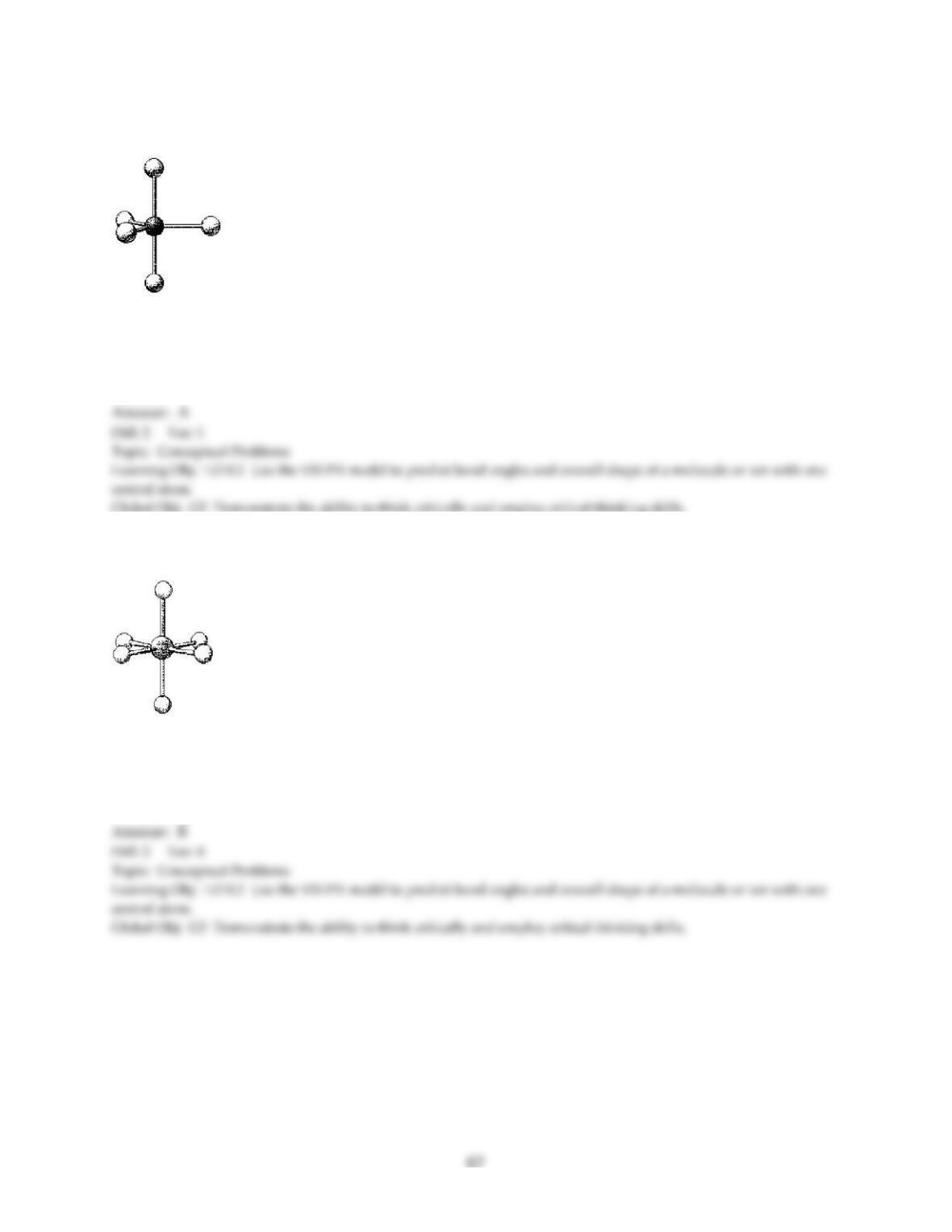
42) What is the geometry around the central atom in the following molecular model of PF5?
A) trigonal bipyramidal
B) seesaw
C) T-shaped
D) linear
43) What is the geometry around the central atom in the following molecular model of SI6?
A) trigonal bipyramidal
B) octahedral
C) square pyramidal
D) square planar
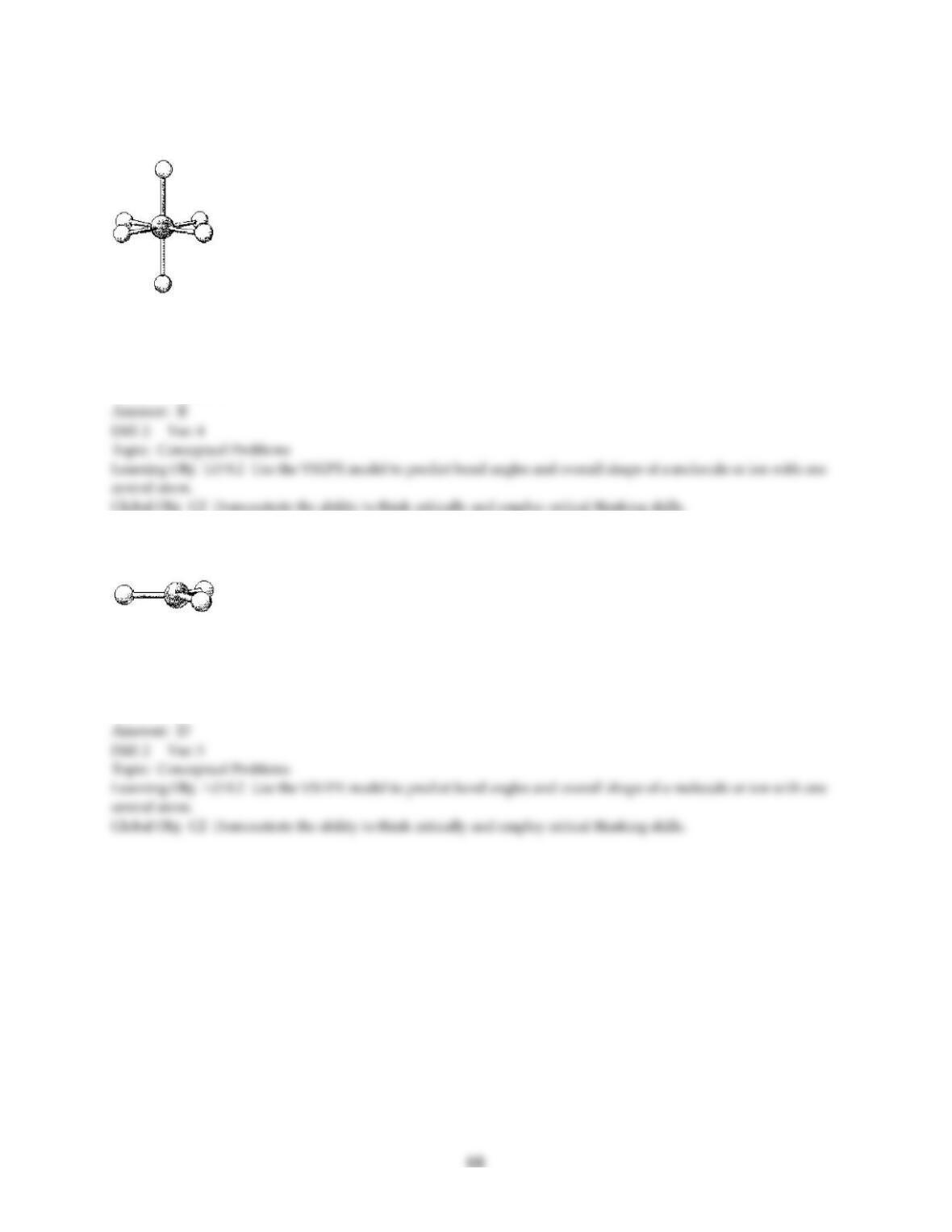
44) What is the geometry around the central atom in the following molecular model of PCl6–?
A) trigonal bipyramidal
B) octahedral
C) square pyramidal
D) square planar
45) What are the bond angles in the following molecular model of BBr3?
A) less than 109.5°
B) 109.5°
C) less than 120° but greater than 109.5°
D) 120°
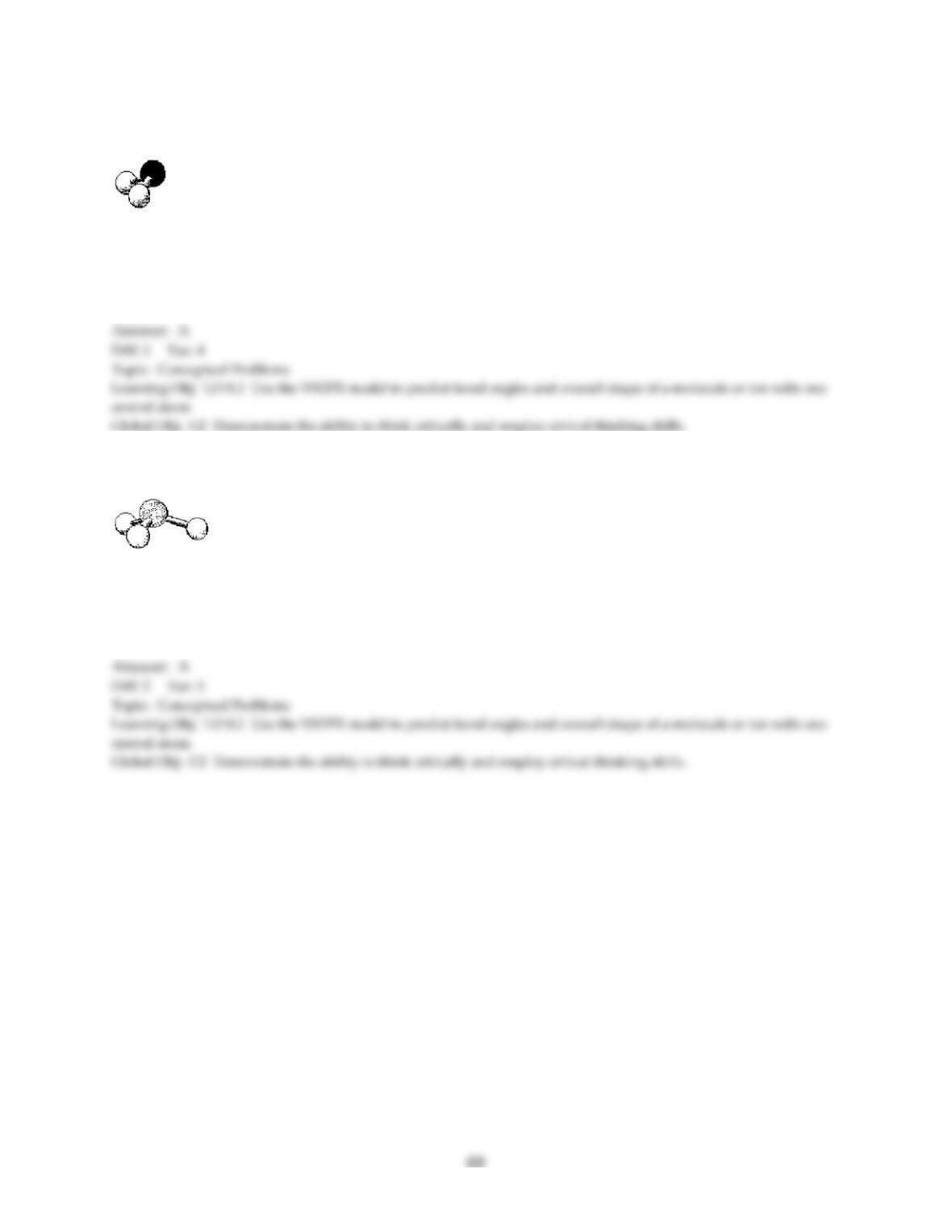
46) What is the bond angle in the following molecular model of H2Te?
A) less than 109.5°
B) 109.5°
C) less than 120° but greater than 109.5°
D) 120°
47) What are the bond angles in the following molecular model of PH3?
A) less than 109.5°
B) 109.5°
C) less than 120° but greater than 109.5°
D) 120°
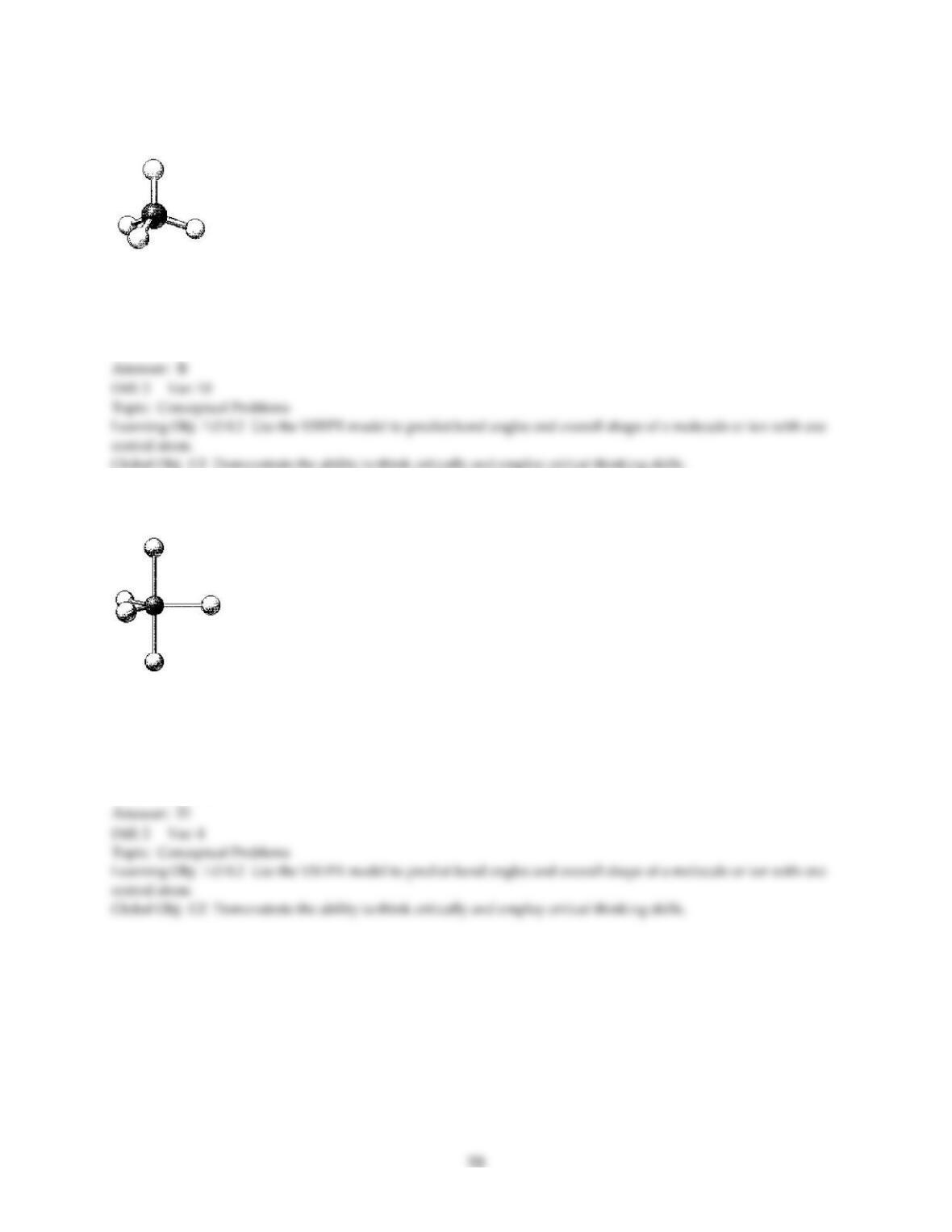
48) What are the bond angles in the following molecular model of SiCl4?
A) less than 109.5°
B) 109.5°
C) less than 120° but greater than 109.5°
D) 120°
49) What are the bond angles in the following molecular model of PCl5?
A) some less than 90° and one less than 180°
B) 90° and 180°
C) some less than 90° and some less than 120° but greater than 90°, and one less than 180° but greater
than 120°
D) 90°, 120°, and 180°
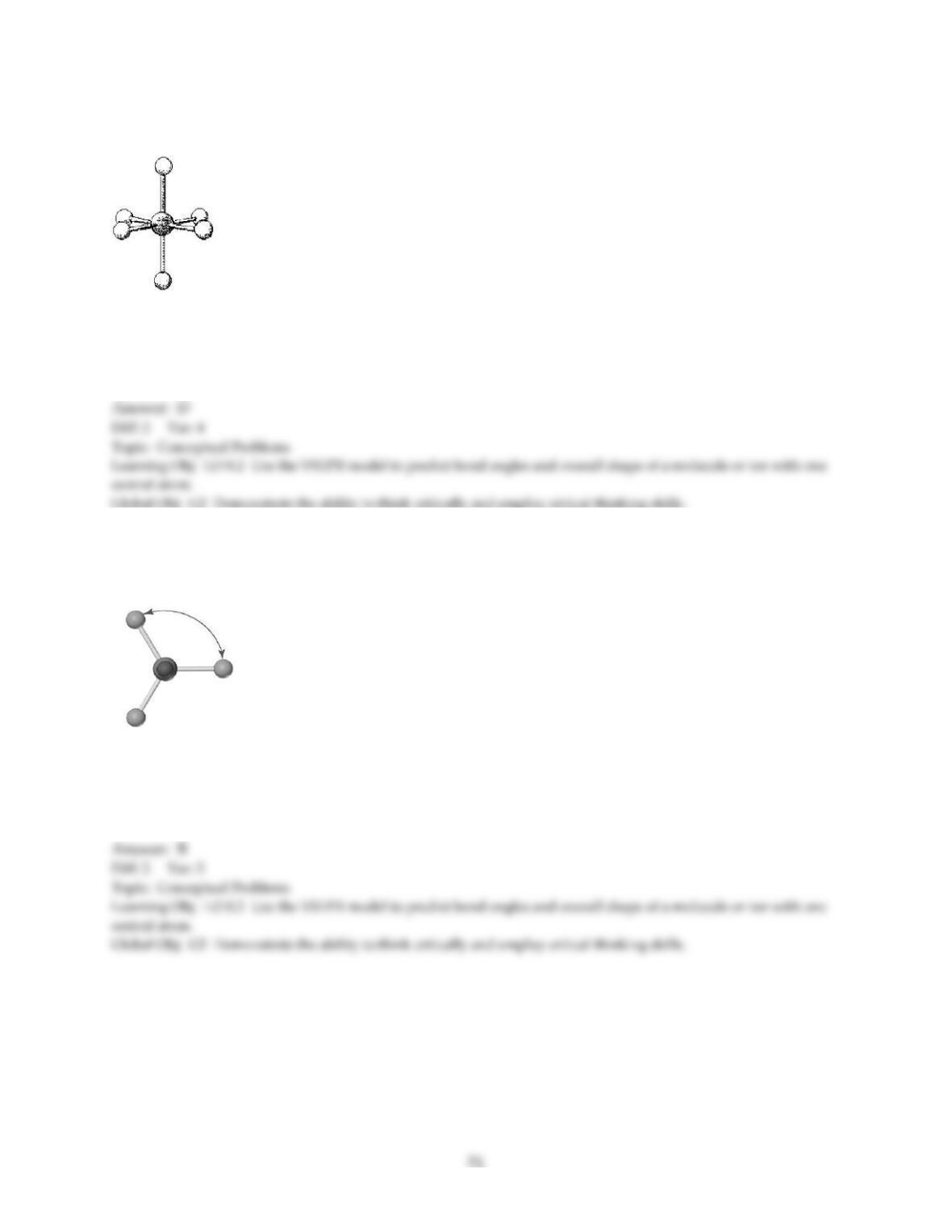
50) What are the bond angles in the following molecular model of SI6?
A) some less than 90° and some less than 120° but greater than 90°
B) 90° and 120°
C) some less than 90° and some less than 180° but greater than 120°
D) 90° and 180°
51) Shown below is a model of CBr4 having an orientation in which one or more atoms are hidden from
view. What is the indicated bond angle?
A) less than 109.5°
B) 109.5°
C) less than 120° but greater than 109.5°
D) 120°
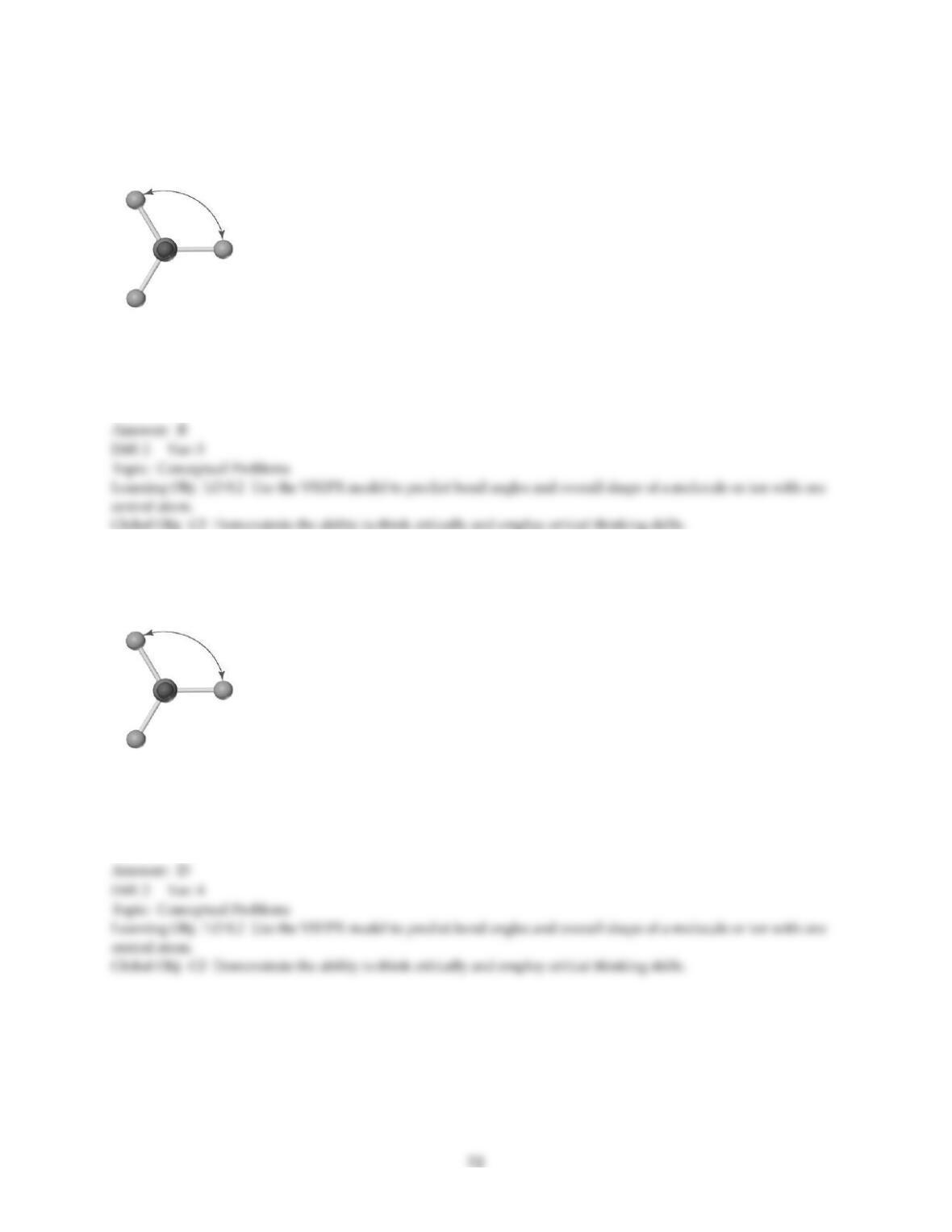
52) Shown below is a model of SiH4 having an orientation in which one or more atoms are hidden from
view. What is the indicated bond angle?
A) less than 109.5°
B) 109.5°
C) less than 120° but greater than 109.5°
D) 120°
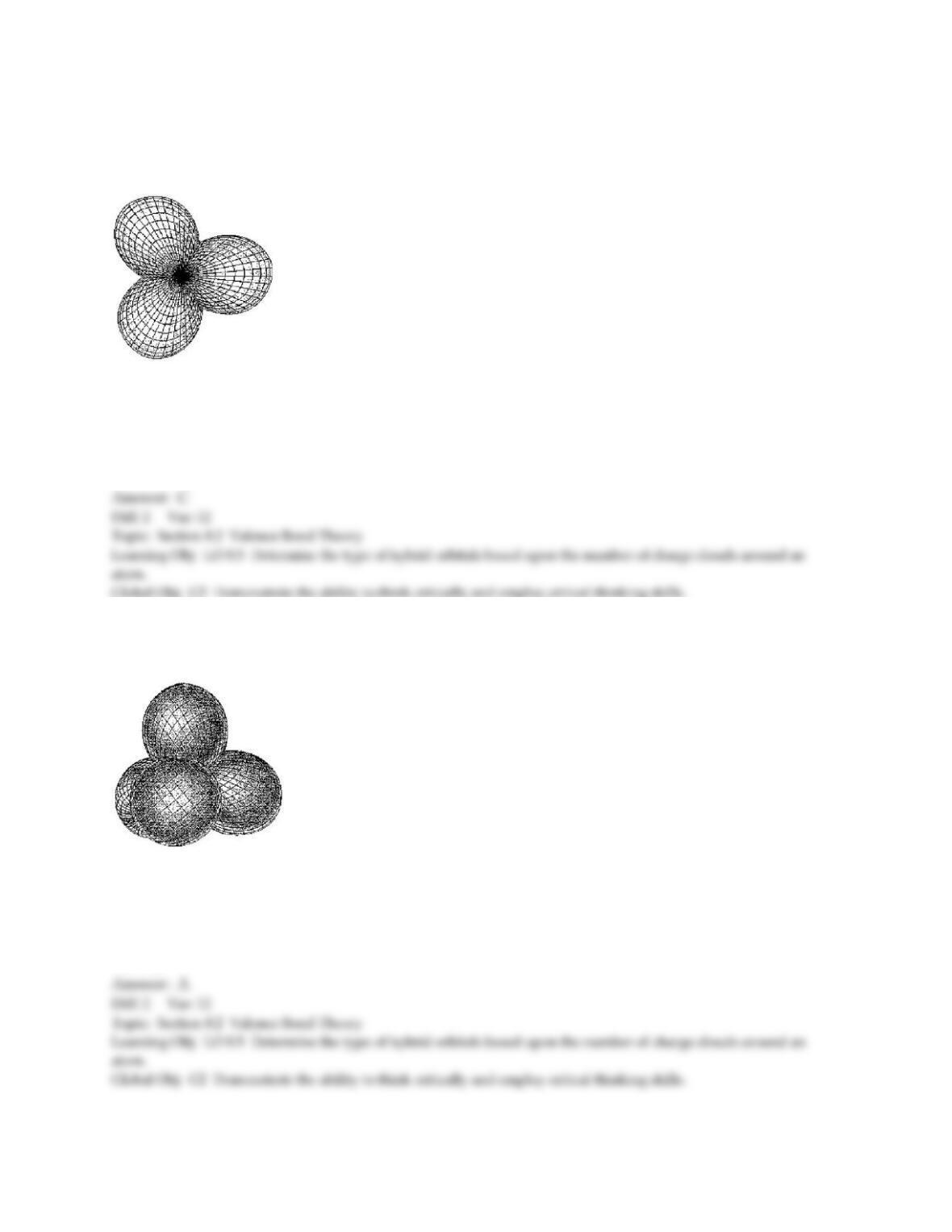
53) Shown below is a model of PCl5 having an orientation in which one or more atoms are hidden from
view. What is the indicated bond angle?
A) less than 109.5°
B) 109.5°
C) less than 120° but greater than 109.5°
D) 120°
73
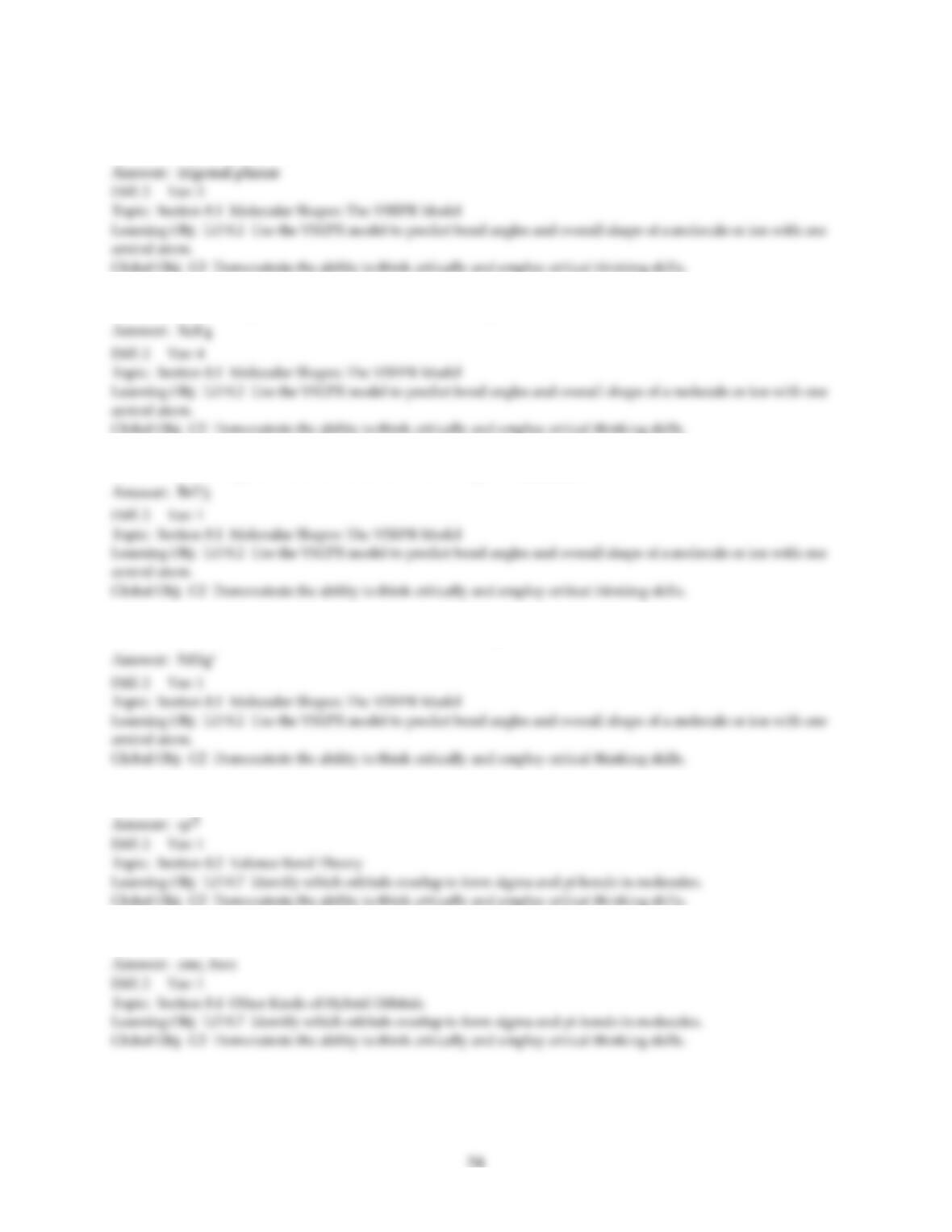
54) Which molecule has a central atom that uses the set of hybrid orbitals shown below to form bonds
with the non-central atoms?
A) H2S
B) CS2
C) NO2–
D) IF2–
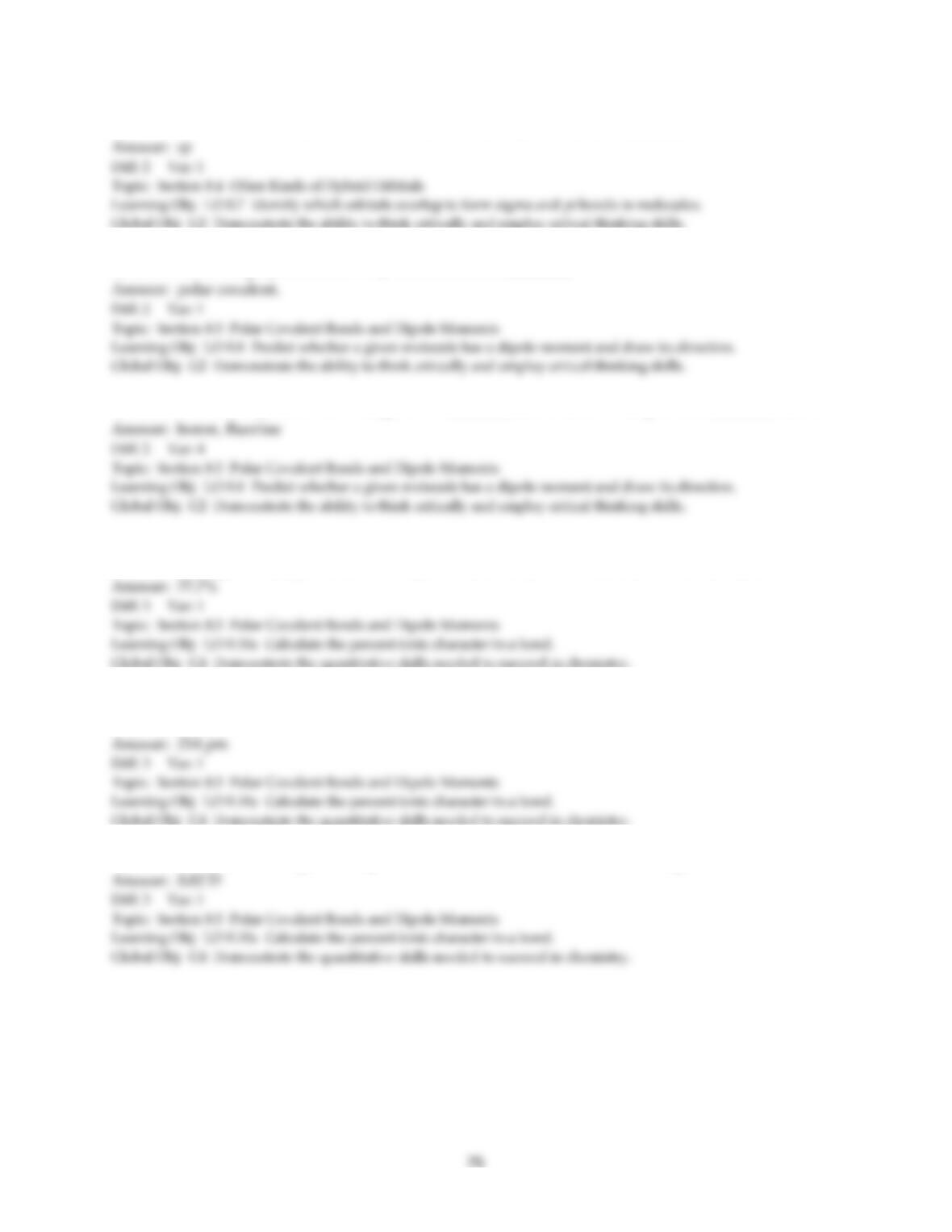
55) Which molecule has a central atom that uses the set of hybrid orbitals shown below to form bonds
with the non-central atoms?
A) H2Se
B) CS2
C) NO2–
D) ICl2–
8.3 Short Answer Questions
1) The molecular geometry of OCCl2 is ________.
2) Of XeF2 and XeF4, the one with the smaller bond angles is ________.
3) Of BrF3 and PF3, the one with the smaller bond angles is ________.
4) Of NH4+ and NH4– the one with the smaller bond angles is ________.
5) The hybrid orbital used by nitrogen to overlap with the 1s orbital of hydrogen in CH3NH2 is ________.
6) The carbon-carbon bond in C2H2 contains ________ σ and ________ π bonds.
7) The hybrid orbital used by carbon to overlap with hydrogen in C2H2 is ________.
8) The bonds in the polyatomic ion NO3– are classified as ________.
9) In the molecule BF3 there is a δ+ charge on the ________ atom and a δ– charge on the ________ atom.
10) LiH has an experimental dipole moment, μ = 6.00 D. If LiH were 100% ionic, the distance between
positive and negative charges would be 161 pm. What is the percent ionic character in the LiH bond?
11) The Br—Cl bond has 5.05% ionic character and a dipole moment of 0.518 D. What is the distance
between atoms in BrCl?
12) The HBr bond has a length of 141 pm and 12.1% ionic character. What is the dipole moment of HBr?
13) Pt(NH3)2Cl2 is square planar. The isomer of Pt(NH3)2Cl2 that has a non-zero dipole moment has a
bond angle of ________ degrees.
14) The polarity of CCl4 is ________.
15) The intermolecular forces formed when KI is dissolved in water are ________ forces.
16) The intermolecular forces responsible for CH3CH2OH being at liquid at 20°C are ________ bonds.
17) Helium can be liquefied when He atoms are attracted to one another by intermolecular ________
forces.
18) According to molecular orbital theory, is the highest energy orbital that contains an electron
antibonding or bonding in O22-?
19) When an electron is added to the lowest unoccupied molecular orbital of N2, the electron is added to
a(n) ________ (antibonding, bonding) molecular orbital and the N—N bond order will ________
(decrease, increase).
20) Predict whether removing two electrons from F2 will create an ion that is diamagnetic or
paramagnetic and have an F—F that is stronger or weaker than the bond in F2.
21) Are the π-bonds in CH3CO2– delocalized or localized?