15) Which one of the following is the best example of an oligopolistic industry?
A) long-distance telephone service
B) wheat growers
C) apple growers
D) public utilities
16) Which one of the following is the best example of an oligopolistic industry?
A) wheat growers
B) apple growers
C) public utilities
D) soft drinks
17) If the government limits the number of firms in a market by issuing a limited number of
licenses, the market structure is most likely to be
A) a perfectly competitive market.
B) a monopoly.
C) a monopolistically competitive market.
D) an oligopoly.
18) If substantial up-front investments in advertising campaigns become essential to a successful
market entry, the market is most likely to be
A) a perfectly competitive market.
B) a monopoly.
C) a monopolistically competitive market.
D) an oligopoly.
19) An oligopoly might occur as a result of
A) economies of scale in production.
B) government barriers to entry.
C) advertising.
D) all of the above
20) A special case of an oligopoly where there are only two firms is called
A) a monopoly.
B) a duopoly.
C) perfect competition.
D) monopolistic competition.
21) A duopoly is an industry with
A) one firm.
B) two firms.
C) many firms that sell slightly differentiated products.
D) many firms that sell identical products.
22) When firms cooperate with each other rather than compete
A) consumers will end up better off.
B) the firms will end up better off.
C) both consumers and firms end up better off.
D) they will agree to set low prices to help each other out.
23) A group of firms that coordinate their pricing decisions is called
A) a monopoly.
B) a duopoly.
C) a cartel.
D) monopolistic competition.
24) An arrangement under which a number of firms acts as a single firm and coordinate their
pricing decisions is
A) a monopoly.
B) monopolistic competition.
C) price fixing.
D) perfect competition.
25) When firms compete with each other rather than cooperate
A) consumers will end up better off.
B) the firms will end up better off.
C) prices will be higher.
D) output will be lower.
26) Cartels engage in price fixing in order to
A) drive out competition.
B) retain customers.
C) increase profits.
D) promote entry.
27) In general, firms in a cartel
A) agree to set price equal to marginal cost.
B) do not consider the actions of the other firms in the cartel when making output decisions.
C) produce levels of output exceeding the monopoly output level.
D) agree to charge the price the monopolist would charge.
28) Firms in a cartel usually charge
A) the same price.
B) different prices to reflect their different costs.
C) lower prices than a monopoly would.
D) higher prices than a monopoly would.
29) Price fixing is an arrangement whereby firms agree to
A) set price equal to marginal revenue.
B) set price equal to marginal cost.
C) set price equal to average total cost.
D) coordinate their pricing decisions.
30) In general, the market price in an oligopoly market is
A) lower than in perfect competition.
B) higher than in perfect competition.
C) the same as in perfect competition.
D) The answer depends on the shape of the average cost curve.
31) In general, the quantity of output in an oligopoly market is
A) lower than in perfect competition.
B) higher than in perfect competition.
C) the same as in perfect competition.
D) The answer depends on the shape of the average cost curve.
32) If the price in an oligopoly market is the same as that of a monopoly with identical cost and
demand conditions then
A) the average cost curve must be downward sloping.
B) there may be collusion between firms.
C) market demand must be unit elastic.
D) This could never happen.
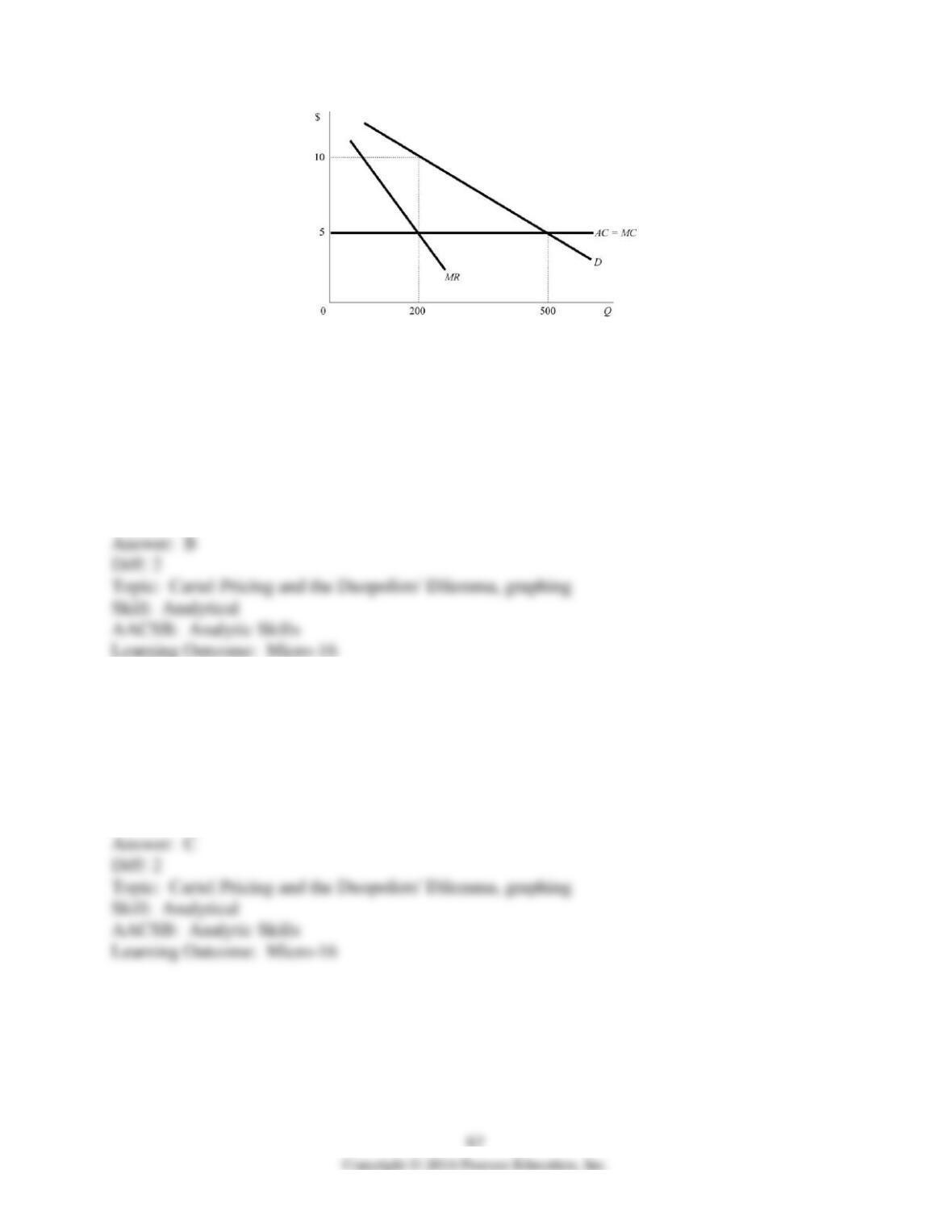
Figure 8.7
33) Figure 8.7 shows the market for a successful price-fixing arrangement (cartel) between two
identical firms. When the two firms act like one and charge the same price, the market price will
be ________ and each firm will produce and sell a quantity of ________.
A) $10; 200
B) $10; 100
C) $5; 500
D) $5; 250
34) Figure 8.7 shows a successful price-fixing arrangement (cartel) between two identical firms.
When the two firms act like one and charge the same price, each firm will earn an economic
profit of ________.
A) $1,250
B) $1,000
C) $500
D) $0
35) Figure 8.7 shows a successful price-fixing arrangement (cartel) between two identical firms.
If the cartel collapses and the two firms compete against each other, the price will be ________
and the quantity will be ________.
A) higher; greater
B) higher; smaller
C) lower; greater
D) lower; smaller
36) Figure 8.7 shows a successful price-fixing arrangement (cartel) between two identical firms.
If the cartel collapses and the two firms compete against each other, each firm’s profit will be
________ and the quantity will be ________.
A) smaller; smaller
B) smaller; greater
C) greater; smaller
D) greater; greater
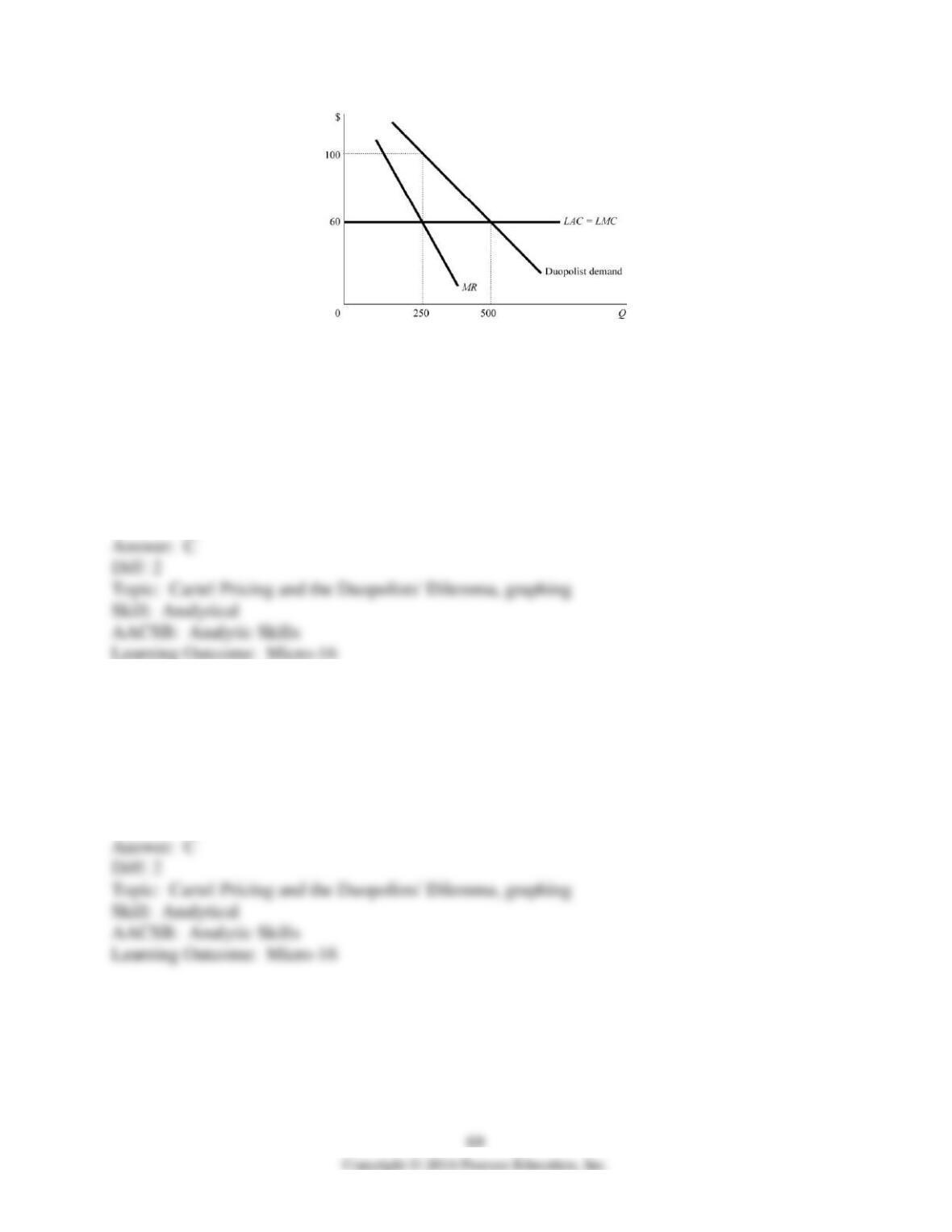
Figure 8.8
37) Figure 8.8 shows demand, marginal revenue, and costs of an individual duopolist. If the two
duopolists have the same costs and split the market equally, each profit maximizing duopolist
will produce and sell a quantity of ________.
A) 1,000 units
B) 500 units
C) 250 units
D) 125 units
38) Figure 8.8 shows demand, marginal revenue, and costs of a duopolist. If the two duopolists
have the same costs and split the market equally, each profit maximizing duopolist will earn a
profit of ________.
A) $30,000
B) $15,000
C) $10,000
D) $0
39) Figure 8.8 shows demand, marginal revenue, and costs of a duopolist. Suppose that the two
duopolists have the same costs. If the two firms form a cartel and charge the profit maximizing
monopoly price, compared to perfect competition, the market price will be ________ and the
total output level will be ________.
A) higher; greater
B) higher; smaller
C) lower; greater
D) lower; smaller
40) Figure 8.8 shows demand, marginal revenue, and costs of a duopolist. Suppose that the two
duopolists have the same costs. If the two firms form a cartel and charge the profit maximizing
monopoly price, then compared to perfect competition each firm’s profit will be ________ and
the total output level will be ________.
A) greater; greater
B) greater; smaller
C) smaller; greater
D) smaller; smaller
41) A graphical tool that provides a visual representation of the consequences of alternative
strategies is a
A) game tree.
B) network.
C) strategy set.
D) decision node.
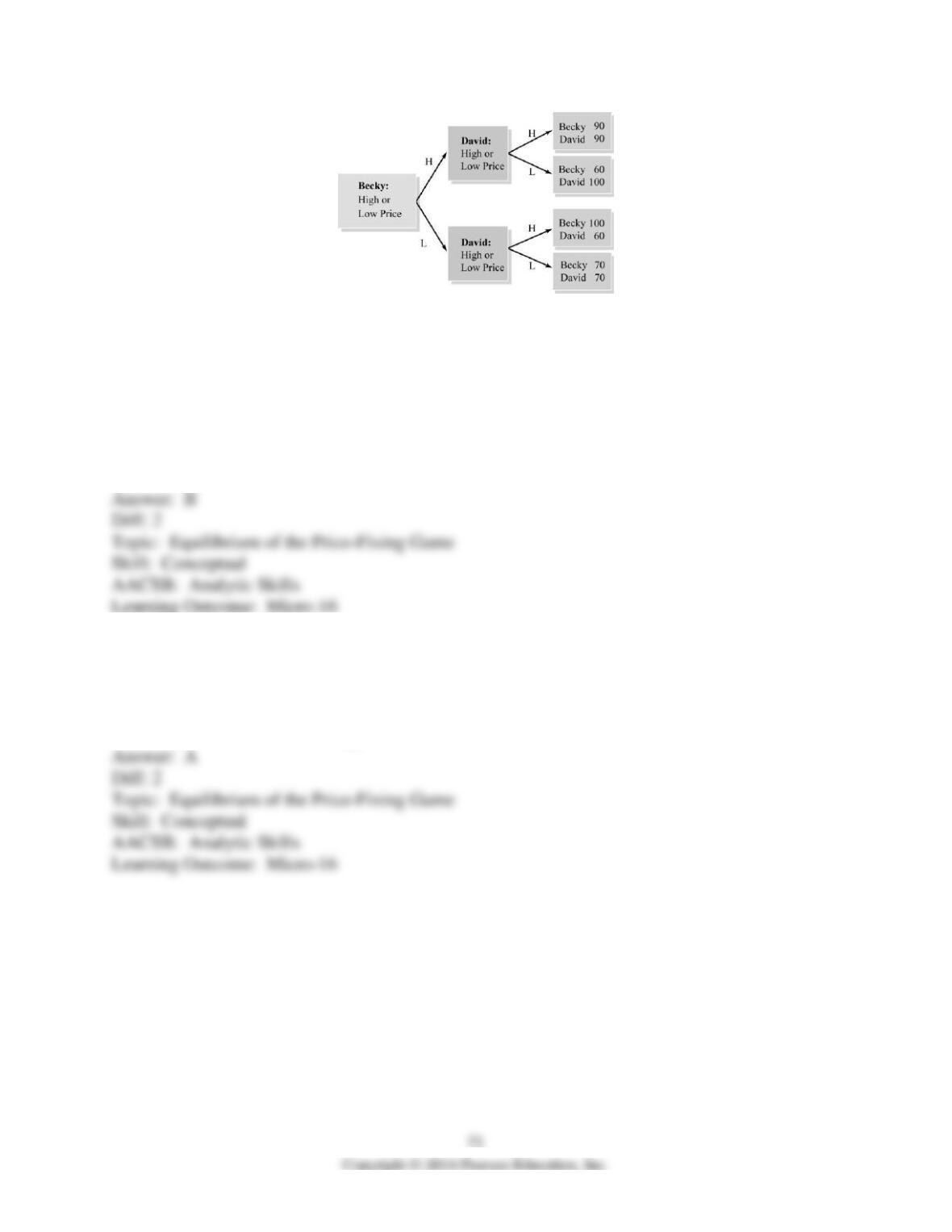
Figure 8.9
42) Consider Figure 8.9. Becky’s dominant strategy is ________ and David’s dominant strategy
is ________.
A) high; high
B) low; low
C) high; low
D) low; high
43) Consider Figure 8.9. Which of the following statements is true?
A) Both David and Becky have a dominant strategy.
B) Neither David nor Becky has a dominant strategy.
C) David has a dominant strategy but Becky does not.
D) Becky has a dominant strategy but David does not.
44) Consider Figure 8.9. Choosing a low price is
A) a dominant strategy for David but not for Becky.
B) a dominant strategy for Becky but not for David.
C) a dominant strategy for both David and Becky.
D) not a dominant strategy for either David or Becky.
45) Consider Figure 8.9. Choosing a high price is
A) a dominant strategy for David but not for Becky.
B) a dominant strategy for Becky but not for David.
C) a dominant strategy for both David and Becky.
D) not a dominant strategy for either David or Becky.
46) Consider Figure 8.9. David chooses to charge a low price
A) only if Becky chooses a high price.
B) only if Becky chooses a low price.
C) regardless of whether Becky chooses a high or low price.
D) in order to induce Becky to choose a high price.
47) Consider Figure 8.9. Becky chooses to charge a low price
A) only if David chooses a low price.
B) only if David chooses a high price.
C) regardless of whether David chooses a high or low price.
D) in order to induce David to choose a high price.
48) Consider Figure 8.9. The outcome of the game will be that
A) both choose a high price.
B) both choose a low price.
C) Becky chooses a high price and David chooses a low price.
D) David chooses a high price and Becky chooses a low price.
49) Consider Figure 8.9. If Becky’s payoff in the top rectangle were 300 instead of 90, the
outcome of the game would be that
A) both choose a high price.
B) both choose a low price.
C) Becky chooses a high price and David chooses a low price.
D) David chooses a high price and Becky chooses a low price.
50) Consider Figure 8.9. If David’s payoff in the bottom rectangle were 40 instead of 70, the
outcome of the game would be that
A) both choose a high price.
B) both choose a low price.
C) Becky chooses a high price and David chooses a low price.
D) David chooses a high price and Becky chooses a low price.
51) Consider Figure 8.9. If Becky’s payoff in the second rectangle from the top were 80 instead
of 60, the outcome of the game would be that
A) both choose a high price.
B) both choose a low price.
C) Becky chooses a high price and David chooses a low price.
D) David chooses a high price and Becky chooses a low price.
52) The incentive to charge a low price even though it leads to lower profits in Figure 8.9 is an
example of
A) the duopolists’ dilemma.
B) tying products.
C) scarcity and choice.
D) the economic problem.
53) Consider Figure 8.9. If Becky and David could coordinate their decisions then
A) they would each earn profits of 100.
B) they would both choose to charge a low price and earn profits of 90 each.
C) they would both choose to charge a high price and earn profits of 90 each.
D) they would both choose to charge a high price and earn profits of 70 each.
54) Consider Figure 8.9. Relative to the dominant strategy outcome, guaranteed price fixing
would lead to
A) lower prices but higher profits.
B) lower prices and lower profits.
C) higher prices and higher profits.
D) higher prices and lower profits.
55) Consider Figure 8.9. If the players choose independently, what will be the outcome?
A) Becky chooses a low price and David chooses a low price.
B) Becky chooses a high price and David chooses a low price.
C) Becky chooses a low price and David chooses a high price.
D) Becky chooses a high price and David chooses a high price.
56) Price fixing tends to fail in an oligopoly because
A) firms like to have flexibility in setting prices.
B) each firm has an incentive to underprice the other firms.
C) it increases the quantity demanded.
D) consumers don’t like fixed prices.
57) A dominant strategy is one that
A) maximizes profits.
B) is optimal under some conditions.
C) never yields a negative payoff.
D) is the best choice under all conditions.
58) An action that is the best choice under all conditions is known as a
A) profit-maximizing strategy.
B) dilemma.
C) trigger strategy.
D) dominant strategy.
59) The duopolists’ dilemma refers to the situation in which
A) duopolists would be better off maintaining high prices but face an incentive to choose a low
price.
B) duopolists can only earn high profits by breaking the law.
C) duopolists who are engaged in price fixing have an incentive to report the behavior to the
government.
D) duopolists do not have a dominant strategy.
60) A Nash Equilibrium in a game is that outcome in which
A) each player is doing the best he or she can given the other player’s action.
B) the players’ profits are equal.
C) the players’ earn the highest profits possible.
D) neither player plays his or her dominant strategy.
61) The concept of Nash Equilibrium
A) has wide applicability.
B) is limited in its applicability to economic behavior because firms do not follow their dominant
strategies.
C) is limited in its applicability to economic behavior because firms generally follow their
dominant strategies.
D) has been disproven by modern economists.
Recall the Application about the attempt to form a salt cartel in the 19th century to answer
the following question(s).
62) Recall the Application. One reason cited for the failure of the salt cartel was
A) the demand for salt sharply declined in the late 19th century.
B) new firms entering the market and underpricing the cartel.
C) foreign competition taking over the salt market.
D) the federal government’s banning of price fixing in the salt market.
63) Recall the Application. One of the primary goals of the salt producers who tried to form a
cartel was to
A) establish a uniform price for salt.
B) boost the demand for salt.
C) establish an export market for salt.
D) increase competition in the market for salt.
64) An oligopoly is an industry with just one firm.
65) Oligopoly arises with scale economies that large enough to cause a natural monopoly.
66) In oligopoly the actions of one firm has a perceptible affect on the other firms.
67) The higher the Herfindahl-Hirschman Index, the more firms there are in a market.
68) Market power is the power to produce at the lowest cost.
69) Even though in oligopoly the actions of one firm has a perceptible effect on the other firms,
oligopoly firms act independently.
70) Because in oligopoly the actions of one firm has a perceptible affect on the other firms,
oligopoly firms act strategically.
71) A duopoly is an industry with two firms in it.
72) A dominant strategy is one that is best no matter what the other player(s) do.
73) A dominant strategy is one that always produces the maximum profits for both firms.
74) Suppose that Jack promises that if Jill chooses the high price, he will too. Jack has an
incentive to cheat on the agreement.
75) Suppose that Jack promises that if Jill chooses the high price, he will too. Jill has no
incentive to cheat on the agreement.
76) In the price fixing game, when both firms choose their dominant strategy, each firm will
generally earn more profits than when both firms choose the alternative strategy.
77) The Nash Equilibrium outcome assures the maximum profit for firms.