41
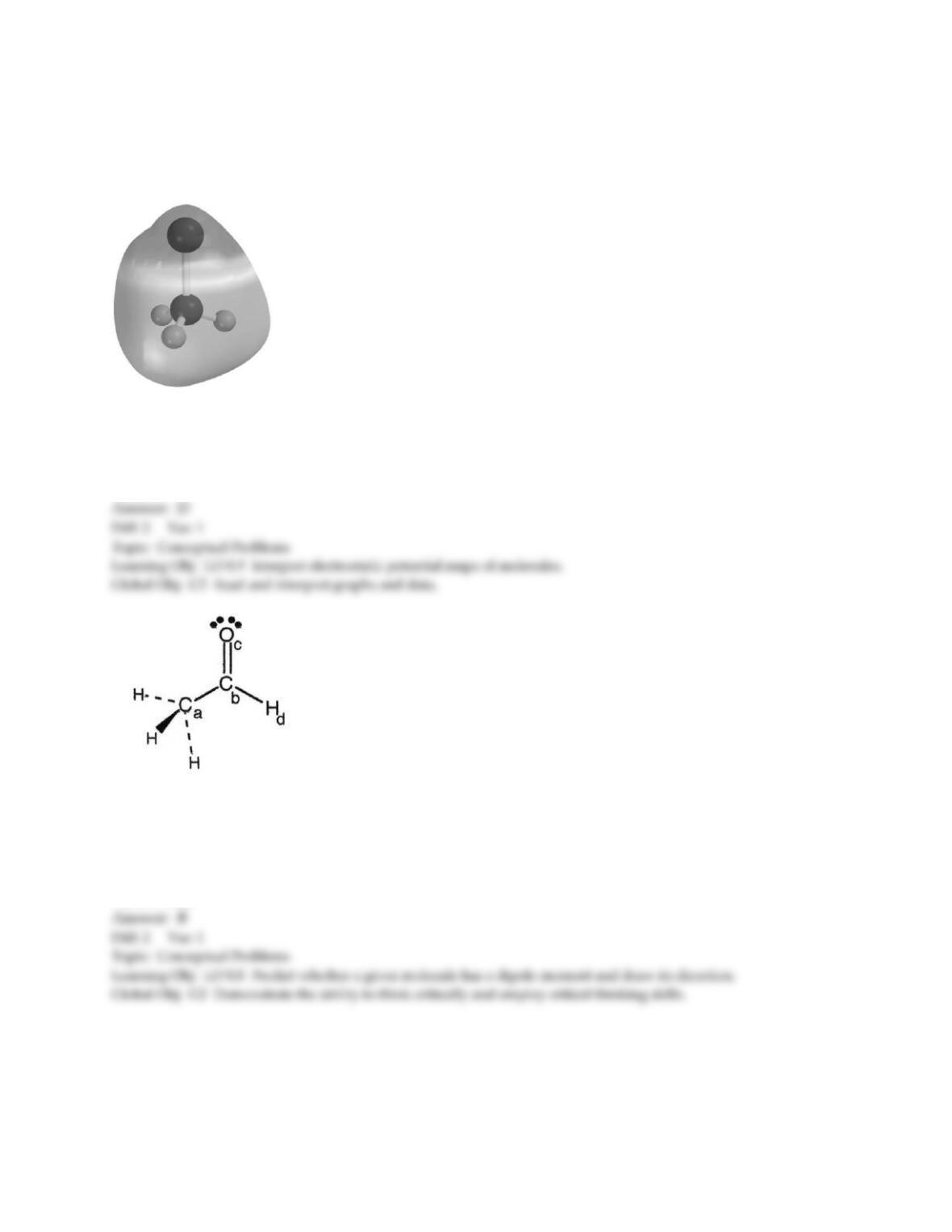
Atoms that are electron poor and carry a δ+ charge are shown in blue. Atoms that are electron rich and
carry a δ– charge are shown in red. Atoms with little or no charge are shown in green. The electrostatic
potential map of CH3Li below should show
A) C blue and Li red.
B) C blue and Li green.
C) C green and Li blue.
D) C red and Li blue.
108) In the drawing of acetaldehyde, CH3CHO, the largest partial positive charge (δ+) occurs on
A) atom (a).
B) atom (b).
C) atom (c).
D) atom (d).
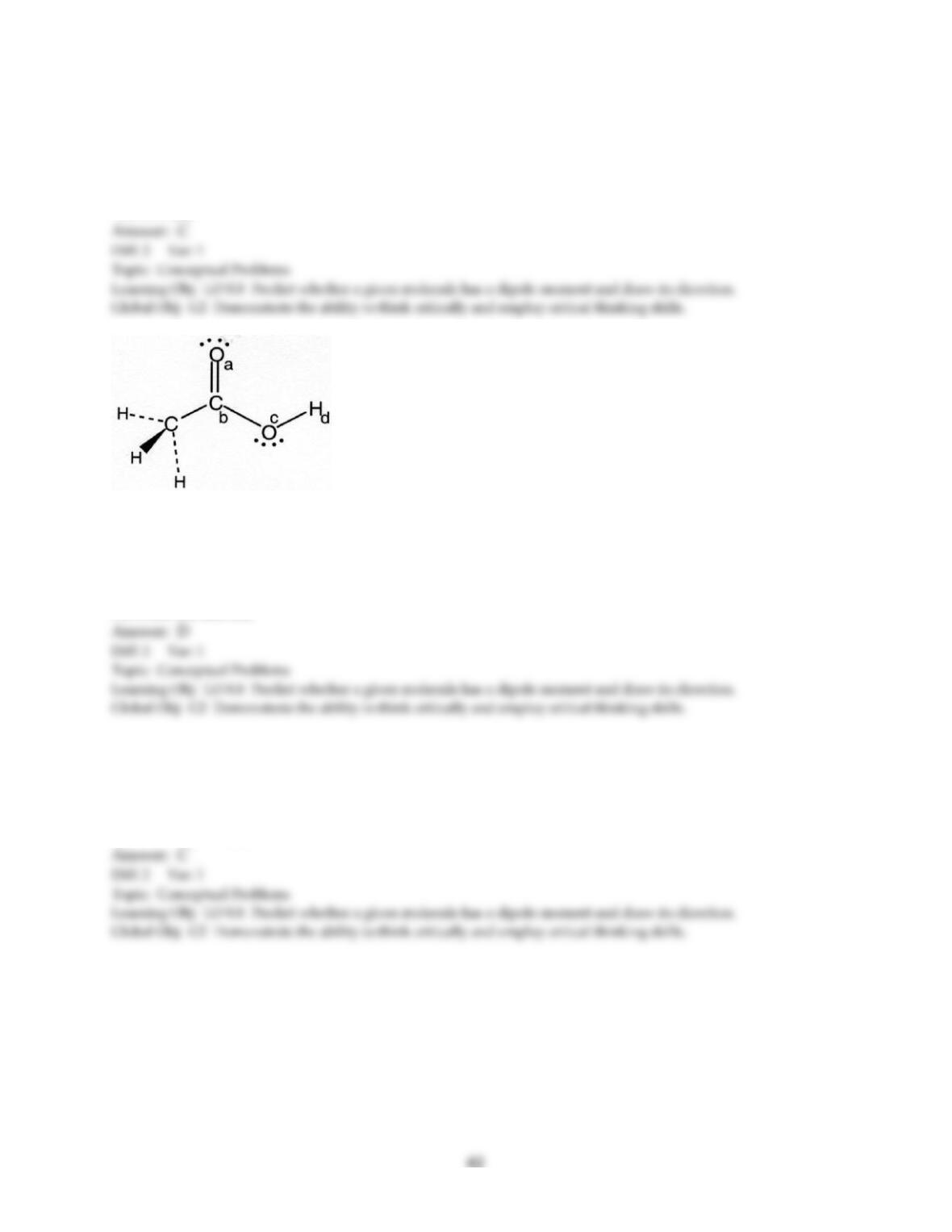
109) In the drawing of acetaldehyde, CH3CHO, the largest partial negative charge (δ-) occurs on
A) atom (a).
B) atom (b).
C) atom (c).
D) atom (d).
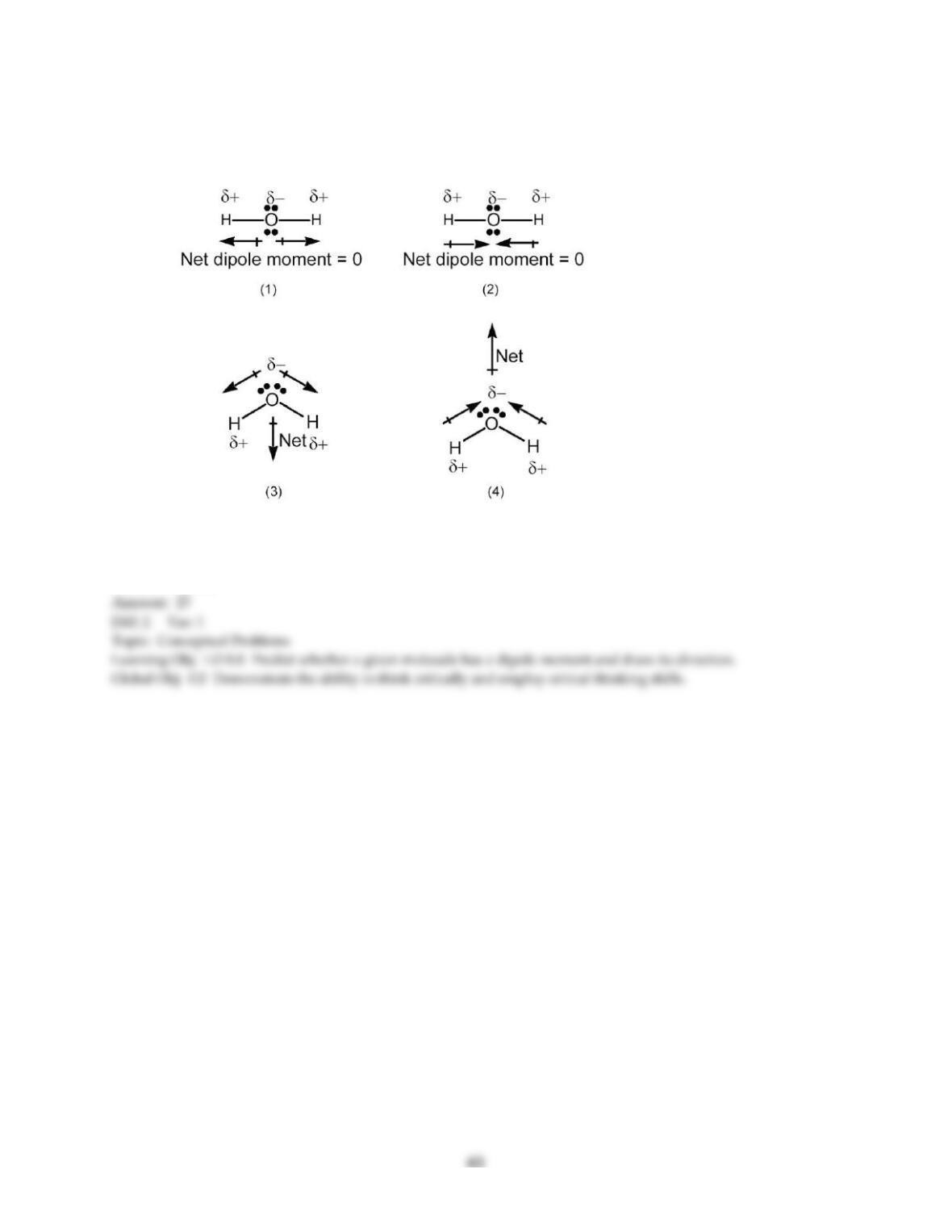
110) In the drawing of acetic acid, CH3CO2H, a partial positive charge (δ+) occurs on
A) only atom (a).
B) only atom (b).
C) atoms (a) and (c).
D) atoms (b) and (d).
111) In the drawing of acetic acid, CH3CO2H, a partial negative charge (δ-) occurs on
A) only atom (a).
B) only atom (b).
C) atoms (a) and (c).
D) atoms (b) and (d).
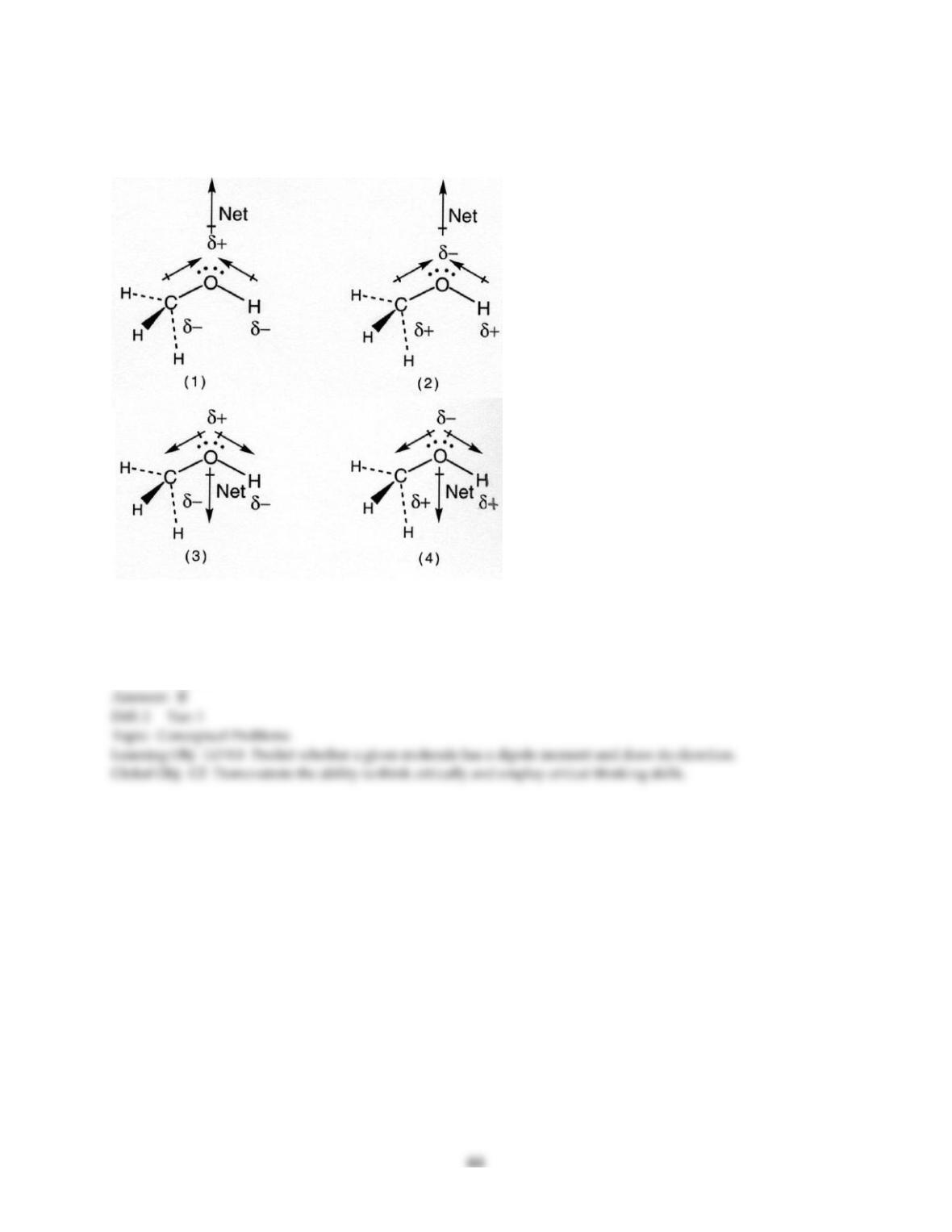
112) Which drawing best accounts for the polarity of water, H2O, and the bond polarities that make a
major contribution to the overall molecular polarity?
A) drawing (1)
B) drawing (2)
C) drawing (3)
D) drawing (4)
113) Which drawing best accounts for the polarity of methanol, CH3OH, and the bond polarities that
make a major contribution to the overall molecular polarity?
A) drawing (1)
B) drawing (2)
C) drawing (3)
D) drawing (4)
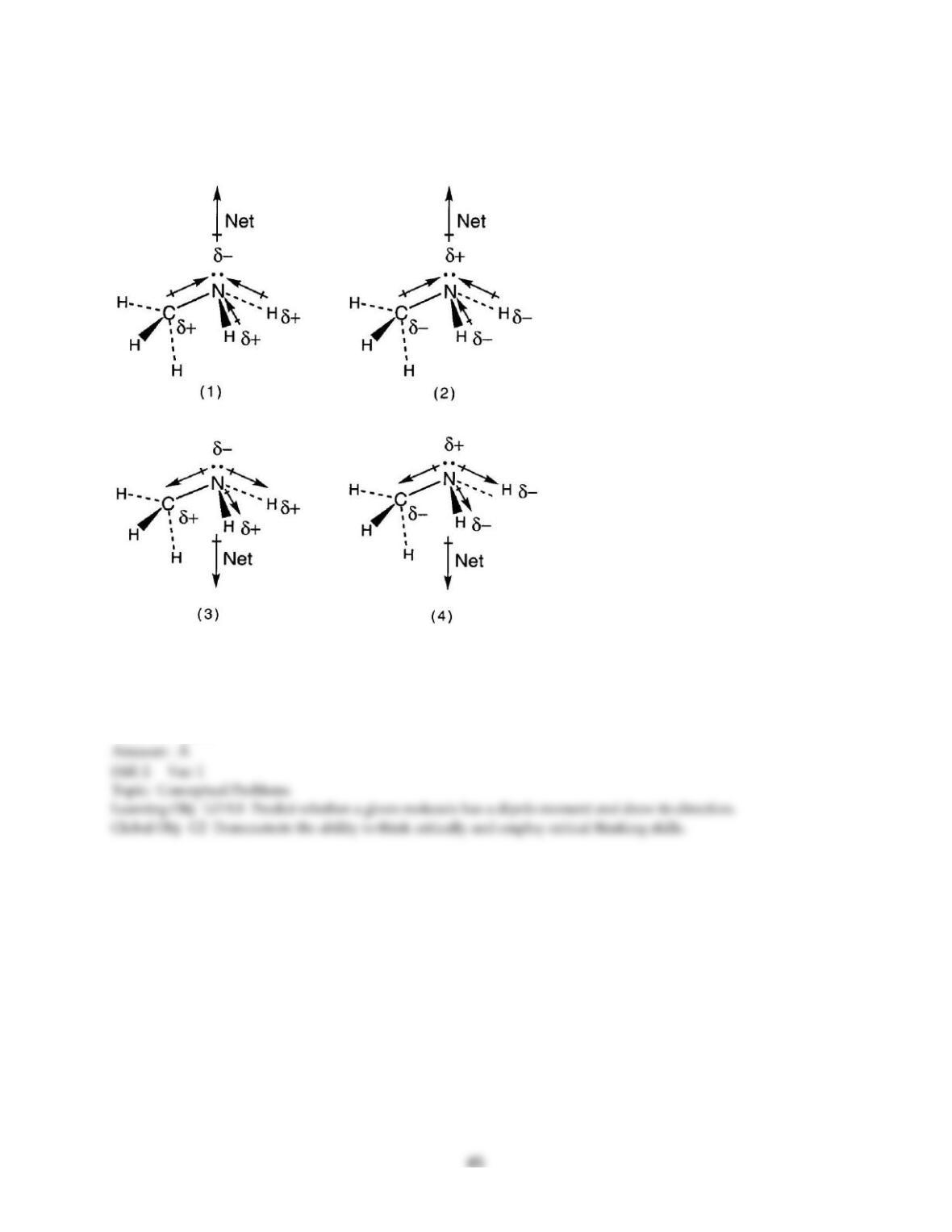
114) Which drawing best shows the molecular polarity of methylamine, CH3NH2, and the bond
polarities that make a major contribution to the overall molecular polarity?
A) drawing (1)
B) drawing (2)
C) drawing (3)
D) drawing (4)
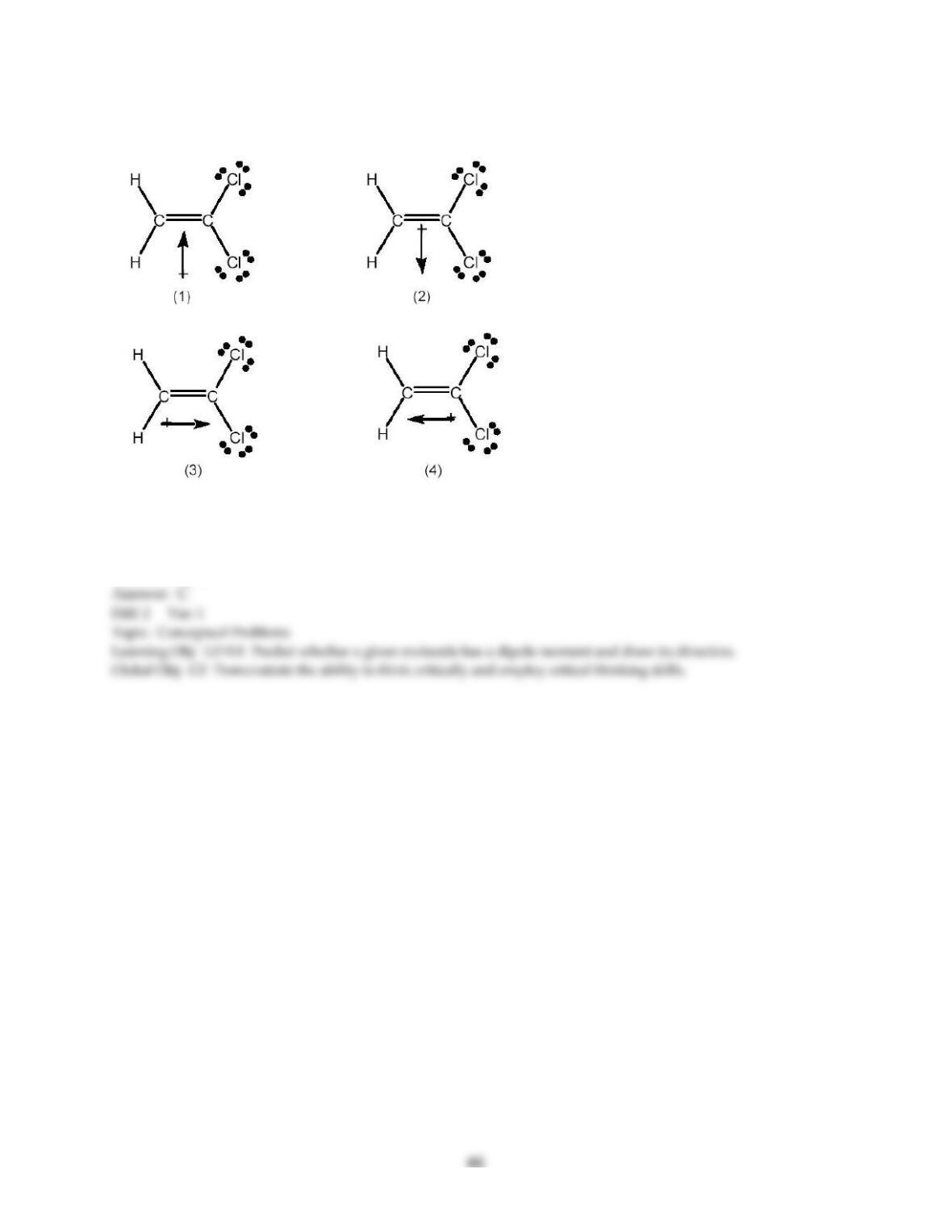
115) Which drawing best shows the direction of the dipole moment in H2C=CCl2?
A) drawing (1)
B) drawing (2)
C) drawing (3)
D) drawing (4)
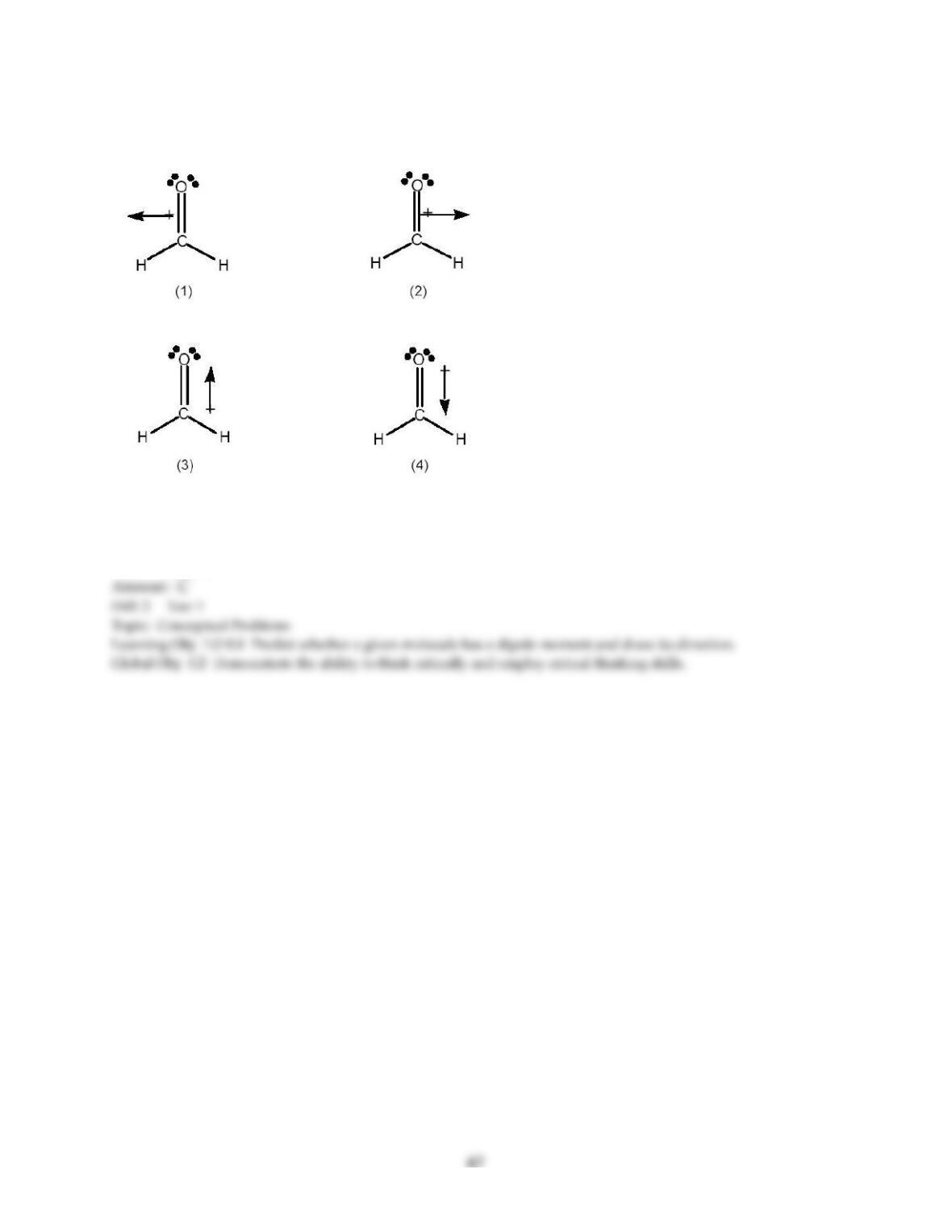
116) Which best indicates the direction of the dipole moment in formaldehyde, H2C=O?
A) drawing (1)
B) drawing (2)
C) drawing (3)
D) drawing (4)
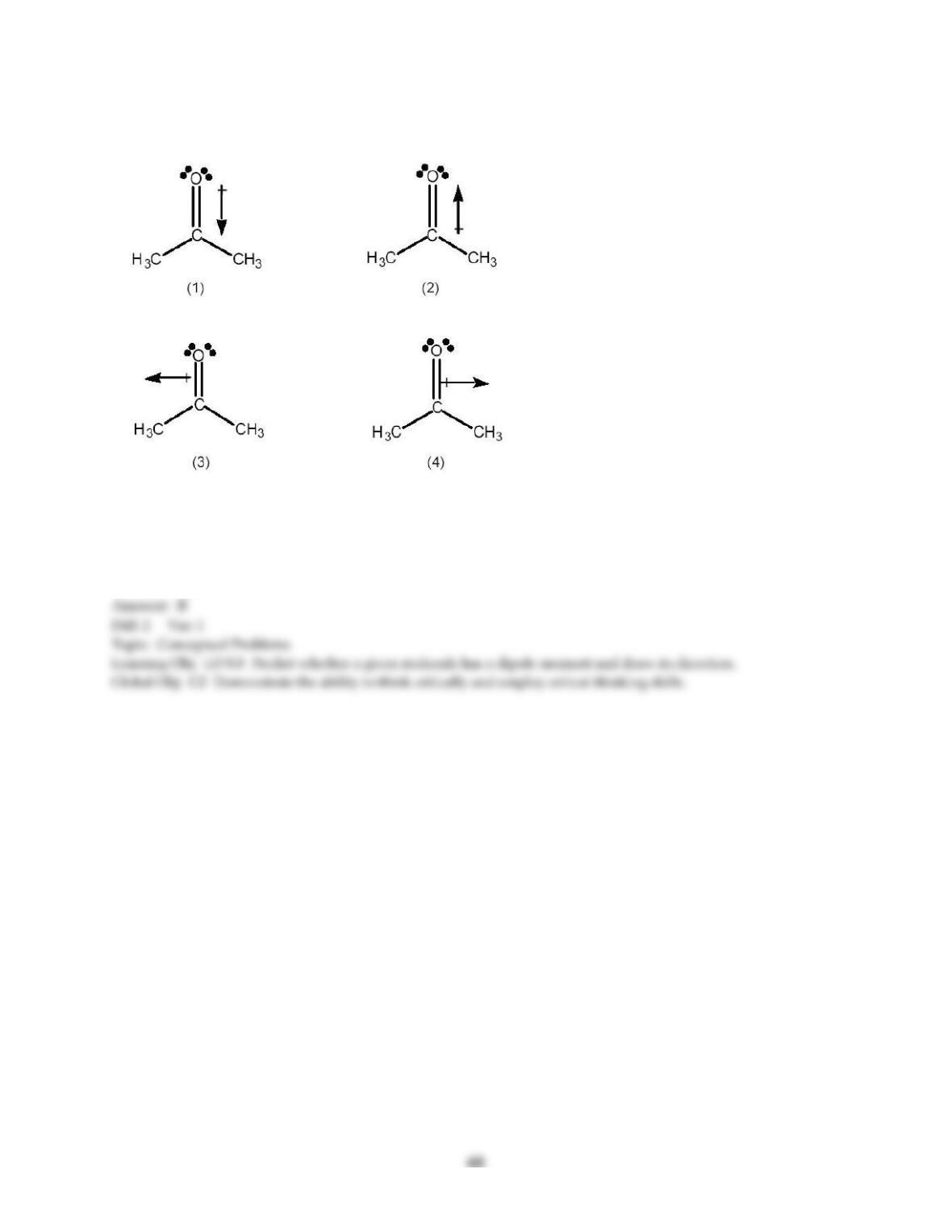
117) Which best indicates the direction of the dipole moment in acetone, (CH3)2C=O?
A) drawing (1)
B) drawing (2)
C) drawing (3)
D) drawing (4)
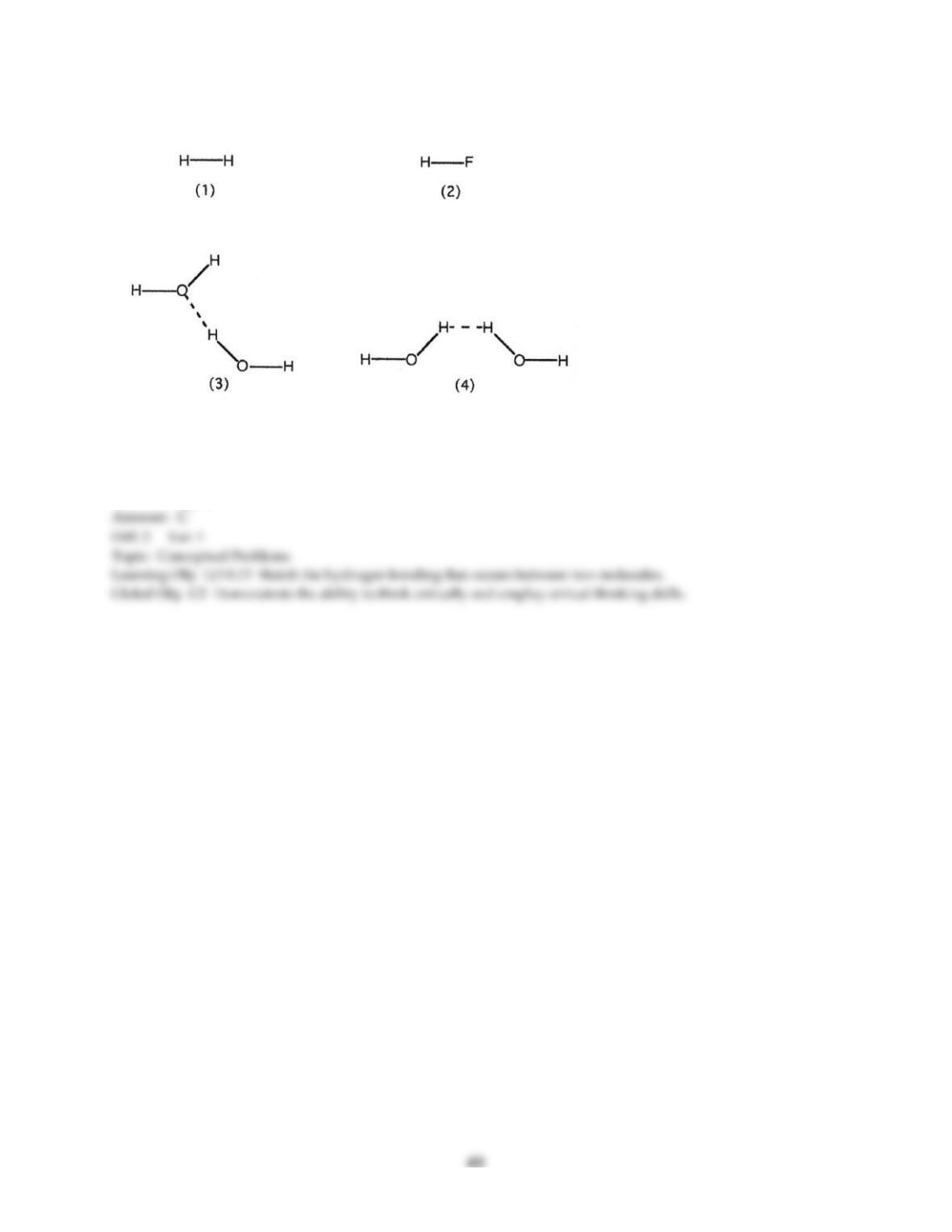
118) Which drawing best represents hydrogen bonding?
A) drawing (1)
B) drawing (2)
C) drawing (3)
D) drawing (4)
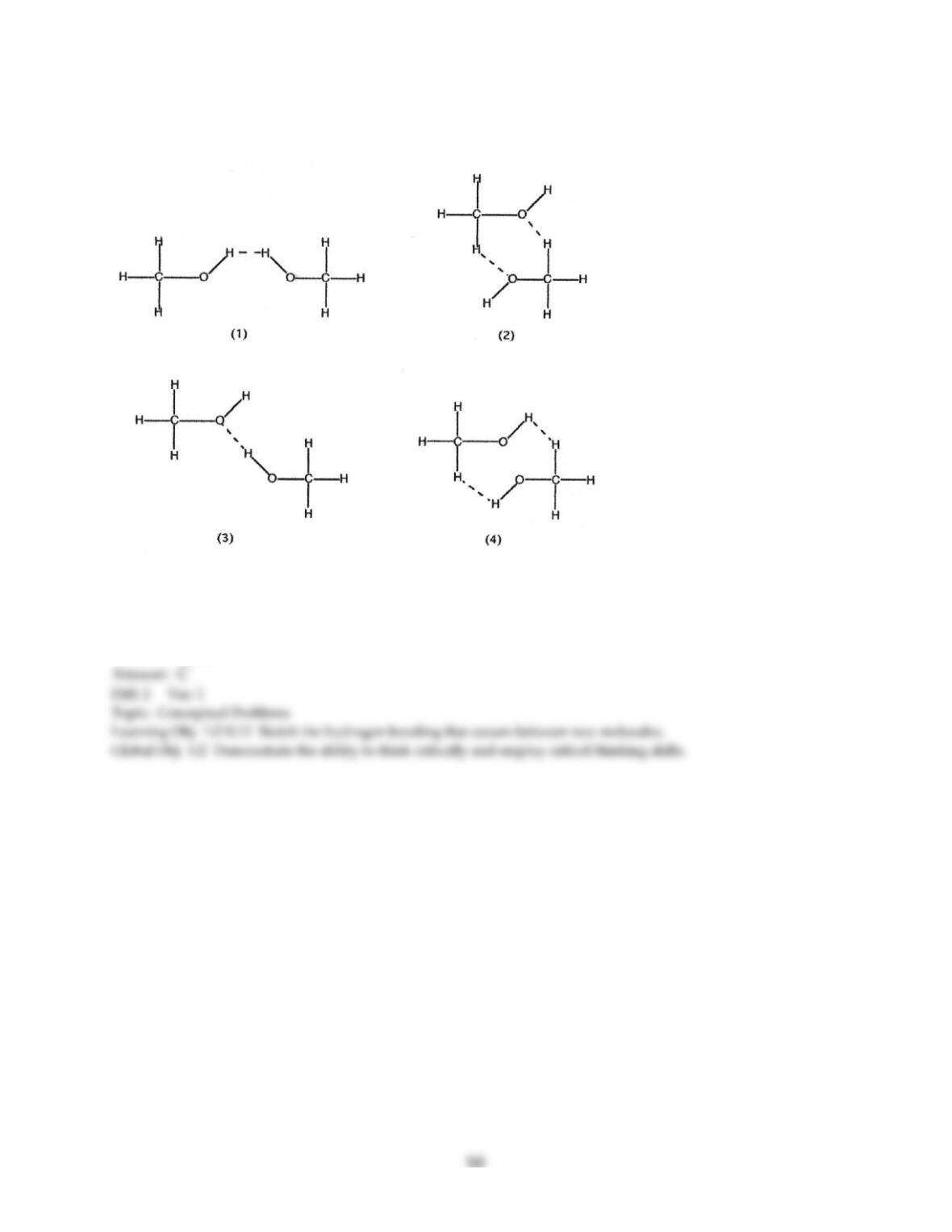
119) Which drawing below best represents hydrogen bonding methanol, CH3OH?
A) drawing (1)
B) drawing (2)
C) drawing (3)
D) drawing (4)
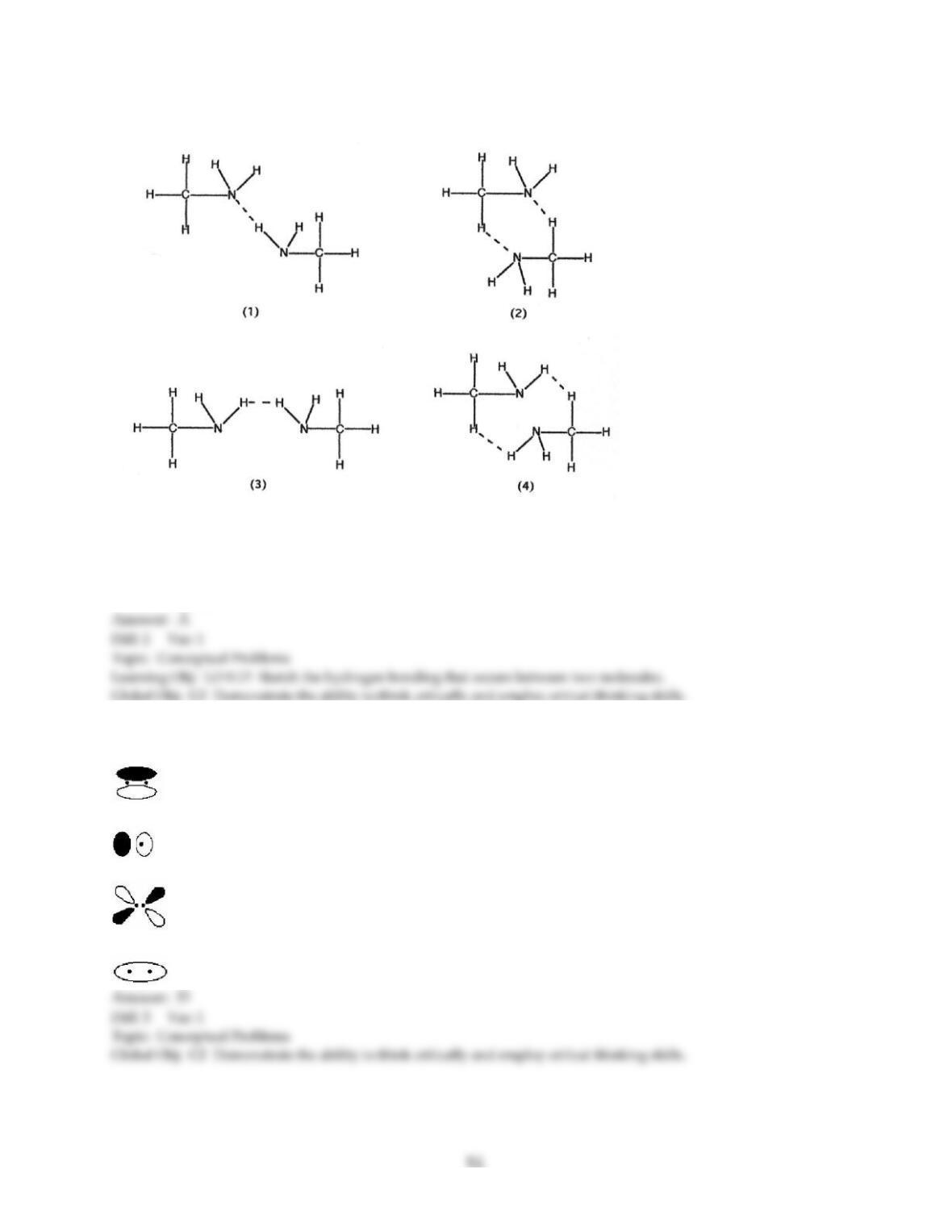
120) Which drawing best represents hydrogen bonding in methylamine, CH3NH2?
A) drawing (1)
B) drawing (2)
C) drawing (3)
D) drawing (4)
121) Which drawing represents a σ bonding molecular orbital for a homonuclear diatomic molecule?
A)
B)
C)
D)
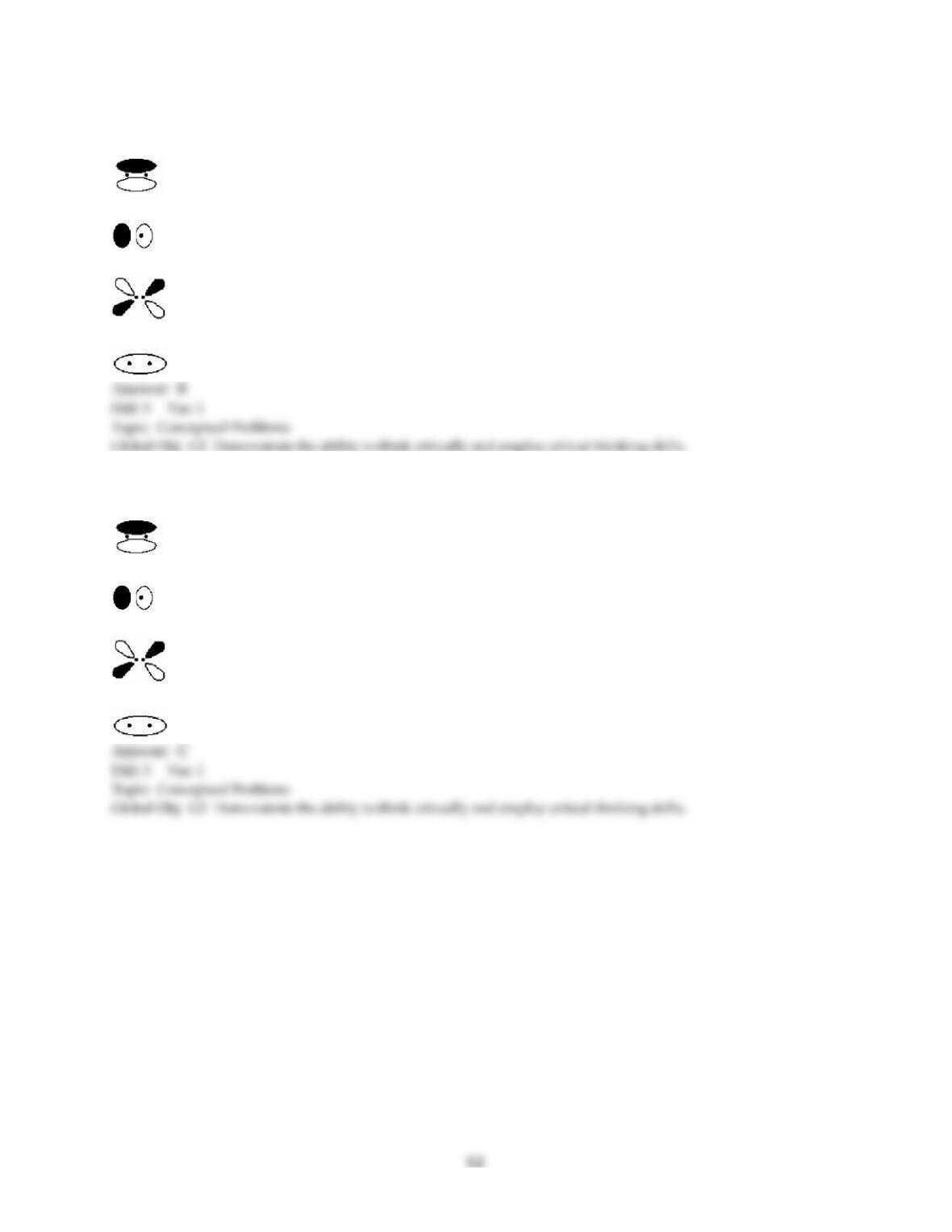
122) Which drawing represents a σ* antibonding molecular orbital for a homonuclear diatomic molecule?
A)
B)
C)
D)
123) Which drawing represents a π* antibonding molecular orbital for a homonuclear diatomic molecule?
A)
B)
C)
D)
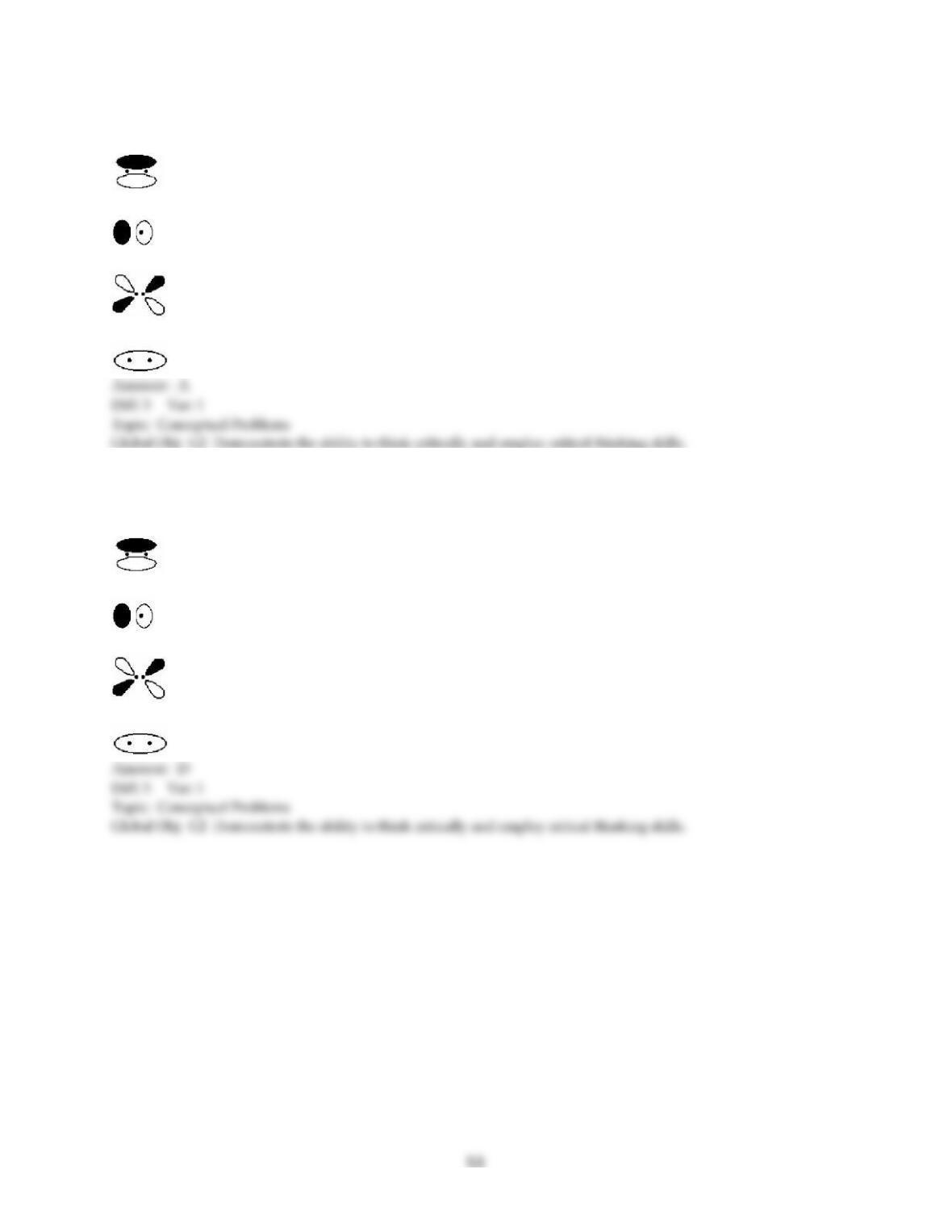
124) Which drawing represents a π bonding molecular orbital for a homonuclear diatomic molecule?
A)
B)
C)
D)
125) Which drawing represents the molecular orbital containing the highest energy electrons in the H2
molecule in its ground state?
A)
B)
C)
D)
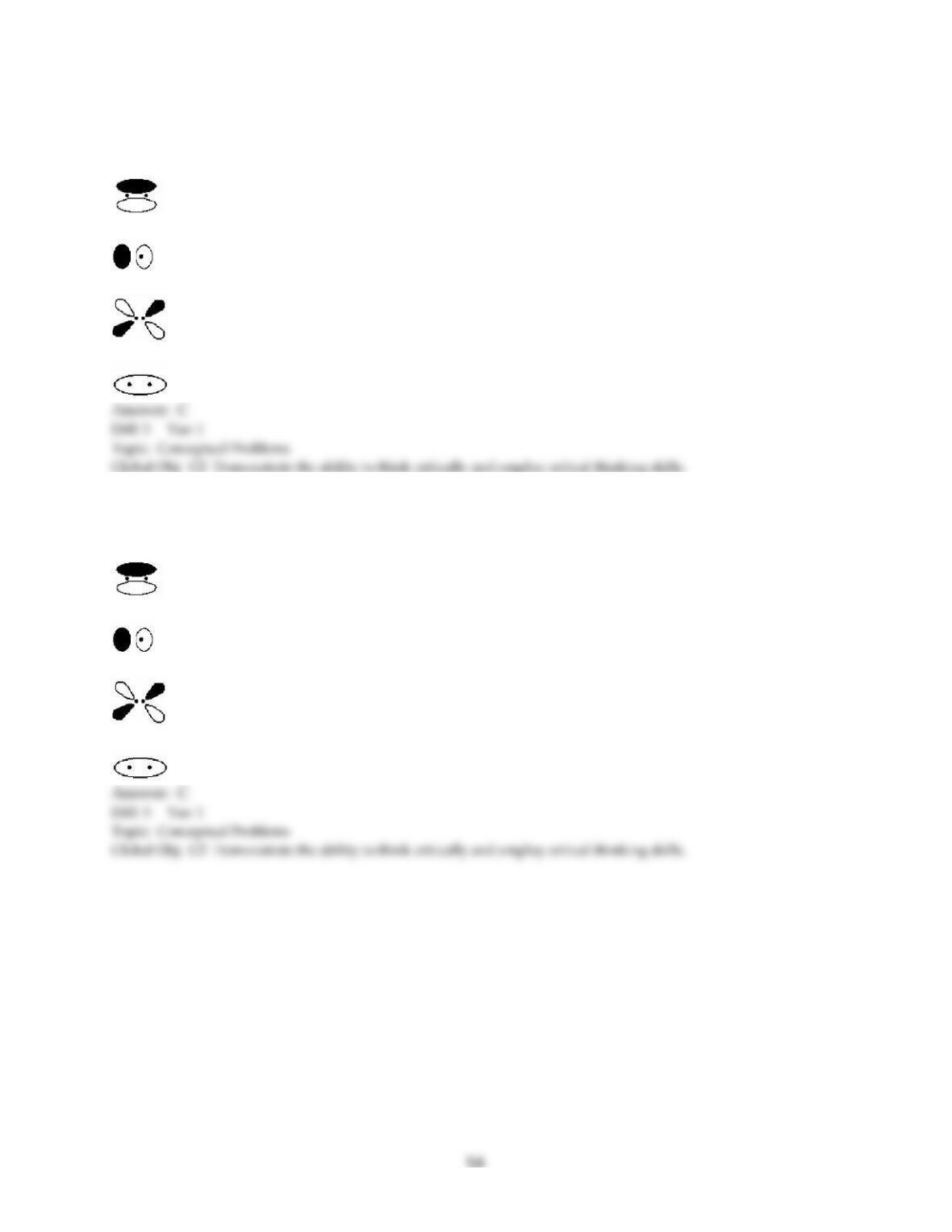
126) Which drawing represents the molecular orbital containing the highest energy electrons in the O2
molecule in its ground state?
A)
B)
C)
D)
127) Which drawing represents the lowest energy unoccupied molecular orbital in the N2 molecule in its
ground state?
A)
B)
C)
D)
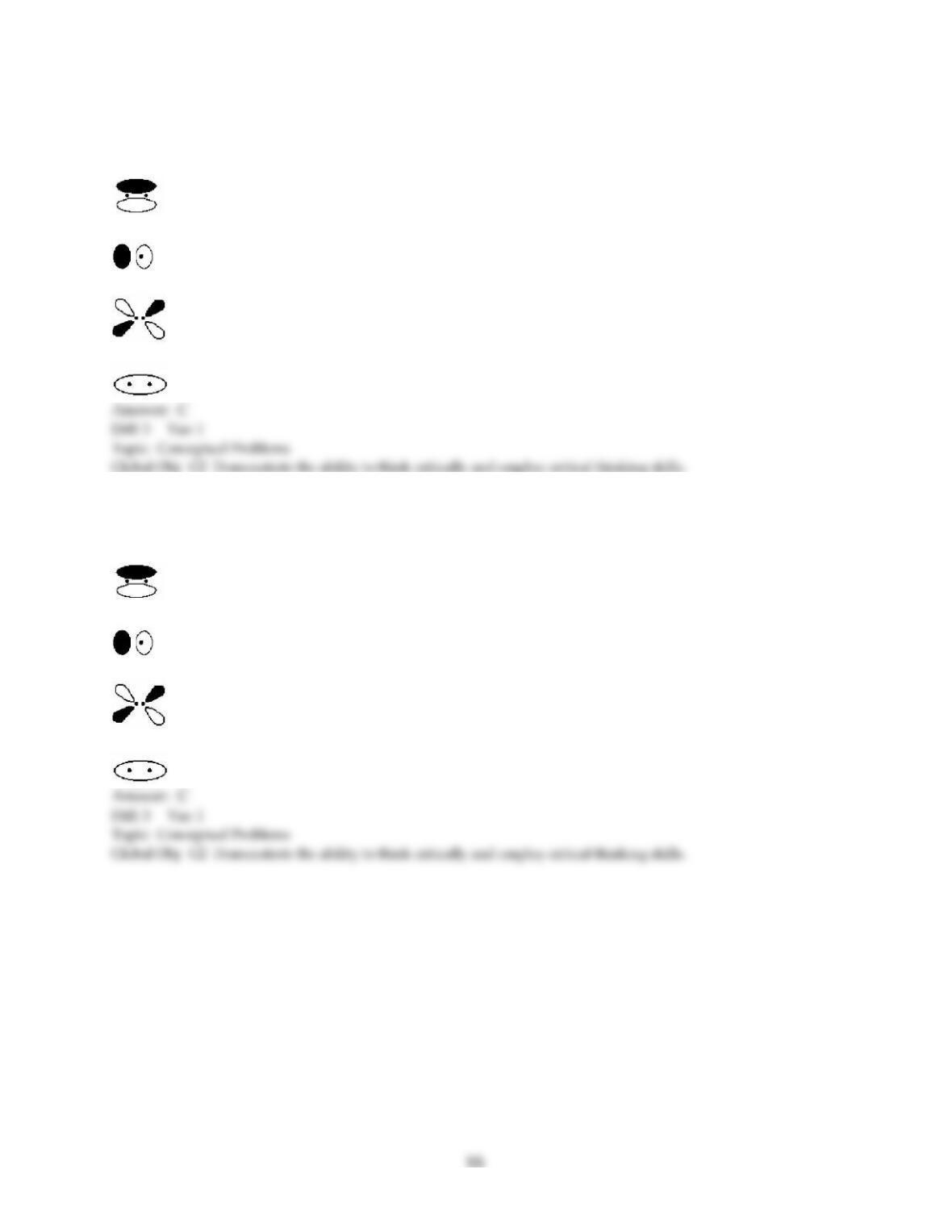
128) Which drawing represents the molecular orbital containing the highest energy electrons in the F2
molecule in its ground state?
A)
B)
C)
D)
129) Which drawing represents the molecular orbital containing the highest energy electrons in the O22-
molecular ion in its the ground state?
A)
B)
C)
D)
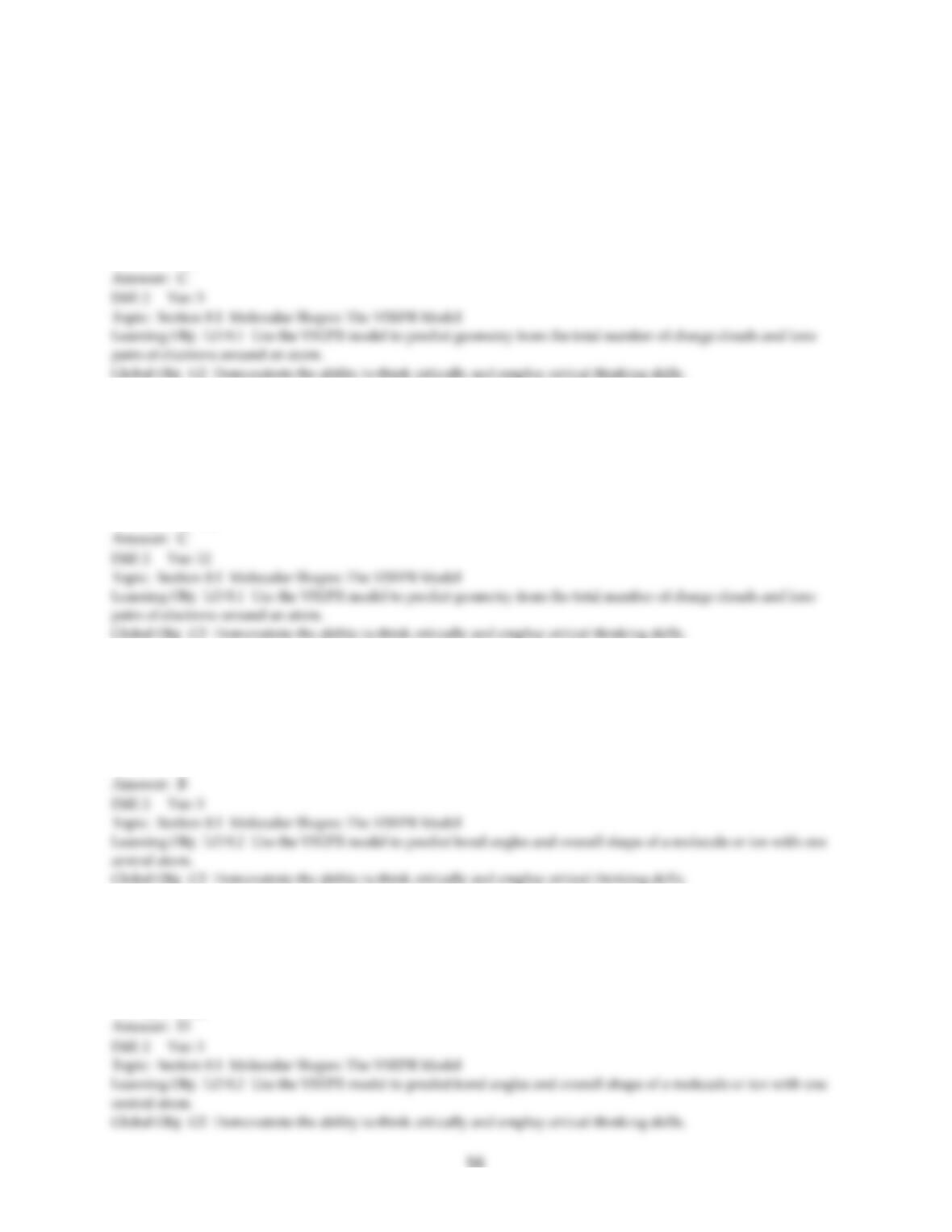
8.2 Algorithmic Questions
1) What geometric arrangement of charge clouds is expected for an atom that has five charge clouds?
A) tetrahedral
B) square planar
C) trigonal bipyramidal
D) octahedral
2) What geometric arrangement does the molecule have for a central atom that has five charge clouds
with two lone pairs?
A) tetrahedral
B) octahedral
C) T-shaped
D) trigonal bipyramidal
3) What is the molecular geometry of ICl4–?
A) seesaw
B) square planar
C) square pyramidal
D) tetrahedral
4) What is the molecular geometry of SbCl3?
A) T-shaped
B) tetrahedral
C) trigonal planar
D) trigonal pyramidal
5) What is the O—S—O bond angle in SO3?
A) less than 109.5°
B) 109.5°
C) 120°
D) greater than 120°
6) What is the molecular geometry of SeF5–?
A) octahedral
B) seesaw
C) square pyramidal
D) trigonal bipyramidal
7) Which of the following best describes ICl2–? It has a molecular geometry that is
A) linear with no lone pairs on the I atom.
B) linear with lone pairs on the I atom.
C) nonlinear with no lone pairs on the I atom.
D) nonlinear with lone pairs on the I atom.
8) What is the molecular geometry of TeBr4?
A) seesaw
B) square planar
C) square pyramidal
D) tetrahedral
58
9) What are the F—Se—F bond angles in SeF6?
A) 60°
B) 90°
C) 109.5°
D) 120°
10) The VSEPR model predicts the O—S—O bond angle in SO2 to be
A) 90°.
B) 109.5°.
C) less than 120° but greater than 109.5°.
D) 120°.
11) Arrange in order from the smallest to the largest bond angle: CCl3+, NF3, NH4+, XeBr4.
A) CCl3+, NF3, NH4+, XeBr4
B) NF3, NH4+, XeBr4, CCl3+
C) XeBr4, NH4+, NF3, CCl3+
D) XeBr4, NF3, NH4+, CCl3+
12) The VSEPR model predicts the H—B—H bond angle in BH3 to be
A) 90°.
B) 109.5°.
C) less than 120° but greater than 109.5°.
D) 120°.
13) What is the electron geometry and molecular shape of CH2O?
A) Tetrahedral, tetrahedral
B) Trigonal planar, trigonal planar
C) Trigonal planar, bent
D) Tetrahedral, trigonal planar
14) What electron geometry would you expect for atoms that have 6 charge clouds?
A) Tetrahedral
B) Octahedral
C) Trigonal planar
D) Trigonal bipyramid
15) A single sp3 hybrid orbital has
A) one lobe.
B) two lobes of equal size.
C) two lobes of unequal size.
D) three lobes of equal size.
16) What orbital hybridization is expected for the central atom in a molecule with a trigonal planar
geometry?
A) sp
B) sp2
C) sp3
D) sp4