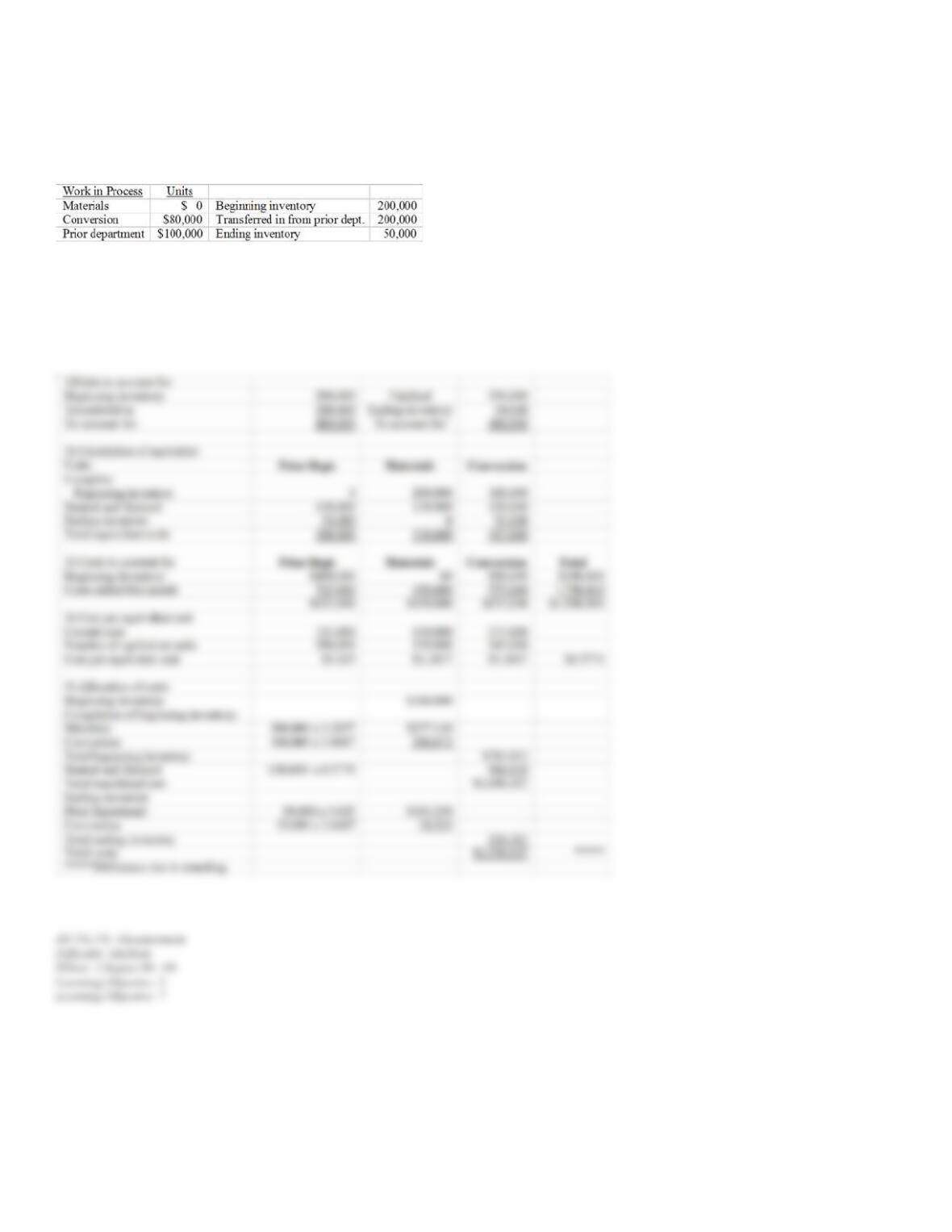
98. Wax Company has the following information available for its process costing system for the month of July
in the finishing department, the second of a multiple department manufacturing plant. Materials are added at the
end of the process in finishing. Beginning inventory was 20% complete for conversion cost. Ending inventory
was 70% complete for conversion costs.
Costs added this month: Materials: $450,000; Conversion: $575,000; Prior department: $725,000
Required: Calculate the cost of the units transferred out during July and the ending inventory at July 31 using
the FIFO method. There were no spoiled units. Round equivalent-unit costs to four decimal points. (Appendix
A)
99. Crazy Cool Colas prepares specialty-flavored sodas for large grocery chains and bakeries. The company
employs a process-costing system. Most of the basic ingredients, labeled Material Group A, are added at the
beginning of the mixing process. However, to give the sodas the special “sizzle” they are named for, the
company adds a special ingredient when units are 80% complete, which is labeled Material Group B.
Information regarding the mixing department in a recent month reveals the following:
Beginning inventory: 2,000 Cases (60% complete for conversion)
Cases started: 18,000
Cases finished: 16,000
The ending inventory is 90% complete as to conversion costs
Cost information:
Beginning Work-in-Process: $21,600 consisting of $5,200 of Material Group A, $0 of
Material Group B and $16,400 of conversion costs
Added during the month: $48,000 of Material Group A, $4,500 of Material Group B and
$162,000 of conversion costs
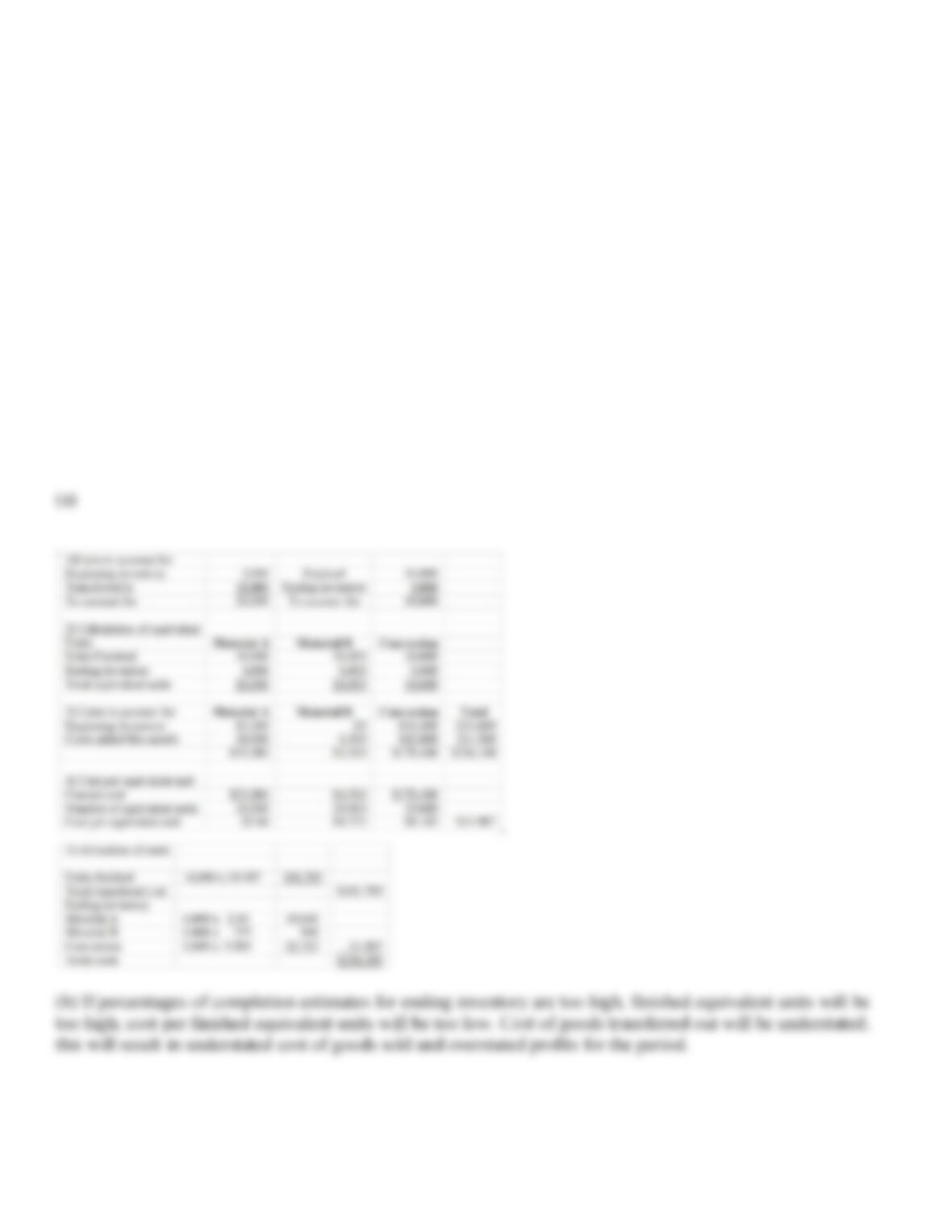
Required: a) Prepare a cost report using the weighted-average method. Round all numbers to four decimal
points.
b) During the annual audit, the company‘s auditors discover that management’s estimates of percentage of
completion for the ending inventory were too high. Discuss how this error will affect the company’s ending
inventory and profits for the period.

100. Sizzling Sodas prepares specialty–flavored sodas for large grocery chains and bakeries. The company
employs a process-costing system. Most of the basic ingredients, labeled Material Group A, are added at the
beginning of the mixing process. However, to give the sodas the special “sizzle” they are named for, the
company adds a special ingredient when units are 80% complete, labeled, Material Group B. Information
regarding the mixing department in a recent month reveals the following:
Beginning inventory: 1,000 Cases (60% complete for conversion)
Cases started: 9,000
Cases finished: 8,000
The ending inventory is 90% complete as to conversion costs
Cost information:
Beginning Work in Process: $21,600 consisting of $5,200 of Material Group A, $0 of Material Group B and
$16,400 of Conversion Costs
Added during the month: $48,000 of Material Group A, $4,500 of Material Group B and $162,000 of
Conversion Costs
Required: (Appendix A)
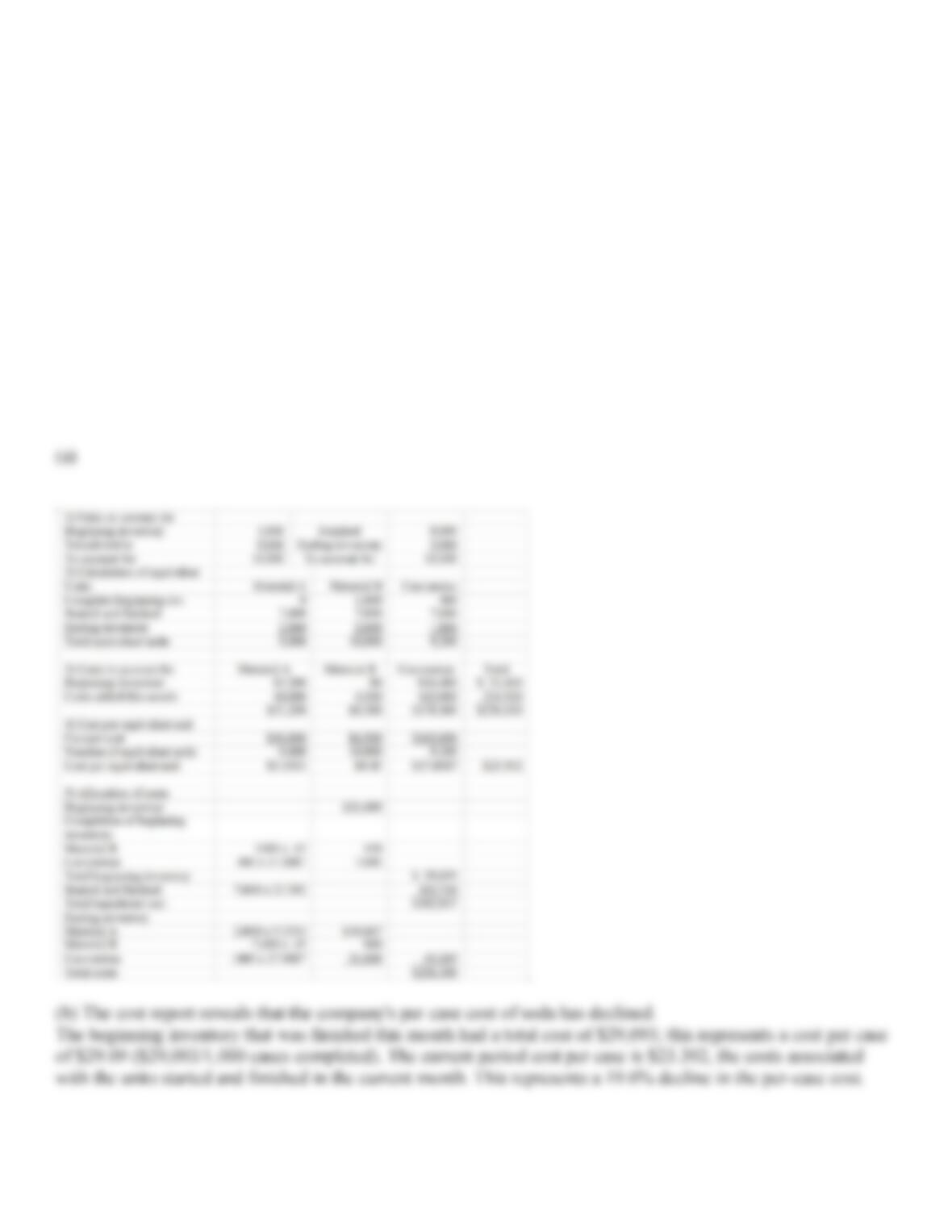
a) Prepare a cost report using the FIFO method. Round all numbers to four decimal points.
b) Based on your report, prepare an analysis of the cost trend for this company.

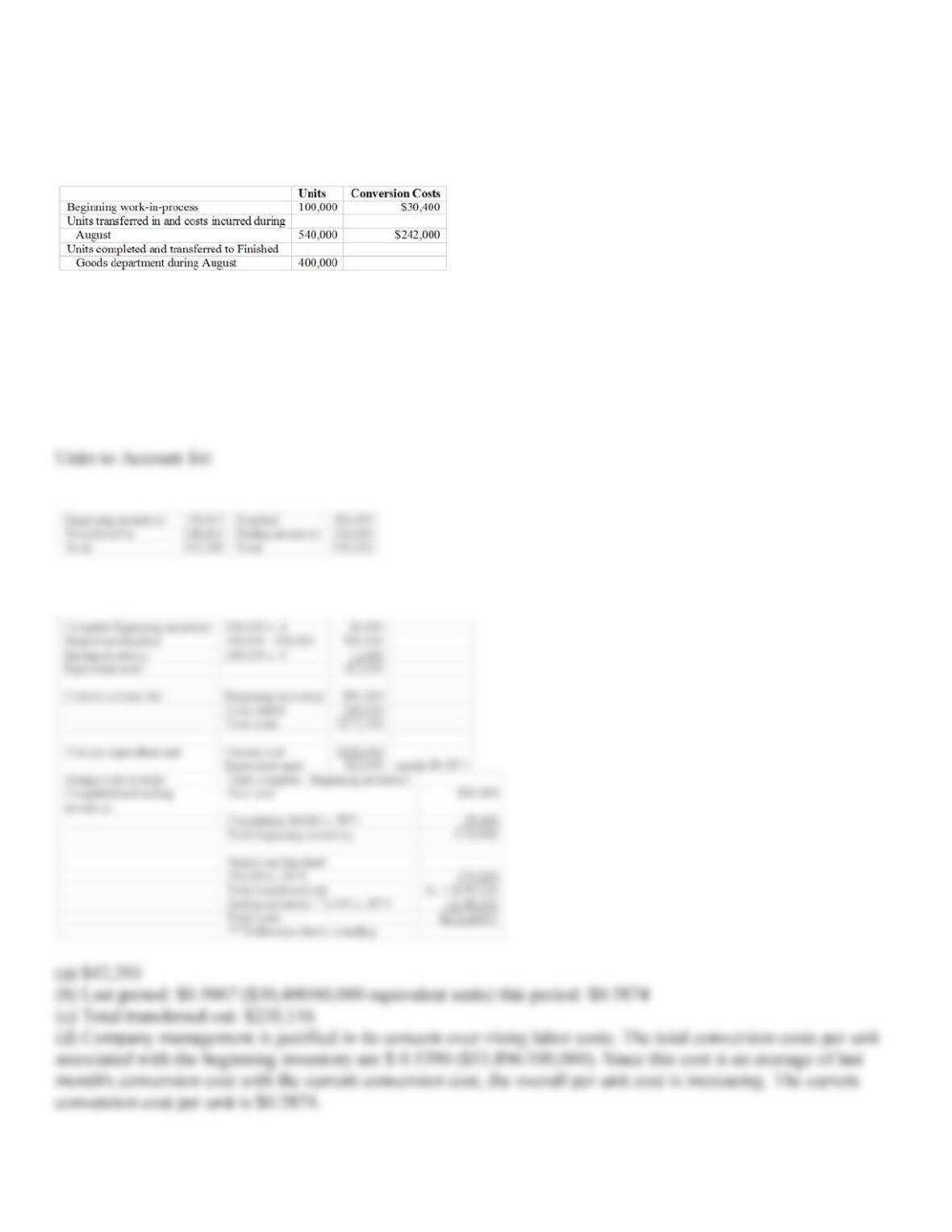
101. The following information is based on the Drying and Packaging Department of Cape Elizabeth Potato
Chips. Conversion costs of beginning inventory were 60% complete and ending inventory was 30% complete.
Management has recently been concerned with the rising costs of factory labor in a tight labor market. Other
information on this process:
The company uses the FIFO method.
Required: (Appendix A)
a) What was the conversion cost of work-in-process in the Drying and Packaging department at August 31?
b) What were the conversion costs per equivalent-unit produced last period and this period?
c) What were the total conversion costs transferred out?
d) Comment on the information provided by your calculations.
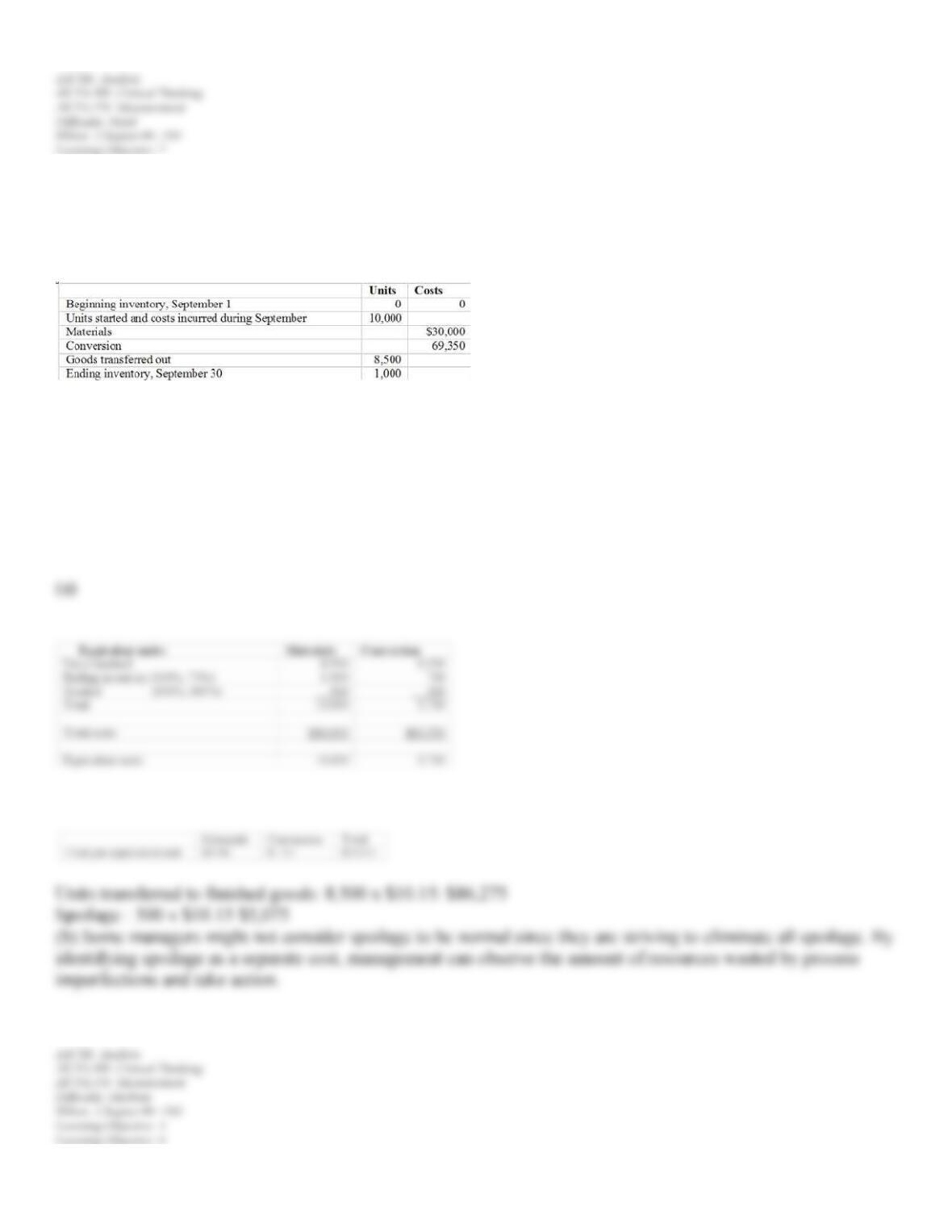
102. The Holt Manufacturing Company has the following information available regarding its September
operations:
Holt adds all materials at the beginning of the process and estimates that ending inventory is 70% complete.
Required:
a) Compute the cost of goods transferred to finished goods and the cost of spoilage assuming that all spoilage
cost is considered to be undesirable and is written off in the accounting period incurred. The company uses the
weighted-average method. Spoiled units are inspected out at the end of the process.
b) Explain why some managers might not consider any spoilage to be normal spoilage. How does identifying
spoilage as a separate cost help in process improvement?
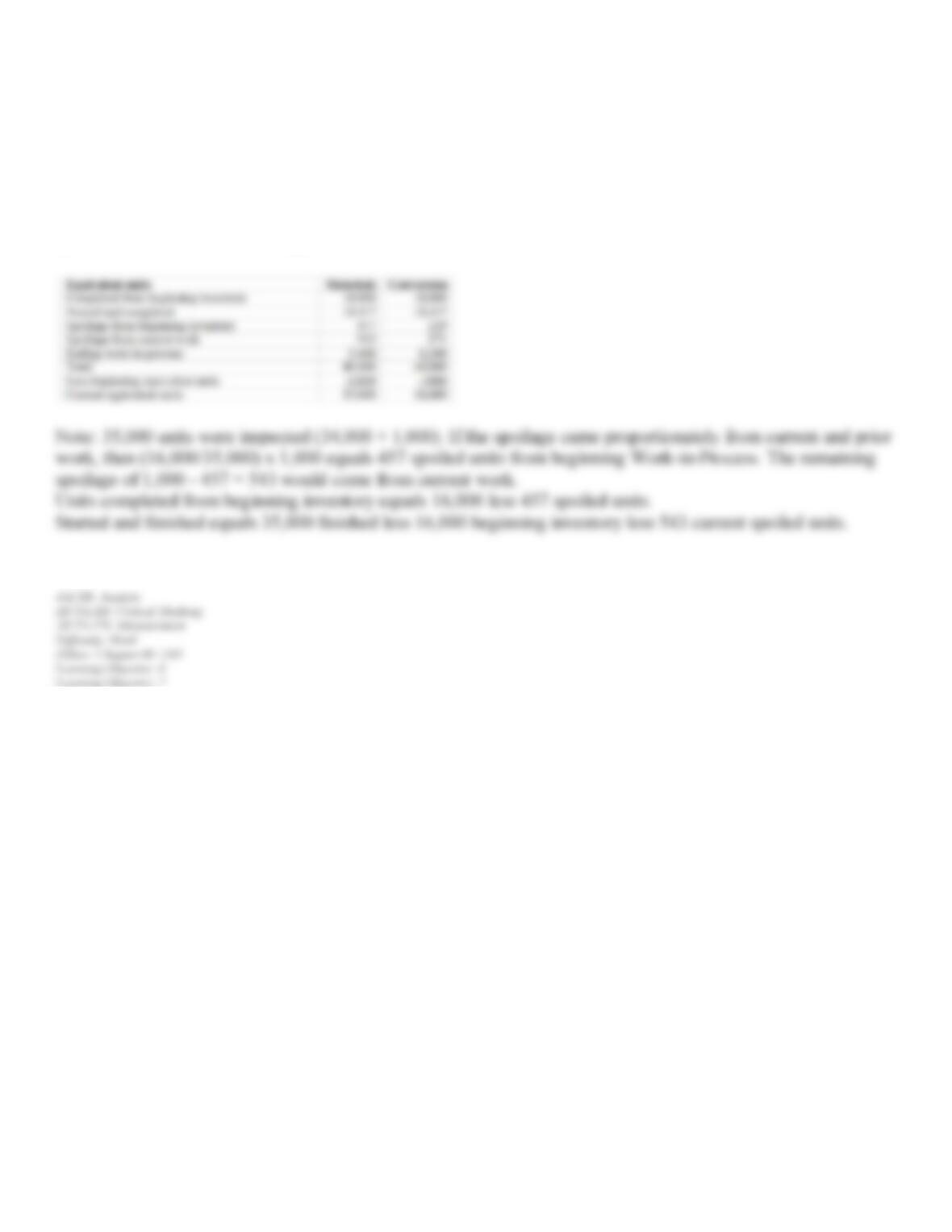
103. Rivera Salad Dressing had 16,000 units (one unit equals one case) in beginning inventory, 30% complete
with respect to both materials and to conversion costs. During November, 34,000 units were transferred out,
1,000 were spoiled and 9,000 remained in ending inventory. The spoiled units were 50% complete for
conversion costs and 100% complete for materials. The ending work-in-process was 70% complete for
conversion costs and 60% complete as to direct materials. Rivera accounts for spoiled units separately and does
not spread their cost over good units produced. Assume that spoilage came proportionately from current and
prior work.
Required: Calculate the finished equivalent units for November, assuming the company separately identifies
spoiled units and uses FIFO. (Appendix A).
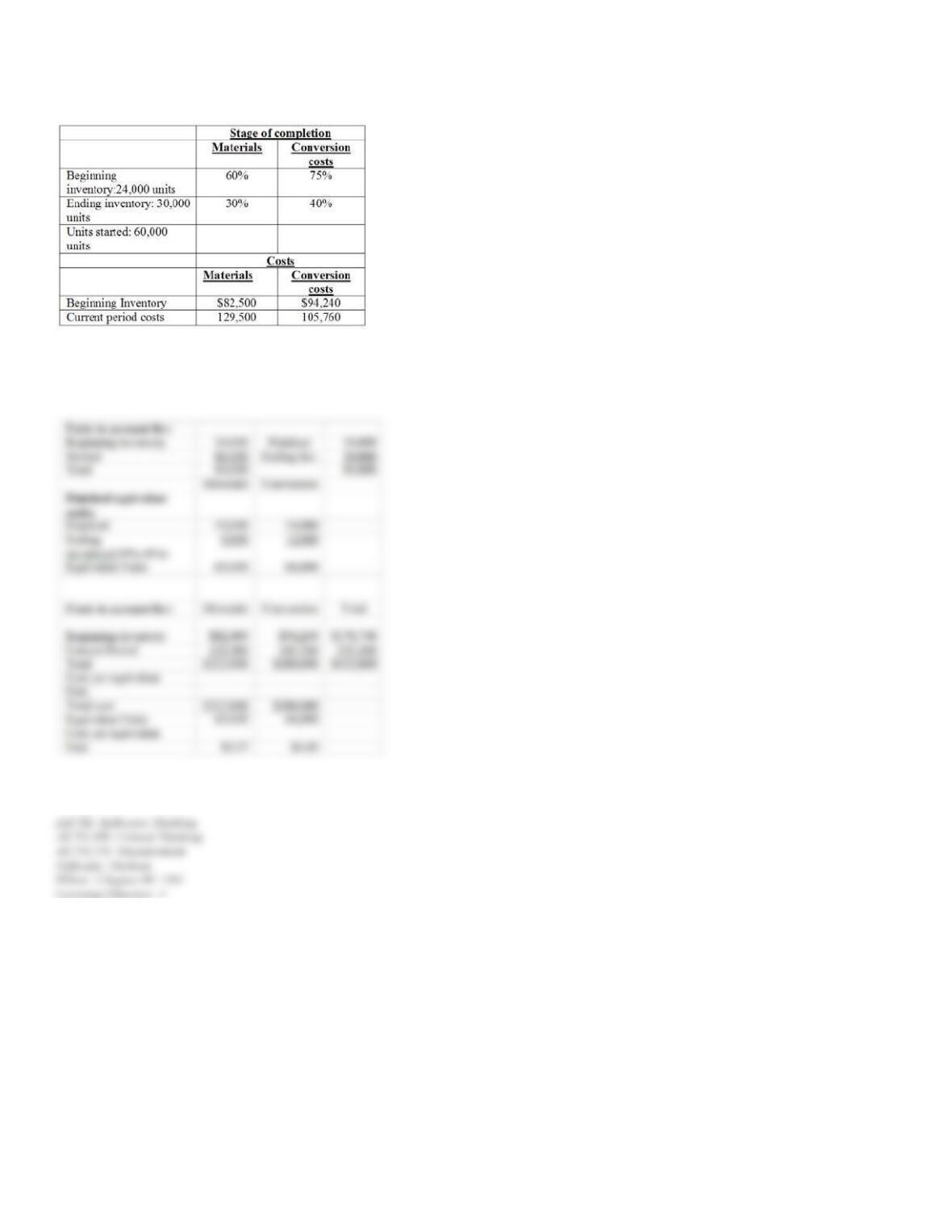
104. The following information is known about a company’s process costing system for the latest period:
Required: Calculate the cost per equivalent-unit for materials and conversion costs for the period. The
company uses weighted-average. Show all computations.
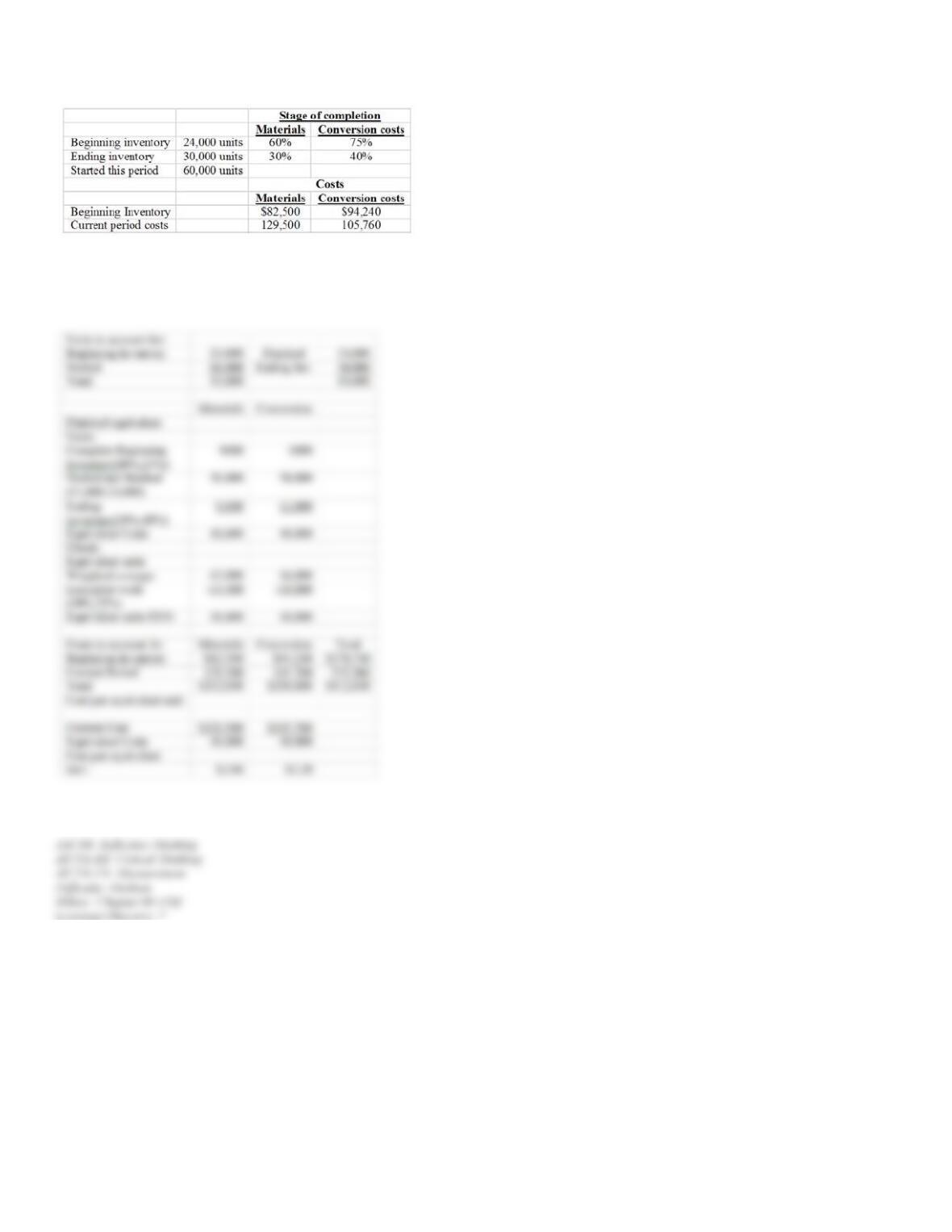
105. The following information is known about a company‘s process costing system for the latest period:
Required: Calculate the cost per equivalent-unit for materials and conversion costs for the period. The company
uses FIFO. Show all computations. (Appendix A)
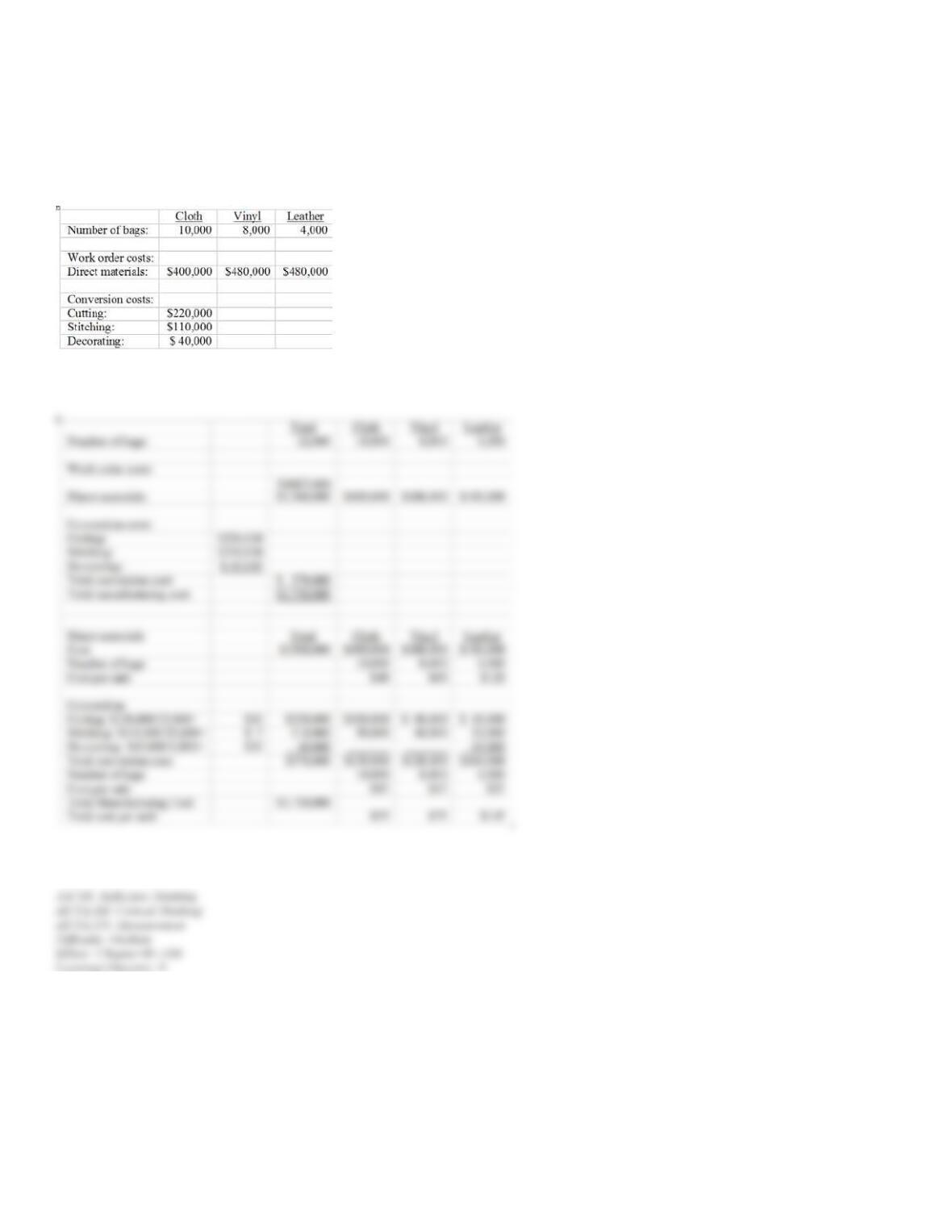
106. Medfield Designer Bags produces high quality designer women’s handbags. The company produces cloth,
vinyl and leather bags. The company employs an operation costing system in which material costs are assigned
to each category of handbag, while units pass through the same processing departments. All three types of
handbags pass through cutting and stitching, while only leather bags pass through a final decorating process.
Information related to the production of bags for the month of December follows:
Required: Compute the per unit production cost for each type of handbag. (Appendix B)
107. An inevitable result of most process costing systems is spoilage. There are several accepted approaches to
accounting for spoilage costs. Name three ways to account for spoilage costs and their theoretical justifications.
108. What is the advantage of using a FIFO process-costing system over a Weighted average system? Are there
any situations where FIFO and Weighted average will give the same per unit cost? (Appendix)
109. Explain how earnings of a period can be manipulated by misstating the degrees of completion of finished
equivalents units to result in higher profit. Can this practice be continued indefinitely?
110. What is operation costing? Briefly explain how operation costing is similar to and differs from
process-costing. What type of company would most likely use operation costing? How is operating costing like
job-order costing? (Appendix)
111. How would a company manipulate the degrees of completion to understate profits, resulting in lower
income taxes? Can this practice be continued indefinitely?