Valuation of Inventories: A Cost-Basis Approach
8 – 37
No. Answer Derivation
DERIVATIONS — CPA Adapted
No. Answer Derivation
Test Bank for Intermediate Accounting, Fifteenth Edition
8 – 38
No. Answer Derivation
BRIEF EXERCISES
BE. 8-148—Recording purchases at net amounts.
Flint Co. records purchase discounts lost and uses perpetual inventories. Prepare journal entries
in general journal form for the following:
(a) Purchased merchandise costing $2,500 with terms 2/10, n/30.
(b) Payment was made thirty days after the purchase.
Solution 8-148
BE. 8-149—Recording purchases at net amounts.
Dill Co. records purchases at net amounts and uses periodic inventories. Prepare entries for the
following:
June 11 Purchased merchandise on account, $9,000, terms 2/10, n/30.
15 Returned part of June 11 purchase, $500, and received credit on account.
30 Prepared the adjusting entry required for financial statements.
Solution 8-149
Valuation of Inventories: A Cost-Basis Approach
8 – 39
BE. 8-150—Comparison of FIFO and LIFO.
During periods of rising prices, the use of FIFO (as compared with LIFO) will result in what effect
on the financial statements?
Solution 8-150
EXERCISES
Ex. 8-151—FIFO and LIFO inventory methods.
During June, the following changes in inventory item 27 took place:
June 1 Balance 1,400 units @ $24
14 Purchased 800 units @ $36
24 Purchased 700 units @ $30
8 Sold 400 units @ $50
10 Sold 1,000 units @ $40
29 Sold 500 units @ $44
Perpetual inventories are maintained.
Instructions
What is the cost of the ending inventory for item 27 under the following methods? (Show
calculations.)
(a) FIFO.
(b) LIFO.
Solution 8-151
Ex. 8-152—FIFO and LIFO periodic inventory methods.
The Rock Shop shows the following data related to an item of inventory:
Inventory, January 1 200 units @ $5.00
Purchase, January 9 600 units @ $5.40
Purchase, January 19 140 units @ $6.00
Inventory, January 31 200 units

Test Bank for Intermediate Accounting, Fifteenth Edition
8 – 40
Instructions
(a) What value should be assigned to the ending inventory using FIFO?
(b) What value should be assigned to cost of goods sold using LIFO?
Solution 8-152
Ex. 8-153—Perpetual LIFO.
A record of transactions for the month of May was as follows:
Purchases Sales
May 1 (balance) 400 @ $4.20 May 3 200 @ $7.00
4 1,300 @ $4.10 6 1,000 @ 7.00
8 800 @ $4.30 12 900 @ 7.50
14 700 @ $4.40 18 400 @ 7.50
22 1,200 @ $4.50 25 1,400 @ 8.00
29 500 @ $4.55
Assuming that perpetual inventory records are kept in dollars, determine the ending inventory
using LIFO.
Solution 8-153

Valuation of Inventories: A Cost-Basis Approach
8 – 41
Ex. 8-154—Perpetual LIFO and Periodic FIFO.
Matlock Corporation sells item A as part of its product line. Information as to balances on hand,
purchases, and sales of item A are given in the following table for the first six months of 2014.
Quantities
Unit Price
Date Purchased Sold Balance of Purchase
January 11 — — 400 $3.65
January 24 1,300 — 1,700 $3.90
February 8 — 300 1,400 —
March 16 — 560 840 —
June 11 600 — 1,440 $4.10
Instructions
(a) Compute the ending inventory at June 30 under the perpetual LIFO inventory pricing
method.
(b) Compute the cost of goods sold for the first six months under the periodic FIFO inventory
pricing method.
Solution 8-154
Ex. 8-155—Analysis of gross profit.
During 2014, King’s Drug Company experienced a significant increase in the rate of gross profit
on sales, compared with the rate it has averaged in recent years. You are asked to determine the
most likely reason for this improvement. Support your answer.
The following data are from the records of the company:
2014 sales (at an average price of $40 a unit) were $2,300,000.
2014 purchases (at an average cost of $24 a unit) were $1,200,000.
The company uses the LIFO inventory method and has used it since 1985.
Solution 8-155
Test Bank for Intermediate Accounting, Fifteenth Edition
8 – 42
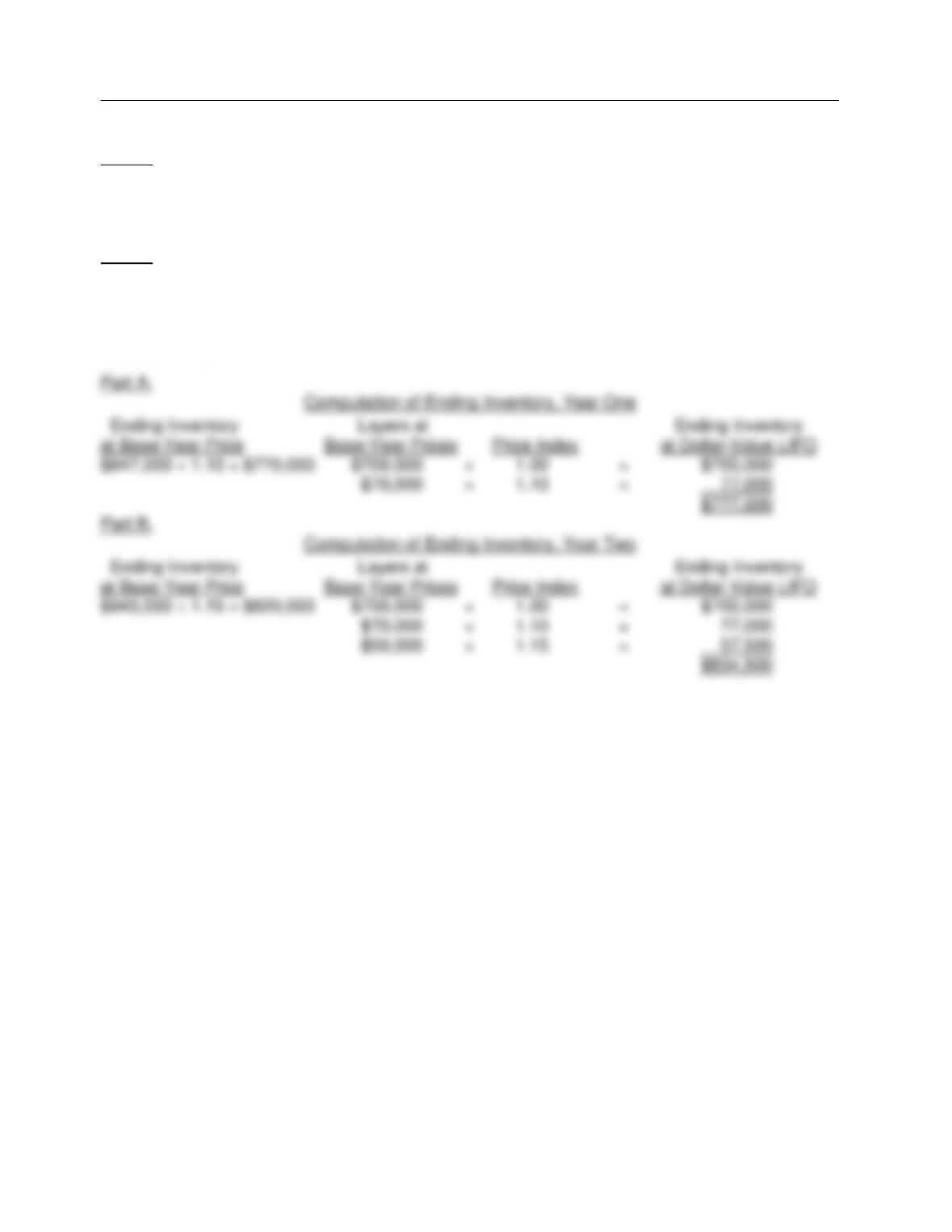
Ex. 8-156—Dollar-value LIFO method.
Part A. Judd Company has a beginning inventory in year one of $700,000 and an ending
inventory of $847,000. The price level has increased from 100 at the beginning of the
year to 110 at the end of year one. Calculate the ending inventory under the dollar-
value LIFO method.
Part B. At the end of year two, Judd’s inventory is $943,000 in terms of a price level of 115
which exists at the end of year two. Calculate the inventory at the end of year two
continuing the use of the dollar-value LIFO method.
Solution 8-156
Valuation of Inventories: A Cost-Basis Approach
8 – 43
PROBLEMS
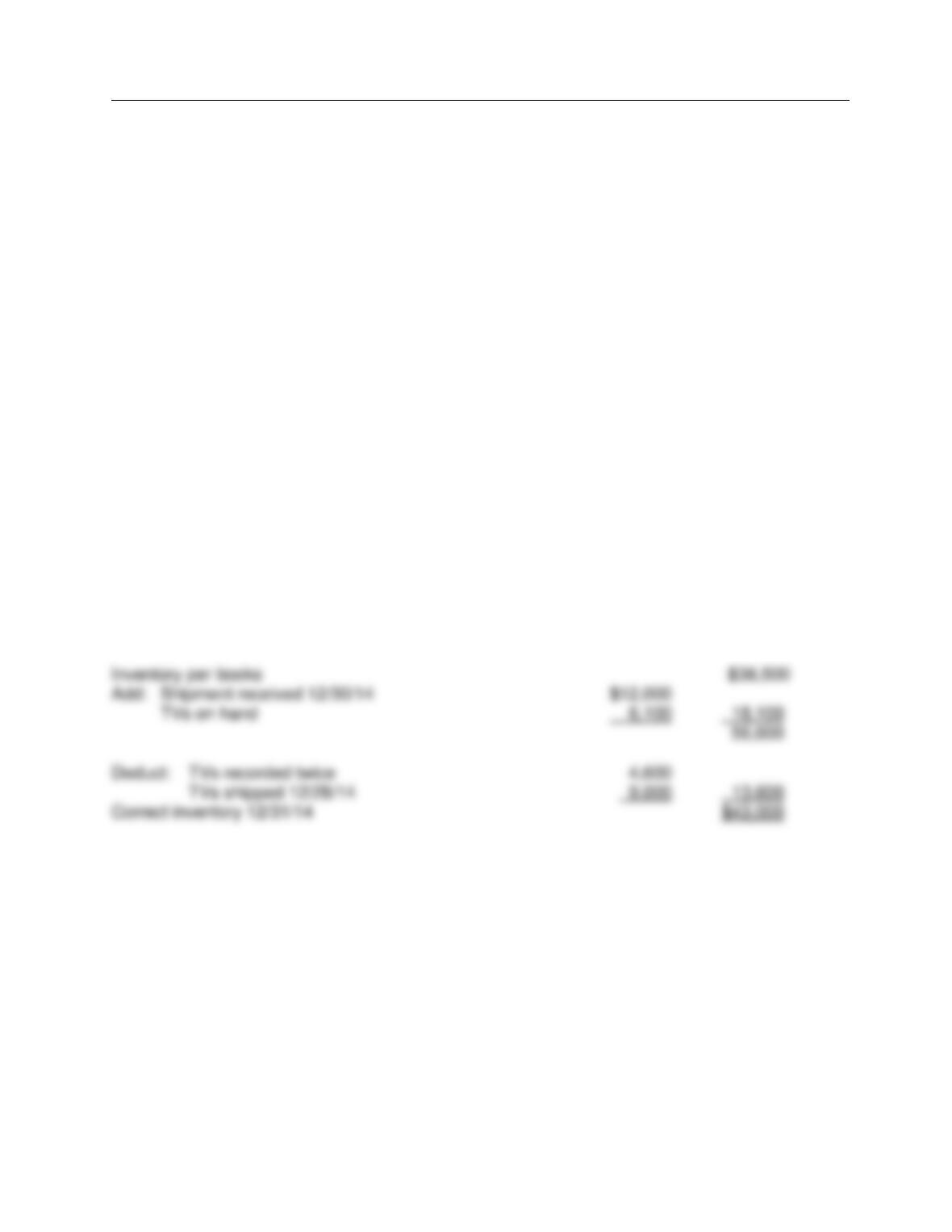
Pr. 8-157—Inventory cut-off.
Vogts Company sells TVs. The perpetual inventory was stated as $38,500 on the books at
December 31, 2014. At the close of the year, a new approach for compiling inventory was used
and apparently a satisfactory cut-off for preparation of financial statements was not made. Some
events that occurred are as follows.
1. TVs shipped to a customer January 2, 2015, costing $5,000 were included in inventory at
December 31, 2014. The sale was recorded in 2015.
2. TVs costing $12,000 received December 30, 2014, were recorded as received on January 2,
2015.
3. TVs received during 2014 costing $4,600 were recorded twice in the inventory account.
4. TVs shipped to a customer December 28, 2014, f.o.b. shipping point, which cost $9,000, were
not received by the customer until January, 2015. The TVs were included in the ending
inventory.
5. TVs on hand that cost $6,100 were never recorded on the books.
Instructions
Compute the correct inventory at December 31, 2014.
Solution 8-157

Test Bank for Intermediate Accounting, Fifteenth Edition
8 – 44
Pr. 8-158—Analysis of errors.
(All sales and purchases are on credit.)
Indicate in each of the spaces provided the effect of the described errors on the various elements
of a company’s financial statements. Use the following codes: O = amount is overstated; U =
amount is understated; NE = no effect. Assume a periodic inventory system.
Accounts Accounts Cost of
Receivable Inventory Payable Sales Goods Sold
EXAMPLE: Excluded goods in rented
warehouse from inventory NE U NE NE O
count.
____________________________________________________________________________
1. Goods in transit shipped “f.o.b.
destination” by supplier were
recorded as a purchase but were
excluded from ending inventory.
____________________________________________________________________________
2. Goods held on consignment were
included in inventory count and
recorded as a purchase.
____________________________________________________________________________
3. Goods in transit shipped “f.o.b.
shipping point” were not recorded
as a sale and were included in
ending inventory.
____________________________________________________________________________
4. Goods were shipped and appro-
priately excluded from ending
inventory but sale was not
recorded.
____________________________________________________________________________
Solution 8-158
Valuation of Inventories: A Cost-Basis Approach
8 – 45
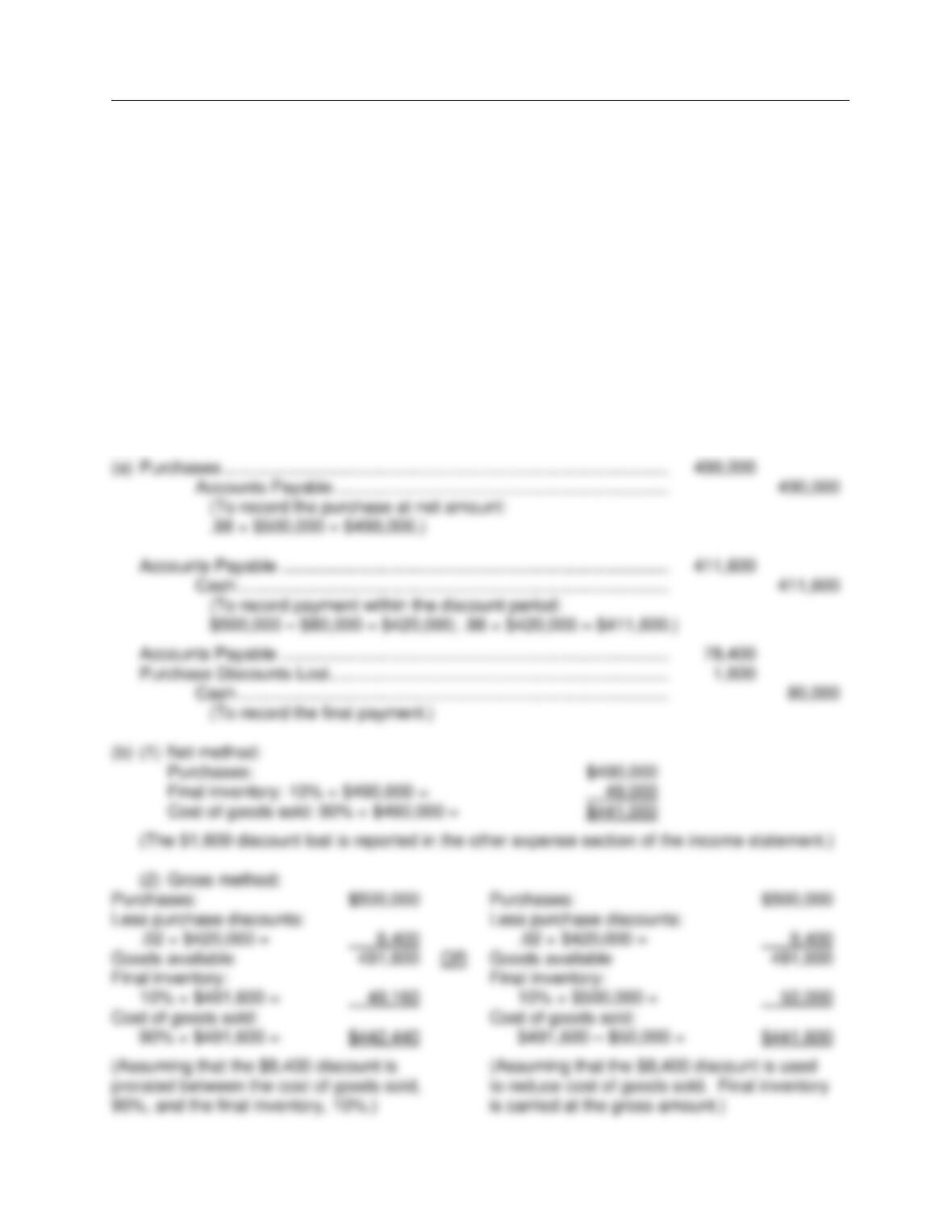
Pr. 8-159—Accounting for purchase discounts.
Otto Corp. purchased merchandise during 2014 on credit for $500,000; terms 2/10, n/30. All of
the gross liability except $80,000 was paid within the discount period. The remainder was paid
within the 30-day term. At the end of the annual accounting period, December 31, 2014, 90% of
the merchandise had been sold and 10% remained in inventory. The company uses a periodic
system.
Instructions
(a) Assuming that the net method is used for recording purchases, prepare the entries for the
purchase and two subsequent payments.
(b) What dollar amounts should be reported for the final inventory and cost of goods sold under
the (1) net method; (2) gross method? Assume that there was no beginning inventory.
Solution 8-159
Test Bank for Intermediate Accounting, Fifteenth Edition
8 – 46
Pr. 8-160—Inventory methods.
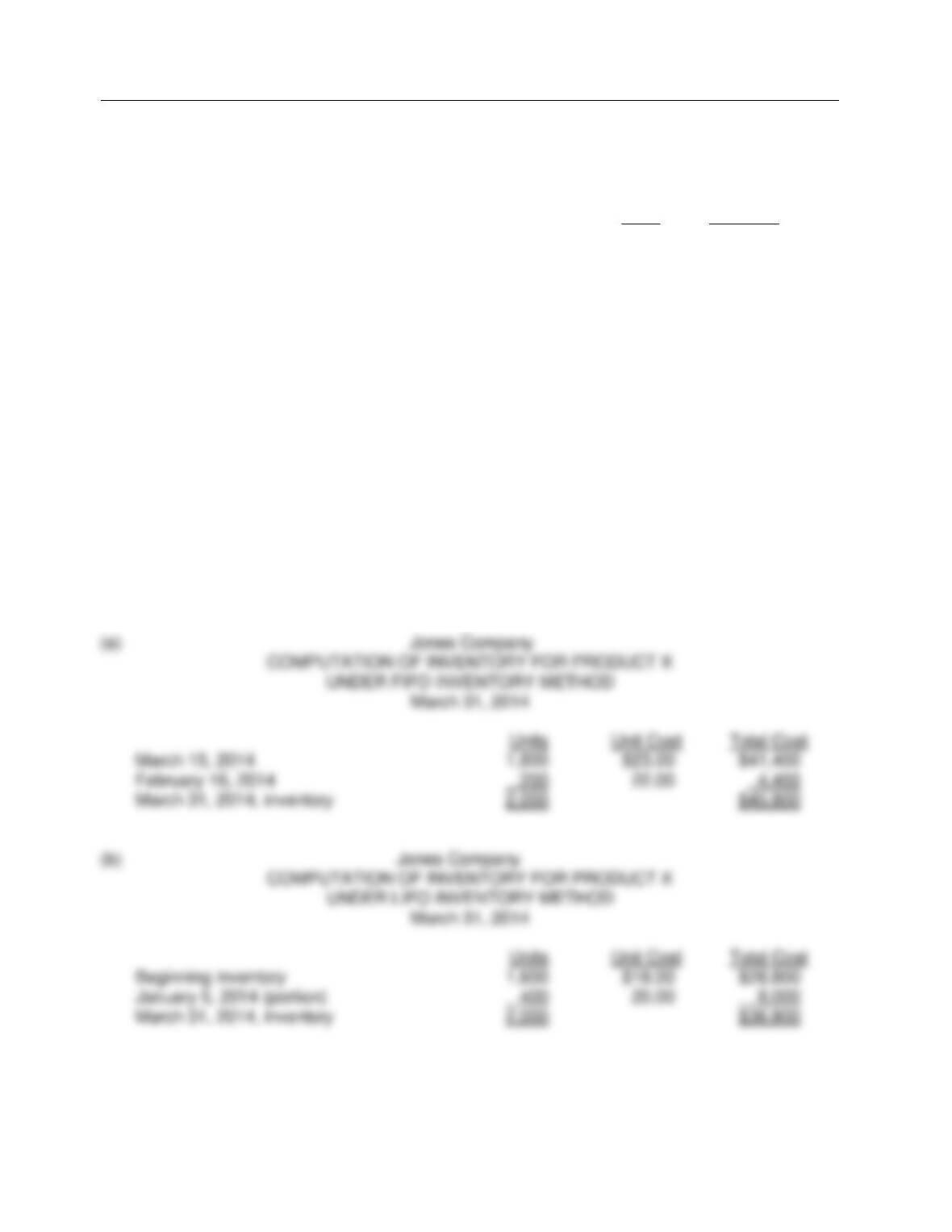
Jones Company was formed on December 1, 2013. The following information is available from
Jones’s inventory record for Product X.
Units Unit Cost
January 1, 2014 (beginning inventory) 1,600 $18.00
Purchases:
January 5, 2014 2,600 $20.00
January 25, 2014 2,400 $21.00
February 16, 2014 1,000 $22.00
March 15, 2014 1,800 $23.00
A physical inventory on March 31, 2014, shows 2,000 units on hand.
Instructions
Prepare schedules to compute the ending inventory at March 31, 2014, under each of the
following inventory methods:
(a) FIFO.
(b) LIFO.
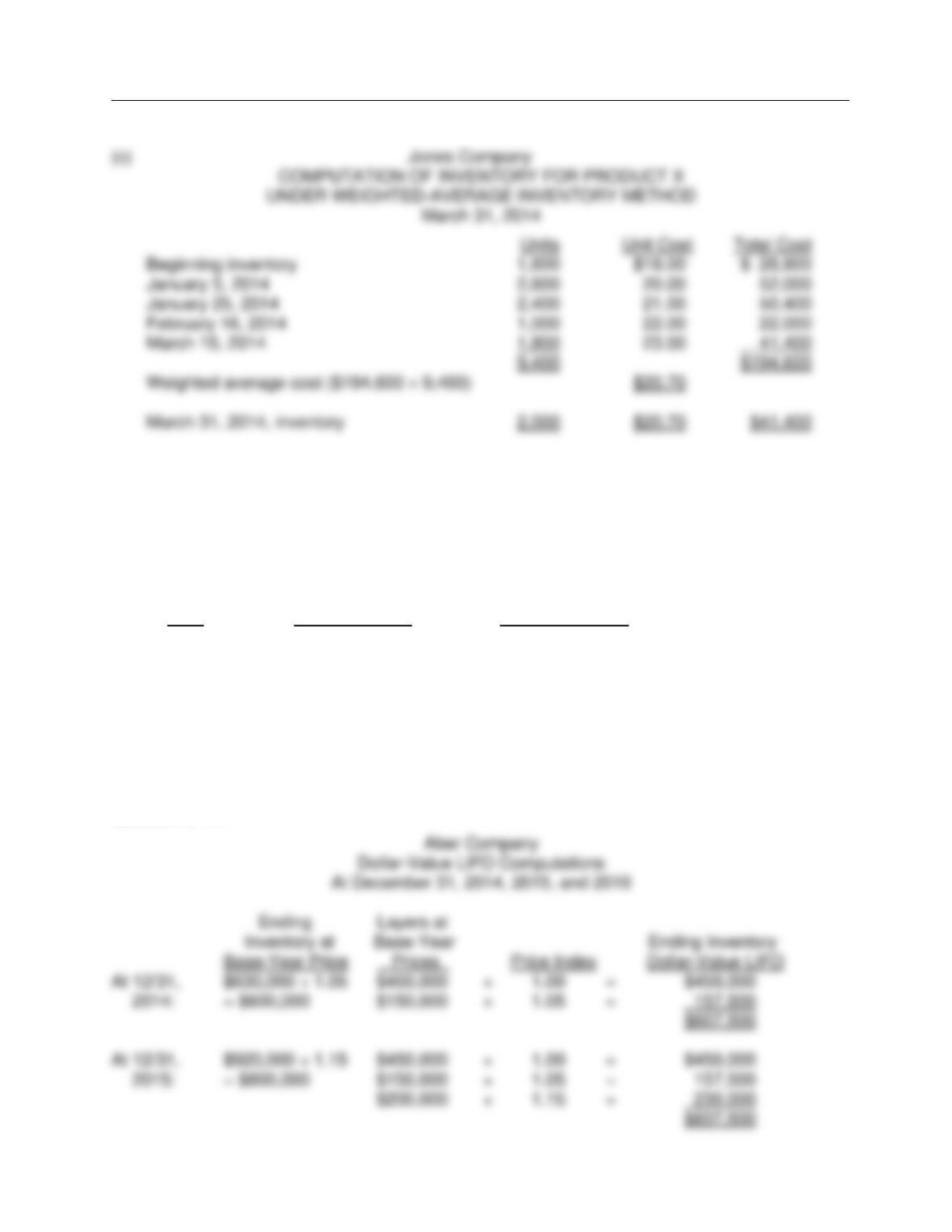
(c) Weighted-average.
Show supporting computations in good form.
Solution 8-160
Valuation of Inventories: A Cost-Basis Approach
8 – 47
Solution 8-160 (cont.)
Pr. 8-161—Dollar-value LIFO.
Aber Company manufactures one product. On December 31, 2013, Aber adopted the dollar-value
LIFO inventory method. The inventory on that date using the dollar-value LIFO inventory method
was $450,000. Inventory data are as follows:
Inventory at Price index
Year year-end prices (base year 2009)
2014 $630,000 1.05
2015 920,000 1.15
2016 950,000 1.25
Instructions
Compute the inventory at December 31, 2014, 2015, and 2016, using the dollar-value LIFO
method for each year.
Solution 8-161
Test Bank for Intermediate Accounting, Fifteenth Edition
8 – 48
Solution 8-161 (cont.)
Pr. 8-162—Dollar-value LIFO.
Gott Company adopted the dollar-value LIFO inventory method on 12/31/13. On this date, its
inventory consisted of the following items.
Item Number of Units Cost Per Unit Total Cost
X 200 $2.50 $ 500
Y 600 4.50 2,700
$3,200
Additional information: December 31
2014 2015
1. Units of X in inventory 300 400
2. Cost of each X unit $3.00 $3.25
3. Units of Y in inventory 800 1,200
4. Cost of each Y unit $5.50 $6.00
Instructions
(a) Compute the price index for 2014. Round to 2 decimal places.
(b) Calculate the 12/31/14 inventory. Label all numbers.
(c) Compute the price index for 2015. Round to 2 decimal places.
(d) Calculate the 12/31/15 inventory. Label all numbers.
Solution 8-162

Valuation of Inventories: A Cost-Basis Approach
8 – 49
Solution 8-162 (cont.)
Short Answer:
1. As compared with the FIFO method of costing inventories, does the LIFO method result in a
larger or smaller net income in a period of rising prices? What is the comparative effect on
net income in a period of falling prices?
1. The LIFO method results in a smaller net income because later costs, which are higher
than earlier costs, are matched against revenue. Conversely, in a period of falling prices,
the LIFO method would result in a higher net income because later costs in this case
would be lower than earlier costs, and these later costs would be matched against
revenue.
2. Explain the following terms.
(a) LIFO layer (b) LIFO reserve (c) LIFO effect
2. (a) LIFO layer – a LIFO layer (increment) is formed when the ending inventory at base-
year prices exceeds the beginning inventory at base-year prices.
(b) LIFO reserve – the difference between the inventory method used for internal purposes
and LIFO.
(c) LIFO effect – the change in the LIFO reserve (Allowance to Reduce Inventory to LIFO)
from one period to the next.

Test Bank for Intermediate Accounting, Fifteenth Edition
8 – 50
IFRS QUESTIONS
True / False
1. Who owns the goods, as well as the costs to include in inventory, are essentially
accounted for the same under IFRS and U.S. GAAP.
2. U.S. GAAP has less detailed rules related to the accounting for inventories, compared to
IFRS.
3. IFRS does not permit the LIFO method to account for inventories.
4. Many U.S. companies that have international operations use LIFO for U.S. purposes but
use FIFO for their foreign subsidiaries.
5. Both U.S. GAAP and IFRS permit the use of the LIFO method to account for inventories.
Answers to True / False questions:
Multiple Choice Questions:
1. Under IFRS, an entity should initially recognize inventory when
a. it has control of the inventory
b. it expects it to provide future economic benefits
c. the cost of the inventory can be reliably measured
d. All of these choices are correct
2. With respect to accounting for inventories, which of the following is a difference that exists
for IFRS, as opposed to U.S. GAAP?
a. There is required recognition of certain development costs.
b. The FIFO method of inventories is prohibited.
c. The specific identification method of inventories is only allowed when goods are
interchangeable.
d. The weighted average method of inventories is prohibited.
3. Under IFRS, which of the following would be included in the cost of inventories?
a. Product specific designer costs
b. Abnormal waste materials
c. Selling costs
d. All of these would be included in the cost of inventories.

Valuation of Inventories: A Cost-Basis Approach
8 – 51
4. Which of the following best describes the IFRS requirement for applying the same cost
formula to all inventories?
a. When they are purchased from different suppliers.
b. When they are purchased from the same geographic region.
c. When they are similar in nature or use.
d. When they sell for the same price.
5. Under IFRS, inventories are classified as
a. noncurrent assets
b. current assets
c. stockholders’ equity
d. current liabilities
Use the following information to answer questions 6-8.
Barton Company uses a periodic inventory system. On January 1, 2014, Barton Company had
1,200 units of inventory on hand at a cost of $8 per unit. During 2014, Barton made the following
inventory purchases.
April 1
Purchased 400 units at $10
June 1
Purchased 300 units at $12
September 1
Purchased 800 units at $14
November 1
Purchased 1,000 units at $15
Assume Barton Company sold 2,300 units of inventory during 2014.
6. If you assume that Barton follows IFRS and uses the FIFO method, what is the ending
inventory and cost of goods sold, respectively?
a. Ending inventory = $11,600; Cost of Goods Sold = $31,800
b. Ending inventory = $16,520; Cost of Goods Sold = $26,880
c. Ending inventory = $16,422; Cost of Goods Sold = $26,978
d. Ending inventory = $20,600; Cost of Goods Sold = $22,800
7. If you assume that Barton follows IFRS and uses the Average-cost method, what is the
ending inventory and cost of goods sold, respectively?
a. Ending inventory = $11,600; Cost of Goods Sold = $31,800
b. Ending inventory = $16,520; Cost of Goods Sold = $26,880
c. Ending inventory = $16,422; Cost of Goods Sold = $26,978
d. Ending inventory = $20,600; Cost of Goods Sold = $22,800

Test Bank for Intermediate Accounting, Fifteenth Edition
8 – 52
8. Based on your answers to Questions 6 and 7, which of the following is a disadvantage of
using the IFRS FIFO method, as compared to Average-cost under U.S. GAAP?
a. Under FIFO, during periods of inflation, inventory costs matched against sales are
lower than the inventory replacement cost.
b. When price levels increase and inventory quantities do not decrease, taxes are
greater under FIFO
c. FIFO may cause poorer buying habits as management attempts to manipulate net
income.
d. FIFO typically causes lower reported earnings.
9. Which of the following is an advantage for U.S. companies with international operations to
use LIFO for U.S. purposes, as opposed to using FIFO for foreign subsidiaries?
a. LIFO creates paper profits.
b. LIFO generally approximates the physical flow of items.
c. Under LIFO, inventory is less vulnerable to price declines.
d. LIFO eliminates balance sheet distortion.
10. Both U.S. GAAP and IFRS exclude which of the following from the cost of inventory?
a. Selling costs
b. General administrative costs
c. Storage costs of finished goods
d. All of these are excluded by U.S. GAAP and IFRS.
Answer to Multiple Choice.