Page 300 M/C Problems Chapter 8: Risk and Return
c. 10.62%
d. 11.18%
e. 11.77%
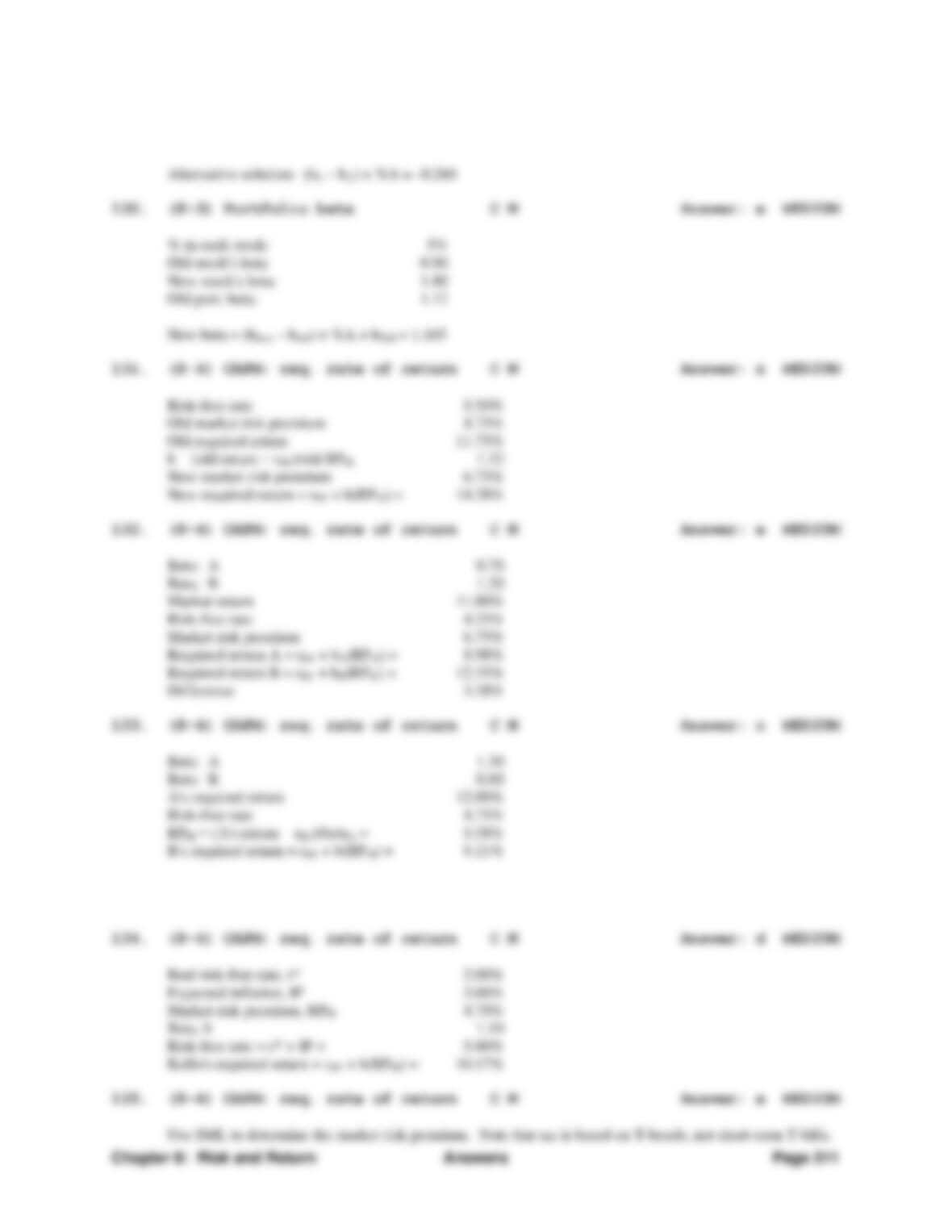
138. Data for Dana Industries is shown below. Now Dana acquires some risky
assets that cause its beta to increase by 30%. In addition, expected
inflation increases by 2.00%. What is the stock’s new required rate of
return?
Initial beta 1.00
Initial required return (rs) 10.20%
Market risk premium, RPM 6.00%
Percentage increase in beta 30.00%
Increase in inflation premium, IP 2.00%
a. 14.00%
b. 14.70%
c. 15.44%
d. 16.21%
e. 17.02%
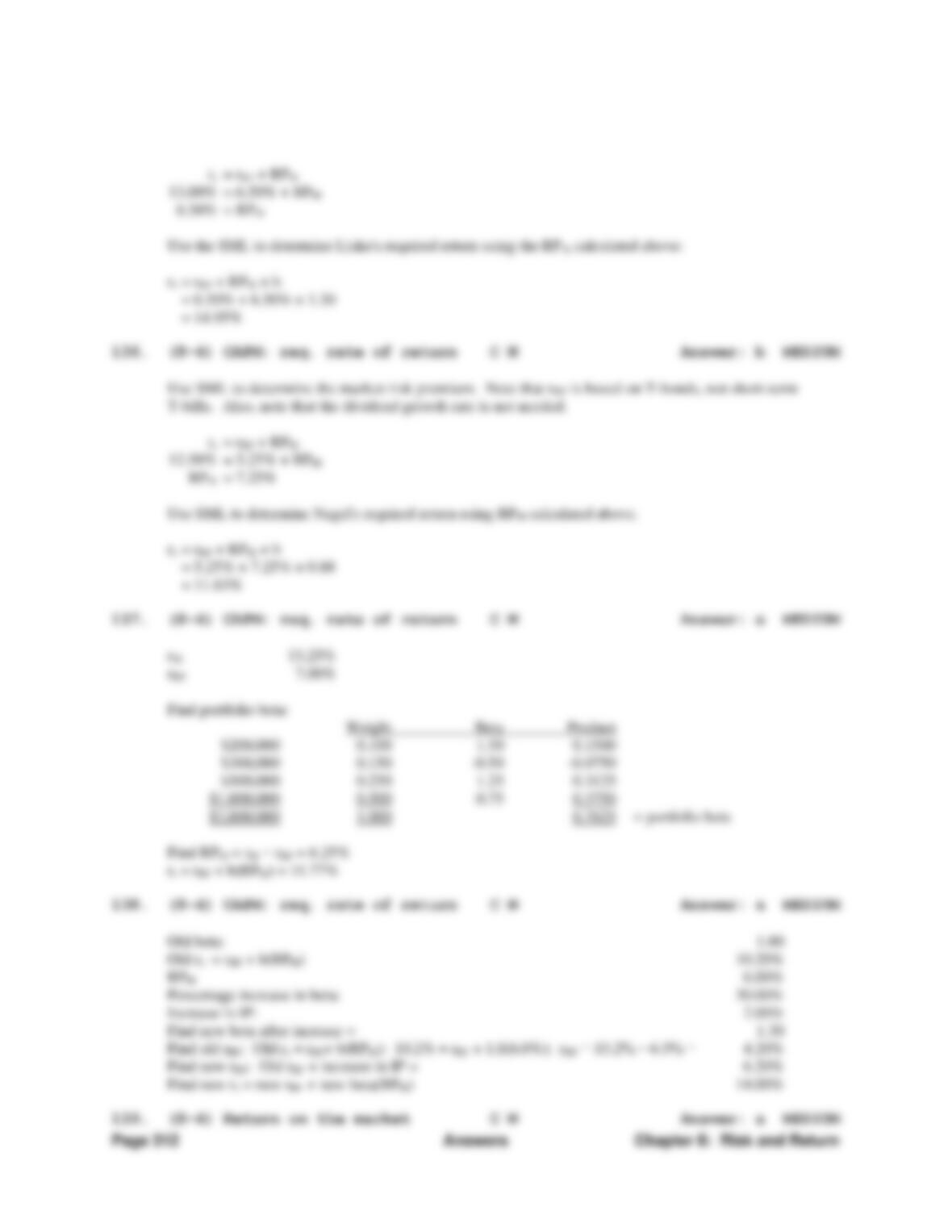
139. Mulherin’s stock has a beta of 1.23, its required return is 11.75%, and
the risk-free rate is 4.30%. What is the required rate of return on
the market? (Hint: First find the market risk premium.)
a. 10.36%
b. 10.62%
c. 10.88%
d. 11.15%
e. 11.43%
140. Suppose you hold a portfolio consisting of a $10,000 investment in each
of 8 different common stocks. The portfolio’s beta is 1.25. Now
suppose you decided to sell one of your stocks that has a beta of 1.00
and to use the proceeds to buy a replacement stock with a beta of 1.35.
What would the portfolio’s new beta be?
a. 1.17
b. 1.23
c. 1.29
d. 1.36
e. 1.43
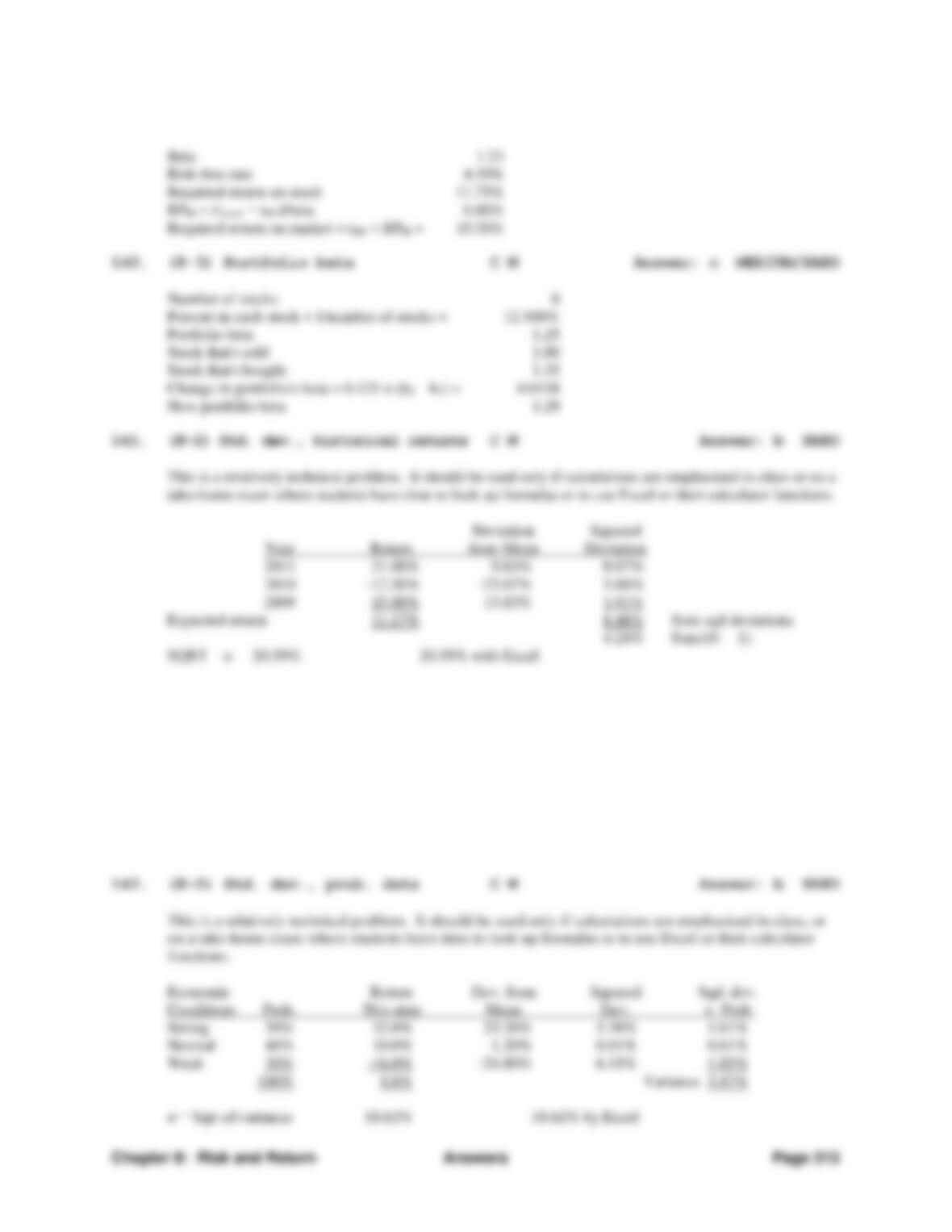
141. Returns for the Dayton Company over the last 3 years are shown below.
What’s the standard deviation of the firm’s returns? (Hint: This is a
sample, not a complete population, so the sample standard deviation
formula should be used.)
Year Return
2011 21.00%
2010 –12.50%

Chapter 8: Risk and Return M/C Problems Page 301
2009 25.00%
a. 20.08%
b. 20.59%
c. 21.11%
d. 21.64%
e. 22.18%
142. Carson Inc.’s manager believes that economic conditions during the next
year will be strong, normal, or weak, and she thinks that the firm’s
returns will have the probability distribution shown below. What’s the
standard deviation of the estimated returns? (Hint: Use the formula
for the standard deviation of a population, not a sample.)
Economic
Conditions Prob. Return
Strong 30% 32.0%
Normal 40% 10.0%
Weak 30% –16.0%
a. 17.69%
b. 18.62%
c. 19.55%
d. 20.52%
e. 21.55%
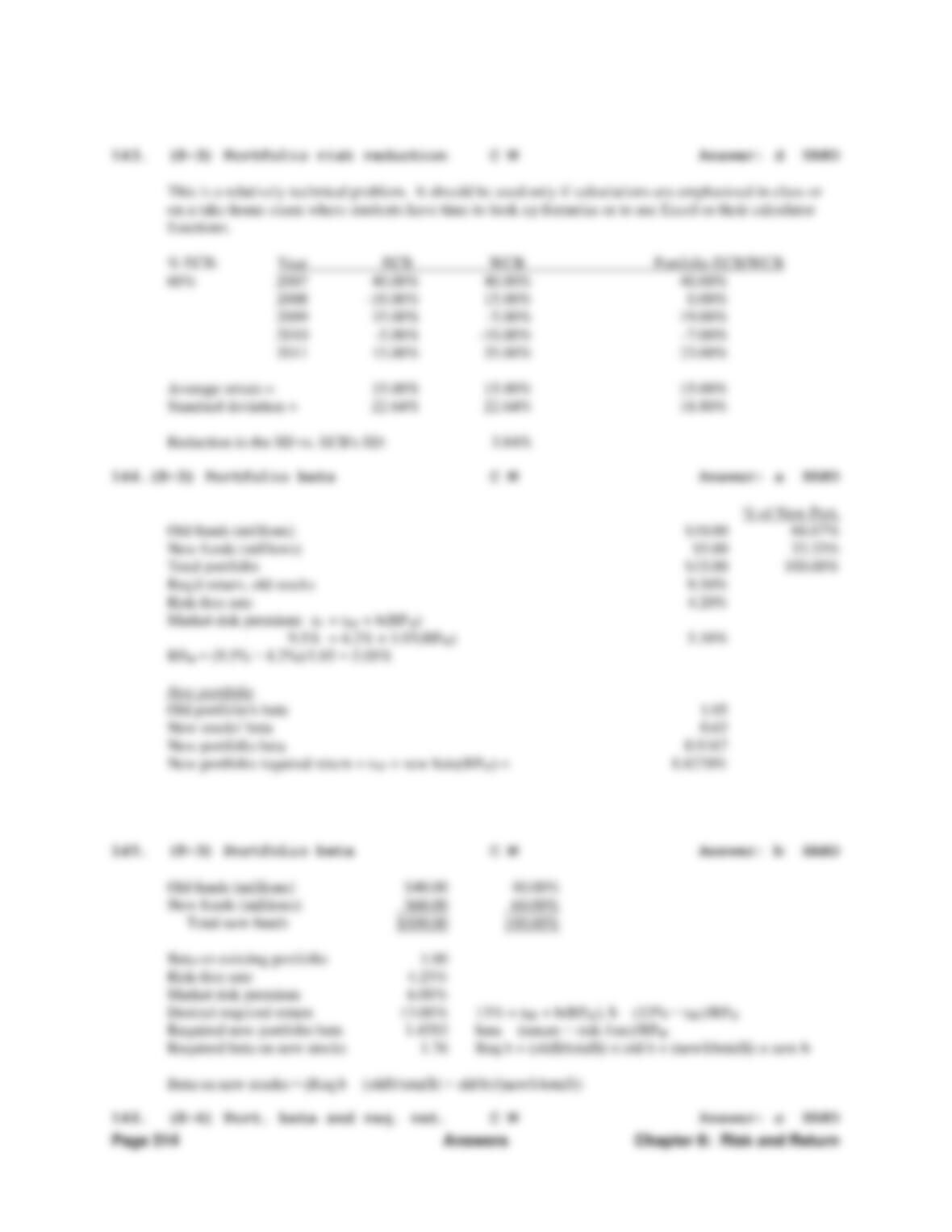
143. Assume that your uncle holds just one stock, East Coast Bank (ECB),
which he thinks has very little risk. You agree that the stock is
relatively safe, but you want to demonstrate that his risk would be
even lower if he were more diversified. You obtain the following
returns data for West Coast Bank (WCB). Both banks have had less
variability than most other stocks over the past 5 years. Measured by
the standard deviation of returns, by how much would your uncle’s risk
have been reduced if he had held a portfolio consisting of 60% in ECB
and the remainder in WCB? (Hint: Use the sample standard deviation
formula.)
Year ECB WCB
2007 40.00% 40.00%
2008 –10.00% 15.00%
2009 35.00% –5.00%
2010 –5.00% –10.00%
2011 15.00% 35.00%
Average return = 15.00% 15.00%
Standard deviation = 22.64% 22.64%
a. 3.29%
b. 3.46%
c. 3.65%
d. 3.84%
e. 4.03%

Page 302 M/C Problems Chapter 8: Risk and Return
144. Assume that you manage a $10.00 million mutual fund that has a beta of
1.05 and a 9.50% required return. The risk-free rate is 4.20%. You
now receive another $5.00 million, which you invest in stocks with an
average beta of 0.65. What is the required rate of return on the new
portfolio? (Hint: You must first find the market risk premium, then
find the new portfolio beta.)
a. 8.83%
b. 9.05%
c. 9.27%
d. 9.51%
e. 9.74%
145. A mutual fund manager has a $40 million portfolio with a beta of 1.00.
The risk-free rate is 4.25%, and the market risk premium is 6.00%. The
manager expects to receive an additional $60 million which she plans to
invest in additional stocks. After investing the additional funds, she
wants the fund’s required and expected return to be 13.00%. What must
the average beta of the new stocks be to achieve the target required
rate of return?
a. 1.68
b. 1.76
c. 1.85
d. 1.94
e. 2.04
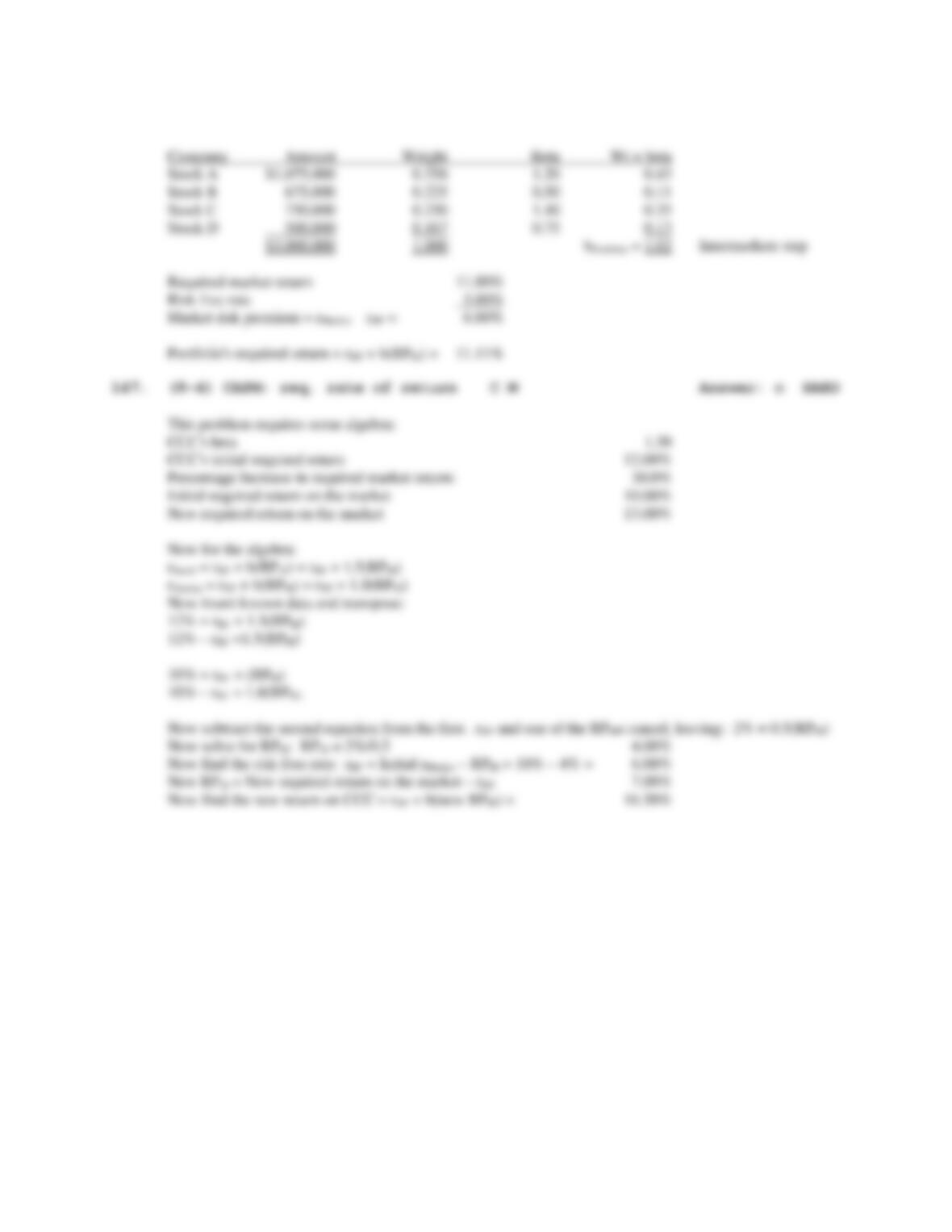
146. Assume that you are the portfolio manager of the SF Fund, a $3 million
hedge fund that contains the following stocks. The required rate of
return on the market is 11.00% and the risk-free rate is 5.00%. What
rate of return should investors expect (and require) on this fund?
Stock Amount Beta
A $1,075,000 1.20
B 675,000 0.50
C 750,000 1.40
D 500,000 0.75
$3,000,000
a. 10.56%
b. 10.83%
c. 11.11%
d. 11.38%
e. 11.67%
147. CCC Corp has a beta of 1.5 and is currently in equilibrium. The
required rate of return on the stock is 12.00% versus a required return
on an average stock of 10.00%. Now the required return on an average
stock increases by 30.0% (not percentage points). Neither betas nor
the risk-free rate change. What would CCC’s new required return be?
a. 14.89%
Chapter 8: Risk and Return M/C Problems Page 303
b. 15.68%
c. 16.50%
d. 17.33%
e. 18.19%
Page 304 Answers Chapter 8: Risk and Return
CHAPTER 8
ANSWERS AND SOLUTIONS
Chapter 8: Risk and Return Answers Page 305
Chapter 8: Risk and Return Answers Page 315