91) In the long run, monopolistically competitive firms earn zero economic profits.
92) Some monopolistically competitive firms differentiate their products simply by opening a
new store at a different location.
93) Describe some of the ways in which firms differentiate their products.
94) Give five examples of industries that are monopolistically competitive.
95) What is “monopolistic” about monopolistic competition?
96) What is “competitive” about a monopolistically competitive market?
97) If you were thinking of entering the ice cream business, would you make a product that is
just like one that is already being produced? Explain.
98) The market for chicken used to be perfectly competitive. Then producers like Frank Perdue
started marketing chicken under their name. What did they gain by doing this?
99) Suppose that A Cleaner World invents a new type of laundry detergent that has an ingredient
that stops stains from setting into clothes. If the laundry detergent market is monopolistically
competitive, explain what will happen to the price of its product in the short run. What will
happen in the long run?
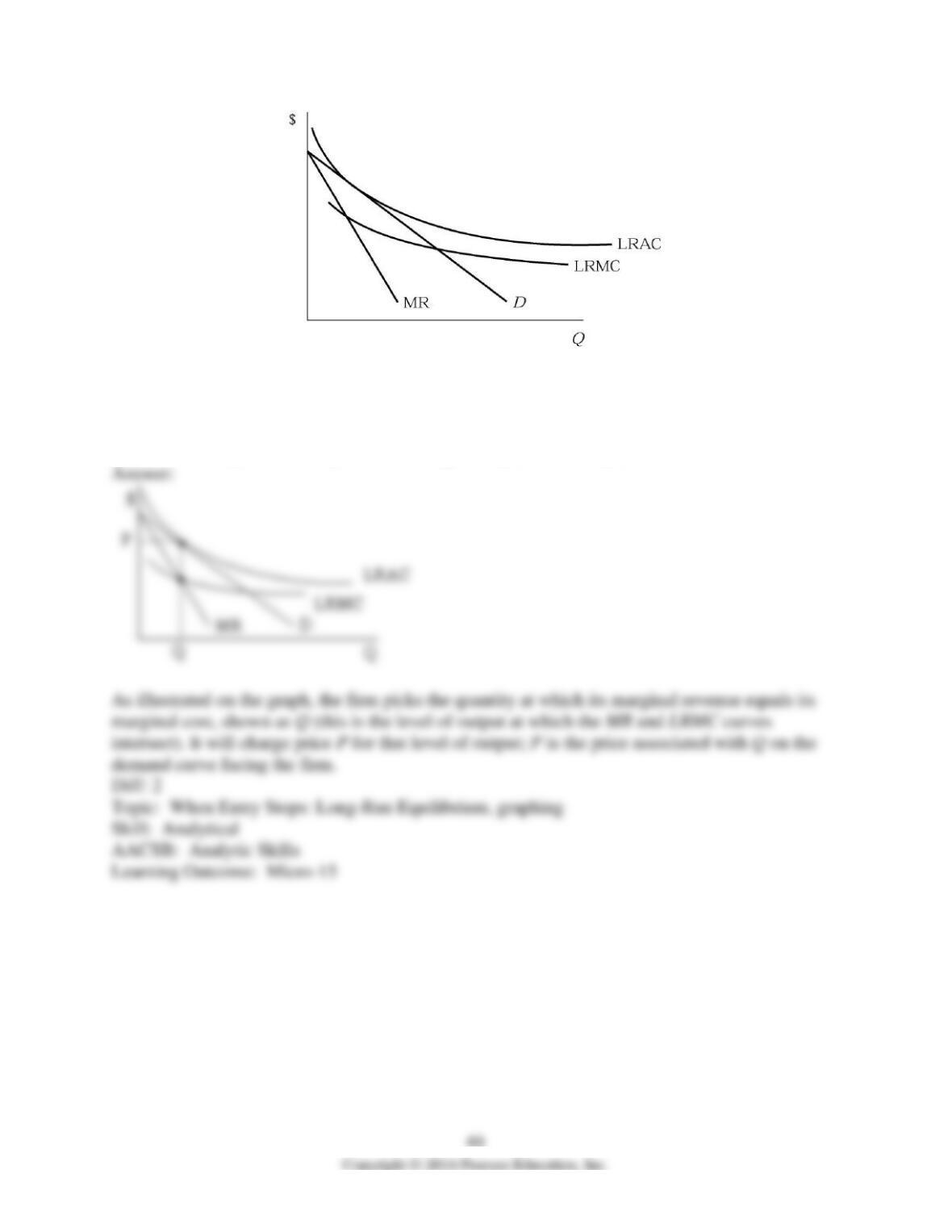
Figure 8.6
100) Figure 8.6 depicts a monopolistically competitive firm in the long run. Illustrate on the
graph the firm’s price and output level in long-run equilibrium. Explain.
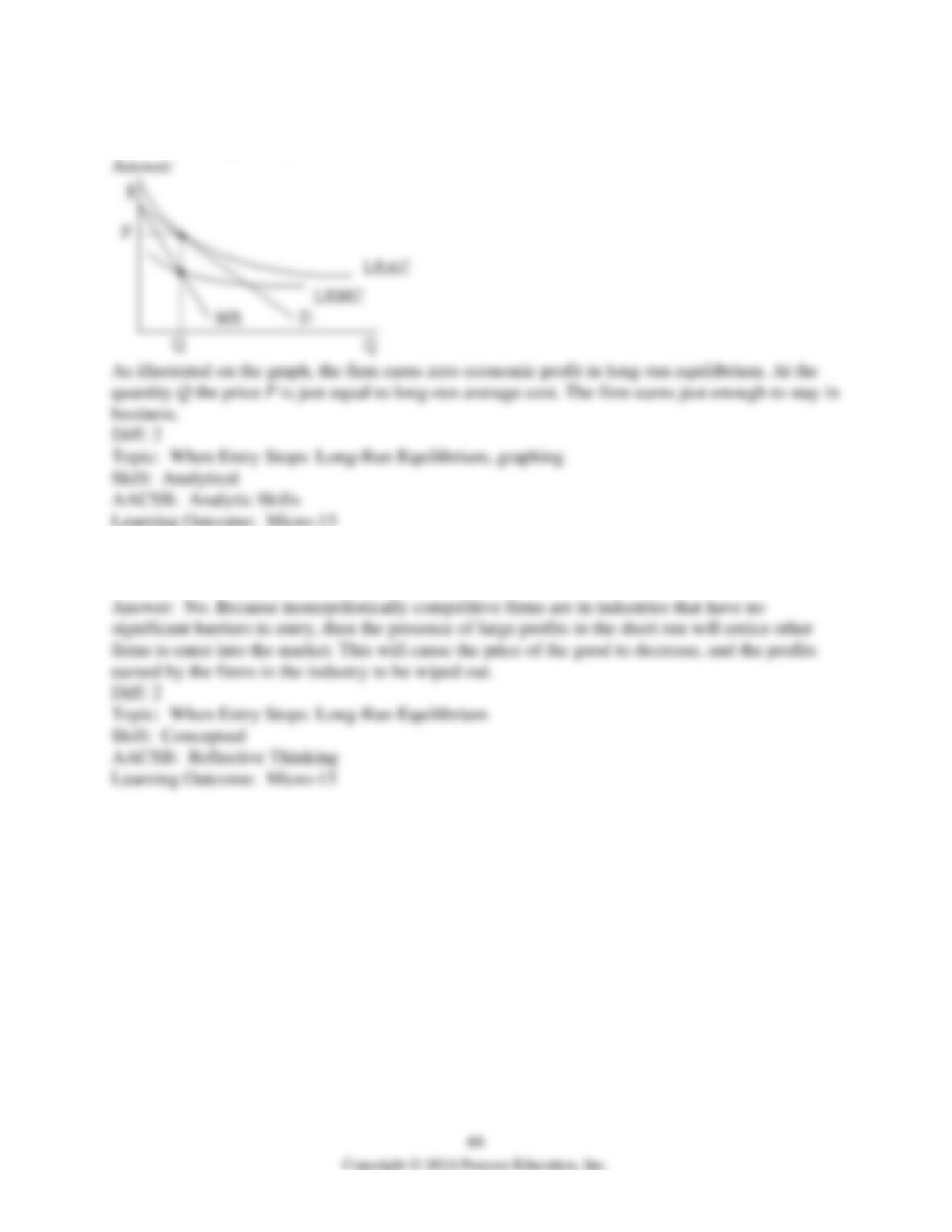
101) Referring to Figure 8.6, how much economic profit does the monopolistically competitive
firm earn in long-run equilibrium?
102) Can a monopolistically competitive firm producing a good with lots of very close
substitutes earn large positive profits in the long run?
8.3 Trade-Offs with Entry and Monopolistic Competition
1) A benefit to consumers of monopolistically competitive markets is that
A) consumers only have to choose from one product.
B) consumers have a variety of products from which to choose.
C) goods are sold at the lowest possible average cost of production.
D) price is equal to marginal cost in equilibrium.
2) Consumers benefit from monopolistically competitive markets because
A) they only have one good from which to choose.
B) in this type of market, producers supply goods in a variety of locations or with a variety of
characteristics.
C) in this type of market, goods are sold at a price equal to the marginal cost of production.
D) goods are sold at a price equal to marginal revenue.
3) The “good news” for consumers from monopolistic competition is ________ but the “bad
news” for producers is that ________.
A) lower prices than monopoly; there are higher production costs
B) lower prices than monopoly; there are higher travel costs
C) lower prices than monopoly; there is less product variety
D) greater product variety; product prices are higher
4) As compared to a perfectly competitive firm, a monopolistically competitive firm will
A) have more control over price.
B) have less control over price.
C) face more barriers to entry.
D) face many more competitors.
5) As compared to a perfectly competitive firm, a monopolistically competitive firm will
A) have less control over price.
B) face more barriers to entry.
C) face more competitors.
D) sell a more differentiated product.
6) Monopolistically competitive markets are like perfectly competitive markets because in both
markets firms
A) have some control over price.
B) face substantial barriers to entry.
C) face a large number of competitors.
D) have no control over price.
7) Monopolistically competitive markets are different from perfectly competitive markets
because in monopolistically competitive markets firms
A) have some control over price, while in perfectly competitive markets firms have no control
over price.
B) face substantial barriers to entry, while in perfectly competitive markets firms face no
significant barriers to entry.
C) have no control over price, while in perfectly competitive markets firms have some control
over price.
D) sell a standardized product, while in perfectly competitive markets firms sell a differentiated
product.
8) In which of the following ways is a monopolistically competitive firm like a perfectly
competitive firm?
A) Short-run economic profits are always positive.
B) Short-run economic profits may be positive, negative, or zero.
C) Long-run economic profits are negative.
D) Long-run economic profits are positive.
9) Which of the following characteristics of the monopolistically competitive and the perfectly
competitive market will cause the firm to earn zero profits in the long run?
A) no barriers to entry
B) many buyers
C) price taker
D) homogeneous product
10) In which of the following ways is a monopolistically competitive firm like a perfectly
competitive firm?
A) Short-run economic profits are always positive.
B) Long-run economic profits are negative.
C) Long-run economic profits are positive.
D) Long-run economic profits are equal to zero.
11) The more product differentiation in the market, the ________ the firm specific demand
curve. The less product differentiation in the market, the ________ the firm specific demand
curve.
A) steeper; flatter
B) flatter; steeper
C) more concave; more convex
D) more convex; more concave
Recall the Application about food and drink pricing during “happy hour” at bars and
restaurants to answer the following question(s).
12) Recall the Application. Bars and restaurants generally operate in a(n)
A) monopoly market.
B) monopolistically competitive market.
C) perfectly competitive market.
D) oligopoly market.
13) Recall the Application. During “happy hour,” many bars and restaurants face an increase in
demand for food and drink, and these establishments often cut prices during these times of
increased demand. When this demand increases, the bars and restaurants face a ________
demand curve.
A) perfectly elastic
B) perfectly inelastic
C) more elastic
D) more inelastic
14) Recall the Application. During “happy hour,” many bars and restaurants face an increase in
demand for food and drink, and these establishments often cut prices during these times of
increased demand. When this demand increases, the demand curve facing these bars and
restaurants becomes
A) vertical.
B) horizontal.
C) steeper.
D) flatter.
15) Monopolistically competitive firms have no benefits to consumers relative to perfectly
competitive firms.
16) Monopolistically competitive firms offer consumers more variety than perfectly competitive
firms.
Recall the Application about food and drink pricing during “happy hour” at bars and
restaurants to answer the following question(s).
17) Recall the Application. In a market subject to monopolistic competition, a restaurant’s
rational response to more elastic demand is to increase its price.
18) Recall the Application. The happy hour combination of higher demand and lower prices is in
accordance with the model of perfect competition.
19) What are the benefits and costs associated with monopolistic competition?
20) “If the amount of product differentiation in a monopolistically competitive industry is very
small, the outcome in that market will not be very different than if it were a perfectly competitive
industry.” Explain.
8.4 Advertising for Product Differentiation
1) Since people generally know that celebrities are paid to endorse products, celebrity
endorsements signal to consumers that
A) the product is likely to be popular.
B) the celebrity loves the product.
C) only rich people can afford the product.
D) all of the above
2) Since people generally know that celebrities are paid to endorse products, celebrity
endorsements signal to consumers that
A) the celebrity loves the product.
B) the product is appealing.
C) only rich people can afford the product.
D) all of the above
3) The main purpose of hiring the celebrity endorser is to
A) make the customers try the product for the first time.
B) make the customers buy the product repeatedly.
C) convince the customers that using the product will turn them into celebrities as well.
D) pay for the endorser’s retirement expenses.
4) For a company to convince consumers to use their products repeatedly, they must
A) make the customers see the benefits of the product.
B) hire another celebrity endorser.
C) hire an independent company to evaluate the product.
D) run the celebrity ads repeatedly.
5) If a firm that makes $100 profit per pair of shoes pays LeBron James $2,000,000 to endorse
their basketball shoes, then to make the endorsement pay off they must sell at least
A) $2,000,000 more in shoes.
B) $20,000 more in shoes.
C) 20,000 more pairs of shoes.
D) 200,000 more pairs of shoes.
6) If a firm that makes $5 profit per box of cigars pays Rush Limbaugh $1,000,000 to endorse
their cigars, then to make the endorsement pay off they must sell at least
A) $2,000,000 more in cigars.
B) $20,000 more in cigars.
C) 20,000 more boxes of cigars.
D) 200,000 more boxes of cigars.
Recall the Application about South African consumer lender that offered different interest
rates in loan offers via mass mailings answer the following question(s).
7) Recall the application. The number of consumers who accepted a particular loan offer from
the mass mailings
A) was lower for offer letters with low interest rates.
B) was higher for offer letters with high interest rates.
C) was lower for offer letters with high interest rates.
D) did not vary with the different interest rates.
8) Recall the application. The number of men who accepted a particular loan offer from the mass
mailings ________ when the offer letter included the picture of a ________.
A) increased; man rather than the picture of a woman
B) increased; woman rather than the picture of a man
C) decreased; either a man or a woman
D) was unaffected; either a man or a woman
9) Recall the application. The number of women who accepted a particular loan offer from the
mass mailings ________ when the offer letter included the picture of a ________.
A) increased; man rather than the picture of a woman
B) increased; woman rather than the picture of a man
C) decreased; either a man or a woman
D) was unaffected; either a man or a woman
10) Monopolistically competitive firms use advertising exclusively to inform customers about
the real differences between their products and their competitors’ products.
11) Advertising can create an image about a product inducing people to try the product.
12) Advertising can lead to more competition and lower prices for consumers.
13) When a celebrity is endorsing a product, it is usually because the celebrity is enthusiastic
about the product.

14) Hiring a more expensive celebrity endorser will always result in higher firm profits.
15) Advertising is a waste of money and just drives up costs and thus price to consumers.
16) Why might a firm pay a celebrity to endorse its product?
17) When is it a good decision to hire a celebrity endorser of your product?
18) What is the purpose of advertisements that focus on beer drinkers frolicking on the beach?
19) Why would a firm choose a lesser known celebrity in its advertising when more famous
celebrities are available?
8.5 Oligopoly and Pricing
1) When there are just a few firms in the industry, the industry structure is most likely to be
A) a perfectly competitive industry.
B) an oligopoly market.
C) a monopoly market.
D) a natural monopoly market.
2) When a few firms sell similar products in a market, the market structure is most likely to be
A) a perfectly competitive market.
B) a monopoly.
C) a monopolistically competitive market.
D) an oligopoly.
3) The four-firm concentration ratio measures the
A) percentage of total output in a market produced by the four largest firms.
B) elasticity of demand of the four largest firms in an industry.
C) average cost of the four largest firms in an industry.
D) number of firms in an industry.
4) The four-firm concentration ratio for the cigarette market is 93%. This means that
A) the four largest firms in the market produce 93% of the total market output.
B) the market is an oligopoly.
C) there is a high degree of concentration in the cigarette market.
D) all of the above
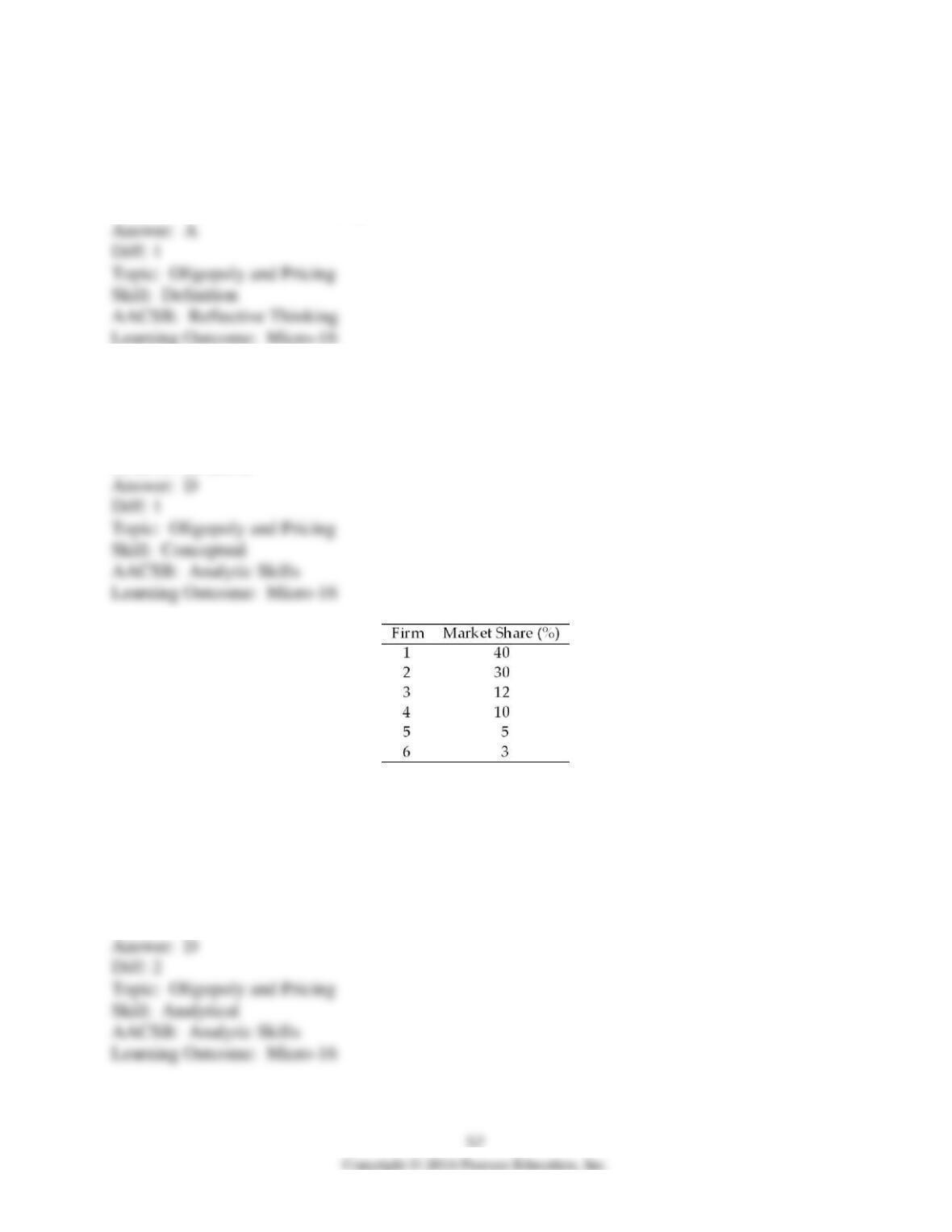
Table 8.1
5) The four-firm concentration ratio for the market depicted in Table 8.1 is
A) 10%.
B) 40%.
C) 82%.
D) 92%.
6) The key feature of ________ is that firms act strategically.
A) perfectly competition
B) an oligopoly
C) a monopoly
D) a natural monopoly
7) The Herfindahl-Hirschman Index measures
A) the degree of concentration in a market.
B) the percentage of market share held by the four largest firms in a market.
C) the percentage of market share held by the largest firm in a market.
D) the market share held by the largest firm in a market divided by the market share held by all
other firms in the market.
8) Oligopoly differs from monopoly and perfect competition in that
A) firms consider each others actions when choosing price and quantity.
B) there are a few firms in the industry.
C) firms act strategically.
D) all of the above
9) Suppose that there are five firms in a market, each controlling 20% of the market. The HHI
would equal
A) 10.
B) 100.
C) 1,000.
D) 2,000.
10) Compare two markets. In one market, the HHI is 500, in the other market the HHI is 1,500.
What must be true of these two markets?
A) The firms in the market in which the HHI is 1,500 have greater market power than do the
firms in the market in which the HHI is 500.
B) There are more firms in the market in which the HHI is 1,500 than in the market in which the
HHI is 500.
C) The firms in the market in which the HHI is 1,500 have less market power than do the firms
in the market in which the HHI is 500.
D) The market in which the HHI is 500 is, by definition, an oligopoly but the market in which
the HHI is 1,500 is not an oligopoly.
11) A high degree of concentration in a market suggests that firms in that market
A) have the power to control prices.
B) are perfectly competitive.
C) cannot act strategically.
D) have formed an illegal cartel.
12) Market power is the power to
A) control prices.
B) gain another firm’s customers.
C) reduce price below cost to deter entry.
D) control output.
13) When economies of scale are present, but sufficiently large to generate a natural monopoly,
the expected market structure is
A) monopoly.
B) monopolistic competition.
C) perfect competition.
D) oligopoly.
14) Which one of the following is the best example of an oligopolistic industry?
A) cigarettes
B) wheat growers
C) apple growers
D) public utilities