132. Eider Company has the following information:
Direct Materials:
Direct Labor:
Standard Quantity
100,000
Standard Hours
1,000
Actual Quantity
99,500
Actual Hours
1,050
Standard Price
$5
Standard Rate
$12
Actual Price
$4
Actual Rate
$13
a) Determine the materials price variance and whether it is favorable or unfavorable.
b) Determine the materials usage variance and whether it is favorable or unfavorable.
c) Determine the labor rate variance and whether it is favorable or unfavorable.
d) Determine the labor efficiency variance and whether it is favorable or unfavorable.
e) Provide the journal entries to record the purchase of materials, the issuance and usage of materials, and direct labor variances.
f) Provide the closing entries for the immaterial variances.
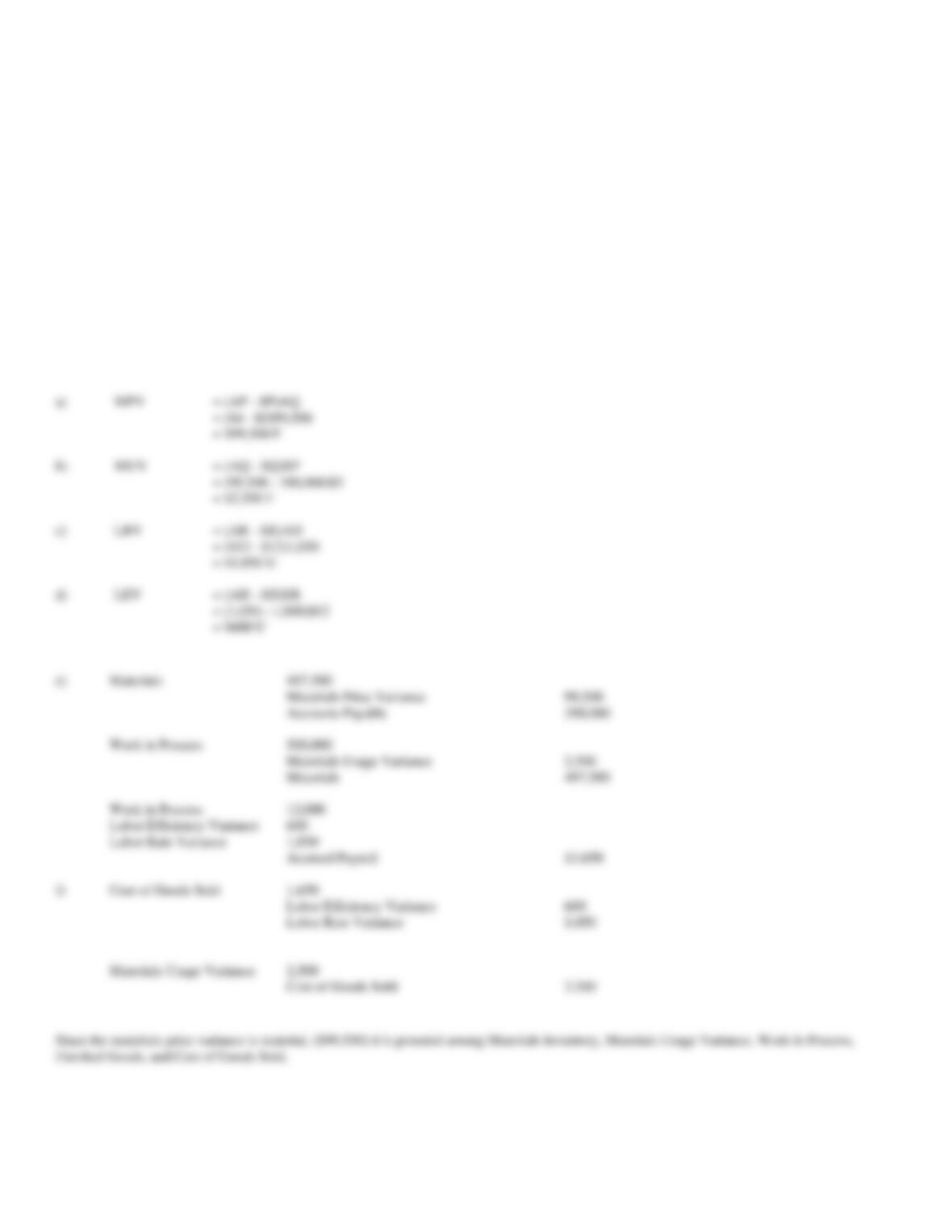
= (AP – SP)AQ
= ($4 – $5)99,500
= $99,500 F
MUV
= (AQ – SQ)SP
= (99,500 – 100,000)$5
= $2,500 F
LRV
= (AR – SR)AH
= ($13 – $12)1,050
= (AH – SH)SR
= (1,050 – 1,000)$12
= $600 U
Materials
497,500
Materials Price Variance
99,500
Accounts Payable
398,000
Work in Process
500,000
Materials Usage Variance
2,500
Materials
497,500
Work in Process
12,000
Labor Efficiency Variance
Labor Rate Variance
1,050
Accrued Payroll
13,650
Cost of Goods Sold
1,650
Labor Efficiency Variance
600
Labor Rate Variance
1,050
Materials Usage Variance
2,500
Cost of Goods Sold
2,500
133. Dagenham Corporation has the following information concerning its direct materials:
Direct Materials:
Standard Quantity
1,800
Actual Quantity
2,100
Standard Price
$50
Actual Price
$55
a) Determine the materials price variance and whether it is favorable or unfavorable.
b) Determine the materials usage variance and whether it is favorable or unfavorable.
c) Provide the journal entries to record the purchase of materials and the issuance and usage of materials.
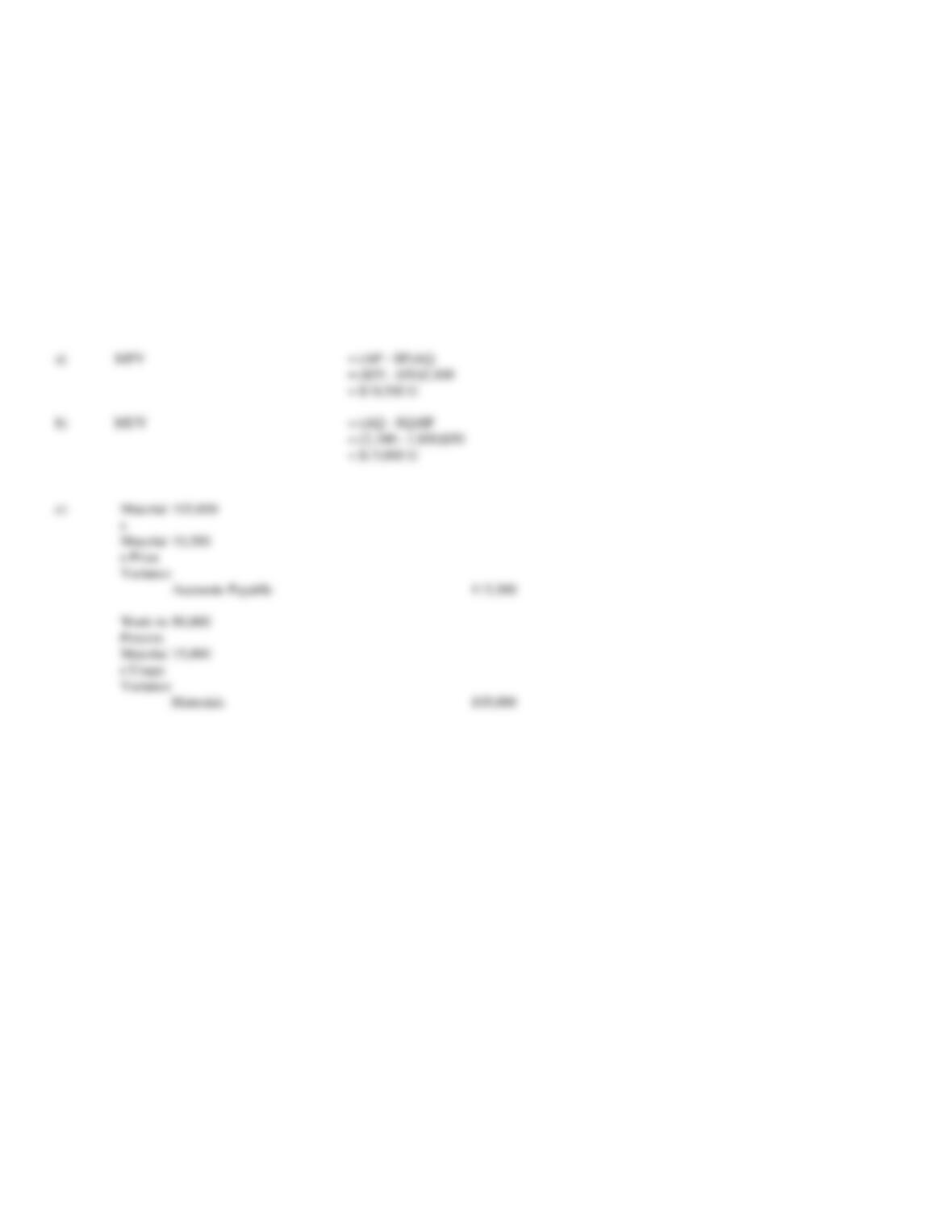
= (AP – SP)AQ
= ($55 – $50)2,100
= $10,500 U
b)
MUV
= (AQ – SQ)SP
= (2,100 – 1,800)$50
= $15,000 U
Accounts Payable
115,500
Materials
105,000
134. Warwick Company has the following information concerning its direct labor:
Direct Labor:
Standard Hours
6,500
Actual Hours
6,350
Standard Rate
$15
Actual Rate
$18
a) Determine the labor rate variance and whether it is favorable or unfavorable.
b) Determine the labor efficiency variance and whether it is favorable or unfavorable.
c) Provide the journal entry for the labor variances.
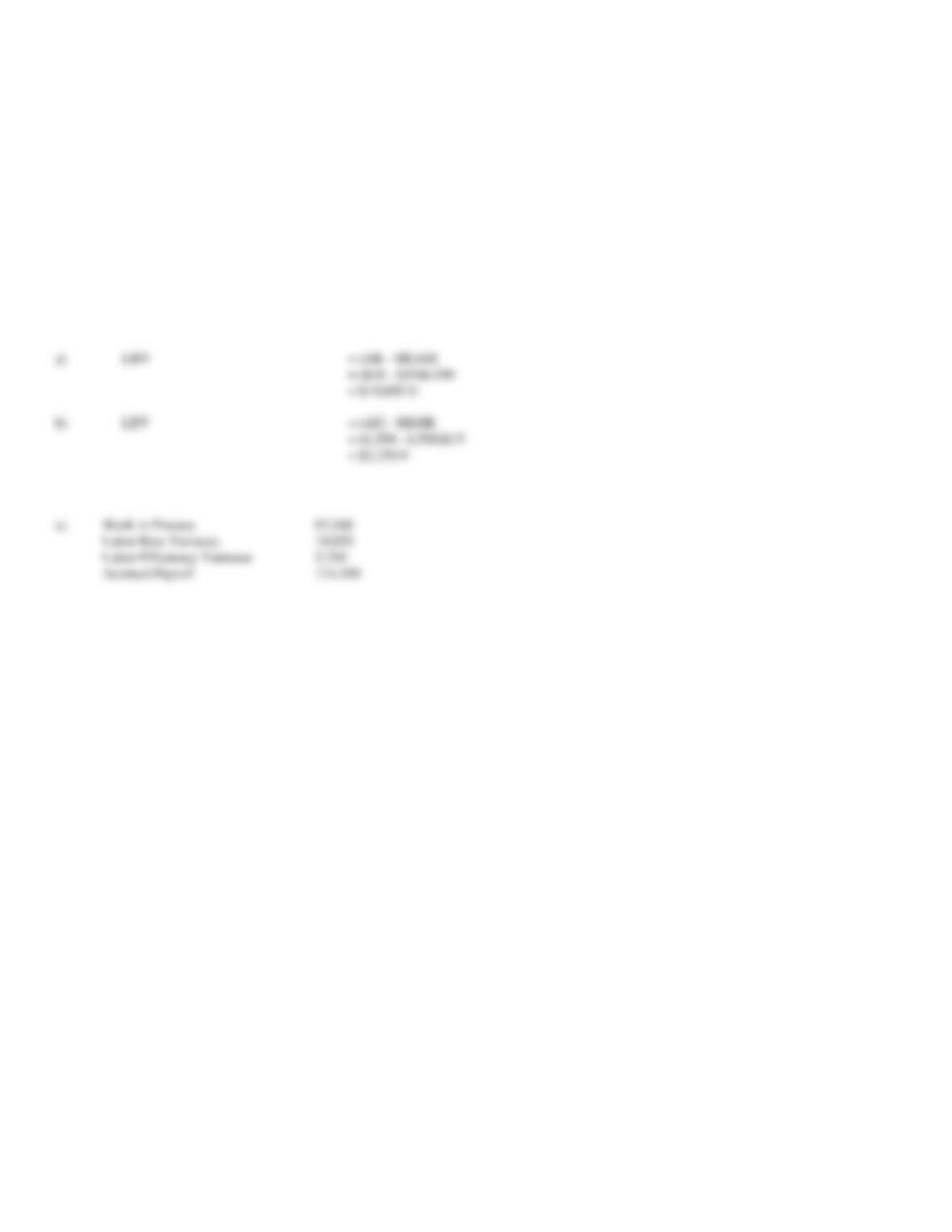
LRV
= (AR – SR)AH
= ($18 – $15)6,350
= $19,050 U
b)
= (AH – SH)SR
= (6,350 – 6,500)$15
= $2,250 F
Work in Process
97,500
Labor Rate Variance
19,050
Labor Efficiency Variance
2,250
Accrued Payroll
114,300
135. Gardener’s Market manufactures hedgers. During the year, it manufactured 5,000 hedgers, using 4.2 hours
of direct labor per hedger at a rate of $8. The materials and labor standards for manufacturing the hedgers are as
follows:
Direct materials (10 units @ $2)
$20
Direct labor (4 hours @ $7.50 per hour)
30
Gardener’s Market actually used 53,000 units of direct materials at a price of $2.25 per unit.
a) Determine the materials price variance and whether it is favorable or unfavorable.
b) Determine the materials usage variance and whether it is favorable or unfavorable.
c) Determine the labor rate variance and whether it is favorable or unfavorable.
d) Determine the labor efficiency variance and whether it is favorable or unfavorable.
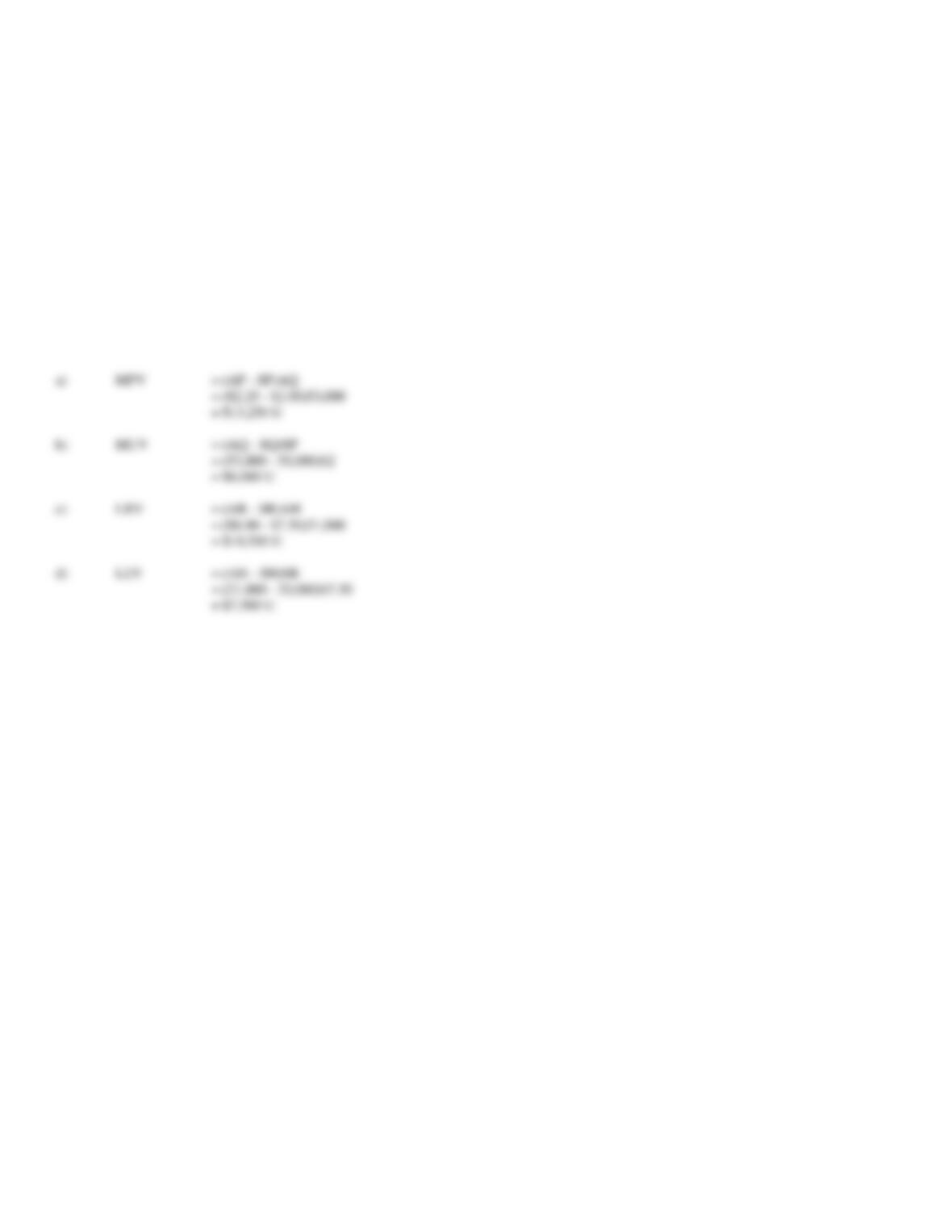
= ($2.25 – $2.00)53,000
= $13,250 U
= (53,000 – 50,000)$2
= $6,000 U
= $10,500 U
= (21,000 – 20,000)$7.50
= $7,500 U
136. Zappy Electrical manufactures electrician’s gloves. During the month, it manufactured 2,000 pairs of
gloves, using 2 hours of direct labor per pair at a rate of $7.10. The materials and labor standards for
manufacturing the gloves are as follows:
Direct materials per pair (1 unit @ $0.50)
$0.50
Direct labor per pair (2.1 hours @ $7.00 per hour)
14.70
Zappy actually used 2,100 units of direct materials at a price of $0.45 per unit.
a) Determine the materials price variance and whether it is favorable or unfavorable.
b) Determine the materials usage variance and whether it is favorable or unfavorable.
c) Determine the labor rate variance and whether it is favorable or unfavorable.
d) Determine the labor efficiency variance and whether it is favorable or unfavorable.
= ($0.45- $0.50)2,100
= $105 F
= $50 U
= ($7.10 – $7.00)4,000
= $400 U
= (4,000 – 4,200)$7.00
= $1,400 F
137. Dog’s Best Friend manufactures dog food. During the month, it manufactured 3,000 bags of kibble, using
0.25 hour of direct labor per bag at a rate of $9.00 per hour. The materials and labor standards for
manufacturing the bags of kibble are as follows:
Direct materials (1 pound of beef @ $1.00 per pound)
$1.00
Direct materials (1 bag @ $0.25)
0.25
Direct labor (0.30 hour @ $9.00)
2.70
The company actually used 3,300 pounds of beef at a price of $1.10 per pound. It also purchased 3,000 bags at a price of $0.15 per bag.
a) Determine the total materials price variance and whether it is favorable or unfavorable.
b) Determine the materials usage variance for beef and whether it is favorable or unfavorable.
c) Determine the labor rate variance and whether it is favorable or unfavorable.
d) Determine the labor efficiency variance and whether it is favorable or unfavorable.
MPV for Beef
= (AP – SP)AQ
= ($1.10 – $1.00)3,300
= $330 U
MPV for Bags
= ($0.15 – $0.25)3,000
= $300 F
Total MPV
= $30 U
MUV
= (AQ – SQ)SP
= (3,300 – 3,000)$1.00
= $300 U
LRV
= (AR – SR)AH
= ($9.00 – $9.00)750
= $0 Neither favorable nor unfavorable
= (AH – SH)SR
= (750- 900)$9.00
= $1,350 F
138. The Cat’s Meow manufactures gourmet cat food. During the month, it manufactured 5,000 cans of tuna,
using 0.10 hour of direct labor per can at a rate of $8.00 per hour. The materials and labor standards for
manufacturing the cans of tuna are as follows:
Direct materials (1 pound of tuna @ $0.50 per pound)
$0.50
Direct materials (1 can @ $0.35)
0.35
Direct labor (0.20 hour @ $7.00)
1.40
The company actually used 4,900 pounds of tuna at a price of $0.65 per pound. It also purchased 5,000 cans at a price of $0.45 per can.
a) Determine the total materials price variance and whether it is favorable or unfavorable.
b) Determine the materials usage variance for tuna and whether it is favorable or unfavorable.
c) Determine the labor rate variance and whether it is favorable or unfavorable.
d) Determine the labor efficiency variance and whether it is favorable or unfavorable.
e) Make all necessary journal entries to record the purchase of materials, the issuance and usage of materials, and the direct labor variances.
f) Provide the closing entries.
MPV for Tuna
= (AP – SP)AQ
= ($0.65 – $0.50)4,900
= $735 U
MPV for Cans
= ($0.35 – $0.45)5,000
= $500 U
Total MPV
= $1,235 U
MUV
= (AQ – SQ)SP
= (4,900 – 5,000)$0.50
= $50 F
LRV
= (AR – SR)AH
= ($8.00 – $7.00)500
= $500 U
= (AH – SH)SR
= (500- 1,000)$7.00
= $3,500 F
139. Grandma’s Attic Company produces soft pillows made from goose down. The company uses a standard
cost system and has set the following standards for materials and labor for each pillow:
Feathers from 5 large white geese (5
geese @ $5)
$25
Fabric to make pillow cases (3 yards
@ $2)
6
Direct labor (5 hours @ $8)
40
Total prime cost
$71
During the month, the company produced 1,000 goose down pillows. Actual geese purchased were 5,100, at $4 per goose. Actual fabric purchases
2,900 yards at $2.10 per yard. There were no beginning or ending inventories of geese or fabric. Actual direct labor was 5,200 hours at $7.75 per
hour.
a) Determine the total materials price variance and whether it is favorable or unfavorable.
b) Determine the total materials usage variance and whether it is favorable or unfavorable.
c) Determine the labor rate variance and whether it is favorable or unfavorable.
d) Determine the labor efficiency variance and whether it is favorable or unfavorable.
e) Make all necessary journal entries to record the purchase of materials, the issuance and usage of materials, and the direct labor variances.
f) Provide the closing entries.
= ($4.00 – $5.00)5,100
= $5,100 F
MPV for Fabric
= ($2.10 – $2.00)2,900
Total MPV Variance
= $5,100 – $290 = $4,810 F
b)
MUV for Geese
= (AQ – SQ)SP
= $500 U
= $200 F
Total MUV
=$500 U – $200 F = $300 U
LRV
= (AR – SR)AH
= ($7.75 – $8.00)5,200
= $1,300 F
d)
= (AH – SH)SR
= (5,200 – 5,000)$8.00
= $1,600 U
Materials
31,300
(5,100 ´ $5.00) + (2,900 ´ $2.00)
Materials Price Variance
4,810
Work in Process
31,000
(5,000 ´ $5.00) + (3,000 ´ $2.00)
Materials Usage Variance
300
Work in Process
40,000
Labor Efficiency Variance
1,600
Accrued Payroll
40,300
140. Mersey Company produced 1,000 trash cans during March using 450 direct labor hours and 3,100 pounds
of rubber. Its materials and labor standards are as follows:
Direct materials (3 pounds of rubber @ $0.50)
$1.50
Direct labor (0.5 hours @ $16.00)
3.00
Its materials price variance was a favorable $620 and its labor rate variance was an unfavorable $900.
a) Calculate the actual price per unit.
b) Calculate the actual labor rate.
c) Determine the materials usage variance and whether it is favorable or unfavorable.
d) Determine the labor efficiency variance and whether it is favorable or unfavorable.
-$620
= (AP – $0.50)3,100
= $0.30 per pound
$900
= (AR – $16.00)450
= (3,100 – 3,000)$0.50
= $50 U
= (450 – 500)$16
= $800 F
Cost of Goods Sold
1,900
Labor Efficiency Variance
1,600
Materials Price Variance
4,810
Cost of Goods Sold
6,110
141. Pontefract Company produced 2,500 widgets during November using 4,000 units of materials at a cost of
$5.00 each. It also used 5,000 direct labor hours at a rate of $7.00. Its direct materials standard is 2 units per
widget. Its direct labor standard is 2.5 hours per widget.
Its materials price variance was a favorable $8,000 and its labor rate variance was an unfavorable $1,000.
a) Calculate the standard price per unit.
b) Calculate the standard labor rate.
c) Determine the materials usage variance and whether it is favorable or unfavorable.
d) Determine the labor efficiency variance and whether it is favorable or unfavorable.
142. During April, Rain Gear Unlimited produced 5,500 umbrellas from nylon that costs $0.45 per yard, which
is $0.05 cheaper than the standard cost. It also used 3,000 direct labor hours at a rate of $6.50. Its direct
materials standard is 1 yard per umbrella. Its direct labor standard is 0.5 hour per umbrella.
Its materials usage variance was a favorable $500 and its labor rate variance was a favorable $900.
a) Calculate the actual quantity of materials.
b) Calculate the standard labor rate.
c) Determine the materials price variance and whether it is favorable or unfavorable.
d) Determine the labor efficiency variance and whether it is favorable or unfavorable.
e) Record the entries for the materials purchase, the issuance and usage of materials, and the labor variances.
f) Provide the closing entries.
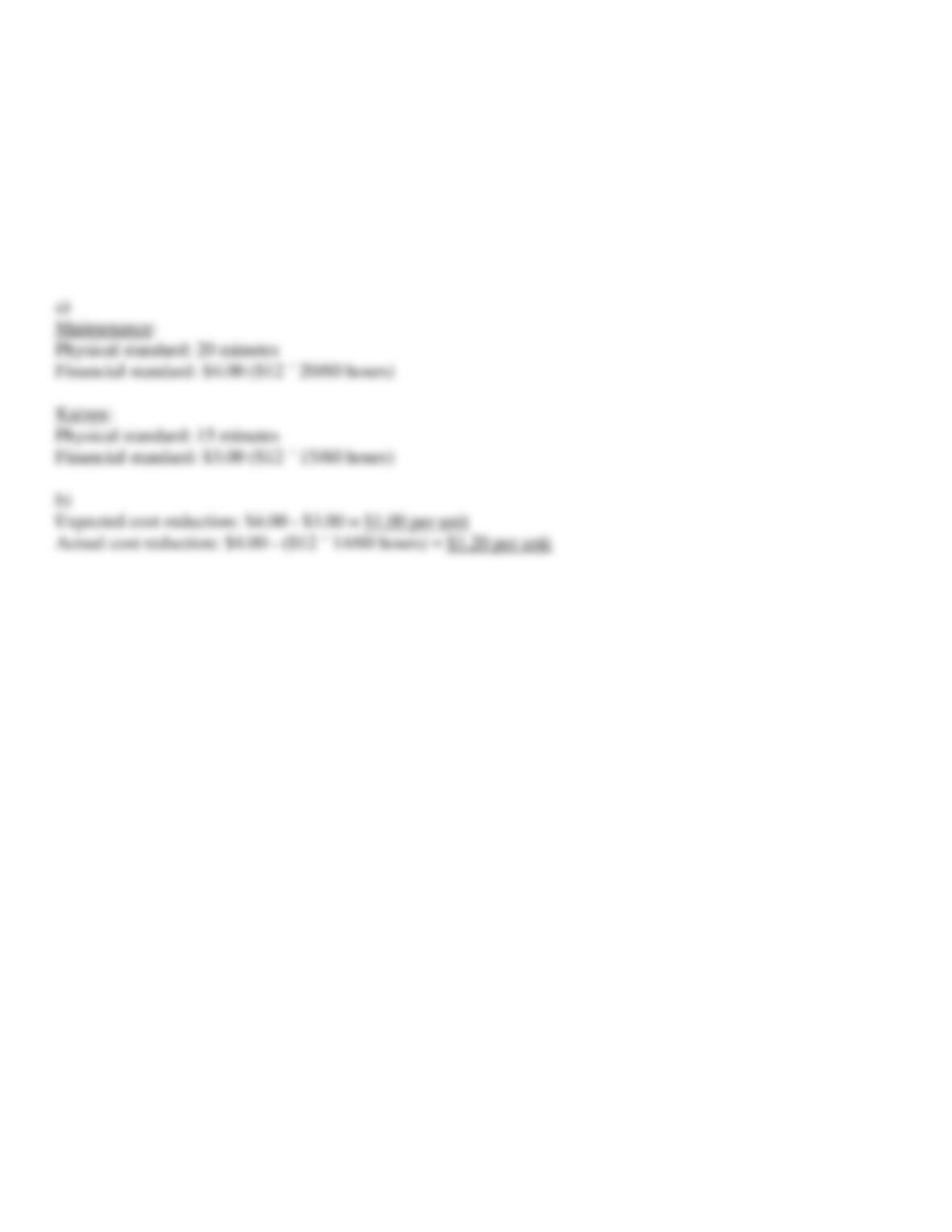
143. Stratford Company inspects every steam iron it manufactures for safety issues. The standard labor cost is
$12 per hour. The maintenance standard at the beginning of the first quarter is 20 minutes per iron. Stratford is
implementing a new production process that will aid in reducing any potential electrical defects in the irons.
This will decrease the inspection time to 15 minutes per iron. After the end of the first quarter, the new process
had reduced the inspection time per iron from 20 minutes to 14 minutes.
a).Identify the kaizen and maintenance labor standards in place at the beginning of the first quarter. Express the
standards in both physical and financial terms.
b).Calculate the expected cost reduction and actual cost reduction.
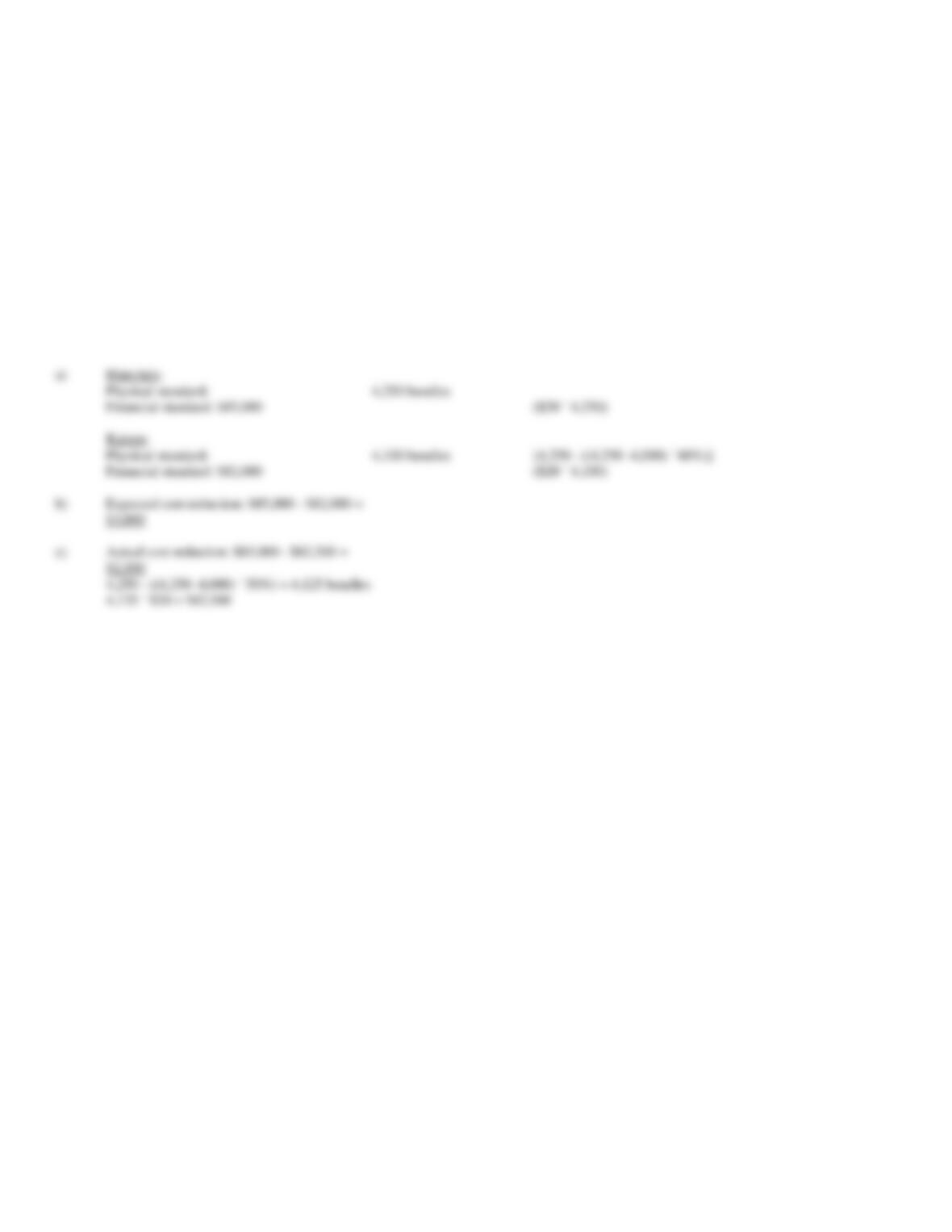
144. Wiltshire Limited produces woolen blankets and clothing. During Year 1, Wiltshire produced 10,000 items
of blankets and clothing using 4,250 bundles of wool at a price of $10 per bundle.
Standard bundles of wool
4,000
Standard price
$20 per bundle
The difference between the actual quantity of materials and the standard quantity of materials is due to waste. At the end of Year 1, Wiltshire
developed a new process that would cut down on the waste by 60 percent. By the end of Year 2, the company had actually cut down its waste by 50
percent.
a) Identify the kaizen and materials standards in place at the beginning of Year 2. Express the standards in both physical and financial terms.
b) Calculate the expected cost reduction.
c) Calculate the actual cost reduction.
Materials:
Physical standard:
4,250 bundles
Financial standard: $85,000
($20 ´ 4,250)
Kaizen:
Physical standard:
4,100 bundles
[4,250 – ((4,250 -4,000) ´ 60%)]
Financial standard: $82,000
($20 ´ 4,100)
4,250 – ((4,250 -4,000) ´ 50%) = 4,125 bundles
4,125 ´ $20 = $82,500
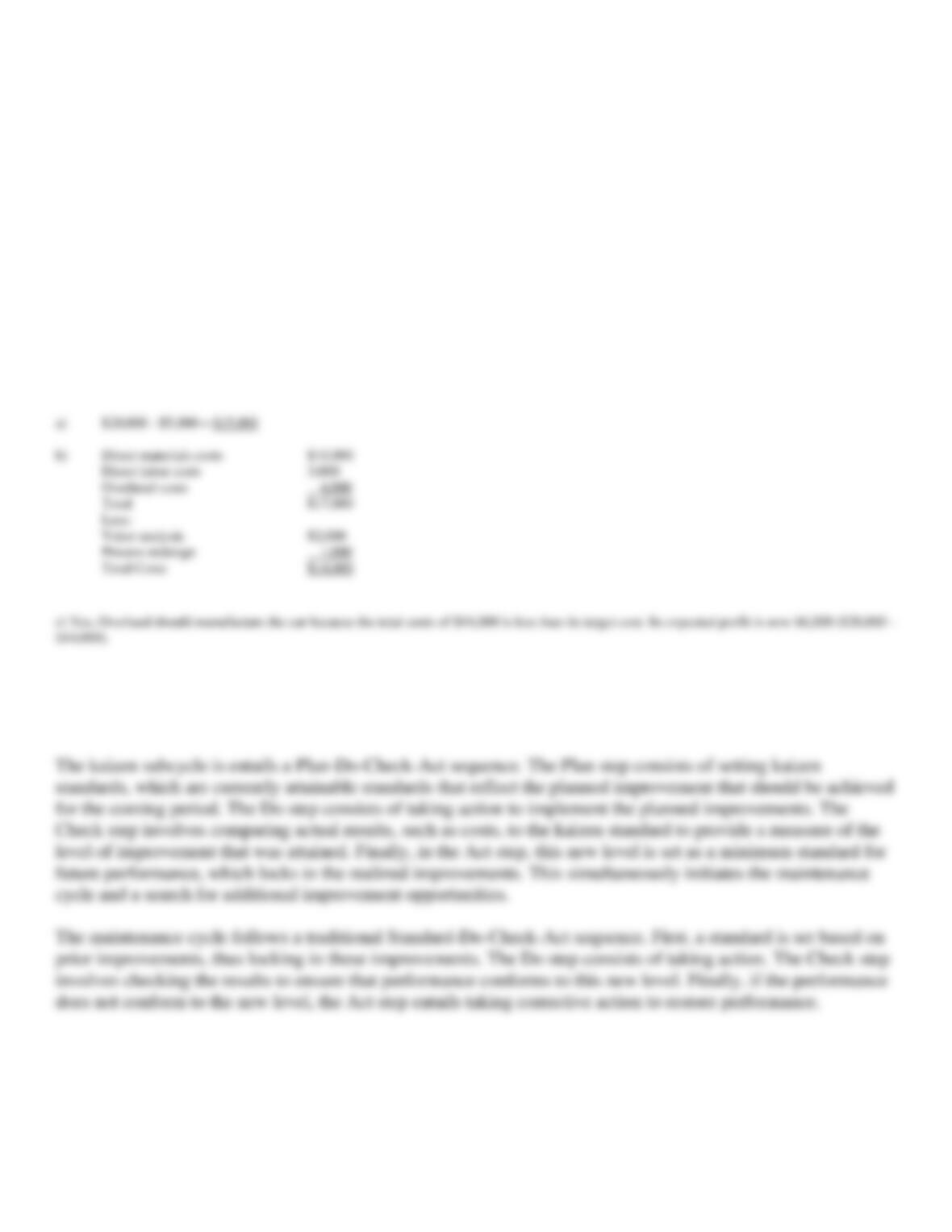
145. Overland Automotive Company is considering on manufacturing a new brand of car. Given the current
product and process designs, the cost data are as follows:
Direct materials costs (per car)
$10,000
Direct labor costs (per car)
$3,000
Overhead costs (per car)
$4,000
The company expects the selling price to be $20,000 and has set a target profit of $5,000.
A supplier told Overland that it could purchase a couple of similar components under a different brand name at a lower price. This would result in
cost savings of $2,000 per car. Furthermore, the company found that it could redesign its manufacturing process to cut down on both inspection labor
and worker labor, which would result in cost savings of $1,000 per car.
a) Calculate Overland’s target cost.
b) Calculate the total costs per car after Overland redesigns its processes and schedules to buy cost-saving components.
c) Should Overland manufacture the car? Calculate the expected profit after the cost savings are taken into account.
146. The kaizen, or continuous improvement, cycle and the maintenance cycle are the two major subcycles used
to control the cost reduction process. Explain the four steps of the kaizen subcycle and the maintenance cycle.
$20,000 – $5,000 = $15,000
Direct materials costs
$10,000
Direct labor costs
3,000
Overhead costs
4,000
Total
$17,000
Less:
Value analysis
$2,000
Process redesign
1,000
Total Costs
$14,000

147. If the target cost is less than what is currently achievable, management must find ways to reduce costs in
order to attain the target cost. Describe the three cost reduction methods that are typically used.