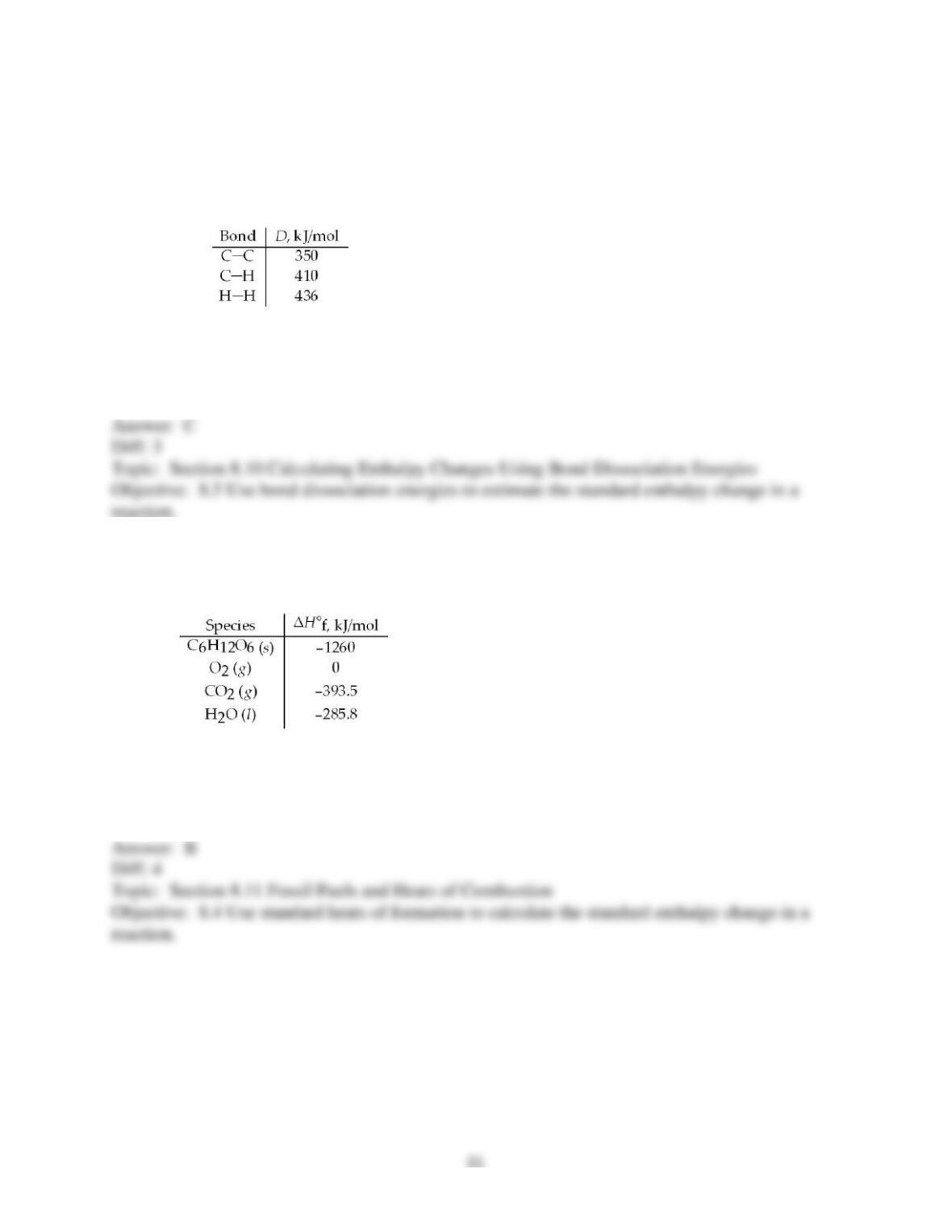
65) Given that ΔH°= -311 kJ for the hydrogenation of acetylene, C2H2:
H–CC–H(g) + 2 H2(g) → CH3–CH3(g)
and the following bond dissociation energies, estimate a value for the C-to-C triple bond
dissociation energy.
A) 1050 kJ/mol
B) 833 kJ/mol
C) 807 kJ/mol
D) 397 kJ/mol
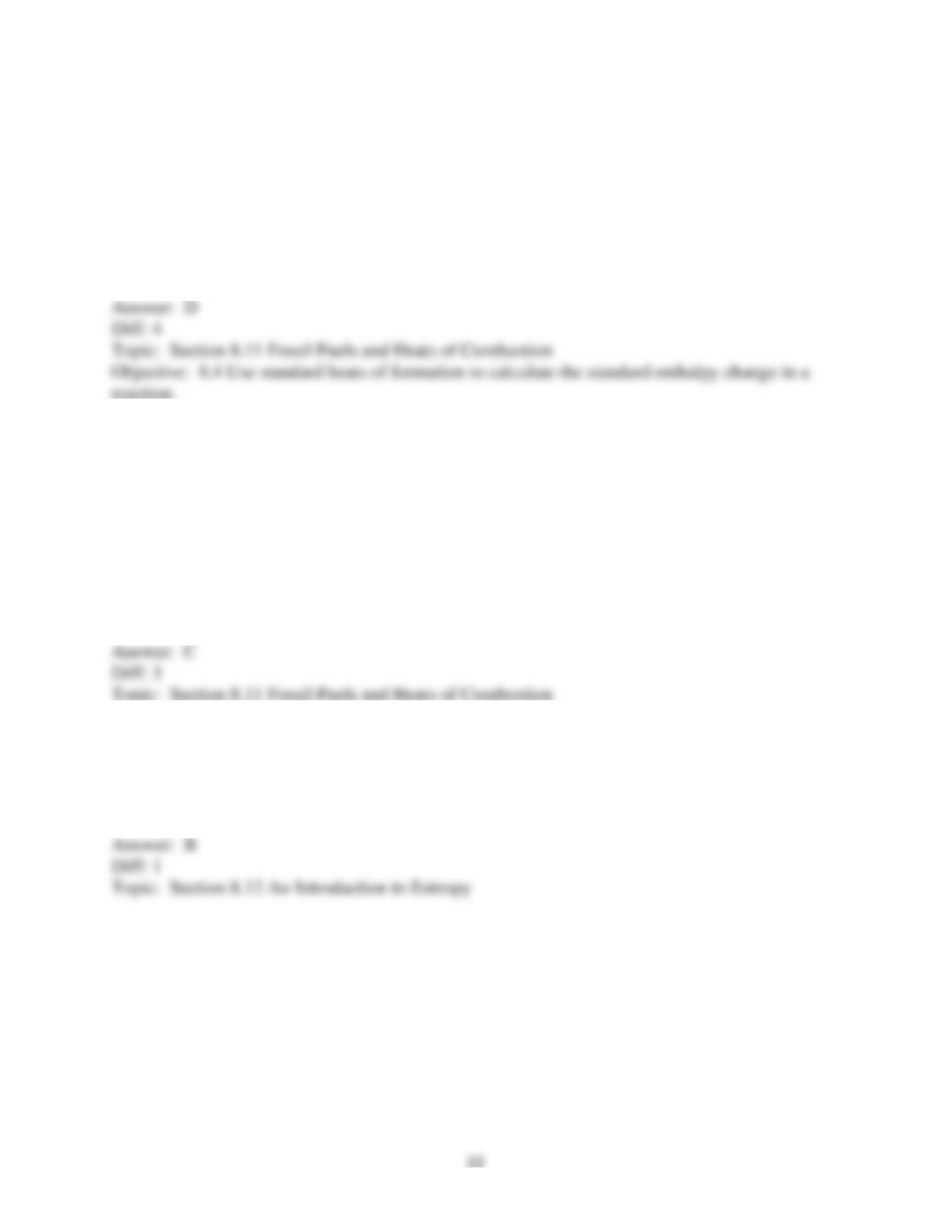
66) Calculate the enthalpy of combustion per mole for C6H12O6. Assume that the combustion
products are CO2(g) and H2O(l).
A) -5336 kJ/mol
B) -2816 kJ/mol
C) -1939 kJ/mol
D) 580.7 kJ/mol
67) The heat of combustion per mole for acetylene, C2H2(g), is -1299.5 kJ/mol. Assuming that
the combustion products are CO2(g) and H2O(l), and given that the enthalpy of formation is –
393.5 kJ/mol for CO2(g) and -285.8 kJ/mol for H2O(l), find the enthalpy of formation of
C2H2(g).
A) -846.1 kJ/mol
B) -620.2 kJ/mol
C) -226.7 kJ/mol
D) +226.7 kJ/mol
68) Which of CH4(g), C2H2(g), and CH3OH(l) provides the most energy per gram upon
combustion and which provides the least?
CH4(g) + 2 O2(g) → CO2(g) + 2 H2O(l) ΔH° = -890 kJ
2 C2H2(g) + 5 O2(g) → 4 CO2(g) + 2 H2O(l) ΔH° = -2599 kJ
2 CH3OH(l) + 3 O2(g) → 2 CO2(g) + 4 H2O(l) ΔH° = -1453 kJ
A) C2H2 provides the most energy per gram and CH4 the least.
B) C2H2 provides the most energy per gram and CH3OH the least.
C) CH4 provides the most energy per gram and CH3OH the least.
D) CH4 provides the most energy per gram and C2H2 the least.
69) Which of the following can be interpreted as a measure of randomness?
A) enthalpy
B) entropy
C) free energy
D) temperature
70) At a given temperature and pressure, which of the following would be expected to have the
greatest molar entropy?
A) Br2(s)
B) Br2(l)
C) Br2(g)
D) All of these would be expected to have the same molar entropy.
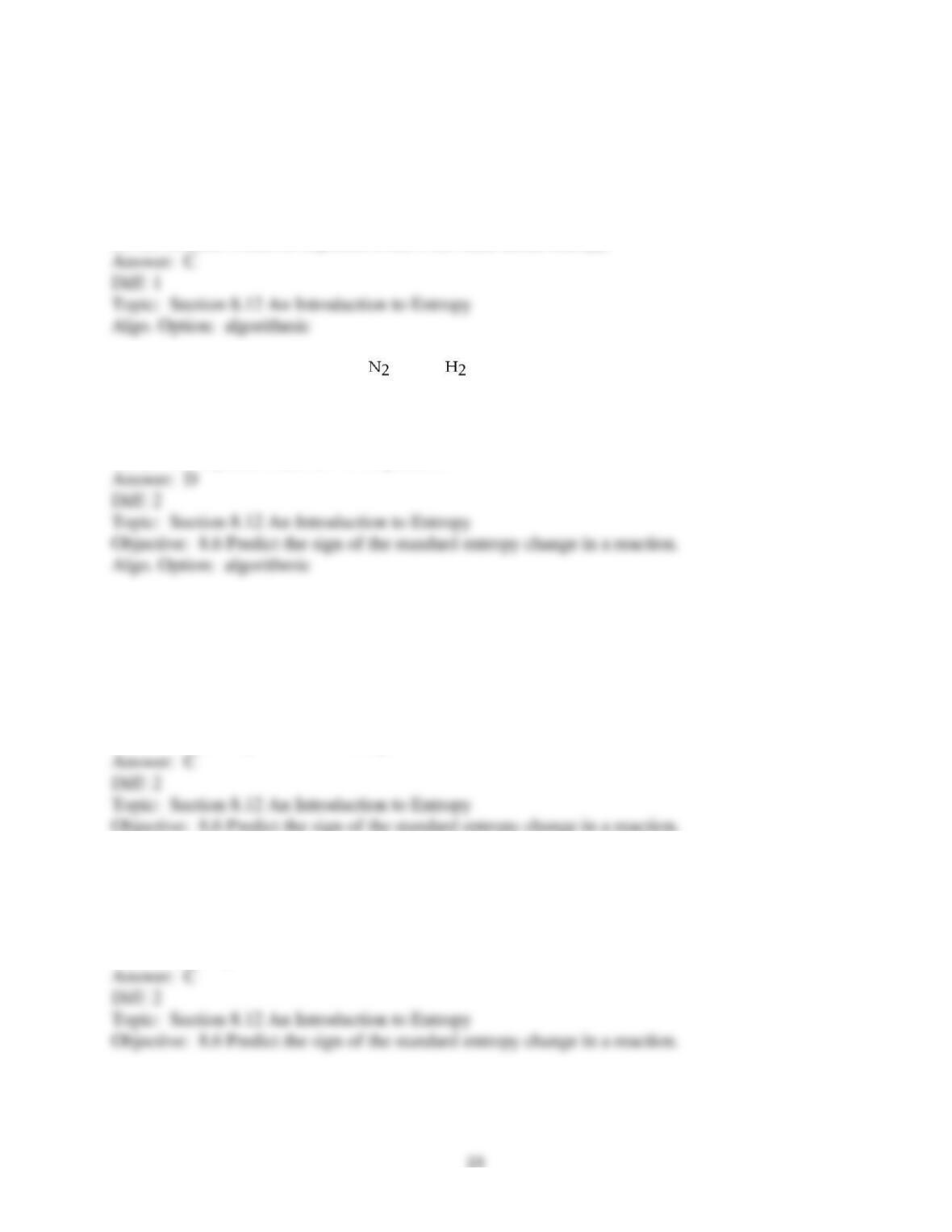
71) For the reaction, 2 NH3(g) → (g) + 3 (g), one would expect
A) ΔH° to be negative and ΔS° to be negative.
B) ΔH° to be negative and ΔS° to be positive.
C) ΔH° to be positive and ΔS° to be negative.
D) ΔH° to be positive and ΔS° to be positive.
72) Determine the sign of ΔS° for each of the following:
I. C6H6(s) → C6H6(l)
II. 2 SO2(g) + O2(g) → 2 SO3(g)
A) ΔS° should be negative for I and negative for II.
B) ΔS° should be negative for I and positive for II.
C) ΔS° should be positive for I and negative for II.
D) ΔS° should be positive for I and positive for II.
73) Which thermodynamic function is most related to randomness?
A) enthalpy
B) internal energy
C) entropy
D) heat capacity
74) For the of freezing liquid ethanol at a given temperature and pressure,
A) ΔH is negative and ΔS is negative.
B) ΔH is negative and ΔS is positive.
C) ΔH is positive and ΔS is negative.
D) ΔH is positive and ΔS is positive.
75) Which of the following is not true?
A) A spontaneous reaction need not occur immediately.
B) A spontaneous reaction must be exothermic and must have an increase in entropy.
C) The reverse of a nonspontaneous reaction is always spontaneous.
D) A spontaneous reaction is one that can proceed on its own.
76) Determine the sign of ΔS° for each of the following:
I. The mixing of two gases at a given temperature and pressure
II. C(s) + 2 H2O(g) → CO2(g) + 2 H2(g)
A) ΔS° is negative for I and negative for II.
B) ΔS° is negative for I and positive for II.
C) ΔS° is positive for I and negative for II.
D) ΔS° is positive for I and positive for II.
77) Which combination always results in a reaction being spontaneous?
A) ΔH is negative and ΔS is negative.
B) ΔH is negative and ΔS is positive.
C) ΔH is positive and ΔS is negative.
D) ΔH is positive and ΔS is positive.
25
78) The reaction 4 Ag(s) + O2(g) → 2 Ag2O(s) favors Ag2O at low temperature, but it favors
Ag and O2 at high temperatures. How can this be explained in terms of ΔH and ΔS?
A) ΔH is negative and ΔS is negative.
B) ΔH is negative and ΔS is positive.
C) ΔH is positive and ΔS is negative.
D) ΔH is positive and ΔS is positive.
79) What is the thermodynamic criterion for equilibrium for a reaction at constant temperature
and pressure (PV work only)?
A) ΔS = 0
B) ΔG = 0
C) ΔS > 0
D) ΔG < 0
80) If an endothermic reaction is spontaneous at constant temperature and pressure,
A) ΔG is negative and ΔS may be positive or negative.
B) ΔG is negative and ΔS is positive.
C) ΔG is positive and ΔS is negative.
D) ΔG is positive and ΔS may be positive or negative.
81) If a reaction with a negative value of ΔS is nonspontaneous at constant temperature and
pressure,
A) ΔG is negative and ΔH may be positive or negative.
B) ΔG is negative and ΔH is positive.
C) ΔG is positive and ΔH may be positive or negative.
D) ΔG is positive and ΔH is positive.
82) Consider the conversion of white tin to gray tin:
Sn(white) → Sn(gray) ΔH° = -2.09 kJ ΔS° = -7.41 J/K
based on these data,
A) white tin is stable below 9°C and gray tin is stable above 9°C.
B) gray tin is stable below 9°C and white tin is stable above 9°C.
C) white tin is stable below 15°C and gray tin is stable above 15°C.
D) gray tin is stable below 15°C and white tin is stable above 15°C.
83) When heated, mercury(II) oxide decomposes into elemental mercury and oxygen:
2 HgO(s) → 2 Hg(l) + O2(g) ΔH° = 181.6 kJ ΔS° = 216.4 J/K
Estimate the temperature at which HgO should begin to decompose if the partial pressure of
O2(g) is constant at 1.00 atm.
A) -34.8°C
B) 34.8°C
C) 566°C
D) 840°C
84) Methanol can be produced from carbon monoxide and hydrogen with suitable catalysts:
CO(g) + 2 H2(g) → CH3OH(l) at 25°C ΔH° = –128.1 kJ and ΔS° = -332 J/K.
Find ΔG° at 25°C.
A) -157.2 kJ
B) -29.1 kJ
C) 98.9 kJ
D) 157.2 kJ
85) He gas is contained in a one-liter flask that is connected to an empty one-liter flask with a
closed stopcock between the two flasks. When the stopcock is opened some of the He enters the
evacuated flask. For this system
A) △H is negative and △S is positive
B) △H is zero and △S is positive
C) △H is zero and △S is negative
D) △H is positive and △S is negative
86) For the conversion of ice to water at 0°C and 1 atm,
A) ΔG is zero, ΔH is positive, and ΔS is negative.
B) ΔG is zero, ΔH is positive, and ΔS is positive.
C) ΔG is negative, ΔH is negative, and ΔS is positive.
D) ΔG is positive, ΔH is negative, and ΔS is positive.
87) For the conversion of water to ice at 25°C and 1 atm,
A) ΔG is negative and ΔH is negative.
B) ΔG is negative and ΔH is positive.
C) ΔG is positive and ΔH is negative.
D) ΔG is positive and ΔH is positive.
88) Calculate ΔG° for the reaction below and tell whether it is spontaneous or nonspontaneous
under standard conditions at 25°C.
2 S (s) + 3 O2 (g) + 2 H2O (l) → 2 H2SO4 (l) ΔH° = -1056 kJ/mol
ΔS° = –505 J/mol
A) ΔG° = -1207 kJ and the process is spontaneous.
B) ΔG° = -1207 kJ and the process is nonspontaneous.
C) ΔG° = -906 kJ and the process is spontaneous.
D) ΔG° = -906 kJ and the process is nonspontaneous.
89) The enthalpy of fusion of naphthalene, C10H8, is 19.1 kJ/mol at 78.2°C, its melting point.
Calculate the entropy of fusion at the melting point.
A) ΔS°fus = 244 J/(K ∙ mol)
B) ΔS°fus = 54.4 J/(K ∙ mol)
C) ΔS°fus = 1.49 J/(K ∙ mol)
D) ΔS°fus = –1.49 J/(K ∙ mol)
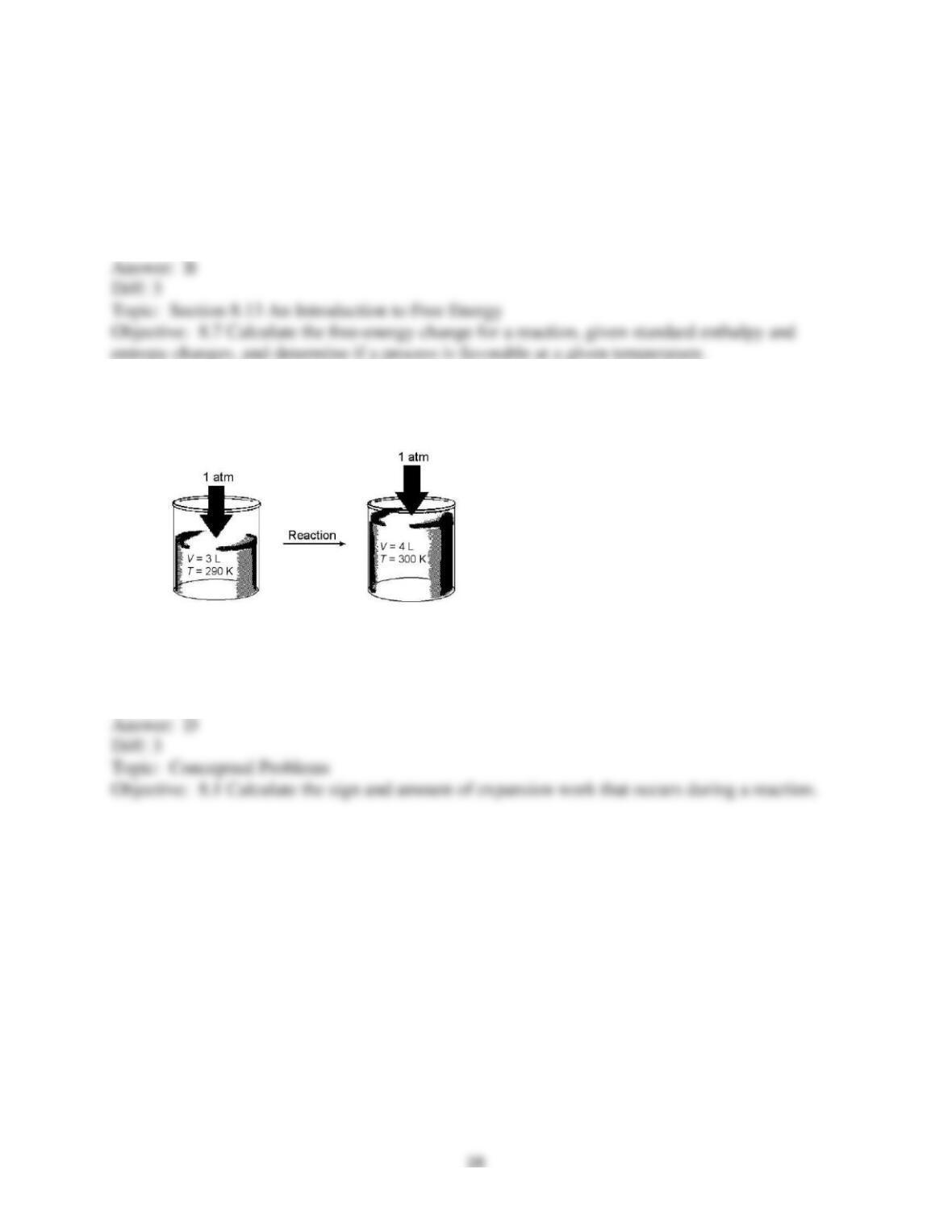
90) Imagine a reaction that results in a change in both volume and temperature, as shown in the
diagram below. What is the sign of the work being done and the sign of the enthalpy change
involved in this reaction?
A) w = + and ΔH = +
B) w = + and ΔH = –
C) w = – and ΔH = +
D) w = – and ΔH = –
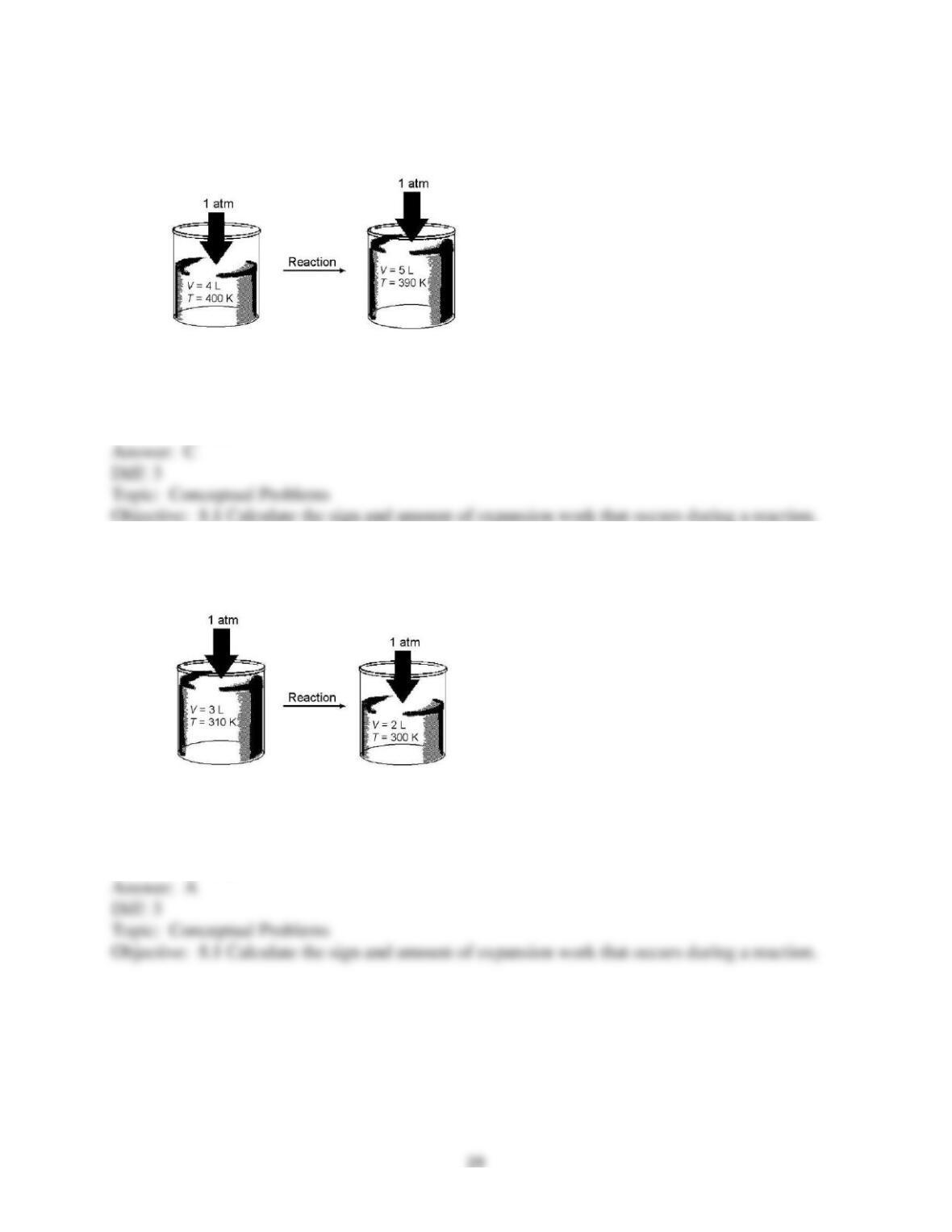
91) Imagine a reaction that results in a change in both volume and temperature, as shown in the
diagram below. What is the sign of the work being done, and what is the sign of the enthalpy
change involved in this reaction?
A) w = + and ΔH = +
B) w = + and ΔH = –
C) w = – and ΔH = +
D) w = – and ΔH = –
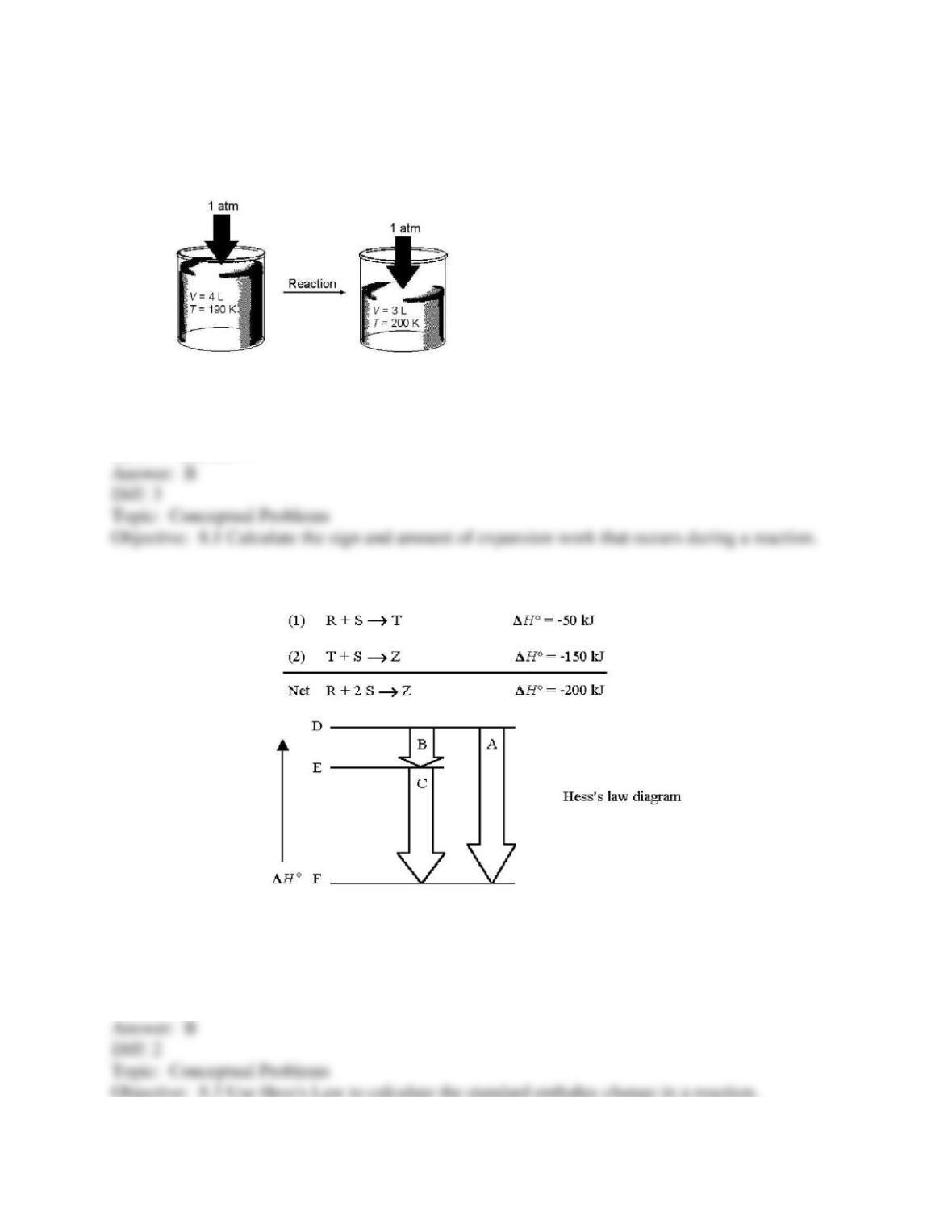
92) Imagine a reaction that results in a change in both volume and temperature, as shown in the
diagram below. What is the sign of the work being done and the sign of the enthalpy change
involved in this reaction?
A) w = + and ΔH = +
B) w = + and ΔH = –
C) w = – and ΔH = +
D) w = – and ΔH = –
30
93) Imagine a reaction that results in a change in both volume and temperature, as shown in the
diagram below. What is the sign of the work being done, and what is the sign of the enthalpy
change involved in this reaction?
A) w = + and ΔH = +
B) w = + and ΔH = –
C) w = – and ΔH = +
D) w = – and ΔH = –
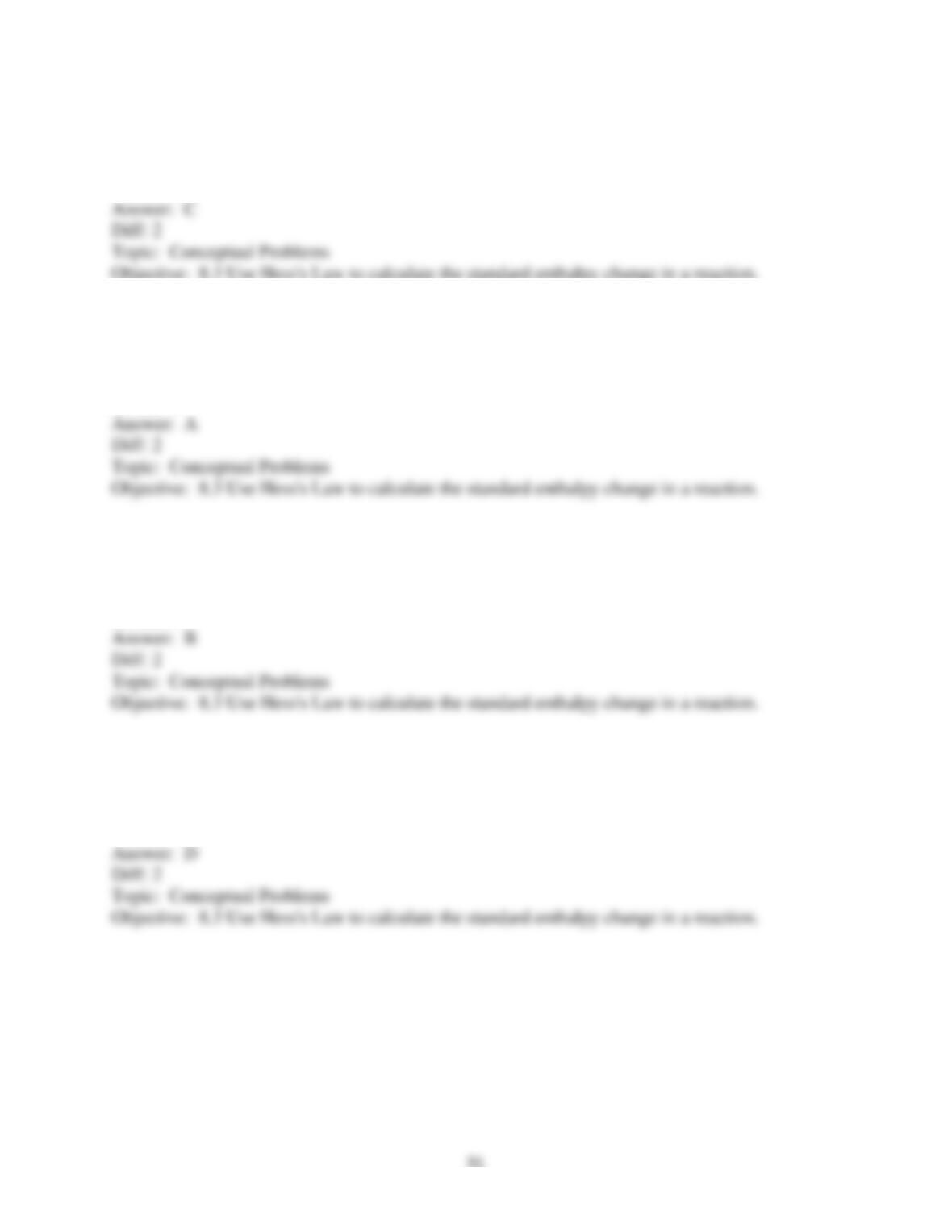
Reactant R reacts with reactant S in two steps to yield product Z.
94) Step (1) in the reaction is represented by
A) arrow A.
B) arrow B.
C) arrow C.
D) line E.
95) Step (2) in the reaction is represented by
A) arrow A.
B) arrow B.
C) arrow C.
D) 3line E.
96) The net reaction is represented by
A) arrow A.
B) arrow B.
C) arrow C.
D) line F.
97) The reactants, R + 2 S, are represented by
A) arrow B.
B) line D.
C) line E.
D) line F.
98) The product, Z, is represented by
A) arrow A.
B) line D.
C) line E.
D) line F.
99) The intermediate, T, + S is represented by
A) arrow C.
B) line D.
C) line E.
D) line F.
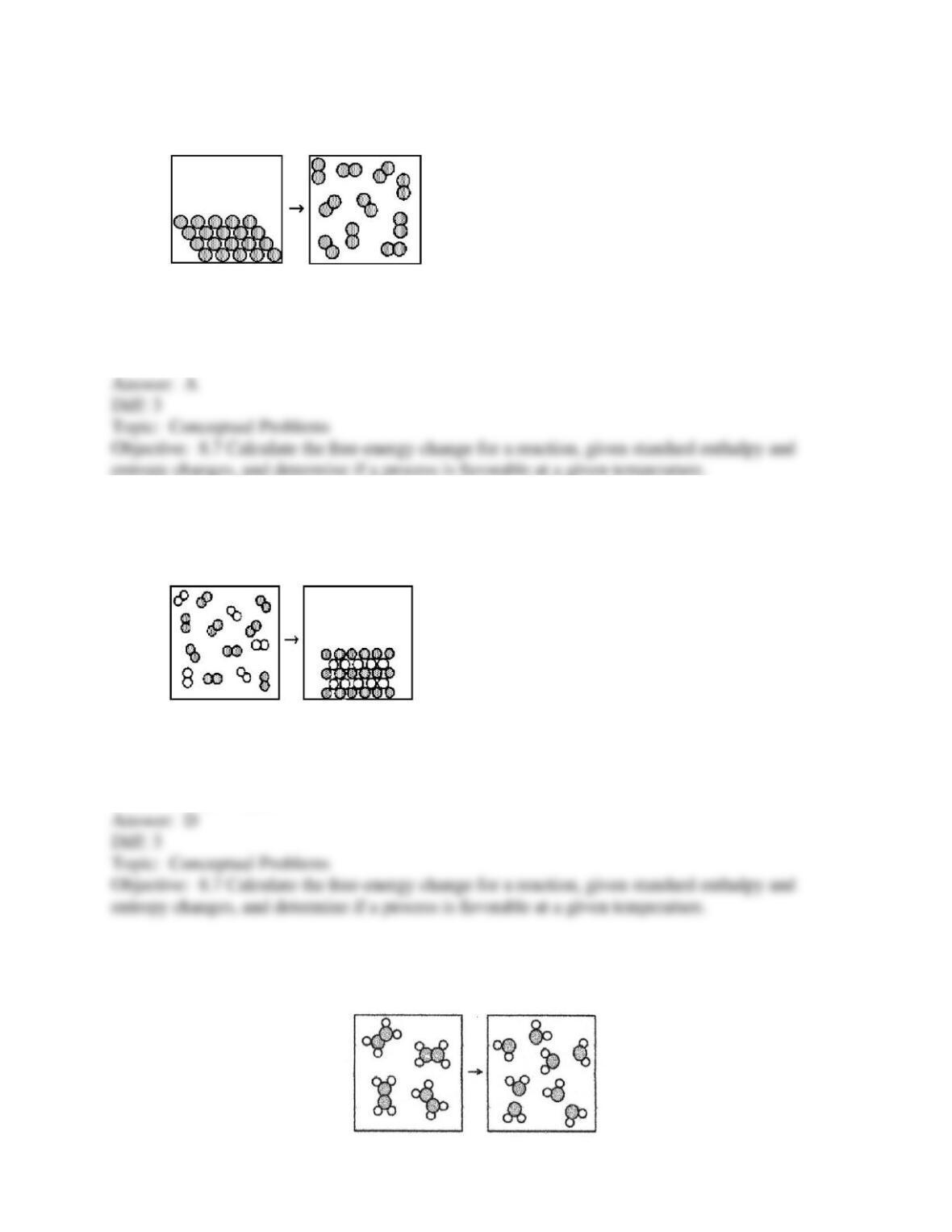
100) What are the signs of ΔH, ΔS, and ΔG for the following spontaneous change?
A) ΔH = +, ΔS = +, ΔG = –
B) ΔH = +, ΔS = –, ΔG = –
C) ΔH = –, ΔS = +, ΔG = –
D) ΔH = –, ΔS = –, ΔG = –
33
101) What are the signs of ΔH, ΔS, and ΔG for the following spontaneous change?
A) ΔH = +, ΔS = +, ΔG = –
B) ΔH = +, ΔS = –, ΔG = –
C) ΔH = –, ΔS = +, ΔG = –
D) ΔH = –, ΔS = –, ΔG = –
102) What are the signs of ΔH, ΔS, and ΔG for the following spontaneous change?
A) ΔH = +, ΔS = +, ΔG = –
B) ΔH = +, ΔS = –, ΔG = –
C) ΔH = –, ΔS = +, ΔG = –
D) ΔH = –, ΔS = –, ΔG = –
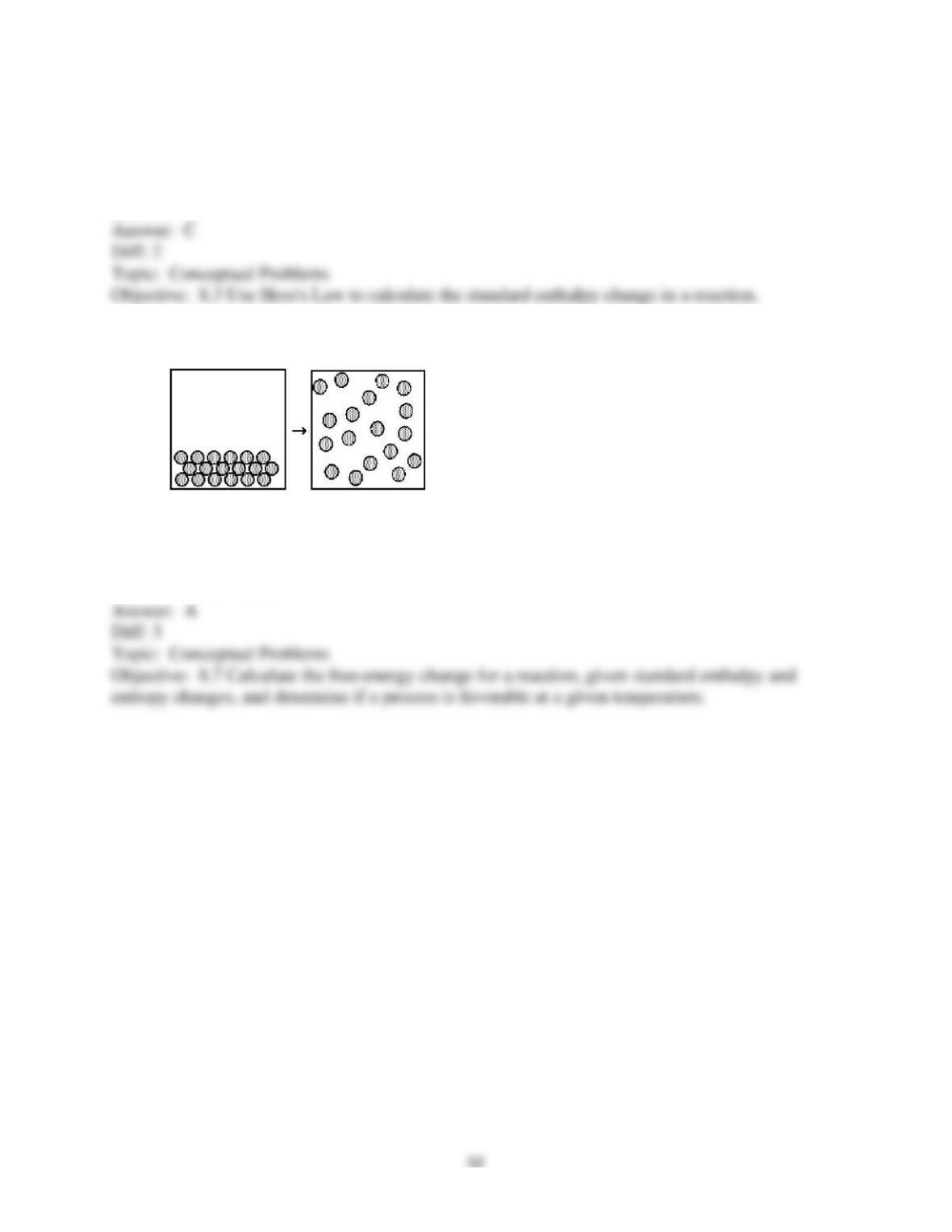
103) What are the signs of ΔH and ΔS for the reaction represented in the above drawing?
A) ΔH = +, ΔS = +
B) ΔH = +, ΔS = –
C) ΔH = –, ΔS = +
D) ΔH = –, ΔS = –
104) The reaction represented in the above drawing is likely to be
A) nonspontaneous at all temperatures.
B) nonspontaneous at low temperatures and spontaneous at high temperatures.
C) spontaneous at low temperatures and non spontaneous at high temperatures.
D) spontaneous at all temperatures.