32) Under the conditions of monopolistic competition
A) firm profits are higher in the long run than in the short run.
B) average costs of production are the same in the short run as they are in the long run.
C) economic profit is zero in the long run.
D) price equals marginal cost.
33) If short-run economic profits are greater than zero for firms in a monopolistically
competitive market, in the long run we expect
A) entry barriers to prevent competing firms from entering this market.
B) the demand curve for firms in the market to shift to the right.
C) competing firms to enter the market and sell similar products.
D) profits to increase.
34) If short-run economic profits are greater than zero for firms in a monopolistically
competitive market, in the long run we expect
A) entry barriers to prevent competing firms from entering this market.
B) the demand curve for firms in the market to shift to the right.
C) the average cost of production to decrease.
D) the average cost of production to increase.
35) Suppose in the city of Smugsburg, DVD rental stores operate in a monopolistically
competitive market. If the price of DVD rentals in Smugsburg is currently equal to $5 per tape
and the average cost of renting videos is $1 per DVD, in the long run we expect the price of
renting DVDs to
A) increase.
B) stay the same.
C) decrease, and the average cost of producing DVD rentals to increase.
D) decrease, and the average cost of producing DVD rentals to decrease.
36) Suppose in the city of Blacksburg, music stores operate in a monopolistically competitive
market. If the price of CDs in Blacksburg is currently equal to $20 per CD and the average cost
of CDs is $15, in the long run we expect the price of CDs to
A) increase.
B) stay the same.
C) decrease, and the average cost of selling CDs to increase.
D) decrease, and the average cost of selling CDs to decrease.
37) If firms in a monopolistically competitive market are earning economic profits greater than
zero in the short run, then in the long run
A) firms will exit this market.
B) profits will increase.
C) profits will decrease.
D) demand will not change.
38) If a firm is operating in a monopolistically competitive market, then in the long-run
A) the firm will earn a zero economic profit.
B) the firm will maximize its profit by producing the output level at which the average cost is
minimized.
C) the firm will maximize its profit by producing the output level at which the marginal revenue
is minimized.
D) all of the above
39) Suppose that a monopolistically competitive market is in its long-run equilibrium. If the
market demand curve shifts to the right due to changes in consumer preferences,
A) the number of firms in the market will increase in the short-run.
B) firms will earn positive economic profits in the short-run.
C) firms’ average costs of production will increase as they increase output levels in the short-run.
D) none of the above
40) Suppose that a monopolistically competitive market is in its long-run equilibrium. If the
market demand curve shifts to the left due to a recession,
A) the number of firms in the market decreases in the short-run.
B) some firms may earn negative profits in the short-run.
C) firms’ average costs of production decreases as they decrease output levels in the short-run.
D) none of the above
41) Under the conditions of monopolistic competition
A) prices are always lower in the long run than in the short run.
B) firm profits are always higher in the long run than in the short run.
C) average costs of production are always higher in the short run than in the long run.
D) None of the above is correct.
42) Under the conditions of monopolistic competition, if a firm is earning economic profits in the
short run
A) prices are higher in the long run than in the short run.
B) firm profits are higher in the long run than in the short run.
C) average costs of production are higher in the long run than in the short run.
D) long-run economic profits are positive.
43) Suppose coffee is sold in a monopolistically competitive market, where coffee is
differentiated by coffee shop location. As firms enter in the long run and the price of coffee falls
A) the market quantity of coffee demanded will increase, but the quantity of coffee supplied by
any individual coffee shop declines.
B) the market quantity of coffee demanded will decrease as does the quantity supplied from any
individual coffee shop.
C) the average costs of production decline.
D) the profits of individual coffee shops increase.
44) As firms enter a monopolistically competitive market in the long run
A) price increases, the market quantity demanded increases, and the quantity supplied by an
individual firm increases.
B) price decreases, the market quantity demanded increases, and the quantity supplied by an
individual firm decreases.
C) price decreases, but firm profits increase as average costs decrease.
D) price increases and firm profits increase.
45) In a monopolistically competitive market, if price is greater than average cost
A) firms will enter.
B) firms will exit.
C) there will be no change in the number of firms.
D) the market is in long-run equilibrium.
46) If price is less than average cost in a monopolistically competitive market
A) there is an incentive for firms to exit the market.
B) there is profit incentive for firms to enter the market.
C) the market must be in long-run equilibrium.
D) there is no incentive for the number of firms in the market to change.
47) If profits in a monopolistically competitive market are positive, we can conclude that
A) price is equal to average cost.
B) price is greater than average cost
C) the market is in long-run equilibrium.
D) price is less than average cost.
48) Suppose Wave detergent is sold in a monopolistically competitive market. If the price of
Wave detergent is currently $6, and the average cost of producing Wave is $4, in the long run we
can expect
A) firms to enter the detergent market and sell products similar to Wave, shifting the demand
curve for Wave to the left.
B) firms to enter the detergent market and sell product similar to Wave, shifting the demand
curve for Wave to the right.
C) the producers of Wave to go out of business.
D) the producers of Wave to earn economic profits greater than zero.
49) Suppose Toor’s beer is sold in a monopolistically competitive market. If the price of Toor’s is
currently $2 and the average cost of producing Toor’s is $1, in the long run we can expect
A) the demand for Toor’s beer to increase.
B) the price of Toor’s beer to decrease, and the average cost of producing Toor’s to increase.
C) the demand curve for Toor’s beer to become horizontal.
D) no change in the price or average cost of producing Toor’s beer.
50) Suppose Toor’s beer is sold in a monopolistically competitive market. In the long run we
expect the price of Toor’s beer to
A) equal the average cost of production of Toors beer.
B) exceed the average cost of production of Toors beer.
C) equal the marginal cost of production for Toors beer.
D) equal the minimum possible average cost of producing Toors beer.
51) Figure 8.1 depicts demand and costs for a monopolistically competitive firm. At the profit
maximizing output level,
A) this firm is earning economic profits equal to zero.
B) this firm is earning economic profits equal to Q1(P1 – AC1).
C) this firm is earning economic profits equal to P1(Q1 – AC1).
D) this firm is in long-run equilibrium.
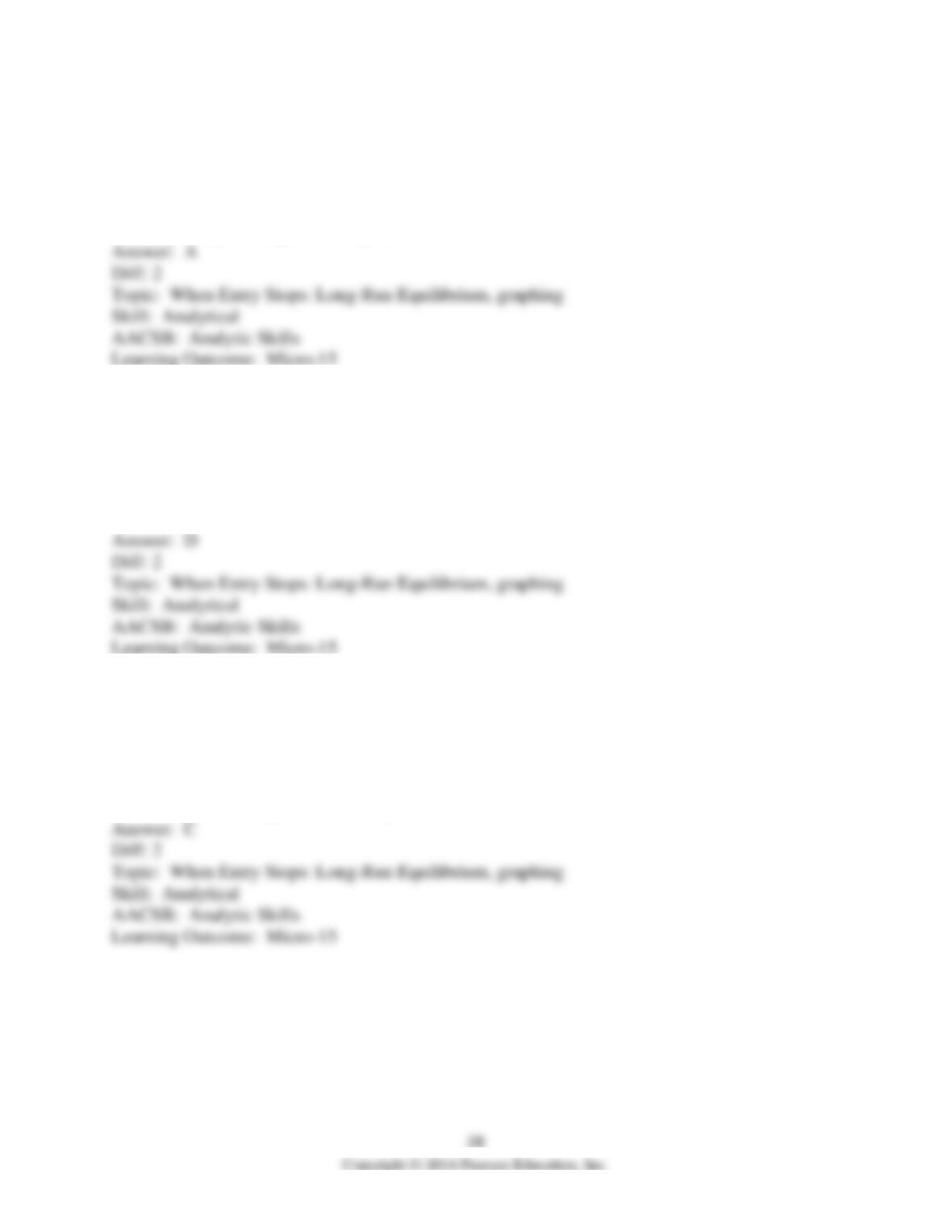
52) If Figure 8.1 depicts the current situation for a monopolistically competitive firm, then in the
long run we expect
A) the firm’s demand curve to shift to the left.
B) the firm’s demand curve to shift to the right.
C) the price of the good to increase.
D) the quantity of the good sold by the firm to increase.
53) If Figure 8.1 depicts the current situation for a monopolistically competitive firm, then in the
long run we expect
A) the firm to charge a price higher than P1.
B) the firm to produce and sell more than Q1.
C) the average costs of production to decrease below AC1.
D) the firm to charge a price lower than P1.
54) If Figure 8.1 depicts the current situation for a monopolistically competitive firm, then in the
long run we expect
A) the firm to charge a price higher than P1.
B) the firm to produce and sell more than Q1.
C) the firm’s average cost of production to rise above AC1.
D) the firm to earn higher economic profits.
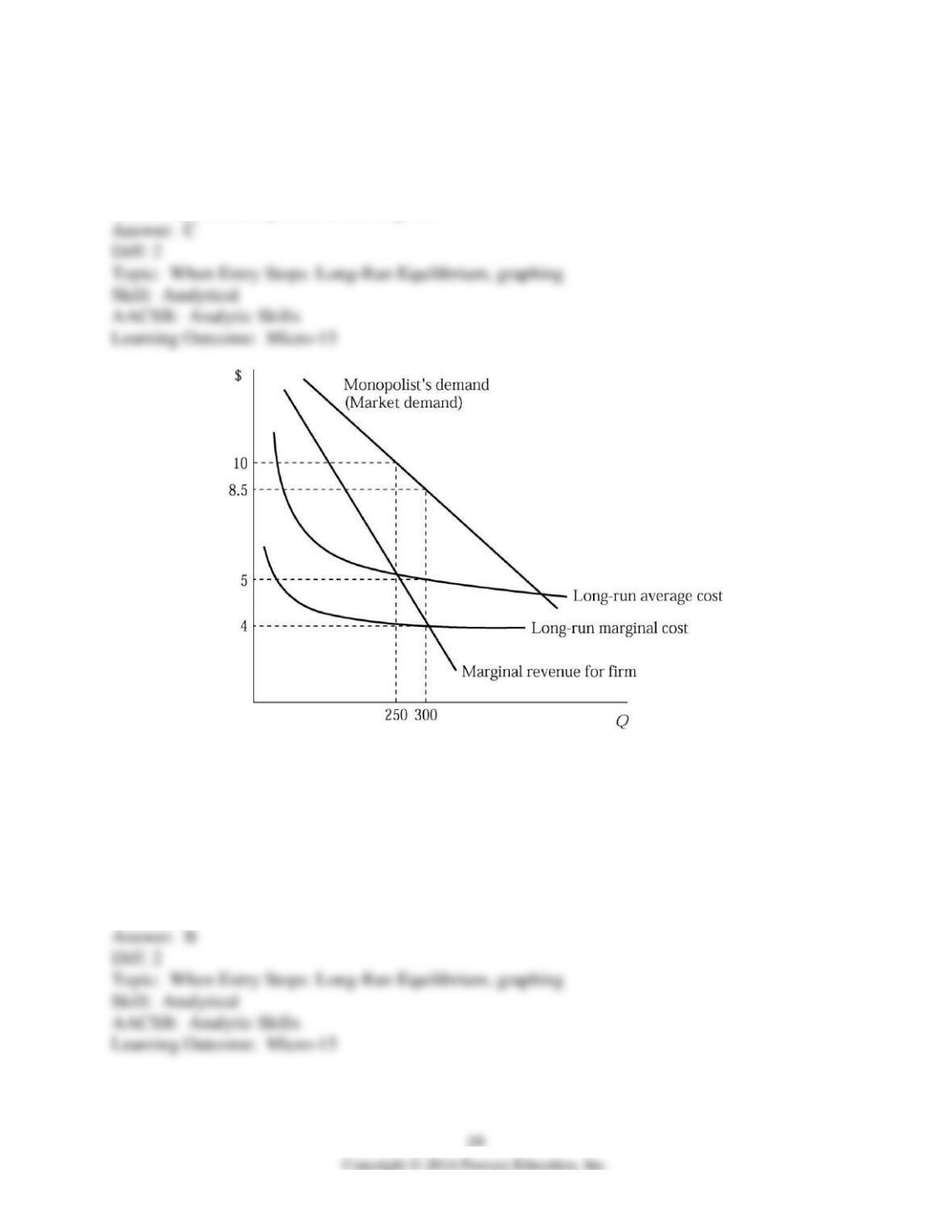
55) Profits for the monopolistically competitive firm depicted in Figure 8.1
A) will increase in the long run.
B) will not change in the long run.
C) will decrease in the long run.
D) are impossible to predict in the long run.
Figure 8.2
56) Figure 8.2 shows demand and costs for a monopolistically competitive firm. At the profit
maximizing output level, the firm’s profit is
A) $1,200.
B) $1,050.
C) $750.
D) $375.
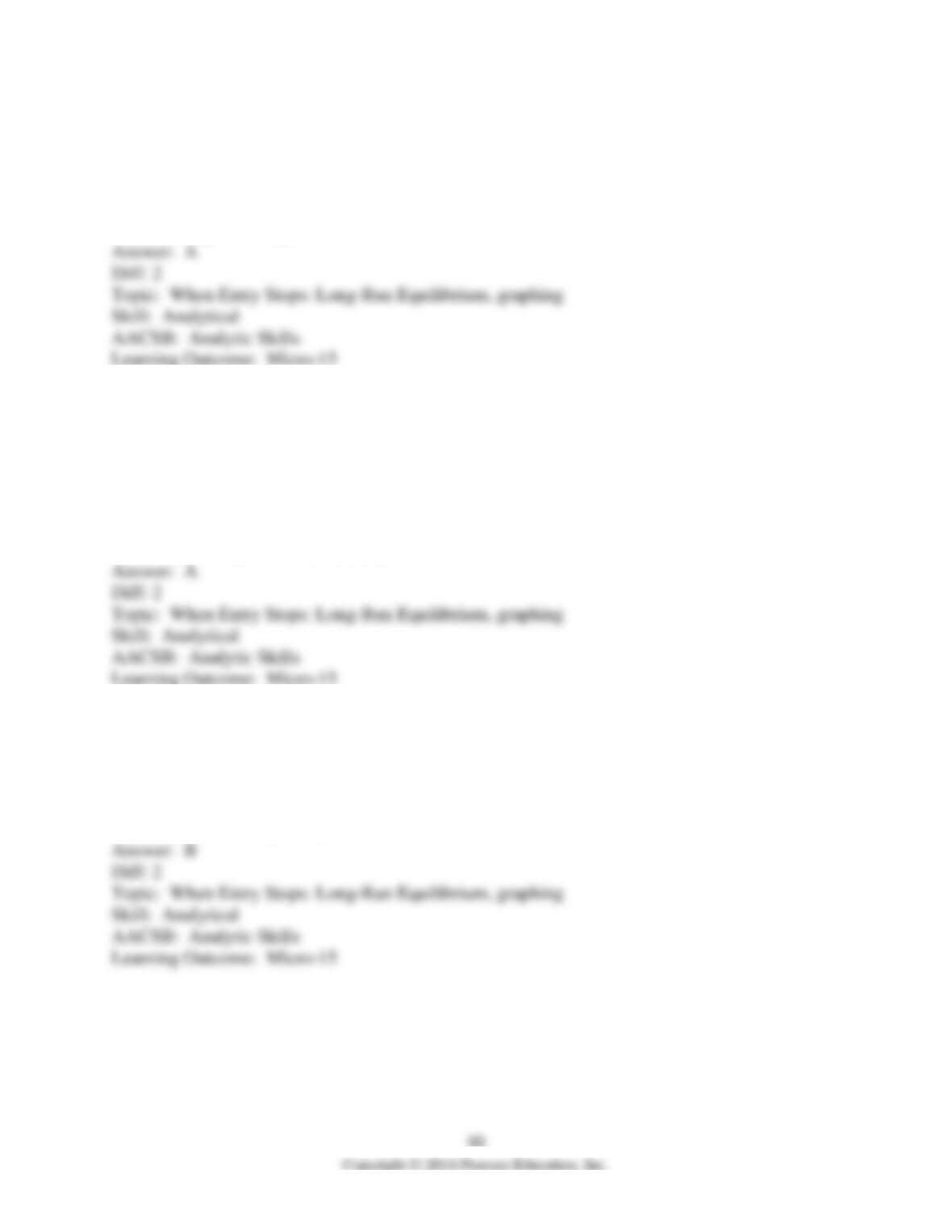
57) Figure 8.2 shows demand and costs for a monopolistically competitive firm. In the long-run
we expect
A) more firms to enter the market.
B) the firm’s demand curve to shift to the right.
C) the price of the good to increase.
D) the average cost of production to decrease.
58) Figure 8.2 shows demand and costs for a monopolistically competitive firm. At the profit
maximizing output level,
A) the firm is earning a positive economic profit and more firms are expected to enter the
market.
B) the firm is earning a zero economic profit and no firms are expected to enter the market.
C) the firm is earning a negative economic profit and more firms are expected to leave the
market.
D) There is not sufficient information.
59) Figure 8.2 shows demand and costs for a monopolistically competitive firm. In the long-run
we expect
A) the firm to produce more output at a higher price.
B) the firm to charge a price which is equal to its average cost of production.
C) the firm to experience a decrease in the average cost of production.
D) the firm to earn a greater profit.
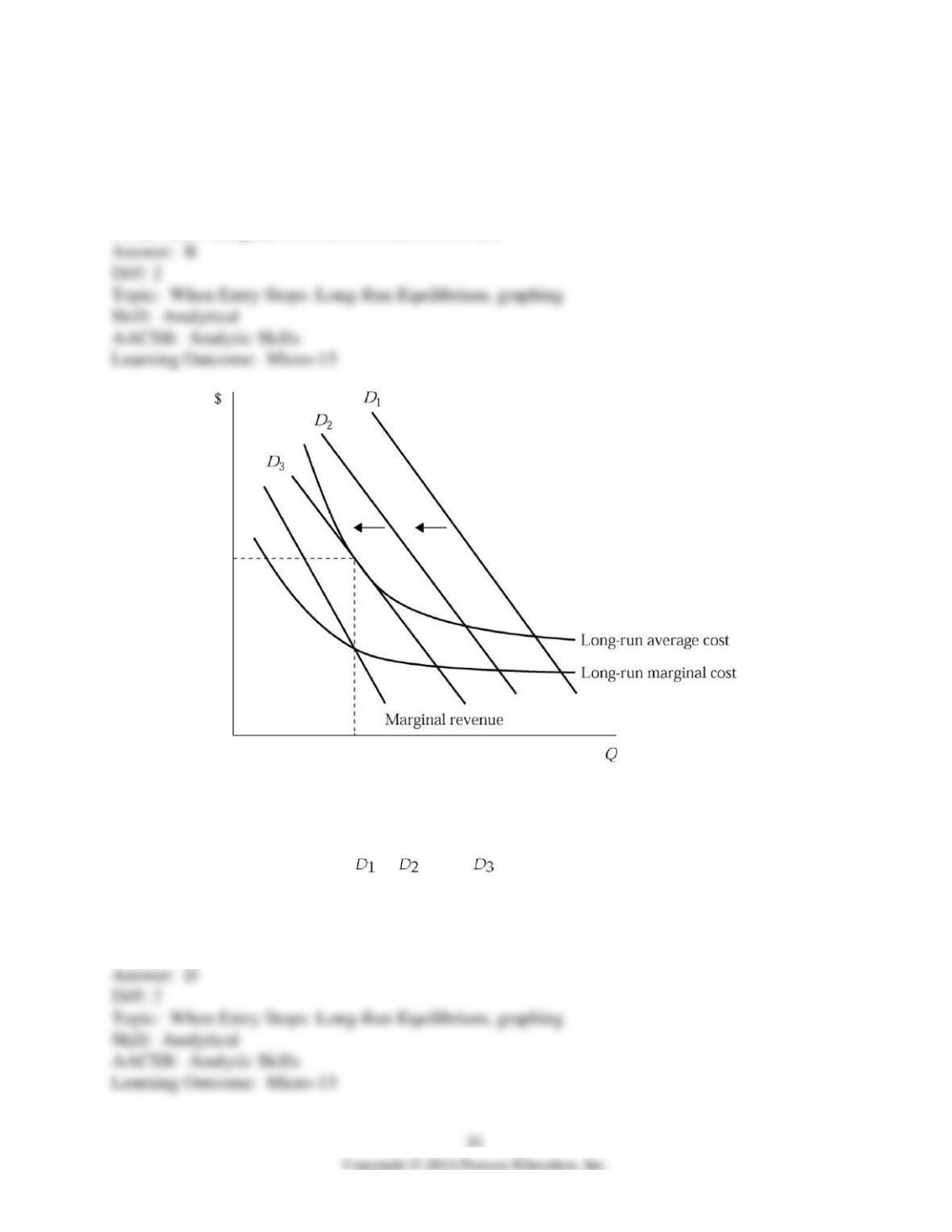
60) Figure 8.2 shows demand and costs for a monopolistically competitive firm. In the long-run
we expect
A) the firm’s demand curve to shift to the right.
B) the firm’s marginal revenue curve to shift to the left.
C) the firm’s average cost curve to shift upward.
D) the firm’s marginal cost curve to shift downward.
Figure 8.3
61) Figure 8.3 shows demands and costs for a monopolistically competitive firm. When the
firm’s demand curve shifts from to and to ,
A) the demand for the firm’s product is decreasing.
B) the firm’s average cost of production is increasing.
C) the firm’s marginal revenue curve also shifts to the left.
D) all of the above
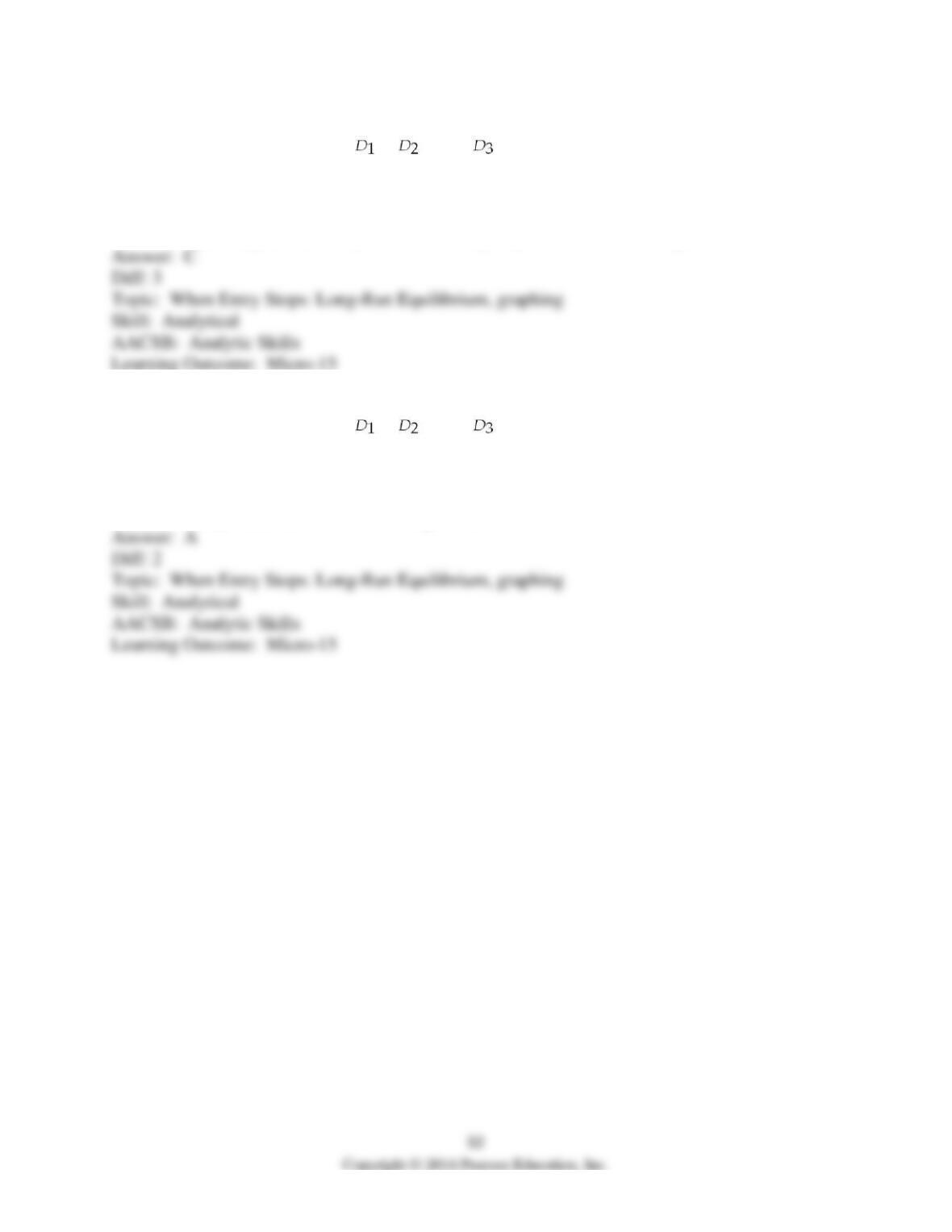
62) Figure 8.3 shows demands and costs for a monopolistically competitive firm. When the
firm’s demand curve shifts from to and to ,
A) the firm’s economic profit remains the same.
B) the firm’s marginal revenue at the profit maximizing output level is decreasing.
C) the firm’s marginal cost at the profit maximizing output level is increasing.
D) the firm’s average cost at the profit maximizing output level is decreasing.
63) Figure 8.3 shows demands and costs for a monopolistically competitive firm. When the
firm’s demand curve shifts from to and to , in the long-run we would expect
A) the firm to earn a zero economic profit.
B) the firm to charge a price equal to its marginal cost.
C) the firm to increase its output level.
D) the firm to produce at the lowest average cost.
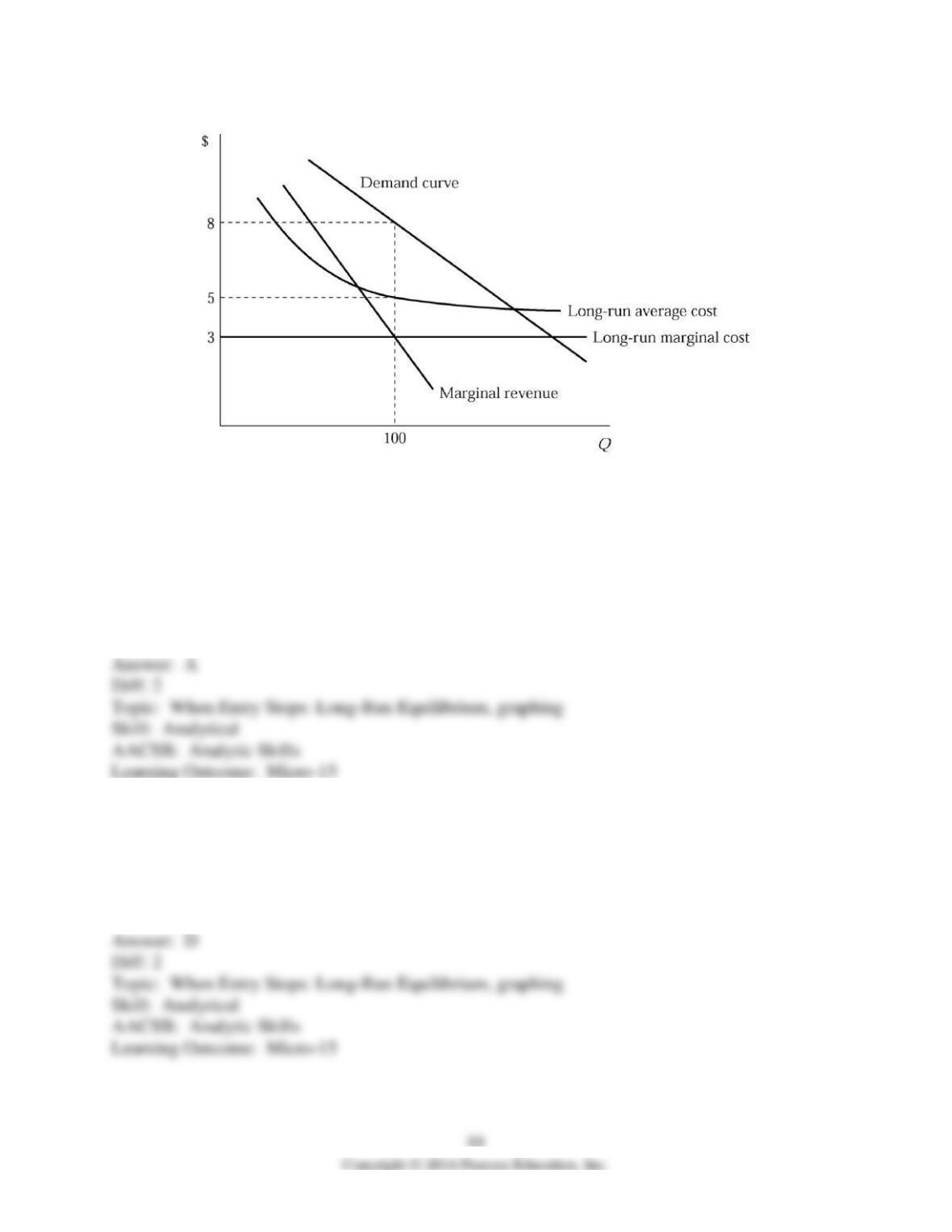
Figure 8.4
64) Figure 8.4 depicts demand and costs for a monopolistically competitive firm. At the profit
maximizing output level,
A) the firm is making a positive economic profit.
B) the firm is earning a zero economic profit.
C) the firm is earning a negative economic profit.
D) There is not sufficient information.
65) Figure 8.4 depicts demand and costs for a monopolistically competitive firm. In the long-run
we expect
A) more firms to enter the market.
B) the firm’s demand curve to shift to the left.
C) the firm’s average cost of production to increase.
D) all of the above
66) Figure 8.4 depicts demand and costs for a monopolistically competitive firm. If the firm’s
demand curve shifts to the left as more firms enter the market,
A) the firm’s average cost will be higher at the new profit maximizing output level.
B) the firm’s average cost will be lower at the new profit maximizing output level.
C) the firm’s average cost will remain the same at the new profit maximizing output level.
D) There is not sufficient information.
67) Figure 8.4 depicts demand and costs for a monopolistically competitive firm. If the firm’s
demand curve shifts to the left as more firms enter the market,
A) the firm’s average cost will be lower at the new profit maximizing output level.
B) the firm’s marginal cost will be higher at the new profit maximizing output level.
C) the firm’s marginal revenue will remain the same at the mew profit maximizing output level.
D) the firm’s marginal cost will remain the same at the new profit maximizing output level.
68) Figure 8.4 depicts demand and costs for a monopolistically competitive firm. If the firm’s
demand curve shifts to the left as more firms enter the market,
A) the firm’s profit will be smaller at the new profit maximizing output level.
B) the firm’s profit will be greater at the new profit maximizing output level.
C) the firm’s profit will remain the same at the new profit maximizing output level.
D) There is not sufficient information.
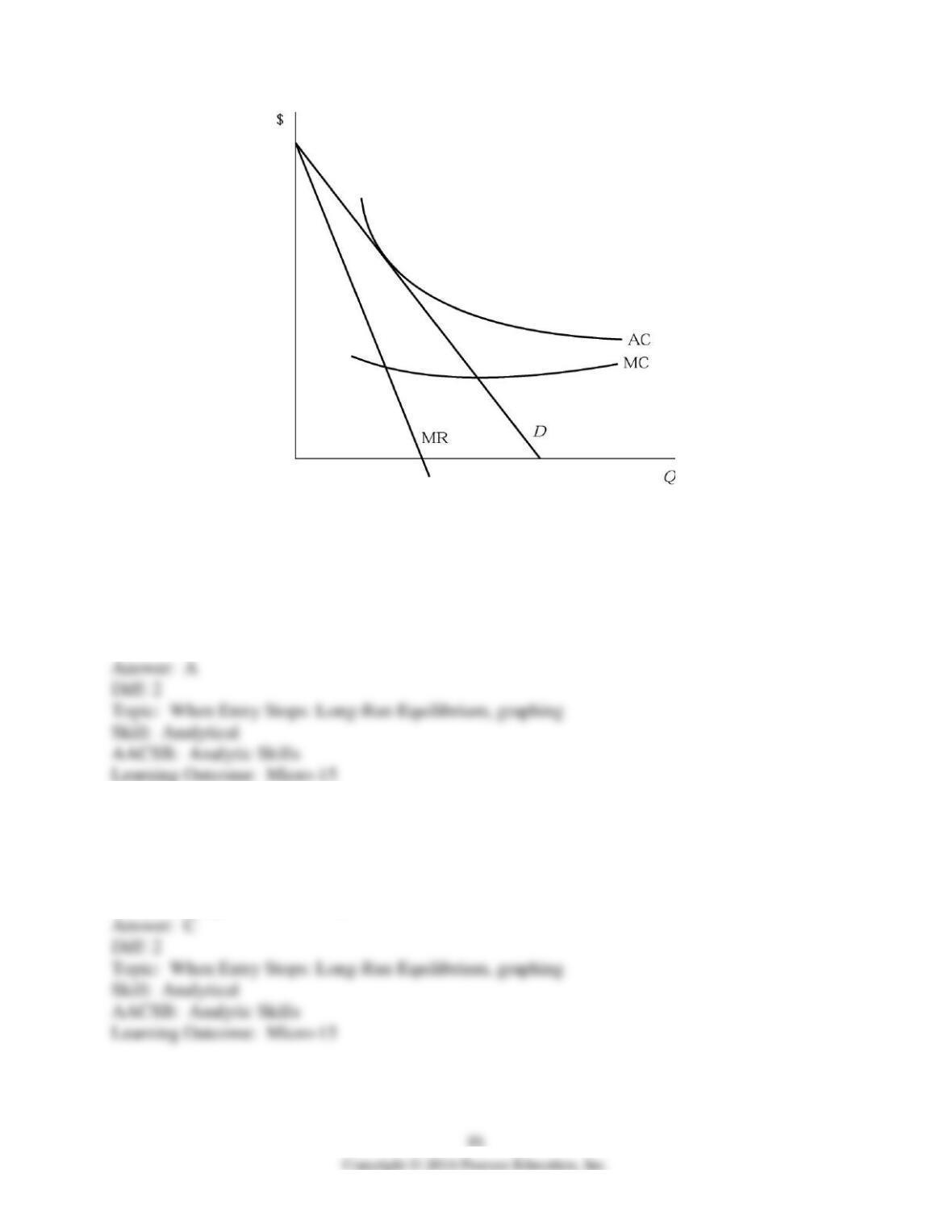
Figure 8.5
69) The monopolistically competitive firm in Figure 8.5 will produce where
A) MC= MR.
B) MC=D.
C) MR= D.
D) all of the above
70) Where the monopolistically competitive firm in Figure 8.5 produces it will
A) make a positive economic profit.
B) suffer a loss.
C) make a zero economic profit.
D) make a negative economic profit.
71) The monopolistic competitive industry in Figure 8.5 will tend to
A) contract.
B) remain the same size.
C) expand.
D) go out of business.
72) Examples of monopolistically competitive industries in which firms differentiate their
products by offering them at more locations include all of the following EXCEPT
A) restaurants.
B) video rental stores.
C) retail clothing stores.
D) wheat farms.
73) Restaurants, video rental stores, clothing stores, and music stores are examples of industries
in which firms differentiate their products by offering them at more locations. This is an example
of a ________ market.
A) perfectly competitive
B) monopoly
C) monopolistically competitive
D) oligopoly
74) Gasoline stations carrying the same fuel brand (e.g., Chevron) are able to charge different
prices in San Francisco because
A) location is a source for product differentiation.
B) gasoline stations are perfect price discriminators.
C) gasoline station operators for a cartel to act as a monopoly.
D) fuel quality varies across stores.
Recall the Application about the costs involved in opening a Dunkin’ Donuts shop to
answer the following question(s).
75) Recall the Application. Which of the following prevents Dunkin’ Donut from being classified
as a monopoly?
A) There are many sellers of donuts other than Dunkin’ Donuts.
B) There are no patents or regulations that prevent entry. All an entrepreneur needs is to pay the
franchise fee and the royalties.
C) Donuts are differentiated products that have many close substitutes.
D) All of the above prevent Dunkin’ Donuts from being classified as a monopoly.
76) Recall the Application. The $40,000 franchise fee is a
A) fixed cost.
B) variable cost from the point of view of the franchise.
C) part of the franchise’s short run profit.
D) part of the franchise’s total revenue.
77) Recall the Application. If you spend the money to become a Dunkin’ Donuts franchise and it
is in a monopolistically competitive market, you would expect in the long-run to earn zero
economic profits because
A) barriers to entering the donut business are small.
B) you must compete against other donut shops, bakeries, coffee shops and grocery stores.
C) franchise fees make sellers of brand names have higher costs than other sellers.
D) all of the above
78) Recall the Application. If you spend the money to become a Dunkin’ Donuts franchise and it
is in a monopolistically competitive market, you would expect in the long-run to
A) earn positive economic profits.
B) earn zero economic profits.
C) suffer losses because people are eating healthier.
D) earn monopoly profits.
79) A market is called monopolistically competitive if each firm has the same product but
consumers can choose to purchase the product from any firm.
80) Monopolistically competitive firms sell differentiated products.
81) In the long run, monopolistically competitive firms become perfectly competitive firms.
82) Monopolistically competitive industries have only a single firm and there is a barrier to
entry.
83) Some firms in monopolistically competitive markets differentiate their products by their
physical characteristics.
84) The market for laundry detergent is monopolistically competitive because products differ by
physical characteristics such as scent, stain fighting ingredients, etc.
85) Department stores are monopolistically competitive because stores differ in the amount of
customer service they provide.
86) An example of a monopolistically competitive industry is cable television service.
87) An example of a monopolistically competitive industry is grocery stores.
88) The price that a monopolistically competitive firm will charge depends on what its
competitors charge.
89) In monopolistically competitive industries, firms find it easy to enter and exit the market in
the long run.
90) In the short run, monopolistically competitive firms find their profit-maximizing quantity by
setting price equal to marginal cost.