33) Given the electronegativities below, which covalent single bond is most polar?
Element: H C N O
Electronegativity: 2.1 2.5 3.0 3.5
A) C—H
B) N—H
C) O—H
D) O—C
E) O—N
34) Electronegativity ________ from left to right within a period and ________ from top to bottom within
a group.
A) decreases, increases
B) increases, increases
C) increases, decreases
D) stays the same, increases
E) increases, stays the same
35) Electropositivity ________ from left to right within a period and ________ from top to bottom within a
group.
A) decreases, increases
B) increases, increases
C) increases, decreases
D) stays the same, increases
E) increases, stays the same
36) A nonpolar bond will form between two ________ atoms of ________ electronegativity.
A) different, opposite
B) identical, different
C) different, different
D) similar, different
E) identical, equal
37) The ion ICl4– has ________ valence electrons.
A) 34
B) 35
C) 36
D) 28
E) 8
38) The ion NO– has ________ valence electrons.
A) 15
B) 14
C) 16
D) 10
E) 12
39) The ion PO43- has ________ valence electrons.
A) 14
B) 24
C) 27
D) 29
E) 32
40) The Lewis structure of AsH3 shows ________ nonbonding electron pair(s) on As.
A) 0
B) 1
C) 2
D) 3
E) This cannot be determined from the data given.
41) The Lewis structure of PF3 shows that the central phosphorus atom has ________ nonbonding and
________ bonding electron pair(s).
A) 2, 2
B) 1, 3
C) 3, 1
D) 1, 2
E) 3, 3
42) The Lewis structure of HCN (H bonded to C) shows that ________ has ________ nonbonding electron
pair(s).
A) C, 1
B) N, 1
C) H, 1
D) N, 2
E) C, 2
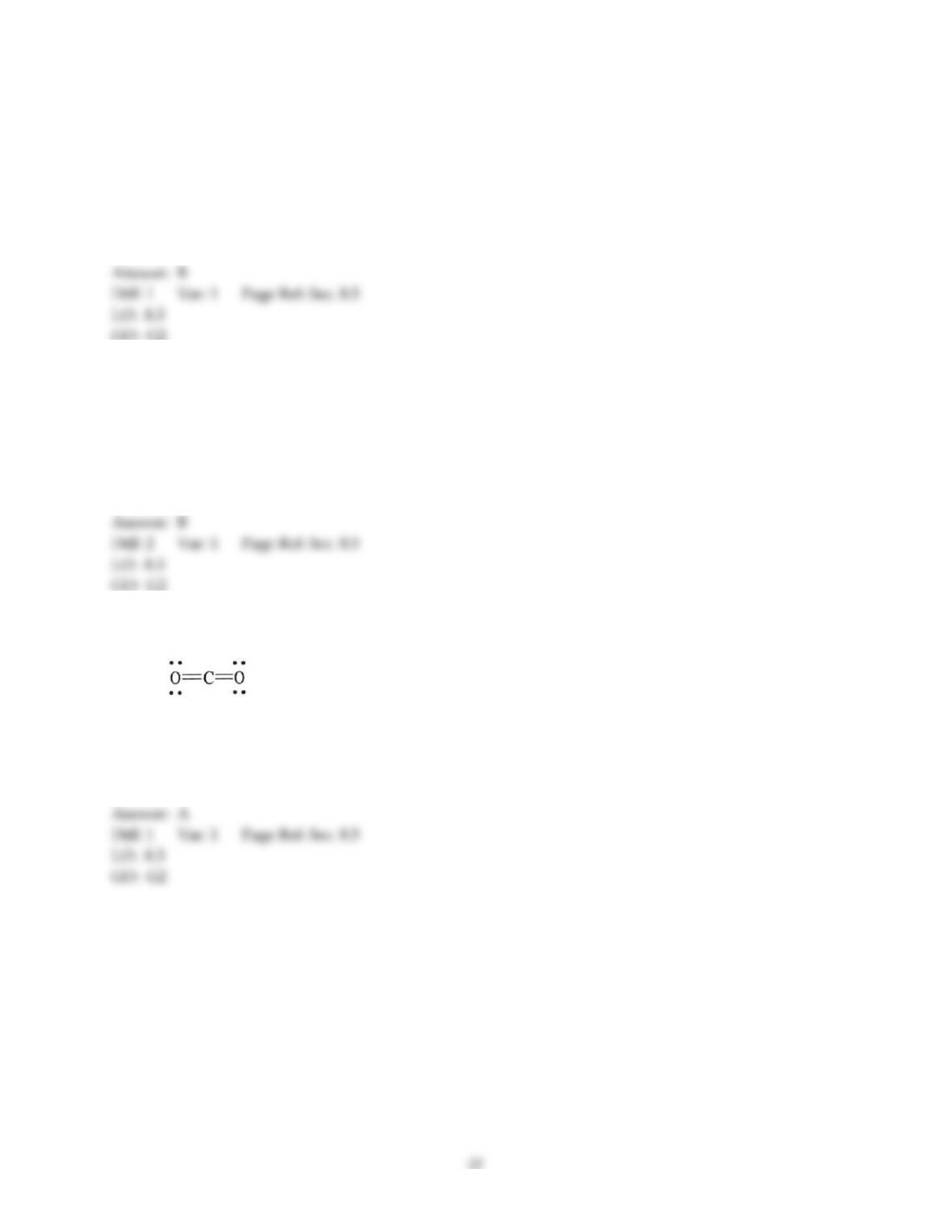
43) The formal charge on carbon in the molecule below is ________.
A) 0
B) +1
C) +2
D) +3
E) -1
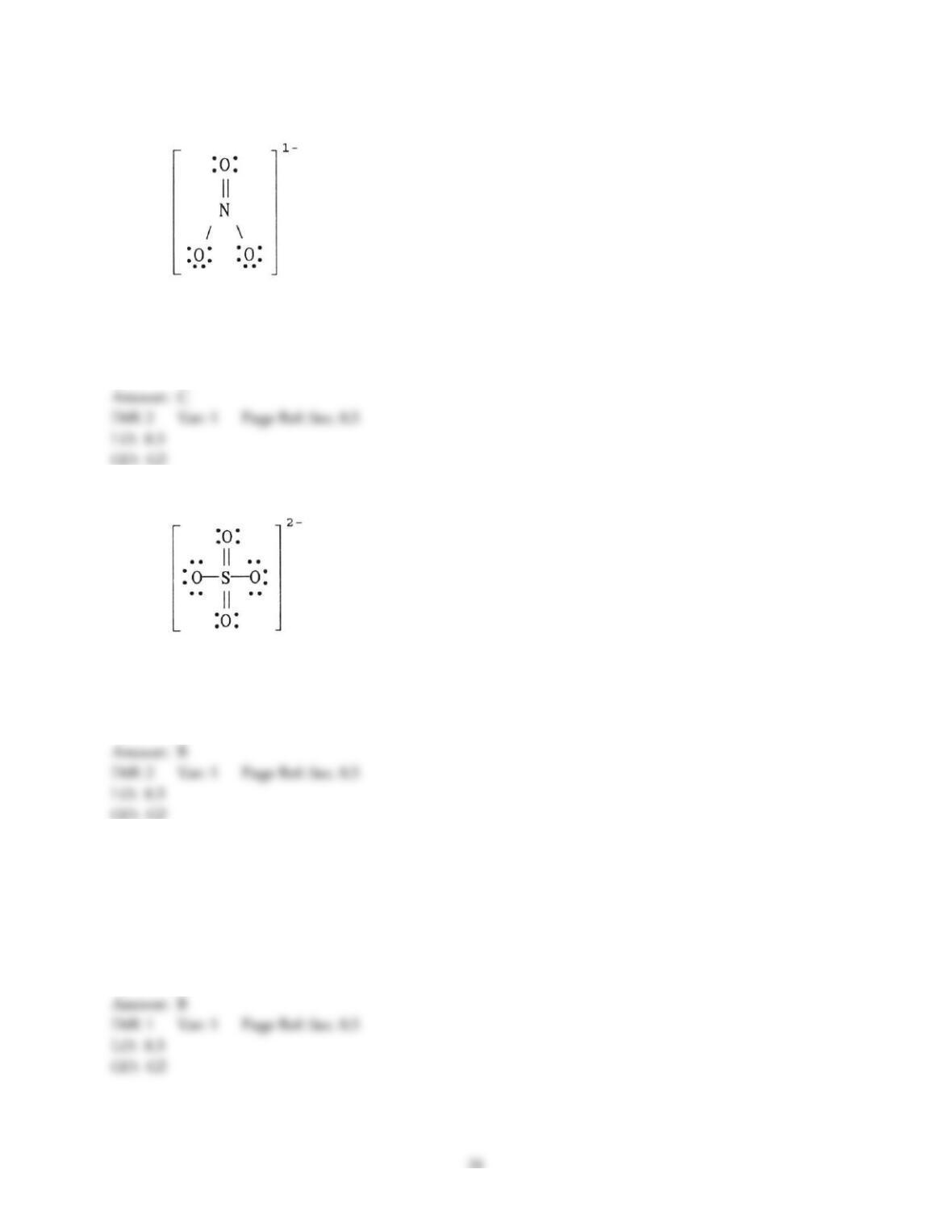
44) The formal charge on nitrogen in NO3– is ________, where the Lewis structure of the ion is:
A) -1
B) 0
C) +1
D) +2
E) -2
45) The formal charge on sulfur in SO42- is ________, where the Lewis structure of the ion is:
A) -2
B) 0
C) +2
D) +4
E) -4
46) In the Lewis structure of ClF, the formal charge on Cl is ________, and the formal charge on F is
________.
A) -1, -1
B) 0, 0
C) 0, -1
D) +1, –1
E) -1, +1
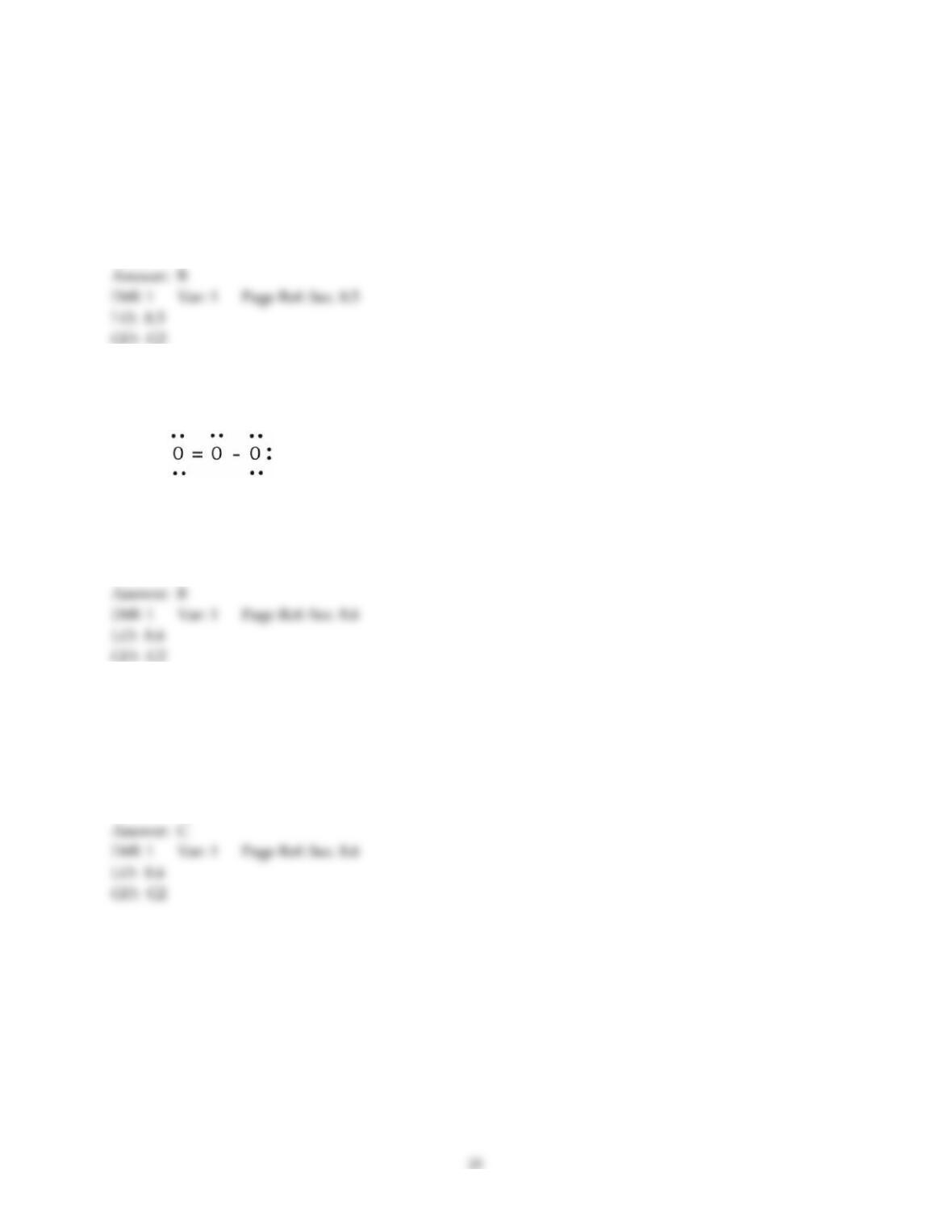
47) In the Lewis structure of HCO3–, the formal charge on H is ________, and the formal charge on C is
________.
A) -1, -1
B) 0, 0
C) 0, -1
D) +1, –1
E) -1, +1
48) In the resonance form of ozone shown below, the formal charge on the central oxygen atom is
________.
A) 0
B) +1
C) -1
D) +2
E) -2
49) How many equivalent resonance forms can be drawn for CO32-? (Carbon is the central atom.)
A) 1
B) 2
C) 3
D) 4
E) 0
50) How many equivalent resonance forms can be drawn for SO2 without expanding octet on the sulfur
atom? (Sulfur is the central atom.)
A) 0
B) 2
C) 3
D) 4
E) 1
51) How many equivalent resonance structures can be drawn for the molecule of SO3 without having to
violate the octet rule on the sulfur atom?
A) 5
B) 2
C) 1
D) 4
E) 3
52) How many different types of resonance structures can be drawn for the ion SO32- where all atoms
satisfy the octet rule?
A) 1
B) 2
C) 3
D) 4
E) 5
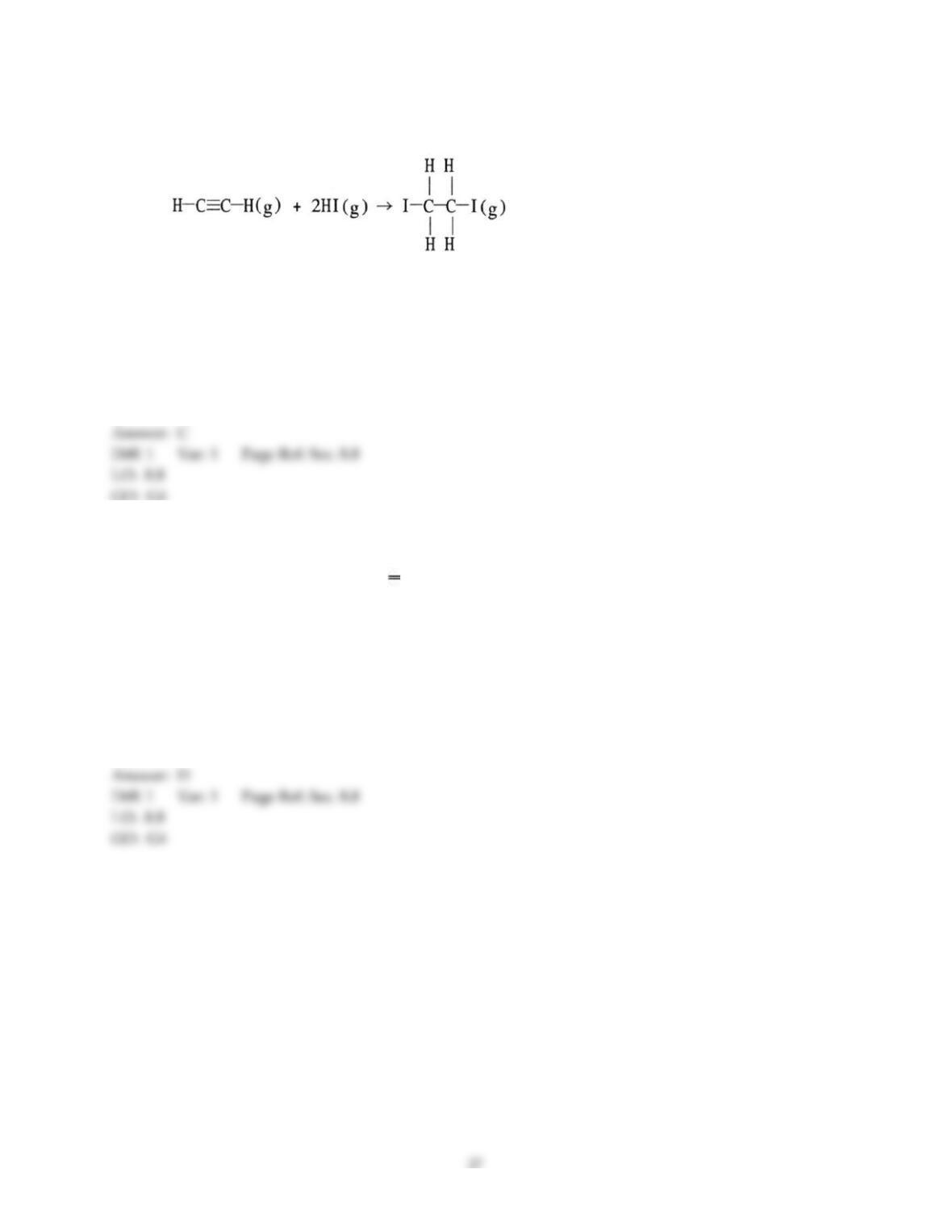
53) Using the table of average bond energies below, the ΔH for the reaction is ________ kJ.
Bond: C≡C C-C H-I C-I C-H
D (kJ/mol): 839 348 299 240 413
A) +160
B) -160
C) -217
D) –63
E) +63
54) Using the table of average bond energies below, the ΔH for the reaction is ________ kJ.
H-C≡C-H (g) + H-I (g) → H2CCHI (g)
Bond: C≡C C=C H-I C-I C-H
D (kJ/mol): 839 614 299 240 413
A) +506
B) -931
C) -506
D) –129
E) +129
55) Using the table of average bond energies below, the △H for the reaction is ________ kJ.
C≡O (g) + 2H2 (g) → H3C-O-H (g)
Bond: C-O C=O C≡O C-H H-H O-H
D (kJ/mol): 358 799 1072 413 436 463
A) +276
B) -276
C) +735
D) –735
E) -116
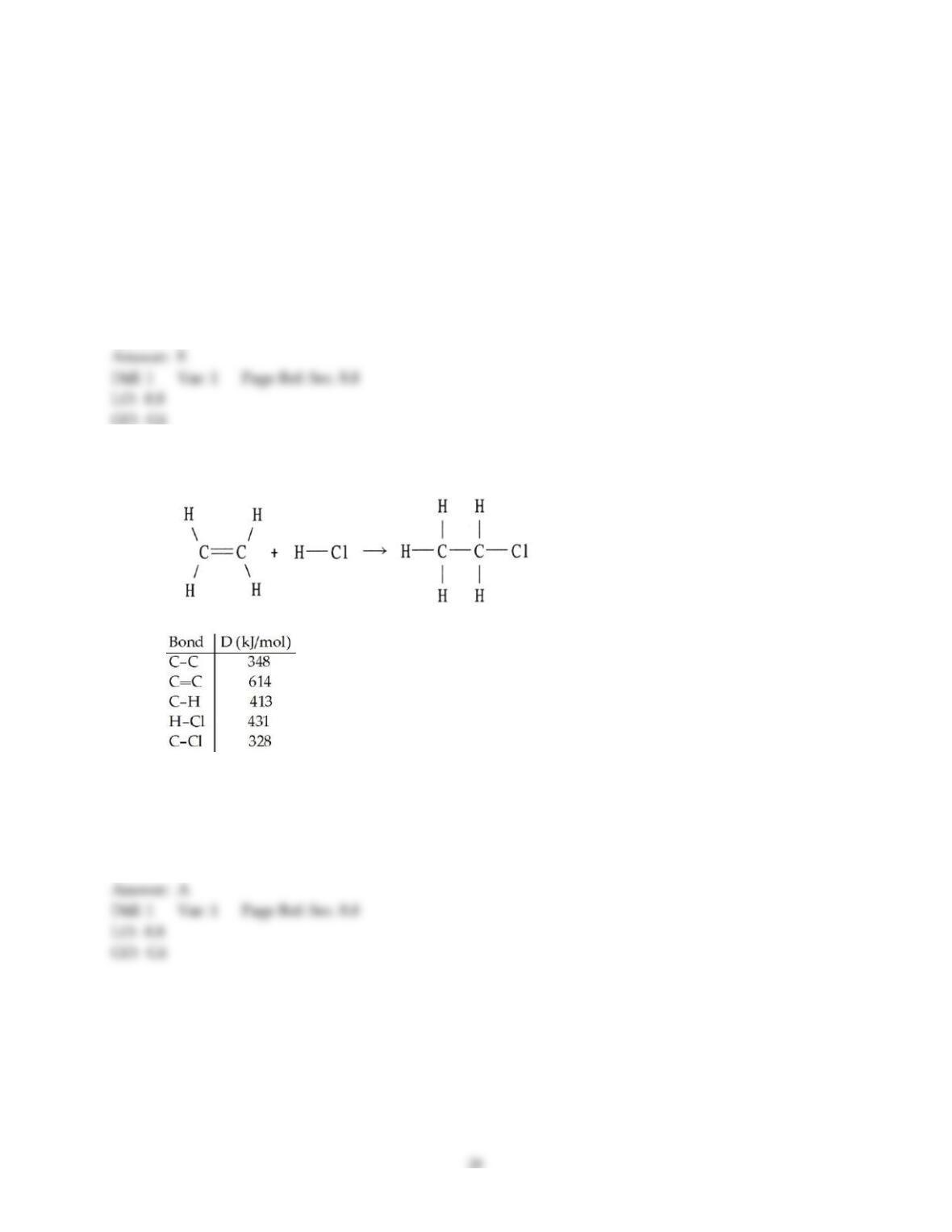
56) Using the table of bond dissociation energies, the ΔH for the following gas-phase reaction is ________
kJ.
A) –44
B) 38
C) 304
D) 2134
E) –38
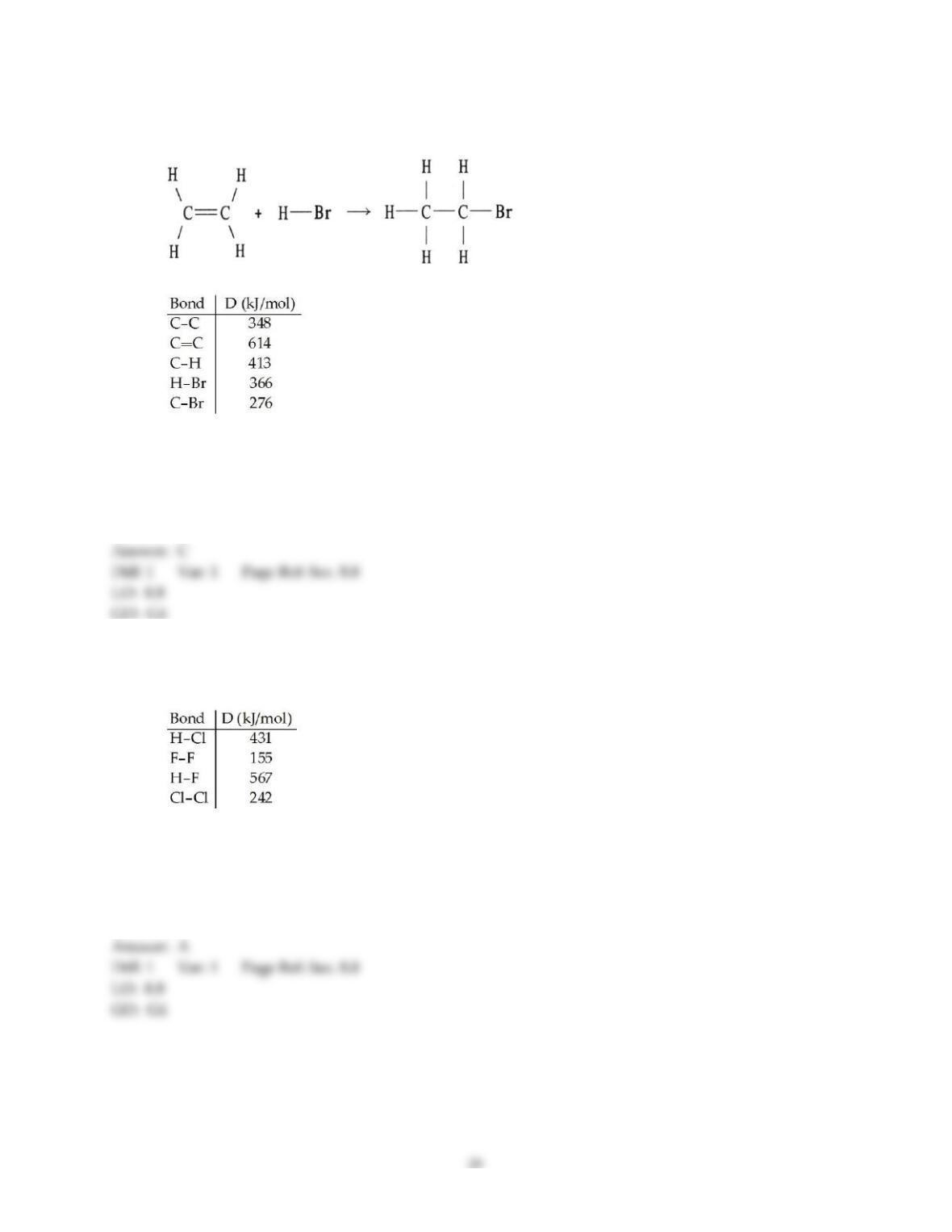
57) Using the table of bond dissociation energies, the ΔH for the following gas-phase reaction is ________
kJ.
A) 291
B) 2017
C) –57
D) –356
E) -291
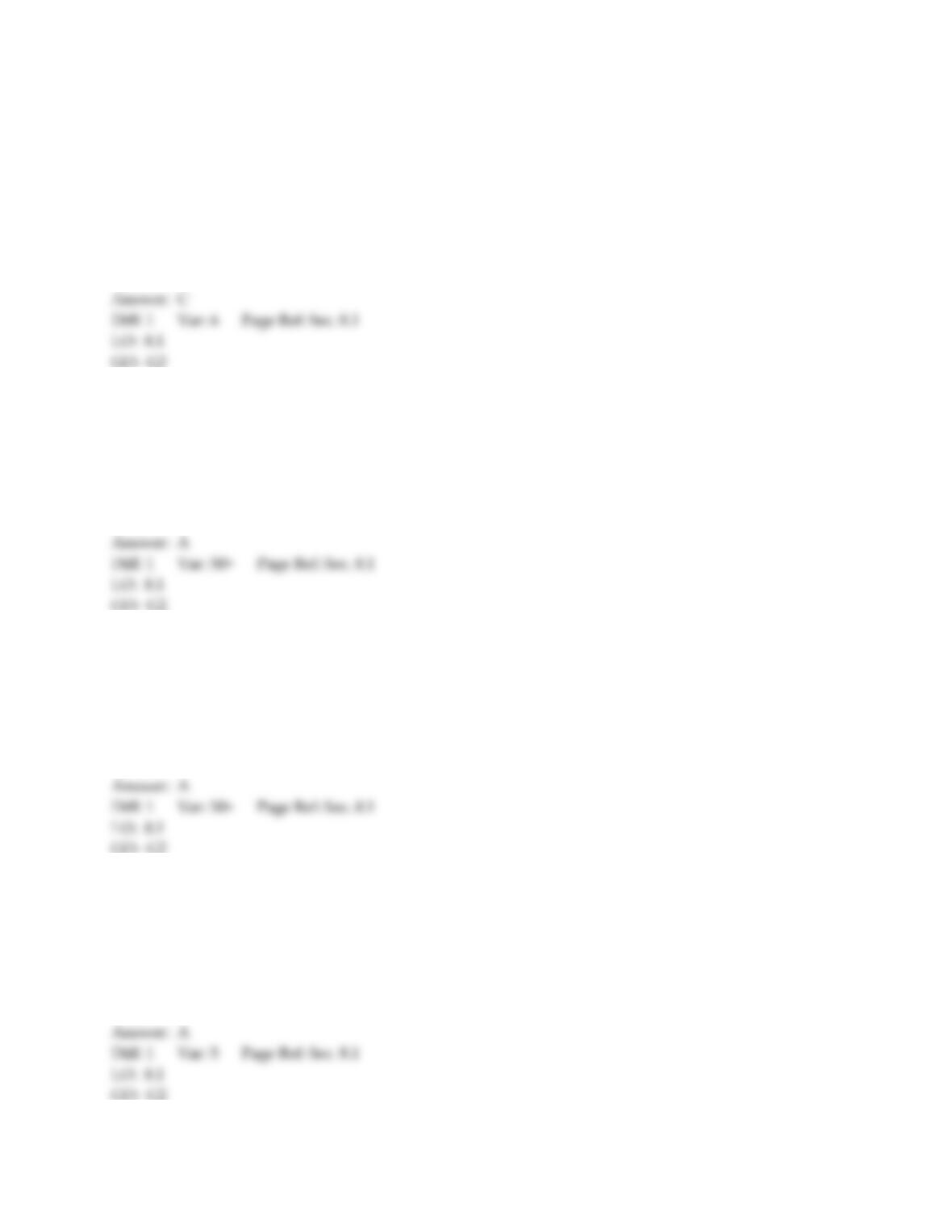
58) Using the table of bond dissociation energies, the ΔH for the following reaction is ________ kJ.
2HCl (g) + F2 (g) → 2HF (g) + Cl2 (g)
A) -359
B) -223
C) 359
D) 223
E) 208
30
8.3 Algorithmic Questions
1) There are ________ paired and ________ unpaired electrons in the Lewis symbol for a fluorine atom.
A) 4, 2
B) 4, 1
C) 6, 1
D) 0, 5
E) 2, 5
2) The ________ ion has a noble gas electron configuration.
A) Be2+
B) Li2+
C) Li
D) Mg2-
E) Al2+
3) The ________ ion has a noble gas electron configuration.
A) Cl–
B) F2-
C) F
D) S2+
E) O–
4) The ________ ion has eight valence electrons.
A) Sc3+
B) Ti3+
C) V3+
D) Cr3+
E) Mn3+
5) There are ________ unpaired electrons in the Lewis symbol for an oxygen atom.
A) 0
B) 1
C) 2
D) 4
E) 3
6) The principal quantum number of the electrons that are lost when iron forms a cation is ________.
A) 4
B) 5
C) 6
D) 2
E) 1
7) The oxide of which of the following metals should have the greatest lattice energy?
A) calcium
B) strontium
C) magnesium
D) beryllium
E) barium
8) The ________ ion is represented by the electron configuration [Ar]3d2.
A) Cr4+
B) V4+
C) Ti4+
D) Mn4+
E) Sc4+
9) The electron configuration [Kr]4d10 represents ________.
A) Ag+
B) Cd
C) Cd+
D) Ag2+
E) Sr2+
10) Ru+ ions are represented by the electron configuration ________.
A) [Kr]5s14d6
B) [Kr]5s24d5
C) [Kr]5s24d7
D) [Kr]4d5
E) [Ar]4s13d6
11) Ni2+ ions are represented by the electron configuration ________.
A) [Ar]3d8
B) [Ar]3d10
C) [Ar]3d6
D) [Ar]4s23d6
E) [Kr]4d8
12) How many single covalent bonds must a chlorine atom form to have a complete octet in its valence
shell?
A) 0
B) 1
C) 2
D) 3
E) 4
13) The most electronegative atom of the ones listed below is ________.
A) B
B) Al
C) Ga
D) In
E) Tl
14) Of the atoms below, ________ is the most electronegative.
A) Ba
B) Sr
C) Ca
D) Mg
E) Be
15) Of the atoms below, ________ is the most electronegative.
A) C
B) Si
C) Ge
D) B
E) Al
16) Of the atoms below, ________ is the least electronegative.
A) B
B) F
C) C
D) N
E) O
17) Of the bonds below, ________ is the least polar.
A) C-O
B) N-O
C) C-F
D) S-O
E) K–Br
18) Which two bonds are most similar in polarity?
A) O-F and Cl-F
B) B-F and Cl-F
C) Al-Cl and I–Br
D) I-Br and Si-Cl
E) C-Cl and Be-Cl
19) There are ________ valence electrons in the Lewis structure of CH3Cl.
A) 14
B) 16
C) 18
D) 20
E) 22
20) There are ________ valence electrons in the Lewis structure of CH3OCH3.
A) 20
B) 16
C) 18
D) 24
E) 22
21) In the Lewis symbol for a nitrogen atom, there are ________ paired and ________ unpaired electrons.
A) two, three
B) one, three
C) three, two
D) zero, five
E) two, two
22) The oxidation number of phosphorus in PF5 is ________.
A) +5
B) +3
C) +1
D) -5
E) 0
23) The central atom in ________ violates the octet rule.
A) PF5
B) SF2
C) Cl2
D) Br2CO
E) FCN
24) Of the following, ________ cannot accommodate more than an octet of electrons.
A) Ni
B) Sc
C) Be
D) Os
E) Sb
25) There are ______ covalent bonds in the Lewis Structure of CH3CHCl2.
A) 7
B) 6
C) 8
D) 5
E) 4
8.4 Short Answer Questions
1) The electron configuration that corresponds to the Lewis symbol, : . is ________.
2) Write the balanced chemical equation for the reaction for which △H°rxn is the lattice energy for
potassium bromide.
3) Using the noble gas shorthand notation, write the electron configuration for Fe3+.
4) Give the electron configuration of Cu2+.
5) Which halogen, bromine or iodine, will form the more polar bond with phosphorus?
6) Draw the Lewis structure of ICl2+.
7) Alternative but equivalent Lewis structures are called ________.
8) Benzene is a(n) ________ compound with ________ equivalent Lewis structures.
9) In a reaction, if the bonds in the reactants are stronger than the bonds in the product, the reaction is
________.
10) In compounds of ________ and ________, the octet rule is violated due to the presence of fewer than
eight valence electrons.
11) Polyatomic ions with an odd number of electrons will ________ the octet rule.
12) The strength of a covalent bond is measured by its ________.
13) To produce maximum heat, an explosive compound should have ________ chemical bonds and
decompose to molecule with ________ bonds.
14) Calculate the bond energy of C—F given that the heat of atomization of CHFClBr is 1502 kJ/mol, and
that the bond energies of C—H, C—Br, and C—Cl are 413, 276, and 328 kJ/mol, respectively.
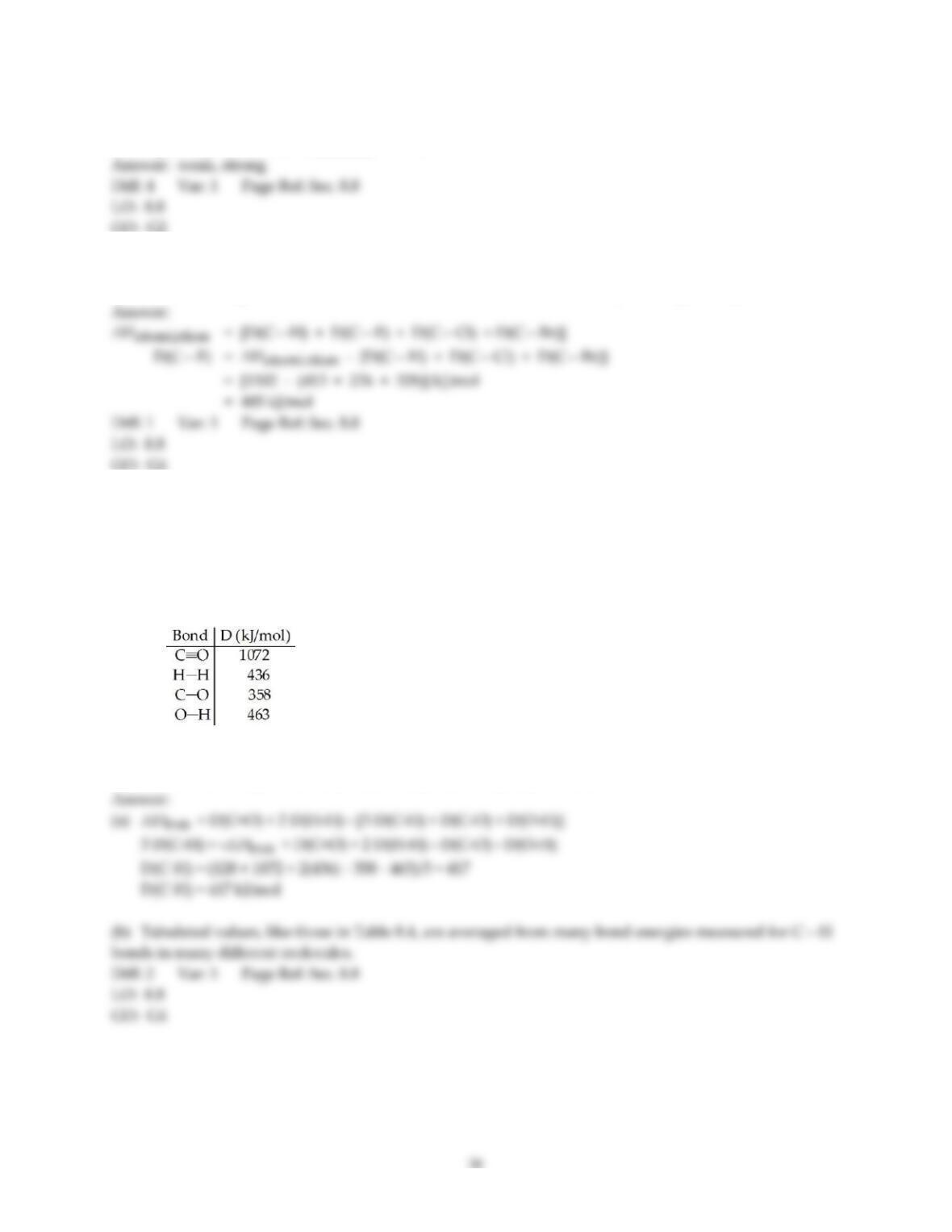
15) The reaction below is used to produce methanol:
CO (g) + 2H2 (g) → CH3OH (l) △Hrxn = -128 kJ
(a) Calculate the C—H bond energy given the following data:
(b) The tabulated value of the (C-H) bond energy is 413 kJ/mol. Explain why there is a difference
between the number you have calculated in (a) and the tabulated value.
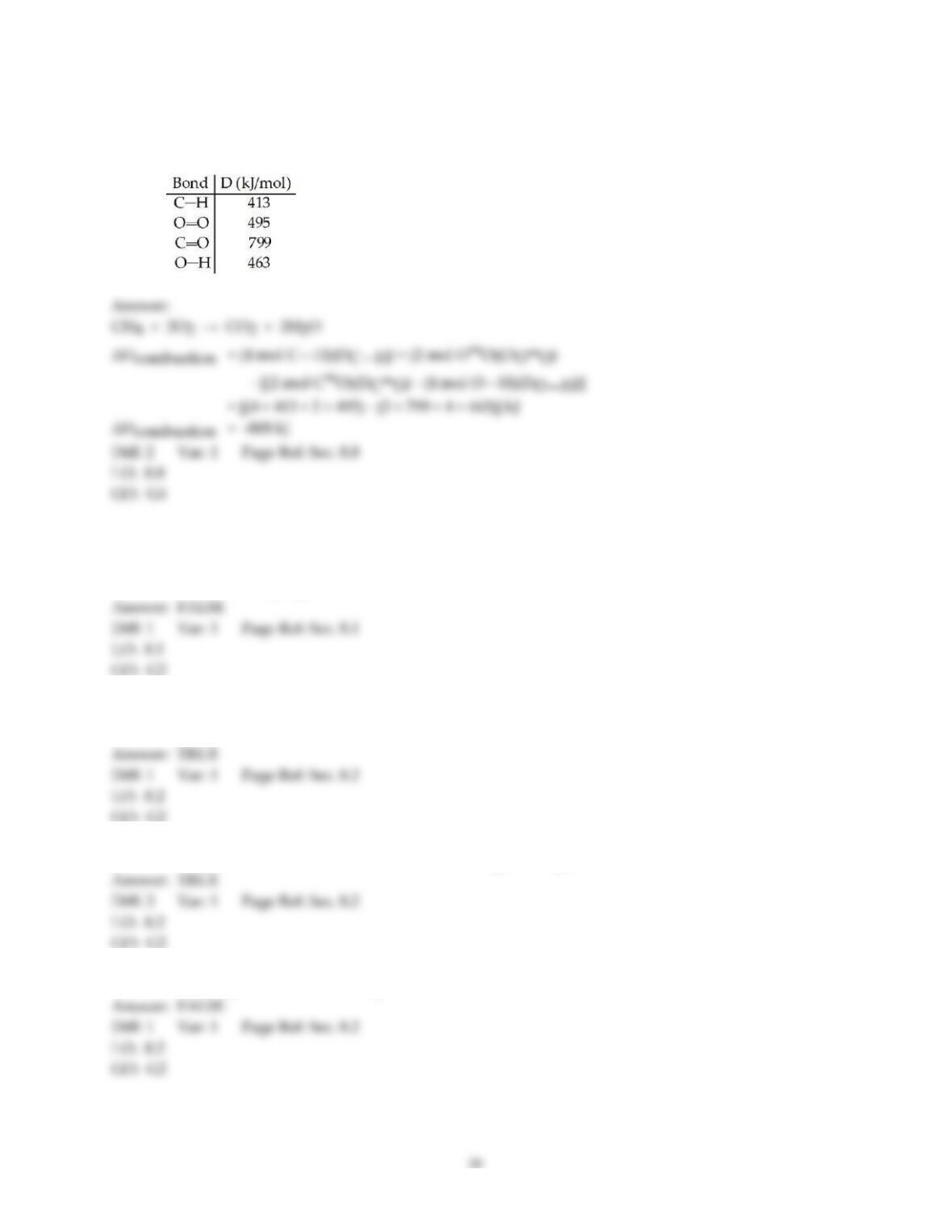
16) From the information given below, calculate the heat of combustion of methane. Start by writing the
balanced equation.
8.5 True/False Questions
1) Atoms surrounded by eight valence electrons tend to lose electrons.
2) The greater the lattice energy, the greater the charges on the participatory ions and the smaller their
radii.
3) Most transition metals do not form ions with a noble gas configuration.
4) When a metal gains an electron, the process is endothermic.
5) Electron affinity is a measure of how strongly an atom can attract additional electrons.
6) As electronegativity difference increases, bond length will decrease.
7) In some molecules and polyatomic ions, the sum of the valence electrons is odd and as a result the octet
rule fails.
8) Bond enthalpy can be positive or negative.