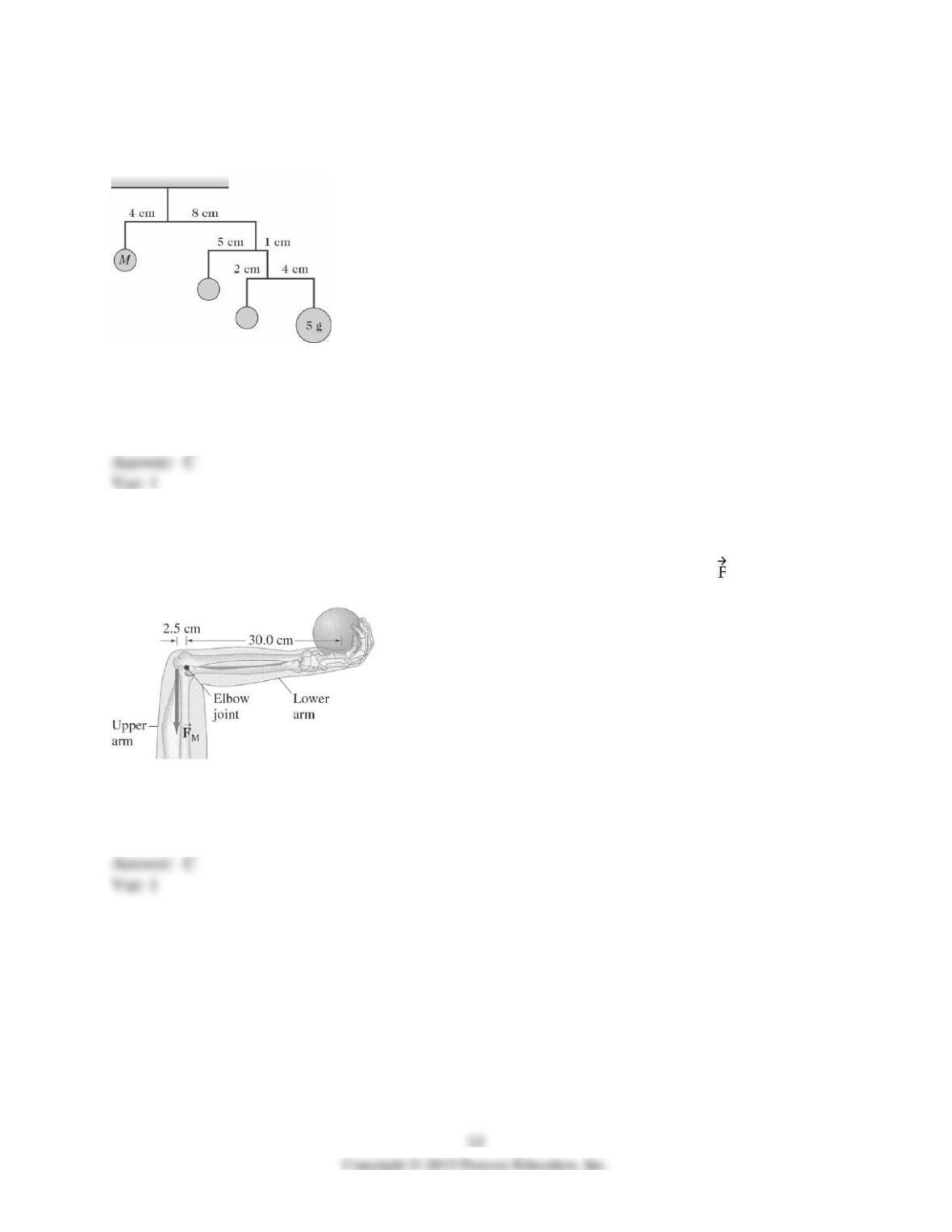
28) A mobile is shown in the figure. The horizontal supports have negligible mass. Assume that
all the numbers given in the figure are accurate to two significant figures. What mass M is
required to balance the mobile?
A) 18 g
B) 30 g
C) 36 g
D) 60 g
E) 90 g
29) An athlete holds a 7.5-kg shot put in his hand with his lower arm horizontal, as shown in the
figure. His lower arm has a mass of 2.8 kg and its center of gravity (or center of mass) is 12 cm
from the elbow-joint pivot. How much force must the extensor muscle (which is M in the
figure) in the upper arm exert on the lower arm?
A) 100 N
B) 500 N
C) 1000 N
D) 1500 N
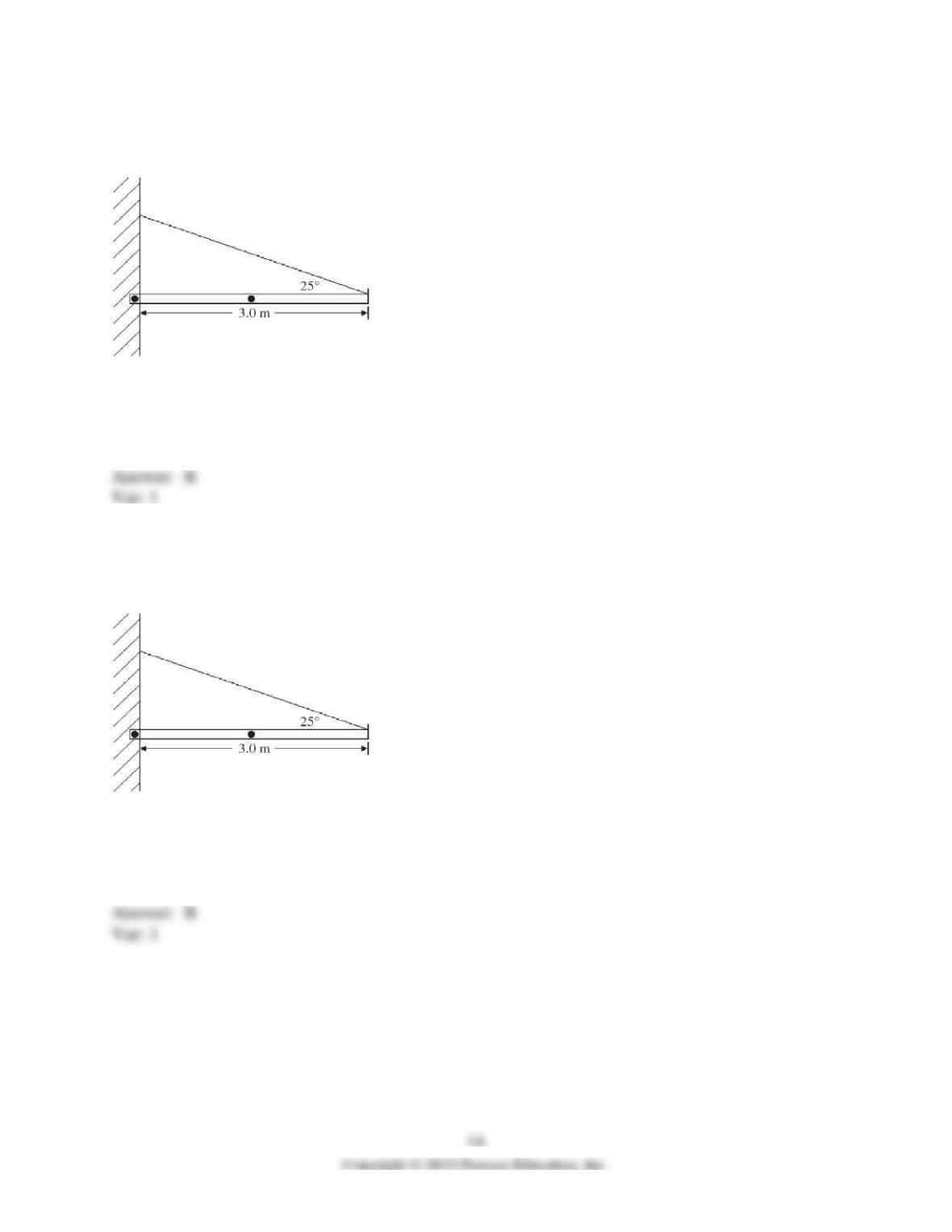
30) A store’s sign has a mass of 20 kg and is 3.0 m long. It is uniform, so its center of gravity is
at the center of the sign. It is supported horizontally by a small loose bolt attached to the wall at
one end and by a wire at the other end, as shown in the figure. What is the tension in the wire?
A) 460 N
B) 230 N
C) 120 N
D) 200 N
E) 300 N
31) A store’s sign has a mass of 20 kg and is 3.0 m long. It is uniform, so its center of gravity is
at the center of the sign. It is supported horizontally by a small loose bolt attached to the wall at
one end and by a wire at the other end, as shown in the figure. What is the magnitude of the net
force that the bolt exerts on the sign?
A) 460 N
B) 230 N
C) 200 N
D) 120 N
E) 300 N
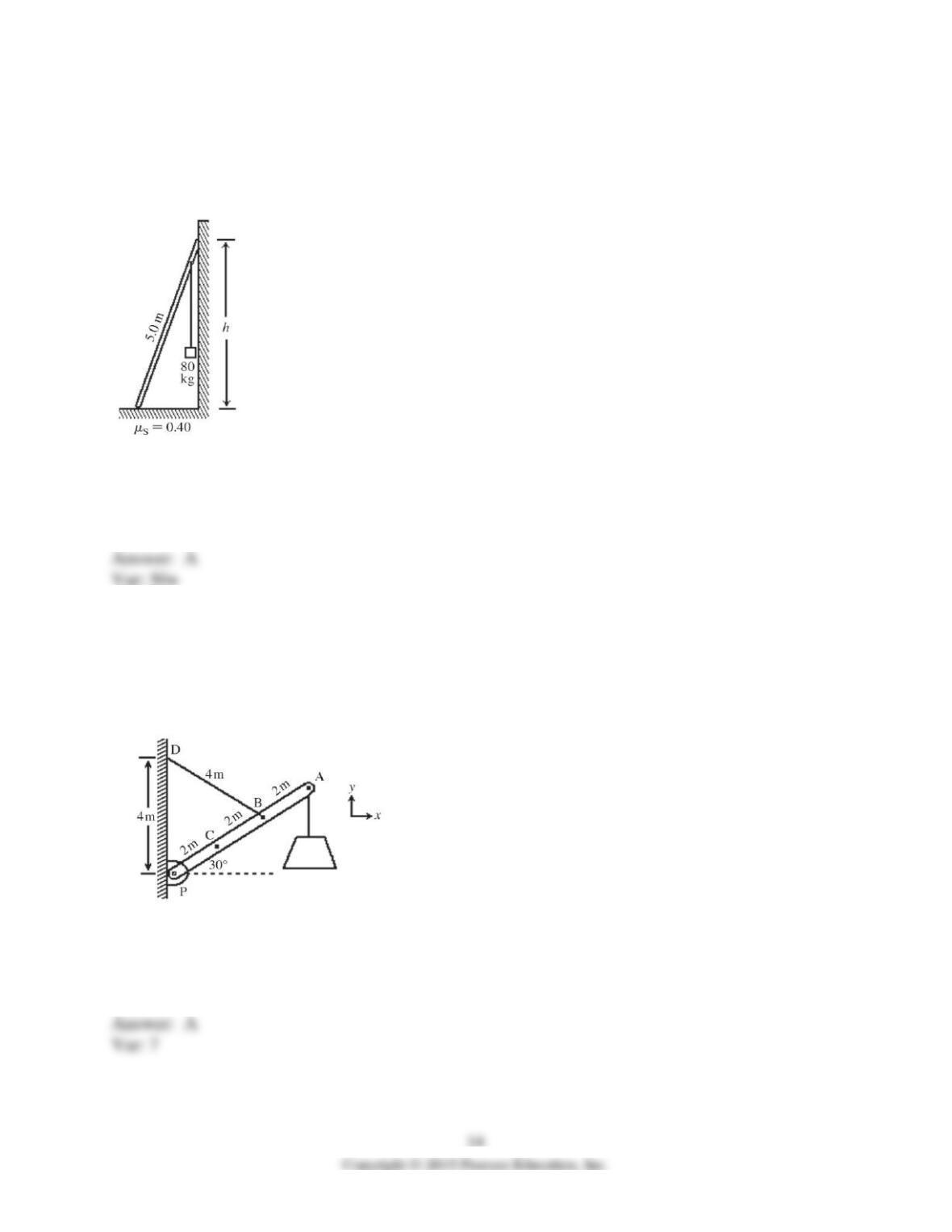
32) A 40-kg uniform ladder that is 5.0 m long is placed against a smooth wall at a height of h =
4.0 m, as shown in the figure. The base of the ladder rests on a rough horizontal surface whose
coefficient of static friction with the ladder is 0.40. An 80-kg bucket is suspended from the top
rung of the ladder, just at the wall. What is the magnitude of the force that the ladder exerts on
the wall?
A) 740 N
B) 1300 N
C) 980 N
D) 900 N
E) 1100 N
33) A 100-kg nonuniform boom that is 6.0 m long is loosely pinned at the pivot at P. A 600-kg
concrete block is suspended from the end of the boom at A, as shown in the figure. The boom
forms a 30° angle above the horizontal, and is supported by a 4.0-m cable between points D and
B. Point B is 4.0 m from P, and point D is 4.0 m above P. The center of mass of the boom is at
point C, which is 2.0 m from P. Assume that all the quantities shown in the figure are accurate to
two significant figures. What is the tension in the cable connected between points B and D?
A) 9300 N
B) 8400 N
C) 8100 N
D) 7500 N
E) 6900 N
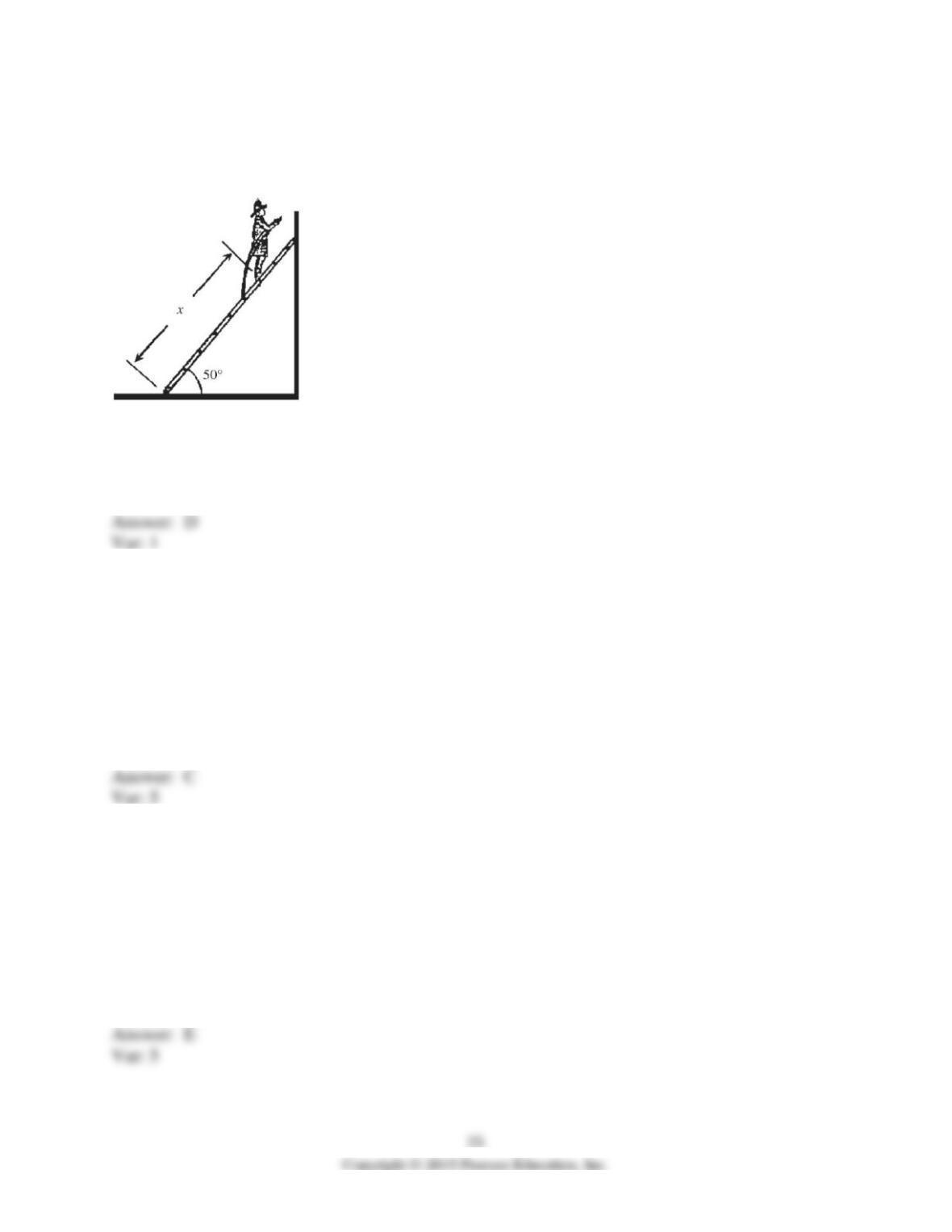
34) In the figure, a uniform ladder of weight 200 N and length 10 m leans against a perfectly
smooth wall. A firefighter of weight 600 N climbs a distance x up the ladder. The coefficient of
static friction between the ladder and the floor is 0.50. What is the maximum value of x for
which the ladder will not slip?
A) 3.9 m
B) 5.0 m
C) 6.0 m
D) 6.3 m
E) 8.4 m
35) A 3.00-m-long ladder, weighing 200 N, leans against a smooth vertical wall with its base on
a horizontal rough floor, a distance of 1.00 m away from the wall. The ladder is not completely
uniform, so its center of gravity is 1.20 m from its base. What force of friction must the floor
exert on the base of the ladder to prevent the ladder from sliding down?
A) 93.3 N
B) 130 N
C) 28.3 N
D) 102 N
E) 150 N
36) A 5.00-m-long uniform ladder, weighing 200 N, rests against a smooth vertical wall with its
base on a horizontal rough floor, a distance of 1.20 m away from the wall. The coefficient of
static friction between the ladder and the floor is 0.200. How far up the ladder, measured along
the ladder, can a 600-N person climb before the ladder begins to slip?
A) 1.50 m
B) 1.26 m
C) 1.05 m
D) 3.95 m
E) 4.56 m
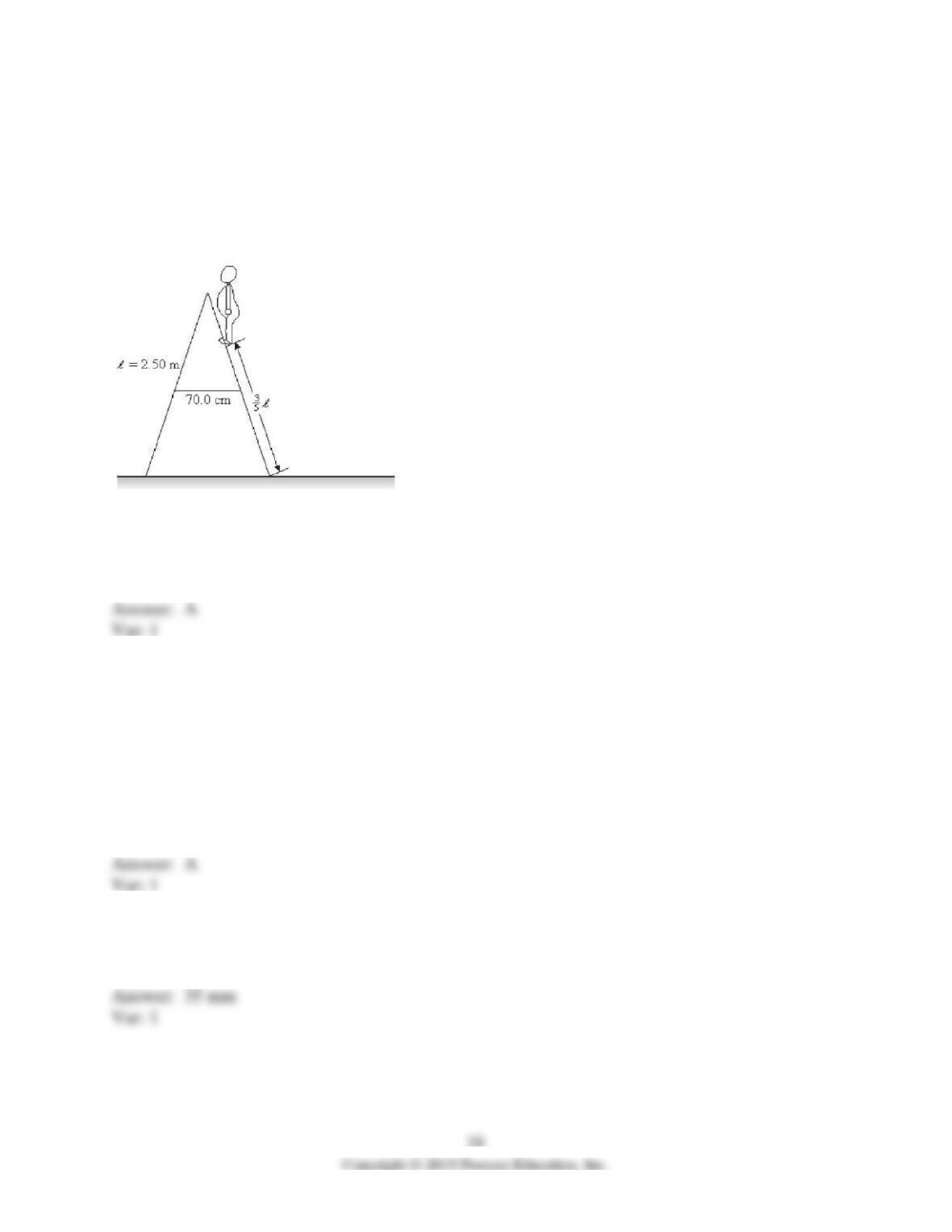
37) A stepladder consists of two halves that are hinged at the top and connected by a tie rod
which keeps the two halves from spreading apart. In this particular instance, the two halves are
2.5 m long, the tie rod is connected to the center of each half and is 70 cm long. An 800-N
person stands 3/5 of the way up the stepladder, as shown in the figure. The ladder is light enough
that we can neglect its weight, and it rests on an extremely smooth floor. What is the tension in
the tie rod? (Note: To solve this problem, it is helpful to imagine cutting the ladder in half
vertically and consider the forces and torques acting on each half of the ladder.)
A) 140 N
B) 240 N
C) 280 N
D) 360 N
E) 560 N
38) A 320-g ball and a 400-g ball are attached to the two ends of a string that goes over a pulley
with a radius of 8.7 cm. Because of friction in its axle, the pulley does not begin to rotate. What
is the magnitude of the frictional torque at the axle of the pulley if the system remains at rest
when the balls are released?
A) 0.068 N ∙ m
B) 0.61 N ∙ m
C) 0.079 N ∙ m
D) 0.063 N ∙ m
E) 0.00070 N ∙ m
39) A 50-kg bucket of concrete is suspended from a steel wire that is 1.0 mm in diameter 1.0 mm
and 11.2 m long. What distance will the wire stretch? Young’s modulus for steel is 2.0 x 10¹¹
Pa.
40) A 7.0-kg pipe is hung from a steel wire that is 2.5 m long and has a diameter of 0.75 mm.
Young’s modulus for steel is 2.0 × 10¹¹ N/m2.
(a) By what distance does the wire stretch?
(b) If the wire diameter were doubled, what would be the stretch?
41) A steel wire, 3.2 m long, has a diameter of 1.2 mm. The wire stretches 1.6 mm when it bears
a load. Young’s modulus for steel is 2.0 × 10¹¹ Pa. The mass of the load is closest to
A) 12 kg.
B) 16 kg.
C) 20 kg.
D) 24 kg.
E) 28 kg.
42) An aluminum wire and a steel wire, each of length 2.0 m, are hung from the ceiling. A 5.0-kg
mass is suspended from the lower end of each wire. The aluminum wire has a diameter of 2.2
mm. What must be the diameter of the steel wire if it is to stretch the same distance as the
aluminum wire, so that the two wires maintain equal lengths after the masses are attached?
Young’s modulus for aluminum is 0.70 × 10¹¹ Pa and for steel it is 2.0 × 10¹¹ Pa.
43) When a 125-kg piece of equipment is hung from a steel wire of diameter 6.00 mm, it
stretches the wire by 4.00 mm. If instead the wire had a diameter of 3.00 mm, but all else were
the same, by what distance would the same equipment stretch the wire?
A) 16.0 mm
B) 8.00 mm
C) 4.00 mm
D) 2.00 mm
E) 1.00 mm
44) When a 125-kg piece of equipment is hung from a steel wire of length 75 cm, it stretches the
wire by 4.00 mm. If instead the wire had a length of 150 cm, but all else were the same, by what
distance would the same equipment stretch the wire?
A) 16.0 mm
B) 8.00 mm
C) 4.00 mm
D) 2.00 mm
E) 1.00 mm
45) A cable is 100-m long and has a cross-sectional area of 1.0 mm2. A 1000-N force is applied
to stretch the cable. Young’s modulus for the cable is 1.0 × 10¹¹ N/m2. How far does the cable
stretch?
A) 0.010 m
B) 0.10 m
C) 1.0 m
D) 10 m
46) A solid steel column is 4.0 m long and 0.20 m in diameter. Young’s modulus for this steel is
2.0 × 10¹¹ N/m2. By what distance does the column shrink when a 5000-kg truck is supported
by it?
A) 8.0 × 10⁻⁷ m
B) 3.2 × 10⁻⁶ m
C) 7.8 × 10⁻⁶ m
D) 3.1 × 10⁻⁵ m
47) A wire of diameter 0.20 mm stretches by 0.20% when a 6.28-N force is applied to it. What
is Young’s modulus for this wire?
A) 2.5 × 10¹⁰ Pa
B) 1.0 × 10¹¹ Pa
C) 2.5 × 10¹² Pa
D) 1.0 ×10¹² Pa
48) A 50-kg load is suspended from a steel wire of diameter 1.0 mm and length 11.2 m. By what
distance will the wire stretch? Young’s modulus for steel is 2.0 × 10¹¹ Pa.
A) 1.5 cm
B) 2.5 cm
C) 3.5 cm
D) 4.5 cm
49) A bridge piling has a cross-sectional area of 1.250 m2 and supports a load of 1875 N. What
is the stress on the column?
A) 1875 N
B) 1875 N/m2
C) 1500 N/m2
D) 2344 N/m2
50) An aluminum wire 2.0 m long and 2.0 mm in diameter supports a 10.0-kg fixture. What is
the stress in the wire? Young’s modulus for aluminum is 7.0 × 10¹⁰ N/m2.
A) 3.1 × 10⁷ N/m2
B) 6.2 × 10⁷ N/m2
C) 9.3 × 10⁷ N/m2
D) 1.2 × 10⁸ N/m2
51) A brass wire 2.0 m long and 2.0 mm in diameter supports a 10.0-kg fixture. By what
distance did this fixture stretch the wire? Young’s modulus for brass is 10 × 1010 N/m2.
A) 0.11 mm
B) 0.22 mm
C) 0.33 mm
D) 0.62 mm
52) A vertical 30-cm steel rod, 1.0 cm in diameter, supports a 300-kg mass. What is the change
in length of the rod caused by this mass? Young’s modulus for steel is 2.0 × 10¹¹ N/m2.
A) 5.6 × 10⁻⁵ m
B) 6.5 × 10⁻⁵ m
C) 5.6 × 10⁻⁶ m
D) 6.5 × 10⁻⁶ m
E) 6.5 × 10⁻⁴ m
53) A 50-kg air conditioner is placed on top of a concrete pad that is 20 cm thick and has a cross-
sectional area of 3.0 m2. What is the change in thickness of the pad caused by the air
conditioner? Young’s modulus for concrete is 2.3 × 10¹⁰ N/m2.
A) 1.4 × 10⁻⁹ m
B) 2.8 × 10⁻⁹ m
C) 1.4 × 10⁻⁸ m
D) 1.4 × 10⁻⁷ m
E) 2.8 × 10⁻⁸ m
54) A 1200-kg car is being raised at a constant speed if 25 cm/s by a crane, using a 20-m long
steel cable that is 1.5 cm in diameter. Young’s modulus for steel is 2.0 × 10¹¹ Pa. What is the
change in length of the cable caused by the car?
A) 6.7 mm
B) 6.7 cm
C) 3.3 mm
D) 3.3 cm
E) 3.3 m
55) A 1200-kg car is being raised with a constant acceleration of 2.53 m/s2 by a crane, using a
20-m long steel cable that is 1.5 cm in diameter. Young’s modulus for steel is 2.0 × 10¹¹ N/m2.
What is the change in length of the cable caused by lifting the car?
A) 8.4 mm
B) 8.4 cm
C) 4.9 mm
D) 4.9 cm
E) 4.9 m
56) A piano wire has a radius of 0.50 mm. One end is fixed and the other is wrapped around a
tuning peg, which has a diameter of 3.5 mm and is 80 cm away. After the wire just becomes taut,
the peg is given three full turns. What is the tension in the wire? Young’s modulus for steel is 2.0
× 1011 N/m2.
A) 3.8 kN
B) 4.3 kN
C) 6.5 kN
D) 8.7 kN
E) 9.8 kN
57) A wire that is 1.0 mm in diameter and 3.5 m long stretches 3.5 mm when an 8.0-kg tool is
hung from it.
(a) What is Young’s modulus for the material from this wire is made?
(b) What is the effective spring constant for the stretching wire?