75. Recognizing revenue before the seller collects cash requires estimating the amount of uncollectible accounts
with reasonable accuracy. Both U.S. GAAP and IFRS require the
76. Allowance for Uncollectibles contra account appears among the _____ on a firm’s balance sheet as a(n)
_____.
77. When a firm decides that a particular customer account is uncollectible, it removes that account by debiting
the _____ and crediting _____ This process is called writing off the account.
78. There are two approaches that management can use to estimate the amount of credit sales that would prove
to be uncollectible, they are the _____. Over time, the two methods, correctly used, will give the same
cumulative income and asset totals. U.S. GAAP and IFRS do not require firms to use one or the other, and
some firms use both methods.
79. The percentage-of-sales procedure arises from the idea that uncollectible amounts will vary with the volume
of credit business. The firm estimates the appropriate percentage by studying its own experience or by inquiring
into the experience of similar firms. Default rates generally fall within the range of _____of credit sales.
80. After the firm estimates the amount of uncollectible accounts associated with the credit sales of each period,
it makes an adjusting entry to debit _____ and credit _____.
81. Under the _____ procedure, the firm estimates and recognizes its bad debt expense; the offsetting credit
increases the balance in the Allowance for Uncollectibles. Under the _____ procedure, the firm estimates the
ending balance in the Allowance for Uncollectibles account and makes a credit entry to bring the balance to this
amount; the offsetting debit is to Bad Debt Expense.
82. At the start of 20×4, Colonial Designs’ Allowance for Uncollectibles balance is €120,000. During 20×4,
Colonial Designs’ credit sales were €5,000,000; of this amount, it expected 2% will become uncollectible.
During 20×4, Colonial Designs wrote off €70,000 of accounts receivable. At the end of 20×4, Colonial Designs
estimates, based on an aging of accounts, that the ending balance in the Allowance for Uncollectibles should be
€130,000.
83. Which of the following is true regarding the U.S. Internal Revenue Service?
84. The financial statements contain information for analyzing the collectibility of accounts receivable and the
adequacy of the expense for uncollectible accounts. Typical ratios used for this analysis include the
85. The accounts receivable turnover ratio captures the speed of cash collections from credit customers and is
calculated as follows:
86. Ratios used to evaluate the allowance for uncollectibles are
87. For U.S. companies, how do U.S. GAAP and income tax reporting compare in their treatment of
uncollectible accounts?
88. The direct write-off method
89. The method that recognizes losses from uncollectible accounts in the period when a firm decides that
specific customers’ accounts are uncollectible is called the
90. Which of the following is/are not a shortcoming of the direct write-off method?
91. The direct write-off method
92. An example of a firm’s use of a different set of accounting principles for financial reporting and for income
tax reporting is
93. The allowance method does not involve
94. When using the allowance method
95. The allowance method overcomes shortcomings of the direct write-off method because it
96. The allowance method is used by a firm
97. The seller of merchandise often offers a reduction from the invoice price for prompt payment, this is called
a
98. The allowance method for uncollectibles is used by a firm
99. In estimating the amount of uncollectible accounts the accountant (1) estimates the amount of outstanding
accounts receivable that the firm does not expect to collect and (2) adjusts the balance in the Allowance for
Uncollectible Accounts so that, after the entry to recognize estimated uncollectibles, the balance in the account
will equal the amount that the firm does not expect to collect. The name of this procedure is/are:
100. Which of the following is/are true?
101. In estimating the amount of uncollectible accounts the accountant (1) estimates the amount of uncollectible
accounts that will likely occur over time in connection with sales of each period and (2) makes an entry debiting
Bad Debt expense and crediting Allowance for Uncollectible Accounts. The name of this procedure is/are the
102. A debit balance in the allowance account may exist before recognizing estimated uncollectibles for the
period because
103. Sellers of merchandise offer sales discount or cash discounts in order to
104. U.S. GAAP does not allow sellers of merchandise to recognize revenue from sales when the customers
have the right to return goods.
105. Firms that reduce the price charged to a customer after the firm has delivered the goods and the customer
has found them to be unsatisfactory or damaged issue a
106. As long as the amount collected from credit sales to a given group of customers exceeds the cost of goods
sold and the other costs of serving that group of customers, including the costs of _____ accounts, the retailer
will be better off selling to that group rather than losing the sales.
107. An accounting issue for accounts receivable is the timing of recognition of the reduction in income caused
by the uncollectibility of some accounts. With regard to timing, both U.S. GAAP and IFRS require that a seller
recognize an expense for estimated uncollectible accounts receivable in the _____.
108. Both U.S. GAAP and IFRS require the allowance method for uncollectible accounts, which involves
estimating the amount of uncollectible accounts receivable associated with
109. Bad Debt Expense is also called
110. Bad Debt Expense is also called the Provision for Bad Debts and the Provision for Uncollectible Accounts.
Provision in this context refers to
111. Sales discounts and allowances include:
112. When customers return goods for cash refunds or, if the customer has not yet paid, for cancellation of the
customer’s obligation to pay, the firm records a sales

113. Accrual accounting requires frequent, ongoing changes in estimates. Which of the following is/are true?

114. Using the information in the following tables, determine the amount of revenue and expense reported in
years 1-4 and the totals reported for all 4 years under both the percentage-of-completion method and the
installment method.
Cash
Costs
Year
Collected
Incurred
1
$ 0
$ 500,000
2
600,000
1,000,000
3
1,200,000
300,000
4
600,000
200,000
Total
$2,400,000
$2,000,000
PERCENTAGE OF
COMPLETION
INSTALLMENT SALES
Year
Revenue
Expense
Revenue
Expense
1
A
B
K
L
2
C
D
M
N
3
E
F
O
P
4
G
H
Q
R
Total
I
J
S
T
PERCENTAGE OF
COMPLETION
INSTALLMENT SALES
Year
Revenue
Expense
Revenue
Expense
1
$ 600,000
$ 500,000
$ 0
$ 0
2
1,200,000
1,000,000
600,000
500,000
3
360,000
300,000
1,200,000
1,000,000
4
240,000
200,000
600,000
500,000
Total
$2,400,000
$2,000,000
$2,400,000
$2,000,000
$ 600,000
$ 500,000
$1,200,000
$1,000,000
$ 360,000
$ 300,000
$ 240,000
$ 200,000
$2,400,000
$2,000,000
$ 0
$ 0
$ 600,000
$ 500,000
$1,200,000
$1,000,000
$ 600,000
$ 500,000
$2,400,000
$2,000,000
115. Assume that a firm uses the accrual basis of accounting. For each of the following independent cases,
indicate the amount of revenue the firm recognizes for the month of August.
a.
Collects $2,000 in July for merchandise to be delivered in August.
b.
Collects $1,200 in May for subscriptions that will be delivered during the next twelve months (beginning in May).
c.
Collects $800 in August for merchandise sold and delivered in July.
d.
Collects $2,400 interest on a 6-month certificate of deposit, which matures on August 15th.
e.
Sells $3,000 of merchandise on account in August. The firm allows a 2% discount for payment prior to 30 days and customers take the
discount.
116. The life of a construction contract is 4 years. The firm used the percentage-of-completion method. Under
this method, cash collected and revenues recognized are shown below. Total cost of the project was $800,000.
What portion of the total cost was incurred each year?
Cash
Revenue
Cost
Year
Collected
Recognized
Incurred
1
$ 100,000
$ 300,000
A
2
200,000
300,000
B
3
200,000
150,000
C
4
500,000
250,000
D
Total
$1,000,000
$1,000,000
$800,000
$240,000
$240,000
$120,000
$200,000

117. Chambliss Company started business on January 1, Year 7. It recognizes revenue and expense at the time
of sale for financial reporting and uses the installment method for income tax reporting. Under the installment
method, the firm recognizes revenue when it receives cash, and matches expenses with revenues based on the
average cost of goods sold to sales percentage for the year in which the firm made the sale. The income tax rate
is 30%. Data for Year 7 and Year 8 as reported to shareholders, appear below:
Year 7
Year 8
Net sales on account
$2,400,000
$3,000,000
Cash collections of Year 7 sales
1,620,000
480,000
Cash collections of Year 8 sales
–
2,040,000
Cost of merchandise sold
1,440,000
1,920,000
All other (period) expenses
240,000
360,000
Required:
a.
Compute the amount of net income after taxes for financial reporting for Year 7 and Year 8.
b.
Compute the amount of taxable income for Year 7 and Year 8.
Sales revenue
$2,400,000
$3,000,000
Cost of goods sold
(1,440,000)
(1,920,000)
Gross profit
$ 960,000
$1,080,000
Other expenses
(240,000)
(360,000)
Net income before taxes
$ 720,000
$ 720,000
Income tax expense
(216,000)
(216,000)
Year 7
Year 8
Sales revenue-Year 7
$1,620,000
$ 480,000
Sales revenue-Year 8
2,040,000
Cost of goods sold-Year 7
$ (972,000)
$ (288,000)
Cost of goods sold-Year 8
(1,305,600)
Gross profit
$ 648,000
$ 926,400
Other expenses
(240,000)
(360,000)
Taxable income
$ 408,000
$ 566,400

118. A construction firm enters a long-term contract to build a bridge. The expected and actual cash receipts and
disbursements for the project are as follows:
Period
Receipts
Expenditures
1
$1,000
$4,000
2
2,000
2,000
3
3,000
1,000
4
4,000
1,000
Required:
What is the revenue during each of the following periods under each of the specified methods of revenue recognition?
Period
Method
a.
1
Completed Contract
b.
4
Completed Contract
c.
1
Percentage of Completion
d.
4
Percentage of Completion
e.
1
Installment Method
f.
4
Installment Method
g.
1
Cost Recovery First
h.
4
Cost Recovery First
$0
b.
$10,000
c.
$5,000
$1,000
f.
$4,000
g.
$1,000
h.
$4,000

119. A construction firm enters a long-term contract to build a bridge. The expected and actual cash receipts and
disbursements for the project are as follows:
Period
Receipts
Expenditures
1
$1,000
$4,000
2
2,000
2,000
3
3,000
1,000
4
4,000
1,000
Required:
What is the income before taxes during each of the following periods under each of the specified methods of revenue recognition?
Period
Method
a.
1
Completed Contract
b.
4
Completed Contract
c.
1
Percentage of Completion
d.
4
Percentage of Completion
e.
1
Installment Method
f.
4
Installment Method
g.
1
Cost Recovery First
h.
4
Cost Recovery First
120. List three ways a firm may convert accounts receivable into cash and briefly describe the features of each
option.
$0
b.
$2,000
c.
$1,000
$200
f.
$800
g.
$0
h.
$2,000
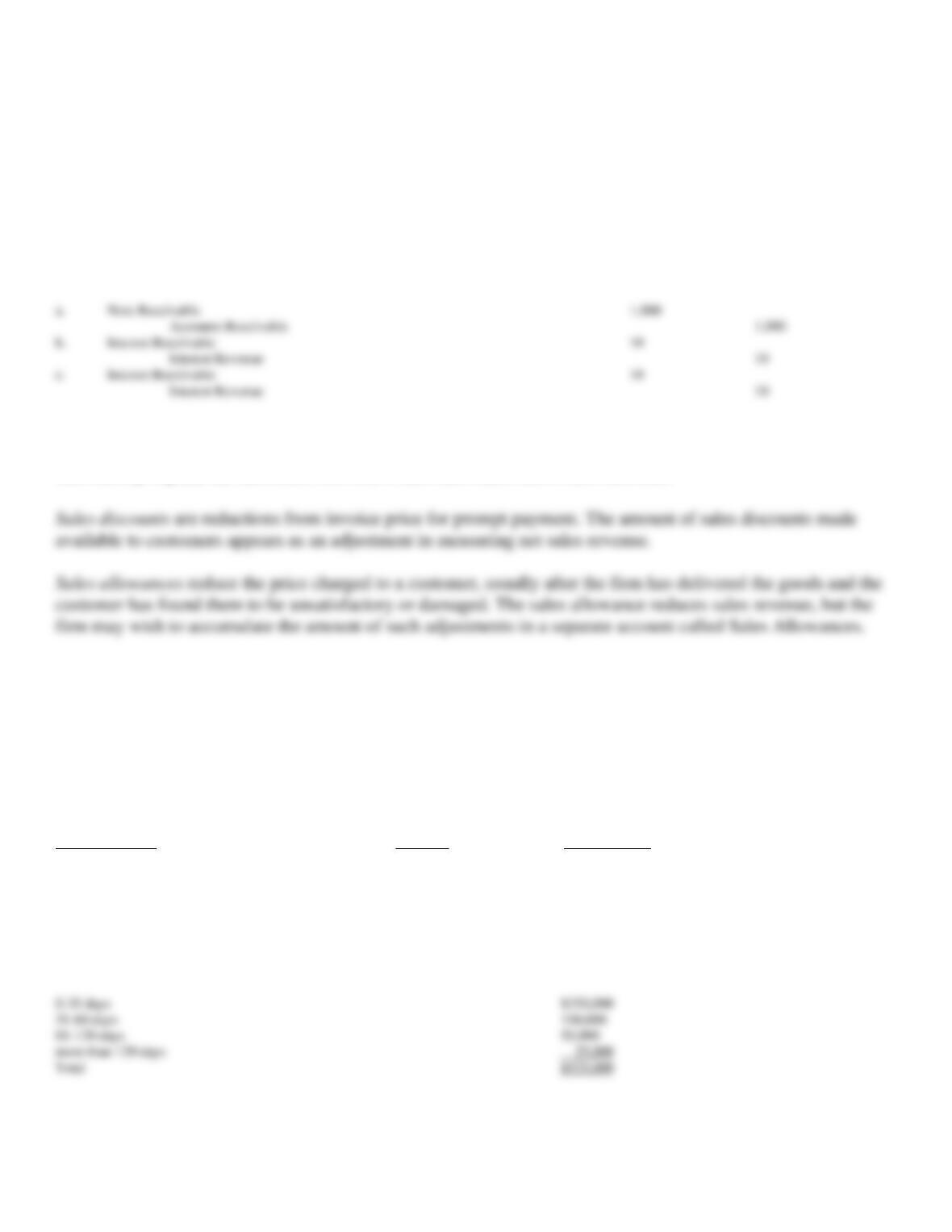
121. Prepare journal entries for the following transactions:
a.
On November 1, Year 1, Slotkin Co. received a $1,000 note receivable with a 90-day maturity and a 12% interest rate in exchange for
an outstanding account receivable of the same face amount.
b.
Assume Slotkin Co. closes its books on a monthly basis. Prepare any adjusting journal entries necessary at November 30, Year 1.
c.
Prepare any adjusting journal entries necessary at December 31, Year 1.
122. Briefly explain the difference between a sales allowance and a sales discount.
123. Darling Company ages its accounts receivable to estimate bad debts for financial statement purposes.
President Darling is at a meeting with creditors and needs to know his total accounts receivable balance.
Unfortunately, Darling picked up the wrong computer report and has, instead, a summary printout of the
company’s estimated bad debts as follows:
Age of Receivable
Bad Debt
% uncollectible
0-30 days
$ 1,750
0.5%
31-60 days
1,500
1.5%
61-120 days
4,000
8.0%
more than 120 days
17,500
70.0%
Calculate the accounts receivable balance based on Darling’s bad debt summary.
0-30 days
$350,000
31-60 days
100,000
61-120 days
50,000
more than 120 days
25,000
Total
$525,000
a.
Note Receivable
1,000
Accounts Receivable
1,000
b.
Interest Receivable
10
Interest Revenue
10
c.
Interest Receivable
10
Interest Revenue
10
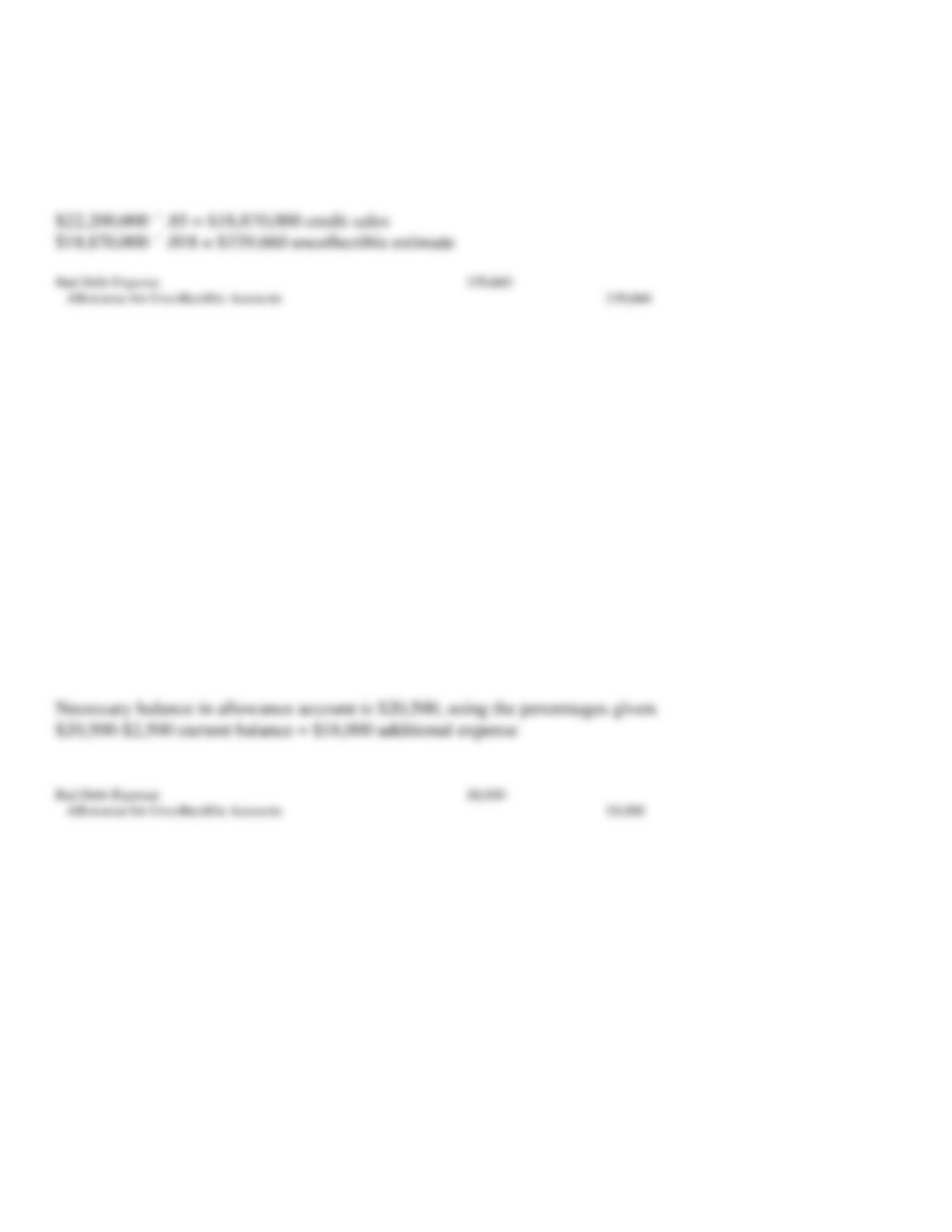
124. At the end of Year 2, the unadjusted trial balance of Alaska Company includes $1,500,000 of outstanding
accounts receivable and an Allowance for Uncollectible Accounts of $14,600. Total sales for the year are
$22,200,000 and 85% of the sales were on account. The company estimates that 1.8% of credit sales are
uncollectible and no entries have been made during the year to reflect these uncollectibles. Prepare the adjusting
entry for the allowance for uncollectible accounts.
125. Breaker Co.’s accounts receivable show the following balances by age:
Age of Receivable
Balance
0-30 days
$600,000
31-60 days
175,000
61-120 days
70,000
more than 120 days
10,000
The credit balance in the allowance for uncollectible accounts is $2,500. Breaker Co. uses the following percentages to compute the estimated
amounts of receivables that will eventually prove uncollectible: 0-30 days, 0.7%; 31-60 days, 1.2%; 61-120 days, 11%; and more than 120 days,
65%.
Required:
Prepare the adjusting journal entry.
Bad Debt Expense
18,000
Allowance for Uncollectible Accounts
18,000
Bad Debt Expense
339,660
Allowance for Uncollectible Accounts
339,660