Use the formula for the general term (the nth term) of an arithmetic sequence to find the indicated term of the sequence
with the given first term, a1, and common difference, d.
68)
Find a 32 when a1= – 9, d =1 .
68)
A)
23
B)
–40
C)
–41
D)
22
Solve the problem.
69)
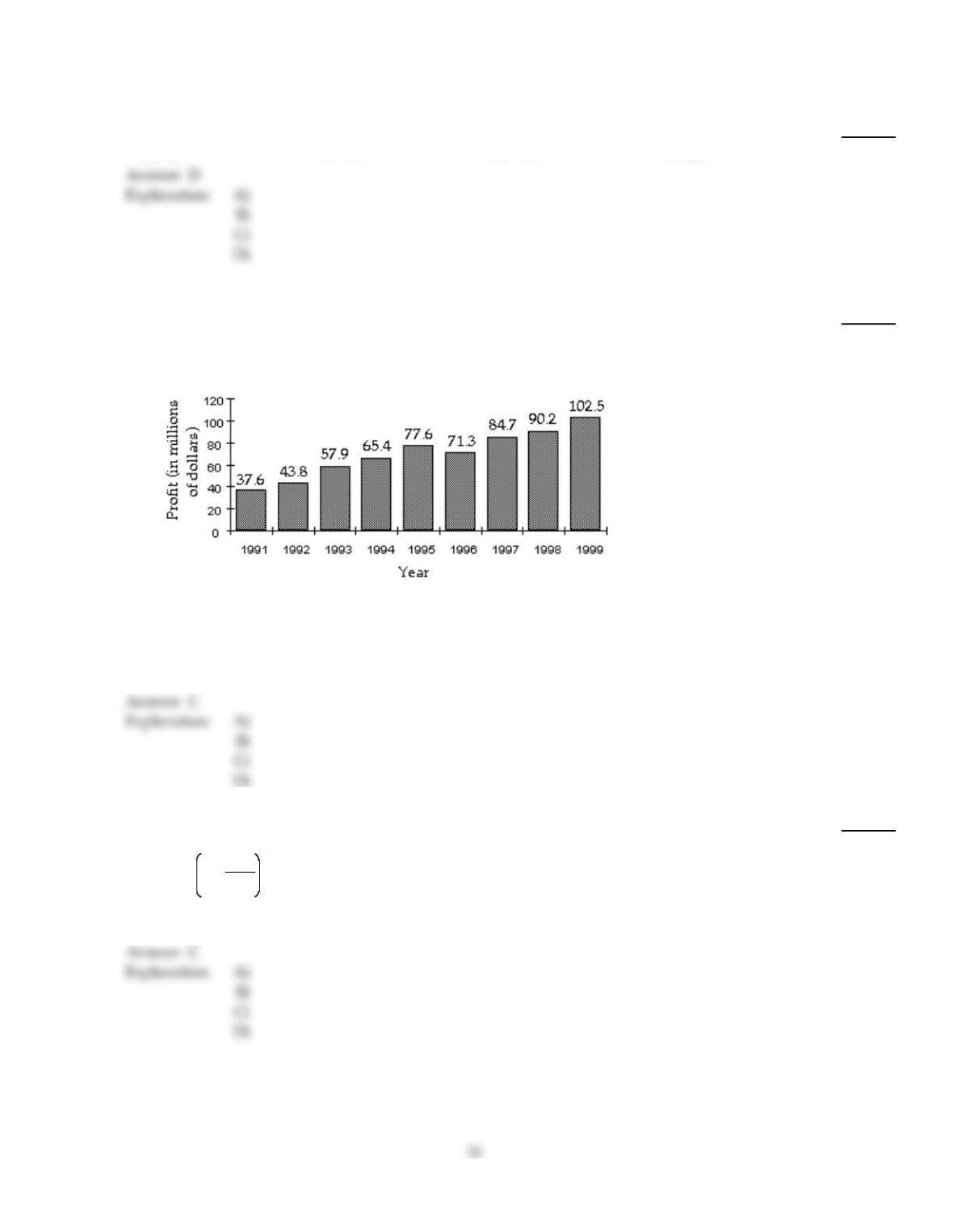
The bar graph below shows a company’s yearly profits from 1991 to 1999. Let an represent the
company’s profit, in millions, in year n, where n=1 corresponds to 1991, n = 2 corresponds to 1992,
and so on.
Find
7
i =2
ai
69)
A)
$128.5 million
B)
$414.1 million
C)
$400.7 million
D)
$438.3 million
70)
A deposit of $8000 is made in an account that earns 6% interest compounded quarterly. The balance
in the account after n quarters is given by the sequence
an=8000 1 +0.06
4
n n = 1, 2, 3, …
Find the balance in the account after 5 years.
70)
A)
$10,626.84
B)
$10,825.84
C)
$10,774.84
D)
$10,871.84
Evaluate the given binomial coefficient.
71)
6
2
71)
A)
15
B)
0
C)
1
D)
6
The general term of a sequence is given. Determine whether the given sequence is arithmetic, geometric, or neither. If the
sequence is arithmetic, find the common difference; if it is geometric, find the common ratio.
72)
an=3n2
72)
A)
arithmetic, d =3
B)
geometric, r =3
C)
geometric, r =3
2
D)
neither
Write the first three terms in the binomial expansion, expressing the result in simplified form.
73)
(x + 2 )20
73)
A)
x20 + 40 x19 – 760 x18
B)
x20 + 380 x19 + 760 x18
C)
x20 + 40 x19 + 760 x18
D)
x20 + 760 x19 + 760 x18
Solve the problem.
74)
The following table shows a country’s population from 1995 to 1998:
Year 1995 1996 1997 1998
Population in millions 12.90 13.29 13.69 14.10
Divide the population for each year by the population in the preceding year. Use this ratio to write
the general term of the geometric sequence describing the country’s population growth n years
after 1994. Then estimate the country’s population, in millions, in 2004.
74)
A)
an=12.90(1.02)n – 1; 19.06 million
B)
an=12.90(1.02)n – 1; 20.01 million
C)
an=12.90(1.03)n – 1; 17.34 million
D)
an=12.90(1.03)n – 1; 16.83 million
Use the Binomial Theorem to expand the binomial and express the result in simplified form.
75)
(x – 2)5
75)
A)
x5– 10x4+ 80x3– 160x2+ 80x – 32
B)
x5– 10x4+ 40x3– 80x2+ 80x – 2
C)
x5– 10x4+ 80x3– 160x2+ 80x – 2
D)
x5– 10x4+ 40x3– 80x2+ 80x – 32
Solve the problem. Round to the nearest dollar if needed.
76)
Kurt deposits $200 each month into an account paying annual interest of 7% compounded monthly.
How much will his account have in it at the end of 5 years?
76)
A)
$14,165
B)
$14,319
C)
$1150
D)
$14,448
Use the formula for the sum of the first n terms of a geometric sequence to solve.
77)
Find the sum of the first 13 terms of the geometric sequence: 6, –12, 24, –48, 96, . . . .
77)
A)
16,393
B)
16,386
C)
16,384
D)
16,380
Express the sum using summation notation. Use 1 as the lower limit of summation and i for the index of summation.
78)
1
3+1
2+3
5+ . . . +5
6
78)
A)
10
i = 1
i
i +2
B)
10
i = 0
i
i +2
C)
10
i =2
i
i + 1
D)
n
i = 1
i
i +2
Solve the problem. Round to the nearest hundredth of a percent if needed.
79)
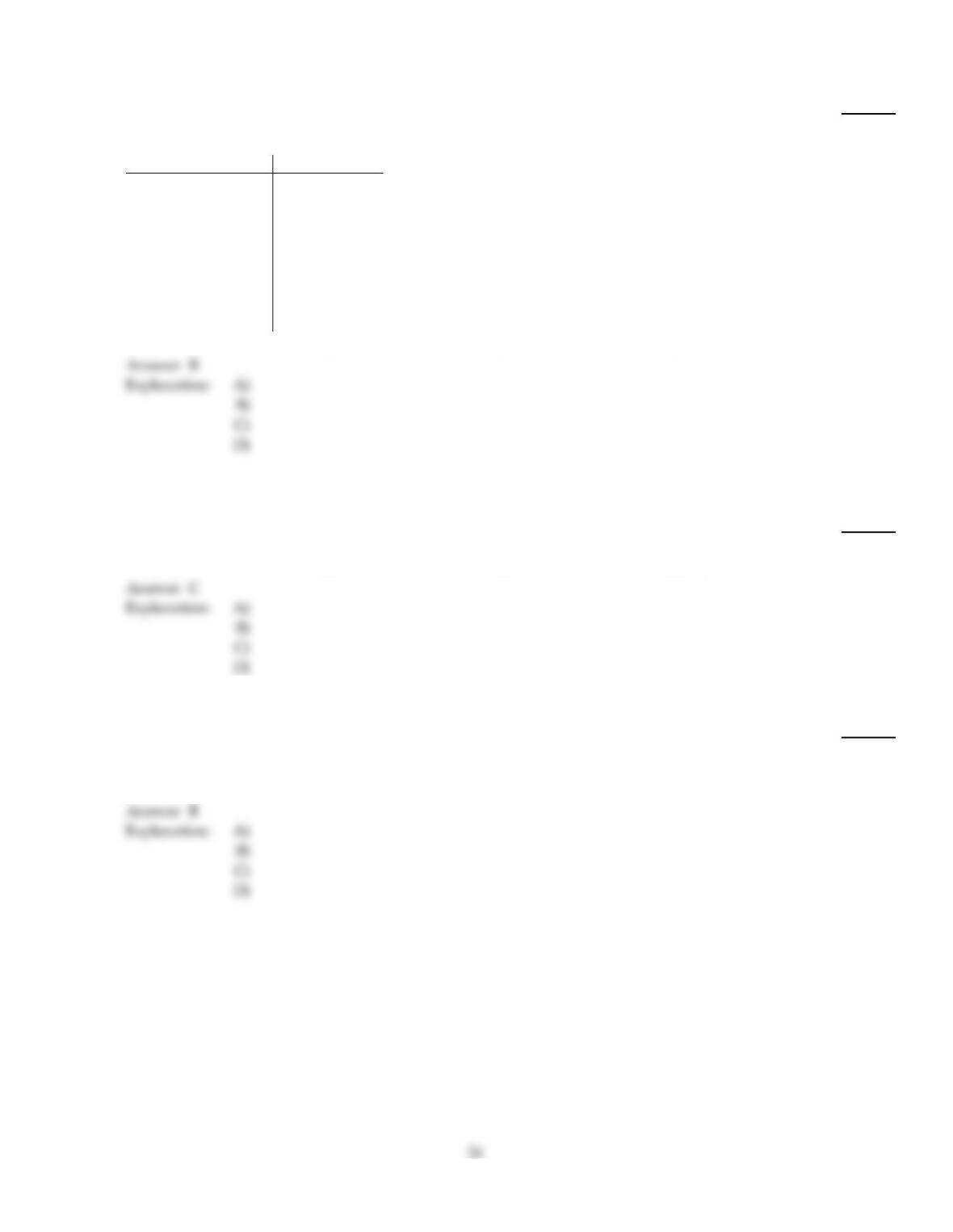
The table below represents the number of deaths per 100 cases for an illness having a median
mortality of four years and a right–skewed distribution over time. What is the probability of living
more than 12 years after diagnosis of the disease?
Years after Diagnosis Number deaths
1–215
3–435
5–616
7–8 9
9–10 6
11–12 4
13–14 2
15+13
79)
A)
19.00%
B)
15.00%
C)
13.00%
D)
85.00%
Find the indicated sum.
80)
4
k = 2
k(k – 7)
80)
A)
–40
B)
–3
C)
–34
D)
–22
Solve the problem.
81)
Lisa has 4 skirts, 10 blouses, and 4 jackets. How many 3–piece outfits can she put together
assuming any piece goes with any other?
81)
A)
320 possible outfits
B)
160 possible outfits
C)
40 possible outfits
D)
18 possible outfits
82)
A deposit of $11,000 is made in an account that earns 7.6% interest compounded quarterly. The
balance in the account after n quarters is given by the sequence
an=11,000 1 +0.076
4
n, n = 1, 2, 3, …
Find the balance in the account after 5 years.
82)
A)
$12,085.47
B)
$7285.40
C)
$6051.40
D)
$16,027.89
Express the repeating decimal as a fraction in lowest terms.
83)
0.6=6
10 +6
100 +6
1,000 +6
10,000 …
83)
A)
2
3
B)
333
500
C)
33
50
D)
2
33
Solve the problem.
84)
The finite sequence whose general term is
an=0.18n2–1.08n +7.07
where n = 1, 2, 3, …, 9 models the total operating costs, in millions of dollars, for a company from
1991 through 1999.
Find
5
i = 1
ai
84)
A)
$22.88 million
B)
$24.68 million
C)
$29.05 million
D)
$30.85 million
Use the Binomial Theorem to expand the binomial and express the result in simplified form.
85)
(3x – 1)5
85)
A)
(9x2– 6x + 1)5
B)
243x5– 81x4+ 27x3– 9x2+ 3x – 1
C)
243x5– 405x4+ 270x3– 90x2+ 15x – 1
D)
243x5+ 15x4– 90x3– 90x2+ 15x – 1
Write the first four terms of the sequence whose general term is given.
86)
an=3n
(n +1)!
86)
A)
3
2, 3
2, 9
4, 27
20
B)
3
2, 3, 27
4, 81
5
C)
2
3, 3, 27
4, 5
81
D)
3
2, 3
2, 9
8, 27
40
Use the formula for the sum of the first n terms of a geometric sequence to solve.
87)
Find the sum of the first four terms of the geometric sequence: –3, –6, –12, . . . .
87)
A)
– 15
B)
–21
C)
– 45
D)
45
Find the probability.
88)
A bag contains 9 red marbles, 4 blue marbles, and 2 green marbles. What is the probability of
choosing a blue marble when one marble is drawn?
88)
A)
4
13
B)
4
15
C)
3
5
D)
2
15
Solve the problem. Round to the nearest hundredth of a percent if needed.
89)
Use of the internet for shopping is increasing dramatically, but still is somewhat age dependent.
When a popular web site that sells books asked the age of users who bought products from them
over the internet, they obtained the following data. What is the probability that a buyer on this web
site is aged 60–69?
Age Group Number
10–19 1951
20–29 3611
30–39 2982
40–49 656
50–59 324
60–69 296
70–79 78
89)
A)
3.27%
B)
3.30%
C)
3.08%
D)
2.99%
If the given sequence is a geometric sequence, find the common ratio.
90)
4
3, 8
3, 16
3, 32
3, 64
3
90)
A)
6
B)
2
C)
not a geometric sequence
D)
4
Use the Binomial Theorem to expand the binomial and express the result in simplified form.
91)
(3x + 2)3
91)
A)
27x3+ 54x2+ 54x + 8
B)
9x2+ 12x + 4
C)
27x3+ 54x2+ 36x + 8
D)
9x6+ 6x3+ 64
C
Solve the problem.
92)
Ms. Patterson proposes to give her daughter Claire an allowance of $0.10 on the first day of her
13–day vacation, $0.20 on the second day, $0.40 on the third day, and so on. Find the allowance
Claire would receive on the last day of her vacation.
92)
A)
$1.30
B)
$4096.10
C)
$819.20
D)
$409.60
D
Find the probability.
93)
Urn A has balls numbered 1 through 7. Urn B has balls numbered 1 through 3. What is the
probability that a 4 is drawn from A followed by a 2 from B?
93)
A)
10
21
B)
1
7
C)
1
21
D)
2
21
C
B
Evaluate the expression.
94)
5P3
3! –5C3
94)
A)
6
B)
120
C)
2
D)
0
Write the first five terms of the arithmetic sequence.
95)
an=an – 1 – 2; a1=10
95)
A)
10, –2, 8, 6, 4
B)
9, 7, 5, 3, 1
C)
–2, 8, 18, 28, 38
D)
10, 8, 6, 4, 2
Use the Binomial Theorem to expand the binomial and express the result in simplified form.
96)
(x2+ 5y)4
96)
A)
x4+ 20x3y + 150x2y2+ 500xy3+ 625y4
B)
x8+ 5x6y + 150x4y2+ 250x2y3+ 625y4
C)
x8+ 20x6y + 150x4y2+ 20x2y3+ 625y4
D)
x8+ 20x6y + 150x4y2+ 500x2y3+ 625y4
Evaluate the given binomial coefficient.
97)
10
1
97)
A)
1
B)
10
9
C)
10!
D)
10
Write the first five terms of the geometric sequence.
98)
a1= – 5; r = – 4
98)
A)
–5, 20, –80, 320, –1280
B)
–5, –20, –80, 320, –1280
C)
–5, –9, –13, –17, –21
D)
–4, 20, –80, 320, –1280
Evaluate the given binomial coefficient.
99)
198
2
99)
A)
19,503
B)
198!
196!
C)
39,006
D)
196
Write the first five terms of the geometric sequence.
100)
an=3an–1; a1= – 5
100)
A)
3, 15, –45, –135, –405
B)
–15, –45, –135, –405, –1215
C)
–5, –15, –45, –135, –405
D)
–5, –2, 1, 4, 7
Write a formula for the general term (the nth term) of the arithmetic sequence. Then use the formula for an to find a20,
the 20th term of the sequence.
101)
a1=5, d = – 0.7
101)
A)
an=5n – 0.7; a20 =99.3
B)
an= – 0.7n + 5.7; a20 = – 8.3
C)
an=5n – 5.7; a20 =94.3
D)
an= – 0.7n + 5; a20 = – 9
Find the probability.
102)
An urn contains balls numbered 1 through 20. A ball is chosen, returned to the urn, and a second
ball is chosen. What is the probability that the first and second balls will be a 6?
102)
A)
1
400
B)
1
10
C)
3
20
D)
3
10
Use the formula for the general term (the nth term) of a geometric sequence to find the indicated term of the sequence
with the given first term, a1, and common ratio, r.
103)
Find a6 when a1=3200, r = – 1
2.
103)
A)
–10
B)
100
C)
–50
D)
–100
Write the first five terms of the geometric sequence.
104)
a1=7; r =4
104)
A)
7, 11, 15, 19, 23
B)
7, 28, 112, 448, 1792
C)
28, 112, 448, 1792, 7168
D)
4, 28, 196, 1372, 9604
Use the formula for the general term (the nth term) of a geometric sequence to find the indicated term of the sequence
with the given first term, a1, and common ratio, r.
105)
Find a6 when a1=8, r = – 5.
105)
A)
–25,000
B)
125,000
C)
25,000
D)
–3125
Express the sum using summation notation. Use 1 as the lower limit of summation and i for the index of summation.
106)
a + ar + ar2+ . . . + ar14
106)
A)
14
i = 1
(ar)i
B)
15
i = 1
ari – 1
C)
14
i = 1
ari
D)
14
i = 1
(ar)i – 1
30
Find the probability.
107)
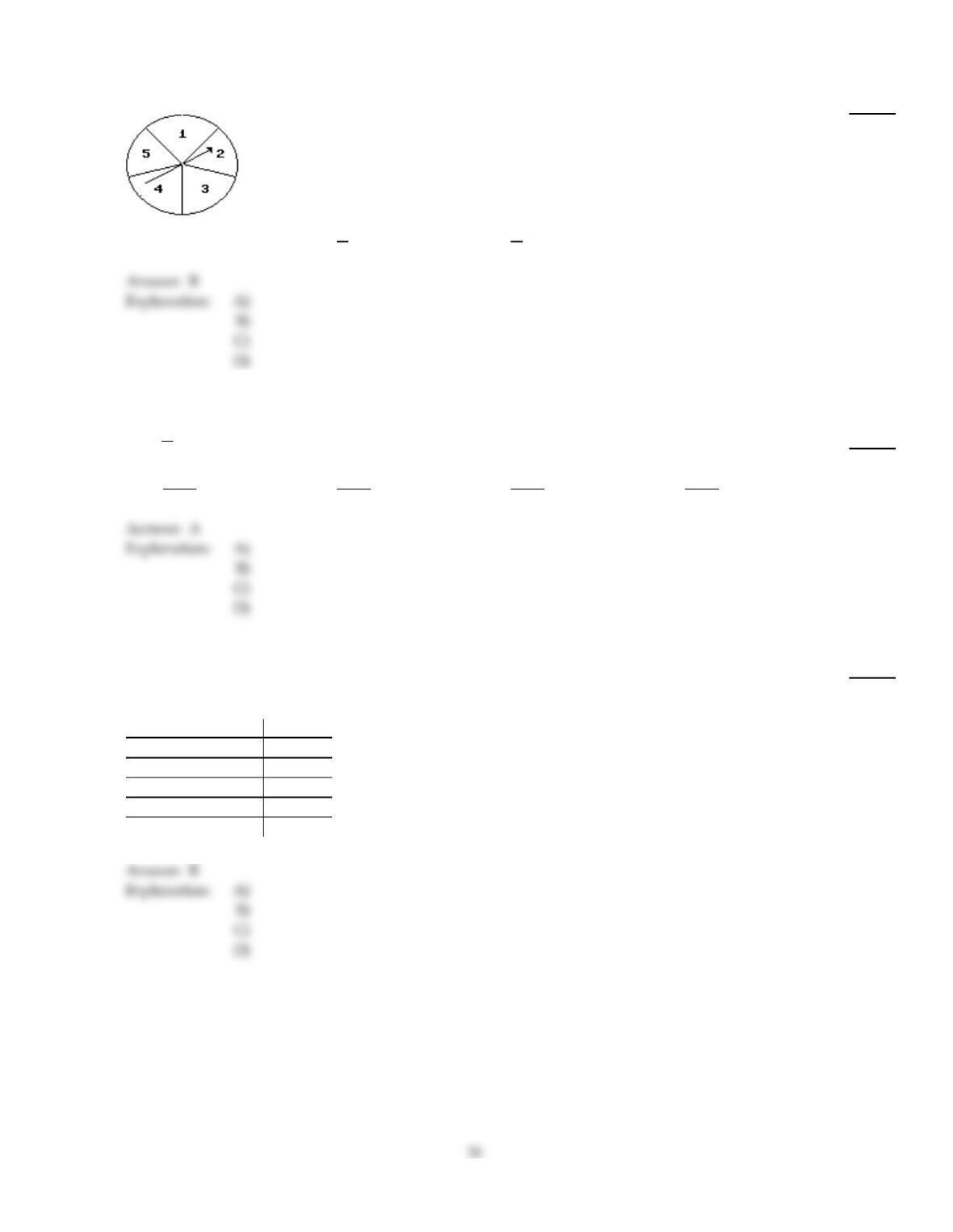
What is the probability that the arrow will land on an odd number?
107)
A)
1
B)
3
5
C)
2
5
D)
0
Find the indicated sum. Use the formula for the sum of the first n terms of a geometric sequence.
108)
5
i = 1
4
3·4i
108)
A)
5456
3
B)
5498
3
C)
5495
3
D)
5486
3
Solve the problem. Round to the nearest hundredth of a percent if needed.
109)
In 1999 the stock market took big swings up and down. A survey of 1000 adult investors asked how
often they tracked their portfolio. The table shows the investor responses. What is the probability
that an adult investor tracks his or her portfolio daily?
How frequently? Response
Daily 234
Weekly 282
Monthly 276
Couple times a year 146
Don’t track 62
109)
A)
28.20%
B)
23.40%
C)
27.60%
D)
24.95%
Find the sum of the infinite geometric series, if it exists.
110)
3+3
2+3
4+3
8+ . . .
110)
A)
6
B)
3
2
C)
9
2
D)
does not exist
Express the repeating decimal as a fraction in lowest terms.
111)
0.597
111)
A)
209
333
B)
209
1000
C)
597
1000
D)
199
333
Solve the problem. Round to the nearest hundredth of a percent if needed.
112)
A traffic engineer is counting the number of vehicles by type that turn into a residential area. The
table below shows the results of the counts during a four–hour period. What is the probability that
the next vehicle passing is an SUV?
Type of vehicle Number
Car 268
SUV 428
Van 66
Small truck 289
Large truck 222
Dump truck 25
Other 77
112)
A)
31.70%
B)
32.97%
C)
31.13%
D)
19.49%
Find the indicated sum.
113)
11
i =8
1
i – 5
113)
A)
18
B)
–2925
4096
C)
19
20
D)
701
792
Solve the problem.
114)
A brick staircase has a total of 15 steps The bottom step requires 116 bricks. Each successive step
requires 5 fewer bricks than the prior one. How many bricks are required to build the staircase?
114)
A)
1215 bricks
B)
1177.5 bricks
C)
2430 bricks
D)
2265 bricks
Express the sum using summation notation. Use a lower limit of summation not necessarily 1 and k for the index of
summation.
115)
9+11 +13 +15 + . . . +25
115)
A)
10
k = 2
2k +5
B)
10
k = 1
2k +5
C)
16
k = 2
2k +5
D)
16
k = 0
2k +5
116)
4+9
2+5+11
2+ . . . +10
116)
A)
20
k = 1
k
2
B)
20
k =8
k
2
C)
12
k =8
k
2
D)
20
k = 2
k
2
33
Write the first five terms of the arithmetic sequence.
117)
an=an – 1 +3
5; a1= – 1
5
117)
A)
–1
5, –4
5, –7
5, – 2, –13
5
B)
–1
5, –2
5, –3
5, –4
5, – 1
C)
–1
5, 2
5, 6
5, 9
5, 12
5
D)
–1
5, 2
5, 1, 8
5, 11
5
118)
an=an – 1 – 5.7; a1= – 7
118)
A)
–8, –13.7, –19.4, –25.1, –30.8
B)
–7, –5.7, –12.7, –18.4, –24.1
C)
–5.7, –12.7, –19.7, –26.7, –33.7
D)
–7, –12.7, –18.4, –24.1, –29.8
Write the first four terms of the sequence defined by the recursion formula.
119)
a1=5 and an=an–1– 5 for n 2
119)
A)
5, 0, –5, –10
B)
5, 10 , 15 , 20
C)
5, 2 , –3 , –8
D)
–5, –10, –15, –20
Find the probability.
120)
A 6–sided die is rolled. What is the probability of rolling a number less than 2?
120)
A)
1
9
B)
1
6
C)
5
6
D)
1
3
Solve the problem.
121)
A church has 9 bells in its bell tower. Before each church service 5 bells are rung in sequence. No
bell is rung more than once. How many sequences are there?
121)
A)
126
B)
6048
C)
3024
D)
15,120
122)
A theater has 28 rows with 26 seats in the first row, 30 in the second row, 34 in the third row, and so
forth. How many seats are in the theater?
122)
A)
2296 seats
B)
2240 seats
C)
4480 seats
D)
4592 seats
Write the first five terms of the geometric sequence.
123)
an= – 8an–1; a1=5
123)
A)
–40, 320, –2560, 20,480, –163,840
B)
–8, –40, –320, –2560, –20,480
C)
5, –3, –11, –19, –27
D)
5, –40, 320, –2560, 20,480
Write the first four terms of the sequence whose general term is given.
124)
an=2(n + 1 )!
n!
124)
A)
4, 3, 8
3, 5
2
B)
4, 3, 4
3, 5
12
C)
3, 4, 5, 6
D)
4, 6, 8, 10
Solve the problem.
125)
The matching section of an exam has 3 questions and 7 possible answers. In how many different
ways can a student answer the 3 questions, if none of the answer choices can be repeated?
125)
A)
1680
B)
840
C)
35
D)
210
Evaluate the given binomial coefficient.
126)
10
5
126)
A)
30,240
B)
126
C)
252
D)
504
Use the formula for the sum of the first n terms of an arithmetic sequence to find the indicated sum.
127)
34
i = 1
(–5i +6)
127)
A)
–2533
B)
–2686
C)
–2652
D)
–2771
Find the term indicated in the expansion.
128)
(2x + 3y)11; 8th term
128)
A)
5,773,680x7y4
B)
3,849,120x7y4
C)
3,849,120x4y8
D)
11,547,360x4y7
Find the indicated sum. Use the formula for the sum of the first n terms of a geometric sequence.
129)
5
i = 1
2(–4)i
129)
A)
–5140
B)
248
C)
–1640
D)
24
Solve the problem.
130)
How many 4–digit numbers can be formed using the digits 1, 2, 3, 4, 5, 6, 7, 8, 9, and 0? No digit can
be used more than once.
130)
A)
302,400
B)
210
C)
151,200
D)
5040