83) The reaction 4 Ag(s) + O2(g) → 2 Ag2O(s) favors Ag2O at low temperature, but it favors Ag and
O2 at high temperatures. How can this be explained in terms of ΔH and ΔS?
A) ΔH is negative and ΔS is negative.
B) ΔH is negative and ΔS is positive.
C) ΔH is positive and ΔS is negative.
D) ΔH is positive and ΔS is positive.
84) What is the thermodynamic criterion for equilibrium for a reaction at constant temperature and
pressure (PV work only)?
A) ΔS = 0
B) ΔG = 0
C) ΔS > 0
D) ΔG < 0
85) If an endothermic reaction is spontaneous at constant temperature and pressure,
A) ΔG is negative and ΔS may be positive or negative.
B) ΔG is negative and ΔS is positive.
C) ΔG is positive and ΔS is negative.
D) ΔG is positive and ΔS may be positive or negative.
86) If a reaction with a negative value of ΔS is nonspontaneous at constant temperature and pressure,
A) ΔG is negative and ΔH may be positive or negative.
B) ΔG is negative and ΔH is positive.
C) ΔG is positive and ΔH may be positive or negative.
D) ΔG is positive and ΔH is positive.
87) Consider the conversion of white tin to gray tin:
Sn(white) → Sn(gray) ΔH° = –2.09 kJ ΔS° = -7.41 J/K
Based on these data,
A) white tin is stable below 9°C and gray tin is stable above 9°C.
B) gray tin is stable below 9°C and white tin is stable above 9°C.
C) white tin is stable below 15°C and gray tin is stable above 15°C.
D) gray tin is stable below 15°C and white tin is stable above 15°C.
88) When heated, mercury(II) oxide decomposes into elemental mercury and oxygen:
2 HgO(s) → 2 Hg(l) + O2(g) ΔH° = 181.6 kJ ΔS° = 216.4 J/K
Estimate the temperature at which HgO should begin to decompose if the partial pressure of O2(g) is
constant at 1.00 atm.
A) -34.8°C
B) 34.8°C
C) 566°C
D) 840°C
89) Methanol can be produced from carbon monoxide and hydrogen with suitable catalysts:
CO(g) + 2 H2(g) → CH3OH(l) at 25°C ΔH° = –128.1 kJ and ΔS° = -332 J/K
Find ΔG° at 25°C.
A) -157.2 kJ
B) -29.1 kJ
C) 98.9 kJ
D) 157.2 kJ
90) He gas is contained in a one-liter flask that is connected to an empty one-liter flask with a closed
stopcock between the two flasks. When the stopcock is opened some of the He enters the evacuated
flask. For this system
A) ΔH is negative and ΔS is positive
B) ΔH is zero and Δ△S is positive
C) ΔH is zero and ΔS is negative
D) ΔH is positive and ΔS is negative
91) For the conversion of ice to water at 0°C and 1 atm,
A) ΔG is zero, ΔH is positive, and ΔS is negative.
B) ΔG is zero, ΔH is positive, and ΔS is positive.
C) ΔG is negative, ΔH is negative, and ΔS is positive.
D) ΔG is positive, ΔH is negative, and ΔS is positive.
92) For the conversion of water to ice at 25°C and 1 atm,
A) ΔG is negative and ΔH is negative.
B) ΔG is negative and ΔH is positive.
C) ΔG is positive and ΔH is negative.
D) ΔG is positive and ΔH is positive.
93) Calculate ΔG° for the reaction below and tell whether it is spontaneous or nonspontaneous under
standard conditions at 25°C.
2 S (s) + 3 O2 (g) + 2 H2O (l) → 2 H2SO4 (l) ΔH° = -1056 kJ/mol
ΔS° = –505 J/mol
A) ΔG° = -1207 kJ and the process is spontaneous.
B) ΔG° = -1207 kJ and the process is nonspontaneous.
C) ΔG° = -906 kJ and the process is spontaneous.
D) ΔG° = -906 kJ and the process is nonspontaneous.
94) The enthalpy of fusion of naphthalene, C10H8, is 19.1 kJ/mol at 78.2°C, its melting point. Calculate
the entropy of fusion at the melting point.
A) ΔS°fus = 244 J/(K ∙ mol)
B) ΔS°fus = 54.4 J/(K ∙ mol)
C) ΔS°fus = 1.49 J/(K ∙ mol)
D) ΔS°fus = –1.49 J/(K ∙ mol)
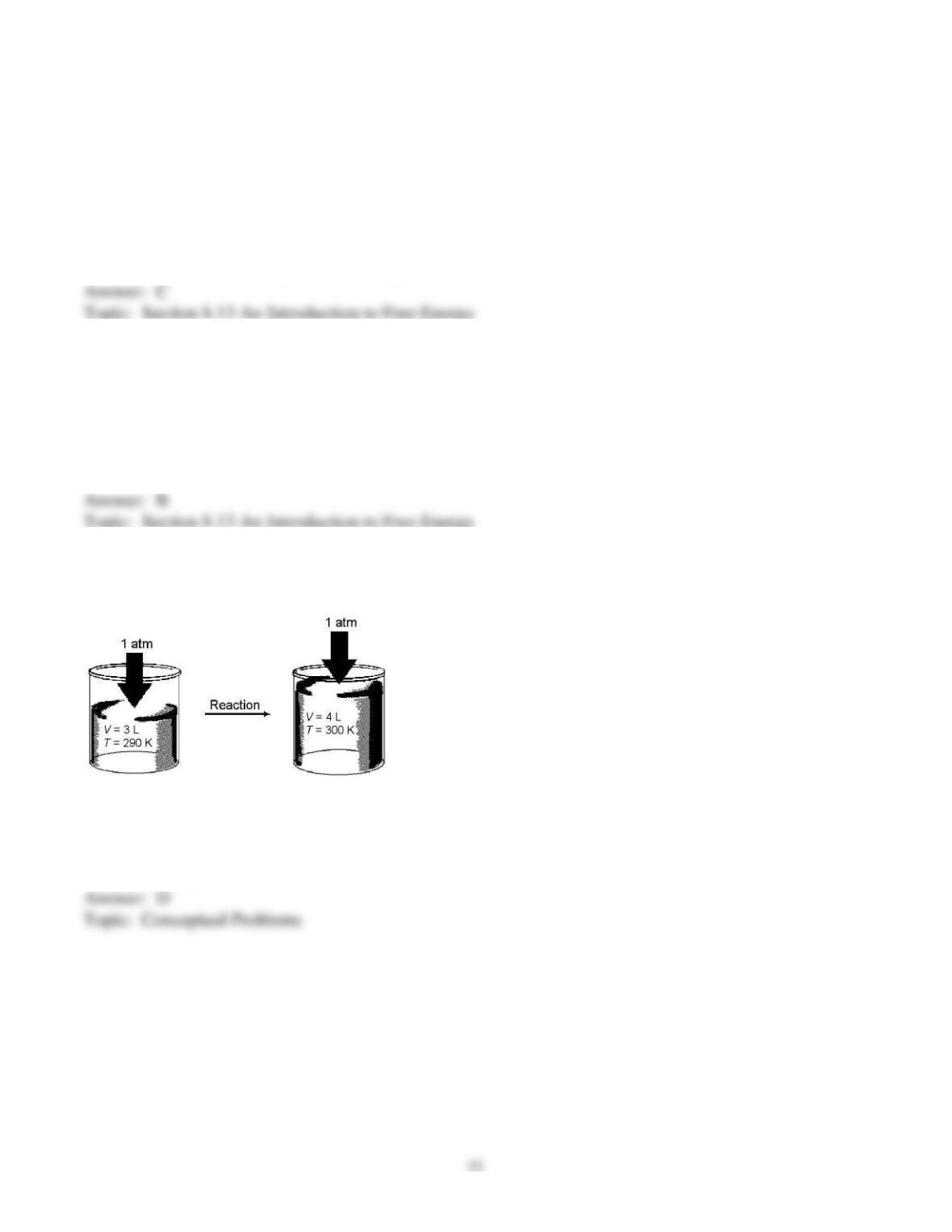
95) Imagine a reaction that results in a change in both volume and temperature, as shown in the diagram
below. What is the sign of the work being done and the sign of the enthalpy change involved in this
reaction?
A) w = + and ΔH = +
B) w = + and ΔH = –
C) w = – and ΔH = +
D) w = – and ΔH = –
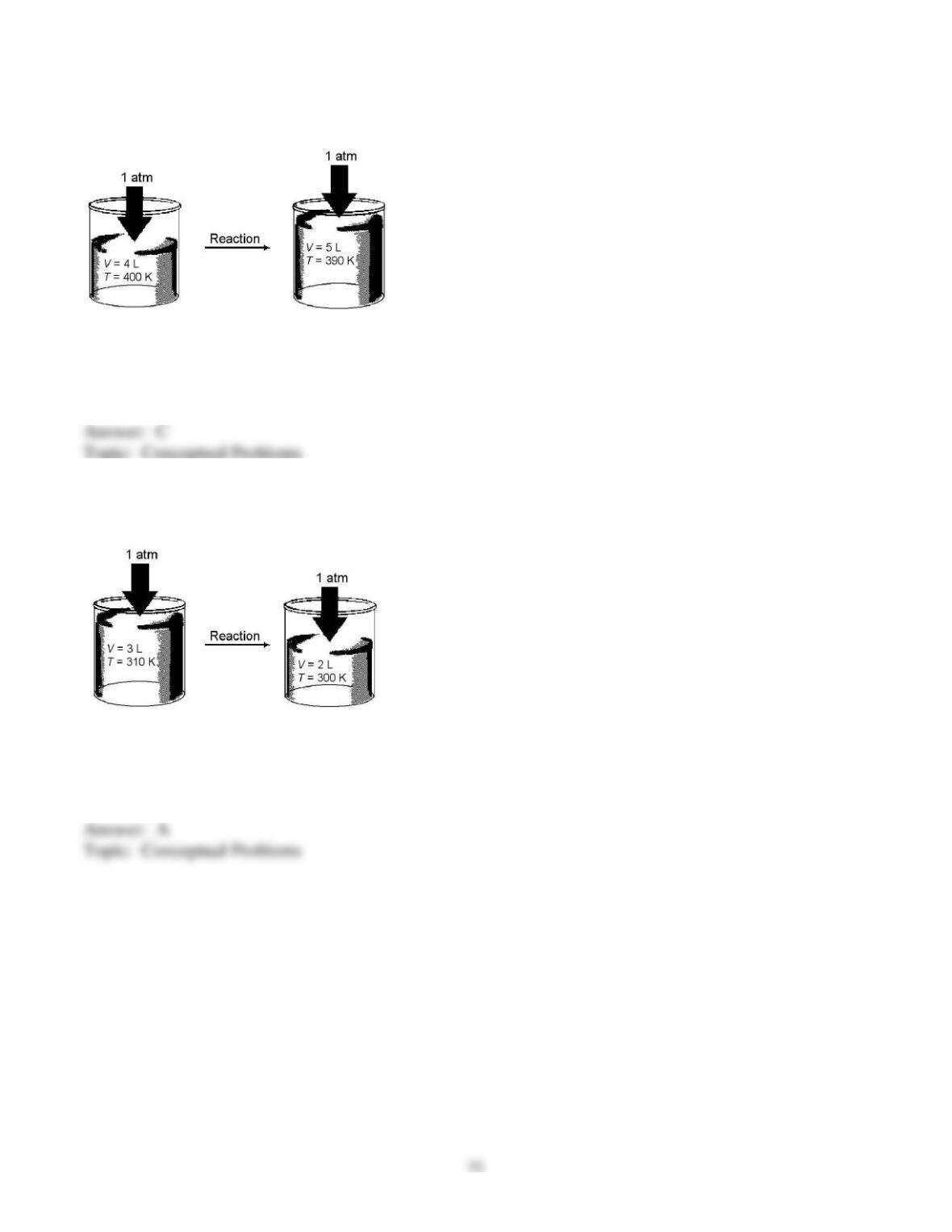
96) Imagine a reaction that results in a change in both volume and temperature, as shown in the diagram
below. What is the sign of the work being done, and what is the sign of the enthalpy change involved in
this reaction?
A) w = + and ΔH = +
B) w = + and ΔH = –
C) w = – and ΔH = +
D) w = – and ΔH = –
97) Imagine a reaction that results in a change in both volume and temperature, as shown in the diagram
below. What is the sign of the work being done and the sign of the enthalpy change involved in this
reaction?
A) w = + and ΔH = +
B) w = + and ΔH = –
C) w = – and ΔH = +
D) w = – and ΔH = –
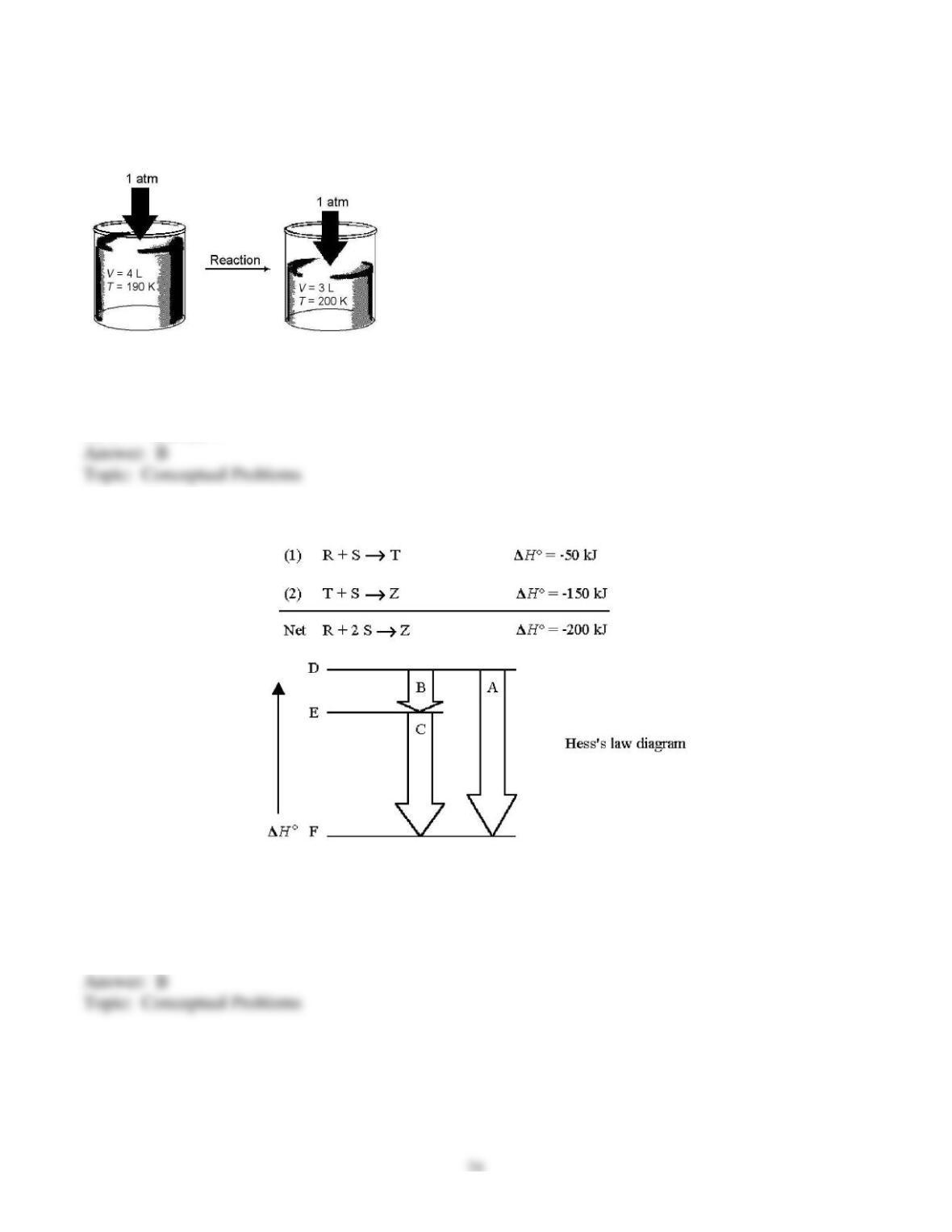
98) Imagine a reaction that results in a change in both volume and temperature, as shown in the diagram
below. What is the sign of the work being done, and what is the sign of the enthalpy change involved in
this reaction?
A) w = + and ΔH = +
B) w = + and ΔH = –
C) w = – and ΔH = +
D) w = – and ΔH = –
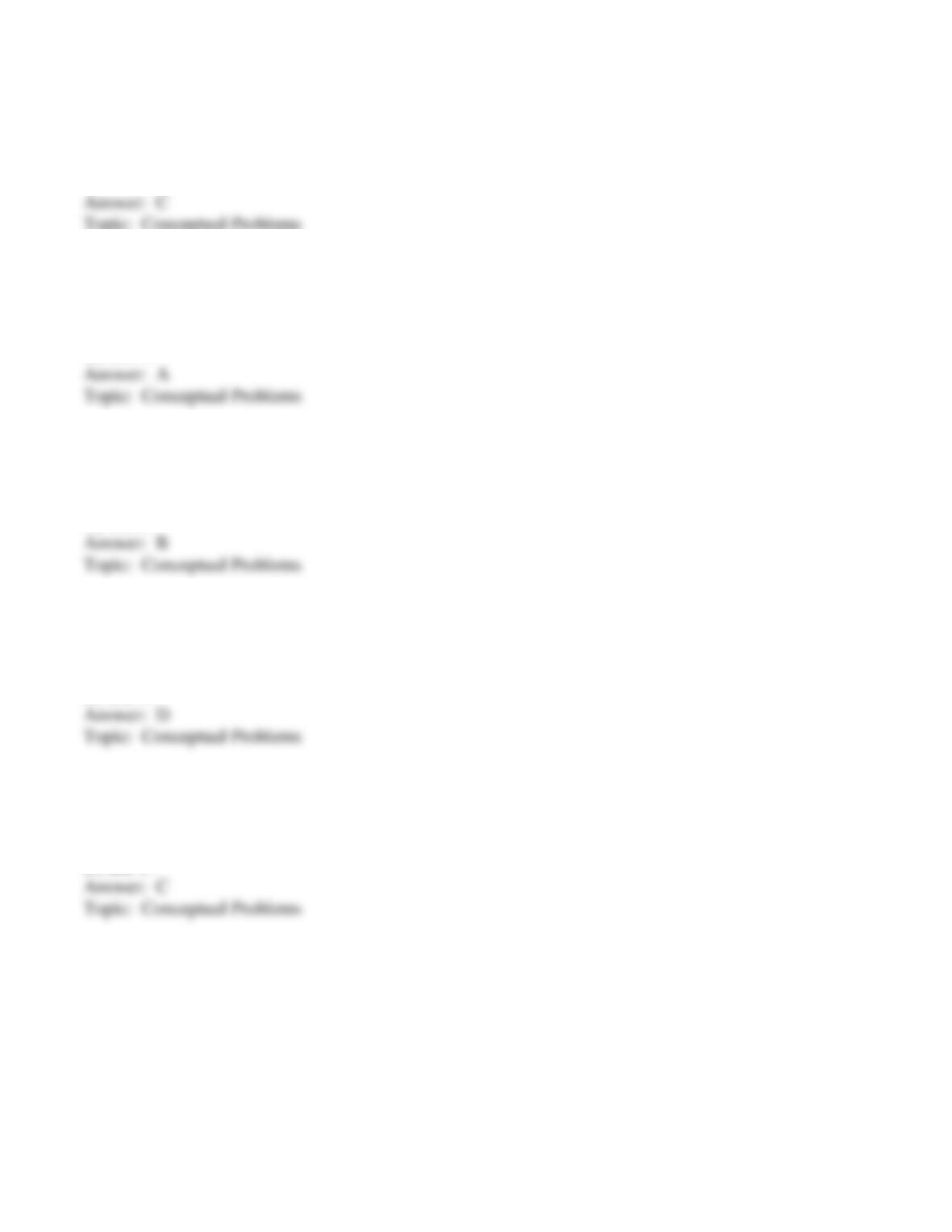
Reactant R reacts with reactant S in two steps to yield product Z.
99) Step (1) in the reaction is represented by
A) arrow A.
B) arrow B.
C) arrow C.
D) line E.
25
100) Step (2) in the reaction is represented by
A) arrow A.
B) arrow B.
C) arrow C.
D) line E.
101) The net reaction is represented by
A) arrow A.
B) arrow B.
C) arrow C.
D) line F.
102) The reactants, R + 2 S, are represented by
A) arrow B.
B) line D.
C) line E.
D) line F.
103) The product, Z, is represented by
A) arrow A.
B) line D.
C) line E.
D) line F.
104) The intermediate, T, + S is represented by
A) arrow C.
B) line D.
C) line E.
D) line F.
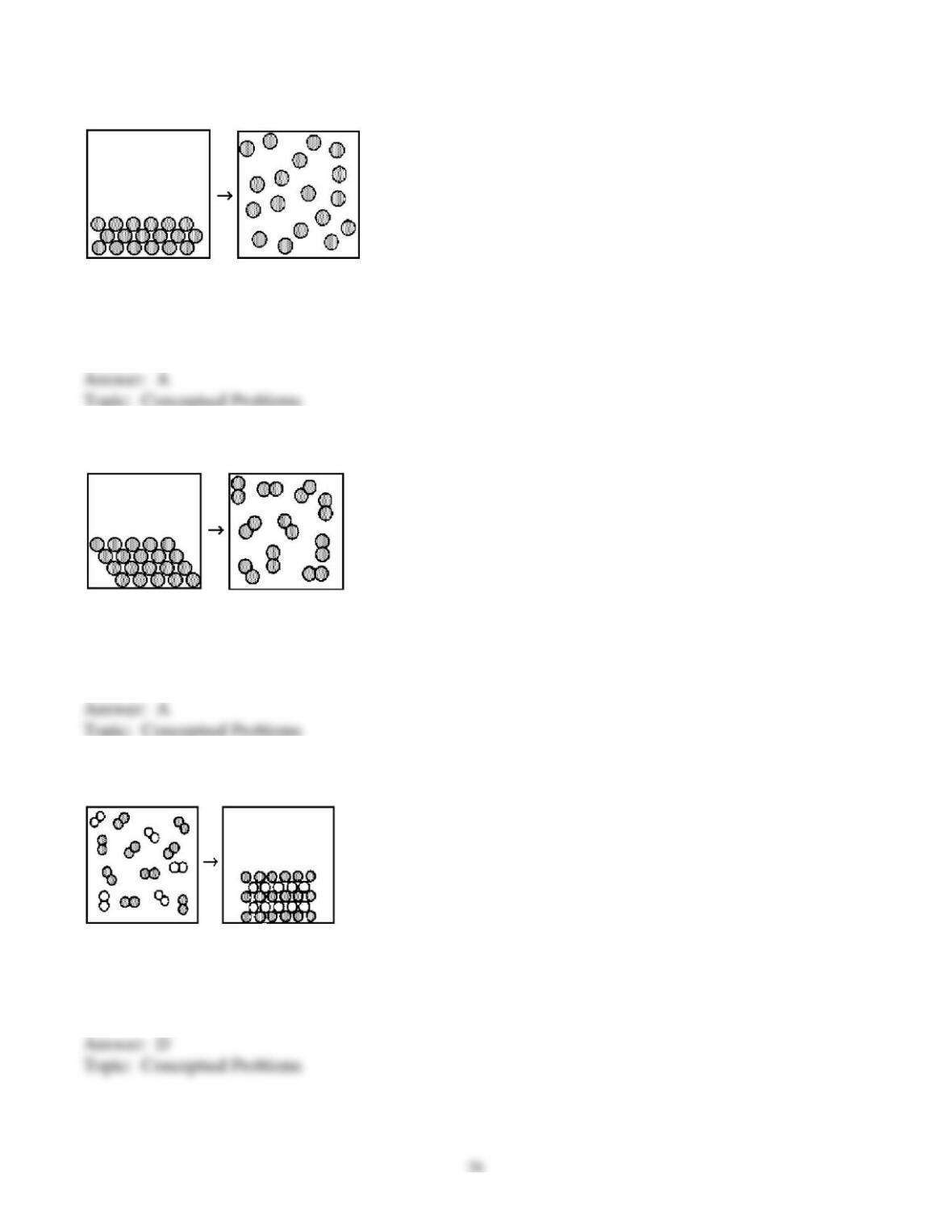
105) What are the signs of ΔH, ΔS, and ΔG for the following spontaneous change?
A) ΔH = +, ΔS = +, ΔG = –
B) ΔH = +, ΔS = –, ΔG = –
C) ΔH = –, ΔS = +, ΔG = –
D) ΔH = –, ΔS = –, ΔG = –
106) What are the signs of ΔH, ΔS, and ΔG for the following spontaneous change?
A) ΔH = +, ΔS = +, ΔG = –
B) ΔH = +, ΔS = –, ΔG = –
C) ΔH = –, ΔS = +, ΔG = –
D) ΔH = –, ΔS = –, ΔG = –
107) What are the signs of ΔH, ΔS, and ΔG for the following spontaneous change?
A) ΔH = +, ΔS = +, ΔG = –
B) ΔH = +, ΔS = –, ΔG = –
C) ΔH = –, ΔS = +, ΔG = –
D) ΔH = –, ΔS = –, ΔG = –
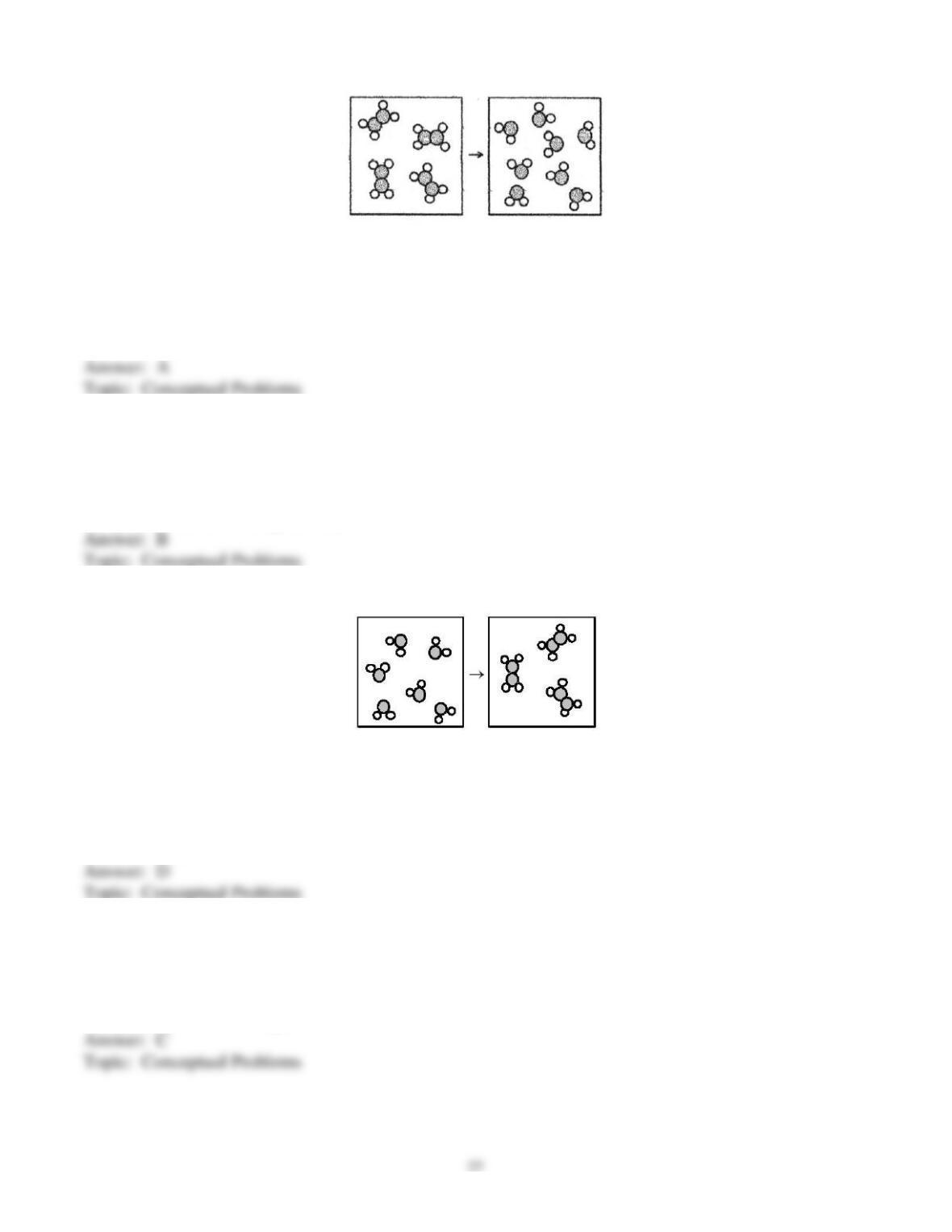
108) What are the signs of ΔH and ΔS for the reaction represented in the above drawing?
A) ΔH = +, ΔS = +
B) ΔH = +, ΔS = –
C) ΔH = –, ΔS = +
D) ΔH = –, ΔS = –
109) The reaction represented in the above drawing is likely to be
A) nonspontaneous at all temperatures.
B) nonspontaneous at low temperatures and spontaneous at high temperatures.
C) spontaneous at low temperatures and non spontaneous at high temperatures.
D) spontaneous at all temperatures.
110) What are the signs of ΔH and ΔS for the reaction represented in the above drawing?
A) ΔH = +, ΔS = +
B) ΔH = +, ΔS = –
C) ΔH = –, ΔS = +
D) ΔH = –, ΔS = –
111) The reaction represented in the above drawing is likely to be
A) nonspontaneous at all temperatures.
B) nonspontaneous at low temperatures and spontaneous at high temperatures.
C) spontaneous at low temperatures and non spontaneous at high temperatures.
D) spontaneous at all temperatures.
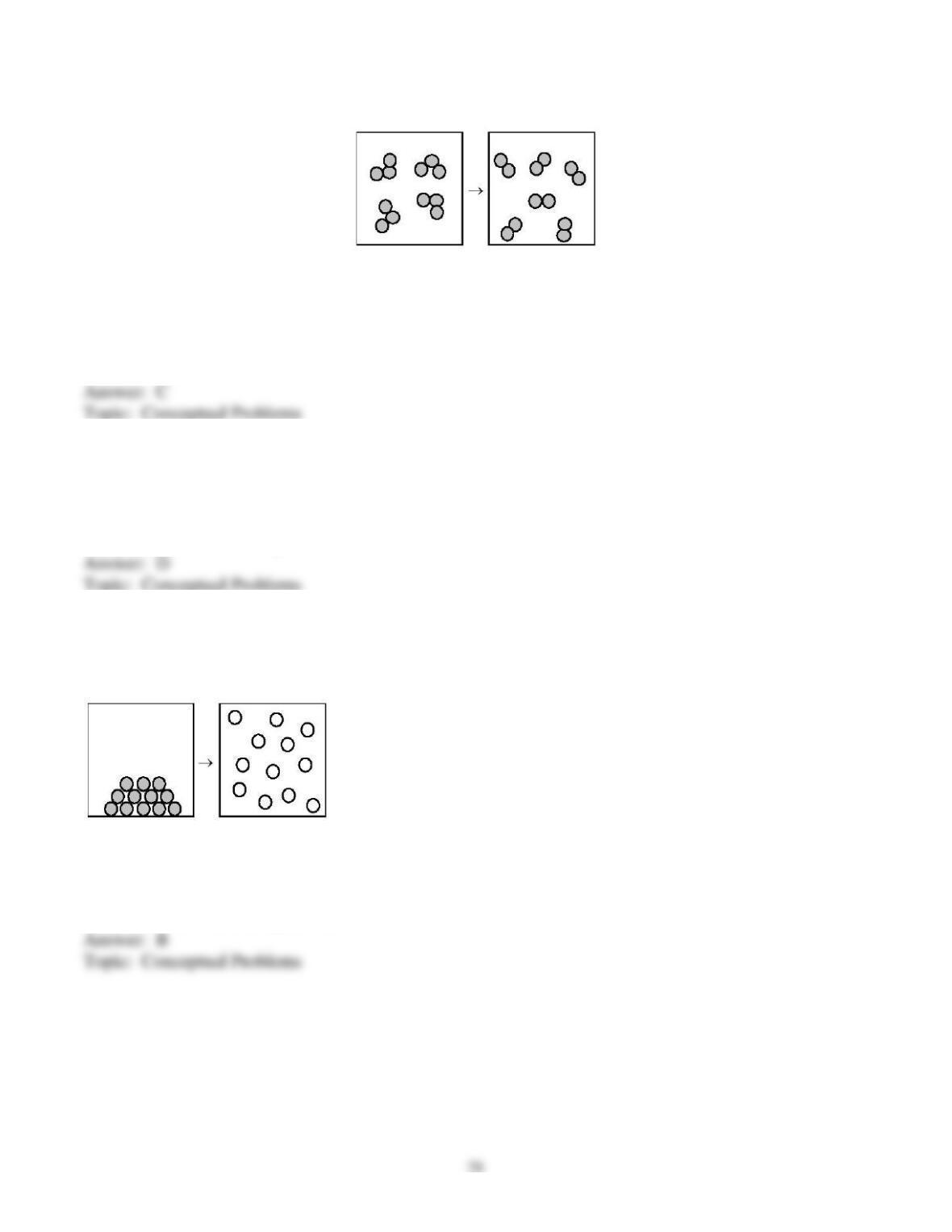
The following drawing is a representation of the exothermic reaction in which ozone forms dioxygen.
112) What are the signs of ΔH and ΔS for this reaction?
A) ΔH = +, ΔS = +
B) ΔH = +, ΔS = –
C) ΔH = –, ΔS = +
D) ΔH = –, ΔS = –
113) This reaction is likely to be
A) nonspontaneous at all temperatures.
B) nonspontaneous at low temperatures and spontaneous at high temperatures.
C) spontaneous at low temperatures and nonspontaneous at high temperatures.
D) spontaneous at all temperatures.
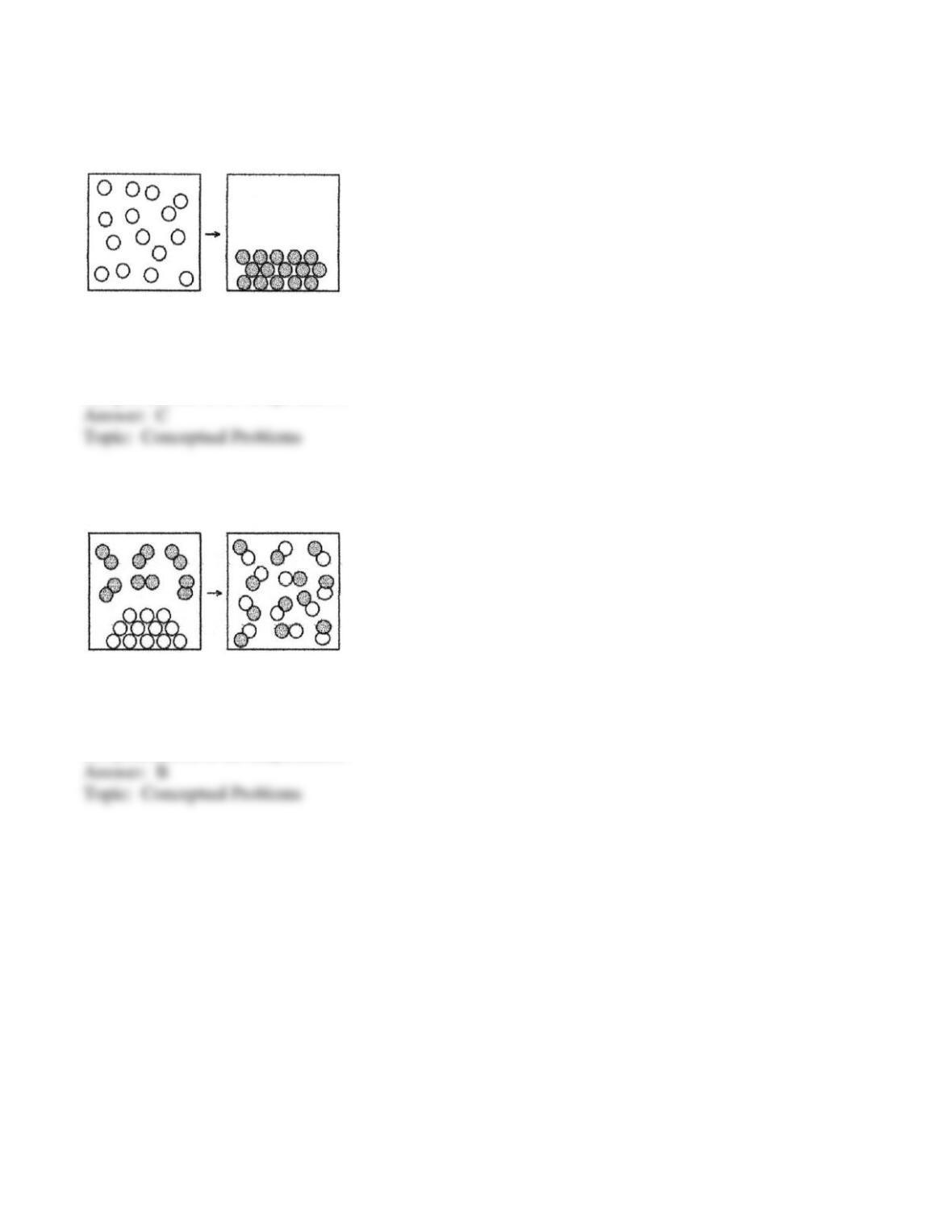
114) The following drawing is a representation of a reaction of the type A → B, where different shaded
spheres represent different molecular structures. For this reaction ΔH° = +45 kJ. This reaction is likely
to be
A) nonspontaneous at all temperatures.
B) nonspontaneous at low temperatures and spontaneous at high temperatures.
C) spontaneous at low temperatures and nonspontaneous at high temperatures.
D) spontaneous at all temperatures.
29
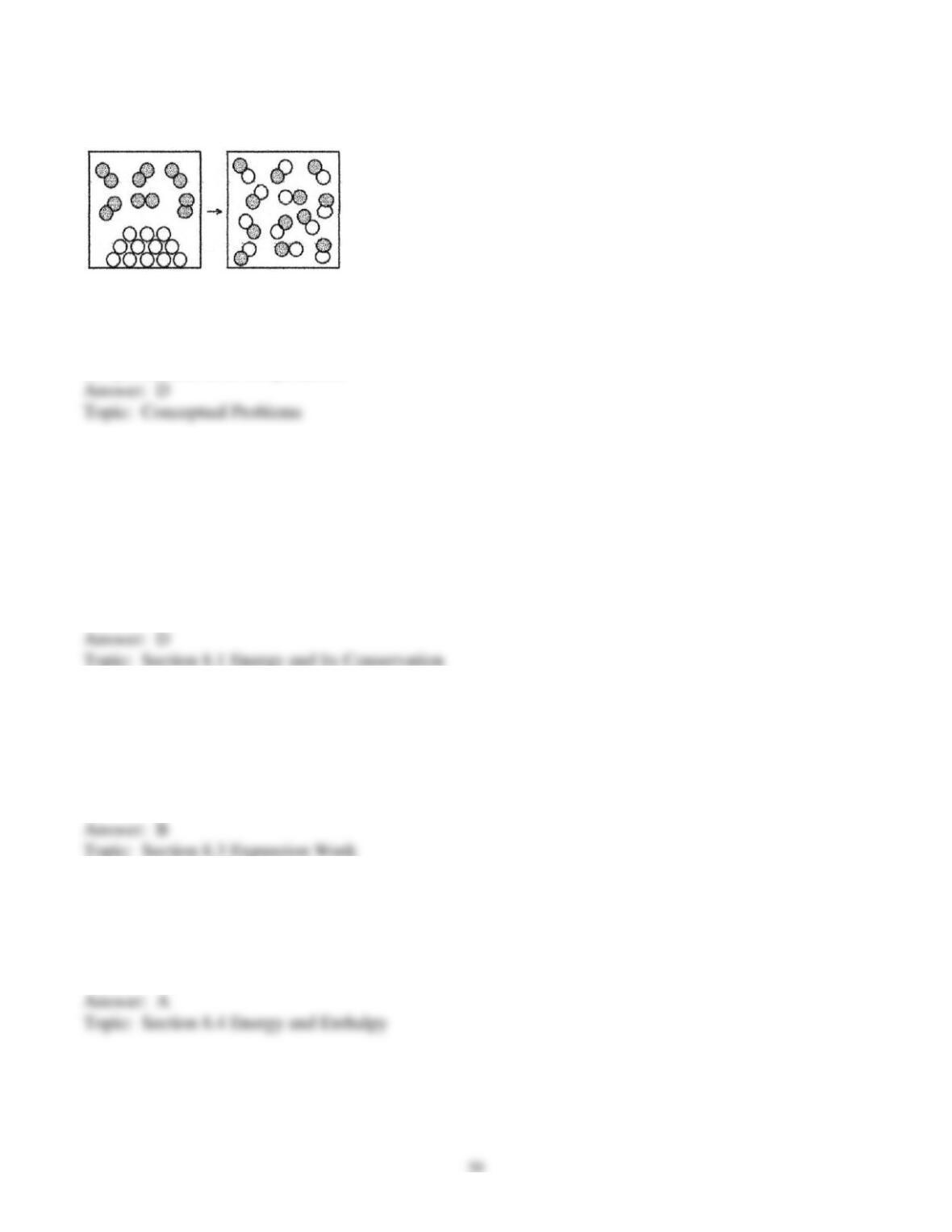
115) The following drawing is a representation of a reaction of the type A → B, where different shaded
spheres represent different molecular structures. For this reaction ΔH° = -30 kJ. This reaction is likely to
be
A) nonspontaneous at all temperatures.
B) nonspontaneous at low temperatures and spontaneous at high temperatures.
C) spontaneous at low temperatures and nonspontaneous at high temperatures.
D) spontaneous at all temperatures.
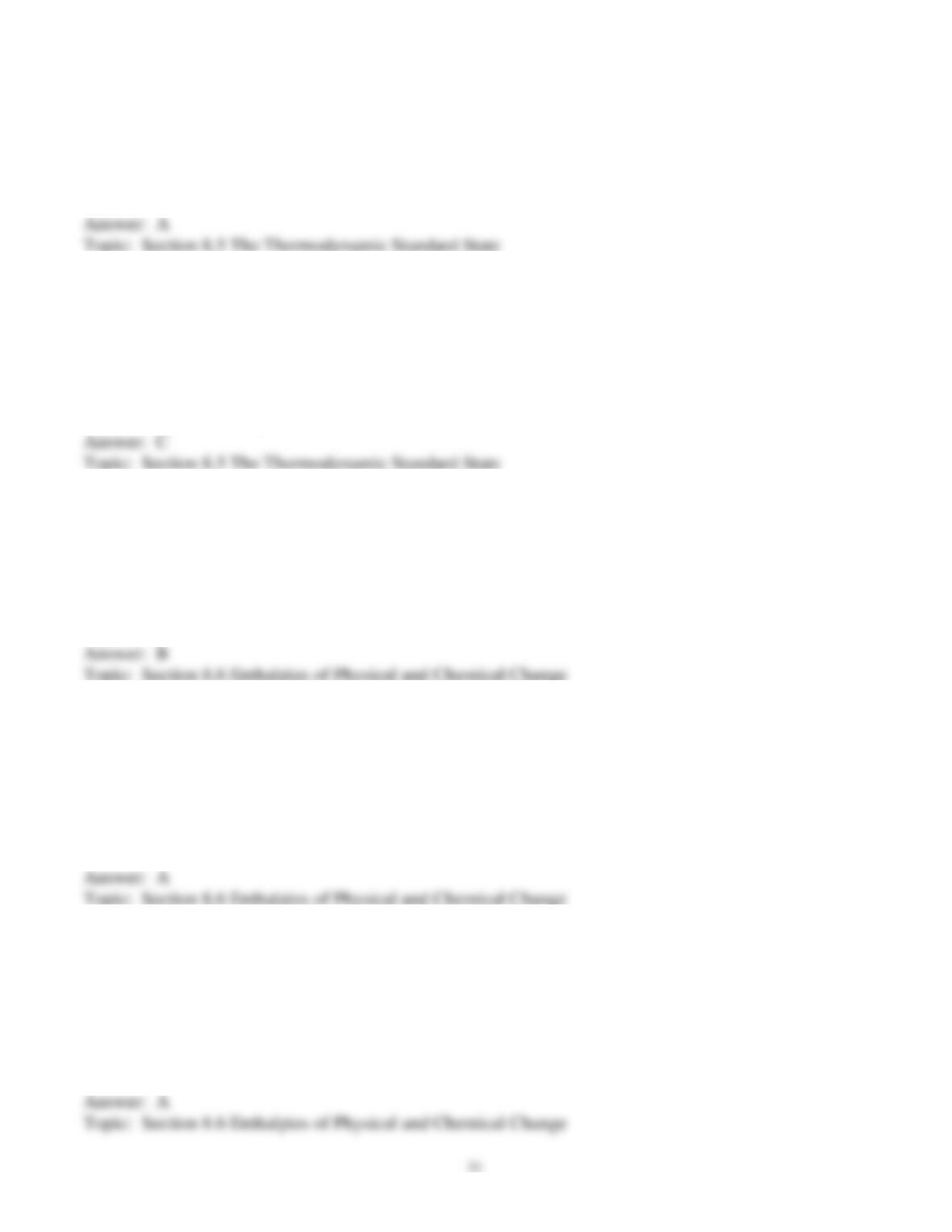
116) The following drawing is a representation of a reaction for which ΔH° = +62 kJ. This reaction is
likely to be
A) nonspontaneous at all temperatures.
B) nonspontaneous at low temperatures and spontaneous at high temperatures.
C) spontaneous at low temperatures and nonspontaneous at high temperatures.
D) spontaneous at all temperatures.
117) The following drawing is a representation of a reaction for which ΔH° = -22 kJ. This reaction is
likely to be
A) nonspontaneous at all temperatures.
B) nonspontaneous at low temperatures and spontaneous at high temperatures.
C) spontaneous at low temperatures and nonspontaneous at high temperatures.
D) spontaneous at all temperatures.
8.2 Algorithmic Questions
1) For a process at constant pressure, 49,600 calories of heat are released. This quantity of heat is
equivalent to
A) 4.82 × 10– 6 J.
B) 1.19 × 10⁴ J.
C) 1.24 × 10⁴ J.
D) 2.08 × 10⁵ J.
2) Calculate the work, w, gained or lost by the system when a gas expands from 15 L to 40 L against a
constant external pressure of 1.5 atm. 1 L ∙ atm = 101 J
A) – 6.1 kJ
B) – 3.8 kJ
C) + 3.8 kJ
D) + 6.1 kJ
3) For a particular process that is carried out at constant pressure, q = 145 kJ and w = – 35 kJ. Therefore,
A) ΔE = 110 kJ and ΔH = 145 kJ.
B) ΔE = 145 kJ and ΔH = 110 kJ.
C) ΔE = 145 kJ and ΔH = 180 kJ.
D) ΔE = 180 kJ and ΔH = 145 kJ.
4) When 5.00 mol of benzene is vaporized at a constant pressure of 1.00 atm and at its normal boiling
point of 80.1°C, 169.5 kJ are absorbed and PΔV for the vaporization process is equal to 14.5 kJ then
A) ΔE = 155.0 kJ and ΔH = 169.5 kJ.
B) ΔE = 184.0 kJ and ΔH = 169.5 kJ.
C) ΔE = 169.5 kJ and ΔH = 184.0 kJ.
D) ΔE = 169.5 kJ and ΔH = 155.0 kJ.
5) When 10.00 moles of H2(g) reacts with 5.000 mol of O2(g) to form 10.00 mol of H2O(l) at 25°C
and a constant pressure of 1.00 atm. If 683.0 kJ of heat are released during this reaction, and PΔV is
equal to – 37.00 kJ, then
A) ΔH° = + 683.0 kJ and ΔE° = + 720.0 kJ.
B) ΔH° = + 683.0 kJ and ΔE° = + 646.0 kJ.
C) ΔH° = – 683.0 kJ and ΔE° = – 646.0 kJ.
D) ΔH° = – 683.0 kJ and ΔE° = – 720.0 kJ.
6) At 1 atm pressure, the heat of sublimation of gallium is 277 kJ/mol and the heat of vaporization is 271
kJ/mol. To the correct number of significant figures, how much heat is required to melt 2.50 mol of
gallium at 1 atm pressure?
A) 6 kJ
B) 20 kJ
C) 262 kJ
D) 274 kJ
7) How much heat is absorbed/released when 35.00 g of NH3(g) reacts in the presence of excess O2(g)
to produce NO(g) and H2O(l) according to the following chemical equation?
4 NH3(g) + 5 O2(g) → 4 NO(g) + 6 H2O(l) ΔH° = 1168 kJ
A) 600.1 kJ of heat are absorbed.
B) 600.1 kJ of heat are released.
C) 2400 kJ of heat are absorbed.
D) 2400 kJ of heat are released.
8) How much heat is absorbed when 45.00 g of C(s) reacts in the presence of excess SO2(g) to produce
CS2(l) and CO(g) according to the following chemical equation?
5 C(s) + 2 SO2(g) → CS2(l) + 4 CO(g) ΔH° = 239.9 kJ
A) 179.8 kJ
B) 239.9 kJ
C) 898.5 kJ
D) 2158 kJ
9) At constant pressure, the combustion of 15.0 g of C2H6(g) releases 777 kJ of heat. What is ΔH for
the reaction given below?
2 C2H6(g) + 7 O2(g) → 4 CO2(g) + 6 H2O(l)
A) – 129 kJ
B) – 779 kJ
C) -1560 kJ
D) -3120 kJ
10) The heat of vaporization of water at 100°C is 40.66 kJ/mol. Calculate the quantity of heat that is
absorbed/released when 9.00 g of steam condenses to liquid water at 100°C.
A) 20.3 kJ of heat are absorbed.
B) 20.3 kJ of heat are released.
C) 81.3 kJ of heat are absorbed.
D) 81.3 kJ of heat are released.
11) When 1.50 mol of CH4(g) reacts with excess Cl2(g) at constant pressure according to the chemical
equation shown below, 1062 kJ of heat are released. Calculate the value of ΔH for this reaction, as
written.
2 CH4(g) + 3 Cl2(g) → 2 CHCl3(l) + 3 H2(g) ΔH = ?
A) -1420 kJ
B) -708 kJ
C) +708 kJ
D) +1420 kJ
12) Calculate the total quantity of heat required to convert 25.0 g of liquid CCl4(l) from 35.0°C to
gaseous CCl4 76.8°C (the normal boiling point for CCl4)? The specific heat of CCl4(l) is
0.857 J/(g ∙°C), its heat of fusion is 3.27 kJ/mol, and its heat of vaporization is 29.82 kJ/mol.
A) 0.896 kJ
B) 1.43 kJ
C) 5.74 kJ
D) 6.28 kJ
13) The specific heat of copper is 0.385 J/(g ∙ °C). If 34.2 g of copper, initially at 24.0°C, absorbs
4.689 kJ, what will be the final temperature of the copper?
A) 24.4°C
B) 26.8°C
C) 356°C
D) 380°C
14) It takes 11.2 kJ of energy to raise the temperature of 145 g of benzene from 23.0°C to 68.0°C.
What is the specific heat of benzene?
A) 1. 14 J/(g ∙ °C)
B) 1.72 J/(g ∙ °C)
C) 3.48 J/(g ∙ °C)
D) 5. 25 J/(g ∙ °C)
15) When 1.50 g of Ba(s) is added to 100.00 g of water in a container open to the atmosphere, the
reaction shown below occurs and the temperature of the resulting solution rises from 22.00°C to
33.10°C. If the specific heat of the solution is 4.18 J/(g ∙ °C), calculate ΔH for the reaction, as written.
Ba(s) + 2 H2O(l) → Ba(OH)2(aq) + H2(g) ΔH = ?
A) -431 kJ
B) -3.14 kJ
C) +3.14 kJ
D) +431 kJ
16) Sodium metal reacts with water to produce hydrogen gas and sodium hydroxide according to the
chemical equation shown below. When 0.0 25 mol of Na is added to 100.00 g of water, the temperature
of the resulting solution rises from 25.00°C to 35.75°C. If the specific heat of the solution is 4.18 J/(g ∙
°C), calculate ΔH for the reaction, as written.
2 Na(s) + 2 H2O(l) → 2 NaOH(aq) + H2(g) ΔH= ?
A) -5.41 kJ
B) -90.0 kJ
C) -180 kJ
D) -360 kJ
17) When 50.0 mL of 0.400 M Ca(NO3)2 is added to 50.0 mL of 0.800 M NaF, CaF2 precipitates, as
shown in the net ionic equation below. The initial temperature of both solutions is 23.0°C. Assuming
that the reaction goes to completion, and that the resulting solution has a mass of 100.00 g and a specific
heat of 4.18 J/(g ∙ °C), calculate the final temperature of the solution.
Ca2+(aq) + 2 F–(aq) → CaF2(s) ΔH° = -11.5 kJ
A) 22.45°C
B) 23.55°C
C) 24.10°C
D) 24.65°C
18) When 0.455 g of anthracene, C14H10, is combusted in a bomb calorimeter that has a water jacket
containing 500.0 g of water, the temperature of the water increases by 8.63°C. Assuming that the
specific heat of water is 4.18 J/(g ∙ °C), and that the heat absorption by the calorimeter is negligible,
estimate the enthalpy of combustion per mole of anthracene.
A) +39.7 kJ/mol
B) -39.7 kJ/mol
C) -7070 kJ/mol
D) -8120 kJ/mol
19) At a given temperature and pressure, which of the following would be expected to have the greatest
molar entropy?
A) F2(s)
B) F2(l)
C) F2(g)
D) All of these would be expected to have the same molar entropy.
20) For the reaction, C H4(g) → C(g) + 4 H(g), one would expect
A) ΔH° to be negative and ΔS° to be negative.
B) ΔH° to be negative and ΔS° to be positive.
C) ΔH° to be positive and ΔS° to be negative.
D) ΔH° to be positive and ΔS° to be positive.
21) For the freezing of liquid bromine, Br2, at a given temperature and pressure,
A) ΔH is negative and ΔS is negative.
B) ΔH is negative and ΔS is positive.
C) ΔH is positive and ΔS is negative.
D) ΔH is positive and ΔS is positive.
8.3 Short Answer Questions
1) The law of conservation of energy is also known as the ________ law of thermodynamics.
2) Energy can be classified as either ________ energy (energy of motion) or ________ energy (stored
energy).
3) Kinetic energy increases with increasing ________ and increasing ________.
4) The SI unit for energy is the ________.
5) ________ energy is the kinetic energy of molecular motion.
6) Is thermal energy a form of kinetic or potential molecular energy?
7) Is chemical energy a form of kinetic or potential molecular energy?
8) The sum of the potential and kinetic energies for every molecule or ion in a system is the ________
energy of the system and is given the symbol ________.
9) A property whose value depends only on the present condition of the system and not how the system
arrived at that condition is called a ________ function.
10) In the reaction below, is energy released or absorbed by the system? What is the sign of the energy
change, E?
432 kJ + A + 2B → 3C
11) When the reaction below is performed in a water bath, will the temperature of the water bath
increase or decrease?
432 kJ + A + 2 B → 3 C
12) A reaction for which ΔE = -450 kJ is one in which products have 450 kJ ________ internal energy
than the reactants, and products are ________ stable than the reactants.
13) Heat transferred in a chemical reaction or physical change is expressed as ΔE when the heat is
transferred under constant ________ and is expressed as ΔH when heat is transferred under constant
________ conditions.
14) In the reaction shown below, ________ kJ of heat are released per mole of O2(g) that reacts.
C3H8(g) + 5 O2(g) → 3 CO2(g) + 4 H2O(g) ΔH = -2045 kJ
15) Because the number of moles of gas are increasing from 6 to 7 in the reaction shown below, at
constant pressure ΔE is predicted to be slightly ________ negative than ΔH.
C3H8(g) + 5 O2(g) → 3 CO2(g) + 4 H2O(g)
16) A reaction is performed in a 1-L balloon at 25°C and 1 atm pressure. At the end of the reaction the
balloon has expanded to 1.5 L and the surface of the balloon has a temperature of 35°C and is at 1 atm
pressure. Determine whether the signs of the heat transferred, the work, and the energy change,
respectively, are positive or negative.
17) A reaction that absorbs 49.6 kJ from the surroundings in a vessel that undergoes a volume decrease
of 1.25 L at a constant 4.00 atm pressure has an energy change, ΔE = ________ kJ.
18) When 1.0 mole of MgSO4 is dissolved in water contained in a calorimeter, the temperature of the
water and dissolved ions increases. Therefore the sign of ΔH for this reaction is ________, heat is
transferred ________ the system ________ the surroundings, and the reaction is classified as ________.
19) A reaction is performed in a water bath initially at 21°C which decreases to 18°C by the end of the
reaction. For this reaction the sign of heat transfer is ________, and the reaction is classified as
________.
20) Heat transfer measured in a coffee-cup calorimeter at constant pressure is a measure of ________,
but heat transfer measured in a bomb calorimeter at constant volume is a measure of ________.
21) For the reaction: A + 2 B → 3 C, ΔH° = –203 kJ. For the reaction 6 C → 2 A + 4 B, ΔH° =
________ kJ.
22) The sign of ΔS° for reaction below is expected to be ________.
2 H2(g) + O2(g) → 2 H2O(g)
23) A spontaneous reaction has a ________ value of ΔG and is favored by a ________ value of ΔH and
a ________ value of ΔS.
24) The sign of ΔG for a reaction is if the reaction is spontaneous, ________ if the reaction is
at equilibrium, and ________ if the reaction is nonspontaneous.
25) At 253 K the sign of ΔG for the physical change shown below is ________.
H2O(s) → H2O(l)