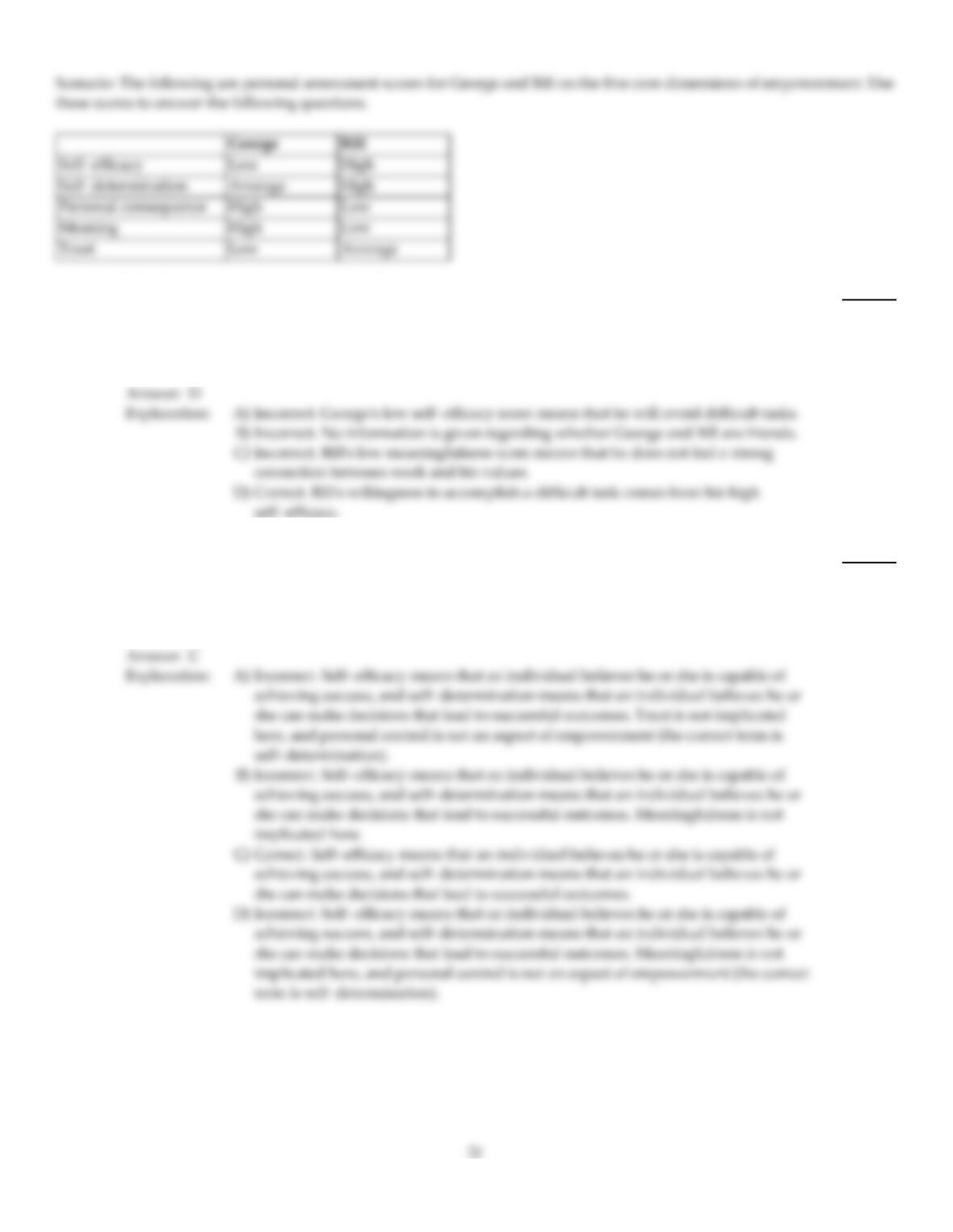
40)
Which is an accurate interpretation of the personal assessment score results?
40)
A)
George will attempt to accomplish a difficult task.
B)
George and Bill are good friends.
C)
Bill thinks his job fits very well with his personal values.
D)
Bill will attempt to accomplish a difficult task.
Incorrect. No information is given regarding whether George and Bill are friends.
41)
In providing resources so that others may accomplish their work, if individuals believe they have
the resources they need to be successful and they have the freedom to pursue what they want to
accomplish, you have fostered a sense of which dimension of empowerment?
41)
A)
Personal control and trust
B)
Self–determination and meaningfulness
C)
Self–efficacy and self–determination
D)
Personal control and meaningfulness
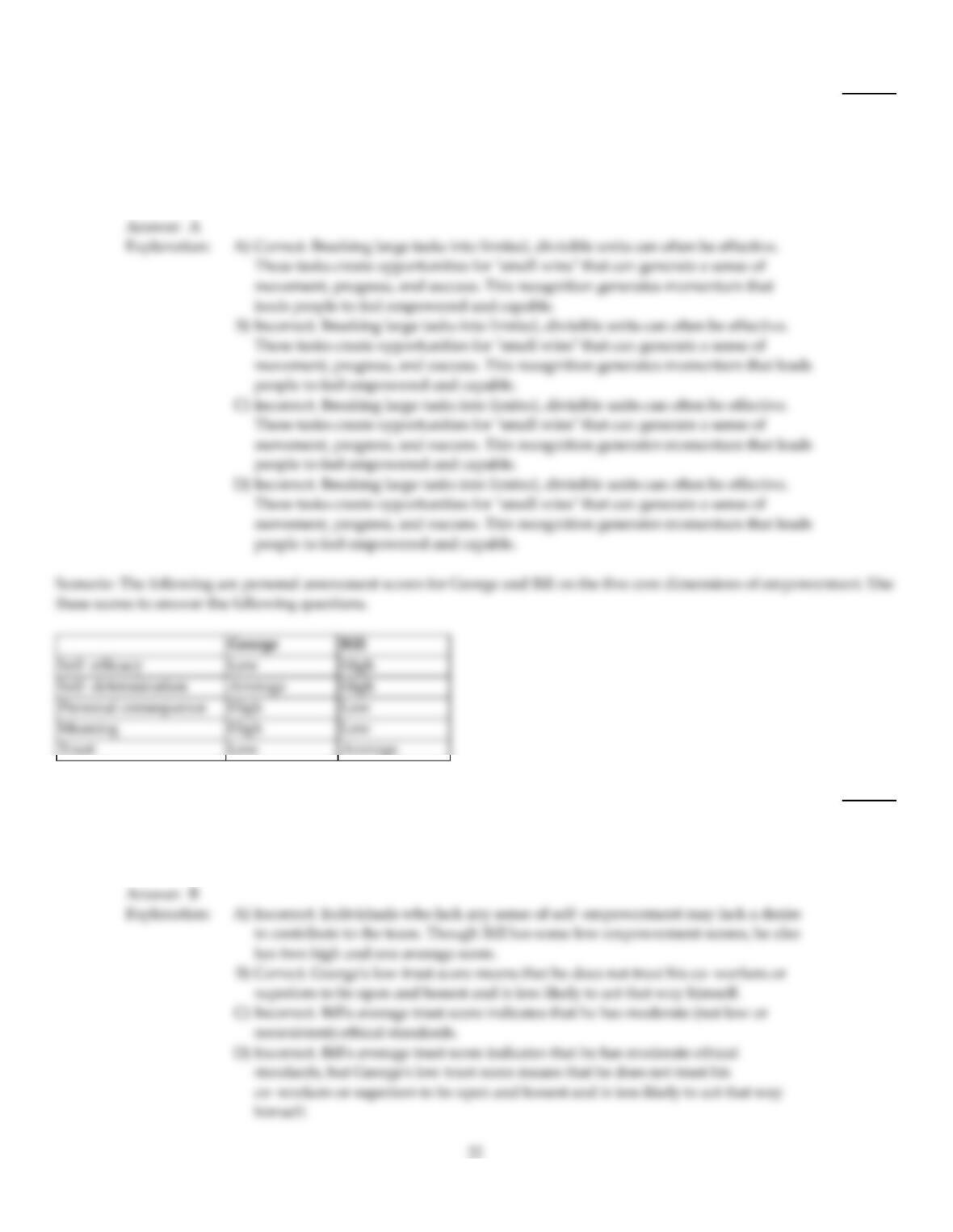
42)
Your boss states, “To foster empowerment, you should provide individuals with a large difficult
task at the beginning. The theory is if they can master this difficult task first, this will encourage
feelings of empowerment.” He then asks for your comment. How should you respond?
42)
A)
“I disagree; the key is to start with easy tasks.”
B)
“It depends.”
C)
“I agree.”
D)
None of the answer choices are correct.
43)
Which is an accurate interpretation of the personal assessment score results?
43)
A)
Bill does not want to be a contributing part of the team.
B)
George will probably play politics and have a hidden agenda.
C)
Neither George nor Bill has ethical standards.
D)
Both George and Bill have high ethical standards.
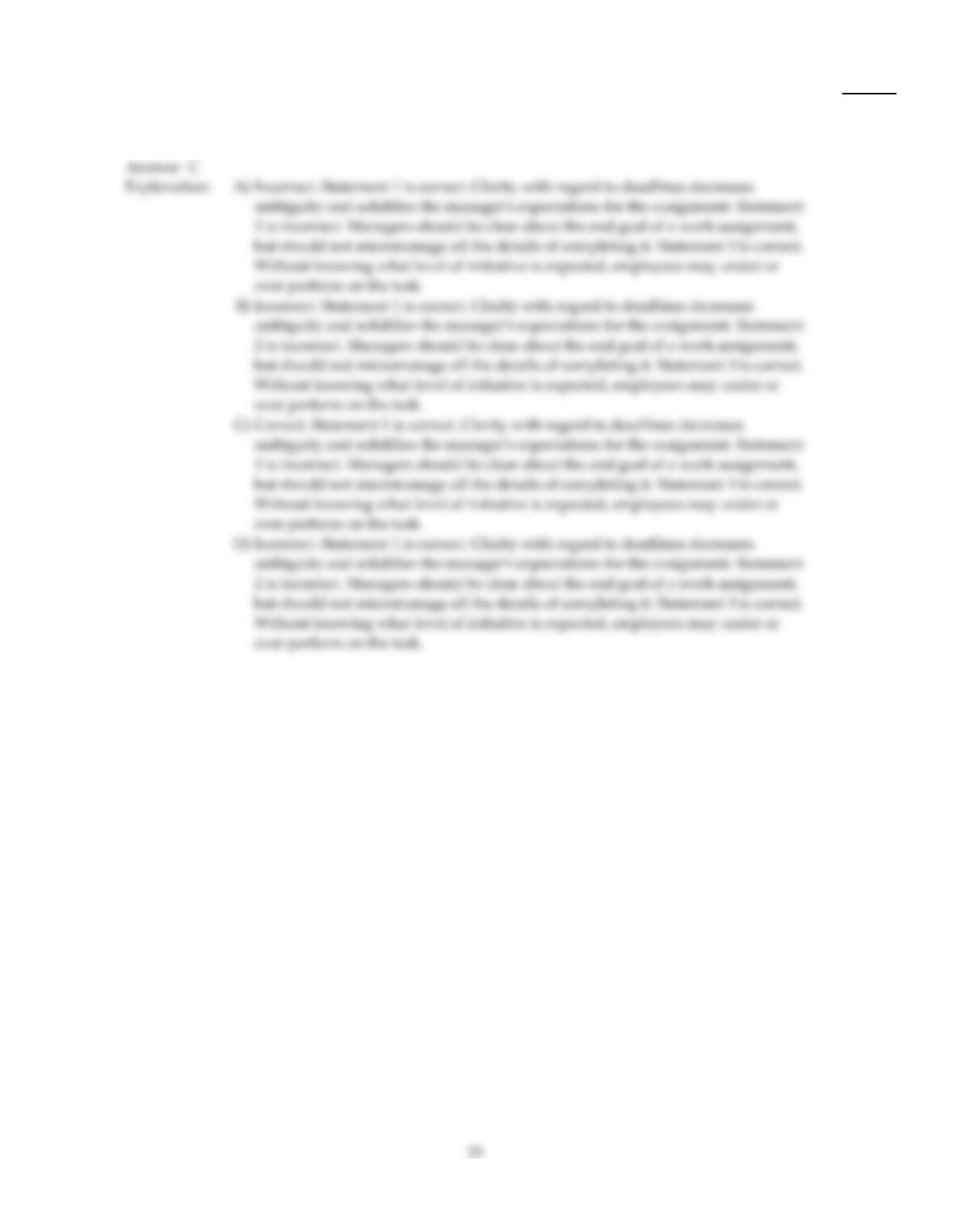
44)
When engaging employees, managers must be clear about (1) deadlines, (2) how the task should be
completed, and (3) the level of initiative expected. Which statements are correct?
44)
A)
All three statements are correct.
B)
Only statements 2 and 3 are correct.
C)
Only statements 1 and 3 are correct.
D)
Only statements 1 and 2 are correct.
45)
The federal government has asked how your company plans to reduce pollution in your
metropolitan area. You decide to organize a team (members from different departments) to handle
the government’s request. To increase a sense of empowerment, what should you do?
45)
A)
Allow them to make the decision and implement the solution as well.
B)
Have them generate ideas for you to decide.
C)
Treat them as a suggestion team and have them teach each other their job.
D)
Allow them to make the decision but tell them that you will handle how the decision will be
implemented.
46)
Your project is going well. As you daydream about your potential bonus, your secretary buzzes
you to remind you of your weekly meeting with your boss over the project’s status. Which initiative
does your boss most likely practice?
46)
A)
Wait to be told
B)
Initiate and report infrequently
C)
Ask what to do
D)
Recommend then take action
47)
Some of the outcomes of successful employee engagement are (1) high morale and motivation, (2)
stronger interpersonal relationships, and (3) more discretionary time for managers. Which
statements are correct?
47)
A)
All three statements are correct.
B)
Only statements 1 and 2 are correct.
C)
Only statements 2 and 3 are correct.
D)
Only statements 1 and 3 are correct.
E)
None of the statements are correct.
48)
You recently discovered that your brother–in–law paid $1,000 more in computer purchases than
you budgeted. In your conversation with him, he explains the additional cost is because he ordered
the screen saver with the flying toasters; he likes them better. You remark to your brother–in–law,
“I don’t hold you totally responsible because obviously you made the best decision you could,
given your limited intellect.” As you slump into your chair, what should you decide concerning
your relationship with your brother–in–law?
48)
A)
You should exhibit a more caring and personal concern for him.
B)
You handled this little meeting quite well (he is still alive).
C)
You have been open and honest in your communications with him.
D)
He flaunted his expertise.
49)
When employees have been empowered without clear directions or resources, what have some of
the results been?
49)
A)
Increased alertness and increased mortality
B)
Reduced stress
C)
Increased performance and job satisfaction
D)
Increased depression
50)
“Why is the boss never around to give his approval when I have some ideas on how to approach
the problem?” you think. Which initiative level does your boss expect?
50)
A)
Initiate action and report only routinely
B)
Act then report
C)
Ask what to do
D)
Wait to be told
51)
Which is an accurate interpretation of the personal assessment score results?
51)
A)
Both Bill and George will sense relatively high levels of empowerment.
B)
George feels more empowered than Bill.
C)
Bill feels more empowered than George.
D)
Neither Bill nor George is likely to sense a high level of empowerment.
52)
Which is an accurate interpretation of the personal assessment score results?
52)
A)
Both George and Bill seem to exhibit some level of internal locus of control.
B)
Both George and Bill seem to exhibit some level of external locus of control.
C)
Bill should demonstrate high levels of commitment to work.
D)
Neither George nor Bill sees himself as a proactive self–starter.
TRUE/FALSE. Write ‘T’ if the statement is true and ‘F’ if the statement is false.
53)
You have recently been promoted to a managerial position and have been assigned a mentor who
will provide you with guidance. The assignment of a mentor is related to the providing of
information guideline of empowerment.
53)

54)
A team has just outlined its approach to a problem. Part of its plan is to have the team members’
manager closely monitor the daily tasks. The manager should discourage this approach and remind
the team the project is its responsibility, but he is available for assistance.
54)
55)
Julie is reluctant to embrace empowerment as her employees have not had the necessary training to
accomplish the work assigned to her purchasing department. Her belief is likely based on her
attitudes about her employees.
55)
56)
People that take the initiative and like to try out new ideas would probably score high on the
self–determination dimension of empowerment.
56)
57)
Joe implemented the following policy effective immediately: All employees have discretion to
resolve customer complaints on the spot. This is most closely linked with creating confidence to
foster empowerment.
57)
58)
The rule of thumb in engaging others is to match the amount of responsibility given with the
amount of authority provided. Though you retain ultimate accountability, you delegate prime
accountability.
58)
59)
The principles of empowerment and engagement are applicable across most, if not all, cultures.
59)

60)
You have decided to provide information to enhance empowerment among your employees. The
information should be relevant to the employees’ tasks and department.
60)
61)
Empowerment involves trade–offs; if some people feel empowered, others will not experience it.
61)
62)
In deciding how to engage employees, you should begin with the end in mind and focus
accountability on the process.
62)
63)
Alane is very passionate about her work for the American Cancer Society, experiencing a strong
sense of self–worth from her job. Alane would probably score highest on the meaningful dimension
of empowerment.
63)
64)
Employee engagement works best when the manager uses it as a tool to relieve his or her stress and
workload.
64)
65)
Empowering others is neither easy nor natural for managers. However, it does not require a great
amount of self–sacrifice, and managers can actually multiply their own effectiveness through
empowerment.
65)
66)
The dimension of empowerment that would most help a person overcome a smoking addiction is
meaningfulness.
66)

67)
If you create a picture of the desired future through word pictures and moving language, you have
satisfied the emotional arousal prescription for empowerment.
67)
68)
People who score high on the trust dimension of empowerment are more direct, open, honest,
self–assured, and willing to cooperate with others.
68)
69)
You recently attended a Mary Kay Cosmetics regional meeting where you received a pink Cadillac
for your achievements. This is most closely linked to modeling effective praise to foster
empowerment.
69)
70)
Many managers and employees are reluctant to accept empowerment, but they are even more
reluctant to offer empowerment. If a rationale offered by management is “I’m willing to empower
people, but when I do, they either mess things up or try to grab all the glory,” the issue is a need for
control.
70)
71)
Fostering personal mastery experiences is related to the self–efficacy dimension of empowerment.
71)
72)
As a manager, Bill understands the concept of empowerment. He recognizes he can empower his
employees by creating circumstances in which his employees feel empowered.
72)
73)
Kenneth derives a great deal of satisfaction from work and has decided to open his own motorcycle
store. He would probably score high on the self–determination dimension of empowerment.
73)
empowerment.

74)
You write notes of praise to employees, as well as to their family members and co–workers, in
recognition of noteworthy accomplishments. This most closely relates to providing support to
encourage empowerment.
74)
75)
After you have arrived at work, your boss e–mails some tasks she would like for you to do by the
end of the day. Your boss practices the wait to be told initiative.
75)
76)
Your department is average in its performance. You believe if you were in charge, the department
would perform above average. You would probably score highest on the self–efficacy dimension of
empowerment.
76)
77)
You are excited. You have a course of action for the problem. You are just waiting for your boss to
give the okay. Your boss practices the ask what to do initiative.
77)
78)
Empowerment is viewed as a “pull” strategy, which involves managers designing a work situation
so that it energizes and provides intrinsic encouragement to employees.
78)
ESSAY. Write your answer in the space provided or on a separate sheet of paper.
79)
There are 10 rules of thumb involved in engaging employees effectively. Explain the following rule in more
depth and provide an example: Avoid upward delegation.
80)
Explain the core dimensions of empowerment. Provide a real–life example for each dimension.

81)
There are 10 rules of thumb involved in engaging employees effectively. Explain the following rule in more
depth and provide an example: Be consistent.
Minding the Store
On January 1, Ruth Cummings was formally named branch manager for the Saks Fifth Avenue store in a suburb of
Denver. Her boss, Ken Hoffman, gave her this assignment on her first day: “Ruth, I’m putting you in charge of this store.
Your job will be to run it so that it becomes one of the best stores in the system. I have a lot of confidence in you, so don‘t let
me down.”
One of the first things Ruth did was to hire an administrative assistant to handle inventories. Because this was such an
important part of the job, she agreed to pay her assistant slightly more than the top retail clerks were making. She felt that
having an administrative assistant would free her to handle marketing, sales, and personnel mattersareas she felt were
crucial if the store was to be a success.
Within the week, however, she received a call from Hoffman: “Say, Ruth, I heard that you hired an administrative
assistant to handle inventories. Don’t you think that is a bit risky? Besides, I think paying an assistant more than your top
salesclerk is damaging to morale in the store. I wish you had cleared this with me before you made the move. It sets a bad
precedent for the other stores, and it makes me look like I don’t know what is going on in the branches.”
Three weeks later, Ruth appeared on a local noontime talk show to discuss new trends in fashion. She had worked hard
to make contact with the hosts of the show, and she felt that public exposure like this would increase the visibility of her
store. Although the TV spot lasted only 10 minutes, she was pleased with her performance and with the chance to get public
exposure.
Later that night at home, she received another phone call from Hoffman: “Don’t you know the policy of Saks? Any TV
appearances made on behalf of the store are to be cleared through the main office. Normally, we like to have representatives
from the main store appear on these kinds of shows because they can do a better job of plugging our merchandise. It’s too
bad that you didn’t notify someone of your intentions. This could be very embarrassing for me.“
Just before Easter, Ruth was approached in the store by one of the salesclerks. A customer had asked to charge
approximately $3,000 worth of china as a gift for his wife. He had been a customer of the store for several years and Ruth had
seen him on several occasions, but store rules indicated that no charge could be made for more than $1,000 for any reason.
She told the customer that she was not authorized to okay a charge of that amount, but that if he would visit the main store in
Denver, maybe arrangements could be made.
Later in the day, an irate Hoffman called again: “What in the world are you thinking about, Ruth? Today we had a
customer come into the main store and say that you wouldn’t make a sale to him because the charge was too much. Do you
know how long he has been a customer of ours? Do you know how much he spends in the store every year? I certainly hope
we have not lost him as a customer because of your blunder. This makes me very upset. You’ve just got to learn to use your
head.”
Ruth thought about the conversation for several days and finally decided that she needed to see Ken Hoffman. She called
his secretary to schedule an appointment for the following day.
82)
What guidelines related to empowerment were violated by Ken Hoffman? By Ruth Cummings?