Learning Objective 8.4 Questions
Table 8–4
Blaze Enterprises bought a machine for $15,000 on January 1, 20X9, with a useful life of 4 years and a
salvage value of $3,000. At the beginning of 2X10, Blaze finds the residual value will be zero.
8.4-1) Using Table 8–4 and assuming Blaze employs straight–line depreciation, what will be the
depreciation expense in 2X10?
A) $3,000
B) $4,000
C) $6,000
D) $3,750
E) $12,000
8.4-2) Using Table 8–4 and assuming Blaze employs double–declining–balance depreciation, what will be
the depreciation expense in 2X10?
A) $3,000
B) $3,750
C) $4,000
D) $7,500
E) $12,000
8.4-3) Using Table 8–4 and assuming Blaze employs straight–line depreciation, additionally suppose that
at the beginning of 2010 Blaze finds a $200 attachment that extends the life of the equipment 2 years
beyond the original estimate. What will be the depreciation expense in 2X10?
A) $2,000
B) $2,400
C) $2,440
D) $3,200
E) $4,200
8.4-4) Accounting for changes in useful life is prospective in nature.
8.4-5) Accounting for changes in residual value must be prospective and retrospective.
8.4-6) Depreciation is recomputed starting in the period that a change in estimate is known.
Table 8–5
Straight–line depreciation schedule of police scanners for Lumpy Electronics
Annual depreciation Book value
$60,000
Year 1 $15,000 45,000
Year 2 15,000 30,000
Year 3 15,000 15,000
Year 4 15,000 0
8.4-7) Referring to Table 8–5, suppose at the beginning of year 3, Lumpy Electronics no longer believes the
police scanners will last 4 years, but instead decides the scanners will last 6 total years.
Required:
1) What is the new depreciation expense for Year 3 and Year 4?
2) What is the new book value after Year 4 records depreciation expense?
3) What is the accumulated depreciation amount after Year 6 records depreciation expense?
Learning Objective 8.5 Questions
8.5-1) Which of the following is an attribute associated with the modified accelerated cost recovery
system (MACRS)?
A) For most assets, MACRS approximates straight–line depreciation.
B) MACRS depreciates assets over a longer useful life than would be expected from the asset, thus
making the asset last longer on the books.
C) MACRS allows for greater depreciation expense in the later years of an asset’s life, thus reducing the
taxes a company will have to pay during those years.
D) The purpose of MACRS is to provide more flexibility in GAAP depreciation methods.
E) None of the above
8.5-2) Attributes associated with the U.S. tax law’s treatment of long–lived assets include all of the
following except:
A) The U.S. tax law allows for very accelerated rates of depreciation, based upon the general use of
double–declining–balance depreciation coupled with shorter useful lives than would normally be allowed.
B) The U.S. tax law is written by the U.S. Congress.
C) The U.S. tax law is the basis used for shareholder reporting purposes.
D) U.S. tax law changes in some way almost every year.
E) U.S. tax laws can be quite different from tax laws in other countries.
8.5-3) The MACRS
A) has longer lives than economic lives resulting in higher income taxes.
B) has longer lives than economic lives resulting in lower income taxes.
C) has shorter lives than economic lives resulting in higher income taxes.
D) has shorter lives than economic lives resulting in lower income taxes.
E) has lives equivalent to economic lives.
8.5-4) Useful lives for tax purposes are frequently shorter than the useful lives used for financial reporting
purposes. Because of this, taxable net income would be
A) lower and lower income taxes payable.
B) lower and higher income taxes payable.
C) higher and lower income taxes payable.
D) higher and higher income taxes payable.
E) undeterminable from the information given.
8.5-5) The MACRS of depreciation is used for income tax purposes and financial reporting purposes.
8.5-6) Financial reports for the Internal Revenue Service must abide by generally accepted accounting
principles.
8.5-7) Depreciation is a noncash expense and therefore not tax–deductible.
Learning Objective 8.6 Questions
8.6-1) Which of the following statements is considered incorrect?
A) Depreciation methods provide a systematic way to expense the cost of an asset, although this expense
is not a negative cash flow.
B) Depreciation is an allocation of the original cost of an asset to the periods in which the asset is used.
C) Accumulated depreciation is the summation of the amount of the original cost of an asset already
written off to expense in prior periods.
D) Accumulated depreciation is not a pile of cash waiting to be used.
E) Charging depreciation expense provides a means of setting aside cash for the replacement of an asset.
Table 8–6
Pecking Company began operations on January 1, 20X9, when the owners invested $80,000 cash in the
company. Also on January 1, the company paid for a $30,000 machine. The machine has a useful life of 4
years and a $2,000 residual value. During its first year of operations, the company had sales of $96,000
and operating expenses except depreciation of $67,000. All sales were cash sales and all non–depreciation
operating expenses were paid in cash. Pecking Company has a 30% tax rate and pays all taxes on
December 31.
8.6-2) Referring to Table 8–6, what is the cash balance before taxes on December 31, 20X9, if Pecking
Company uses straight–line depreciation?
A) $72,000
B) $76,900
C) $79,000
D) $81,100
E) $86,000
8.6-3) Referring to Table 8–6, what is the cash balance before taxes on December 31, 20X9, if Pecking
Company uses double–declining– balance depreciation?
A) $64,000
B) $74,500
C) $79,000
D) $83,500
E) $94,000
8.6-4) Referring to Table 8–6, what is the net cash provided by operating activities before taxes for 20X9, if
Pecking Company uses straight–line depreciation?
A) $(74,000)
B) $(67,000)
C) $ 22,000
D) $ 25,000
E) $ 29,000
8.6-5) Referring to Table 8–6, what is the net cash provided by operating activities before taxes for 20X9, if
Pecking Company uses double–declining–balance depreciation?
A) $(81,000)
B) $(67,000)
C) $ 14,000
D) $ 25,000
E) $ 29,000
8.6-6) Referring to Table 8–6, what is the cash balance after taxes on December 31, 20X9, if Pecking
Company uses straight–line depreciation?
A) $55,300
B) $72,400
C) $72,550
D) $94,050
E) $94,400
8.6-7) Referring to Table 8–6, what is the cash balance after taxes on December 31, 20X9, if Pecking
Company uses double–declining–balance depreciation?
A) $59,800
B) $74,500
C) $74,800
D) $88,800
E) $89,500
8.6-8) Referring to Table 8–6, what is the net cash provided by operating activities after taxes for 20X9, if
Pecking Company uses straight–line depreciation?
A) $ 6,600
B) $15,050
C) $15,400
D) $22,400
E) $22,550
8.6-9) Referring to Table 8–6, what is the net cash provided by operating activities after taxes for 20X9, if
Pecking Company uses double–declining–balance depreciation?
A) $ 6,860
B) $ 9,800
C) $10,500
D) $24,500
E) $24,800
8.6-10) Depreciation generates cash.
8.6-11) Using accelerated depreciation instead of straight–line depreciation results in a lower net income
but a higher cash balance in the initial years of a fixed asset’s life.
8.6-12) Depreciation does not generate cash, but it does have a cash benefit if it results in lower taxes.
8.6-13) On an after–tax basis, the choice of using accelerated or straight–line depreciation affects income
but does not affect cash.
8.6-14) Straight Industries began operations on January 1, 20X9. On that date, the owners invested
$140,000 in the company, and acquired a $90,000 machine. The machine has a useful life of 5 years, and a
residual value of $4,000. The company intends to depreciate the machine on a straight–line basis for
financial reporting purposes. During 20X9, revenues which were all in cash, totaled $630,000. All
operating expenses, other than depreciation and all paid in cash, were $510,000. Straight Industries has a
45% income tax rate.
Given the above information, determine the following (round all answers to the nearest dollar):
a. 20X9 net income using straight–line depreciation
b. 20X9 cash provided by operations using straight–line depreciation
Learning Objective 8.7 Questions
8.7-1) A major expenditure made to equipment that extends its useful life beyond the original estimate is
journalized by
A) debiting repairs expense.
B) debiting depreciation expense.
C) debiting equipment.
D) crediting depreciation expense.
E) crediting accumulated depreciation.
8.7-2) Which of the following activities can be classified as a betterment?
A) Oiling
B) Polishing
C) Restoring to working order after an accident
D) Adjusting
E) Rehabilitating to increase rent
8.7-3) The expenditure for an improvement to equipment that would increase output is journalized by
A) crediting accumulated depreciation.
B) crediting depreciation expense.
C) debiting depreciation expense.
D) debiting equipment.
E) debiting repair expense.
8.7-4) An improvement or betterment is an expenditure that is intended to add to the future benefits from
an existing fixed asset.
8.7-5) Businesses do not capitalize improvements.
8.7-6) If an improvement increases operating efficiency, then the depreciation schedule is revised.
8.7-7) Coach Industries has recently upgraded its delivery truck. The various expenditures related to the
upgrades occurred at the end of year 2 and are as follows:
Item and amounts Capital expenditure/Operating expense
1) Oil changes, $20 _______________________
2) All four tires on each truck replaced, $800 _______________________
3) Engine replacement, $900 _______________________
4) Changed truck colors from blue to green, $500 _______________________
5) Replaced brakes, $400 _______________________
Required:
1) Determine whether the expenditure is a capital improvement or ordinary operating expense.
2) Suppose the delivery truck with an original cost of $35,000 was being depreciated using straight line
depreciation over 5 years and was expected to have a $3,000 residual value, however the upgrades are
expected to increase the useful life from 5 years to 7 years. Based on the upgrades above, what is the
revised depreciation expense for years 3 through 7?
Learning Objective 8.8 Questions
8.8-1) Calcutty Industrie recently sold some equipment for $3,800 cash. The equipment cost $19,600 and
had accumulated depreciation through the date of sale totaling $17,300. The journal entry to record the
sale of the equipment will include a
A) credit to accumulated depreciation of $17,300.
B) credit to equipment for $2,300.
C) debit to gain on sale of equipment for $1,500.
D) credit to gain on sale of equipment for $1,500.
E) debit to depreciation expense for $17,300.
8.8-2) Equipment costing $20,000 with $17,800 of accumulated depreciation is sold for $2,500 cash. The
journal entry will involve a
A) debit to depreciation expense for $17,800.
B) credit to depreciation expense for $17,800.
C) credit to accumulated depreciation for $17,800.
D) debit to accumulated depreciation for $17,800.
E) debit to accumulated depreciation for $2,200.
8.8-3) Equipment costing $45,000 with a book value of $12,000 is sold for $21,500. The journal entry will
involve a
A) credit to accumulated depreciation for $14,900.
B) debit to accumulated depreciation for $22,000.
C) debit to accumulated depreciation for $33,000.
D) credit to equipment for $22,000.
E) credit to accumulated depreciation for $22,000.
8.8-4) Phoney Enterprises uses the indirect method to prepare the statement of cash flows. During 2X09,
Phoney Enterprises had $100,000 in net income which included a gain of $10,000 for the sale of an asset.
To calculate operating cash flows, Phoney Enterprises must
A) deduct $10,000 from net income in the operating activities section of the statement of cash flows.
B) add $10,000 to net income in the operating activities section of the statement of cash flows.
C) deduct $10,000 from net income in the investing section of the statement of the statement of cash flows.
D) add $10,000 to net income in the investing section of the statement of cash flows.
E) deduct $10,000 from net income in the financing section of the statement of cash flows.
8.8-5) The sale of a plant asset may result in a gain but not a loss.
8.8-6) A gain will result when the cash received from the sale of a plant asset exceeds the book value of
the asset.
8.8-7) A loss will result on the sale of a plant asset when the book value of the asset exceeds the cash
received.
8.8-8) Gains or losses on sales of tangible assets are usually measured by the difference between the cash
received and the net book value of the asset given up.
8.8-9) Gains on disposal of plant assets are generally shown as “other income” on the income statement.
8.8-10) Cuppy, Inc., gathered the following data for the year ended December 31, 20X9, related to its
equipment.
Accumulated
Equipment Depreciation
January 1, 20X9, balance $85,000 $40,000
Total debits to the account 55,000 ?
Total credits to the account ? 51,000
December 31, 20X9, balance 92,000 56,000
Based on the above data, prepare the journal entry to record the sale of equipment during the year for
$11,500 cash.
8.8-11) On January 1, 20X9, First Bank acquired 10 cars for company use. The cost of each car was $15,000
and the bank estimated that each car would have a 4-year useful life and a residual value of $2,000.
Required:
a. Provide the journal entry needed on December 31, 2X10, if four cars were sold for a total of $17,500 and
First Bank uses double-declining-balance depreciation.
b. Provide the journal entry needed on December 31, 2X10, if four cars were sold for a total of $17,500 and
First Bank uses straight-line depreciation.
c. Assume instead of the above information that on December 31, 2X10, one of the cars was wrecked.
Provide the journal entry needed on December 31, 2X10, if First Bank’s insurance company paid $2,900
for the wrecked car and the company uses straight-line depreciation.
Learning Objective 8.9 Questions
8.9-1) Companies electing to revalue their fixed assets under IFRS are allowed to
A) only increase the carrying value of the fixed asset.
B) only decrease the carrying value of the fixed asset.
C) only increase the historical cost of the fixed asset.
D) only decrease the historical cost of the fixed asset.
E) increase or decrease the carrying value of the fixed asset.
8.9-2) Once a company begins to make revaluation adjustments, it must continue to make them.
Learning Objective 8.10 Questions
8.10-1) The entry to journalize equipment’s impairment loss would include
A) debit accumulated depreciation.
B) credit accumulated depreciation.
C) credit impairment loss.
D) debit equipment.
E) credit equipment.
8.10-2) A recoverability test for impairment
A) is based on discounted present value.
B) requires SEC approval.
C) establishes that the asset is impaired.
D) only occurs when the asset is sold.
E) identifies the write–up value.
8.10-3) Dwyer Company determines the following information at year end about a piece of equipment
that has a net book value of $75,000. Assume the equipment will not be for sale.
Present value of future expected net cash flows $52,500
Undiscounted future expected cash flows 63,500
Estimated costs to sell 4,000
The impairment loss is
A) $22,500
B) $48,500
C) $52,500
D) $57,500
E) $0 No impairment loss
8.10-4) If the net present value of the expected cash flows from the use of the asset and its disposal is
greater than the carrying value of an asset, then the asset is considered to be impaired.
8.10-5) A recoverability test is necessary to determine if an asset is impaired.
8.10-6) When computing an impairment loss for a tangible asset, the market price shall be the fair value
unless no active market exists for the asset.
8.10-7) Explain the concept of asset impairment. Include in your discussion the process of computing the
impairment.
Learning Objective 8.11 Questions
8.11-1) Attributes associated with intangible assets include all of the following except:
A) The economic life of an intangible asset does not always equal its legal life.
B) The cost of developing an intangible asset internally is capitalized as an asset.
C) Intangible assets are similar to fixed assets, in that their acquisition costs are capitalized as assets, and
this cost is expensed over their estimated useful lives.
D) Intangible assets are long–lived assets which are not physical in nature.
E) Examples of an intangible asset include patents, copyrights, and goodwill.
8.11-2) Amortization of an intangible asset is similar to which depreciation method?
A) Unit depreciation
B) Straight–line
C) Double–declining balance
D) MACRS
E) None of the above
8.11-3) An attribute of leases includes all of the following except:
A) An example of a leasehold improvement would be the installation of new paneling, walls, and a
window air conditioner.
B) The lessee must select the shorter of either the useful life of the leasehold improvement or the
remaining life of the lease to amortize the leasehold improvement.
C) Although they are technically intangible assets, leaseholds and leasehold improvements are frequently
classified with plant assets.
D) A leasehold is a right to use a leased asset for a specified period of time beyond one year.
E) Leasehold improvements can be amortized using either accelerated or straight–line methods.
8.11-4) Amortization expense is computed in the same manner as straight–line depreciation.
8.11-5) Trademarks are distinctive identifications of a manufactured product or of a service, taking the
form of a name, a sign, a slogan, a logo, or an emblem.
8.11-6) The acquisition costs for intangible assets are capitalized as assets and are then gradually
amortized over the estimated useful lives of the assets.
8.11-7) Franchises and licenses are legal contracts that grant the buyer the right to sell a product or
service.
8.11-8) A leasehold is the right to use a fixed asset for a specified period of time beyond one year.
8.11-9) A privilege granted by a government, manufacturer, or distributor to sell a product or service in
accordance with specified conditions is termed a franchise.
8.11-10) Research and development costs are expensed on the income statement as opposed to being
capitalized on the balance sheet.
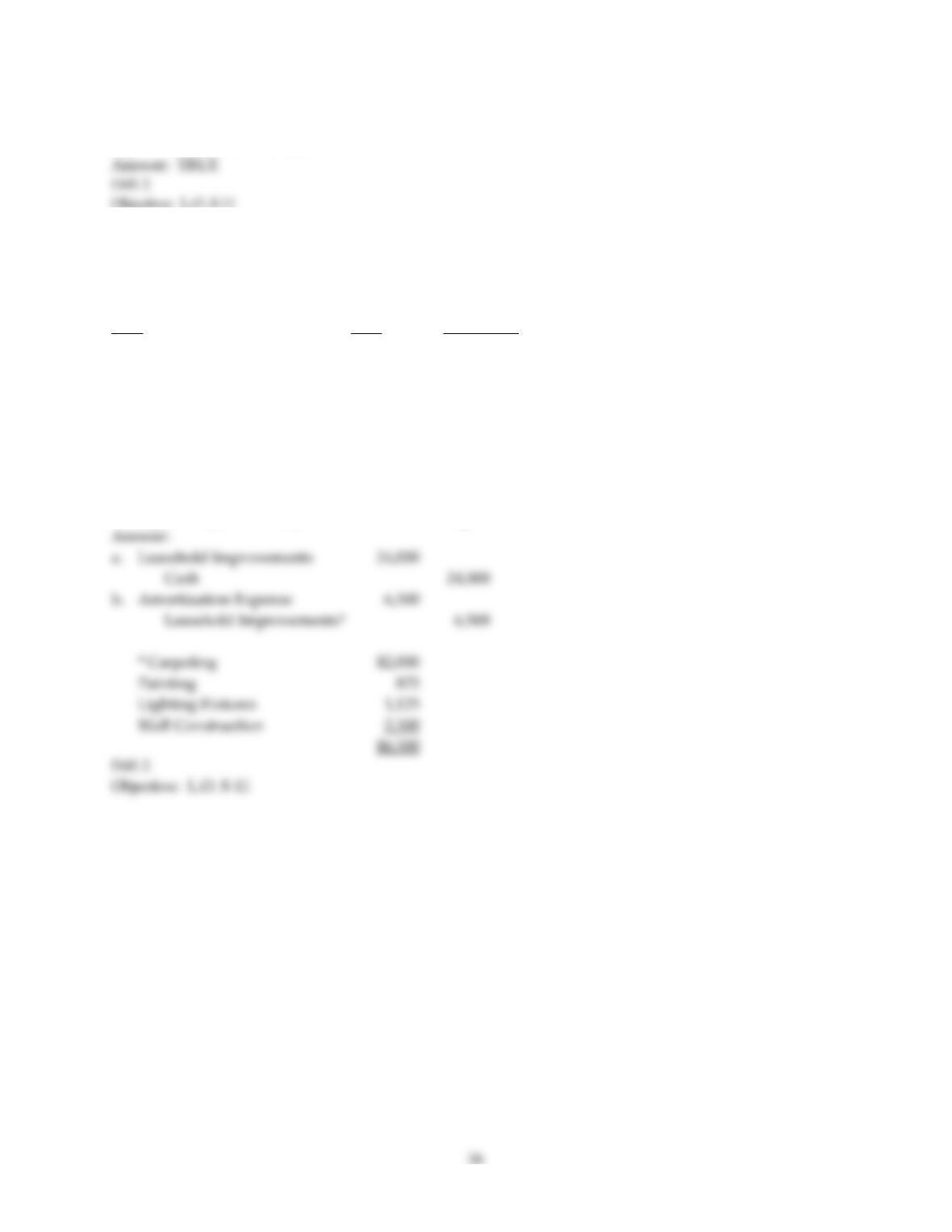
8.11-11) Jamley Company signed a 10–year lease for a store in the best mall in the area. At the beginning
of the seventh year of the lease, the company decided to refurbish the store. The following expenditures
were made:
Item Cost Useful Life
Carpeting $ 6,000 3 years
Painting $ 3,500 5 years
Lighting Fixtures $ 4,500 6 years
Wall Construction $10,000 8 years
All items were paid in cash. There is no residual value for any of the items noted above.
a. Prepare the journal entry to record the expenditures of the above items.
b. Prepare the year–end adjustment to record the expense associated with the above items.
8.11-12) Consider each event concerning intangible assets independently:
a. Twine Corporation purchased a patent for $476,000 on January 1, 20X9. The patent has a remaining
legal life of 14 years. Due to anticipated technological change, it is expected that the patent will be useless
in 5 years.
b. In 20X9, Alton Company spent $3,500,000 in research and development costs. However, the research
did not result in a patent. Alton Company acquired a patent from another company for $1,000,000 on
January 1, 20X9. The acquired patent is expected to last 8 years.
Prepare all journal entries necessitated by events in a. and b. above during the year 20X9.
Learning Objective 8.12 Questions
8.12-1) Bold Company buys Weak Company for $11 million. Weak Company has assets worth $9 million
and liabilities of $2 million. Weak’s stockholders’ equity is recorded at $8 million. What goodwill should
Bold Company record?
A) $10 million
B) $8 million
C) $4 million
D) $2 million
E) $0 million
8.12-2) Toastie Enterprises has $500,000 of goodwill on the balance sheet. The company determines that
an impairment has occurred for $100,000. Toastie Enterprises should
A) recompute the original purchase and restate all subsequent statements.
B) debit goodwill for $100,000.
C) credit goodwill for $100,000.
D) debit goodwill for $400,000.
E) credit goodwill for $400,000.
8.12-3) Paper Products, Inc., has $400,000 of goodwill on the balance sheet from The Fork Company
which was purchased 5 years ago. The goodwill amortization this year should be
A) $10,000.
B) $20,000.
C) $40,000.
D) $80,000.
E) $0.
8.12-4) Goodwill occurs when the purchase price of a company exceeds the fair value of all identifiable
individual assets less total liabilities.
8.12-5) U.S. GAAP requires the immediate write–off of goodwill at purchase.
8.12-6) A goodwill write–off is a noncash expense.
Learning Objective 8.13 Questions
8.13-1) Scone Industries acquired a gold mine for $8,000,000. It is estimated that 40,000 ounces of gold can
be extracted from the mine. In the first year of operations, 15,000 ounces of gold were extracted. Scone
Industries would recognize
A) an increase in net income of $3,000,000.
B) depreciation expense of $3,000,000.
C) cost of goods sold of $3,000,000.
D) amortization expense of $3,000,000.
E) depletion expense of $3,000,000.
8.13-2) In 20X9 Little Yard Oil, Inc., purchased drilling rights for $1,000,000. At the time, the engineer
estimated 20,000 barrels of oil in the field. In 2X10, 4,000 barrels were pumped and in 2X11, 5,000 barrels
were pumped. Which entry below is correct?
A) Credit inventory of $200,000 in 20X9
B) Debit depreciation expense of $250,000 in 2X10
C) Debit cost of goods sold of $200,000 in 2X10
D) Debit depletion expense of $250,000 in 2X11
E) Debit amortization expense of $200,000 in 20X9
8.13-3) Platak, Inc., acquired a silver mine for $4,000,000. The company’s survey estimates that 40,000
ounces of silver can be extracted from the mine, but environmental costs to close the mine will be
$1,000,000. In the first year of operations, 15,000 ounces of silver were extracted. Platak, Inc., would
recognize
A) depletion expense of $1,500,000.
B) depreciation expense of $1,500,000.
C) depletion expense of $1,875,000.
D) amortization expense of $1,875,000.
E) environmental expense of $1,000,000.
8.13-4) Depletion expense is computed in the same manner as straight–line depreciation.
8.13-5) Depletion follows a units–of–production approach.
8.13-6) The process of allocating the cost of natural resources to the periods in which the resources are
used is termed amortization.