Test Bank – Chapter 8 – Investments in Equity Securities 8-19
MATCHING QUESTIONS
1. Each transaction numbered 1 through 5 below involves an equity security originally
acquired at a cost of $1,000. Identify the effect each transaction has on the current ratio
and earnings per share by selecting from the effects listed in a through f. You may use
each letter more than once or not at all.
Effects
a. Increase in current ratio and earnings per share.
b. Does NOT change earnings per share or the current ratio.
c. Does NOT change earnings per share; may impact the current ratio under certain
conditions.
d. Decrease in current ratio and earnings per share.
e. Increases earnings per share.
f. Can’t determine the direction of changes in at least one ratio from the event given.
____ 1. Passive investment with a current balance sheet value of $1,200 is sold for
$1,100.
____ 2. Passive investment with a current balance sheet value of $800 is sold for
$800.
____ 3. Passive investment with a current balance sheet value of $1,200 is sold for
$1,300.
____ 4. Passive investment has a market value of $800 at yearend.
____ 5. Passive investment has a market value of $1,200 at yearend.
2. Each transaction listed in 1 through 4 relates to an investment in a long-term equity
security. Place the letter that corresponds to the effect (a through h) the transaction has
on the accounting equation in the space provided. You may use each letter more than
once or not at all.
Accounting Effects
a. + A and + L
b. + A and + SE (Contributed Capital)
c. + A and + SE (Retained Earnings)
d. – A and – L
e. – A and – SE (Contributed Capital)
f. – A and – SE (Retained Earnings)
g. + A and – A
h. The event is not reported on financial statements.
____ 1. Under the mark-to-market method, the investee company declares a cash
dividend.
____ 2. Under the equity method, the investee company declares a cash dividend.
____ 3. Under the mark-to-market method, the investee company recognizes net
income.
____ 4. Under the equity method, the investee company recognizes net income.

8-20 Test Bank – Chapter 8 – Investments in Equity Securities
3. For each transaction numbered 1 through 4 below, identify which effect (a through f) the
transaction is most likely to cause. You may use each letter more than once or not at all.
Effects
a. Increase in current ratio and earnings per share
b. Decrease in current ratio and earnings per share
c. Does NOT change the current ratio; increases earnings per share
d. Increases the current ratio; does NOT change earnings per share
e. Does not change the current ratio or earnings per share
f. Can’t determine the effect
_____ 1. The mark-to-market method is used for an investment in long-term equity
securities, and the investee company declares a cash dividend.
_____ 2. The equity method is used for an investment in long-term equity securities
and the investee company declares a cash dividend.
_____ 3. The mark-to-market method is used for an investment in long-term equity
securities and the investee company recognizes net income.
_____ 4. The equity method is used for an investment in long-term equity securities
and the investee company recognizes net income.
4. Each transaction listed in 1 through 4 below relates to a long-term investment in equity
securities. Select the letters of the accounting effects (a through h) and place them in the
space provided. Transactions may have more than one answer.
Accounting Terms
a. Increase assets
b. Increase shareholders’ equity (Contributed Capital)
c. Increase shareholders’ equity (Retained Earnings)
d. Decrease liabilities
e. Decrease shareholders’ equity (Retained Earnings)
f. Decrease assets
g. Increase liabilities
h. The event is not communicated on financial statements.
_____ 1. Using the equity method, the market price of the investment increases
above its cost.
_____ 2. Using the mark-to-market method, the market price of the investment
increases above its cost.
_____ 3. Using the equity method, the investee company recognizes a net loss
for the year.
_____ 4. An investment in a 40%-owned subsidiary is sold for more than its
carrying value.
Test Bank – Chapter 8 – Investments in Equity Securities 8-21
5. For each transaction numbered 1 through 4 below, identify which effect (a through g)
would most likely occur as a result of the transaction.
Effects
a. Increase in current ratio and earnings per share
b. Decreases current ratio; increases earnings per share
c. Increases current ratio; does NOT change earnings per share
d. Decrease in current ratio and earnings per share
e. Decreases current ratio; does NOT change earnings per share
f. Does not change the current ratio or earnings per share
g. Can’t determine the direction of changes in the current ratio
_____ 1. A passive investment in equity securities are purchased for $1,000 cash.
_____ 2. The securities that cost $1,000 have a yearend market value of $800.
_____ 3. The securities that cost $1,000 have a yearend market value of $1,200.
_____ 4. The securities that cost $1,000 and have a current balance sheet value of
$800 are sold for $900.
6. For each transaction listed in 1 through 9, place the letter (a through g) of the best effect
in the space provided. You may use each letter more than once or not at all. All
transactions involve a passive investment in equity securities unless otherwise specified.
Effects
a. + A and + L
b. + A and + SE (on income statement)
c. – A and – L
d. – A and – SE (on income statement)
e. No change in total A, L, or SE
1
1
Equity securities are purchased for $900 cash.
2
12.
Equity securities with a cost of $600 have a market value of $350 when the
financial statements are produced.
3
3.
Equity securities with a cost of $12,000 have a market value of $14,000 when the
financial statements are produced.
4
4.
Equity securities with an original cost of $3,000 and a balance sheet value of $700
are sold for $800.
5
5.
Equity securities with an original cost of $4,000 and a balance sheet value of
$4,500 are sold for $4,300.
6
6.
Equity securities with an original cost of $9,000 and a balance sheet value of
$7,800 are sold for $7,800.
7
7.
Equity securities with an original cost of $4,000 and a balance sheet value of
$4,500 are sold for $4,500.
8
8.
Securities for which the equity method is used, with a cost of $7,000, have a
market value of $5,200 when the financial statements are produced.
9
9.
Securities for which the equity method is used, with a cost of $7,000, have a
market value of $7,200 when the financial statements are produced.
8-22 Test Bank – Chapter 8 – Investments in Equity Securities
SHORT PROBLEMS
1. Equity securities were purchased as a short-term passive investment at a cost of $5,000.
Their current market value is $4,000. Prepare the December 31 adjusting journal entry.
2. Prepare the December 31 journal entry that adjusts equity securities that were
purchased as a long-term passive investment at a cost of $5,000 when current market
value is $4,200.
3. On December 31, the cost and market price of a short-term passive investment in equity
securites are $5,000 and $9,000, respectively. Give the appropriate adjusting entry on
December 31.
4. On December 31, the cost and market price of equity securities purchased as a long-
term passive investment are $5,000 and $8,000, respectively. Give the appropriate
adjusting entry on December 31.
Test Bank – Chapter 8 – Investments in Equity Securities 8-23
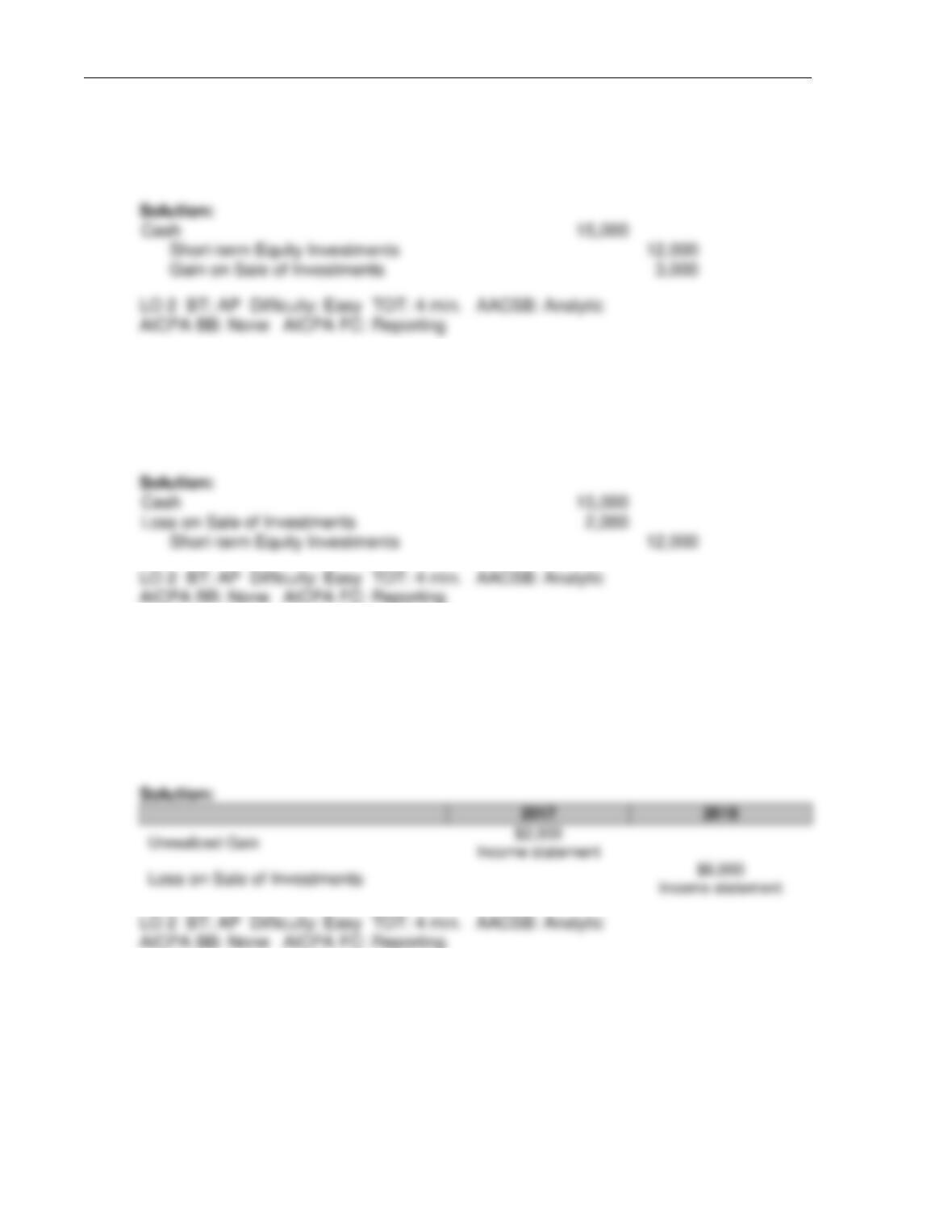
5. On December 31, 2017, short-term equity securities with an original cost of $10,000
have a carrying value on the balance sheet equal to their market value of $12,000. On
January 5, 2018, those securities are sold for $11,000. Give the appropriate entry to
record the sale of the securities.
6. On December 31, 2017, short-term equity securities with an original cost of $45,000
have a market value of $47,000. On January 11, 2018, those securities are sold for
$51,000. Determine the gains or losses in 2017 and 2018 associated with these
securities, which are held as a passive investment. Clearly label whether the gains or
losses are realized or unrealized. Name the financial statement on which each is
reported.
7. On December 31, 2017, short-term equity securities with an original cost of $14,000
have a carrying value on the balance sheet equal to their market value of $16,000. On
January 11, 2018, those securities are sold for $18,000. Give the appropriate entry to
record the sale of the securities.
Cash
Cash
8-24 Test Bank – Chapter 8 – Investments in Equity Securities
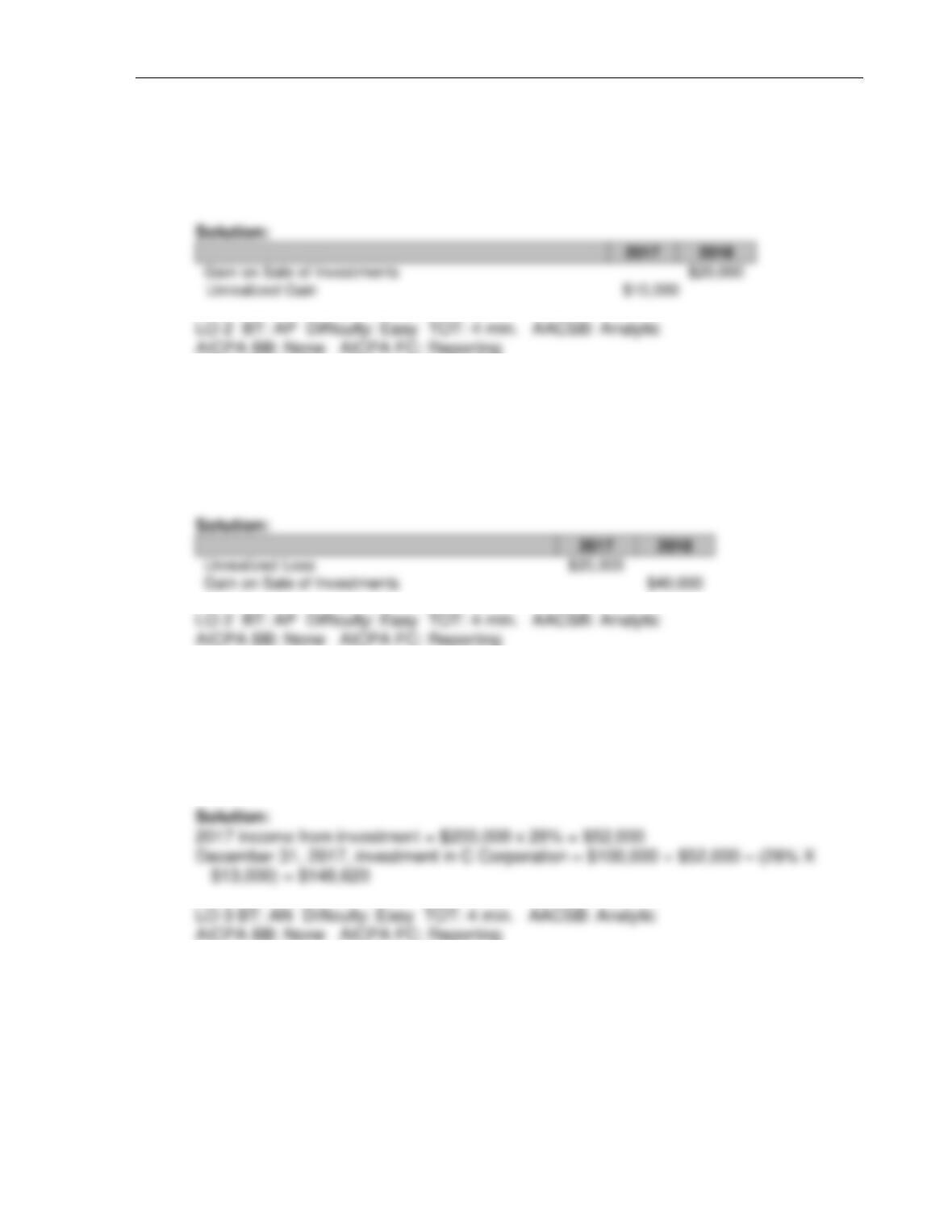
8. On December 31, 2017, short-term equity securities with an original cost of $10,000
have a carrying value on the balance sheet equal to their market value of $12,000. On
January 11, 2018, those securities are sold for $15,000. Prepare the appropriate entry to
record the sale of the securities.
9. On December 31, 2017, short-term equity securities with an original cost of $10,000
have a carrying value on the balance sheet equal to their market value of $12,000. On
January 5, 2018, those securities are sold for $10,000. Give the appropriate entry to
record the sale of the securities.
10. On December 31, 2017, short-term equity securities with an original cost of $45,000
have a market value of $47,000. On January 5, 2018, those securities are sold for
$41,000. Determine the gains or losses in 2017 and 2018 associated with these
securities, which are held as a passive investment. Clearly label whether the gains or
losses are realized or unrealized. Name the financial statement on which each is
reported.
Test Bank – Chapter 8 – Investments in Equity Securities 8-25
11. On December 31, 2017, short-term equity securities held as a passive investment, with
an original cost of $100,000, have a market value of $110,000. On January 11, 2018, the
securities are sold for $130,000. Determine the gains or losses in 2017 and 2018
associated with these securities that must be reported on the income statements.
Indicate whether the gains or losses are realized or unrealized.
12. On October 10, 2017, Marcus Inc. buys short-term equity securities with an original cost
of $100,000. On December 31, 2017, they have a market value of $80,000. On March 9,
2018, those securities are sold for $120,000. Determine the gains or losses in 2017 and
2018 associated with these securities that will be reported on the income statement.
Indicate whether the gains or losses are realized or unrealized.
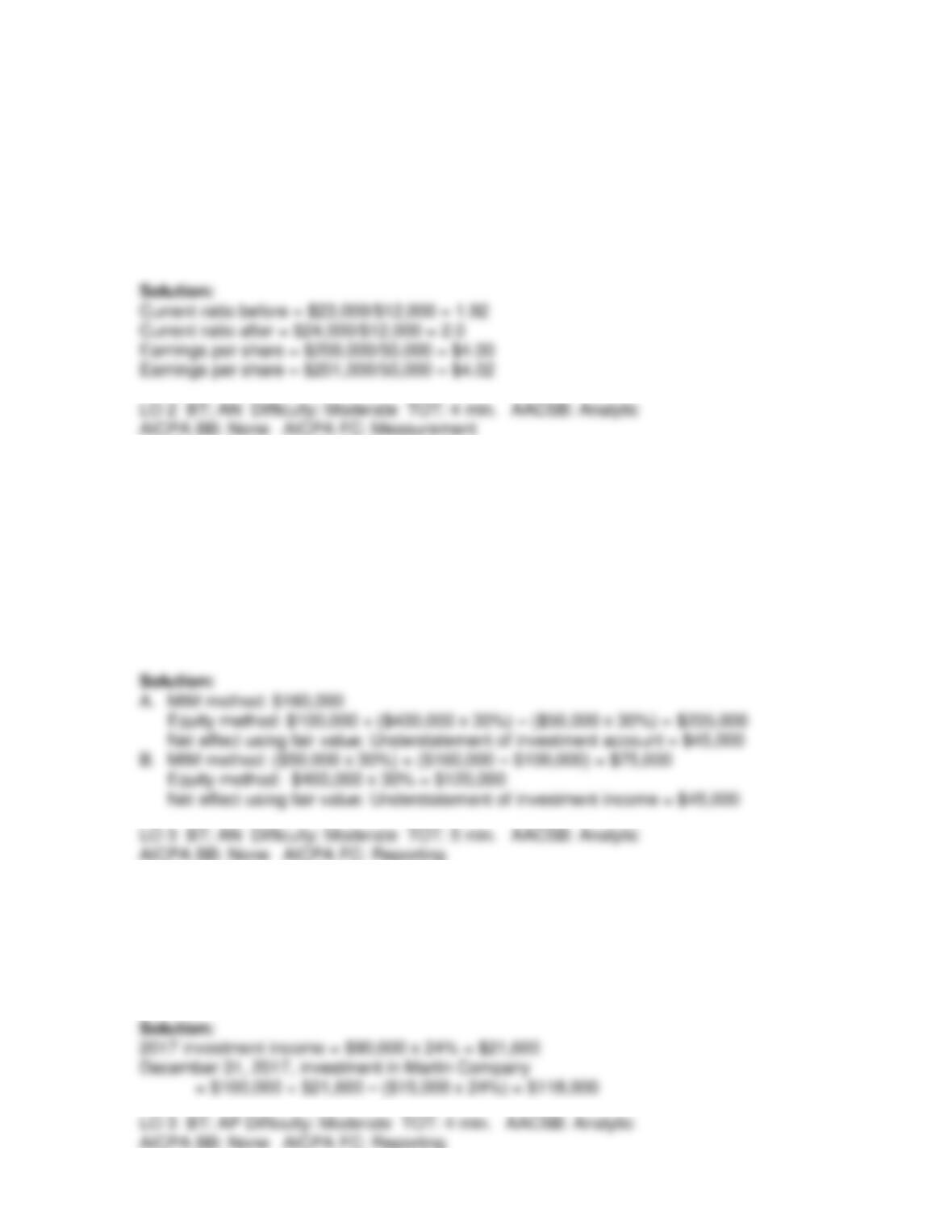
13. On January 4, 2017, Harrison Corp. purchased 26% of C Corporation’s voting stock for
$100,000. During 2017, C recorded income of $200,000 and paid total dividends of
$13,000. Harrison uses the equity method to account for this investment. Calculate
Harrison’s income from the C investment and the December 31, 2017, balance sheet
value of its long-term equity investment in C.
8-26 Test Bank – Chapter 8 – Investments in Equity Securities
14. Before adjusting its current passive investments in equity securities, Apex Company has
total current assets and current liabilities of $23,000 and $12,000, respectively. During
the current year, Apex has net income of $200,000 with 50,000 shares of common stock
outstanding. This amount excludes the effects of yearend adjustments related to the
investments. Included in current assets are equity securities recorded at their original
cost of $3,000. However, the current market value of those securities is $4,000 at
yearend. If Apex properly accounts for the securities, determine the effect on Apex’s
current ratio and earnings per share.
15. Falcon, Inc. acquired 30% of Dodson Corporation for $100,000 on December 31, 2016.
During the calendar year 2017, Dodson had net earnings of $400,000 and paid total
dividends of $50,000. The fair value of Dodson Corporation’s stock at yearend was
$160,000. Falcon mistakenly recorded these transactions using the mark-to-market
method rather than the equity method of accounting.
A. Determine the effect the error would have on the investment account at December
31, 2017.
B. Determine the effect the error would have on net income for the year ending
December 31, 2017.
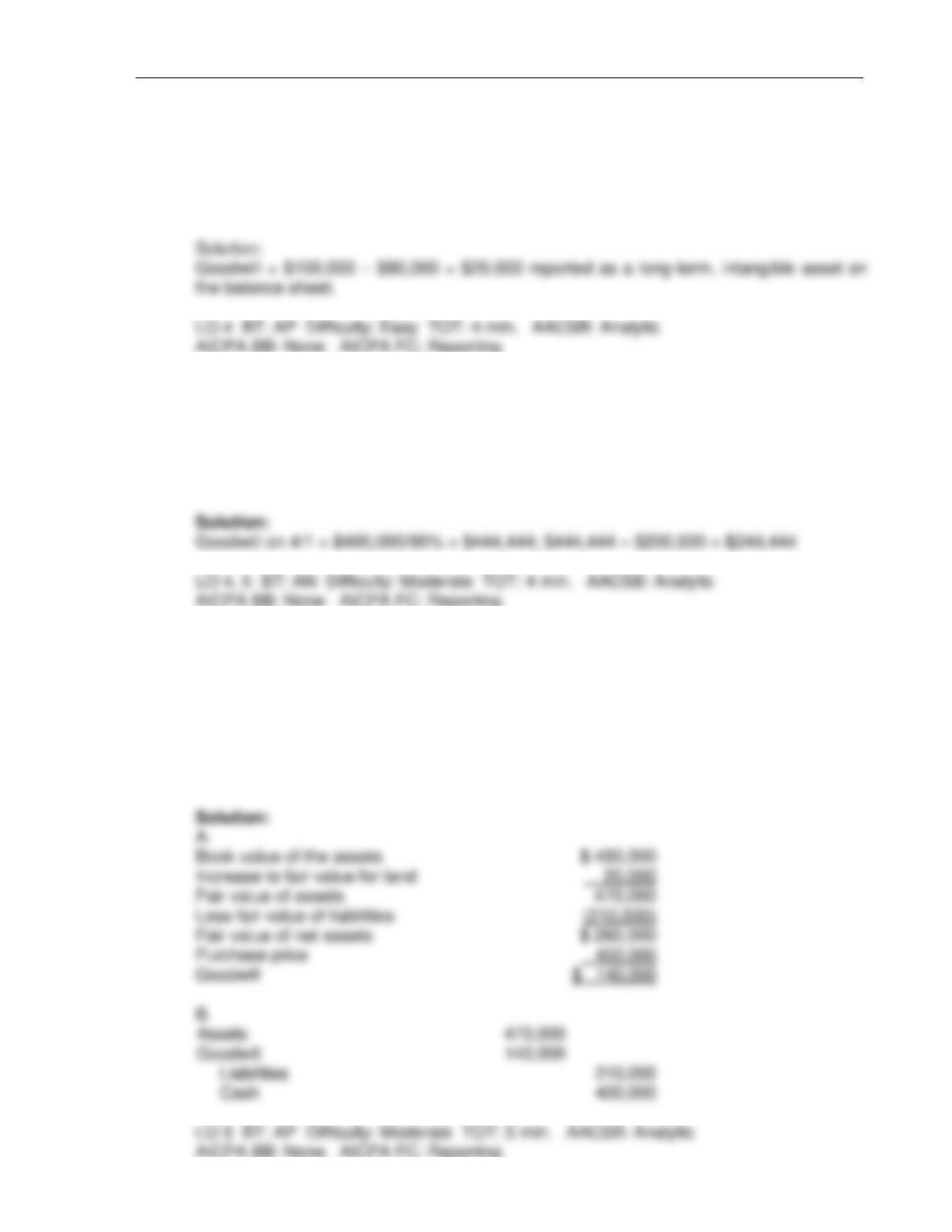
16. On January 3, 2017, Blanton Co. purchased 24% of Martin Company’s voting stock for
$100,000. During 2017, Martin recorded income of $90,000 and paid total dividends of
$15,000. Blanton uses the equity method to account for this investment. Calculate
Blanton’s income from the Martin investment and the December 31, 2017, balance sheet
value of its long-term equity investment in Martin. Show your work.
Test Bank – Chapter 8 – Investments in Equity Securities 8-27
17. On November 30, 2017, Arnold Company purchased 100% of the outstanding voting
common stock of Compton Corporation for $100,000. At that date the fair market value
of Compton assets less liabilities was $80,000. What amount, if any, of goodwill must
Arnold recognize in connection with its purchase of Compton? Where should Arnold
Company report this amount?
18. On April 1, 2017, Parrish Company purchased 90% of the outstanding voting common
stock of Hamilton Corporation for $400,000. At that date the fair market value of
Hamilton’s assets less liabilities was $200,000. What amount, if any, of goodwill must
Parrish recognize in its consolidated balance sheet on December 31, 2017? Show your
work.
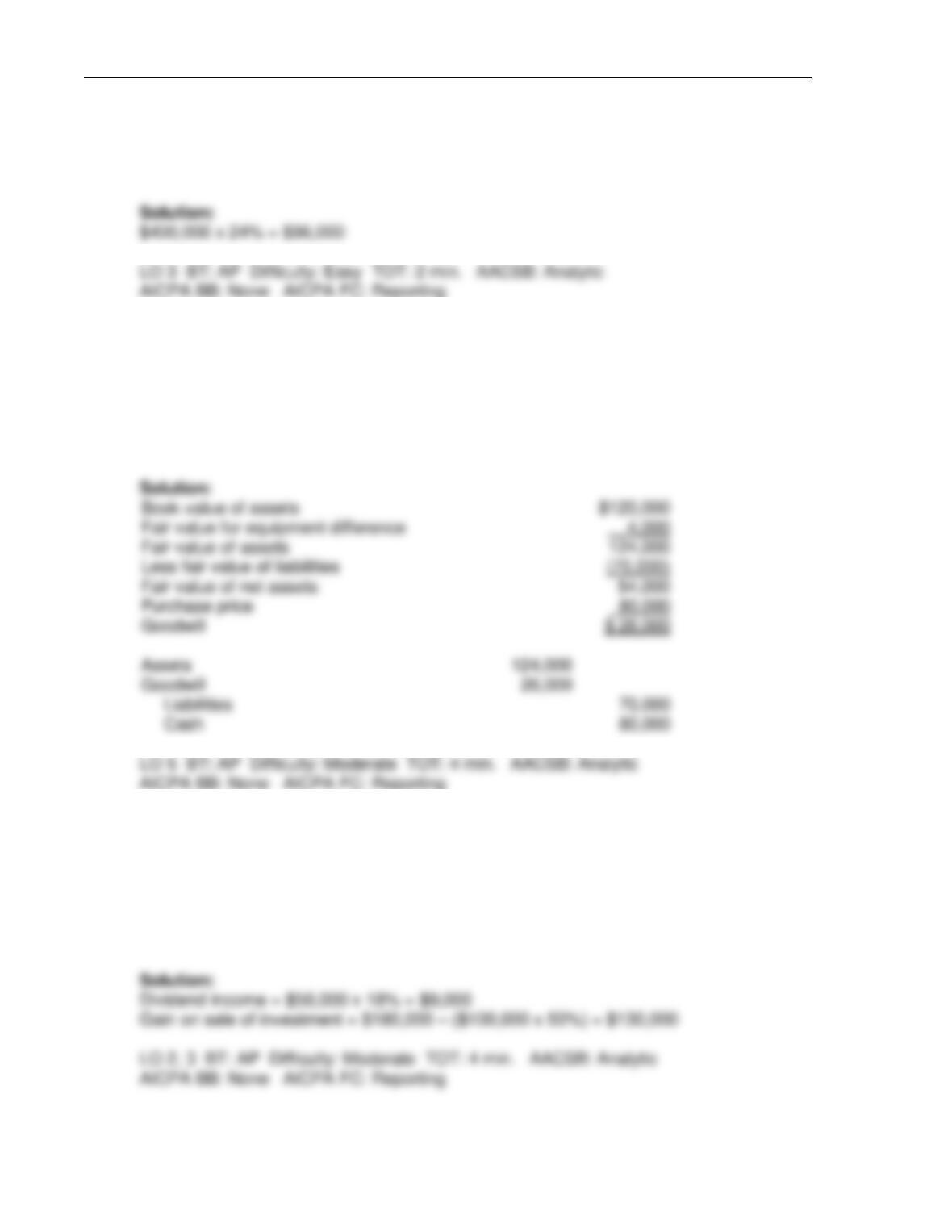
19. On January 1, 2017, Simpson Company purchased all of the assets and assumed all of
the liabilities of Dobson Company for $400,000. Dobson’s balance sheet showed total
assets of $450,000 and total liabilities of $210,000 of this date. An appraiser determined
all assets except for land are valued at fair market value. The land is worth $20,000
more than its book value.
A. Calculate goodwill in connection with this business combination.
B. Prepare the journal entry to record the combination.
8-28 Test Bank – Chapter 8 – Investments in Equity Securities
20. On December 31, 2017, Celtic Inc. acquired a 24% interest in Romano Corp. for
$100,000 and appropriately applied the equity method. During 2017, Romano had net
income of $400,000 and paid cash dividends of $50,000. How much will Celtic report for
the year ending December 31, 2018 on its income statement? Show your work.
21. On January 1, 2017, Danner Company purchased all of the assets and assumed all of the
liabilities of Clancy Company for cash of $80,000. Clancy’s balance sheet showed total
assets of $120,000 and total liabilities of $70,000. The equipment had a fair market value
on the same date of $10,000 instead of the $6,000 reported on the balance sheet.
Calculate goodwill in connection with this business combination. Prepare the journal entry
to record the combination.
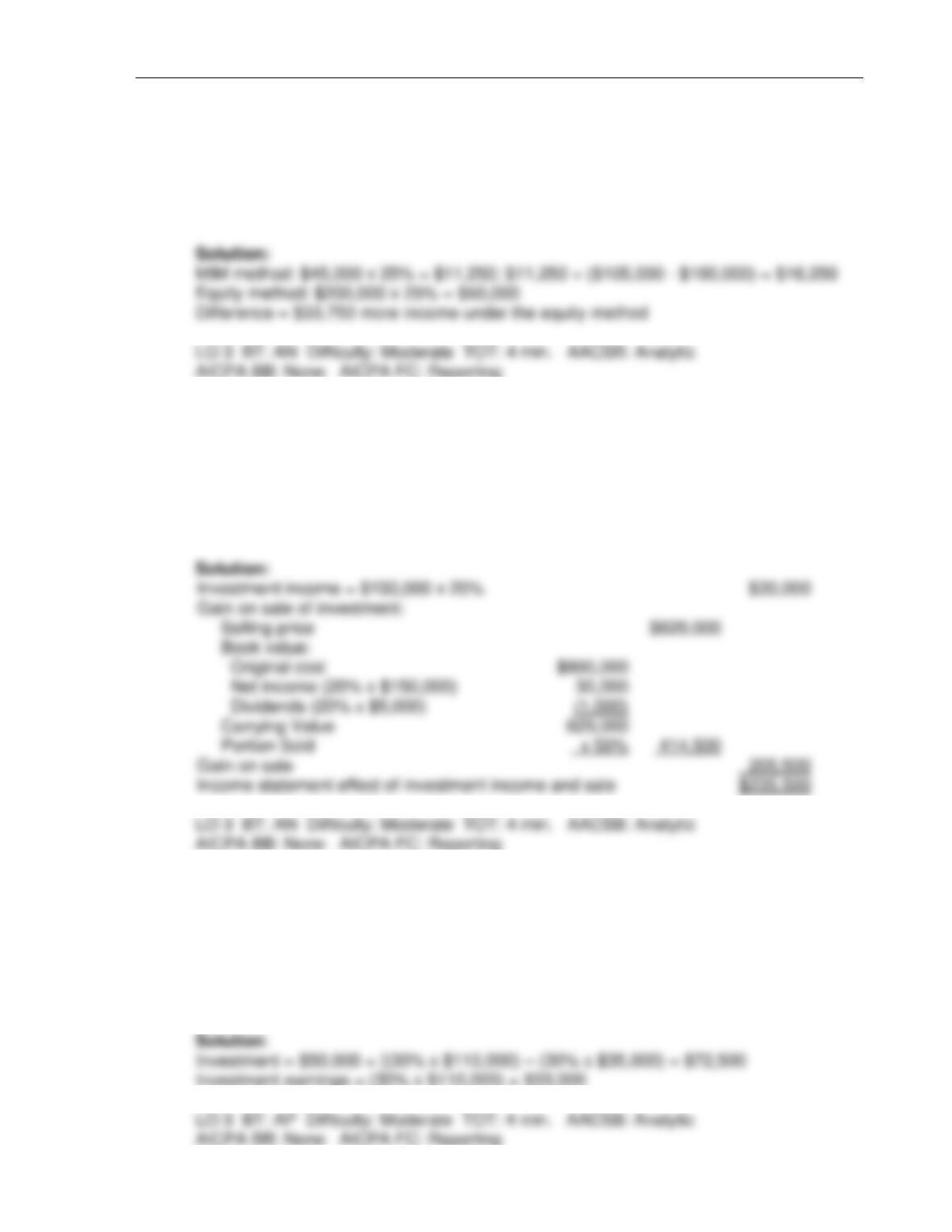
22. On December 31, 2017, Rory Corp. acquired an 18% interest in Batson Corp. for
$100,000 and appropriately applied the mark-to-market method. During 2018, Batson
had net income of $200,000 and paid cash dividends of $50,000. On the last day of
2018, Rory sold one-half of its investment in Batson Corp. for $180,000. How much
should Rory report on its income statement for the year ending December 31, 2018?
Show your work.
Test Bank – Chapter 8 – Investments in Equity Securities 8-29
23. York Corporation owns 25% of Carson, Inc. that it purchased on January 1, 2017, for
$100,000. York uses the mark-to-market method for accounting for its investment in
Carson, Inc. During 2017, Carson, Inc. paid a total of $45,000 of dividends and recorded
income of $200,000. The fair market value of the investment at yearend is $105,000.
Determine how much York’s net income would differ if it used the equity method instead
of the mark-to-market method. Show your work.
24. On December 31, 2017, Tanner Corp. acquired a 20% interest in Gantry Corp. for
$800,000 and appropriately applied the equity method. During 2018, Gantry had net
income of $150,000 and paid cash dividends of $5,000. On last day of 2018, Tanner
sold one-half of its investment in Gantry Corp. for $620,000. How much should Tanner
report on its income statement for the year ending December 31, 2018? Show your
work.
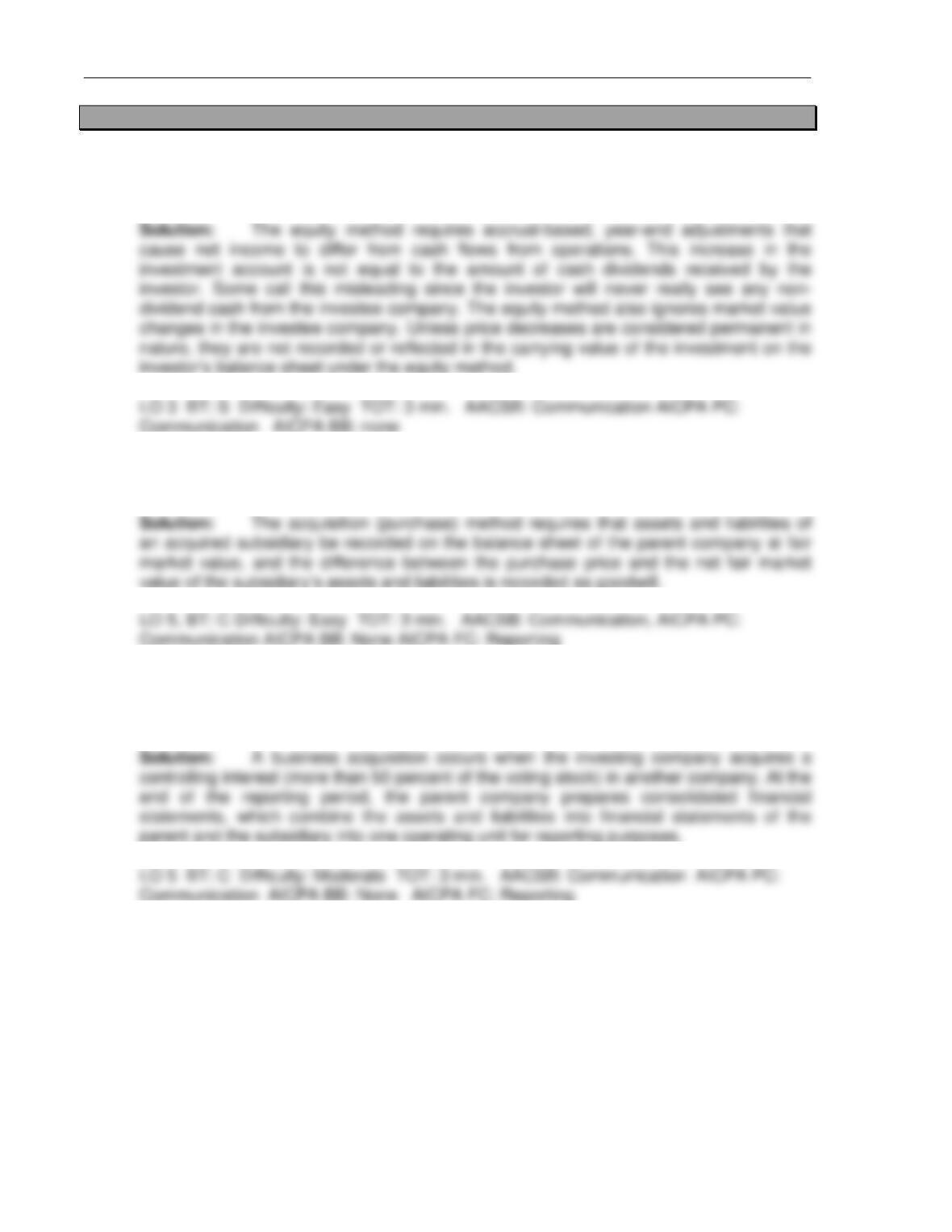
25. On January 2, 2018, Merton Co. acquired 30 percent of the outstanding voting common
stock of Tilton, Inc., at a cost of $50,000. With this investment, Merton has the ability to
exercise significant influence over Tilton, Inc. During 2018, Tilton, Inc. reported net
income of $110,000 and paid total cash dividends of $35,000. What amount should be
reported as investment and investment earnings by Merton for the year ending
December 31, 2018? Show your work.
8-30 Test Bank – Chapter 8 – Investments in Equity Securities
SHORT ESSAY QUESTIONS
1. Why should users be cautious when examining financial statements in which the
company has accounted for investments using the equity method?
2. How is the acquisition (purchase) method used in accounting for business acquisitions?
3. How does the concept of “consolidated financial statements” relate to a business
acquisition?
Test Bank – Chapter 8 – Investments in Equity Securities 8-31
4. What are several features about the equity method that should cause financial report
users to view it carefully?
5. What is the concept of ‘noncontrolling interest’?
6. What two criteria must be met for an investment in a security to be considered as current
on an investor’s balance sheet?
8-32 Test Bank – Chapter 8 – Investments in Equity Securities
7. How does the concept of ‘merger’ differ from an ‘acquisition’?
8. List the primary reasons a company might invest in equity securities. Explain how each
of these reasons helps to achieve the primary goal of a business entity—to make profit.
9. Explain how passive investments in equity securities are accounted for, and indicate
what different events must be accounted for.
Test Bank – Chapter 8 – Investments in Equity Securities 8-33
10. Explain how the transactions involving passive investments in equity securities affect the
balance sheet and income statement.
8-34 Test Bank – Chapter 8 – Investments in Equity Securities
11. Explain how the original amount for goodwill is determined, and how goodwill is amortized.
Test Bank – Chapter 8 – Investments in Equity Securities 8-35
IFRS QUESTIONS
1. IFRS has an option for which assets to be reported at fair value?
a. Equity investments but not plant assets
b. Plant assets but not equity investments
c. Equity investments and plant assets
d. Neither equity investments nor plant assets.
2. Under GAAP, investee companies that are 20 to 50 percent owned by investor
companies are often referred to as affiliate companies. Under IFRS, affiliate companies
are referred as:
a. Sister companies
b. Associate companies
c. Brother companies
d. Subordinate companies