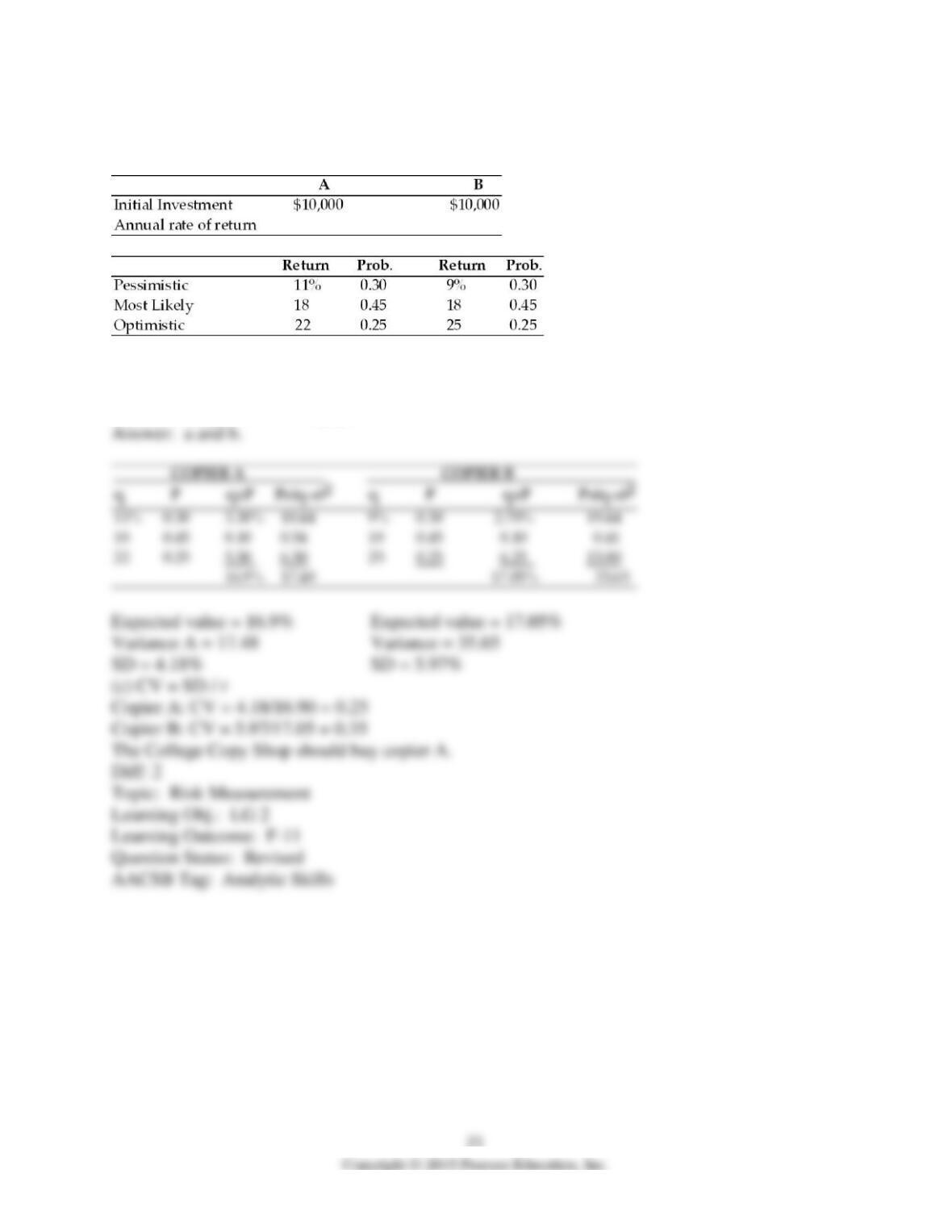
37) The College Copy Shop is in process of purchasing a high-tech copier. In its search, it has
gathered the following information about two possible copiers A and B.
(a) Compute expected rate of return for each copier.
(b) Compute variance and standard deviation of rate of return for each copier.
(c) Which copier should they purchase?
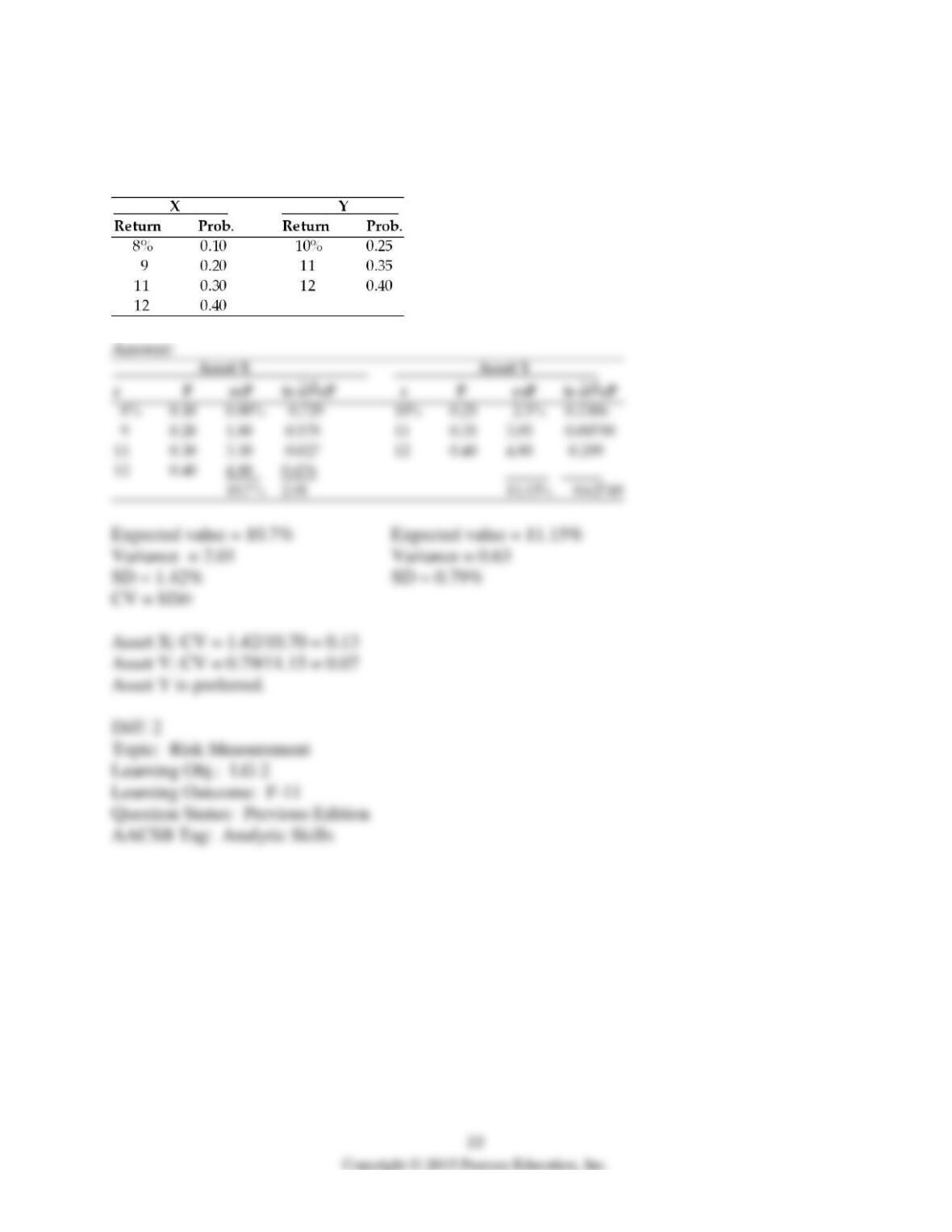
38) Given the following probability distribution for assets X and Y, compute the expected rate of
return, variance, standard deviation, and coefficient of variation for the two assets. Which asset is
a better investment?

23
8.3 Discuss the measurement of return and standard deviation for a portfolio and the concept of
correlation.
1) An efficient portfolio is a portfolio that maximizes return for a given level of risk or
minimizes risk for a given level of return.
2) New investments must be considered in light of their impact on the risk and return of the
portfolio of assets because the risk of any single proposed asset investment is not independent of
other assets.
3) A financial manager’s goal for the firm is to create a portfolio that maximizes return for a
given level of risk.
4) Two assets whose returns move in the same direction and have a correlation coefficient of +1
are very risky assets.

5) Two assets whose returns move in the opposite directions and have a correlation coefficient of
-1 are either risk-free assets or low-risk assets.
6) The standard deviation of a portfolio is a function of the standard deviations of the individual
securities in the portfolio, the proportion of the portfolio invested in those securities, and the
correlation between the returns of those securities.
7) A(n) ________ portfolio maximizes return for a given level of risk, or minimizes risk for a
given level of return.
A) efficient
B) risk-free
C) risk-neutral
D) risk-indifferent
8) An efficient portfolio is defined as ________.
A) grouping of assets with same level of risk
B) collection of assets with the aim of maximizing the return
C) an investment in a single asset
D) grouping of assets with the highest possible correlation
9) The goal of an efficient portfolio is to ________.
A) achieve a predetermined rate of return for a given level of risk
B) maximize risk in order to maximize profit
C) minimize profit in order to minimize risk
D) minimize risk for a given level of return
10) An efficient portfolio is one that ________.
A) guarantees a predetermined rate of return
B) maximizes return for a given level of risk
C) consists of a single asset, which gives maximum return
D) maximizes return at all risk levels
11) An investment advisor has recommended a $50,000 portfolio containing assets R, J, and K;
$25,000 will be invested in asset R, with an expected annual return of 12 percent; $10,000 will
be invested in asset J, with an expected annual return of 18 percent; and $15,000 will be invested
in asset K, with an expected annual return of 8 percent. The expected annual return of this
portfolio is ________.
A) 12.67%
B) 12.00%
C) 10.00%
D) 11.78%

12) Given the returns of two stocks J and K in the table below over the next 4 years. Find the
expected return and standard deviation of holding a portfolio of 40% of stock J and 60% in stock
K over the next 4 years:
Stock J
Stock K
2010
10%
9%
2011
12%
8%
2012
13%
10%
2013
15%
11%
A) 10.7% and 1.34%
B) 10.6% and 1.79%
C) 10.6% and 1.16%
D) 14.3% and 2.02%
13) ________ is a statistical measure of the relationship between any two series of numbers.
A) Coefficient of variation
B) Standard deviation
C) Correlation
D) Probability

14) Perfectly ________ correlated series move exactly together and have a correlation coefficient
of ________, while perfectly ________ correlated series move exactly in opposite directions and
have a correlation coefficient of ________.
A) negatively; -1; positively; +1
B) negatively; +1; positively; -1
C) positively; -1; negatively; +1
D) positively; +1; negatively; -1
15) Combining negatively correlated assets having the same expected return results in a portfolio
with ________ level of expected return and ________ level of risk.
A) a higher; a lower
B) the same; a higher
C) the same; a lower
D) a lower; a higher

Table 8.1
16) The correlation of returns between Asset A and Asset B can be characterized as ________.
(See Table 8.1)
A) perfectly positively correlated
B) perfectly negatively correlated
C) uncorrelated
D) partially correlated
17) If you were to create a portfolio designed to reduce risk by investing equal proportions in
each of two different assets, which portfolio would you recommend? (See Table 8.1)
A) Assets A and B
B) Assets A and C
C) none of the available combinations
D) cannot be determined
18) The portfolio with a standard deviation of zero ________. (See Table 8.1)
A) is comprised of Assets A and B
B) is comprised of Assets A and C
C) is not possible
D) cannot be determined
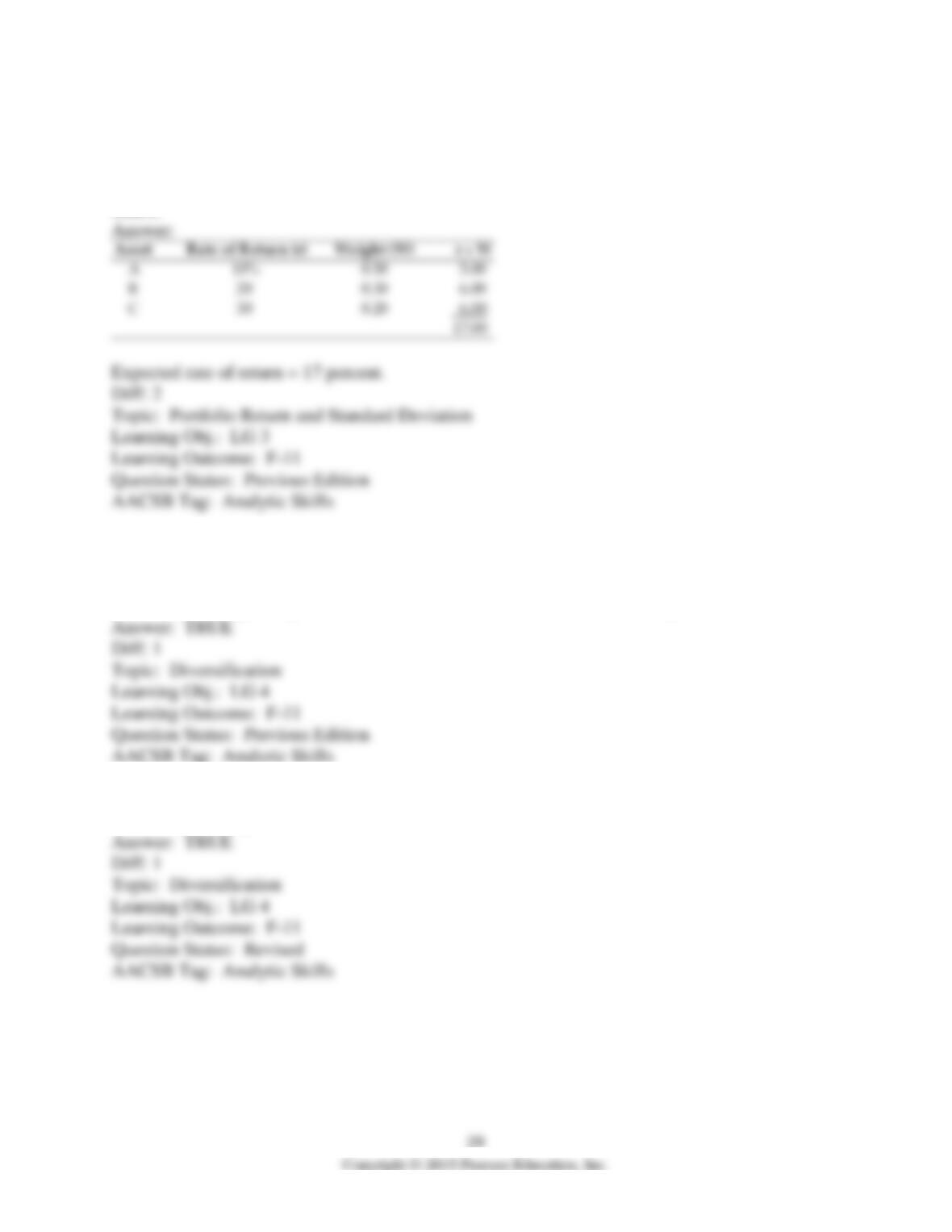
19) Akai has a portfolio of three assets. Find the expected rate of return for the portfolio
assuming he invests 50 percent of its money in asset A with 10 percent rate of return, 30 percent
in asset B with a rate of return of 20 percent, and the rest in asset C with 30 percent rate of
return.
8.4 Understand the risk and return characteristics of a portfolio in terms of correlation and
diversification and the impact of international assets on a portfolio.
1) Combining negatively correlated assets can reduce the overall variability of returns.
2) Even if assets are not negatively correlated, lower the positive correlation between them, the
lower the resulting risk.

3) In general, the lower the correlation between asset returns, the greater the potential
diversification of risk.
4) A portfolio of two negatively correlated assets has less risk than either of the individual assets.
5) Under no circumstances, adding assets to a portfolio would result in greater risk than that of
the riskiest asset included in the portfolio.
6) A portfolio that combines two assets having perfectly positive correlation returns cannot
reduce the portfolio’s overall risk below the risk of the least risky asset.

7) A portfolio combining two assets with less than perfectly positive correlation can reduce total
risk to a level below that of either of the components.
8) Uncorrelated assets have correlation coefficient close to zero.
9) Combining uncorrelated assets can reduce risk—not as effectively as combining negatively
correlated assets, but more effectively than combining positively correlated assets.
10) A firm produces goods which has high sales when the economy is expanding and low sales
during a recession. This firm’s overall risk will be higher if it invests in another product which is
counter cyclical.

11) A portfolio combining two assets whose returns are less than perfectly positive correlated
can increase total risk to a level above that of either of the components.
12) The creation of a portfolio by combining two assets having perfectly positively correlated
returns cannot reduce the portfolio’s overall risk below the risk of the least risky asset.
13) The risk of a portfolio containing international stocks generally contains less nondiversifiable
risk than one that contains only domestic stocks.
14) The inclusion of assets from countries with business cycles that are not highly correlated
with the U.S. business cycle reduces the portfolio’s responsiveness to market movements.

15) Returns from internationally diversified portfolios tend to be superior to those yielded by
purely domestic ones.
16) The inclusion of assets from countries that are less sensitive to the U.S. business cycle
reduces the portfolio’s responsiveness to market movement and to foreign currency fluctuation.
17) When the U.S. currency gains in value, the dollar value of a foreign-currency-denominated
portfolio of assets decline.
18) The risk of a portfolio containing international stocks generally does not contain less
nondiversifiable risk than one that contains only domestic stocks.

19) Combining two negatively correlated assets to reduce risk is known as ________.
A) diversification
B) valuation
C) securitization
D) risk aversion
20) Lower (less positive and more negative) the correlation between asset returns, ________.
A) lesser the potential diversification of risk
B) greater the potential diversification of risk
C) lower the potential profit
D) lesser the assets have to be monitored
21) Combining two assets having perfectly negatively correlated returns will result in the
creation of a portfolio with an overall risk that ________.
A) remains unchanged
B) decreases to a level below that of either asset
C) increases to a level above that of either asset
D) stabilizes to a level between the asset with the higher risk and the asset with the lower risk

22) Combining two assets having perfectly positively correlated returns will result in the creation
of a portfolio with an overall risk that ________.
A) remains unchanged
B) decreases to a level below that of either asset
C) increases to a level above that of either asset
D) lies between the asset with the higher risk and the asset with the lower risk
8.5 Review the two types of risk and the derivation and role of beta in measuring the relevant
risk of both a security and a portfolio.
1) Total security risk is the sum of a security’s nondiversifiable and diversifiable risk.
2) Total security risk is attributable to firm-specific events, such as strikes, lawsuits, regulatory
actions, or the loss of a key account.
3) As any investor can create a portfolio of assets that will eliminate all, or virtually all,
nondiversifiable risk, the only relevant risk is diversifiable risk.

4) Diversifiable risk is the relevant portion of risk attributable to market factors that affect all
firms.
5) Diversified investors should be concerned solely with nondiversifiable risk because it can
create a portfolio of assets that will eliminate all, or virtually all, diversifiable risk.
6) Nondiversifiable risk reflects the contribution of an asset to the risk, or standard deviation, of
the portfolio.
7) Systematic risk is that portion of an asset’s risk that is attributable to firm-specific, random
causes.

8) Unsystematic risk can be eliminated through diversification.
9) Unsystematic risk is the relevant portion of an asset’s risk attributable to market factors that
affect all firms.
10) The required return on an asset is an increasing function of its nondiversifiable risk.
11) The empirical measurement of beta can be approached by using least-squares regression
analysis to find the regression coefficient (bj) in the equation for the slope of the “characteristic
line.”

12) Investors should recognize that betas are calculated using historical data and that past
performance relative to the market average may not accurately predict future performance.
13) Beta coefficient is an index that measures the degree of movement of an asset’s return in
response to a change in the market return.
14) Beta coefficient is an index of the degree of movement of an asset’s return in response to a
change in the risk-free asset.
15) The beta of a portfolio is a function of the standard deviations of the individual securities in
the portfolio, the proportion of the portfolio invested in those securities, and the correlation
between the returns of those securities.

16) Systematic risk is also referred to as ________.
A) business specific risk
B) internal risk
C) nondiversifiable risk
D) maturity risk
17) Risk that affects all firms is called ________.
A) maturity risk
B) unsystematic risk
C) nondiversifiable risk
D) reinvestment risk
18) The portion of an asset’s risk that is attributable to firm-specific, random causes is called
________.
A) unsystematic risk
B) nondiversifiable risk
C) market risk
D) political risk

19) Relevant portion of an asset’s risk attributable to market factors that affect all firms is called
________.
A) credit risk
B) diversifiable risk
C) systematic risk
D) maturity risk
20) ________ risk represents the portion of an asset’s risk that can be eliminated by combining
assets with less than perfect positive correlation.
A) Diversifiable
B) Market
C) Systematic
D) Economic
21) Unsystematic risk ________.
A) does not change
B) can be eliminated through diversification
C) cannot be estimated
D) affects all firms in a market