Receivables ♦ 405
3. Explain the effect on the financial statements of writing off an uncollectible account under the
allowance method.
4. Explain the effect on the financial statements when an account is written off under the direct write-
off method.
5. What kind of account is the “Allowance for Doubtful Accounts?” On what financial statement
does it appear? Where is it classified?
6. Explain what is meant by the term “net realizable value” as applied to receivables. What does it
equal?
7. Under the allowance method, which approach to estimating—based on sales or based on aging of
receivables—results in a better balance sheet versus a better income statement? Explain why.
406 ♦ Chapter 8
8. Explain the effect on the financial statements when a company estimates uncollectible accounts
expense under the allowance method.
9. Explain whether the allowance method or the direct write-off method results in a better
presentation of accounts receivable on the balance sheet.
10. Discuss the difference between the face amount of the note from the maturity value of a note.
11. List the three basic steps in managing accounts receivable and briefly explain each.
Receivables ♦ 407
12. Discuss what the accounts receivable turnover ratio measures.
13. Discuss what the number of days’ sales in receivables measures.
PROBLEM
1. During the first year of operations, a company generated $940,000 in net sales and reported
$152,000 in net income. At fiscal year end accounts receivable had a balance of $103,000 after
uncollectible account write-offs of $4,300. The company used the direct write-off method of
accounting for uncollectibles. Had the allowance method been used instead, 1% of net sales would
have been estimated as uncollectible.
(a)
Prepare the entry made by the company to record uncollectibles.
(b)
Prepare the entry to record uncollectibles if the company used the allowance method instead
(c)
Determine what net income would have been had the allowance method been used.
(d)
Calculate net accounts receivable under both the direct write-off and allowance methods.
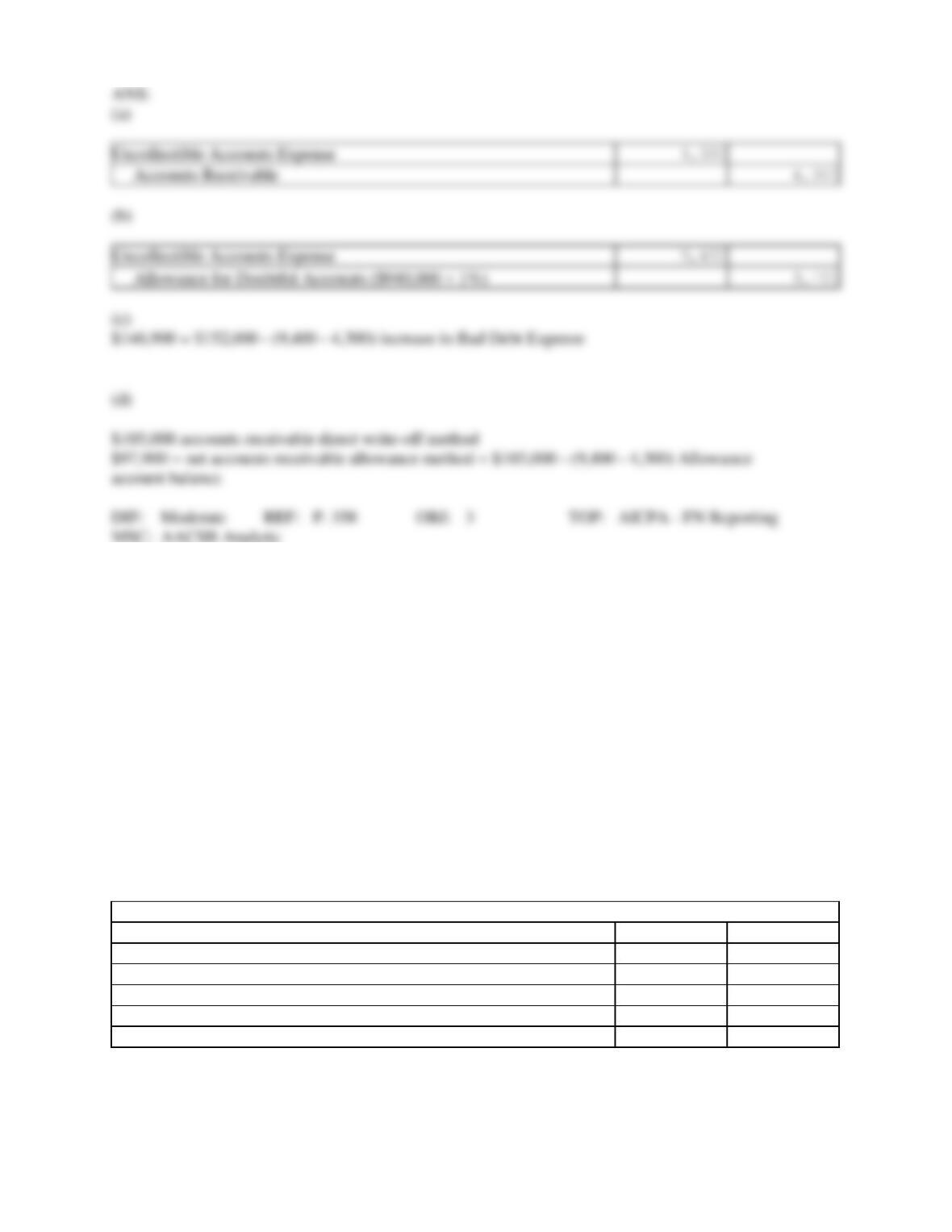
General Journal
408 ♦ Chapter 8
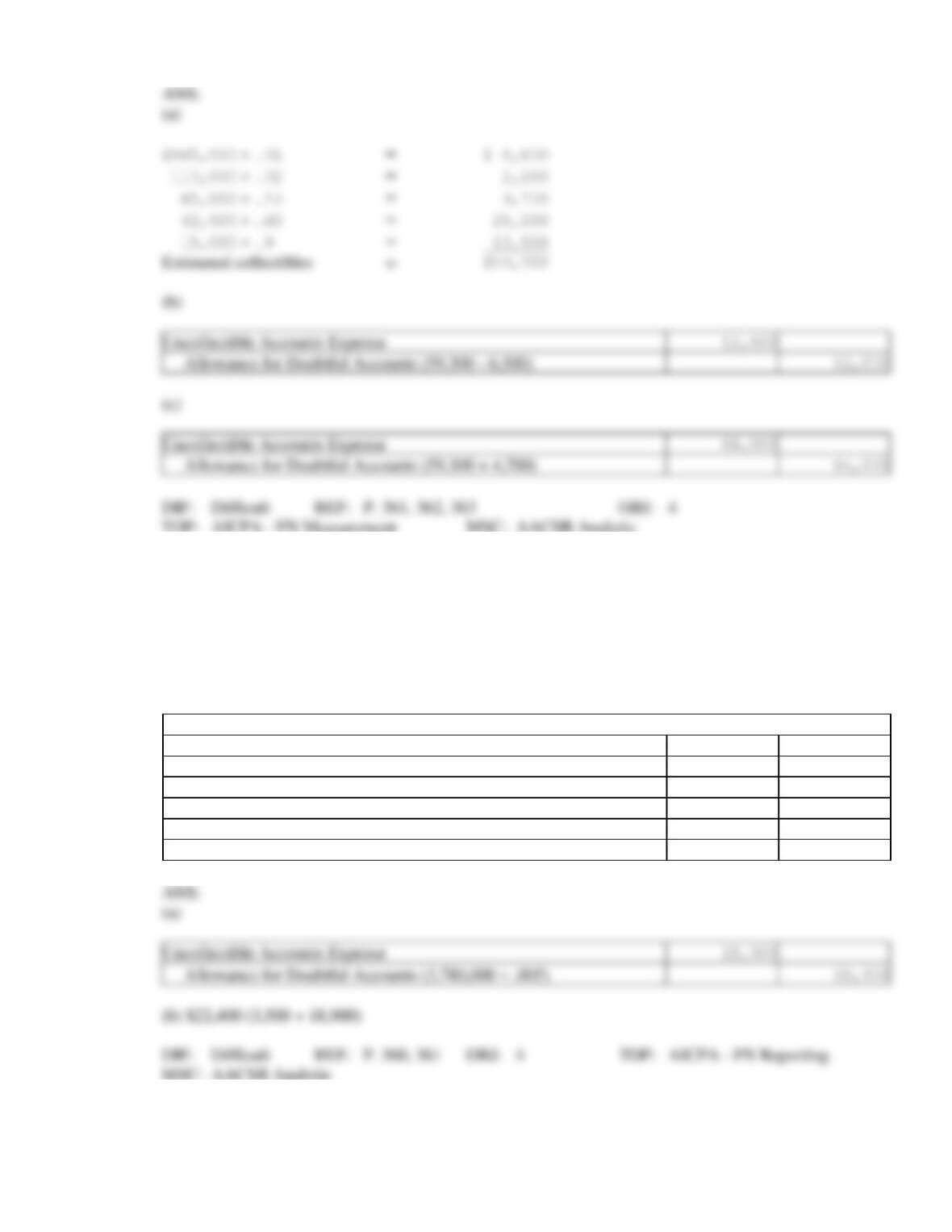
2. A company ages its accounts receivable as follows:
Age Interval
Balance
Percent Uncollectible
Not past due
$865,000
1%
1-30 days past due
110,000
2%
31-90 days past due
65,000
15%
91-180 days past due
42,000
60%
over 180 days past due
15,000
90%
(a)
Estimate what the proper balance of the allowance for doubtful accounts should be at fiscal year end.
(b)
Assuming the allowance for doubtful accounts has a credit balance of $6,500 prior to adjustment,
prepare the adjusting entry to record uncollectibles at fiscal year end.
(c)
Assuming the allowance for doubtful accounts has a debit balance of $4,700 prior to adjustment,
prepare the adjusting entry to record uncollectibles at fiscal year end.
General Journal
Uncollectible Accounts Expense
Accounts Receivable
Uncollectible Accounts Expense
Allowance for Doubtful Accounts ($940,000 1%)
Receivables ♦ 409
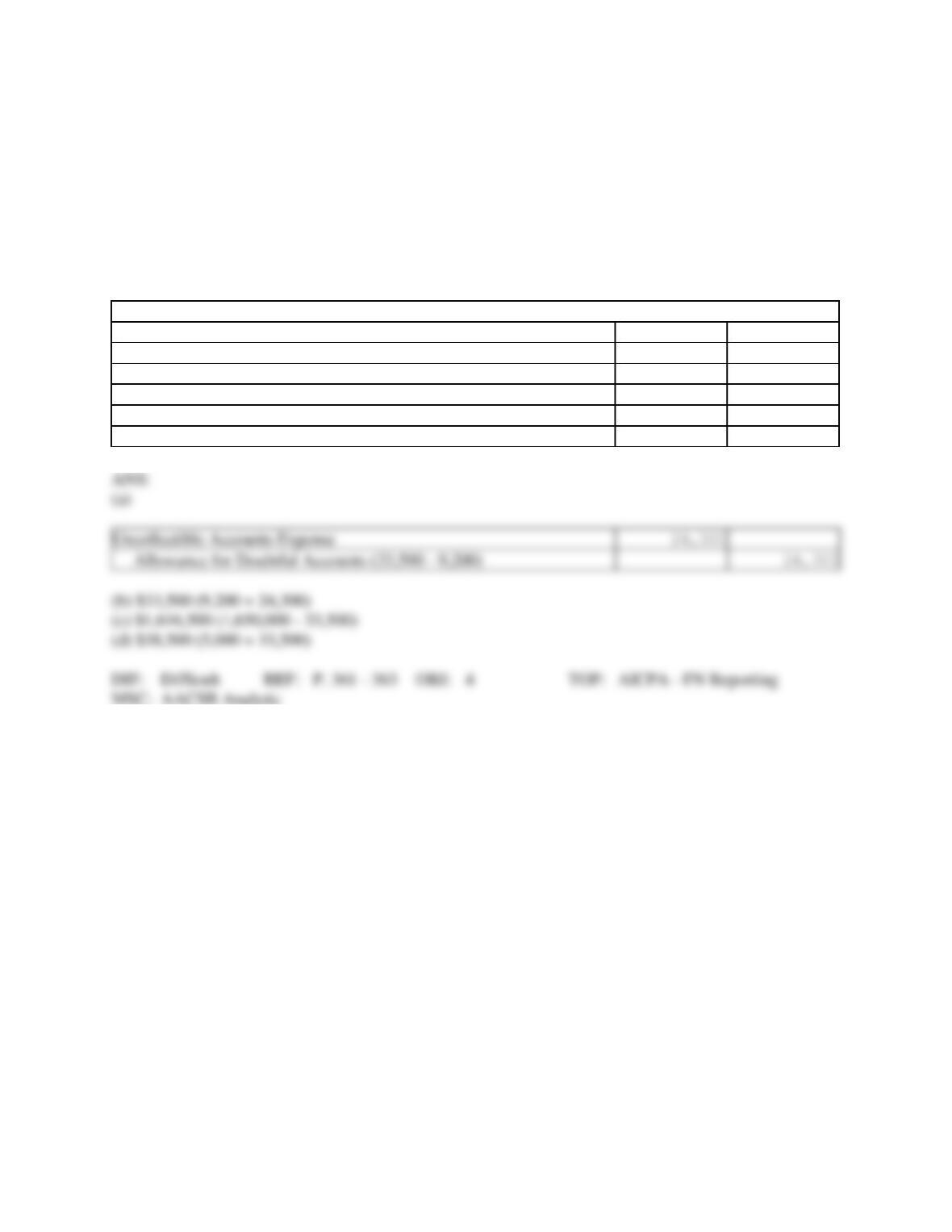
3. At fiscal year end accounts receivable has a debit balance of $565,000 and the allowance for
doubtful accounts has a credit balance of $3,500 prior to adjustment. Net credit sales for the year
total $3,780,000 and uncollectible accounts expense is estimated at one-half of 1% of net sales.
(a)
Prepare the adjusting entry to record uncollectible accounts expense for the year.
(b)
Calculate the balance in the allowance for doubtful accounts after adjustment.
General Journal
Uncollectible Accounts Expense
Allowance for Doubtful Accounts (3,780,000 .005)
Estimated collectibles
=
Uncollectible Accounts Expense
Allowance for Doubtful Accounts (59,300 – 6,500)
Uncollectible Accounts Expense
Allowance for Doubtful Accounts (59,300 + 4,700)
410 ♦ Chapter 8
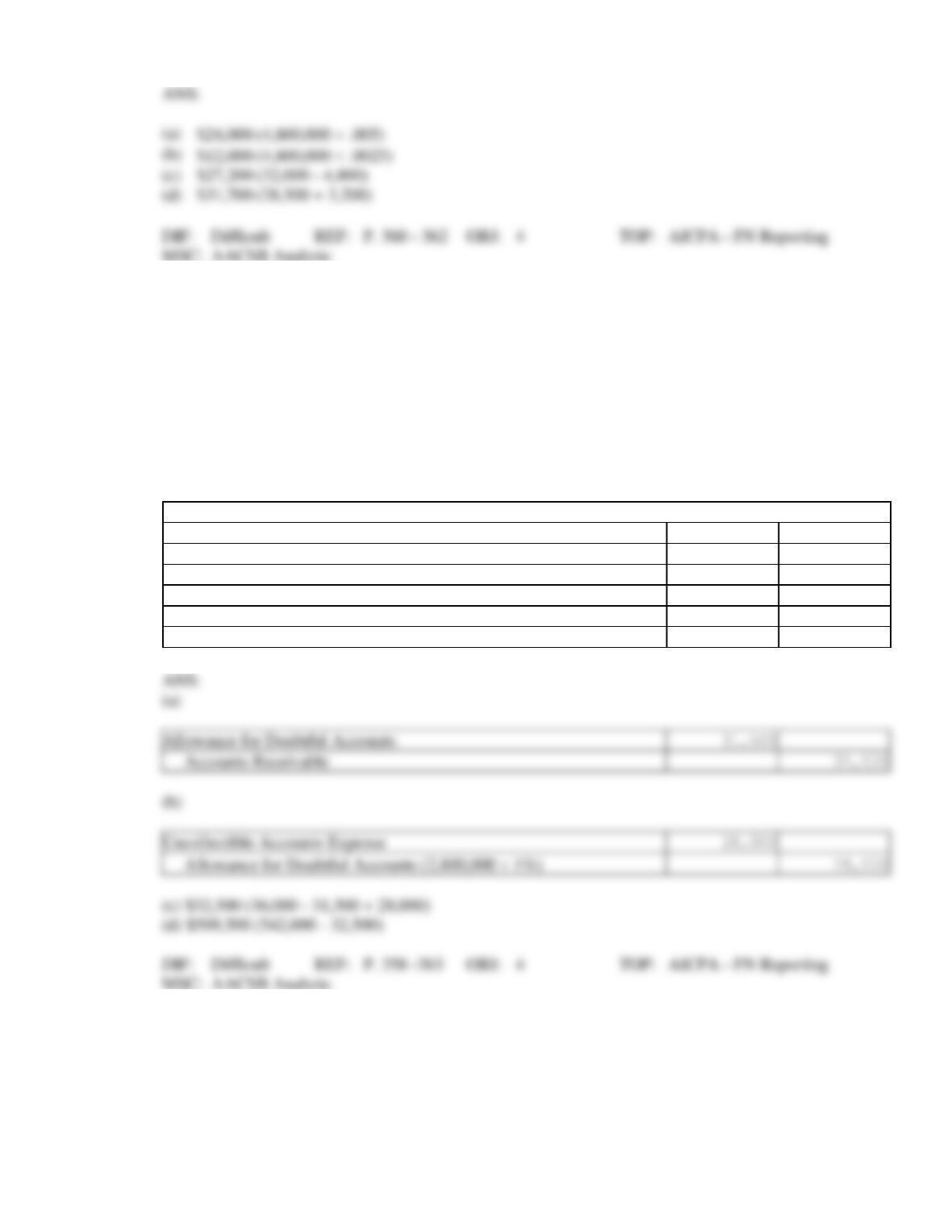
4. Accounts receivable has a balance of $1,650,000 and the Allowance for Doubtful Accounts has a
credit balance of $9,200 at fiscal year end prior to adjustment. The estimate of uncollectible
accounts determined by the aging of receivables is $33,500.
(a)
Prepare the year end adjustment to record uncollectible accounts expense.
(b)
Calculate the balance in the allowance for doubtful accounts after adjustment
(c)
Calculate net accounts receivable.
(d)
Calculate uncollectible accounts expense for the year assuming the allowance for doubtful accounts
has debit balance of $5,000 instead at fiscal year end prior to adjustment.
General Journal
5. At fiscal year end, the accounts receivable account has a debit balance of $642,000 and net sales
for the year total $4,800,000. Calculate uncollectible accounts expense under each of the following
assumptions:
(a)
Uncollectible accounts expense is estimated at one-half of 1% of net sales and the allowance for
doubtful accounts has a credit balance of $3,500 prior to adjustment.
(b)
Uncollectible accounts expense is estimated at one-fourth of 1% of net sales and the allowance for
doubtful accounts has a debit balance of $1,400 prior to adjustment.
(c)
An aging of the customer accounts indicate estimated uncollectible accounts of $32,000 and the
allowance for doubtful accounts has credit balance of $4,800 prior to adjustment.
(d)
An aging of the customer accounts indicate estimated uncollectible accounts of $28,500 and the
allowance for doubtful accounts has debit balance of $3,200 prior to adjustment.
Uncollectible Accounts Expense
Allowance for Doubtful Accounts (33,500 – 9,200)
Receivables ♦ 411
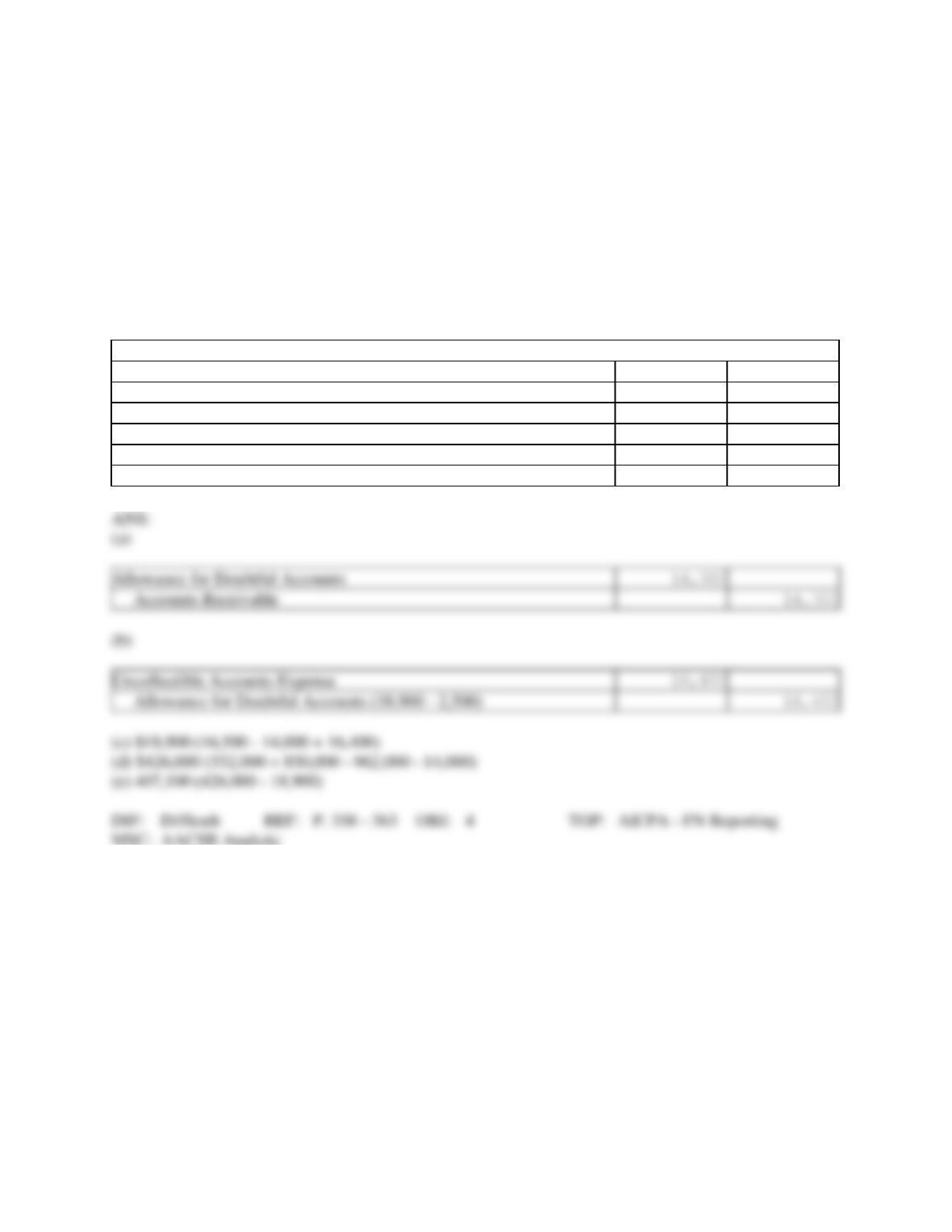
6. The allowance for doubtful accounts has a credit balance of $36,000 at the beginning of the fiscal
year. During the year, $31,500 of uncollectible accounts are written off. Net sales for the year total
$2,800,000 and uncollectible accounts expense is estimated at 1% of net sales. Accounts
receivable at year end total $542,000.
(a)
Prepare the entry to write off uncollectibles during the year using the allowance method.
(b)
Prepare the entry to record estimated uncollectible accounts expense for the fiscal year.
(c)
Calculate the balance in the allowance for doubtful accounts.
(d)
Calculate net accounts receivable.
General Journal
Allowance for Doubtful Accounts
Accounts Receivable
Uncollectible Accounts Expense
Allowance for Doubtful Accounts (2,800,000 1%)
$24,000 (4,800,000 .005)
$12,000 (4,800,000 .0025)
(c)
$27,200 (32,000 – 4,800)
(d)
$31,700 (28,500 + 3,200)
412 ♦ Chapter 8
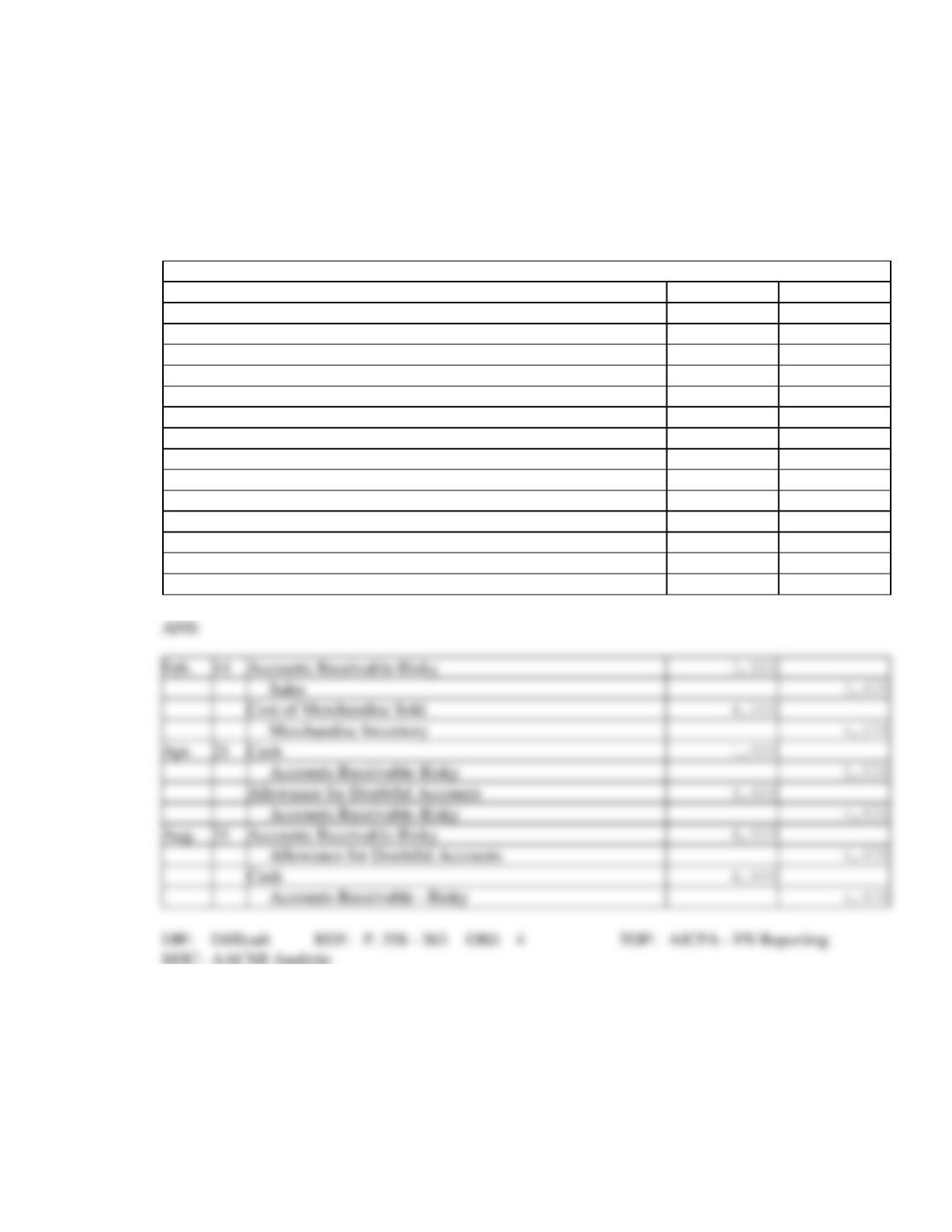
7. Accounts receivable has a balance of $552,000 and the allowance for doubtful accounts has a
credit balance of $16,500 at the beginning of the fiscal year. During the year, $14,000 of
uncollectible accounts were written off. An aging of customer accounts indicates $18,900 of
estimated uncollectible accounts at fiscal year end. Net credit sales totaled $850,000 and cash
collections on accounts receivable total $962,000 for the year.
(a)
Prepare the entry to write off uncollectibles during the year using the allowance method.
(b)
Prepare the adjusting entry to record uncollectible accounts for the year.
(c)
Calculate the year end balance in the allowance for doubtful accounts.
(d)
Calculate accounts receivable at year end.
(e)
Calculate net accounts receivable at year end.
General Journal
Allowance for Doubtful Accounts
Accounts Receivable
Uncollectible Accounts Expense
Allowance for Doubtful Accounts (18,900 – 2,500)
Receivables ♦ 413
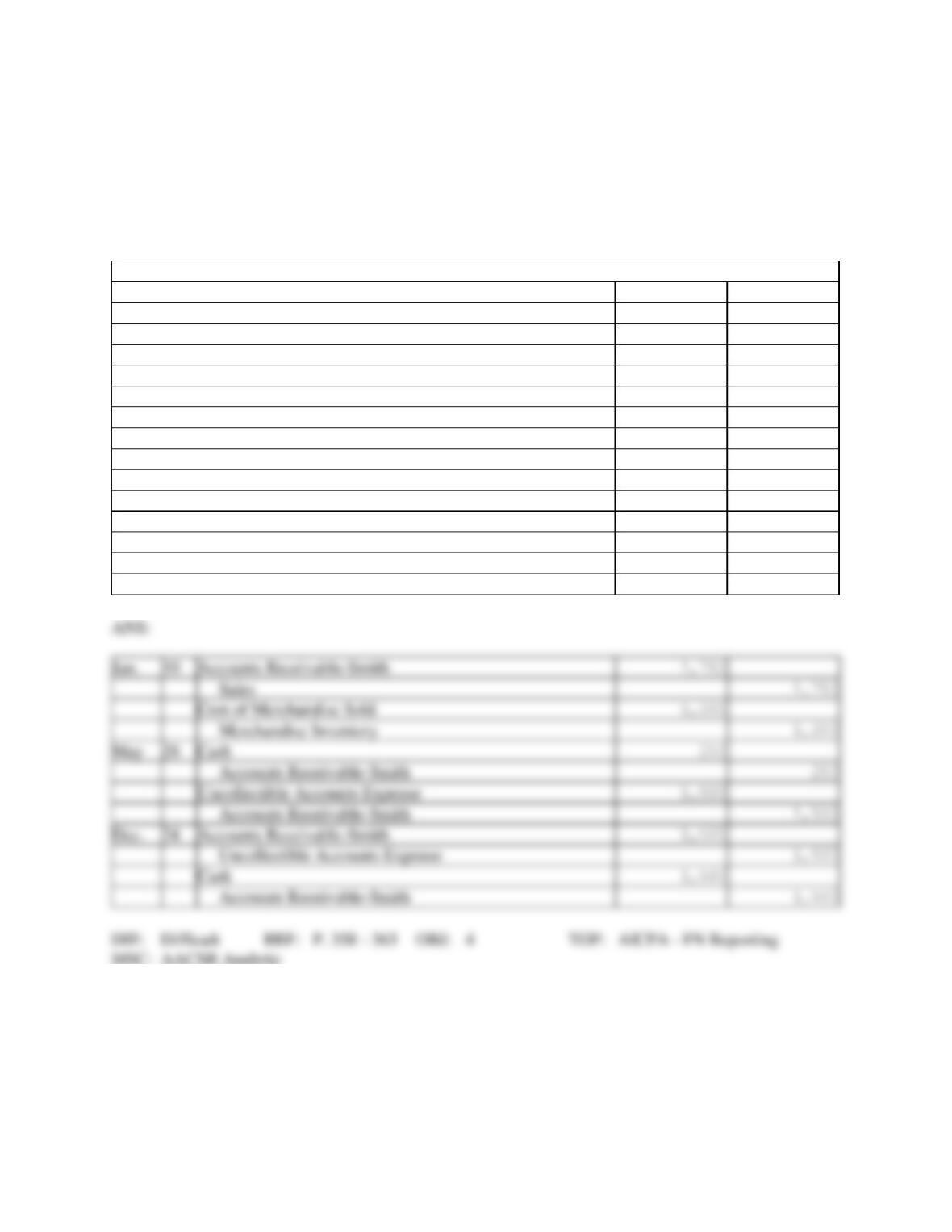
8. Prepare entries for the following transactions assuming the company uses the allowance method of
accounting for uncollectible receivables.
Feb.
14
Sold merchandise costing $4,200 to Risky Co. for $5,600 on account
Apr.
21
Received $1,000 from Risky and wrote off the remainder owed for the Feb. 14 sale
Aug.
31
Reinstated the account of Risky that had been written off on April 21 and received $4,600
cash in full payment
General Journal
Feb.
14
Accounts Receivable-Risky
Sales
Cost of Merchandise Sold
Merchandise Inventory
Apr.
21
Cash
Accounts Receivable-Risky
Allowance for Doubtful Accounts
Accounts Receivable-Risky
Aug.
31
Accounts Receivable-Risky
Allowance for Doubtful Accounts
Cash
Accounts Receivable – Risky
414 ♦ Chapter 8
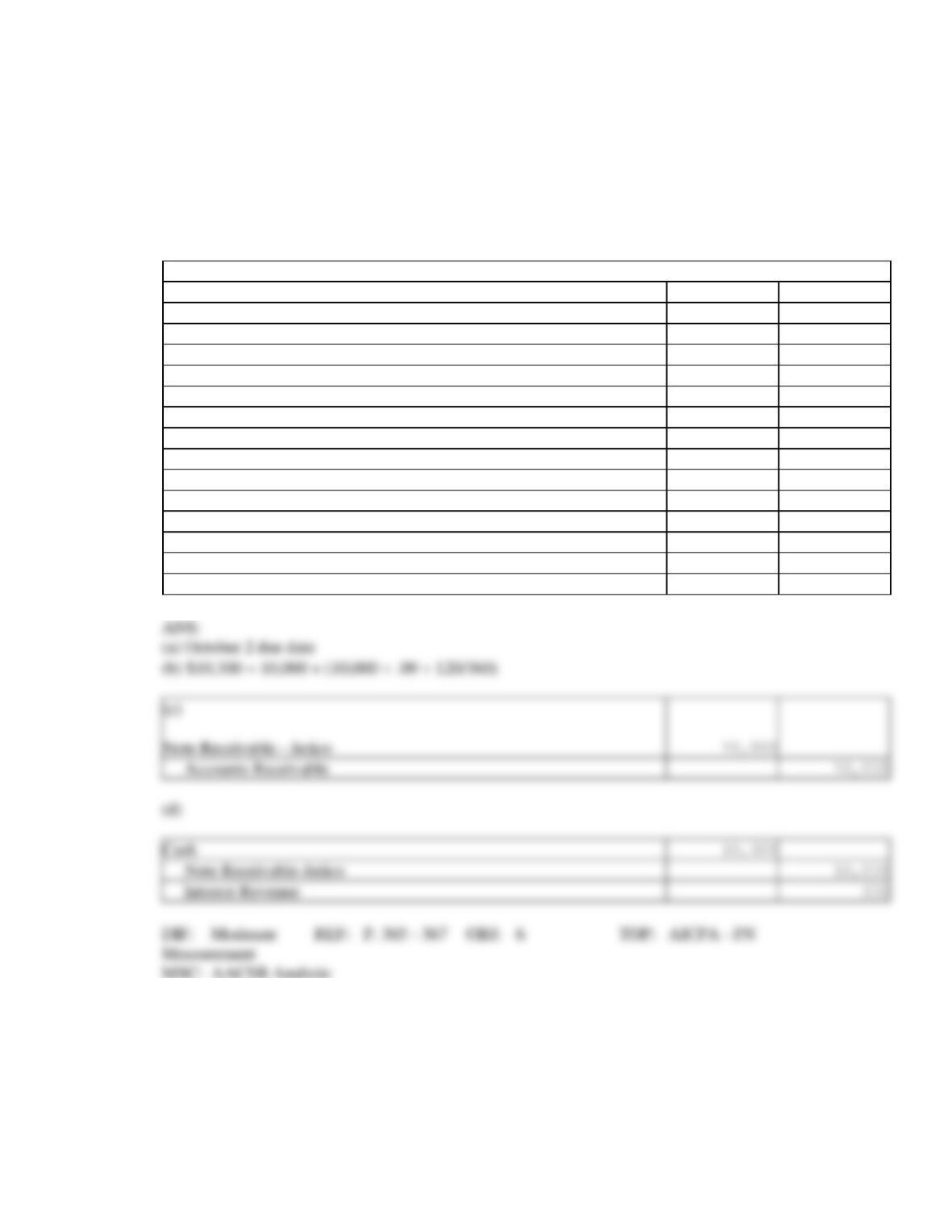
9. Prepare entries for the following transactions assuming the company uses the direct write-off
method of accounting for uncollectible receivables.
Jan.
10
Sold merchandise costing $1,200 to G. Smith for $1,750 on account
May
28
Received $250 from Smith and wrote off the remainder owed from the January 10 sale
Dec.
24
Reinstated the account of Smith that had been written off on May 28 and received $1,500
cash in full payment
General Journal
Jan.
10
Accounts Receivable-Smith
Sales
Cost of Merchandise Sold
Merchandise Inventory
May
28
Cash
Accounts Receivable-Smith
Uncollectible Accounts Expense
Accounts Receivable-Smith
Dec.
24
Accounts Receivable-Smith
Uncollectible Accounts Expense
Cash
Accounts Receivable-Smith
Receivables ♦ 415
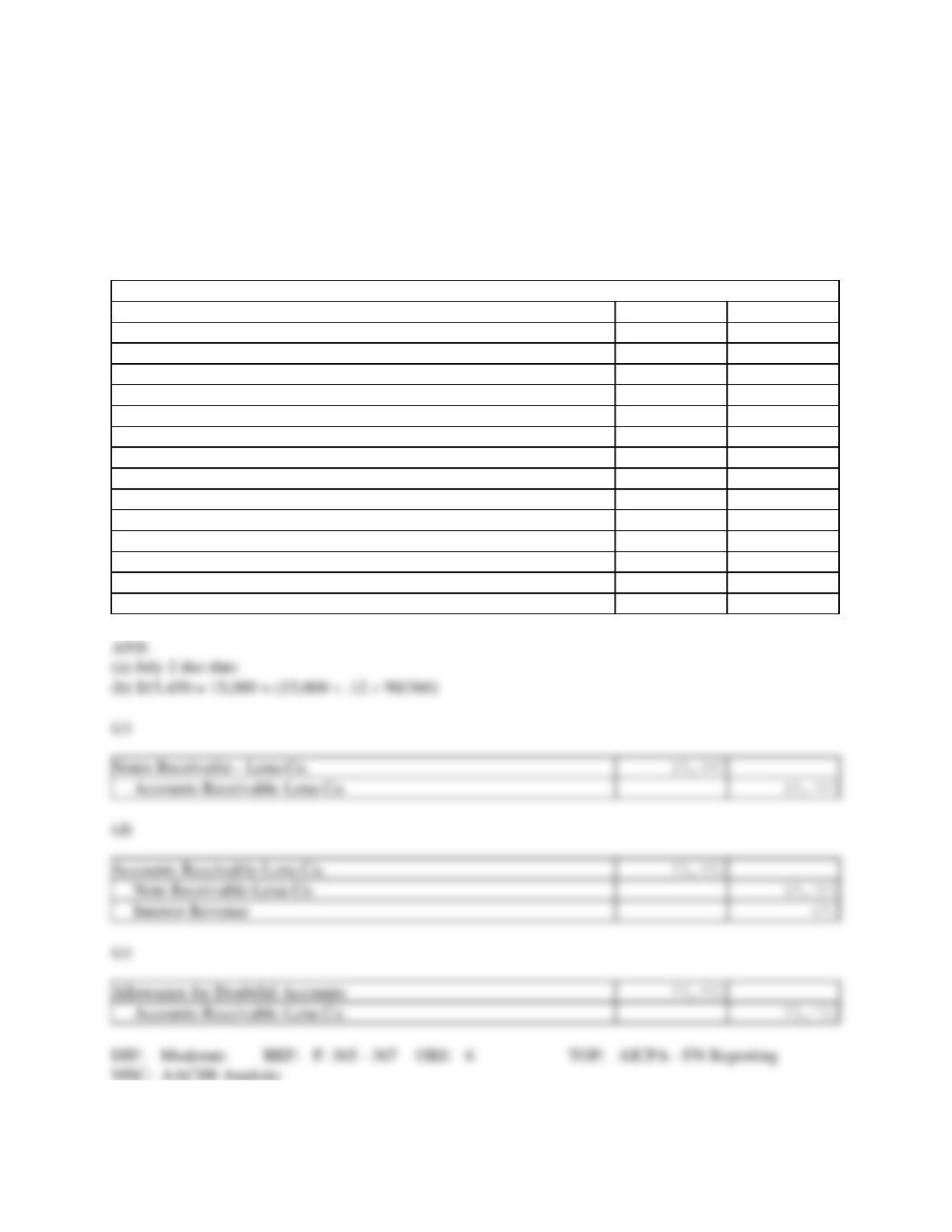
10. Company A receives a 120-days, 9% note for $10,000 dated June 4 from Jerico in settlement of an
account.
(a) Determine the due date of the note.
(b) Determine the maturity value of the note.
(c) Prepare the entry to record receipt of the note by Company A.
(d) Prepare the entry to record collection on the note at maturity.
General Journal
Note Receivable – Jerico
Accounts Receivable
Cash
Note Receivable-Jerico
Interest Revenue
416 ♦ Chapter 8
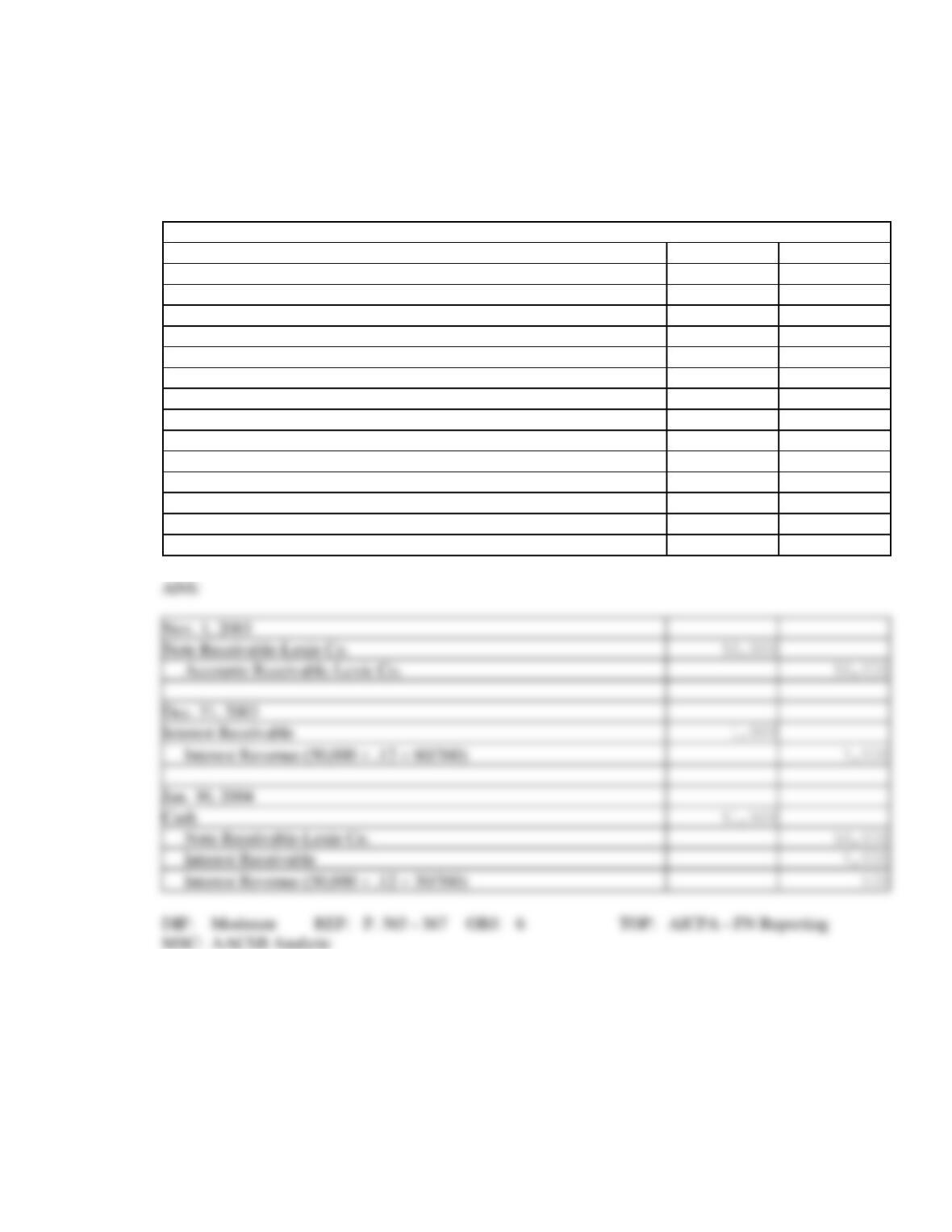
11. Company A receives a 90-day, 12% note from $15,000, dated April 3 from Lena Company in
settlement of an account.
(a)
Determine the due date of the note.
(b)
Determine the maturity value of the note
(c)
Prepare the entry to record receipt of the note by Company A.
(d)
Prepare the entry at maturity assuming Lena Company dishonored the note.
(e)
Prepare the entry to write-off Lena Company under the allowance method.
General Journal
Notes Receivable – Lena Co.
Accounts Receivable-Lena Co.
Accounts Receivable-Lena Co.
Note Receivable-Lena Co.
Interest Revenue
Allowance for Doubtful Accounts
Accounts Receivable-Lena Co.
Receivables ♦ 417
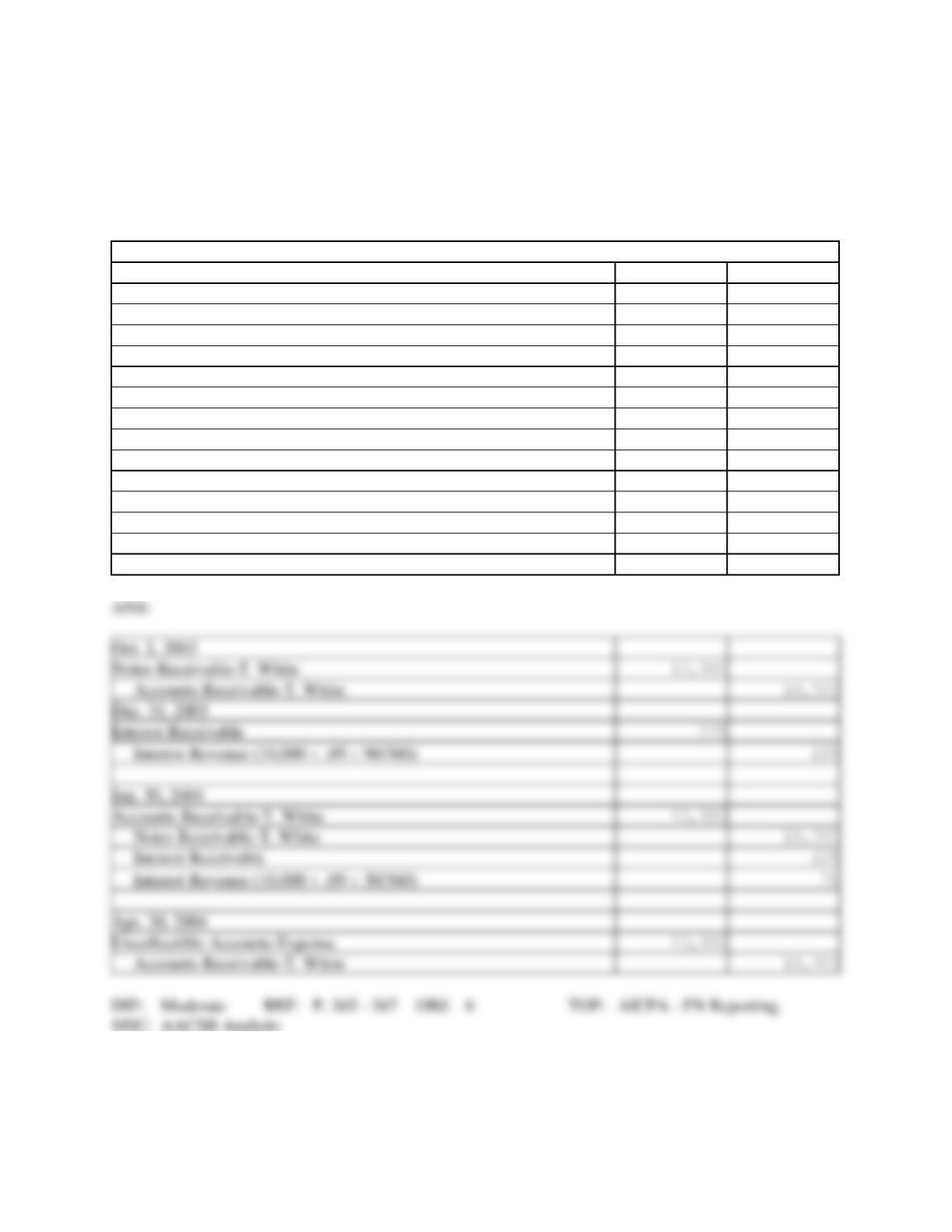
12. Prepare entries for the following transactions entered into by Candy Company:
Nov. 1, 2003
Received from Lexie, Co., on account, $50,000, 90-day, 12% note dated November 1
Dec. 31, 2003
Recorded an adjusting entry to accrued interest on the note dated November 1
Jan. 30, 2004
Received payment on note and interest from Lexie, Co.
General Journal
Nov. 1, 2003
Note Receivable-Lexie Co.
Accounts Receivable-Lexie Co.
Dec. 31, 2003
Interest Receivable
Interest Revenue (50,000 .12 60/360)
Jan. 30, 2004
Cash
Note Receivable-Lexie Co.
Interest Receivable
Interest Revenue (50,000 .12 30/360)
418 ♦ Chapter 8
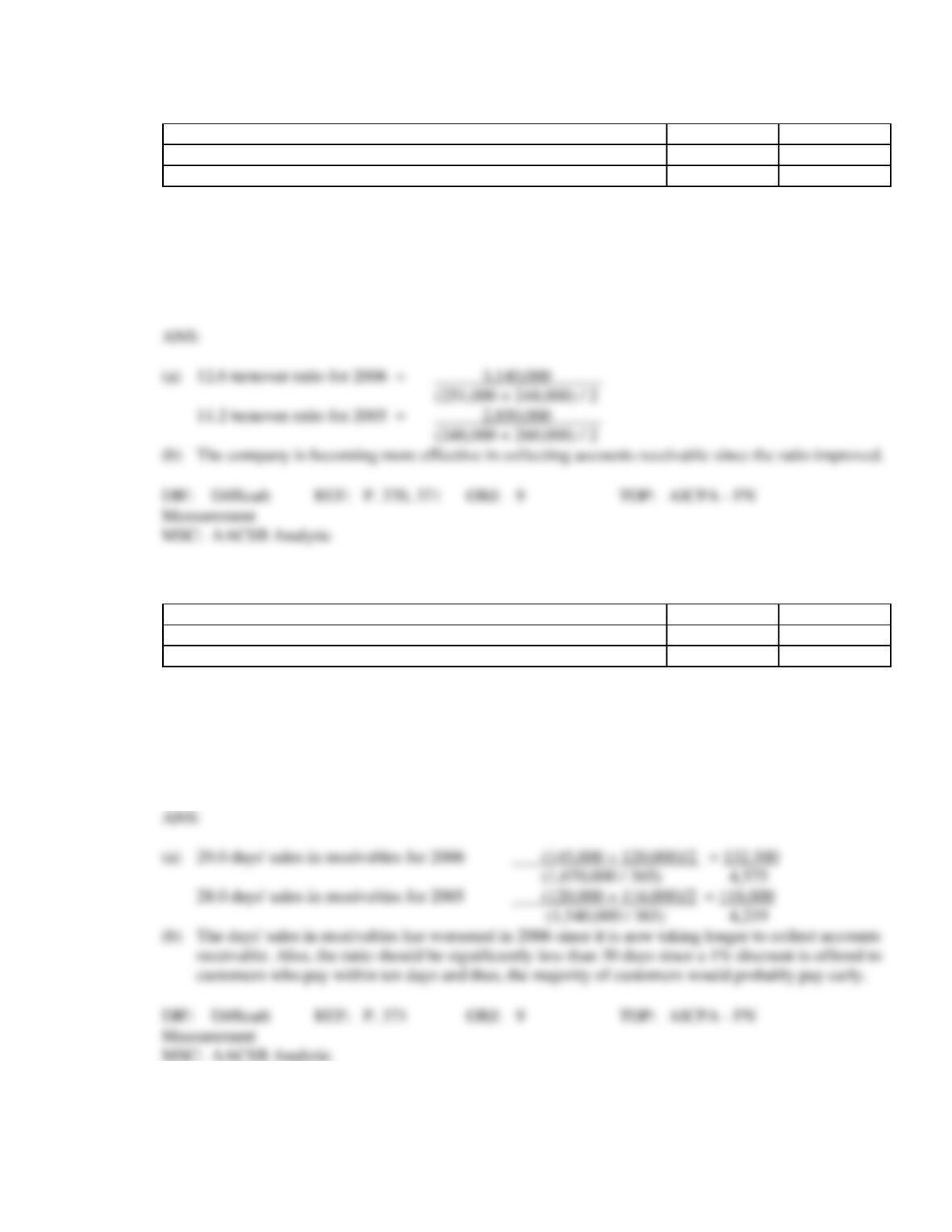
13. Prepare entries for the following transactions entered into by Buffy Co.:
Oct. 2, 2003
Received from T. White, on account, a $10,000, 120-day, 9% note dated October 2
Dec. 31, 2003
Recorded an adjusting entry for accrued interest on the note dated October 2
Jan. 30, 2004
T. White dishonored the note at maturity
Apr. 30, 2004
Wrote off the account of T. White under the direct write-off method.
General Journal
Oct. 2, 2003
Notes Receivable-T. White
Accounts Receivable-T. White
Dec. 31, 2003
Interest Receivable
Interest Revenue (10,000 .09 90/360)
Jan. 30, 2004
Accounts Receivable-T. White
Notes Receivable-T. White
Interest Receivable
Interest Revenue (10,000 .09 30/360)
Apr. 30, 2004
Uncollectible Accounts Expense
Accounts Receivable-T. White
Receivables ♦ 419
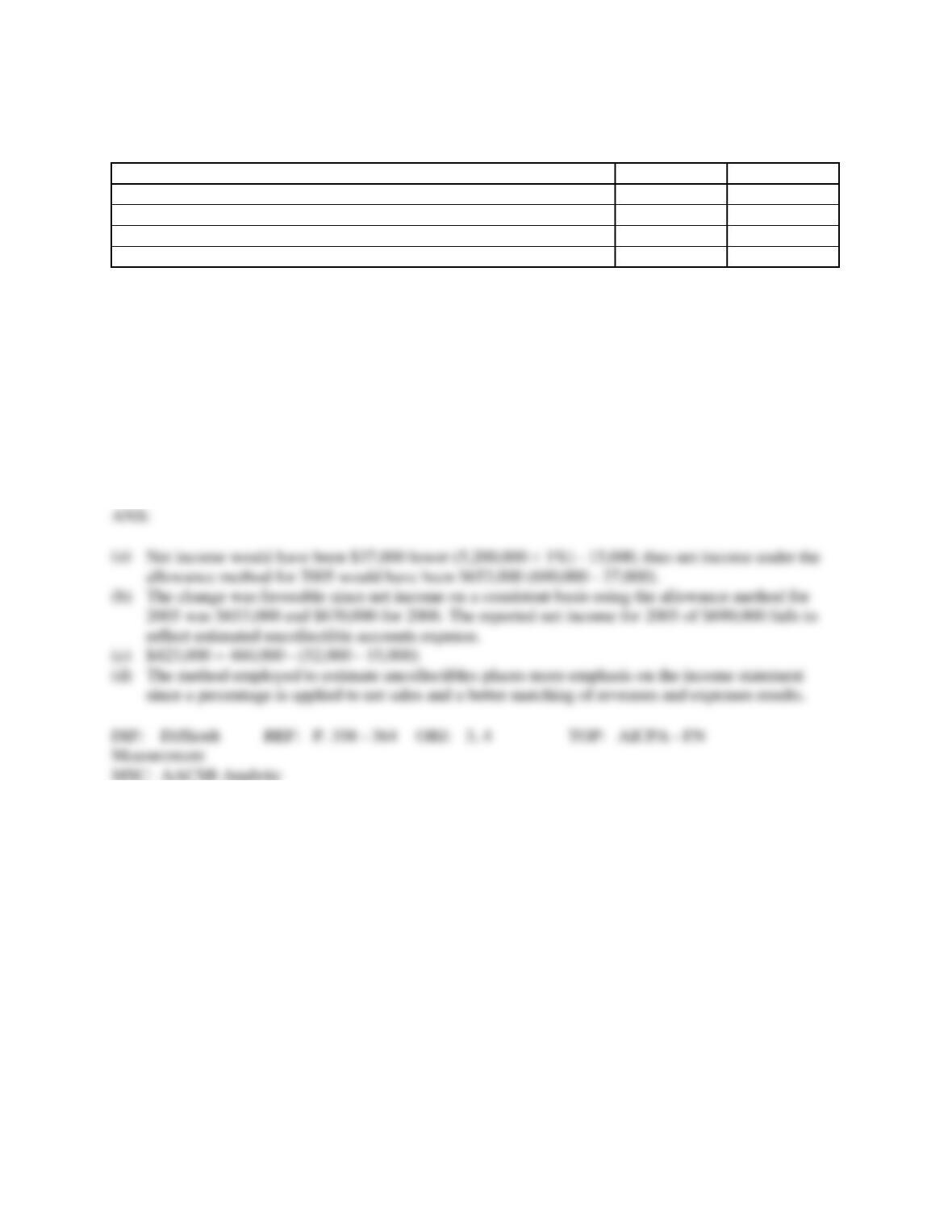
14. A company reports the following information:
Dec. 31, 2006
Dec. 31, 2005
Net Credit Sales
$3,140,000
$2,850,000
Accounts Receivable
251,000
248,000
Assume that accounts receivable on January 1, 2005 was $260,000.
(a)
Compute the accounts receivable turnover ratio for 2006 and 2005 (round to one decimal place).
(b)
Discuss whether the company is becoming more effective or less effective in collecting accounts
receivable.
15. A company reports the following information:
Dec. 31, 2006
Dec. 31, 2005
Net Credit Sales
$1,670,000
$1,540,000
Accounts Receivable
145,000
120,000
Assume that accounts receivable on January 1, 2005 was $116,000.
(a)
Compute the days sales in receivables at the end of 2006 and 2005. (Round to one decimal place).
(b)
Discuss whether the company is becoming more effective or less effective in collecting accounts
receivable if the credit terms are 1/10, n/30.
(a)
29.0 days’ sales in receivables for 2006
(145,000 + 120,000)/2 = 132,500
(1,670,000 / 365) 4,575
(1,540,000 / 365) 4,219
receivable. Also, the ratio should be significantly less than 30 days since a 1% discount is offered to
customers who pay within ten days and thus, the majority of customers would probably pay early.
(251,000 + 248,000) / 2
11.2 turnover ratio for 2005 =
2,850,000
(248,000 + 260,000) / 2
(b)
The company is becoming more effective in collecting accounts receivable since the ratio improved.
420 ♦ Chapter 8
CASE
1. You are examining the following information for the past two years:
Dec. 31, 2006
Dec. 31, 2005
Net credit sales
$4,600,000
$5,200,000
Uncollectible accounts expense
46,000
15,000
Net income
670,000
690,000
Accounts receivable (net)
420,000
460,000
The company discloses that the direct write-off method was employed in 2005, and changed to the
allowance method in 2006 whereby uncollectible accounts expense was estimated at 1% of net
credit sales.
(a)
If the company used the allowance method in 2005, how much higher or lower would net income be
for 2005.
(b)
Was the change in net income from 2005 to 2006 favorable or unfavorable, explain?
(c)
If the allowance method was used in 2005, determine net accounts receivable at year end.
(d)
Indicate whether the method employed for estimating uncollectibles in 2006 places more emphasis
on the income statement or the balance sheet and explain why.
Net income would have been $37,000 lower (5,200,000 1%) – 15,000, thus net income under the
allowance method for 2005 would have been $653,000 (690,000 – 37,000).
2005 was $653,000 and $670,000 for 2006. The reported net income for 2005 of $690,000 fails to
reflect estimated uncollectible accounts expense.
(c)
$423,000 = 460,000 – (52,000 – 15,000)
since a percentage is applied to net sales and a better matching of revenues and expenses results.
Receivables ♦ 421
2. You have been hired by a fast growing retailer to provide consulting advice regarding the
collection of accounts receivable. Management informs you that the company is having difficulty
collecting on accounts receivable. After a careful review of company procedures you observe the
following: The manager of the sales department is responsible for all credit approvals so sales
personnel can concentrate more on the selling function. All customer payments are sent directly to
the company accountant who deposits the receipts and credits the customers accounts accordingly.
(a)
Inform management about any internal control weaknesses you observe and make several
suggestions on how to improve internal controls surrounding the collection of accounts receivable.
(b)
Provide management with at least three recommendations on how to better manage accounts
receivable.
Also, customer payment should not be sent to the accountant. Instead, the collection and recording
functions need to be separated.
(b)
1. Check customers credit worthiness prior to credit sale approval.
offer a discount if the account is paid early. Also, establish a credit limit for customers based on their
3. Prepare an aging of accounts receivable and terminate further sales to any customers past due.
Follow-up with late payment and past due notices to customers.
422 ♦ Chapter 8
3. A company reports the following information in its annual report.
Dec. 31, 2006
Dec. 31, 2005
Net credit sales
$10,470,000
$8,720,000
Accounts receivable
820,000
780,000
Assume that accounts receivable on January 1, 2005 was $870,000 and the credit term for sales are
2/10, n/30.
(a)
Compute the accounts receivable turnover ratio for 2006 and 2005 (round to one decimal place).
(b)
Compute the days sales in receivables at the end of 2006 and 2005 (round to one decimal place).
(c)
Discuss whether the company’s collection of receivables is improving or deteriorating and relate
your position to the credit terms.
(d)
Discuss some procedures management could implement to improve the collection of accounts
receivable.
(a)
13.1 turnover for 2006
10,470,000
(820,000 + 780,000 / 2)
10.6 turnover for 2005
8,720,000
(780,000 + 870,000 / 2)
(b)
27.9 days sales for 2006
(820,000 + 780,000)/2 = 800,000
(10,470,000 / 365) 28,684.93
34.5 days sales for 2005
(780,000 + 870,000) /2 = 825,000
(8,720,000 / 365) 23,890.41
days. Continue sending late payment and past due notices.
Receivables ♦ 423
4. You are providing financial consulting services for Jessup Company, a rapidly growing high tech
supply company. Company management has informed you that they are having problems
collecting accounts receivables on a timely basis with credit terms of n/30. You have completed
the following calculations:
Accounts receivable turnover ratio
9.7
Number of days’ sales in receivables
37.4 days
Also, you have calculated the following ratios for Jessup’s best competitor who has credit terms of
2/10, n/30.
Accounts receivable turnover ratio
24.3
Number of days’ sales in receivables
15.2 days
(a)
Explain why Jessup’s competitor has a much higher turnover ratio and a significantly lower days’
sales in receivables ratio.
(b)
Is Jessup Company efficient in collecting receivables? Explain why.
(c)
Discuss at least four ways Jessup can improve its efficiency in collecting accounts receivable.
(a)
Jessup’s competitor reports significantly better ratios because of the credit terms of 2/10, net 30. It
37.4 days and the credit terms are net 30. A number of customers are not paying within the 30-day
period.
(c)
1. Offer customers a discount if they pay early similar to the company’s best competitor.
2. Check customers’ credit worthiness prior to sale.
3. Prepare an aging of accounts receivable and stop future sales to customers past due.
4. Consider imposing an interest charge if customers pay after 30 days.
5. Send late payment and past due notices to customers.
424 ♦ Chapter 8
5. You are reviewing an aging of accounts receivable and notice a number of accounts are past due.
The president of the company has asked you to consider possible alternatives to writing the
accounts off and wonders if requiring the customers to issue a note has any advantage. Also, the
president indicates that the company is facing a cash shortage and someone suggested factoring
might be an option. Finally, the company president is concerned that writing off uncollectible
accounts will have a negative effect on earnings and cash flows.
(a)
Explain the advantages of requiring customers to issue a note to the company.
(b)
Describe what is meant by the term factoring and discuss any advantages or disadvantages.
(c)
If certain accounts must be written off under the allowance method, explain what effect this has on
net income, assets and cash flows.
claim.
receivable. The write-off entry is neutral.