Multiple Choice
1. These tests are used to measure a specific ability, for example, fine-motor ability.
A. Diagnostic test
B. Achievement test
C. Aptitude test
D. Screening test
2. These tests are designed specifically to measure what the student has learned.
A. Diagnostic test
B. Achievement test
C. Aptitude test
D. Screening test
3. This type of assessment is a brief test containing items that survey a range of skill levels,
domains, or content areas. They are typically used to determine weak areas.
A. Diagnostic test
B. Achievement test
C. Aptitude test
D. Screening test
4. When carefully administered, these tests are specifically designed to yield reliable and
valid information by comparing a student with their peer group.
A. Aptitude test
B. Diagnostic tests
C. Norm-referenced tests
D. Adaptive behavior scales
5. Once the raw score has been determined, this is often completed on a separate form
allowing the team to determine the educational needs of the student.
A. Item-level error analysis
B. Within-item error analysis
C. Diagnostic analysis
D. Screening analysis
6. What term refers to a student using inner language concepts and applying them to what is
heard?
A. Receptive language
B. Expressive language
C. Written language
D. Spoken language
7. What term defines utilizing language skills in speaking or writing?
A. Receptive language
B. Expressive language
C. Reflective language
D. Language assessment
8. These tests measure how well students adapt to different environments.
A. Adaptive behavior scales
B. Achievement tests
C. Aptitude tests
D. Diagnostic tests
9. This derived score is used specifically to determine ongoing progress.
A. Grade equivalent
B. Age equivalent
C. Growth scale value
D. Significant level
10. This is used to determine current areas of strength as well as future potential.
A. Domain
B. Subtest
C. Achievement test
D. Aptitude test
11. Which of the following tools is aligned to the NCTM standards?
A. Test of Mathematical Abilities-2
B. KeyMath Diagnostic Assessment-3
C. Peabody Individual Achievement Test-4
D. Kaufman Test of Educational Achievement-3
12. Information regarding a student’s functional range within an assessment based on the
subtest raw scores can be found in which of the following?
A. Tables
B. Index
C. Domains
D. Basal
13. In determining significant difference between scores, a significant difference at the .05
level indicates which of the following?
A. There is a 5% chance that the difference is significant.
B. There is a 95% chance that the difference is due to error.
C. There is a 5% chance that the difference is due to error.
D. There is a difference of 5% between the scores.
14. The following is totaled in order to determine the scaled scores for a given subtest.
A. Percentile ranks
B. Age and grade equivalents
C. Raw score
D. All of the above
15. Which of the following indicates when diagnostic instruments may be used?
A. Once every three years
B. Before each annual review
C. To determine if exit criteria are met
D. When additional information is needed to make decisions about interventions
16. The percentile ranking of a student on a standardized diagnostic test indicates which of
the following?
A. The student has been ranked according to the performance of other students in
the norm group.
B. The student is above the percentile stated.
C. The student is below the percentile stated.
D. The student has performed in the expected range.
17. The most important step for teachers learning new diagnostic instruments is which of the
following?
A. Meeting with the parents before the testing
B. Becoming familiar with the correct responses
C. Becoming familiar with the test manual and test
D. All of the above
18. This is the first score to be calculated and is used to determine the standard score.
A. Raw score
B. Percentile rank
C. Scaled score
D. Composite score
19. On this instrument, the student reads stories aloud to the teacher, who scores rate,
accuracy, fluency, comprehension, and overall reading ability.
A. Gray Oral Reading Test-5
B. Test of Reading Comprehension-4
C. Test of Written Language-4
D. Test of Written Spelling-5
20. This assesses areas of math functioning that might not be addressed by other
instruments.
A. Test of Mathematical Abilities-2
B. KeyMath-3
C. Peabody Individual Achievement Test-Revised
D. Kaufmann Test of Educational Achievement-III
21. This instrument is consistent with Cattell-Horn-Carroll (CHC) theory of cognitive
abilities and comes with extended tests to further test specific skills and abilities.
A. Woodcock-Johnson IV Tests of Achievement
B. Process Assessment of the Learner-II
C. Gray Oral Reading Test-5
D. Test of Reading Comprehension-4
22. This instrument measures a student’s verbal comprehension skills by presenting the
student with a series of stimuli and asking the student to discriminate a given stimulus
that best represents an orally stated word.
A. Peabody Picture Vocabulary Test-4
B. Expressive Vocabulary Test-2
C. Test of Language Development-4
D. Test of Written Language-4
23. This test assesses the processes used in initial emerging reading and writing skills as well
as other skills needed for the intermediate grades.
A. Woodcock-Johnson IV
B. Process Assessment of the Learner-II: Test Battery for Reading and Writing
C. Peabody Individual Achievement Test-Revised
D. Kaufman Test of Educational Achievement-III
24. This following is an individually administered achievement battery.
A. Woodcock-Johnson IV Tests of Achievement
B. Kaufman Test of Educational Achievement-III
C. Wechsler Individual Achievement Test-III
D. All of the above
25. This test assesses overall writing, contrived writing and spontaneous writing.
A. Gray Oral Reading Test-5
B. Test of Reading Comprehension-4
C. Test of Written Language-4
D. Test of Written Spelling-5
Short Answer
1. Discuss why practice and mastery of a standardized instrument are necessary before
actual administration of that instrument.
2. What are the reasons for using basal and ceiling levels in the administration of a
comprehensive standardized instrument?
3. Describe some similarities and differences between norm-referenced assessments and
curriculum-based assessments.
4. Describe some circumstances under which a teacher might make the decision to use a
specific diagnostic instrument.
5. Describe the criteria you would consider when selecting a diagnostic instrument to use
with a particular student.
6. Discuss the sample of individuals included in the norming process of the Woodcock-
Johnson IV Test of Achievement. Provide an explanation as to why the details of the
sample are important in determining the validity of the test.
7. Explain the importance of error analysis in your own words.
8. Explain when a teacher might use a screening test.
9. The WIAT-III provides two ways for determining learning disabilities. Discuss each.
10. Identify some domains that are evaluated through achievement testing. What specific
skills would be evaluated in each domain?
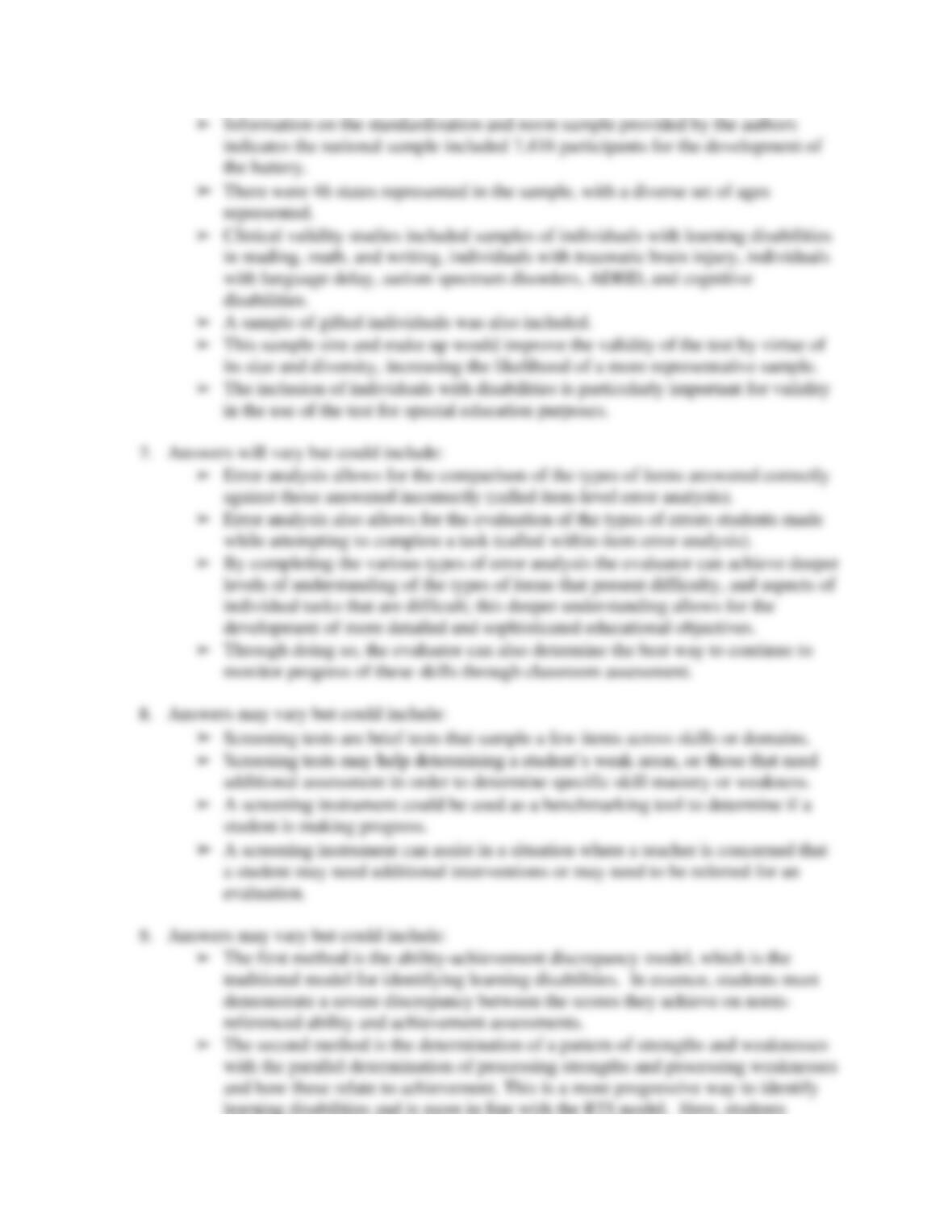
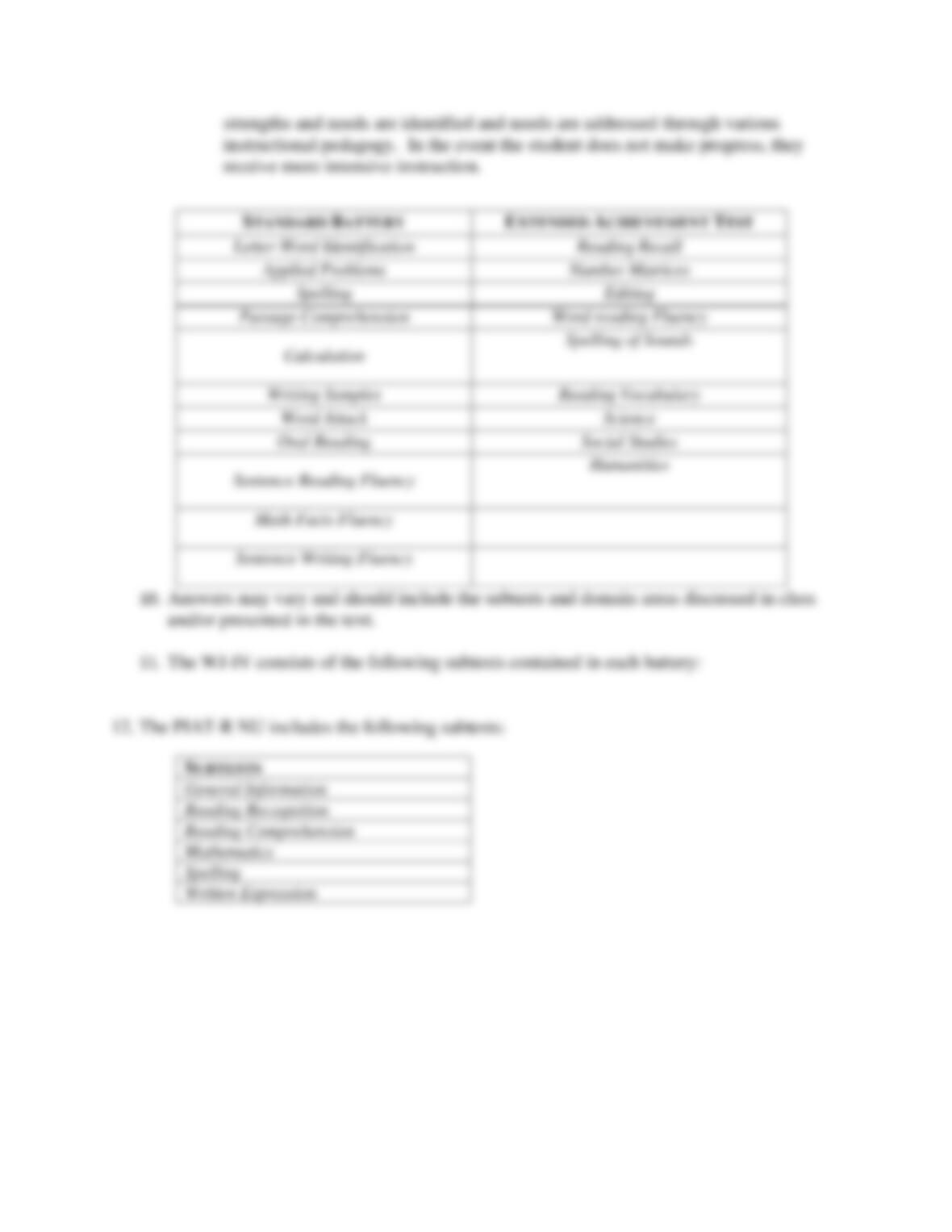
11. Identify the subtests included in the standard and extended batteries in the Woodcock-
Johnson IV Test of Achievement.
12. Identify the subtests in the Peabody Individual Achievement Test-Revised (PIAT-R NU).
Chapter 8 Test Bank Answer Key
True and False

Multiple Choice
Short Answer