Exam
Name___________________________________
SHORT ANSWER. Write the word or phrase that best completes each statement or answers the question.
A statement Sn about the positive integers is given. Write statements S1, S2, and S3, and show that each of these
statements is true.
1)
Sn: 2 is a factor of n2+11n
1)
A statement Sn about the positive integers is given. Write statements Sk and Sk+
1, simplifying Sk+
1 completely.
2)
Sn: 1 ·2 + 2 ·3 + 3 ·4 +. . . + n(n + 1) =n(n + 1)(n + 2)
3
2)
A statement Sn about the positive integers is given. Write statements S1, S2, and S3, and show that each of these
statements is true.
3)
Sn: 12+42+72+. . . + (3n – 2)2=n(6n2– 3n – 1)
2
3)
Use mathematical induction to prove that the statement is true for every positive integer n.
1
4)
1+1
2+1
4+ . . . +1
2n – 1 =21 –1
2n
4)
2
5)
10 + 20 + 30 + . . . + 10n =5n(n + 1)
5)
3
6)
4+9+14 + . . . + (5n –1) =n(5n + 3)
2
6)
4
A statement Sn about the positive integers is given. Write statements S1, S2, and S3, and show that each of these
statements is true.
7)
Sn: 4+9+14 + . . . + (5n –1) =n(5n + 3)
2
7)
A statement Sn about the positive integers is given. Write statements Sk and Sk+
1, simplifying Sk+
1 completely.
8)
Sn: 2+5+8+ . . . + (3n –1) =n(3n + 1)
2
8)
9)
Sn: 2 is a factor of n2+7n
9)
5
A statement Sn about the positive integers is given. Write statements S1, S2, and S3, and show that each of these
statements is true.
10)
Sn: 1 ·2 + 2 ·3 + 3 ·4 +. . . + n(n + 1) =n(n + 1)(n + 2)
3
10)
Use mathematical induction to prove that the statement is true for every positive integer n.
11)
2 is a factor of n2– n + 2
11)
6
12)
1 ·3+ 2 ·3+ 3 ·3+ . . . +3n =3n(n + 1)
2
12)
Explanation:
A statement Sn about the positive integers is given. Write statements Sk and Sk+
1, simplifying Sk+
1 completely.
13)
Sn: 12+42+72+. . . + (3n – 2)2=n(6n2– 3n – 1)
2
13)
Explanation:
7
MULTIPLE CHOICE. Choose the one alternative that best completes the statement or answers the question.
Use the formula for the general term (the nth term) of an arithmetic sequence to find the indicated term of the sequence
with the given first term, a1, and common difference, d.
14)
Find a 19 when a1= – 7, d =2
3.
14)
A)
–59
3
B)
– 19
C)
5
D)
17
3
Write the first five terms of the geometric sequence.
15)
a1=6; r =1
4
15)
A)
6, 25
4, 13
2, 27
4, 7
B)
6, 24, 96, 384, 1536
C)
6, 3
2, 3
8, 3
32 , 3
128
D)
3
2, 3
8, 3
32 , 3
128, 3
512
C
Solve the problem. Round to the nearest dollar if needed.
16)
Yvette invests $300 each quarter in a fixed–interest mutual fund paying annual interest of 7%
compounded quarterly. How much will her account have in it at the end of 11 years?
16)
A)
$4735
B)
$19,765
C)
$59,243
D)
$19,636
D
If the given sequence is a geometric sequence, find the common ratio.
17)
3, 12, 48, 192, 768
17)
A)
12
B)
4
C)
1
4
D)
not a geometric sequence
B
C
Express the sum using summation notation. Use a lower limit of summation not necessarily 1 and k for the index of
summation.
18)
a + ar + ar2+ . . . + ar14
18)
A)
14
k = 0
ark
B)
15
k = 1
ark
C)
14
k = 1
ark
D)
14
k = 0
(ar)k
Write the first four terms of the sequence whose general term is given.
19)
an=3n
19)
A)
9, 27, 81, 243
B)
3, 9, 27, 81
C)
1, 3, 9, 27
D)
1, 8, 27, 64
Find the probability.
20)
What is the probability that a card drawn from a deck of 52 cards is not a spade?
20)
A)
4
13
B)
2
5
C)
3
4
D)
1
4
Find the indicated sum.
21)
5
i = 1
(–1)i – 1
(i – 1)!
21)
A)
–5
12
B)
3
8
C)
5
12
D)
–3
8
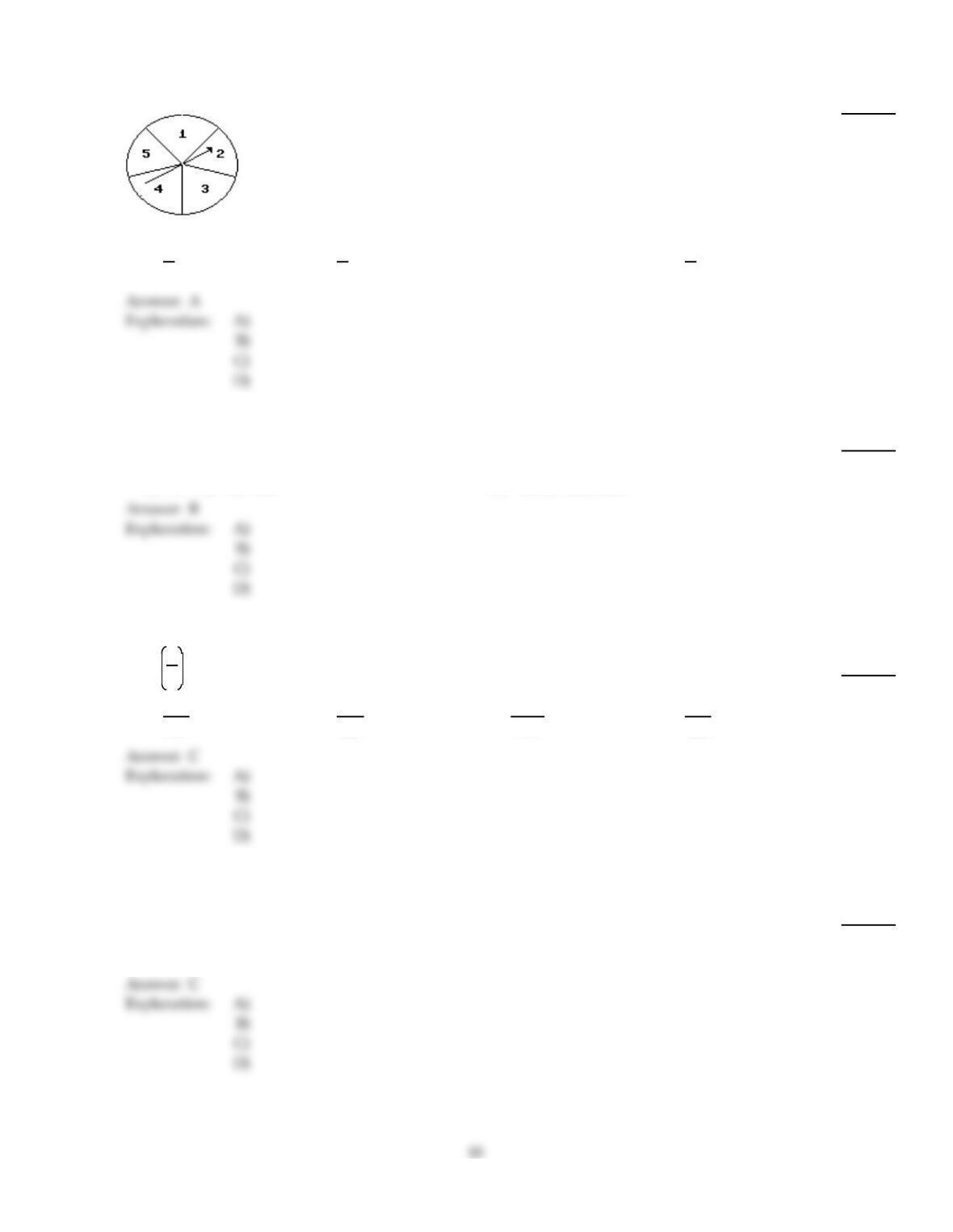
Find the probability.
22)
What is the probability that the arrow will land on 4 or 5?
22)
A)
2
5
B)
5
3
C)
4
D)
3
4
Write the first four terms of the sequence whose general term is given.
23)
an= – 3(n +1)!
23)
A)
–3, 6, –18, 72
B)
–6, –18, –72, –360
C)
–3, –12, –54, –288
D)
–6, 36, –216, 1440
Find the indicated sum. Use the formula for the sum of the first n terms of a geometric sequence.
24)
6
i = 1
2
3
i
24)
A)
422
729
B)
211
243
C)
1330
729
D)
665
243
The general term of a sequence is given. Determine whether the given sequence is arithmetic, geometric, or neither. If the
sequence is arithmetic, find the common difference; if it is geometric, find the common ratio.
25)
an=3n –2
25)
A)
arithmetic, d = – 2
B)
geometric, r =3
C)
arithmetic, d =3
D)
neither

Use the formula for the general term (the nth term) of a geometric sequence to find the indicated term of the sequence
with the given first term, a1, and common ratio, r.
26)
Find a8 when a1=4000, r =1
3.
26)
A)
4000
2187
B)
4000
6561
C)
12007
3
D)
4000
19683
Find the indicated sum.
27)
5
i = 1
(i + 1)!
(i + 2)!
27)
A)
39
20
B)
81
20
C)
547
140
D)
153
140
28)
8
i =3
8
28)
A)
264
B)
240
C)
48
D)
40
Evaluate the given binomial coefficient.
29)
90
88
29)
A)
4005
B)
4005
88
C)
45
44
D)
352,440
Write a formula for the general term (the nth term) of the arithmetic sequence. Then use the formula for an to find a20,
the 20th term of the sequence.
30)
a1= – 4
5, d = – 3
5
30)
A)
an= – 4
5n –3
5; a20 = – 83
5
B)
an= – 4
5n +1
5; a20 = – 79
5
C)
an= – 3
5n –1
5; a20 = – 61
5
D)
an= – 3
5n –4
5; a20 = – 64
5
Find the indicated sum.
31)
4
i = 1
1
9i
31)
A)
5
36
B)
11
54
C)
1
36
D)
25
108
Find the probability.
32)
Given the sequence 5, 6, 7, 8 … 44, what is the probability that a number in the sequence is even or
that it is greater than 8 and less then 25?
32)
A)
9
10
B)
55
78
C)
11
16
D)
7
10
Use the formula for the general term (the nth term) of a geometric sequence to find the indicated term of the sequence
with the given first term, a1, and common ratio, r.
33)
Find a10 when a1=4, r = – 3.
33)
A)
–78,728
B)
–23
C)
236,196
D)
–78,732
Write the first four terms of the sequence whose general term is given.
34)
an= – 2
3
n
34)
A)
–2
3, –4
9, –8
27 , –16
81
B)
–2
3, 4
9, –8
27 , 16
81
C)
–2
3, 2
6, –2
9, –2
12
D)
2
3, –2
6, 2
9, –2
12
Solve the problem.
35)
Keyana takes a job with a starting salary of $30,000 for the first year with an annual increase of
4.5% beginning in the second year. What is Keyana‘s salary, to the nearest dollar, in the seventh
year?
35)
A)
$37,855
B)
$41,303
C)
$39,068
D)
$40,037
36)
In how many ways can 5 volunteers be assigned to 5 booths for a charity bazaar?
36)
A)
20 ways
B)
240 ways
C)
120 ways
D)
60 ways
37)
From 8 names on a ballot, a committee of 3 will be elected to attend a political national convention.
How many different committees are possible?
37)
A)
336
B)
56
C)
6720
D)
168
Use the Binomial Theorem to expand the binomial and express the result in simplified form.
38)
(3x + 5)4
38)
A)
405x4+ 2700 x3+ 1350x2+ 7500x + 625
B)
81x4+ 540x3+ 1350x2+ 1500x + 625
C)
81x4+625x4
D)
81x3+ 540x2+ 1350x + 1500
Use the formula for the general term (the nth term) of a geometric sequence to find the indicated term of the sequence
with the given first term, a1, and common ratio, r.
39)
Find a8 when a1=3,000,000, r = 0.1.
39)
A)
0.03
B)
0.3
C)
3
D)
0.003
Express the repeating decimal as a fraction in lowest terms.
40)
0.45
40)
A)
9
200
B)
5
11
C)
500
11
D)
9
20
Use the Binomial Theorem to expand the binomial and express the result in simplified form.
41)
(x + 4)4
41)
A)
x4+ 4x3+ 96x2+ 128x + 256
B)
x4+ 16x3+ 128x2+ 256x + 256
C)
x4+ 16x3+ 96x2+ 16x + 256
D)
x4+ 16x3+ 96x2+ 256x + 256
Find the term indicated in the expansion.
42)
(x + 3y)9; 6th term
42)
A)
30,618x5y4
B)
30,618x4y5
C)
10,206x5y4
D)
10,206x4y6
Find the probability.
43)
A card is drawn from a deck of 52 cards. What is the probability that it is a numbered card (2–10) or
a club?
43)
A)
53
52
B)
33
52
C)
10
13
D)
23
52

Write the first four terms of the sequence defined by the recursion formula.
44)
a1=5 and an=4an–1 for n 2
44)
A)
16, 64, 256, 512
B)
5, 20, 80, 320
C)
5, 19, 18, 17
D)
5, 22, 82, 322
Write a formula for the general term (the nth term) of the geometric sequence.
45)
0.0003, 0.003, 0.03, 0.3, . . .
45)
A)
an=0.0003(10)n – 1
B)
an=3(0.1)n
C)
an=0.003(10)n – 1
D)
an=3(10)n
Find the indicated sum.
46)
4
i = 1
( –1
2 )i
46)
A)
5
16
B)
15
16
C)
–1
16
D)
–5
16
Write the first four terms of the sequence whose general term is given.
47)
an=(–1)n + 1
n +5
47)
A)
–1
6, 1
7, –1
8, 1
9
B)
–1
7, 1
8, –1
9, 1
10
C)
1
6, –1
7, 1
8, –1
9
D)
1
6, –1
14 , 1
24 , –1
36
15
Express the sum using summation notation. Use a lower limit of summation not necessarily 1 and k for the index of
summation.
48)
3
4+4
5+5
6+6
7+ . . . +20
21
48)
A)
20
k =4
k + 1
k
B)
20
k =3
k
k + 1
C)
20
k =4
k
k + 1
D)
20
k =3
k + 1
k
Use the formula for the sum of the first n terms of an arithmetic sequence to find the indicated sum.
49)
50
i = 1
(2i +4)
49)
A)
2750
B)
3175
C)
3000
D)
2700
Find the probability.
50)
A lottery game contains 23 balls numbered 1 through 23. What is the probability of choosing a ball
numbered 24?
50)
A)
0
B)
1
23
C)
23
D)
1
Write the first five terms of the geometric sequence.
51)
an=2an–1; a1=4
51)
A)
2, 8, 16, 32, 64
B)
4, 8, 16, 32, 64
C)
4, 6, 8, 10, 12
D)
8, 16, 32, 64, 128
Use the Binomial Theorem to expand the binomial and express the result in simplified form.
52)
(x + 2y)3
52)
A)
x3+ 6x2y + 12xy2+ 8y3
B)
x3+ 8y3
C)
x3+ 2x2y + 4xy + 4xy2+ 8y2+ 8y3
D)
3x +6y
Evaluate the factorial expression.
53)
10!
8!
53)
A)
10
B)
10
8
C)
2!
D)
90
D)
Find the indicated sum.
54)
Find 1+3+5+7+ . . ., the sum of the first 85 positive odd integers.
54)
A)
7140
B)
7136
C)
7225
D)
7229
D)
Write the first four terms of the sequence whose general term is given.
55)
an=n + 3
2n – 1
55)
A)
4, 5
3, 6
5, 1
B)
–4, 5
3, 6
5, 1
C)
4, –5
3, 6
5, 1
D)
–4, –5
3, 6
5, 1
D)
17
D)
Solve the problem. Round to the nearest hundredth of a percent if needed.
56)
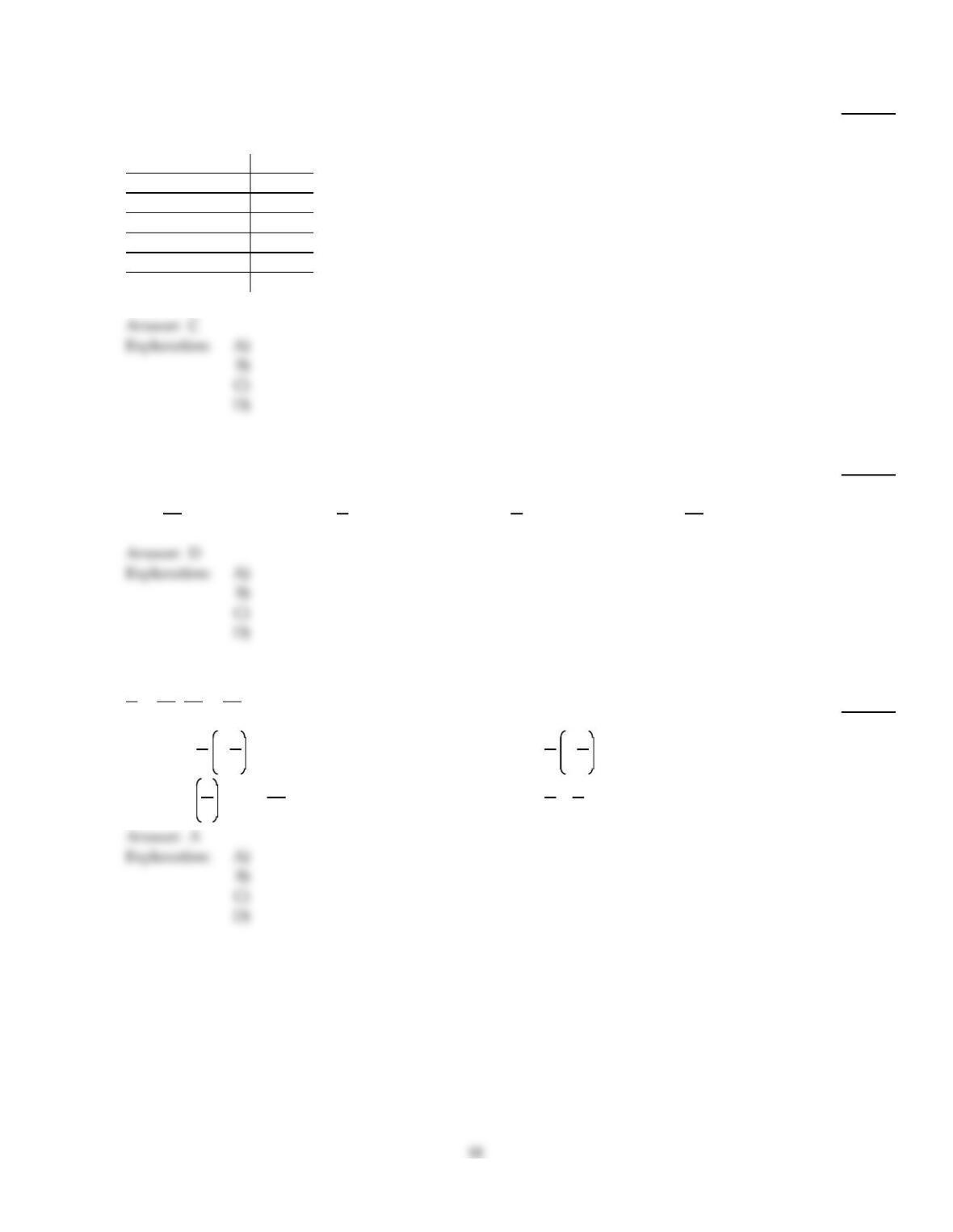
During clinical trials of a new drug intended to reduce the risk of heart attack, the following data
indicate the occurrence of adverse reactions among 1200 adult male trial members. What is the
probability that an adult male using the drug will experience nausea?
Adverse Reaction Number
Heartburn 18
Headache 12
Dizziness 10
Urinary problems 6
Nausea 22
Abdominal pain 17
56)
A)
25.88%
B)
1.42%
C)
1.83%
D)
1.71%
Find the probability.
57)
Each of ten tickets is marked with a different number from 1 to 10 and put in a box. If you draw a
ticket from the box, what is the probability that you will draw 7, 8, or 6?
57)
A)
1
10
B)
1
8
C)
1
7
D)
3
10
Write a formula for the general term (the nth term) of the geometric sequence.
58)
1
5, –1
10 , 1
20 , –1
40 , . . .
58)
A)
an=1
5–1
2
n – 1
B)
an=1
2–1
5
n – 1
C)
an=1
5
n – 1
–3
10
D)
an=1
5–1
2(n – 1)
Use the Binomial Theorem to expand the binomial and express the result in simplified form.
59)
(x + 8y)5
59)
A)
x5+ 40x4y + 640x3y2+ 5120x2y3+ 20,480xy4+ 32,768
B)
x5+ 40x4y + 1280x3y2+ 10,240x2y3+ 20,480xy4+ 8y5
C)
x5+ 40x4y + 1280x3y2+ 10,240x2y3+ 20,480xy4+ 32,768y5
D)
x5+ 40x4y + 640x3y2+ 5120x2y3+ 20,480xy4+ 32,768y5
Evaluate the factorial expression.
60)
8!
7!
60)
A)
8
B)
8!
C)
8
7
D)
1
Find the indicated sum.
61)
4
i = 1
2i
61)
A)
20
B)
18
C)
14
D)
30
Use the Binomial Theorem to expand the binomial and express the result in simplified form.
62)
(4x – 4y)3
62)
A)
16x3y – 32x2y2+ 16xy3
B)
64x3– 192x2y + 192xy2– 64y3
C)
16x3y – 16x2y2+ 16xy3
D)
64x3– 64x2y + 64xy2– 64y3
Find the common difference for the arithmetic sequence.
63)
541, 546, 551, 556, . . .
63)
A)
–541
B)
541
C)
–5
D)
5
Write the first five terms of the arithmetic sequence.
64)
a1=3, d = – 1
2
64)
A)
3, 5
4, 2
3, 3
8, 1
5
B)
3, 7
4, 4
3, 9
8, 1
C)
3, 5
2, 2, 3
2, 1
D)
3, 7
2, 4, 9
2, 5
Evaluate the given binomial coefficient.
65)
8
8
65)
A)
2
B)
40,320
C)
0
D)
1
Solve the problem.
66)
A student must choose 1 of 4 science electives, 1 of 5 social studies electives, and 1 of 8 language
electives. How many possible course selections are there?
66)
A)
17 course selections
B)
20 course selections
C)
160 course selections
D)
320 course selections
Write the first five terms of the arithmetic sequence.
67)
a1=3; d =4
67)
A)
3, 6, 9, 12, 15
B)
3, 7, 11, 15, 19
C)
0, 3, 7, 11, 15
D)
7, 11, 15, 19, 23