Exam
Name___________________________________
SHORT ANSWER. Write the word or phrase that best completes each statement or answers the question.
Solve the problem.
1)
Two groups of people were asked their preference in television programs from among
three new programs. The results are shown in the table below. What is the probability that
a person selected at random will be from group A or prefer program X?
Television Program
Group of People X Y Z
A25 15 40
B20 60 50
1)
Find the probability.
2)
Each person in a group of students was identified by his or her hair color and then asked
whether he or she preferred taking classes in the morning, afternoon, or evening. The
results are shown in the table below. Find the probability that a student preferred morning
classes given that he or she has blonde hair.
Hair Color
Class Time Preference Blonde Brunette Rehead
Morning 45 25 10
Afternoon 40 15 50
Evening 35 20 30
2)
3)
One urn has 4 red balls and 1 white ball; a second urn has 2 red balls and 3 white balls. A
single card is randomly selected from a standard deck. If the card is less than 5 (aces count
as 1), a ball is drawn out of the first urn; otherwise a ball is drawn out of the second urn. If
the drawn ball is red, what is the probability that it came out of the second urn?
3)
4)
A class of 40 students has 10 honor students and 13 athletes. Three of the honor students
are also athletes. One student is chosen at random. Find the probability that this student is
an athlete if it is known that the student is not an honor student.
4)
1
Provide an appropriate response.
5)
The payoff table for three possible courses of action A1, A2, and A3 is given below.
pi
A1
xi
A2
xi
A3
xi
.3 $70 $40 $50
.2 $100 $120 $110
.1 $160 $140 $90
.4 $80 $140 $160
Which course of action will produce the largest expected value? What is it?
5)
Find the probability.
6)
A basketball team is to play two games in a tournament. The probability of winning the
first game is .10. If the first game is won, the probability of winning the second game is .15.
If the first game is lost, the probability of winning the second game is .25. What is the
probability the first game was won if the second game is lost?
6)
Provide an appropriate response.
7)
A shipment of 20 digital cameras contains two that are defective. A random sample of
three is selected and tested. Let X be the random variable associated with the number of
defective cameras in a sample. Find the probability distribution of X and the expected
number of defective cameras in a sample.
7)
Solve the problem.
8)
From a survey involving 2,000 students at a large university, it was found that 1,300
students had classes on Monday, Wednesday, and Friday; 1,500 students had classes on
Tuesday and Thursday; and 800 students had classes every day. If a student at this
university is selected at random, what is the (empirical) probability that the student has
classes only on Tuesday and Thursday?
8)
List the outcomes of the sample space.
9)
A fair die and a fair coin are tossed in succession. Find the sample space composed of
equally likely events.
9)
Find the probability.
10)
Refer to the table below for events in a sample space, S, compute P(C|E).
A B C Total
D 0.12 0.50 0.08 0.70
E 0.03 0.10 0.17 0.30
Totals 0.15 0.60 0.25 1.00
10)
11)
A box contains 7 red balls and 3 white balls. Two balls are to be drawn in succession
without replacement. What is the probability that the sample will contain exactly one
white ball and one red ball?
11)
MULTIPLE CHOICE. Choose the one alternative that best completes the statement or answers the question.
12)
Two 6–sided dice are rolled. What is the probability the sum of the two numbers on the die will be
5, P(sum of 5)?
12)
A)
P(sum of 5) =1
9
B)
P(sum of 5) =8
9
C)
P(sum of 5) = 4
D)
P(sum of 5) =5
6
Use the tree diagram to find the requested probability.
13)
Find P(XA). Give your answer as a decimal and round your answer to three decimal places if
necessary.
a =0.3, b =0.7, c =0.4, d =0.6, e =0.7, f =0.3
13)
A)
0.4
B)
0.197
C)
0.12
D)
0.109
3
Use Bayes’ rule to find the indicated probability.
14)
An water well is to be drilled in the desert where the soil is either rock, clay or sand. The
probability of rock P(R) = 0.53. The clay probability is P(C) = 0.21. The sand probability is P(S) =
0.26. It if it rock, a geological test gives a positive result with 35% accuracy. If it is clay, this test
gives a positive result with 48% accuracy. The test gives a 75% accuracy for sand. Given the test is
positive, what is the probability that soil is rock, P(sand | positive)?
14)
A)
P(sand | positive) = 0.385
B)
P(sand | positive) = 0.209
C)
P(sand | positive) = 0.26
D)
P(sand | positive) = 0.405
Determine independence. Answer Yes or No.
15)
The table shows the political affiliation of voters in one city and their positions on stronger gun
control laws.
Stronger Gun Control
Favor Oppose
Republican 0.08 0.33
Democrat 0.22 0.20
Other 0.13 0.04
Are party affiliation and position on gun control laws independent?
15)
A)
Yes
B)
No
Estimate the indicated probability.
16)
College students were given three choices of pizza toppings and asked to choose one favorite. The
following table shows the results.
toppings freshman sophomore junior senior
cheese 16 12 29 22
meat 18 22 12 16
veggie 12 16 18 22
A randomly selected student prefers a cheese topping.
16)
A)
.367
B)
.102
C)
.316
D)
.278

Find the probability.
17)
The table shows the political affiliation of voters in a small midwestern town and their positions on
stronger drug control laws.
Stronger Drug Control
Favor Oppose
Republican 0.11 0.27
Democrat 0.25 0.16
Other 0.15 0.06
Find the probability that a Democrat opposes stronger drug control laws.
17)
A)
0.490
B)
0.420
C)
0.350
D)
0.390
Find the indicated probability.
18)
In a family with family with 4 children, excluding multiple births, what is the probability of having
2 girls and 2 boys, in that order? Assume that a boy is as likely as a girl at each birth.
18)
A)
1
16
B)
1
8
C)
1
4
D)
1
2
In a survey of the number of DVDs in a house, the table shows the probabilities.
Number of DVDs 0 1 2 3 4 or more
Probability 0.05 0.024 0.33 0.21 0.17
19)
Find the probability of a house having 3 or more DVDs.
19)
A)
0.83
B)
0.38
C)
0.05
D)
0.57

Estimate the indicated probability.
20)
College students were given three choices of pizza toppings and asked to choose one favorite. The
following table shows the results.
toppings freshman sophomore junior senior
cheese 13 12 25 29
meat 25 29 12 13
veggie 12 13 25 29
A randomly selected student who is a a junior or senior is also prefers veggie. Round the answer to
the nearest hundredth.
20)
A)
.684
B)
.403
C)
.228
D)
.406
Find the odds.
21)
In a certain town, 20% of people commute to work by bus. If a person is selected randomly from the
town, what are the odds against selecting someone who commutes by bus?
21)
A)
1:4
B)
4:1
C)
4:5
D)
1:5
List the outcomes of the sample space.
22)
A group of 18 songs are assigned numbers 1 through 18. List the outcomes of sample space of the
event choosing a song with a number 5 or less.
22)
A)
{1, 2, 3, 4}
B)
{18}
C)
{1}
D)
{1, 2, 3, 4, 5}
Determine independence. Answer Yes or No.
23)
According to a survey, 8% of students at a college are left handed, 53% are female, and 4.24% are
both female and left handed. Is being left handed independent of gender?
23)
A)
Yes
B)
No
Find the probability.
24)
A calculator requires a keystroke assembly and a logic circuit. Assume that 85% of the keystroke
assemblies and 88% of the logic circuits are satisfactory. Find the probability that a finished
calculator will be satisfactory. Assume that defects in keystroke assemblies are independent of
defects in logic circuits.
24)
A)
.8700
B)
.7225
C)
.7744
D)
.7480
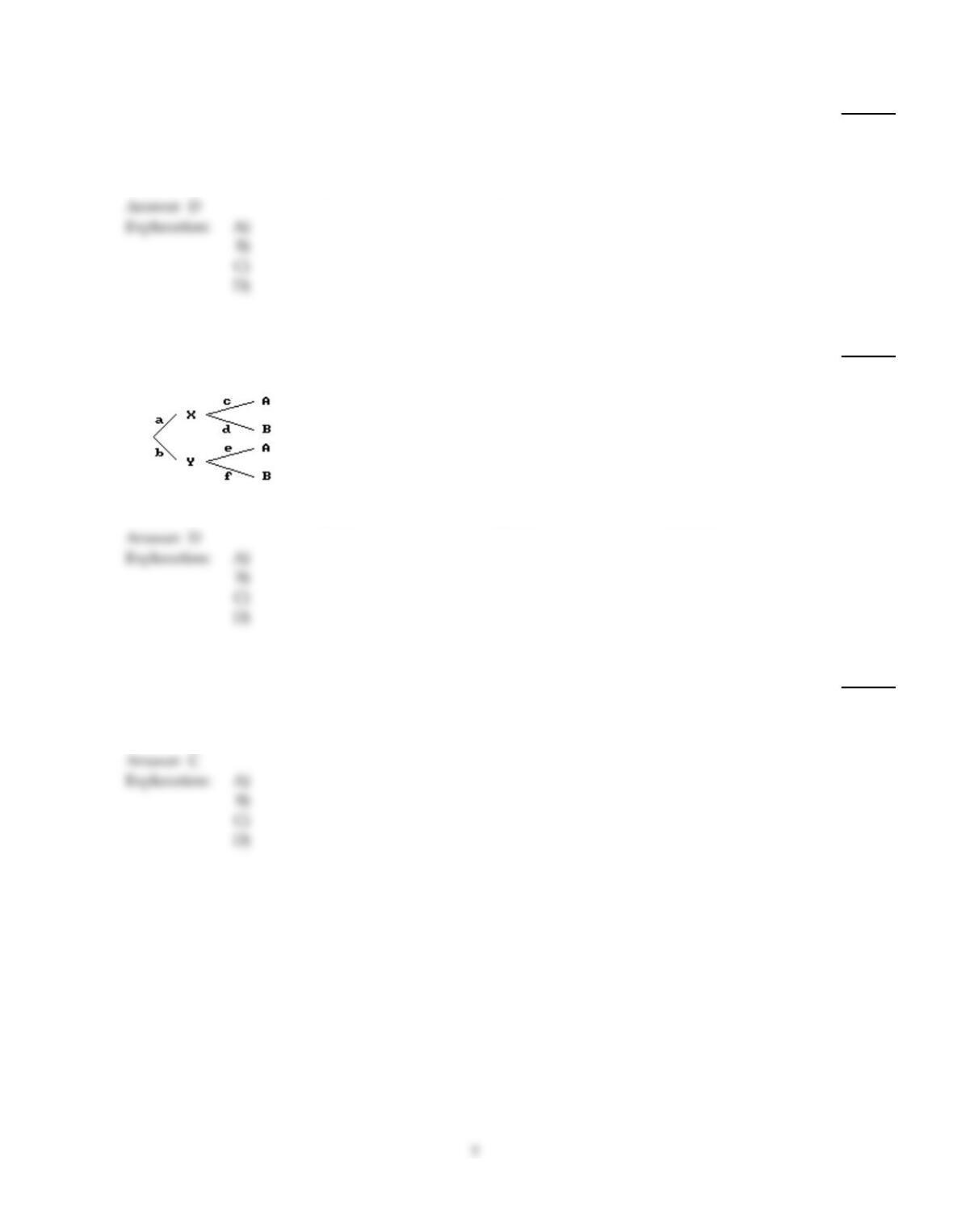
Use the tree diagram to find the requested probability.
25)
Find P(XA). Give your answer as a decimal and round your answer to three decimal places if
necessary.
a =0.1, b =0.9, c =0.8, d =0.2, e =0.4, f =0.6
25)
A)
0.067
B)
0.8
C)
0.08
D)
0.182
Find the probability.
26)
At the Stop ‘n Go tune–up and brake shop, the manager has found that an SUV will require a
tune–up with a probability of 0.6, a brake job with a probability of 0.1 and both with a probability
of 0.02. What is the probability that an SUV requires either a tune–up or a brake job?
26)
A)
0.32
B)
0.7
C)
0.68
D)
0.58

The graduates at a southern university are shown in the table.
Art & Science
A
Education
E
Business
B Total
Male, M 342 424 682 1448
Female, F 324 102 144 570
Total 666 526 826 2018
A student is selected at random from the graduating class.
27)
Find the probability that the student is female, given that an education degree is not received,
P(F|E’).
27)
A)
P(F|E’) =424
526
B)
P(F|E’) =324
666
C)
P(F|E’) =102
526
D)
P(F|E’) =117
373
Find the probability.
28)
A single fair die is rolled. The number on the die is a 3 or a 4.
28)
A)
2
B)
1
6
C)
1
36
D)
1
3
Estimate the indicated probability.
29)
College students were given three choices of pizza toppings and asked to choose one favorite. The
following table shows the results.
toppings freshman sophomore junior senior
cheese 15 10 26 18
meat 25 18 10 15
veggie 10 15 25 18
A randomly selected student prefers a cheese topping.
29)
A)
.073
B)
.217
C)
.337
D)
.500

Find the expected value.
30)
Mr. Cameron is sponsoring an summer concert. He estimates that he will make $300,000 if it does
not rain and make $60,000 if it does rain. The weather bureau predicts the chance of rain is 0.34 for
the day of the concert. An insurance company is willing to insure the concert for $150,000 against
rain for a premium of $30,000. If he buys this policy, what are his expected earnings from the
concert?
30)
A)
$300,000
B)
$270,000
C)
$180,000
D)
$239,400
31)
Suppose that 1,000 tickets are sold for a raffle that has the following prizes: one $300 prize, two
$100 prizes, and one hundred $1 prizes. What is expected value of a ticket?
31)
A)
$300
B)
$100
C)
$1
D)
$0.60
Provide an appropriate response.
32)
In a raffle 1000 tickets are being sold at $1.00 each. The first prize is $100, and there are 3 second
prizes fo $50 each. By how much does the price of a ticket exceed its expected value?
32)
A)
$50
B)
$1.00
C)
$0.75
D)
$1.75
Find the indicated probability.
33)
In a homicide case 6 different witnesses picked the same man from a line up. The line up contained
5 men. If the identifications were made by random guesses, find the probability that all 6 witnesses
would pick the same person.
33)
A)
0.000064
B)
1.2
C)
0.00032
D)
0.0001286

List the outcomes of the sample space.
34)
There are 3 balls in a hat; one with the number 3 on it, one with the number 5 on it, and one with
the number 8 on it. You pick a ball from the hat at random and then you flip a coin. Using a tree
diagram , obtain the sample space for the experiment. List the elements that make up the sample
space.
34)
A)
3 H, 3 T, 5 H, 5 T, 8 H, 8 T
B)
3 H, 5 H, 8 H
C)
3 5 8 H, 3 5 8 T
D)
3 H T, 5 H T, 8 H T
Find the probability.
35)
A bag contains 19 balls numbered 1 through 19. What is the probability of selecting a ball that has
an even number?
35)
A)
19
9
B)
9
19
C)
2
19
D)
9
B
Find the odds.
36)
If two fair dice are thrown, what are the odds of obtaining a sum of 7?
36)
A)
5:1
B)
3:4
C)
1:6
D)
1:5
D
Use a tree diagram to find the indicated probability.
37)
3.9% of a secluded island tribe are infected with a certain disease. There is a test for the disease,
however the test is not completely accurate. 92% of those who have the disease will test positive.
However 4.4% of those who do not have the disease will also test positive (false positives). What is
the probability that any given person will test positive? Round your answer to three decimal places
if necessary.
37)
A)
0.042
B)
0.078
C)
0.036
D)
0.482
B
A

List the outcomes of the sample space.
38)
A box contains 10 blue cards numbered 1 through 10. List the sample space of picking one card
from the box.
38)
A)
{8}
B)
{1, 2, 3, 4, 5, 6, 7, 8, 9, 10}
C)
{100}
D)
{10}
Find the probability.
39)
The table lists the eight possible blood types. Also given is the percent of the U.S. population
having that type.
Type/RH factor Percent
O positive 38%
A positive 34%
B Positive 9%
O Negative 7%
A Negative 6%
AB Positive 3%
B Negative 2%
AB Negative 1%
Let E be the event that a randomly selected person in the U. S. has type B blood. Let F be the event
that a randomly selected person in the U. S. has RH–positive blood.
Find P(F|E).
39)
A)
0.720
B)
0.107
C)
0.340
D)
0.818
Prepare a probability distribution for the experiment. Let x represent the random variable, and let P represent the
probability.
40)
Two marbles are drawn from a bag in which there are 4 red marble and 2 blue marble. The number
of blue marbles is counted.
40)
A)
x P
0 0.333
1 0.333
2 0.333
B)
x P
0 0.719
1 0.280
2 0.001
C)
x P
0 0.4
1 0.53
2 0.07
D)
x P
0 0.07
1 0.53
2 0.4

Solve the problem.
41)
At the Stop ‘n Go tune–up and brake shop, the manager has found that an SUV will require a
tune–up with a probability of 0.6, a brake job with a probability of 0.1 and both with a probability
of 0.02. What is the probability that an SUV requires a tune–up but not a brake job?
41)
A)
0.7
B)
0.58
C)
0.02
D)
0.68
Find the probability.
42)
A bag contains 3 red marbles, 7 blue marbles, and 5 green marbles. What is the probability of
choosing a blue marble?
42)
A)
P(B) =
7
10
B)
P(B) =
1
5
C)
P(B) =
7
15
D)
P(B) =
1
3
Find the expected value.
43)
A car agency has found daily demand to be as shown in the table.
Number of customers 7 8 9 10 11
Probability 0.10 0.20 0.40 0.20 0.10
Find the expected number of customers.
43)
A)
9
B)
10
C)
2
D)
12
Find the probability.
44)
A sample space consists of 20 separate events that are equally likely. What is the probability of
each?
44)
A)
1
B)
1
20
C)
20
D)
0
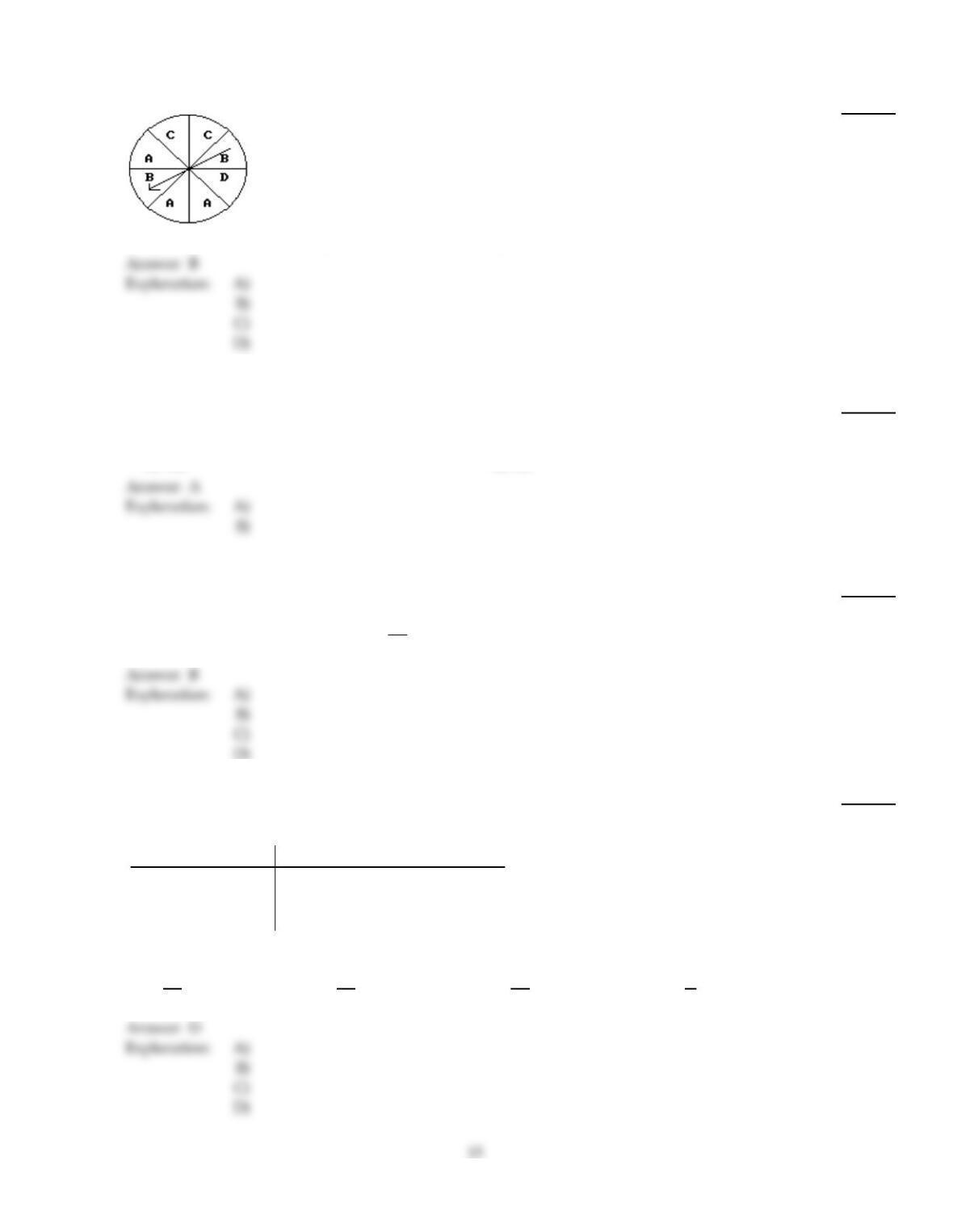
Find the odds.
45)
If the sectors are of equal size, what are the odds of spinning an A on this spinner?
45)
A)
4:2
B)
3:5
C)
6:2
D)
2:6
Determine independence. Answer Yes or No.
46)
A group of 25 people contains 10 brunettes, 8 blondes, and 7 redheads. Of the 20 girls in the group,
8 are brunettes, 6 are blondes, and 6 are redheads. A person is selected at random. Are the events of
being a girl and having brown hair independent?
46)
A)
Yes
B)
No
Find the probability.
47)
A lottery game contains 28 balls numbered 1 through 28. What is the probability of choosing a ball
numbered 28, P(28)?
47)
A)
P(28) = 0
B)
P(28) =1
28
C)
P(28) = 1
D)
P(28) = 28
48)
People were given three choices of soft drinks and asked to choose one favorite. The following
table shows the results.
diet cola root beer lemon–drop
under 18 years of age 40 25 20
between 18 and 40 35 20 30
over 40 years of age 20 30 35
Find P(person is over 40|person drinks root beer).
48)
A)
20
17
B)
5
17
C)
6
17
D)
2
5

In a survey of the number of DVDs in a house, the table shows the probabilities.
Number of DVDs 0 1 2 3 4 or more
Probability 0.05 0.024 0.33 0.21 0.17
49)
Find the probability of a house having 1 or 2 DVDs.
49)
A)
0.38
B)
0.83
C)
0.57
D)
0.95
Use Bayes’ rule to find the indicated probability.
50)
In Cumberland County, 55% of registered voters are Democrats, 30% are Republicans and 15% are
independent. During a recent election, 35% of the Democrats voted, 65% of the Republicans voted,
and 75% of the independent voted. What is the probability that someone who voted is a
Republican?
50)
A)
0.225
B)
0.065
C)
0.39
D)
0.385
Find the probability.
51)
If 80% of scheduled flights actually take place and cancellations are independent events, what is the
probability that 3 separate flights will all take place?
51)
A)
.64
B)
.01
C)
.80
D)
.51
52)
A 6–sided die is rolled. What is the probability of rolling a number less than 2?
52)
A)
5
6
B)
1
6
C)
1
3
D)
1
3