8-1: Processing Further
Walters Company produces 15,000 pounds of Product A and 30,000 pounds of Product B
each week by incurring a joint cost of $400,000. These two products can be sold as is or processed
further. Further processing of either product does not delay the production of subsequent batches
of the joint product. Data regarding these two products are as follows:
Product A Product B
Selling price per pound without further processing $12.00 $9.00
Selling price per pound with further processing $15.00 $11.00
Total separate weekly variable costs
of further processing $50,000 $45,000
To maximize Walters Company’s manufacturing contribution margin, how much total
separate variable costs of further processing should be incurred each week?
Source: CMA adapted
8-1: Solution to Processing Further (15 minutes)
8-2: Death Spiral
An insurance company has the following profitability analysis of its services:
Life Insurance Auto Insurance Home Insurance
Revenues $5,000,000 $10,000,000 $3,000,000
Commissions (1,000,000) (2,000,000) (600,000)
Payments (3,000,000) (7,300,000) (2,000,000)
Fixed Costs (500,000) (500,000) (500,000)
Profit $ 500,000 $ 200,000 ($ 100,000)
The fixed costs are distributed equally among the services and are not avoidable if one of the
services is dropped.
What is the profitability of the remaining services if all services with losses are dropped?
8-2: Solution to Death Spiral (10 minutes)
8-3: Joint Cost versus Common Costs
What is the difference between joint costs and common costs?
8–3: Solution to Joint Costs versus Common Costs (15 minutes)

8-4: Evaluating Decision Alternatives Involving Common Costs
Cosmo Inc. operates two retail novelty stores: the Mall Store and the Town Store.
Condensed monthly operating income data for Cosmo Inc. for November are presented in the
accompanying table. Additional information regarding Cosmo’s operations follows the statement.
Total
Mall
Store
Town
Store
Sales
$200,000
$80,000
$120,000
Less variable costs
116,000
32,000
84,000
Contribution margin
$84,000
$48,000
$36,000
Less direct fixed expenses
60,000
20,000
40,000
Store segment margin
$24,000
$28,000
$(4,000)
Less common fixed expenses
10,000
4,000
6,000
Operating income
$14,000
$24,000
$(10,000)
• One-fourth of each store’s direct fixed expenses would continue through December
of next year if either store were closed.
• Cosmo allocates common fixed expenses to each store on the basis of sales dollars.
• Management estimates that closing the Town Store would result in a 10 percent
decrease in Mall Store sales, while closing the Mall Store would not affect Town
Store sales.
• The operating results for November are representative of all months.
Required:
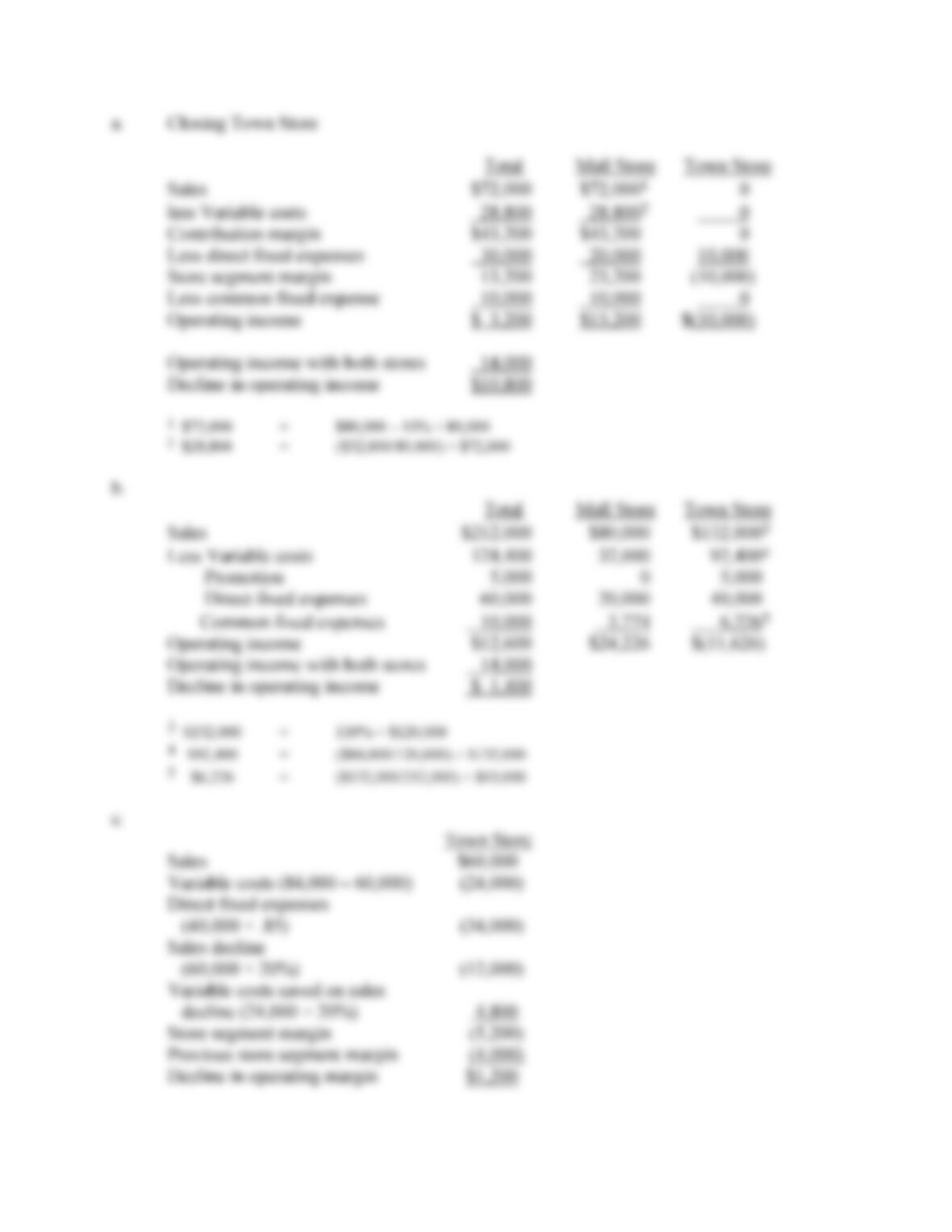
a. A decision by Cosmo Inc. to close the Town Store would result in a monthly increase
(decrease) in Cosmo’s operating income during next year of how much?
b. Cosmo is considering a promotional campaign at the Town Store that would not affect the
Mall Store. Increasing monthly promotional expenses at the Town Store by $5,000 in order
to increase Town Store sales by 10 percent would result in a monthly increase (decrease)
in Cosmo’s operating income during next year of how much?
c. Half of Town Store’s dollar sales are from items sold at variable cost to attract customers
to the store. Cosmo is considering deleting these items, a move that would reduce the
Town Store’s direct fixed expenses by 15 percent and result in the loss of 20 percent of
Town Store’s remaining sales volume. This change would not affect the Mall Store. A
decision to eliminate the items sold at cost would result in a monthly increase (decrease)
in Cosmo’s operating income during next year of how much?
Source: CMA adapted.
8–4: Solution to Evaluating Decision Alternatives Involving Common Costs (CMA adapted)
(20 minutes)
8-5: Beware of Unit Costs, Costs Beyond the Split-off Point are not Necessarily all
Variable
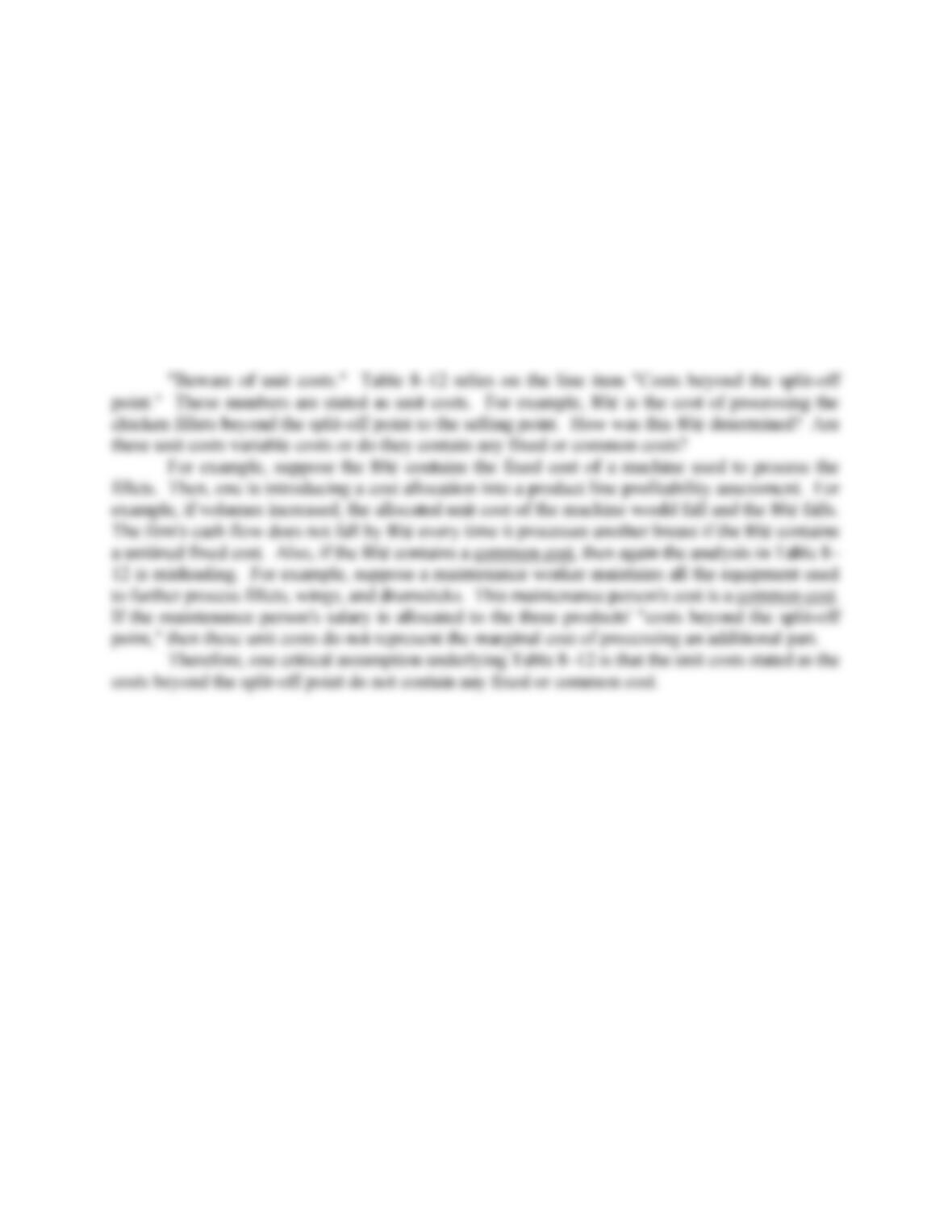
Table 8-12 in the text allocates joint costs using net realizable value as the allocation base.
What critical assumptions underlie the analysis in Table 8-12? That is, under what circumstances
can the data in this table be used to assess product line profitability?
8–5: Solution to Beware of Unit Costs, Costs Beyond the Split-off Point are not Necessarily
all Variable (20 minutes)
8-6: Allocating joint costs
Sonimad Sawmill manufactures two lumber products from a joint milling process. The
two products developed are mine support braces (MSBs) and unseasoned commercial building
lumber (CBL). A standard production run incurs joint costs of $300,000 and results in 60,000
units of MSB and 90,000 units of CBL. Each unprocessed unit of MSB sells for $2 per unit and
each unprocessed unit of CBL sells for $4 per unit.
If the CBL is processed further at a cost of $200,000, it can be sold at $10 per unit but
10,000 units are unavoidably lost (with no discernible value). The MSB units can be coated with
a preservative at a cost of $100,000 per production run and then sold for $3.50 each.
Required:
a. If no further work is done after the initial milling process, calculate the cost of CBL using
physical quantities to allocate the joint cost.
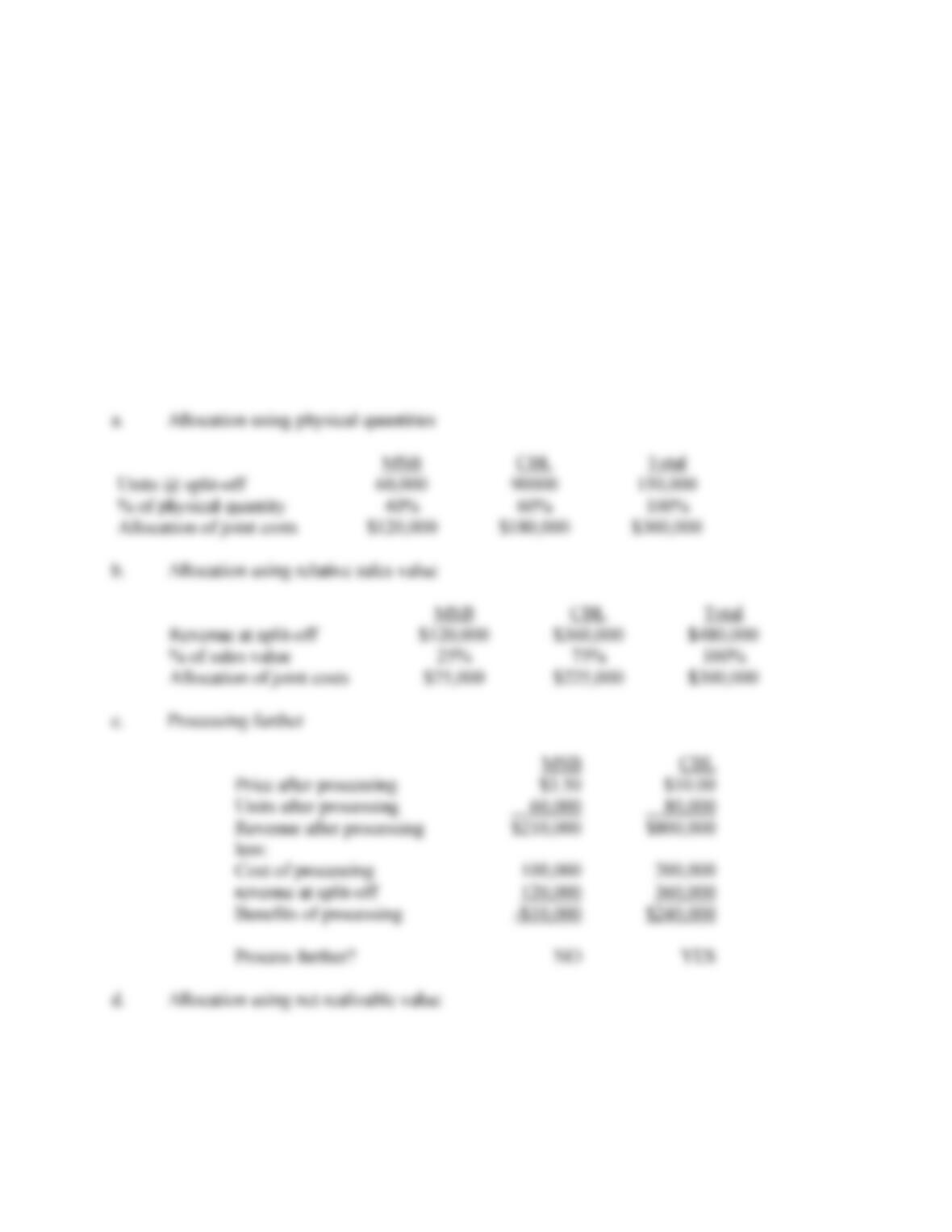
b. If no further work is done after the initial milling process, calculate the cost of MSB using
relative sales value to allocate the joint cost.
c. Should MSB and CBL be processed further or sold immediately after initial milling?
d. Given your decision in (c), prepare a schedule computing the completed cost assigned to
each unit of MSB and CBL as charged to finished goods inventory. Use net realizable
value for allocating joint costs.
Source: CMA adapted.
8–6: Solution to Allocating Joint Costs (CMA adapted) (30 minutes)