
8-1
Chapter 8: Surveys and Sampling – Quiz A Name___________________________
8.3.1 Determine and analyze sampling methods; identify and understand biases.
1. The administration of a large university is interested in learning about the types of
wellness programs that would interest its employees. To do this, they plan to survey a
random sample of employees. Under consideration are several plans for selecting the
sample. Name the sampling strategy for each.
a. There are five categories of employees (administration, faculty, professional staff,
clerical and maintenance). Randomly select ten individuals from each category.
b. Each employee has an ID number. Randomly select 50 numbers.
c. Randomly select a school within the university (e.g., Business School) and survey all
of the individuals (administration, faculty, professional staff, clerical and maintenance)
who work in that school.
d. The HR Department has an alphabetized list of newly hired employees (hired within
the last five years). After starting the process by randomly selecting an employee from
the list, then every 5th name is chosen to be included in the sample.
8.3.1 Determine and analyze sampling methods; identify and understand biases.
2. Suppose the administration decides to do the following. At a Starbucks located on
campus, every tenth person who enters on a Monday morning is selected to be surveyed.
Explain why this may be biased.
8.4.1 Determine and analyze sampling methods; identify and understand biases.
3. Two of the questions asked in the survey of employees are shown below.
• Since exercise is so important to good health, would you be willing to participate
in organized walks during lunch hour?
• Would you attend a “healthy cooking” demonstration?
a. Are these questions valid (appropriately worded)? Explain.
b. Which question is more neutral? Explain.
8.2.1 Determine and analyze sampling methods; identify and understand biases.
4. A consumer research group is interested in how older drivers view hybrid cars.
Specifically, they wish to assess the percentage of drivers in the U.S. 50 years of age or
older who intend to purchase a hybrid in the next two years. They used a list of AARP
(American Association of Retired Persons) members as the sampling frame. Based on a
systematic sample, they estimated the percentage to be 17%.
a. Define the target population.
b. Define the parameter.
c. What is the statistic?
d. How might the results be biased?

8-2 Chapter 8 Surveys and Sampling
Chapter 8: Surveys and Sampling – Quiz A – Key
1. The administration of a large university is interested in learning about the types of
wellness programs that would interest its employees. To do this, they plan to survey a
random sample of employees. Under consideration are several plans for selecting the
sample. Name the sampling strategy for each.
a. There are five categories of employees (administration, faculty, professional staff,
clerical and maintenance). Randomly select ten individuals from each category.
b. Each employee has an ID number. Randomly select 50 numbers.
c. Randomly select a school within the university (e.g., Business School) and survey all
of the individuals (administration, faculty, professional staff, clerical and maintenance)
who work in that school.
d. The HR Department has an alphabetized list of newly hired employees (hired within
the last five years). After starting the process by randomly selecting an employee from
the list, then every 5th name is chosen to be included in the sample.
2. Suppose the administration decides to do the following. At a Starbucks located on
campus, every tenth person who enters on a Monday morning is selected to be surveyed.
Explain why this may be biased.
Depending on the time during which individuals are surveyed, undercoverage may be an
issue. For example, different categories of employees have different levels of flexibility
(clerical and maintenance workers don’t have as much flexibility in their work days as do
administration, faculty and professional staff). In addition, persons other than employees
would presumably enter Starbucks, although a screening question can be used to make
sure those interviewed are employees.
3. Two of the questions asked in the survey of employees are shown below.
• Since exercise is so important to good health, would you be willing to participate
in organized walks during lunch hour?
• Would you attend a “healthy cooking” demonstration?
a. Are these questions valid (appropriately worded)? Explain.
The first question is “leading” the respondent to answer yes.
Quiz A 8–3
b. Which question is more neutral? Explain.
4. A consumer research group is interested in how older drivers view hybrid cars.
Specifically, they wish to assess the percentage of drivers in the U.S. 50 years of age or
older who intend to purchase a hybrid in the next two years. They used a list of AARP
(American Association of Retired Persons) members as the sampling frame. Based on a
systematic sample, they estimated the percentage to be 17%.
a. Define the target population.
b. Define the parameter.
c. What is the statistic?
d. How might the results be biased?

8-4 Chapter 8 Surveys and Sampling
Chapter 8: Surveys and Sampling – Quiz B Name_____________________________
8.3.1 Determine and analyze sampling methods; identify and understand biases.
1. Molly’s Reach, a regional restaurant and gift shop, has recently launched an increased
sales campaign, particularly focused on their gift shop. To determine if their proposal is
of interest, they plan to survey a random sample of their regular customers. Under
consideration are several plans for selecting the sample. Name the sampling strategy for
each.
a. Regular customers belong to a rewards program and have a customer rewards ID
number. Randomly select 100 numbers.
b. Molly’s Reach has stores in three different cities in northwestern U.S. and Canada.
Randomly select one of the stores and survey all regular customers that belong to its
rewards program.
c. Molly’s Reach has an alphabetized list of regular customers who belong to their
rewards program. After randomly selecting a customer on the list, every 25th customer
from that point on is chosen to be in the sample.
d. Customers are grouped into four age categories (under 21, 21 to 35, 36 to 50, and over
50). Randomly select 10 regular customers in each age category.
8.2.1 Determine and analyze sampling methods; identify and understand biases.
2. In the Molly’s Reach study described above,
a. Define the target population.
b. Define the parameter.
c. What is the sampling frame?
d. How might the results be biased?
8.5.1 Determine and analyze sampling methods; identify and understand biases.
3. One member of the management team at Molly’s Reach wanted to know if customers
were concerned by recent security breaches. He suggests that their survey could be
conducted online. Customers logging on to the online store would be asked to take a few
minutes to complete the survey and would be offered a coupon as incentive to participate.
Explain how this approach might be biased.
8.4.1 Determine and analyze sampling methods; identify and understand biases.
4. Two of the questions asked in the survey of customers are shown below.
• Given the prevalence of identity theft, are you reluctant to provide credit card
information online to purchase items from the gift shop?
• Are you confident that any information you provide to our online store is
secure?
a. Are these questions valid (appropriately worded)? Explain.
b. Which question is more neutral? Explain.
Quiz B 8–5
Chapter 8: Surveys and Sampling – Quiz B – Key
1. Molly’s Reach, a regional restaurant and gift shop, has recently launched an increased
sales campaign, particularly focused on their gift shop. To determine if their proposal is
of interest, they plan to survey a random sample of their regular customers. Under
consideration are several plans for selecting the sample. Name the sampling strategy for
each.
a. Regular customers belong to a rewards program and have a customer rewards ID
number. Randomly select 100 numbers.
b. Molly’s Reach has stores in three different cities in northwestern U.S. and Canada.
Randomly select one of the stores and survey all regular customers that belong to its
rewards program.
c. Molly’s Reach has an alphabetized list of regular customers who belong to their
rewards program. After randomly selecting a customer on the list, every 25th customer
from that point on is chosen to be in the sample.
d. Customers are grouped into four age categories (under 21, 21 to 35, 36 to 50, and over
50). Randomly select 10 regular customers in each age category.
2. In the Molly’s Reach study described above,
a. Define the target population.
b. Define the parameter.
c. What is the sampling frame?
d. How might the results be biased?
8-6 Chapter 8 Surveys and Sampling
3. One member of the management team at Molly’s Reach wanted to know if customers
were concerned by recent security breaches. He suggests that their survey could be
conducted online. Customers logging on to the online store would be asked to take a few
minutes to complete the survey and would be offered a coupon as incentive to participate.
Explain how this approach might be biased.
4. Two of the questions asked in the survey of customers are shown below.
• Given the prevalence of identity theft, are you reluctant to provide credit card
information online to purchase items from the gift shop?
• Are you confident that any information you provide to our online store is
secure?
a. Are these questions valid (appropriately worded)? Explain.
b. Which question is more neutral? Explain.

Quiz C 8-7
Chapter 8: Surveys and Sampling – Quiz C – Multiple Choice
Name_____________________________________
8.3.1 Determine and analyze sampling methods; identify and understand biases.
1. The main ideas of sampling do not include
A. Sample size matters
B. Examine a part of the whole
C. The fraction of the larger population determines the precision of the resulting
statistics
D. Randomization
E. All ideas of sampling should be included
8.3.1 Determine and analyze sampling methods; identify and understand biases.
2. The administration of a large university is interested in learning about the types of
wellness programs that would interest its employees. Suppose that there are five
categories of employees (administration, faculty, professional staff, clerical and
maintenance) and the university decides to randomly select ten individuals from each
category. This sampling plan is called
A. Simple Random Sampling
B. Stratified Sampling
C. Cluster Sampling
D. Systematic Sampling
E. Convenience Sampling
8.3.1 Determine and analyze sampling methods; identify and understand biases.
3. The administration of a large university is interested in learning about the types of
wellness programs that would interest its employees. Suppose that the university
randomly selects a school (e.g., the Business School) and surveys all of the individuals
(administration, faculty, professional staff, clerical and maintenance) who work in that
school. This sampling plan is called
A. Simple Random Sampling
B. Stratified Sampling
C. Cluster Sampling
D. Systematic Sampling
E. Convenience Sampling

8-8 Chapter 8 Surveys and Sampling
8.3.1 Determine and analyze sampling methods; identify and understand biases.
4. Molly’s Reach, a regional restaurant and gift shop, has recently launched an increased
sales campaign, particularly focused on their gift shop. To determine if their proposal is
of interest, they plan to survey a random sample of their regular customers. Suppose that
Molly’s Reach’s regular customers belong to a rewards program and have a customer
rewards ID number. Molly’s Reach decides to randomly select 100 numbers. This
sampling plan is called
A. Simple Random Sampling
B. Stratified Sampling
C. Cluster Sampling
D. Systematic Sampling
E. Convenience Sampling
8.3.1 Determine and analyze sampling methods; identify and understand biases.
5. Molly’s Reach, a regional restaurant and gift shop, has recently launched an increased
sales campaign, particularly focused on their gift shop. To determine if their proposal is
of interest, they plan to survey a random sample of their regular customers. Suppose that
Molly’s Reach has an alphabetized list of regular customers who belong to their rewards
program. After randomly selecting a customer on the list, every 25th customer from that
point on is chosen to be in the sample. This sampling plan is called
A. Simple Random Sampling
B. Stratified Sampling
C. Cluster Sampling
D. Systematic Sampling
E. Convenience Sampling
8.2.1 Determine and analyze sampling methods; identify and understand biases.
6. Molly’s Reach, a regional restaurant and gift shop, has recently launched an increased
sales campaign, particularly focused on their gift shop. To determine if their proposal is
of interest, they plan to survey a random sample of their regular customers. All regular
Molly’s Reach customers is known as the ________ of the study.
A. parameter
B. statistic
C. target population
D. sampling frame
E. sample

Quiz C 8-9
8.2.1 Determine and analyze sampling methods; identify and understand biases.
7. Molly’s Reach, a regional restaurant and gift shop, has recently launched an increased
sales campaign, particularly focused on their gift shop. To determine if their proposal is
of interest, they plan to survey a random sample of their regular customers. Which of the
following is the parameter of interest in the Molly’s Reach study?
A. all regular Molly’s Reach customers
B. % of regular Molly’s Reach customers who have concerns about online security
C. Molly’s Reach customers who belong to the rewards program
D. % of Molly’s Reach customers who belong to the rewards program that don’t shop
online
E. none of the above
8.3.1 Determine and analyze sampling methods; identify and understand biases.
8. Molly’s Reach, a regional restaurant and gift shop, has recently launched an increased
sales campaign, particularly focused on their gift shop. To determine if their proposal is
of interest, they plan to survey a random sample of their regular customers. One member
of the management team at Molly’s Reach suggests that their survey could be conducted
online. Customers logging on to the online store would be asked to take a few minutes to
complete the survey and would be offered a coupon as incentive to participate. Which of
the following statements is true?
A. This is a voluntary response sample.
B. This would result in an unbiased random sample.
C. This would result in a biased sample.
D. Both A and B
E. Both A and C
8.3.1 Determine and analyze sampling methods; identify and understand biases.
9. A consumer research group is interested in how older drivers view hybrid cars.
Specifically, they wish to assess the percentage of drivers in the U.S. 50 years of age or
older who intend to purchase a hybrid in the next two years. They selected a systematic
sample from a list of AARP (American Association of Retired Persons) members.
Based on this sample, they estimated the percentage to be 17%. The sampling frame for
this study is
A. all drivers in the U.S. 50 years of age or older
B. 17%
C. the list of AARP members
D. how older drivers view hybrid cars
E. none of the above

8-10 Chapter 8 Surveys and Sampling
8.2.1 Determine and analyze sampling methods; identify and understand biases.
10. A consumer research group is interested in how older drivers view hybrid cars.
Specifically, they wish to assess the percentage of drivers in the U.S. 50 years of age or
older who intend to purchase a hybrid in the next two years. They selected a systematic
sample from a list of AARP (American Association of Retired Persons) members.
Based on this sample, they estimated the percentage to be 17%. Which of the following
statements about this study is true?
A. 17% of all U.S. drivers 50 years of age or older intend to purchase a hybrid in the
next two years.
B. 17% is a parameter.
C. 17% is a statistic.
D. Both A and B
E. Both A and C
8.4.1 Determine and analyze sampling methods; identify and understand biases.
11. Which of the following survey questions is leading?
A. Given the prevalence of identity theft, are you reluctant to provide credit card
information online?
B. Are you confident that any information you provide online is secure?
C. Are you concerned about the security of online transactions?
D. Both A and B
E. Both B and C
Quiz C 8-11
Chapter 8: Surveys and Sampling – Quiz C – Key

8-12 Chapter 8 Surveys and Sampling
Chapter 8: Surveys and Sampling – Multiple Choice Quiz – Quiz D
Name_____________________________________
8.3.1 Determine and analyze sampling methods; identify and understand biases.
1. Management at a large multinational corporation would like to survey its employees
about the level of interest in combining flexible work schedules with telecommuting from
home. Each employee has an ID number, and the administration plans to randomly select
250 numbers. This sampling plan is called
A. Simple Random Sampling
B. Stratified Sampling
C. Cluster Sampling
D. Systematic Sampling
E. Convenience Sampling
8.3.1 Determine and analyze sampling methods; identify and understand biases.
2. Management at a large multinational corporation would like to survey its employees
about the level of interest in combining flexible work schedules with telecommuting from
home. The HR Department has an alphabetized list of newly hired employees (hired
within the last year). After starting the process by randomly selecting an employee from
the list, then every 5th name is chosen to be included in the sample. This sampling plan is
called
A. Simple Random Sampling
B. Stratified Sampling
C. Cluster Sampling
D. Systematic Sampling
E. Convenience Sampling
8.3.1 Determine and analyze sampling methods; identify and understand biases.
3. Management at a large multinational corporation would like to survey its employees
about the level of interest in combining flexible work schedules with telecommuting from
home. Which of the following is the parameter of interest in this study?
A. All employees at the corporation.
B. Percentage of employees who are interested in combining flexible work schedules
with telecommuting from home.
C. Employees who work overtime.
D. Percentage of employees who do not have a computer at home.
E. None of the above

Quiz D 8-13
8.3.1 Determine and analyze sampling methods; identify and understand biases.
4. Suppose that a local government agency is interested in gauging public opinion about
natural gas drilling in northeastern Pennsylvania by surveying residents who live near a
proposed drilling site. Which of the following questions is leading?
A. Do you support the proposed gas drilling?
B. Given the positive economic impact, do you support gas drilling?
C. Given the negative impact on the environment, do you oppose gas drilling?
D. Both A and B.
E. Both B and C.
8.3.1 Determine and analyze sampling methods; identify and understand biases.
5. The online MBA director at a large business school surveys a sample of current
students to determine their level of satisfaction with the program. She finds that 67% are
“very satisfied” with the online program. This is a
A. parameter.
B. statistic.
C. target population.
D. sampling frame.
E. good result.
8.3.1 Determine and analyze sampling methods; identify and understand biases.
6. A women’s advocacy group believes that there is gender discrimination in the
financial services industry. One member of the group, a financial analyst, offers to
survey a sample of women at her company about this issue. Which of the following
statements is true about the proposed study?
A. It involves a stratified sample that is representative of the population.
B. It involves a simple random sample that is representative of the population.
C. It involves a convenience sample and may not be representative of the population.
D. It will result in unbiased data.
E. It involves taking a census of the target population.
8.5.1 Determine and analyze sampling methods; identify and understand biases.
7. Shortly after the Sandy Hook Elementary School shooting in December 2012, a local
television news program asked viewers to call in with their opinion about gun control.
These results were likely biased because
A. of a bad sampling frame.
B. of an undefined target population.
C. leading questions.
D. of a voluntary response sample.
E. of measurement error.

8-14 Chapter 8 Surveys and Sampling
8.2.1 Determine and analyze sampling methods; identify and understand biases.
8. From July to September, 2013, the Pew Research Center for the People & the Press
carried out a national survey to determine use of social networking by African American
internet users. It found that 73% used a social networking of some kind. This is a
A. statistic.
B. parameter.
C. target population.
D. sampling frame.
E. census.
8.3.1 Determine and analyze sampling methods; identify and understand biases.
9. The HR department of a large company wants to determine how often to bring
representatives from the financial firm managing employee pensions on site to meet with
individuals about their retirement plans. In order to determine level of interest, they
decide to survey employees. Suppose they group employees by age categories (e.g.,
under 30; 30 – under 45; 45 – under 60, 60 or older) and randomly select 50 individuals
from each category. This sampling plan is called
A. Simple Random Sampling
B. Stratified Sampling
C. Cluster Sampling
D. Systematic Sampling
E. Convenience Sampling
8.3.1 Determine and analyze sampling methods; identify and understand biases.
10. The HR department of a large company wants to determine how often to bring
representatives from the financial firm managing employee pensions on site to meet with
individuals about their retirement plans. In order to determine level of interest, they
decide to survey employees. Suppose they select one department (e.g., Sales) and survey
all employees within that department. This sampling plan is called
A. Simple Random Sampling
B. Stratified Sampling
C. Cluster Sampling
D. Systematic Sampling
E. Convenience Sampling

Quiz D 8-15
8.4.1 Determine and analyze sampling methods; identify and understand biases.
11. If you open a new department store, reasons not to survey all of the area residents to
understand their needs would not include
A. Difficulty accessing the entire population
B. Cost
C. Bias
D. Time consuming
E. All reasons should be included
8-16 Chapter 8 Surveys and Sampling
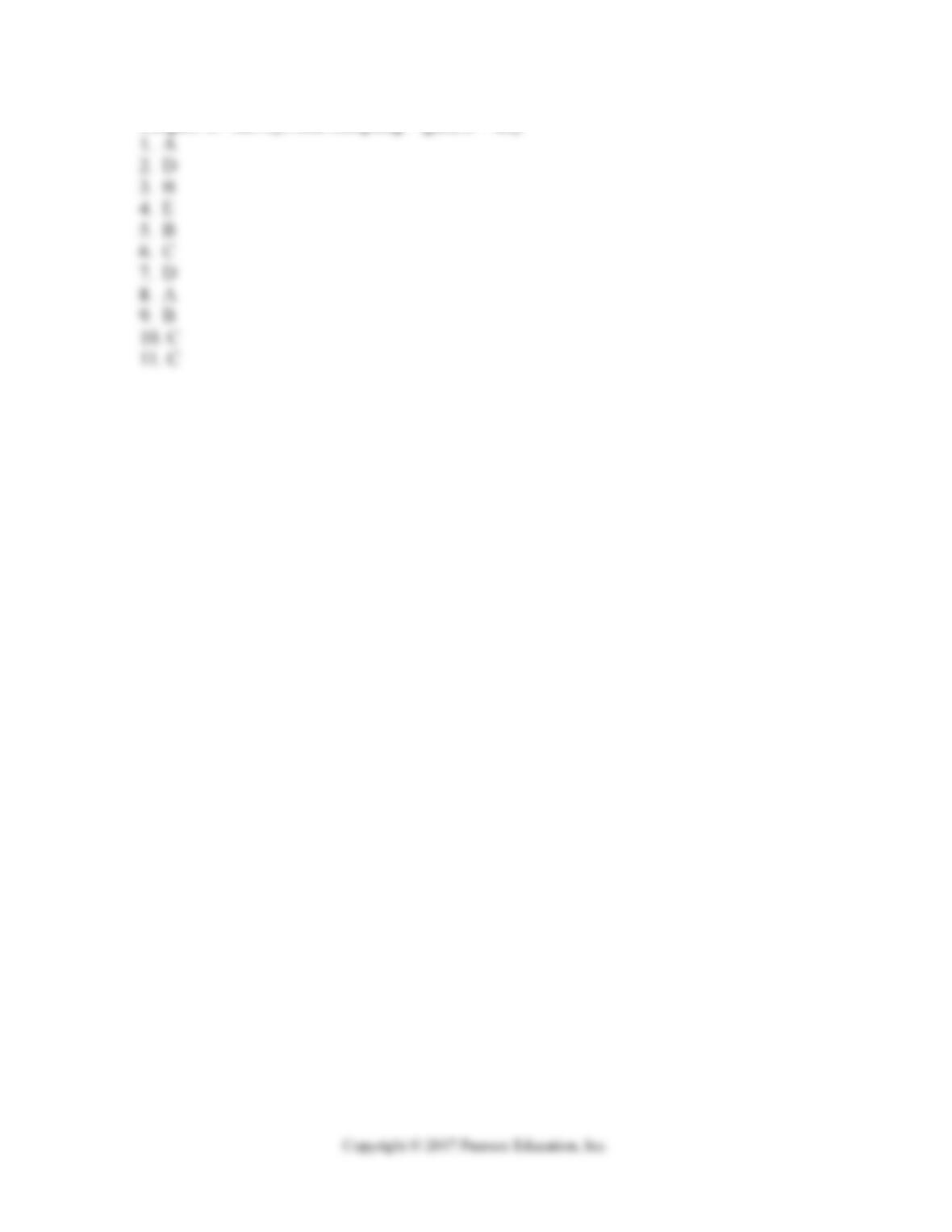
Chapter 8: Surveys and Sampling – Quiz D – Key