Principles of Managerial Finance, Brief, 7e (Gitman)
Chapter 8 Risk and Return
8.1 Understand the meaning and fundamentals of risk, return, and risk preferences.
1) Investment A guarantees its holder $100 return. Investment B earns $0 or $200 with equal
chances (i.e., an average of $100) over the same period. Both investments have equal risk.
2) The return on an asset is the change in its value plus any cash distribution over a given period
of time, expressed as a percentage of its ending value.
3) For a risk-seeking manager, no change in return would be required for an increase in risk.
4) For a risk-averse manager, required return would decrease for an increase in risk.
5) For a risk-indifferent manager, no change in return would be required for an increase in risk.
6) Most managers are risk-averse, since for a given increase in risk they require an increase in
return.
7) For a risk-averse manager, the required return increases for an increase in risk.
8) Interest rate risk is the chance that changes in interest rates will adversely affect the value of
an investment.
9) Most investments decline in value when the interest rates rise and increase in value when
interest rates fall.
10) The term “risk” is used interchangeably with “uncertainty” to refer to the variability of
returns associated with a given asset.
11) In the most basic sense, risk is a measure of the uncertainty surrounding the return that an
investment will earn.
12) An investment’s total return is the sum of any cash distributions minus the change in the
investment’s value, divided by the beginning-of-period value.
13) Stocks are less riskier than either bonds or bills.
14) The interest rate risk associated with Treasury bonds is much higher than with bills.
15) Which of the following is true of risk-return trade off?
A) Risk can be measured on the basis of variability of return.
B) Risk and return are inversely proportional to each other.
C) T-bills are more riskier than equity due to imbalances in government policies.
D) Riskier investments tend to have lower returns.
16) Which of the following is true of risk?
A) Risk and return are inversely proportionate to each other.
B) Higher the risk associated with a security the lower is its return.
C) Risk is a measure of the uncertainty surrounding the return that an investment will earn.
D) Riskier investments tend to have lower returns as compared to T-bills which are risk free.
17) Nico bought 500 shares of a stock for $24.00 per share on January 1, 2013. He received a
dividend of $2.50 per share at the end of 2013 and $4.00 per share at the end of 2014. At the end
of 2015, Nico collected a dividend of $3.00 per share and sold his stock for $20.00 per share.
What is Nico’s realized total rate of return?
A) -12.5%
B) 12.5%
C) -20.7%
D) 20.7%
18) Nico bought 100 shares of Cisco Systems stock for $30.00 per share on January 1, 2013. He
received a dividend of $2.00 per share at the end of 2013 and $3.00 per share at the end of 2014.
At the end of 2015, Nico collected a dividend of $4.00 per share and sold his stock for $33.00
per share. What was Nico’s realized holding period return?
A) -40%
B) +40%
C) -36.36%
D) +36.36%
19) The total rate of return on an investment over a given period of time is calculated by
________.
A) dividing the asset’s cash distributions during the period, plus change in value, by its
beginning-of period investment value
B) dividing the asset’s cash distributions during the period, plus change in value, by its ending-of
period investment value
C) dividing the asset’s cash distributions during the period, minus change in value, by its ending-
of period investment value
D) dividing the asset’s cash distributions during the period, minus change in value, by its
beginning-of period investment value
20) Last year, Mike bought 100 shares of Dallas Corporation common stock for $53 per share.
During the year he received dividends of $1.45 per share. The stock is currently selling for $60
per share. What rate of return did Mike earn over the year?
A) 11.7 percent
B) 13.2 percent
C) 14.1 percent
D) 15.9 percent
21) If a manager prefers a higher return investment regardless of its risk, then he is following a
________ strategy.
A) risk-seeking
B) risk-neutral
C) risk-averse
D) risk-aware
22) If a manager prefers investments with greater risk even if they have lower expected returns,
then he is following a ________ strategy.
A) risk-seeking
B) risk-indifferent
C) risk-averse
D) risk-neutral
23) Risk aversion is the behavior exhibited by managers who require ________.
A) an increase in return, for a given decrease in risk
B) an increase in return, for a given increase in risk
C) no changes in return, for a given increase in risk
D) decrease in return, for a given increase in risk
24) If a manager requires greater return when risk increases, then he is said to be ________.
A) risk-seeking
B) risk-indifferent
C) risk-averse
D) risk-aware
8
25) Perry purchased 100 shares of Ferro, Inc. common stock for $25 per share one year ago.
During the year, Ferro, Inc. paid cash dividends of $2 per share. The stock is currently selling for
$30 per share. If Perry sells all of his shares of Ferro, Inc. today, what rate of return would he
realize?
26) Nico bought 100 shares of a company’s stock for $22.00 per share on January 1, 2013. He
received a dividend of $2.00 per share at the end of 2013 and $3.00 per share at the end of 2014.
At the end of 2015, Nico collected a dividend of $4.00 per share and sold his stock for $18.00
per share. What was Nico’s realized holding period return? What was Nico’s compound annual
rate of return? Explain the difference?
27) Tim purchased a bounce house one year ago for $6,500. During the year it generated $4,000
in cash flow. If Time sells the bounce house today, he could receive $6,100 for it. What would be
his rate of return under these conditions?
28) Asset A was purchased six months ago for $25,000 and has generated $1,500 cash flow
during that period. What is the asset’s rate of return if it can be sold for $26,750 today?
8.2 Describe procedures for assessing and measuring the risk of a single asset.
1) The range of an asset’s risk is found by subtracting the worst outcome from the best outcome.
2) Larger the difference between an asset’s worst outcome from its best outcome, the higher the
risk of an asset.
3) Risk can be assessed by means of scenario analysis and probability distributions.
4) An approach for assessing risk that uses a number of possible return estimates to obtain a
sense of the variability among outcomes is called scenario analysis.
5) Greater the range of an asset, more the variability, or risk, the asset is said to possess.
6) The real utility of the coefficient of variation is in comparing assets that have equal expected
returns.
7) The risk of an asset can be measured by its variance, which is found by subtracting the worst
outcome from the best outcome.
8) Coefficient of variation is a measure of relative dispersion used in comparing the risks of
assets with differing expected return.
9) The more certain the return from an asset, the less variability and therefore the less risk.
10) In U.S., during the past 75 years, on an average the return on large-company stocks has
exceeded the return on small-company stocks.
11) In U.S., during the past 75 years, on an average the return on small-company stocks has
levelled the return on large-company stocks.
12) A normal probability distribution is a symmetrical distribution whose shape resembles a bell-
shaped curve.
13) For normal probability distributions, 95 percent of the possible outcomes will lie between ±1
standard deviation from the expected return.
14) Standard deviation is a measure of relative dispersion that is useful in comparing the risks of
assets with different expected returns.
15) A normal probability distribution is an asymmetrical distribution whose shape resembles a
pyramid.
16) Higher the coefficient of variation, the greater the risk and therefore the higher the expected
return.
17) Lower the coefficient of variation, the greater the risk and therefore the higher the expected
return.
18) Standard deviation measures the dispersion of an investment’s return around the expected
return.
19) In U.S., during the past 75 years, on an average the return on U.S. Treasury bills has
exceeded the inflation rate.
20) On average in U.S., during the past 75 years, the return on U.S. Treasury bills has exceeded
the return on long-term government bonds.
21) On average in U.S., during the past 75 years, the return on large-company stocks has
exceeded the return on long-term corporate bonds.
22) A common approach of estimating the variability of returns involving the forecast of
pessimistic, most likely, and optimistic returns associated with an asset is called ________.
A) marginal analysis
B) scenario analysis
C) break-even analysis
D) DuPont analysis
23) ________ is the extent of an asset’s risk. It is found by subtracting the pessimistic outcome
from the optimistic outcome.
A) Variance
B) Standard deviation
C) Probability distribution
D) Range
24) The simplest type of probability distribution is a ________.
A) bar chart
B) normal distribution
C) lognormal distribution
D) Poisson distribution
25) The ________ of a given outcome is its chance of occurring.
A) dispersion
B) standard deviation
C) probability
D) reliability
26) A(n) ________ distribution shows all possible outcomes and associated probabilities for a
given event.
A) discrete
B) lognormal
C) exponential
D) probability
27) A ________ measures the dispersion around the expected value.
A) coefficient of variation
B) chi square
C) mean
D) standard deviation
28) A ________ is a measure of relative dispersion used in comparing the risk of assets with
differing expected returns.
A) coefficient of variation
B) chi square
C) mean
D) standard deviation
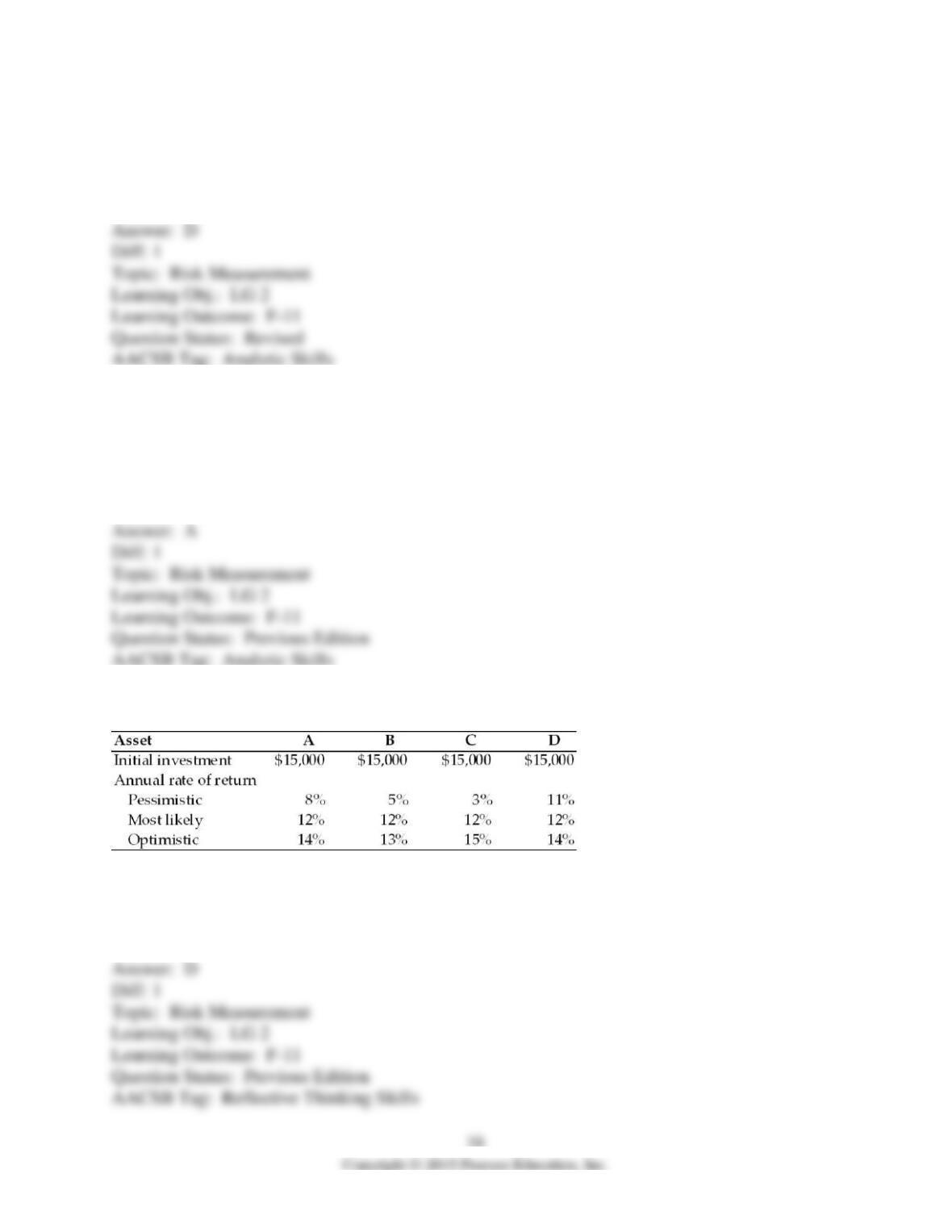
29) Which asset would the risk-averse financial manager prefer? (See below.)
A) Asset A
B) Asset B
C) Asset C
D) Asset D
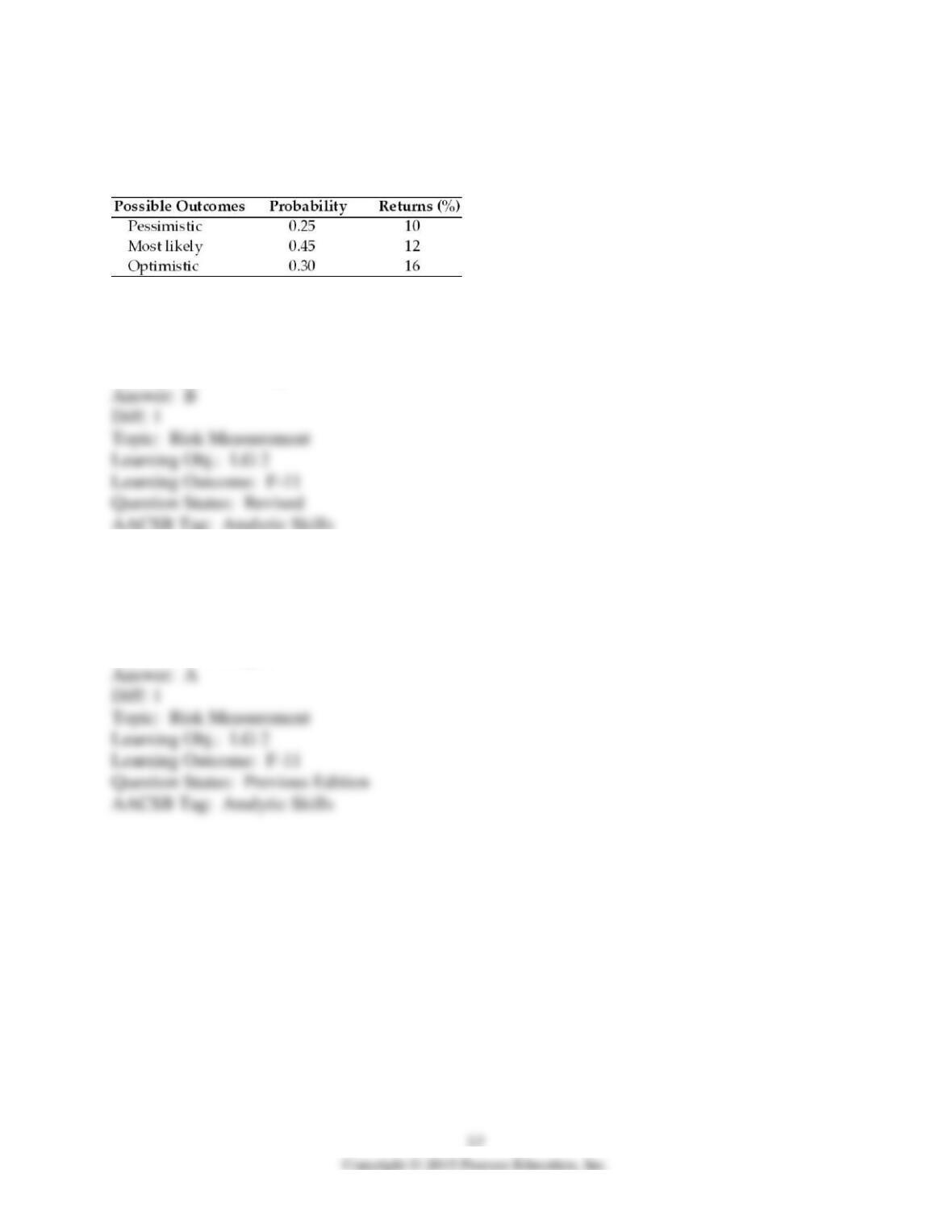
30) The expected value and the standard deviation of returns for asset A is ________. (See
below.)
Asset A
A) 12 percent and 4 percent
B) 12.7 percent and 2.3 percent
C) 12.7 percent and 4 percent
D) 12 percent and 2.3 percent
31) The ________ the coefficient of variation, the ________ the risk.
A) lower; lower
B) higher; lower
C) lower; higher
D) more stable; higher
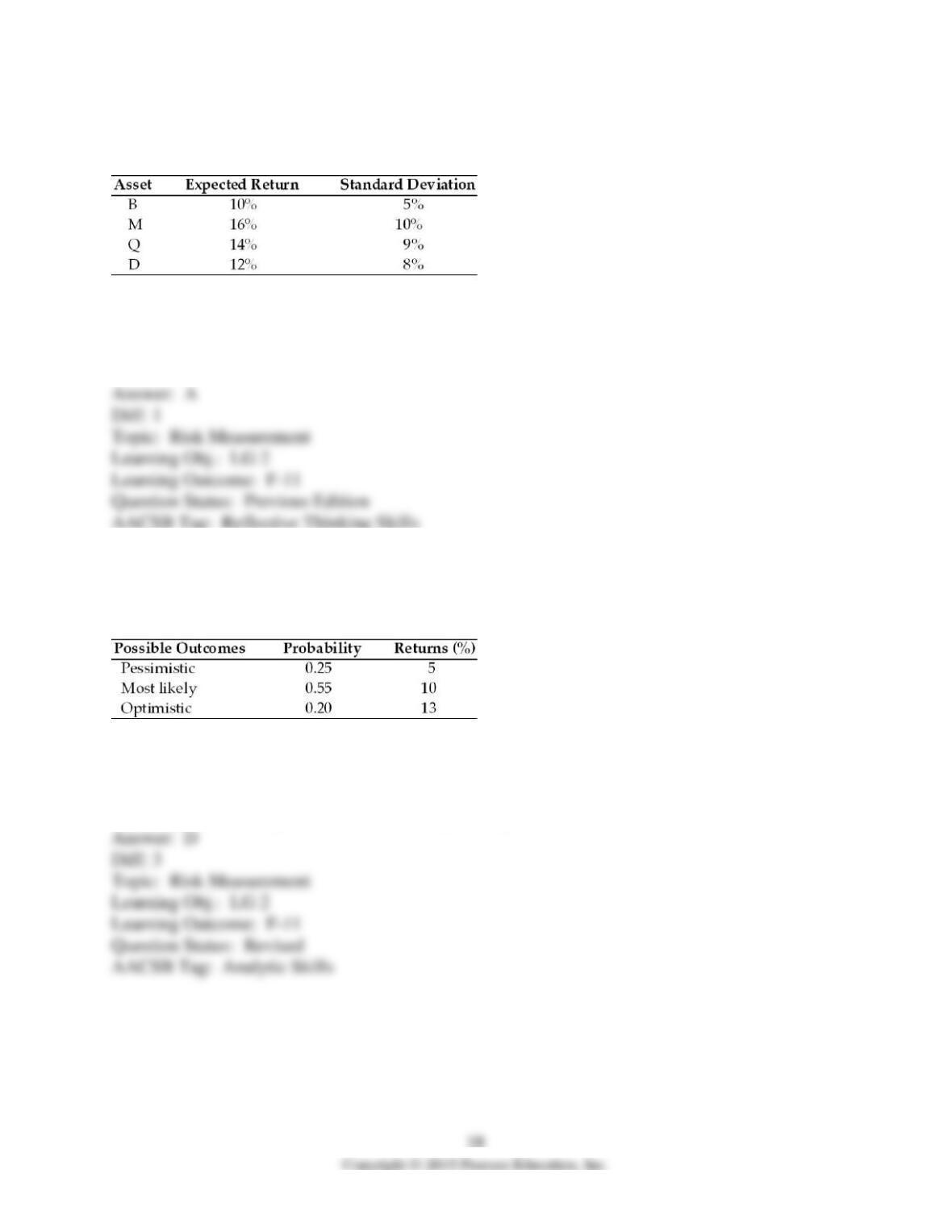
32) Given the following expected returns and standard deviations of assets B, M, Q, and D,
which asset should the prudent financial manager select?
A) Asset B
B) Asset M
C) Asset Q
D) Asset D
33) The expected value, standard deviation of returns, and coefficient of variation for asset A are
________.(See below.)
Asset A
A) 10 percent, 8 percent, and 1.25, respectively
B) 9.33 percent, 8 percent, and 2.15, respectively
C) 9.35 percent, 4.68 percent, and 2.00, respectively
D) 9.35 percent, 2.76 percent, and 0.295, respectively
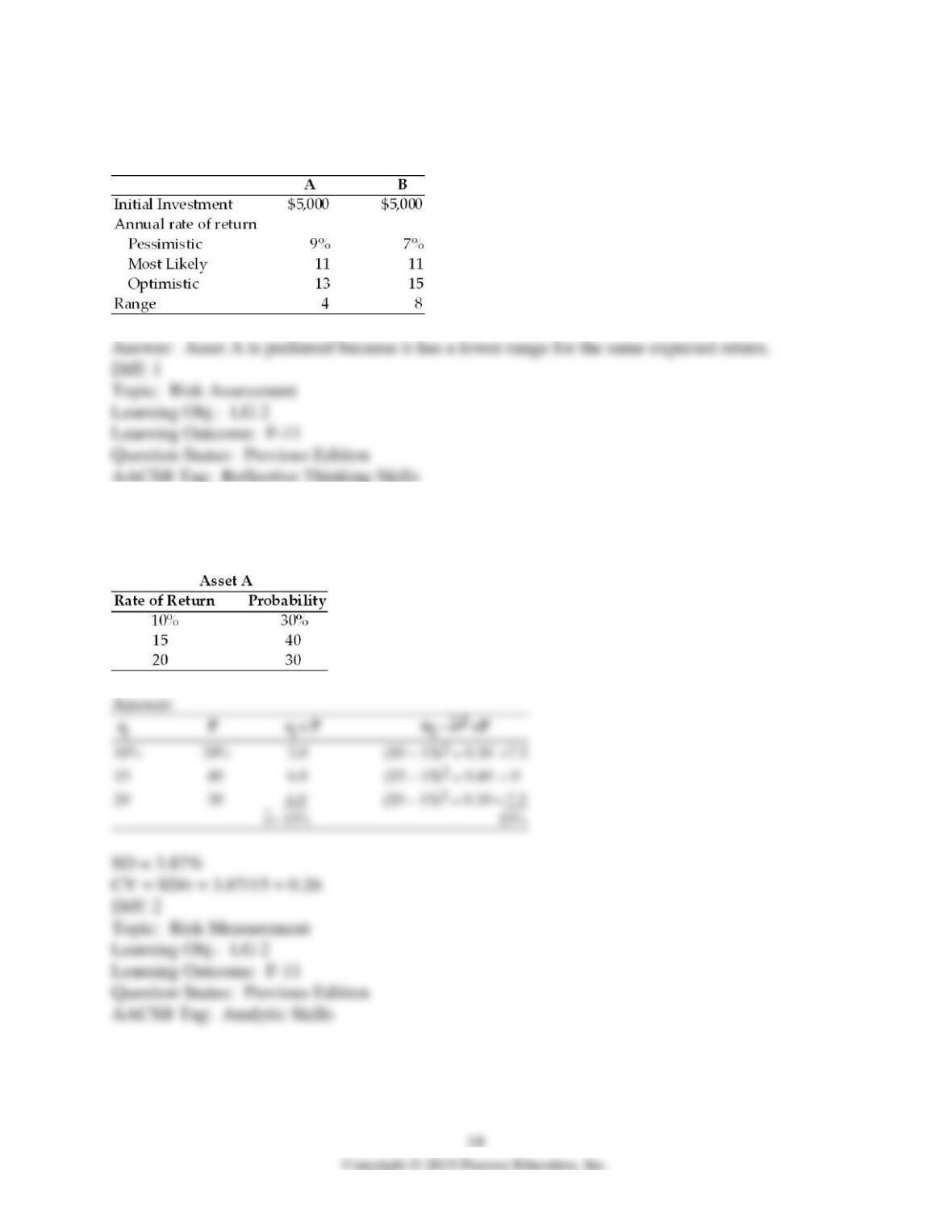
34) Given the following information about the two assets A and B, determine which asset is
preferred.
35) Assuming the following returns and corresponding probabilities for asset A, compute its
standard deviation and coefficient of variation.
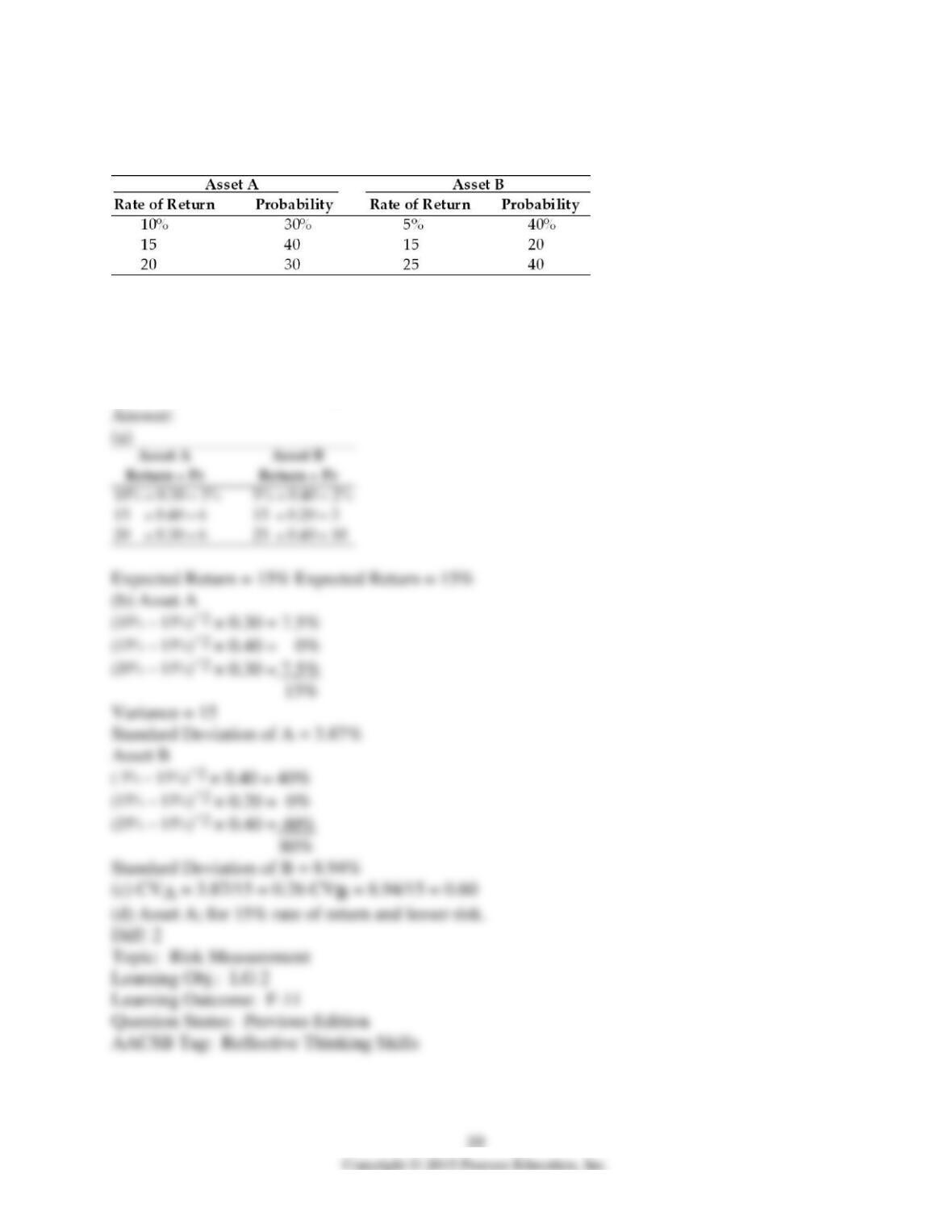
36) Champion Breweries must choose between two asset purchases. The annual rate of return
and related probabilities given below summarize the firm’s analysis.
For each asset, compute
(a) the expected rate of return.
(b) the standard deviation of the expected return.
(c) the coefficient of variation of the return.
(d) Which asset should Champion select?