ch8 Key
1. In process-costing, material costs are not traced to individual units of output, as in job costing.
2. Companies that produce products in continuous-flow production, such as paint and cereals use
process-costing.
3. Process-costing is used to help set selling prices, but is not used to determine inventory values for financial
accounting.
4. Conversion costs of resources used by processes generally occur at the unit–level of output.
5. Conversion costs of resources used by processes can apply to all levels of the cost hierarchy.
6. Temporary labor is normally a batch–level conversion cost.
7. In process costing, material costs are traced to individual units of output.
8. The first step in the process costing system is to compute the number of equivalent units produced.
9. The first step in the process costing system is to summarize the physical flow of units.
10. The basic cost flow model to help account for units processed during the period is beginning inventory plus
transfers in minus transfers out equals ending inventory.
11. Equivalent units represent the amount of physical units transferred to finished goods.
12. Equivalent units represent the amount of work actually accomplished, expressed as the number of units that
could have been fully completed.
13. In process costing, two half-finished units equal one equivalent unit.
14. Cost per equivalent unit is calculated by dividing the number of equivalent units by the total cost.
15. Weighted-average costing combines the cost in beginning inventory with costs incurred during the period to
compute unit costs.
16. For weighted-average costing, it is not necessary to know which of the finished units were from the
beginning inventory in order to compute the number of finished equivalent units.
17. Weighted-average process costing provides detailed information to management to assess worker
productivity for the current period.
18. Overstating the percentage of completion of the ending inventory under weighted-average process-costing
will result in overstated profits for the period.
19. Under weighted-average process-costing, all costs of material and conversion are averaged together in
determining cost per finished equivalent unit.
20. If the degree of completion of the ending inventory is underestimated, a company’s profits will be overstated
for the period.
21. Prior department costs should be excluded from a department‘s costs for purposes of performance
evaluations.
22. In a multiple department process, the costs of units transferred out of one department and into another are
called prior department costs.
23. Prior department process costs are always assigned an equivalent unit percent complete of 0%.
24. The cost of normal spoilage should be written off as an expense account during the accounting period.
25. The cost of abnormal spoilage should be written off as a cost of the period rather than added to inventory.
26. Companies that have a zero defect policy might treat all spoilage as abnormal.
27. The entry to account for abnormal spoilage consists of a debit to work-in-process inventory and a credit to
an expense account.
28. Lost units are goods that evaporate or otherwise disappear during a production process.
29. All lost units should be written off as an expense for the period.
30. Total costs to be accounted for are the same for both the weighted-average and FIFO methods. (Appendix)
31. The weighted-average method is usually more accurate in matching actual costs to the period of production.
(Appendix)
32. Only the weighted-average method is allowed for external financial reporting. (Appendix)
33. If both the number of physical units in the beginning and ending inventory and their degrees of completion
are equal, then the number of units started will equal the number of units transferred out. (Appendix)
34. If there are no units in beginning inventory, weighted-average and FIFO will result in the same number of
finished equivalent units. (Appendix)
35. If there are no units in ending inventory, weighted-average and FIFO will result in the same number of
finished equivalent units. (Appendix)
36. If materials are added at the end of the process and assuming no spoilage, under FIFO process costing, the
equivalent units will always be equal to the number of units transferred out during the period. (Appendix)
37. The FIFO method differs from the weighted-average method in that the FIFO method allocates costs based
on whole units whereas the weighted-average method uses equivalent units. (Appendix)
38. The weighted-average method differs from the FIFO method in that the weighted–average method does not
consider the degree of completion for the beginning work-in-process inventory whereas FIFO does. (Appendix)
39. Prior process costs are always assigned an equivalent unit percent complete of 100% under both the FIFO
and weighted-average methods. (Appendix)
40. In computing the cost per equivalent unit, the weighted-average-method considers current costs only, while
the FIFO Method considers prior period costs and current costs. (Appendix)
41. Under FIFO process-costing, if materials are added at the end of the process, the materials portion of the
ending inventory of work-in-process will always be assigned a cost of zero.
42. In operation costing, direct materials for each work order or batch passing through a particular operation are
different, while conversion costs are the same. (Appendix)
43. A company using operation costing typically uses different materials for products that pass through the
same operations. (Appendix)
Use the following to answer questions 44-45:
Diamond Company has a process costing system using the weighted-average cost flow method. All materials
are introduced at the beginning of the process in Department 1. The following information is available for the
month of January:
Hilton – Chapter 08
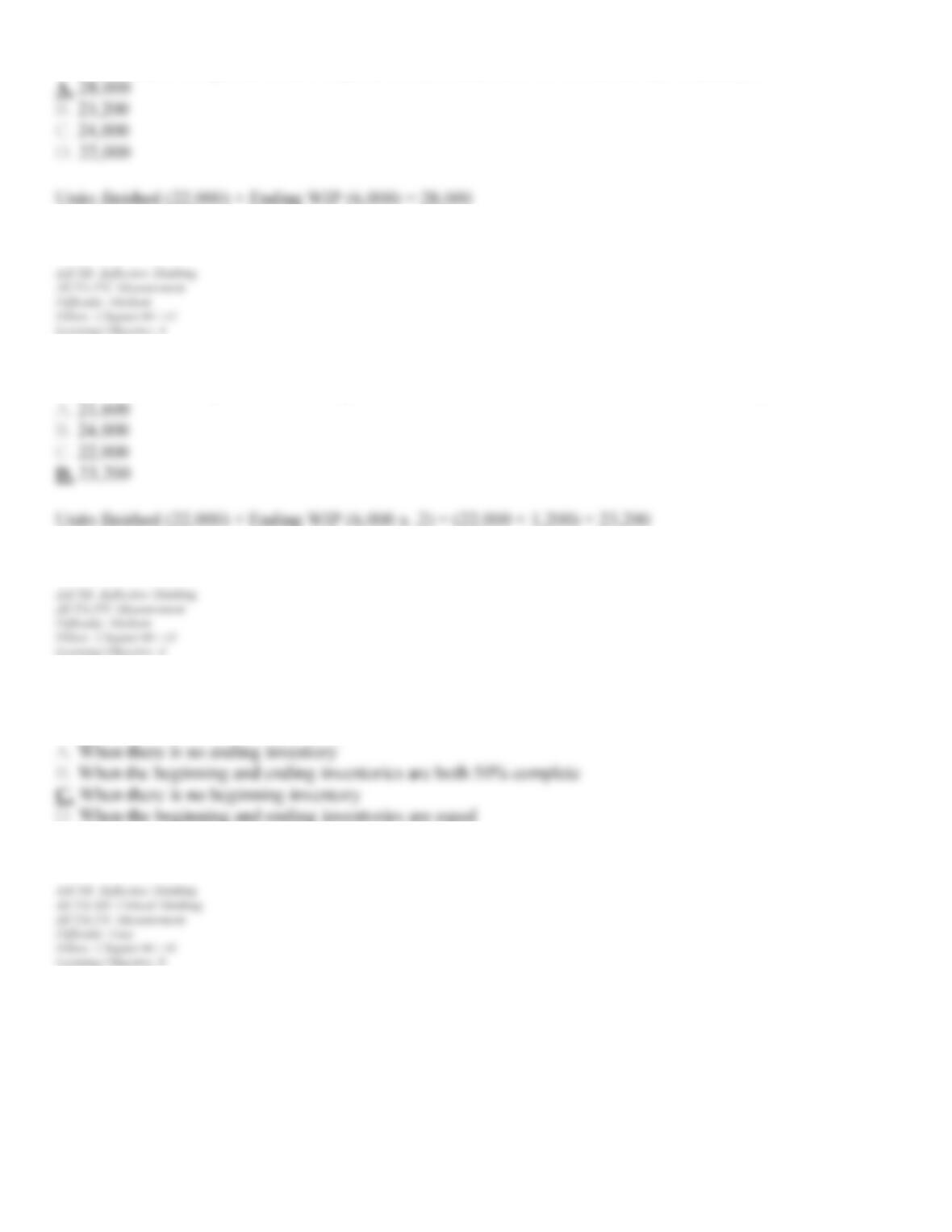
44. The number of equivalent units of production for material costs for the month of January is:
45. The number of equivalent units of production for conversion costs for the month of January is:
46. Under what conditions will the FIFO method produce the same cost of goods manufactured as the
weighted–average method? (Appendix)
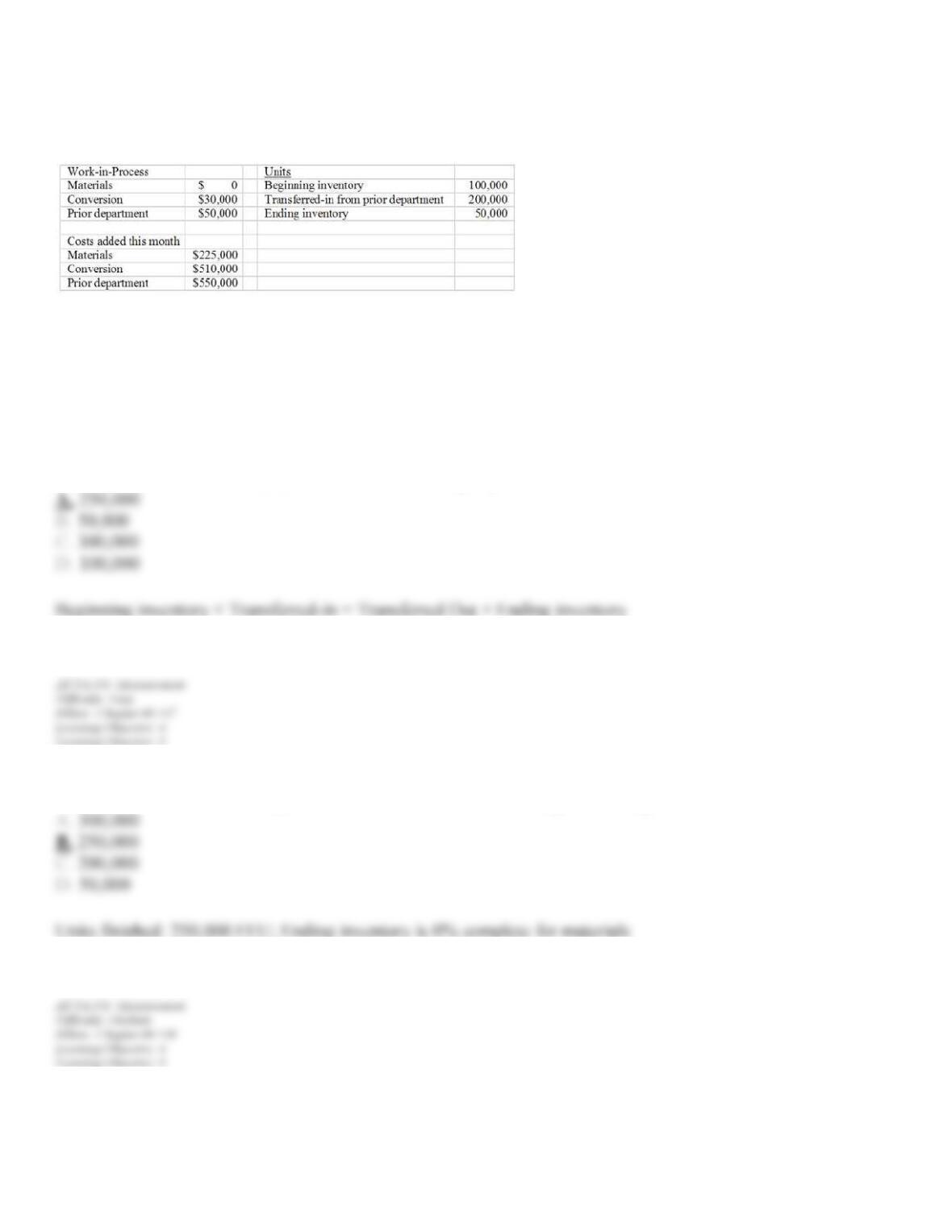
Use the following to answer questions 47-50:
Carlton Manufacturing Company has the following information available for its process–costing system for the
month of May in the finishing department. The finishing department is the second of a multiple-department
manufacturing plant. Materials are added at the end of the process in finishing.
Beginning inventory is 30% complete as to conversion costs; ending inventory is 80% complete as to
conversion costs.
Hilton – Chapter 08
47. The number of units transferred out of the finishing department is:
48. The number of finished equivalent units of materials under weighted-average is:
49. The cost per finished equivalent unit for materials under weighted-average is:
50. The value assigned to the materials portion of ending inventory under weighted-average is:
51. The total cost of the units transferred out under weighted-average is:
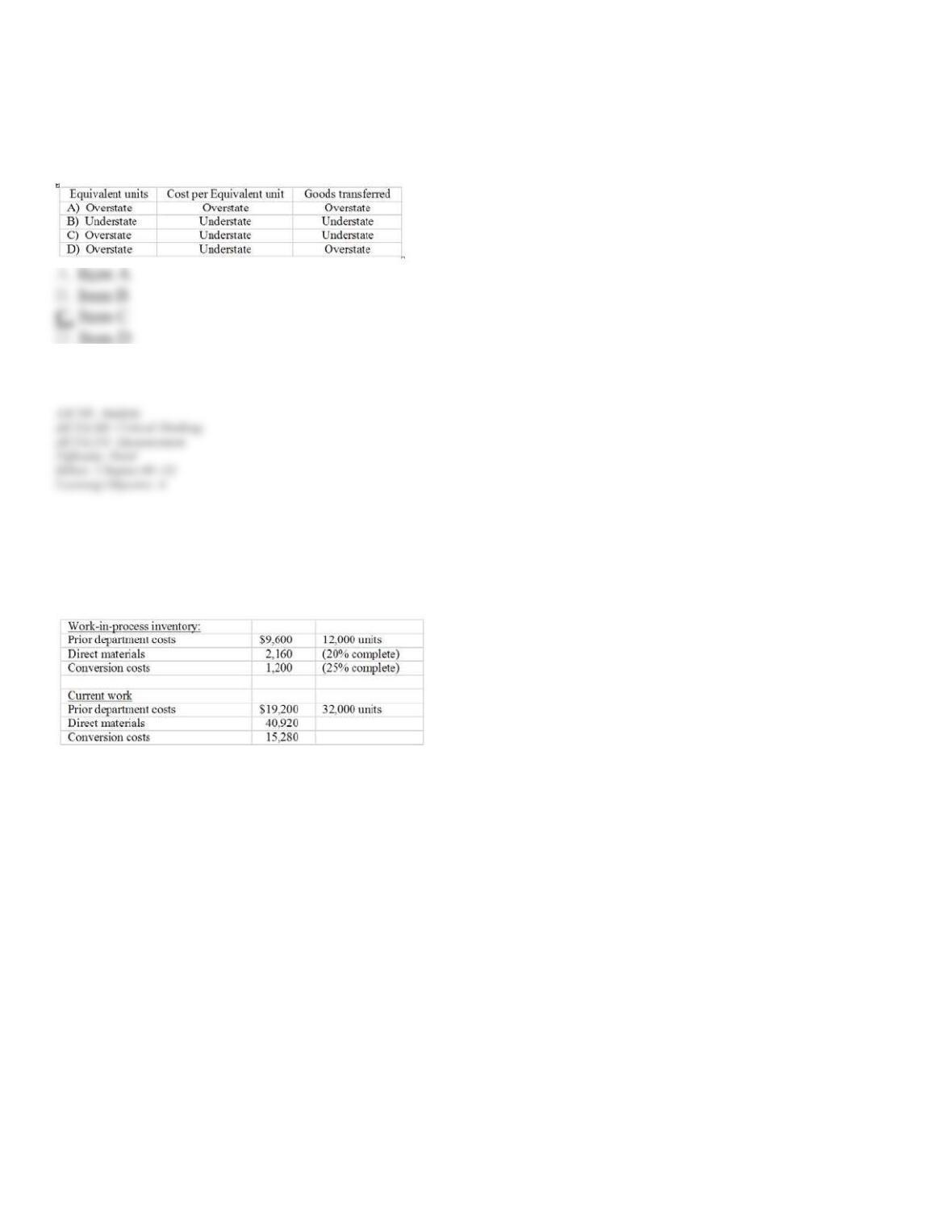
52. An error was made in the computation of the percentage of completion of the current year ending
Work-in-Process inventory. The error resulted in assigning a higher percentage of completion to each
component than was actually the case. Assume that there was no beginning inventory. The effect of this error on
equivalent units, cost per equivalent unit and costs assigned to the goods transferred out would be:
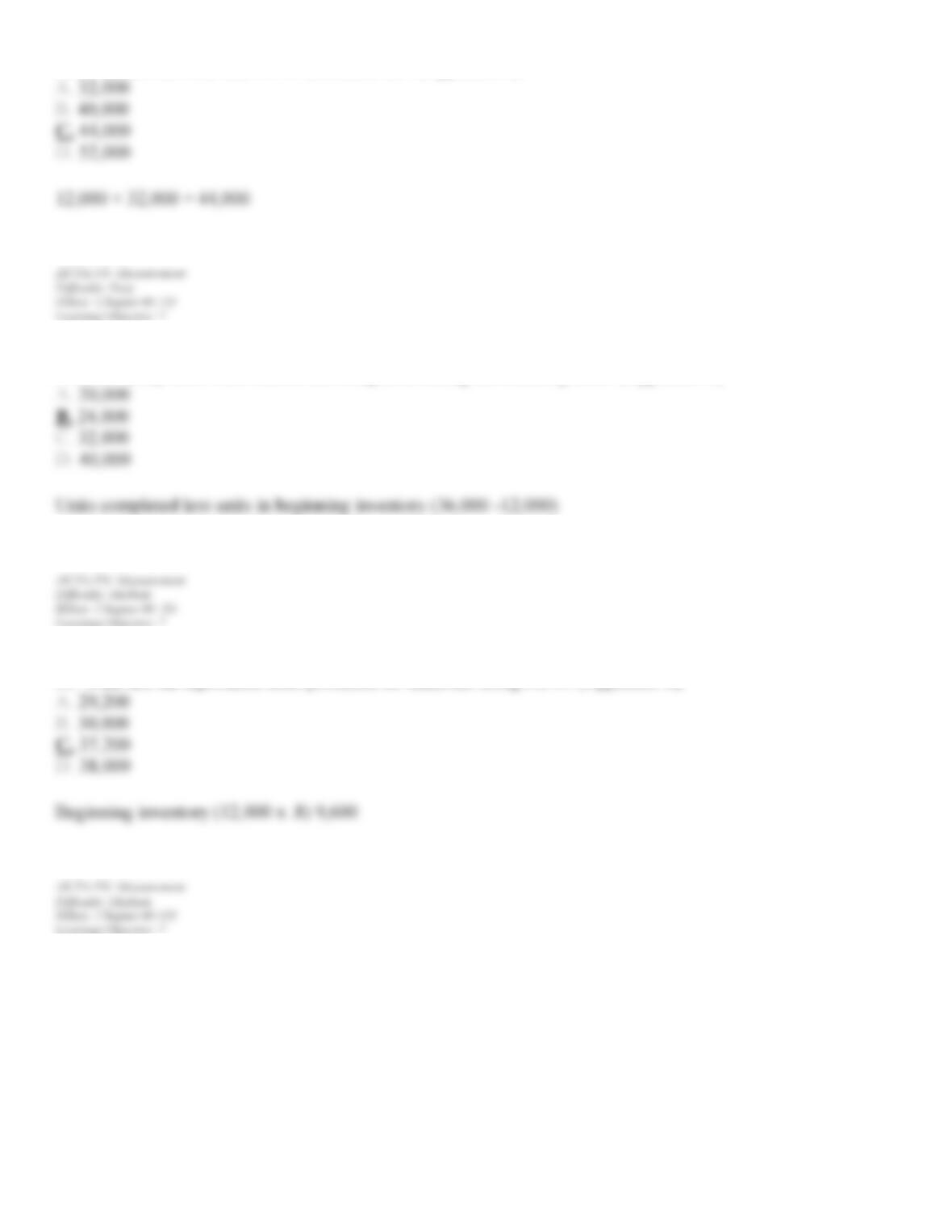
Use the following to answer questions 53-60:
The following information is available for Sulmonter Manufacturing Company for the current period:
32,000 units were started during the period
The ending inventory has 8,000 units, which are 45% complete with respect to direct materials and 65%
complete with respect to conversion costs. FIFO costing is used.
Hilton – Chapter 08
53. What are the total units to be accounted for? (Appendix A)
54. How many units were started and completed during the current period? (Appendix A)
55. What are the equivalent units produced for materials using FIFO? (Appendix A)
56. What are the equivalent units produced for conversion costs using FIFO Costing? (Appendix A)
57. What is the prior department cost per equivalent unit, using FIFO costing (rounded to the nearest cent?)
58. What is the material cost per equivalent unit using FIFO costing? (Appendix A)
59. What is the total cost of the units transferred out under FIFO? (Appendix A)
60. What is the total cost of the ending inventory under FIFO? (Appendix A)
Use the following to answer questions 61-62:
Vassel Company has a process-costing system using the Weighted-Average cost flow method. All materials are
introduced at the beginning of the process in Department 1. The following information is available for the
month of December.
Hilton – Chapter 08
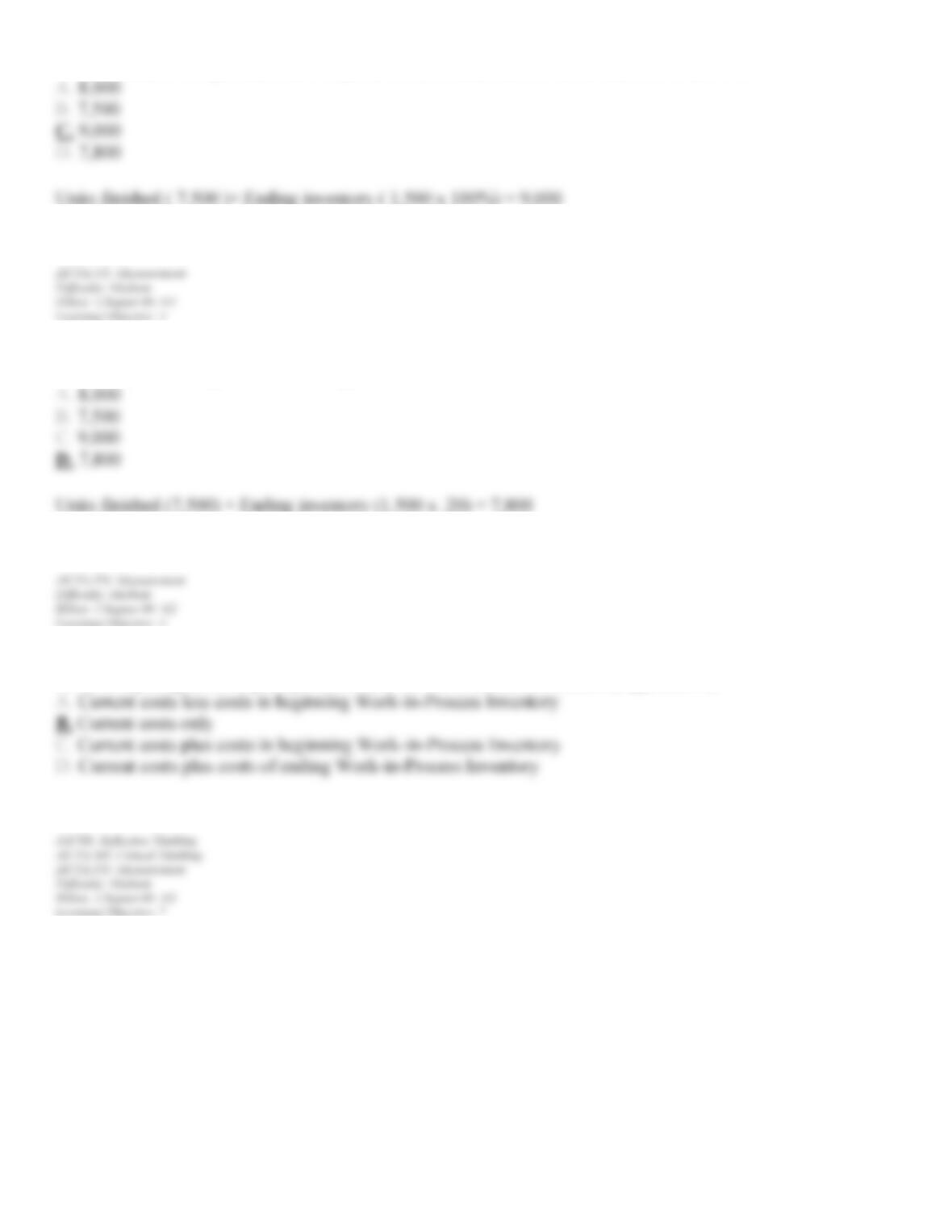
61. The number of equivalent units of production for materials for the month of December is:
62. The number of equivalent units of production for conversion costs for the month of December is:
63. In computing the cost per equivalent unit, the FIFO method considers: (Appendix A)
Use the following to answer questions 64-67:
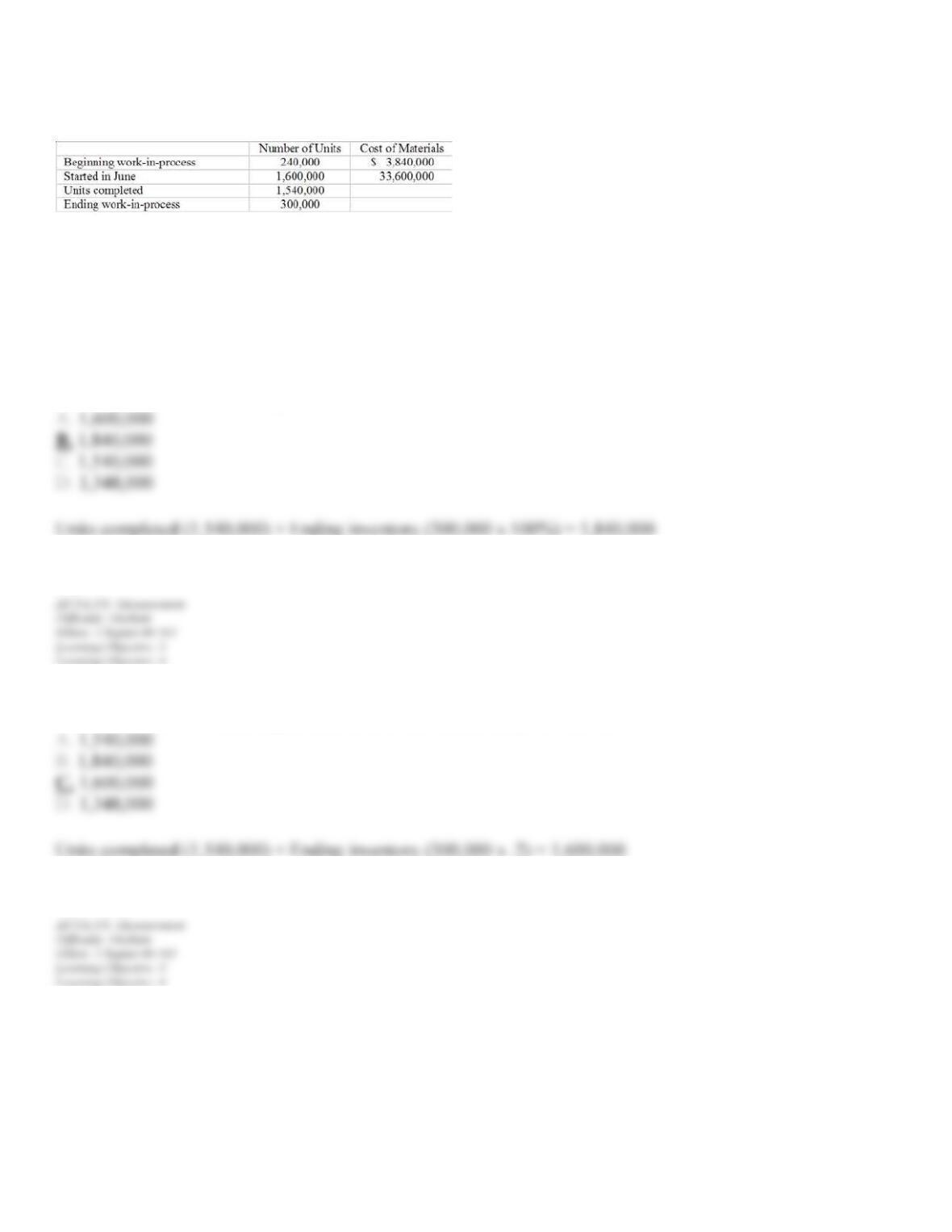
The following information pertains to Yiannis Oil Company for the month of June:
All materials are added at the beginning of the process. Beginning inventory is 80% complete for conversion
costs; ending inventory is 20% complete for conversion costs. Yiannis uses the weighted-average method.
Hilton – Chapter 08
64. The number of finished equivalent units of materials for June is:
65. The number of finished equivalent units of conversion costs for June is:
66. The cost per finished equivalent unit for materials for June is:
67. The total material cost of the ending inventory for June is: