
Chapter 8: Revenue Recognition, Receivables, and Advances from
Customers Key
1. If the firm has received a promise of payment but cannot measure this promise with reasonable reliability,
and U.S. GAAP would permit revenue to be recognized, but IFRS would not permit revenue to be recognized.
2. Realization is the presumption that a firm will remain in operation long enough to carry out its current plans,
and in the normal course of its operations, realize changes in the fair values of its assets either by using those
assets or selling them.
3. Under the accrual method, the timing of revenue recognition is influenced by when the services or product
are provided.
4. The method of revenue recognition where the seller collects part of the selling price in cash and at the same
time recognizes as expenses each period the same portion of the cost of goods or services sold as the portion of
total revenues recognized is called the direct payment method.
5. If an event or transaction leads to the recognition of revenue, firms match the consumption of any assets (the
expense), in time, with the revenue recognized.
6. Notes receivable is the amount owed to a seller by customers who have purchased goods and services on
credit.

7. The financial statements contain information for analyzing the collectibility of accounts receivable and the
adequacy of the expense for uncollectible accounts. Typical ratios used for this analysis include the accounts
receivable turnover ratio, days receivables outstanding, and write-off percentage.
8. Bad Debt Expense is also called the Provision for Bad Debts and the Provision for Uncollectible Accounts.
9. The Accounts Receivable, Gross amount less the Allowance for Uncollectibles yields Accounts Receivable,
Net, which reflects the amount of cash the firm expects to collect.
10. When a firm decides that a particular customer account is uncollectible, it removes that account by debiting
the Allowance for Uncollectibles and crediting Accounts Receivable, Gross. This process is called writing off
the account.
11. The write-off of specific customers’ accounts using the allowance method has no effect on the income
statement.
12. The write-off of specific customers’ accounts has no effect on Accounts Receivable, Net, because the write-
off amount decreases Accounts Receivable, Gross, and its contra account, the Allowance for Uncollectibles, by
exactly the same amount.
13. A debit balance in the Allowance for Uncollectibles appears on the balance sheet.
14. U.S. GAAP and IFRS require that firms disclose sufficient information to allow the reader of financial
statements to calculate Accounts Receivable, Gross, Allowance for Uncollectibles, and Accounts Receivable,
Net.

15. The U.S. Internal Revenue Service requires that firms recognize bad debt expense only when they conclude
an account is not collectible.
16. U.S. GAAP permits firms to use the installment method or the cost recovery method only when receivables
is/are collectible over an extended period and the seller has no reasonable basis for estimating the amount of
cash that it will collect.
17. The cost recovery method matches the costs of generating revenue with cash receipts until the seller
recovers all its costs.
18. The percentage-of-completion method provides information about the seller’s performance during the
contract period; in contrast, the completed contract method reports all profit only when seller completes the
contract.
19. Firms that reduce the price charged to a customerafter the firm has delivered the goods and the customer has
found them to be unsatisfactory or damaged issue a sales allowance.
20. Both U.S. GAAP and IFRS do not require the allowance method for uncollectible accounts, which involves
estimating the amount of uncollectible accounts receivable associated with each accounting period’s credit
sales.
21. The percentage-of-sales procedure arises from the idea that uncollectible amounts will vary with the volume
of credit business. The firm estimates the appropriate percentage by studying its own experience or by inquiring
into the experience of similar firms. Default rates generally fall within the range of .01% to .02% of credit
sales.
22. The percentage-of-completion method measures the proportion of total work carried out during the
accounting period either from engineers’ estimates of the degree of completion or from the ratio of costs
incurred to date to the total costs expected for the entire contract.
23. A common-size income statement expresses each expense and net income as a percentage of
24. If the firm has received a promise of payment but cannot measure this promise with reasonable reliability,
25. Which section includes income derived from a firm’s primary business activities as well as from activities
peripherally related to operations? (The firm expects these sources of earnings to continue.)
26. Operating risks
27. Ulrich Co. sells an asset to a buyer for a total sales price of $6,000 with a payment schedule of $2,000 in
year 1, $2,000 in year 2, and $2,000 in year 3. The cost of the asset is $5,000. Under the cost-recovery-first
method, what amount of net profit is recognized in year 3?
28. Which of the following is true regarding income recognition?
29. Cowden Properties
Cowden Properties sold a condominium to Ms. Roberts for $90,000. Cowden originally acquired the condo at a
cost of $40,000 and made improvements to the unit totaling $20,000. The contract for sale required Ms. Roberts
to pay the $90,000 as follows:
Year 1 – $ 5,000
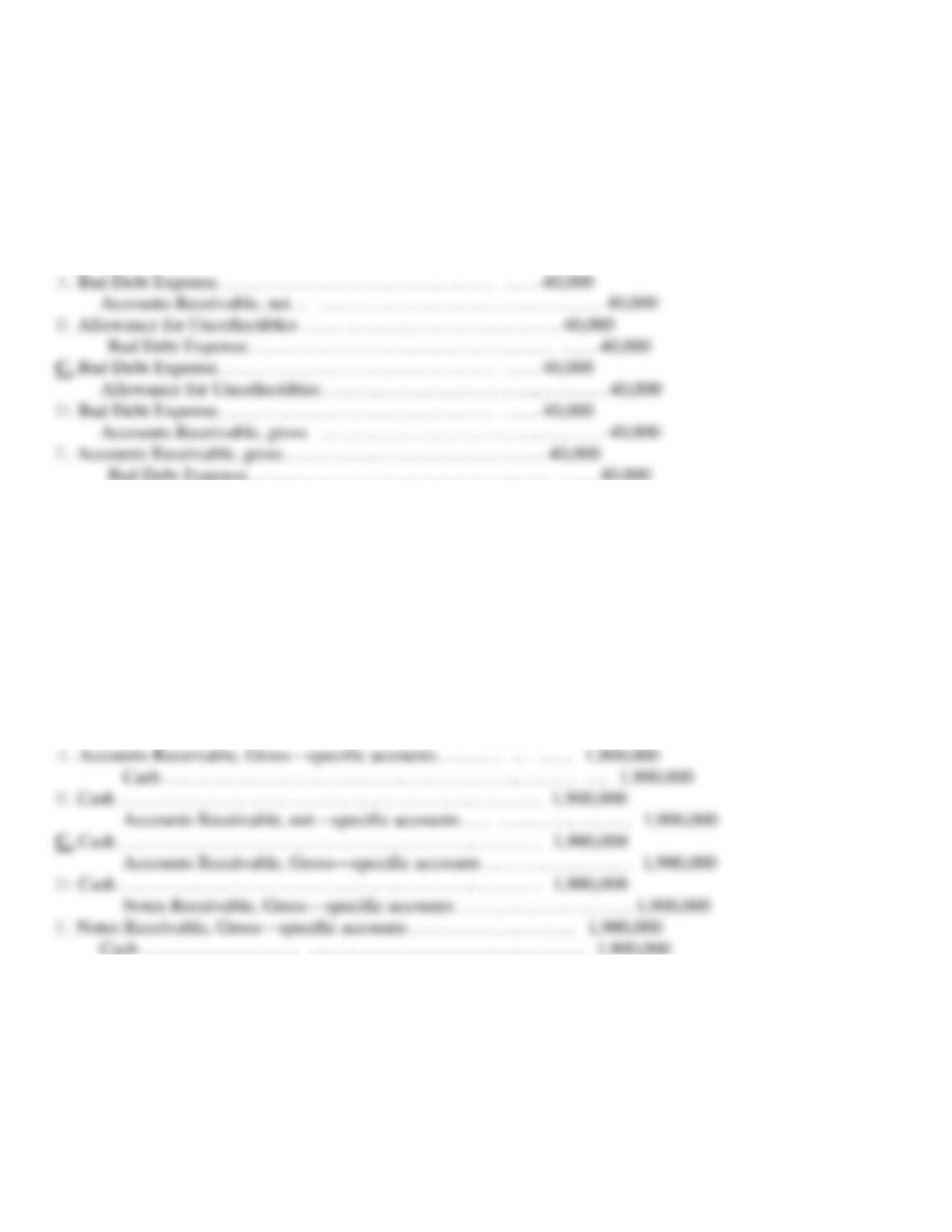
Year 2 – $10,000
Year 3 – $30,000
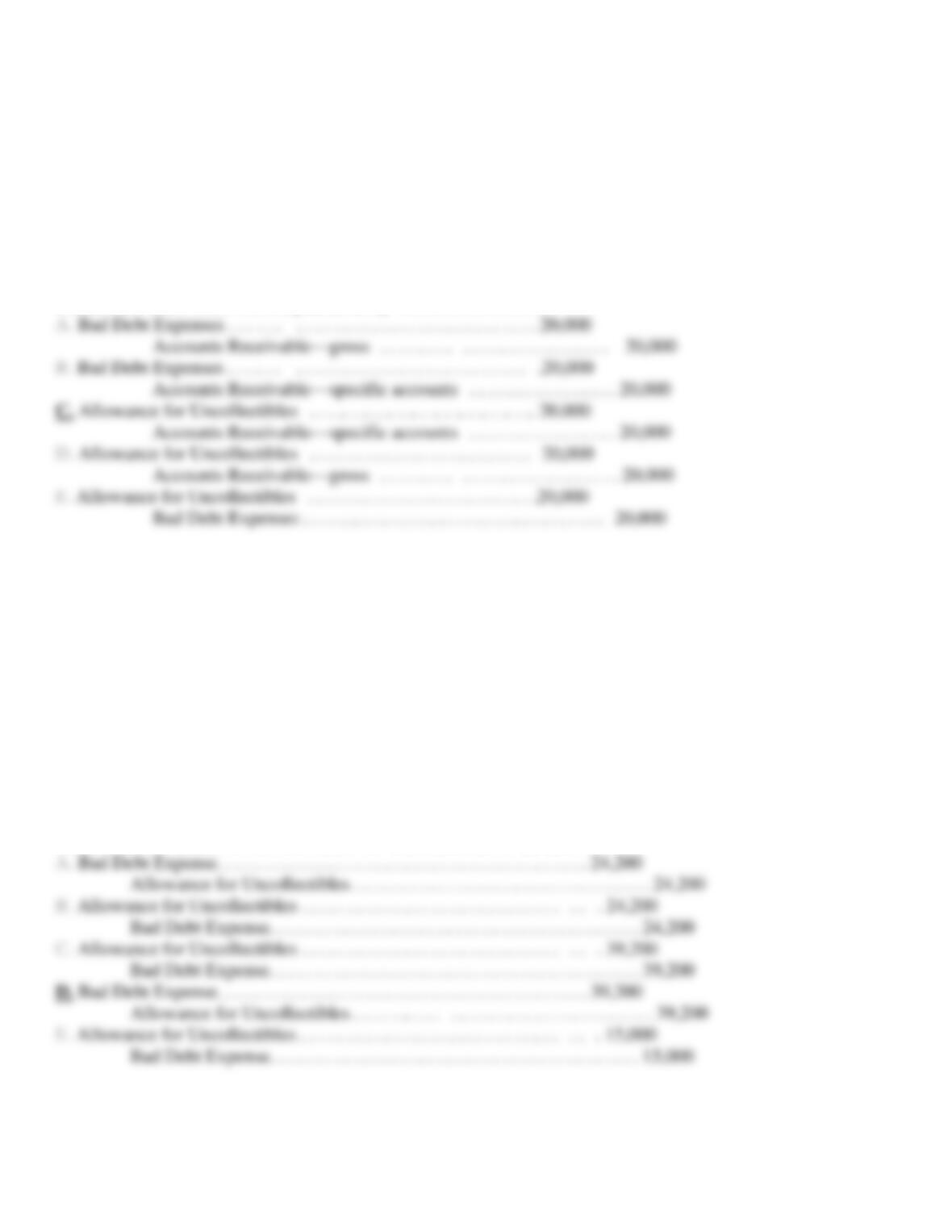
Year 4 – $45,000
Refer to the Cowden Properties example. If Cowden uses the installment method, how much cost is recognized
as expense in year 3?

30. Cowden Properties
Cowden Properties sold a condominium to Ms. Roberts for $90,000. Cowden originally acquired the condo at a
cost of $40,000 and made improvements to the unit totaling $20,000. The contract for sale required Ms. Roberts
to pay the $90,000 as follows:
Year 1 – $ 5,000
Year 2 – $10,000
Year 3 – $30,000
Year 4 – $45,000
Refer to the Cowden Properties example. Under the installment method, how much net profit would Cowden
recognize in year 1?
31. Cowden Properties
Cowden Properties sold a condominium to Ms. Roberts for $90,000. Cowden originally acquired the condo at a
cost of $40,000 and made improvements to the unit totaling $20,000. The contract for sale required Ms. Roberts
to pay the $90,000 as follows:
Year 1 – $ 5,000
Year 2 – $10,000
Year 3 – $30,000
Year 4 – $45,000
Refer to the Cowden Properties example. If Cowden uses the cost-recovery-first method, how much profit is
recognized in year 4?
32. Fassino’s Wholesale Corporation
Fassino Wholesale Corporation (“Fassino’s”) operates discount retail stores. To shop in a Fassino’s store,
customers must pay a nonrefundable, annual membership fee in advance, using either cash or an American
Express card. A customer purchases an annual membership from Fassino’s for $120, a 20-pack of paper towels
for $10.99, and four new tires for $480. The tire purchase includes mounting and aligning by a Fassino’s tire
technician at the time of initial installation and alignment and tire rotation services for three years afterward.
The customer pays with an American Express card.
Using the Fassino’s Wholesale Corporation example, when should Fassino’s recognize the $120 membership
fee as revenue?
33. Fassino’s Wholesale Corporation
Fassino Wholesale Corporation (“Fassino’s”) operates discount retail stores. To shop in a Fassino’s store,
customers must pay a nonrefundable, annual membership fee in advance, using either cash or an American
Express card. A customer purchases an annual membership from Fassino’s for $120, a 20-pack of paper towels
for $10.99, and four new tires for $480. The tire purchase includes mounting and aligning by a Fassino’s tire
technician at the time of initial installation and alignment and tire rotation services for three years afterward.
The customer pays with an American Express card.
When should Fassino’s recognize revenue from selling the tires plus mounting, alignment, and rotation
services?
34. Fassino’s Wholesale Corporation
Fassino Wholesale Corporation (“Fassino’s”) operates discount retail stores. To shop in a Fassino’s store,
customers must pay a nonrefundable, annual membership fee in advance, using either cash or an American
Express card. A customer purchases an annual membership from Fassino’s for $120, a 20-pack of paper towels
for $10.99, and four new tires for $480. The tire purchase includes mounting and aligning by a Fassino’s tire
technician at the time of initial installation and alignment and tire rotation services for three years afterward.
The customer pays with an American Express card.
When should Fassino’s recognize revenue from selling the paper towels?
35. The SRI company provides substantial services after the time of product sale and this condition introduces
uncertainty. Which of the following is true?
36. The percentage-of-completion method
37. The method of revenue recognition where the seller has substantial uncertainty about the amount of cash it
will collect and matches the costs of generating revenues dollar for dollar with cash receipts until the seller
recovers all such costs is called the
38. U.S. GAAP requires that the completed contract method be used
39. When a firm’s construction activities meet the criteria for revenue recognition as construction progresses,
the firm usually recognizes revenue during the construction period using the
40. The method of revenue recognition where the seller collects parts of the selling price in cash and at the same
time recognizes as expenses each period the same portion of the cost of goods or services sold as the portion of
total revenues recognized is called the
41. Firms extending credit to customers should
42. When the seller has received cash, but has not earned all of the revenues represented by the cash by
providing goods and services, the seller has incurred an obligation to provide goods or services. These
liabilities
43. The cost recovery method
44. Conceptual guidance in U.S. GAAP refers to the selling entity having earned the revenues (that is, having
completed the earnings process). IFRS refers to
45. When the customer pays with a credit card
46. Project Paso Vineyards processes grapes into champagne, which it bottles, corks, and places on shelves in
underground caverns to age for several years. During the aging process, the winemakers hand-turn the bottles a
quarter rotation every few months; also, at fixed intervals, they release yeast gases to preclude unwanted
fermentation. Assume that Project Paso contracts to sell a quantity of champagne to a customer for €30 million.
Under the terms of the contract, Project Paso will store the champagne in its caverns and perform all necessary
functions associated with the aging process (for example, turning the bottles and releasing yeast gases). The
selling price includes the costs of producing the champagne and providing services during the aging process.
The customer pays Project Paso €15 million at the beginning of the aging and storage process, and agrees to pay
the remainder in five years upon delivery of the champagne.When should Project Paso Vineyards recognize
revenue from selling the champagne?
47. The percentage-of-completion method
48. Rogers Manufacturing sells an old machine to KSS Corp. which is having financial difficulty. Rogers agrees
to accept payment over 3 years. The adjusted basis of the machine to the seller is $5,000 and the buyer is
expected to make payments of $2,000 per year for 3 years. What amount of net profit is recognized by the seller
in year 3 if the seller uses the installment method? (Assume that the buyer makes the payments.)
49. Jaymar Software Corporation sells SPAM BE GONE to customers, who receive the software and have
access to postdelivery telephone support and the right to receive certain upgrades and enhancements if and
when Jaymar Software develops them. Jaymar Software sells SPAM BE GONE for approximately $100;
customers pay cash or with a credit card. When should Jaymar Software recognize revenue from selling SPAM
BE GONE?
50. Sao Paulo Trains Inc., incorporated in Brazil, manufactures high-speed trains. In this industry, the time to
manufacture products usually exceeds one year. Assume that Sao Paulo Trains recently signed a €8 billion
contract to provide 10 new high-speed trains to a customer in the European Union. The customer has paid a
deposit of €500 million and will pay the remainder in equal installments over the next four years. When should
Sao Paulo Trains recognize the revenue from this contract?
51. Wigs and Torys Plc. is a leading operator of pubs and pub restaurants in the United Kingdom. It operates
and franchises about 10 wine restaurants under the name Bottoms Up Bar, primarily in London. Suppose that in
contracting with a franchisee of an Bottoms Up Bar wine restaurant, Wigs and Torys agrees to provide services,
including site selection, décor design, marketing, advertising, and recruiting; and the franchisee agrees to pay
Wigs and Torys £100,000. It is common in the industry to permit the franchisee to pay in equal installments
over several years. When should Wigs and Torys recognize revenue from the franchisee contract?
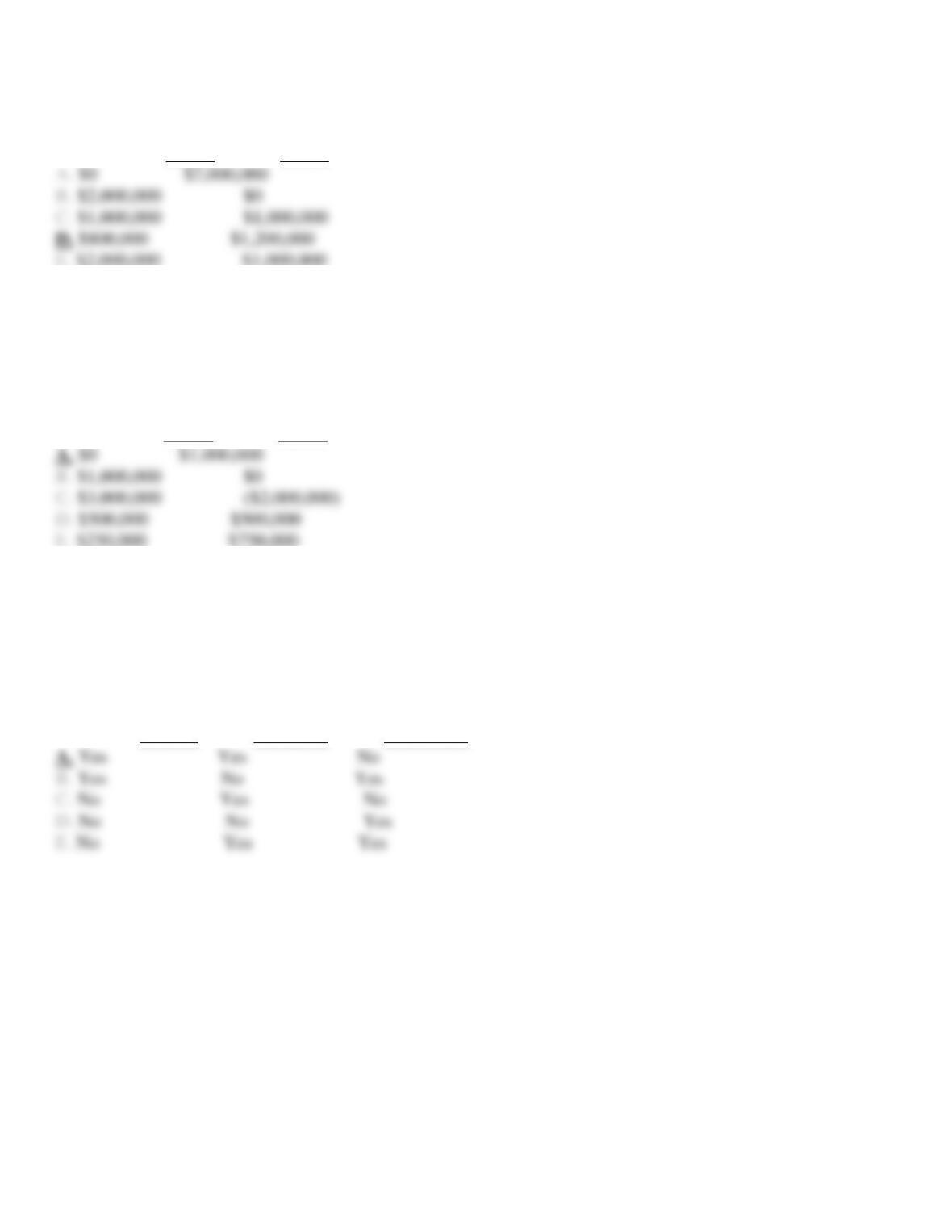
52. In year 1, Southern Construction agrees to construct a school building for $12,000,000, receiving payments
for the work of $6,000,000 in both year 1 and year 2. Southern estimates that the costs will be $4,000,000 in
Year 1 and $6,000,000 in Year 2. If Southern uses the percentage-of-completion method (based on total costs),
what amount of profit is recognized in each year of the contract?
Year 1 Year 2
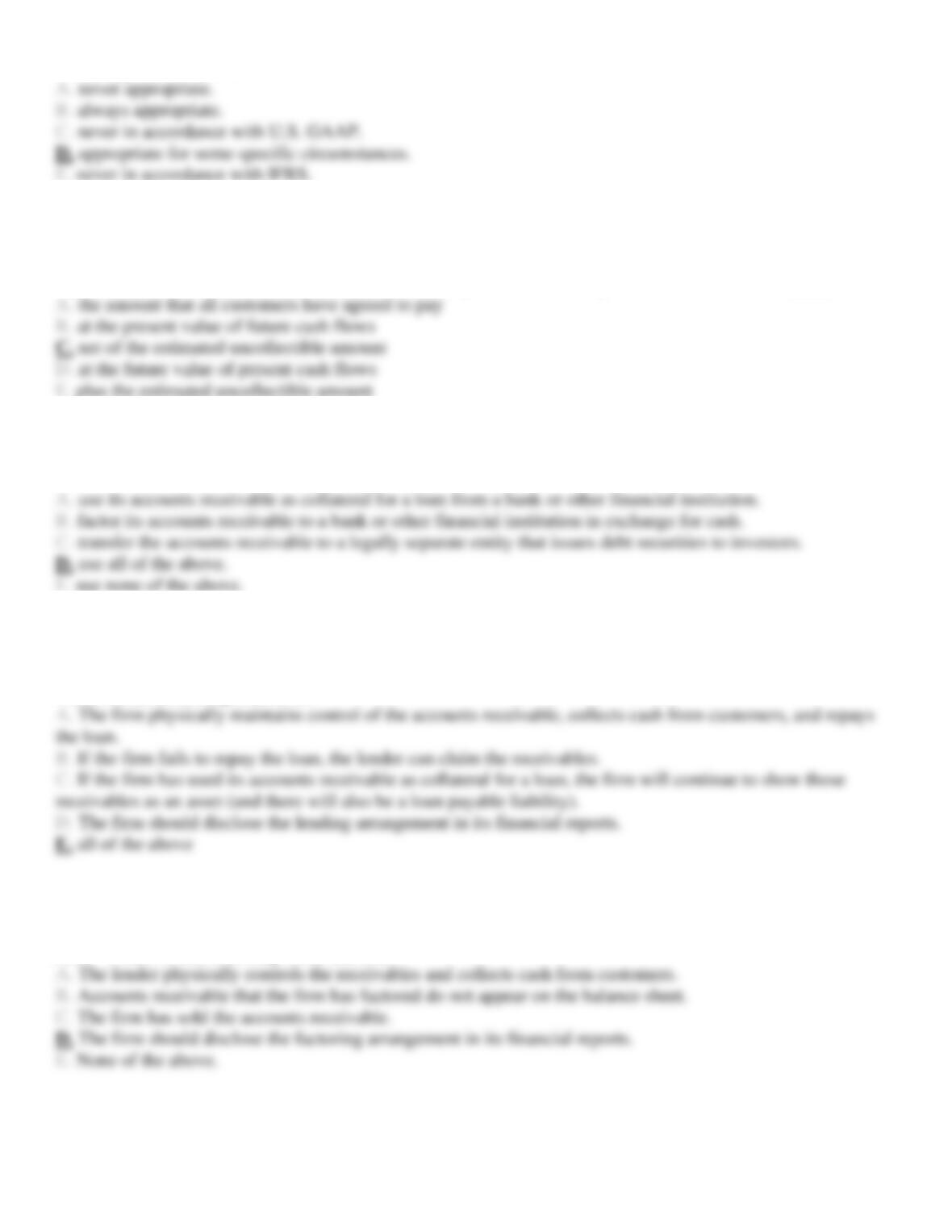
53. In year 1, Northern Construction agrees to build a fire station that will be completed in year 2. Construction
starts in year 1. The station will have costs of $2,000,000 in year 1 and $2,000,000 in year 2. Northern receives
payment for the station of $5,000,000 in advance, in year 1. If Northern uses the completed contract method,
what net profit is recognized by Northern in each year?
Year 1 Year 2
54. (CMA adapted, Dec 92 #18) The mining industry frequently recognizes revenue using the completion of
production method. This method is acceptable under the revenue recognition principle because
Sales prices are Assets are Production cost
reasonably readily can be readily
assured realizable determined

55. Rock Aerospace Company
Rock Aerospace Company signed a contract on April 1, Year 4, to build a satellite for $28,000,000. Estimated
costs for the contract are:
Year 4
$ 5,600,000
Year 5
$11,200,000
Year 6
$ 5,600,000
Assume that actual costs incurred coincide with expectations. Cash collections of the contract price are as follows:
Year 4
$ 4,200,000
Year 5
$ 7,000,000
Year 6
$16,800,000
Refer to the Rock Aerospace Company example. Income from the contract for Year 5 under the percentage–of-completion method is:
56. Rock Aerospace Company
Rock Aerospace Company signed a contract on April 1, Year 4, to build a satellite for $28,000,000. Estimated
costs for the contract are:
Year 4
$ 5,600,000
Year 5
$11,200,000
Year 6
$ 5,600,000
Assume that actual costs incurred coincide with expectations. Cash collections of the contract price are as follows:
Year 4
$ 4,200,000
Year 5
$ 7,000,000
Year 6
$16,800,000
Refer to the Rock Aerospace Company example. Income from the contract for Year 5 under the cost-recovery-first method is:

57. Rock Aerospace Company
Rock Aerospace Company signed a contract on April 1, Year 4, to build a satellite for $28,000,000. Estimated
costs for the contract are:
Year 4
$ 5,600,000
Year 5
$11,200,000
Year 6
$ 5,600,000
Assume that actual costs incurred coincide with expectations. Cash collections of the contract price are as follows:
Year 4
$ 4,200,000
Year 5
$ 7,000,000
Year 6
$16,800,000
Refer to the Rock Aerospace Company example. Income from the contract for Year 5 under the installment method is:
58. Rock Aerospace Company
Rock Aerospace Company signed a contract on April 1, Year 4, to build a satellite for $28,000,000. Estimated
costs for the contract are:
Year 4
$ 5,600,000
Year 5
$11,200,000
Year 6
$ 5,600,000
Assume that actual costs incurred coincide with expectations. Cash collections of the contract price are as follows:
Year 4
$ 4,200,000
Year 5
$ 7,000,000
Year 6
$16,800,000
Refer to the Rock Aerospace Company example. Income from the contract for Year 5 under the completed contract method is:
59. Recognizing income after the time of sale is
60. An accounting issue for accounts receivable is measurement of the amount on the balance sheet. With
regard to measurement, both U.S. GAAP and IFRS require that sellers report accounts receivable _____.
61. A firm that transfers its receivables in exchange for cash can
62. A firm may use its accounts receivable as collateral for a loan from a bank or other financial institution.
Which of the following is/are true?
63. A firm may factor its accounts receivable to a bank or other financial institution in exchange for
cash. Which of the following is/are not true?
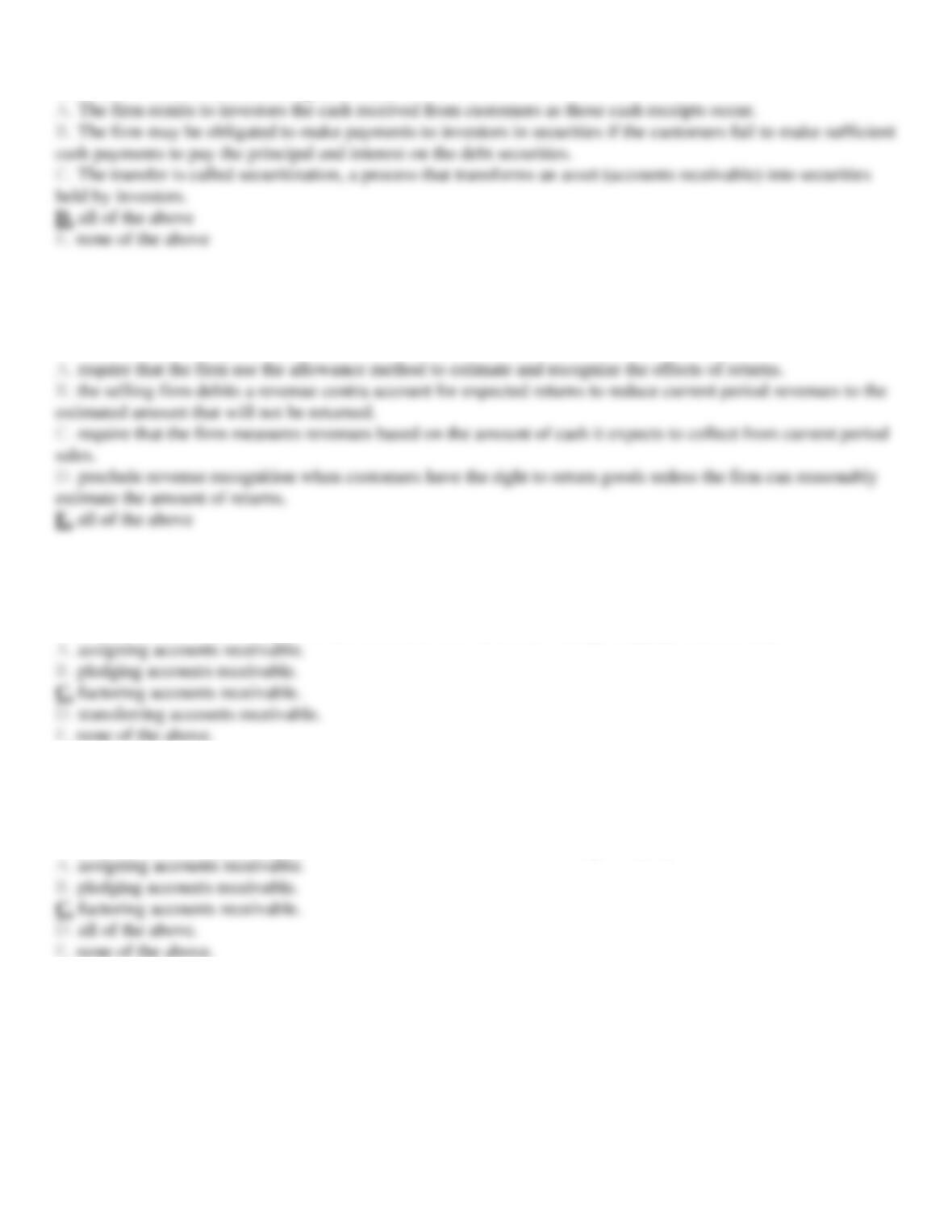
64. The firm may transfer the accounts receivable to a legally separate entity that issues debt securities to
investors. Which of the following is/are true?
65. Sales returns affect net cash collections when a customer has the right to return a product for a refund, and
the firm can reasonably estimate the amount of returns at the time of sale, U.S. GAAP and IFRS
66. Firms that are temporarily short of cash and unable to borrow from usual sources can convert accounts
receivable into cash by selling accounts receivable to a bank or financing company. This is called
67. Firms that are temporarily short of cash and unable to borrow from usual sources can convert accounts
receivable into cash by selling accounts receivable to a bank or financing company. This is called
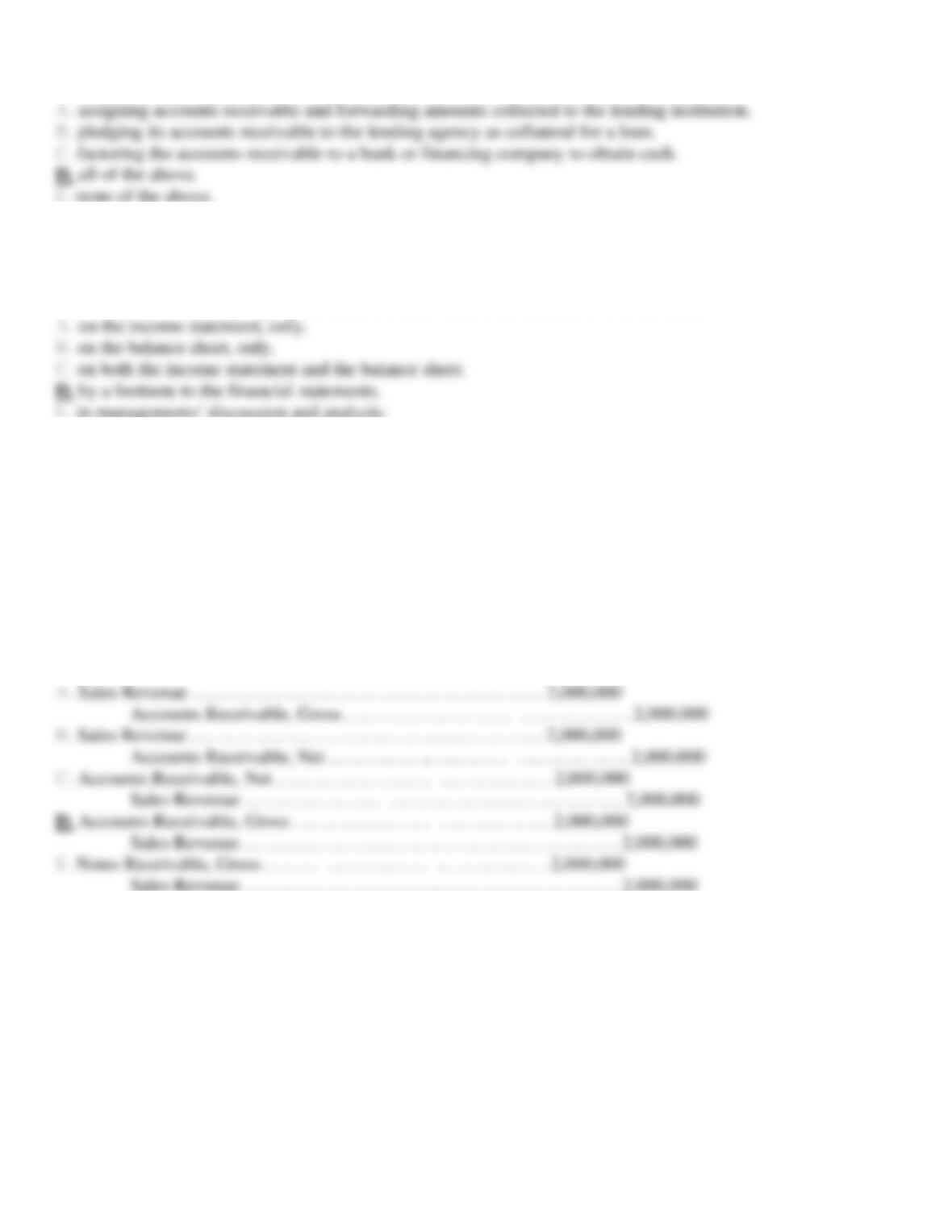
68. Firms that are temporarily short of cash and unable to borrow from usual sources can convert accounts
receivable into cash by
69. When firms that are temporarily short of cash and unable to borrow from usual sources convert accounts
receivable into cash by pledging the accounts receivable, they disclose this information
70. Healthy Lawn Maintenance Company
Healthy Lawn Maintenance Company started a lawn services business on January 1, 2013. It sends invoices to
its customers for lawn maintenance services at the end of each month, and expects the customer to pay within
30 days. During 2013, Healthy Lawn Maintenance billed its customers a total of $2,000,000 for services
rendered during the year. It made journal entries at the end of each month.
(Use the Healthy Lawn information to answer this question.) The aggregate effect of these entries during 2013
is as follows:
71. Healthy Lawn Maintenance Company
Healthy Lawn Maintenance Company started a lawn services business on January 1, 2013. It sends invoices to
its customers for lawn maintenance services at the end of each month, and expects the customer to pay within
30 days. During 2013, Healthy Lawn Maintenance billed its customers a total of $2,000,000 for services
rendered during the year. It made journal entries at the end of each month.
Assume that Healthy Lawn Maintenance estimates that it will not collect 2% of total credit sales in a given
month. At the end of each month, it makes an adjusting entry. The aggregate effect of these entries during 2013
is as follows:
72. Healthy Lawn Maintenance Company
Healthy Lawn Maintenance Company started a lawn services business on January 1, 2013. It sends invoices to
its customers for lawn maintenance services at the end of each month, and expects the customer to pay within
30 days. During 2013, Healthy Lawn Maintenance billed its customers a total of $2,000,000 for services
rendered during the year. It made journal entries at the end of each month.
If Healthy Lawn Maintenance’s customers remitted $1,900,000 in cash during 2013, it would make the
following journal entries with the following aggregated amounts:
73. Healthy Lawn Maintenance Company
Healthy Lawn Maintenance Company started a lawn services business on January 1, 2013. It sends invoices to
its customers for lawn maintenance services at the end of each month, and expects the customer to pay within
30 days. During 2013, Healthy Lawn Maintenance billed its customers a total of $2,000,000 for services
rendered during the year. It made journal entries at the end of each month.
Healthy Lawn Maintenance deems uncollectible any customer account not paid after six months. This means
that every accounting period, Healthy Lawn Maintenance ascertains which accounts remained uncollected for
six months, and treats these customer accounts as uncollectible by writing them off. If, during 2013, Healthy
Lawn Maintenance identified accounts of specific customers totaling $20,000 with unpaid balances for six
months and wrote them off, the journal entry would be as follows:
74. Healthy Lawn Maintenance Company
Healthy Lawn Maintenance Company started a lawn services business on January 1, 2013. It sends invoices to
its customers for lawn maintenance services at the end of each month, and expects the customer to pay within
30 days. During 2013, Healthy Lawn Maintenance billed its customers a total of $2,000,000 for services
rendered during the year. It made journal entries at the end of each month.
The 2013 year-end balance in Accounts Receivable, Gross, for Healthy Lawn Maintenance is $1,085,000 An
aging of these accounts receivable shows that the estimated uncollectible amount is $24,200. Before aging the
accounts, the Allowance for Uncollectibles has a debit balance of $15,000 from writing off actual accounts
during 2013. Healthy Lawn Maintenance would record the following adjusting entry at the end of 2013 to
obtain a credit balance in the Allowance for Uncollectibles of $24,200: