Introduction to Financial Accounting, 10e (Horngren)
Chapter 8 Long–Lived Assets and Depreciation
Learning Objective 8.1 Questions
8.1-1) Repairs made to equipment as part of yearly maintenance would be recorded in the journal by
A) debiting equipment.
B) debiting repairs expense.
C) debiting depreciation expense.
D) debiting accumulated depreciation.
E) crediting accumulated depreciation.
8.1-2) Treating a capital expenditure as repairs and maintenance expense
A) understates expenses and overstates owners‘ equity.
B) understates expenses and understates assets.
C) overstates expenses and understates net income.
D) overstates assets and overstates owners’ equity.
E) overstates assets and overstates revenue.
8.1-3) Expenditures for long–lived assets are expensed when they
A) add new assets.
B) increase capacity.
C) improve efficiency.
D) provide benefits lasting one year or less.
E) lengthen an asset’s useful life.
8.1-4) The decision whether to expense or capitalize expenditures depends on many factors. Which of the
following is NOT a factor for a company choosing to expense or capitalize an expenditure?
A) The decision of whether to expense or capitalize an expenditure is based on management’s judgment.
B) The decision of whether to expense or capitalize an expenditure is influenced by cost–benefit and
materiality tests.
C) The decision of whether to expense or capitalize an expenditure is not based on management’s
judgment since U.S. GAAP provides clear rules on specific types of assets.
D) The decision of whether to expense or capitalize an expenditure has the potential to cause ethical
issues for companies.
E) The decision of whether to expense or capitalize an expenditure is influenced by the principle of
conservatism causing accountants to expense an expenditure as opposed to capitalize it when faced with
contradictory evidence.
8.1-5) An operating expense is the cost that is added to an asset account.
8.1-6) Long–lived assets include accounts receivable and inventory.
8.1-7) Expenditures are purchases of goods or services, whether for cash or on credit.
3
8.1-8) For each of the following items, identify whether they are a capital expenditure or an expense:
a. Built a new elevator in the office building.
b. Acquired a copyright.
c. Incurred research and development expense to develop a patent.
d. Modified a machine, thus extending its useful life and capabilities.
e. Paid wages for the maintenance workers.
f. Paid for a new roof on the building.
g. Paid for a month’s electricity in the office building.
h. Replaced the furnace in the office building.
i. Replaced the carpeting in the office building.
4
8.1-9) For each of the following items, identify whether they are a tangible or intangible asset. In addition,
if the asset is long–lived, identify whether it is depreciated, amortized, or depleted. If the asset is not a
long–lived asset, identify it as a current asset.
Tangible/ Depreciated/
Intangible /Current Amortized/Depleted
1) Natural gas reserves __________________ __________________
2) Warehouse forklift __________________ __________________
3) Computers held for resale __________________ __________________
4) Copyrights __________________ __________________
5) Land __________________ __________________
6) Delivery truck __________________ __________________
7) Trademarks __________________ __________________
8) Oil and coal __________________ __________________
9) Building __________________ __________________
10) Building owned by a real estate company __________________ __________________
11) Accounts receivable __________________ __________________
Learning Objective 8.2 Questions
Table 8–1
Barrett, Inc., acquired a building and the 2 acres of land on which it is located. The total purchase price
was $1,000,000. For valuation purposes, the company contacted three local commercial real estate agents,
who gave the following valuation estimates:
Land Building
Donna Gilroy $ 450,000 $1,050,000
Abby Pamer $ 600,000 $ 900,000
Megan Mallony $ 300,000 $1,200,000
8.2-1) Referring to Table 8–1, if Barrett, Inc., used the valuation made by Megan Mallony, and assuming it
paid cash for the land and building, what journal entry would Barrett, Inc. make to record the purchase?
A) Land 300,000
Building 700,000
Cash 1,000,000
B) Land 200,000
Building 800,000
Cash 1,000,000
C) Land 300,000
Building 1,200,000
Cash 1,500,000
D) Land 400,000
Building 600,000
Cash 1,000,000
E) Land 300,000
Building 1,200,000
Cash 1,000,000
Gain on Purchase of Assets 500,000
8.2-2) Referring to Table 8–1, if Barrett, Inc., used the valuation made by Abby Pamer, and assuming it
paid cash for the land and building, what journal entry would Barrett, Inc., make to record the purchase?
A) Land 300,000
Building 700,000
Cash 1,000,000
B) Land 200,000
Building 800,000
Cash 1,000,000
C) Land 600,000
Building 900,000
Cash 1,500,000
D) Land 400,000
Building 600,000
Cash 1,000,000
E) Land 600,000
Building 900,000
Cash 1,000,000
Gain on Purchase of Assets 500,000
8.2-3) Referring to Table 8–1, if Barrett, Inc., used the valuation made by Donna Gilroy, and assuming it
paid cash for the land and building, what journal entry would Barrett, Inc., make to record the purchase?
A) Land 300,000
Building 700,000
Cash 1,000,000
B) Land 200,000
Building 800,000
Cash 1,000,000
C) Land 450,000
Building 1,050,000
Cash 1,500,000
D) Land 366,667
Building 633,333
Cash 1,000,000
E) Land 450,000
Building 1,050,000
Cash 500,000
Gain on Purchase of Assets 500,000
8.2-4) Equipment is acquired for $100,000. Freight costs are $1,800, sales tax amounted to $1,000.
Maintenance during the first year of use cost $6,000. What is the cost of the equipment?
A) $102,800
B) $100,000
C) $108,800
D) $101,000
E) $101,800
8.2-5) The removal of an old building to make land suitable for its intended use is charged to
A) repairs expense.
B) land.
C) buildings.
D) land improvements.
E) None of the above
8.2-6) Williams Construction Company constructed a shed for Quickens, Inc., Instead of giving cash,
Quickens, Inc., gave Williams Construction Company a used delivery truck originally costing Quickens,
Inc., $35,000. The book value for the delivery truck on the financial statements of Quickens, Inc., showed
the delivery truck with a value of $29,000, a new delivery truck is currently selling for $38,000, and an
independent appraiser assessed the delivery truck with a value of $31,000. What value should Quickens,
Inc., record the shed on its financial statements?
A) $39,000
B) $35,000
C) $29,000
D) $38,000
E) $31,000
8.2-7) If land was acquired many years ago, and inflation has occurred over time, the value of the land on
the financial statements should be increased to reflect some of the change in the land’s valuation.
However, the land will still be valued at a relatively conservative amount.
8.2-8) If a company acquires a new machine, the cost of rewiring the building to accommodate the
machine, and the cost to reinforce the floor to support the weight of the machine, are all considered a part
of the total cost of the machine.
8.2-9) The cost of equipment shall include all costs of acquisition and preparation for use.
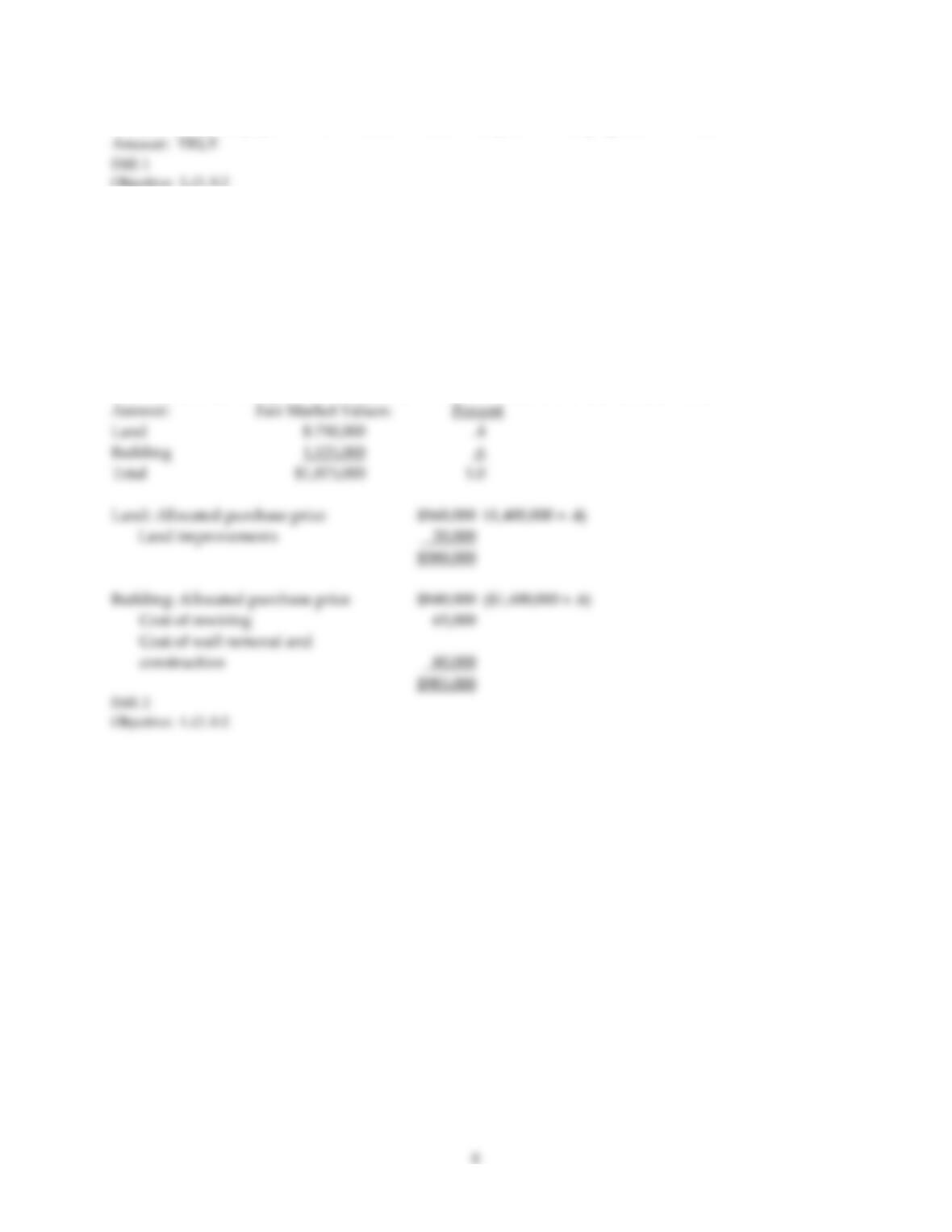
8.2-10) Symons Tool and Die acquired land and a building on March 1, 20X9, paying a total of $1,400,000.
Separately, the land had an estimated fair market value of $750,000 and the building had an estimated
fair market value of $1,125,000. In order to use the property, land improvements of $20,000 were incurred.
Additionally, the building needed to be rewired, at a cost of $65,000. Also, certain walls had to be
knocked down, while others were constructed. The cost to remove and replace walls was $80,000. The
company took occupancy of the building on August 1, 20X9.
For all of items noted above, determine how much will be incorporated into the land account, the
building account, or expensed as of Symons Tool and Die’s year end of December 31, 20X9.
8.2-11) Key Company purchased land for $350,000 with intentions to construct an office building on the
site. At the time of the closing, Key Company paid closing costs of $5,000, title fees of $800, and attorney’s
fees of $3,200. When Key Company purchased the land, removal of an old building was completed in
preparation for the new building at a cost of $8,000. However, Key Company was able to sell a portion of
the building materials retrieved from the old, demolished building to a local contractor for $2,000. After
$21,000 was paid to grade the property and install sewage lines, a building was erected at a total cost of
$600,000. After 2 years from the building’s completion, the hot water heaters were replaced. The warranty
on the heaters had already expired.
Required:
Based on the previous information, identify the total acquisition costs for the land and the building.
Learning Objective 8.3 Questions
Table 8–2
Vanadia Company acquired a $40,000 machine on January 1, 20X9. The machine is estimated to have a
useful life of 5 years, and a residual value of $4,000. For unit depreciation purposes, the machine is
expected to produce 500,000 units.
8.3-1) Referring to Table 8–2, what is the depreciable value of the machine acquired by Vanadia
Company?
A) $4,000
B) $36,000
C) $40,000
D) $8,000
E) Cannot be determined without additional data
8.3-2) Referring to Table 8–2, if Vanadia Company uses straight–line depreciation, what is the depreciation
expense in 2X10?
A) $ 3,686
B) $ 7,200
C) $ 8,000
D) $ 8,800
E) $12,500
8.3-3) Referring to Table 8–2, if Vanadia Company uses straight–line depreciation, what is the balance in
the accumulated depreciation account on January 1, 2X11?
A) $14,400
B) $16,000
C) $17,600
D) $21,600
E) $24,000
8.3-4) Referring to Table 8–2, if Vanadia Company uses unit depreciation, and the company produces
80,000 units in 20X9, what will be the depreciation expense for 20X9?
A) $5,760
B) $6,400
C) $7,200
D) $8,000
E) $8,800
8.3-5) Referring to Table 8–2, if Vanadia Company uses unit depreciation and the company produces
80,000 units in 20X9; 130,000 units in 2X10; and 160,000 units in 2X11; what is the depreciation expense in
2X11?
A) $ 6,682
B) $11,520
C) $12,800
D) $26,640
E) $29,600
8.3-6) Referring to Table 8–2, if Vanadia Company uses unit depreciation, and the company produces
80,000 units in 20X9; 130,000 units in 2X10; 160,000 units in 2X11; and 70,000 units in 2X12; what is the net
book value of the machine at December 31, 2X12?
A) $4,000
B) $4,320
C) $4,800
D) $8,320
E) $8,800
8.3-7) Referring to Table 8–2, if Vanadia Company uses double–declining–balance depreciation, what is the
depreciation expense in 20X9?
A) $14,400
B) $16,000
C) $17,600
D) $25,000
E) $27,776
8.3-8) Referring to Table 8–2, if Vanadia Company uses double–declining–balance depreciation, what is the
depreciation expense in 2X10?
A) $ 8,640
B) $ 9,600
C) $10,560
D) $14,400
E) $16,000
8.3-9) Referring to Table 8–2, what is the balance in the accumulated depreciation account on December
31, 2X10, if Vanadia Company uses double–declining–balance depreciation?
A) $23,040
B) $25,600
C) $28,160
D) $28,800
E) $32,000
8.3-10) Referring to Table 8–2, if Vanadia Company uses double–declining–balance depreciation, what is
the depreciation expense in 2X11?
A) $ 5,184
B) $ 5,760
C) $ 6,336
D) $14,400
E) $16,000
8.3-11) Referring to Table 8–2, what is the balance in the accumulated depreciation account on December
31, 2X11, if Vanadia Company uses double–declining–balance depreciation?
A) $28,224
B) $31,360
C) $34,496
D) $37,140
E) $40,000
8.3-12) Referring to Table 8–2, if Vanadia Company uses double–declining–balance depreciation, what is
the net book value of the machine on December 31, 2X11?
A) $ –0–
B) $ 4,000
C) $ 8,640
D) $11,776
E) $12,640
8.3-13) Referring to Table 8–2, assume Vanadia Company was considering the use of double–declining–
balance depreciation. The company wishes to minimize its tax payments in 2X11, 2X12, and 2X13. The
company is considering switching to straight–line depreciation as soon as it becomes more advantageous
to do so. In what year will that occur?
A) Straight–line depreciation is never more advantageous than double–declining–balance depreciation.
B) Year 20X9
C) Year 2X10
D) Year 2X11
E) In this case, the depreciation expense in 2X13 will be the same for both methods, since you do not
depreciate below residual value in either method.
8.3-14) To measure depreciation for a plant asset, all of the following must be known except:
A) Estimated useful life
B) Current market value
C) Estimate residual value
D) Historical cost
E) All of the above must be known to measure depreciation for a plant asset.
8.3-15) Ganley Rental Cars recently acquired several new cars for their fleet. The cars have an estimated
life of 4 years and should be driven 80,000 miles. What is the most appropriate method of depreciation to
properly match revenues and expenses?
A) Double–declining balance
B) Straight line
C) Units–of–production
D) Revenue recognition
E) Expense deferral
8.3-16) Book value is defined as
A) cost less salvage value.
B) current market value less accumulated depreciation.
C) cost less accumulated depreciation.
D) cost plus accumulated depreciation.
E) cost plus salvage value.
8.3-17) The double–declining–balance method of depreciation
A) causes less depreciation in the early years of an asset’s use as compared to other depreciation methods.
B) causes the same amount of depreciation in the early years of an asset’s use as compared to other
depreciation methods.
C) causes more depreciation in the early years of an asset’s use as compared to other depreciation
methods.
D) is not an acceptable depreciation method according to generally accepted accounting principles.
E) None of the above
Table 8–3
Machiel Manufacturing acquired a $60,000 machine on January 1, 20X9. The machine is estimated to have
a useful life of 4 years, and a residual value of $10,000. For unit depreciation purposes, the machine is
expected to produce 500,000 units.
8.3-18) Referring to Table 8–3, what is the depreciable value of the machine acquired by Machiel
Manufacturing?
A) $10,000
B) $50,000
C) $60,000
D) $15,000
E) Cannot be determined without additional data
8.3-19) Referring to Table 8–3, if Machiel Manufacturing used straight–line depreciation, what will be the
depreciation expense in 20X9?
A) $ 7,200
B) $ 8,000
C) $ 8,800
D) $12,500
E) $13,888
8.3-20) Referring to Table 8–3, if Machiel Manufacturing uses straight–line depreciation, what is the
depreciation expense in 2X11?
A) $ 3,686
B) $ 7,200
C) $ 8,000
D) $ 8,800
E) $12,500
8.3-21) Referring to Table 8–3, if Machiel Manufacturing uses straight–line depreciation, what is the
balance in the accumulated depreciation account on January 1, 2X11?
A) $14,400
B) $16,000
C) $17,600
D) $21,600
E) $25,000
8.3-22) Referring to Table 8–3, if Machiel Manufacturing uses unit depreciation, and the company
produces 80,000 units in 20X9, what will be the depreciation expense for 20X9?
A) $5,760
B) $6,400
C) $7,200
D) $8,000
E) $8,800
8.3-23) Referring to Table 8–3, if Machiel Manufacturing uses unit depreciation and the company
produces 80,000 units in 20X9; 130,000 units in 2X10; and 160,000 units in 2X11; what is the depreciation
expense in 2X11?
A) $ 8,000
B) $13,000
C) $12,800
D) $16,000
E) $37,000
8.3-24) Referring to Table 8–3, if Machiel Manufacturing uses unit depreciation, and the company
produces 80,000 units in 20X9; 130,000 units in 2X10; 160,000 units in 2X11 and 70,000 units in 2X12; what
is the net book value of the machine at December 31, 2X12?
A) $ 8,000
B) $13,000
C) $12,800
D) $16,000
E) $37,000
8.3-25) Referring to Table 8–3, if Machiel Manufacturing uses double–declining–balance depreciation, what
is the depreciation expense in 20X9?
A) $12,500
B) $16,000
C) $17,500
D) $25,000
E) $30,000
8.3-26) Referring to Table 8–3, assume Machiel Manufacturing uses double–declining–balance
depreciation, what is the depreciation expense in 2X10?
A) $ 8,640
B) $ 9,600
C) $12,500
D) $15,000
E) $25,000
8.3-27) Referring to Table 8–3, what is the balance in the accumulated depreciation account on December
31, 2X10, if Machiel Manufacturing uses double–declining–balance depreciation?
A) $25,000
B) $30,000
C) $40,000
D) $45,000
E) $50,000
8.3-28) Which of the following is an appropriate description of an attribute associated with depreciation?
A) The depreciable value of a tangible asset is the total acquisition cost of the asset.
B) The residual value of a tangible asset is the estimated amount to be received for an asset upon its
disposal at the end of its useful life.
C) The useful life of a tangible asset is the time period over which the company believes it will own the
asset.
D) The estimation of useful lives is almost always based upon when the tangible asset will physically
wear out.
E) Depreciation attempts to measure the deteriorating market value of an asset.
8.3-29) Depreciation expense computed under double–declining–balance will decrease each year because
the
A) book value used in the computation each year increases.
B) book value used in the computation each year decreases.
C) rate used in the computation each year increases.
D) rate used in the computation each year decreases.
E) All the above are correct.
8.3-30) The accumulated depreciation account represents a growing amount of cash to be used to replace
the asset.
8.3-31) In order to calculate depreciation, the current market value of the equipment, the salvage value,
and the estimated useful life must be known.
8.3-32) Book value is determined by adding salvage value to the cost of the asset.
8.3-33) Regardless of the depreciation method used, accumulated depreciation will be the same when the
asset is fully depreciated.
8.3-34) The depreciable value is the difference between the total acquisition cost and the predicted
residual value.
8.3-35) Residual value is computed as cost less depreciation expense.
8.3-36) Depreciation is not intended to track the decreasing current market value of a tangible asset.
8.3-37) Both straight–line depreciation and unit depreciation will generate the same depreciation expense
during every year of an asset’s life.
8.3-38) Double–declining–balance depreciation may be referred to as accelerated depreciation.
18
8.3-39) Most companies use accelerated depreciation for financial reporting purposes and straight–line
depreciation for income tax purposes.
8.3-40) Unit depreciation is the most popular form of accelerated depreciation.
8.3-41) Double–declining–balance depreciation computes annual depreciation by multiplying the asset‘s
book value by two times the straight–line rate.
8.3-42) Land is always depreciated using double-declining-balance depreciation.
8.3-43) Blue Technologies acquired a forklift vehicle on January 1, 20X9, for $42,000. The machine is
estimated to have a 5–year life, with a residual value of $6,000. Blue Technologies is not certain whether to
use the straight–line or double–declining–balance method of depreciation.
Prepare the following depreciation schedule:
Straight–Line Double–Declining–Balance
Depreciation Book Depreciation Book
Date Expense Value Expense Value
01/01/2X09 $42,000 $42,000
12/31/2X09
12/31/2X10
12/31/2X11
8.3-44) For each of the independent situations below, determine the age of the asset in question. All assets
were acquired at the beginning of the years.
a. The balance in the buildings account is $400,000; while the balance sheet shows the book value of the
buildings at $217,600. The notes to the financial statements indicate that straight–line depreciation is used
for all plant assets and that residual values are estimated at 5% of cost. The estimated life of the buildings
is 25 years.
b. The book value of delivery equipment is $51,520. The cost of the delivery equipment was $80,500. The
company uses the straight–line method of depreciation for delivery equipment and estimates life at 5
years or 50,000 units. So far, 27,000 units have been produced. Residual value is 10% of cost.
8.3-45) On January 1, 2X09, Donnelly Enterprises purchased lawn mowers for $60,000. The lawn mowers
have an estimated life of 8 years or 40,000 hours and an estimated residual value of $4,000. Donnelly
Enterprises must choose the depreciation method that appropriately allocates depreciation over the lawn
mowers’ useful life and would like the following items calculated.
1) Depreciation expense for 2X09 and 2X10 using the units–of–production depreciation method. The lawn
mowers were operated for 4,000 hours in 2X09 and 6,000 hours in 2X10.
2) Straight–line depreciation for 2X09 and 2X10.
3) Accumulated depreciation at December 31, 2X10 using the straight–line method
4) Accumulated depreciation at December 31, 2X10 using the units–of–production method.
5) Book value of the lawn mowers using the straight–line depreciation method and the book value using
the units–of–production method of depreciation as of December 31, 2X10.
8.3-46) Explain the concept of depreciation. Include in your discussion one common misconception
regarding what depreciation represents.