
Chapter 8—Standard Costing: A Managerial Control Tool Key
1. Managers develop quantity standards when they decide what amount of input should be used per unit of
output.
2. Managers develop price standards when they determine what amount should be paid for the quantity of input
to be used.
3. The standard cost per unit of output for a particular input is calculated by multiplying the standard price per
unit by the standard number of units produced.
4. In setting standards, historical experience is the best source to use when determining the most efficient way to
operate.
5. Operating personnel can easily achieve standards set by engineering studies.
6. Ideal standards can be achieved under efficient operating conditions.
7. Ideal standards allow for machine breakdowns, slack, or momentary lack of skill.
8. Currently attainable standards offer the most behavioral benefits because higher performance levels are
attained through challenging, yet achievable, standards.
9. Currently attainable standards can be achieved under efficient operating conditions.
10. One reason for adopting a standard cost system is to make product costing easier.
11. The benefits of operational control under a standard cost system can extend to all manufacturing
environments.
12. Standard costs are developed for direct materials, direct labor, and variable overhead only.
13. The standard quantity of materials allowed can be calculated by multiplying the unit quantity standard by
the actual output.
14. To compute the standard direct labor hours allowed, multiply the unit labor standard by the standard output.
15. The total budget variance is the difference between the actual cost of the input and its planned cost.
16. The actual quantity of input at the standard price less than the standard quantity of input at the actual price
equals the usage variance.
17. The actual quantity of input at the actual price less the actual quantity of input at the standard price is the
price variance.

18. An unfavorable usage variance would occur when the actual usage of inputs is greater than the standard
usage.
19. A favorable price variance occurs whenever the actual prices are greater than the standard prices.
20. To determine whether variances are significant, managers set control limits, which represent the acceptable
range, plus or minus an allowable deviation.
21. The sum of the price and usage variances will add up to the total materials variance regardless of whether
the materials purchased is equal to the materials used.
22. The materials price variance is computed using the actual quantity of materials used, and the materials usage
variance is computed using the actual quantity of materials purchased.
23. For better control, the materials price variance is computed using actual quantity of materials purchased.
24. The sum of the labor rate and labor efficiency variances will always add up to the total labor variance.
25. Favorable variances are credits and unfavorable variances are debits.
26. In kaizen costing, the Act step involves comparing actual results to the kaizen standard in order to provide a
measure of the level of improvement attained.

27. Of the three cost reduction methods typically used, reverse engineering tears down the competitors’
products to discover more design features that create cost reductions.
28. The quantity of each input that should be used to produce one unit of output is documented on the standard
cost sheet.
29. The standard cost sheet provides the input standards needed to compute the total amount of inputs allowed
for the actual output, an essential component in computing efficiency variances.
30. The standard unit cost is developed before the standard costs for direct materials, direct labor, and overhead
can be set.
31. The unit standard quantity of inputs is vital to the computation of total amount of inputs allowed for the
actual output and efficiency variances.
32. The continuous improvement subcycle of kaizen costing is defined by a Plan-Do-Act-Check sequence.
33. The Act Step of the kaizen subcycle requires actions to be taken to implement the planned improvements.
34. Kasien costing provides fixed standards which reflect continuous improvement efforts.
35. A kaizen standard reflects the realized improvements for the past periods and a search for more
improvements for the future.
36. In kaizen costing, the cost reduction process is controlled by repetitive use of continuous improvements and
maintenance.
37. Standards based on the amount of input that should be used per unit of output are called
38. Price standards are based on
39. The sources of quantitative standards include
40. Which of the following is true regarding historical experience in standard setting?
41. Which of the following is not true regarding engineering studies?
42. In setting price standards for materials and labor,
43. Ideal standards
44. Which of the following is not true regarding currently attainable standards?
45. Standard cost systems are adopted
46. Standard cost systems can enhance operational control through the use of
47. Which of the following is true regarding standard cost systems in manufacturing environments that
emphasize continuous improvement and just-in-time manufacturing and purchasing?
48. In a standard cost system, costs are assigned to all of the following, except for
49. The standard cost system differs from the actual cost system in the assignment of
50. Which of the following is not true regarding normal costing systems?
51. Which of the following is not an advantage of standard costing over normal costing and actual costing?
52. The production data needed to calculate the standard unit cost as well as the underlying details for the
standard cost per unit are provided in
53. Standard hours allowed are computed using the equation
54. The standard quantity of materials allowed is computed by the equation
55. Variances indicate
56. The difference between the actual cost of the input and its planned cost is
57. Which of the following is true concerning the materials price variance?
58. The usage variance is the difference between the actual and standard quantity of inputs
59. Which of the following is true regarding variances?
60. All of the following are true regarding variance investigation except
61. Which of the following is not true concerning control limits?
62. Which of the following is not true concerning direct materials variances?
63. The materials price variance is computed using the equation
64. The materials usage variance is calculated by the equation
65. Which of the following is not true regarding the use of materials variance information?
66. Which of the following is true regarding direct labor variances?
67. The labor rate variance is computed by
68. The labor efficiency variance is calculated by the equation
69. Which of the following is not true regarding the use of labor variance information?
70. All of the following are true except
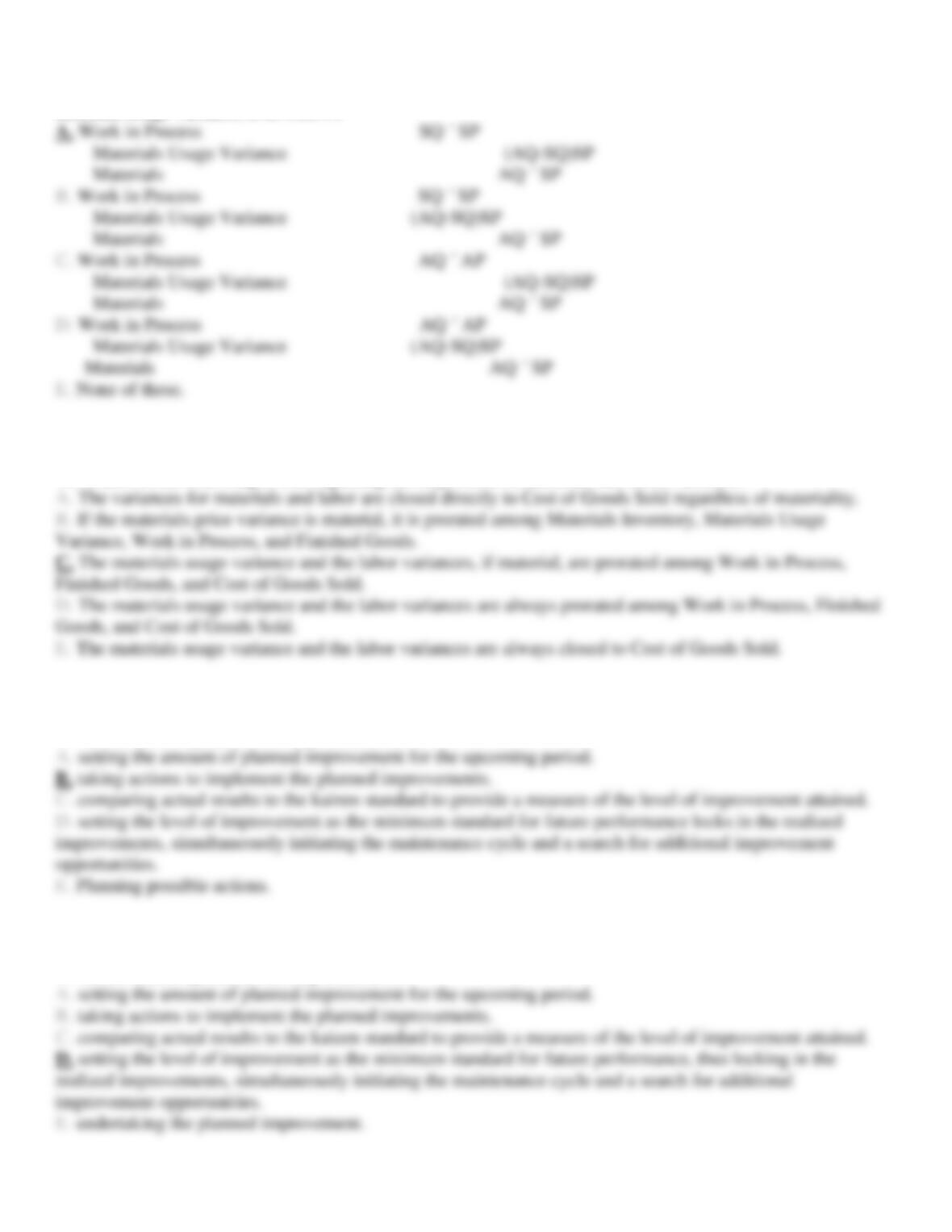
71. Assume that SQ = Standard Quantity, SP = Standard Price, AQ = Actual Quantity, and AP = Actual Price.
The correct entry along with the equation to record the issuance and usage of materials, assuming a favorable
materials usage variance, is as follows
72. Which of the following is true regarding the disposition of materials and labor variances?
73. In the kaizen cycle, the Do step consists of
74. In the kaizen cycle, the Act step consists of
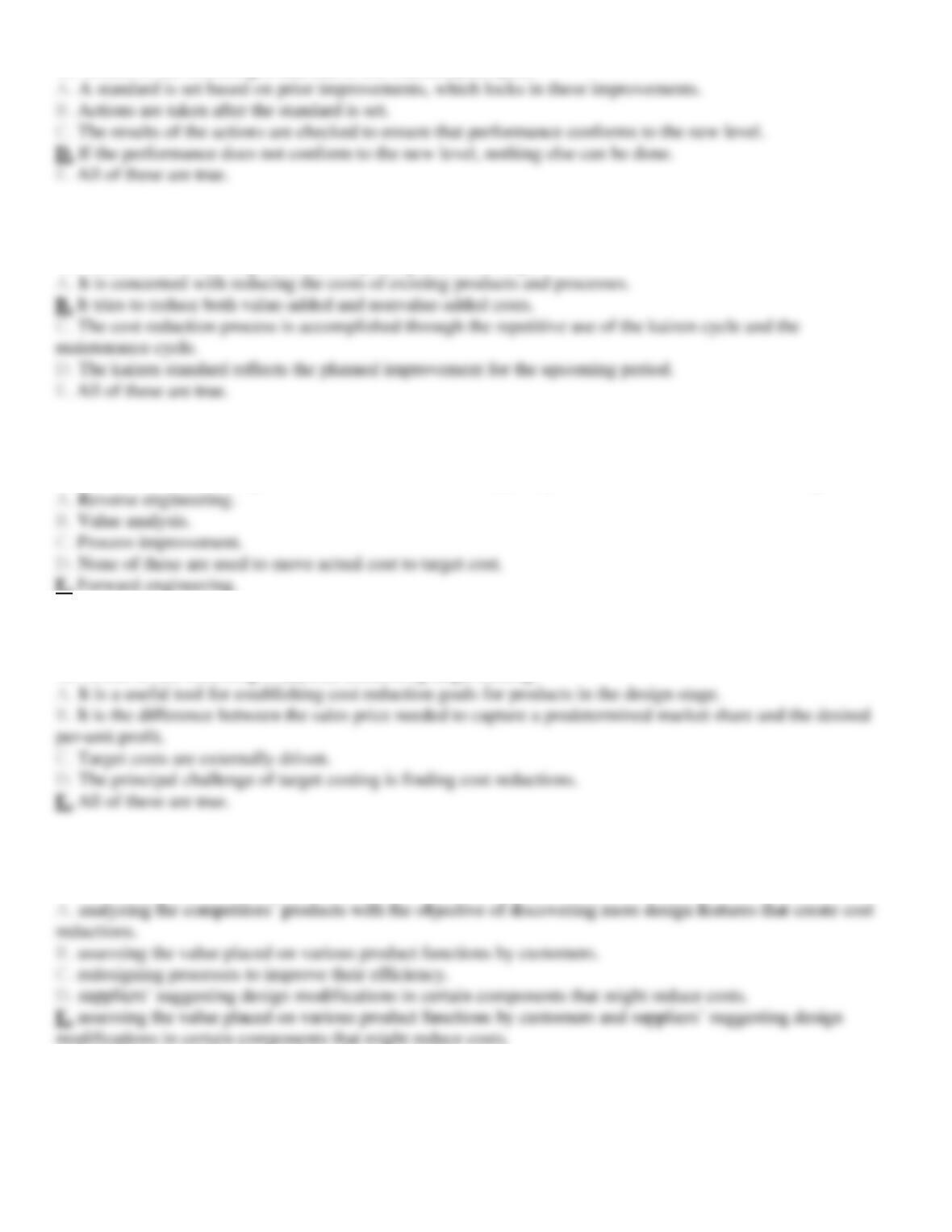
75. Which of the following is not true of the maintenance cycle?
76. Which of the following is not true regarding kaizen costing?
77. Which of the following cost reduction methods is not typically used to move the actual cost to target cost?
78. Which of the following is not true concerning target costing?
79. In cost reduction, value analysis entails
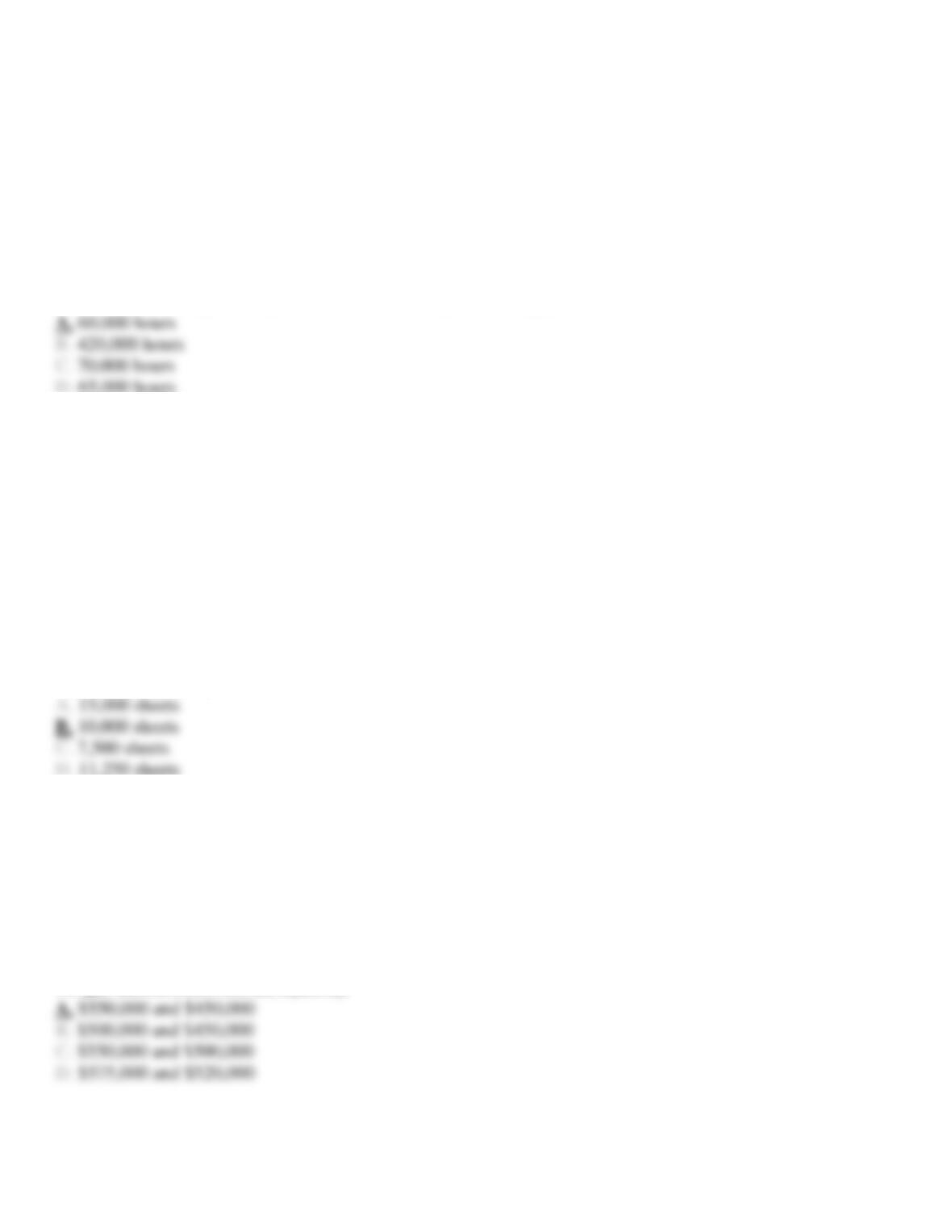
80. Figure 8-1.
Flying High Company manufactures model airplanes. During the month, it manufactured 10,000 airplanes.
Each one used an average of 6.5 direct labor hours and an average of 1.5 sheets of aluminum. It normally
manufactures 7,500 airplanes. Materials and labor standards for making the airplanes are as follows:
Direct Materials (1 sheet of aluminum @ $10.00)
$10.00
Direct Materials (other accessories @ $8.75)
8.75
Direct Labor (6 hours @ $7.00)
42.00
Refer to Figure 8-1. Compute the standard hours allowed for a volume of 10,000 airplanes.
81. Figure 8-1.
Flying High Company manufactures model airplanes. During the month, it manufactured 10,000 airplanes.
Each one used an average of 6.5 direct labor hours and an average of 1.5 sheets of aluminum. It normally
manufactures 7,500 airplanes. Materials and labor standards for making the airplanes are as follows:
Direct Materials (1 sheet of aluminum @ $10.00)
$10.00
Direct Materials (other accessories @ $8.75)
8.75
Direct Labor (6 hours @ $7.00)
42.00
Refer to Figure 8-1. Compute the standard number of sheets of aluminum allowed.
82. Acme Company’s standard cost is $500,000. The allowable deviation is 10%. Its actual costs for three
months are
January
$520,000
February
$550,000
March
$575,000
The upper and lower control limits are, respectively,

83. Figure 8-2.
Highland Company’s standard cost is $250,000. The allowable deviation is 10%. Its actual costs for six
months are
January
$235,000
February
220,000
March
245,000
April
265,000
May
270,000
June
280,000
Refer to Figure 8-2. The upper and lower control limits are, respectively,
84. Figure 8-2.
Highland Company’s standard cost is $250,000. The allowable deviation is 10%. Its actual costs for six
months are
January
$235,000
February
220,000
March
245,000
April
265,000
May
270,000
June
280,000
Refer to Figure 8-2. The variance that is higher than the upper control limit is

85. Figure 8-2.
Highland Company’s standard cost is $250,000. The allowable deviation is 10%. Its actual costs for six
months are
January
$235,000
February
220,000
March
245,000
April
265,000
May
270,000
June
280,000
Refer to Figure 8-2. The variance that is lower than the lower control limit is
86. Figure 8-3.
Caballero Corporation produces high-quality leather saddles. The company has a standard cost system and has
set the following standards for materials and labor:
Leather
(20
strips @
$15)
$300
Direct
labor
(15
hours @
$15)
225
Total prime cost
$525
During the year Caballero produced 150 saddles. Actual leather purchased was 3,100 strips, at $12 per strip. There were no beginning or ending
inventories of leather. Actual direct labor was 2,500 hours at $16 per hour.
Refer to Figure 8-3. Compute the costs of leather and direct labor that should have been incurred for the production of 150 saddles.

87. Figure 8-3.
Caballero Corporation produces high-quality leather saddles. The company has a standard cost system and has
set the following standards for materials and labor:
Leather
(20
strips @
$15)
$300
Direct
labor
(15
hours @
$15)
225
Total prime cost
$525
During the year Caballero produced 150 saddles. Actual leather purchased was 3,100 strips, at $12 per strip. There were no beginning or ending
inventories of leather. Actual direct labor was 2,500 hours at $16 per hour.
Refer to Figure 8-3. Calculate the labor rate variance and the labor efficiency variance, respectively.
88. Figure 8-3.
Caballero Corporation produces high-quality leather saddles. The company has a standard cost system and has
set the following standards for materials and labor:
Leather
(20
strips @
$15)
$300
Direct
labor
(15
hours @
$15)
225
Total prime cost
$525
During the year Caballero produced 150 saddles. Actual leather purchased was 3,100 strips, at $12 per strip. There were no beginning or ending
inventories of leather. Actual direct labor was 2,500 hours at $16 per hour.
Refer to Figure 8-3. Compute the total budget variances for materials and labor, respectively.

89. Figure 8-3.
Caballero Corporation produces high-quality leather saddles. The company has a standard cost system and has
set the following standards for materials and labor:
Leather
(20
strips @
$15)
$300
Direct
labor
(15
hours @
$15)
225
Total prime cost
$525
During the year Caballero produced 150 saddles. Actual leather purchased was 3,100 strips, at $12 per strip. There were no beginning or ending
inventories of leather. Actual direct labor was 2,500 hours at $16 per hour.
Refer to Figure 8-3. Compute the materials price variance and the materials usage variance, respectively.
90. During the month of March, Baker’s Express purchased 10,000 pounds of flour at $1 per pound. At the end
of March, Baker’s Express found that it had an unfavorable materials price variance of $500. The standard cost
per pound must be
91. During the month of March, Baker’s Express purchased 10,000 pounds of flour at $1 per pound. At the end
of March, Baker’s Express found that it had a favorable materials price variance of $500. The standard cost per
pound must be
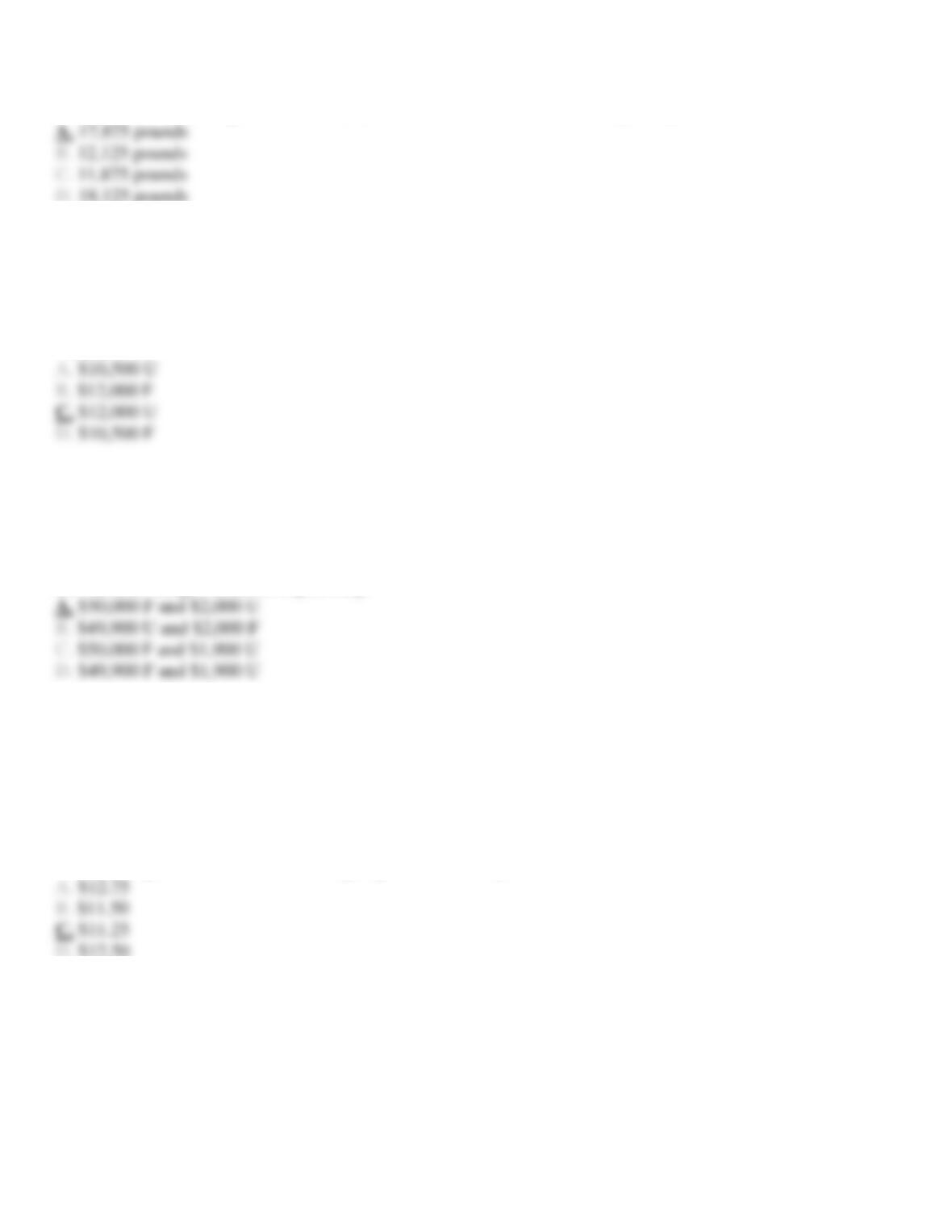
92. During June, Cisco Company produced 12,000 chainsaw blades. The standard quantity of material allowed
per unit was 1.5 pounds of steel per blade at a standard cost of $8 per pound. Cisco determined that it had a
favorable materials usage variance of $1,000 for June. Calculate the actual quantity of materials Cisco used.
93. During June, Cisco Company produced 12,000 chainsaw blades. The standard quantity of material allowed
per unit was 1.5 pounds of steel per blade at a standard cost of $8 per pound. The actual cost was $7 per pound.
The actual pounds of steel that Cisco purchased were 19,500 pounds. Calculate Cisco’s materials usage
variance.
94. Perfect Builders makes all sorts of moldings. Its standard quantity of material allowed is 1 foot of wood per
1 foot of molding at a standard price of $2.00 per foot. During August, it purchased 500,000 feet of wood at a
cost of $1.90 per foot, which produced only 499,000 feet of molding. Calculate the materials price variance and
the materials usage variance, respectively.
95. Figure 8-4.
Soaring High Company produces model airplanes. During the month of July, it produced 1,000 planes. The
actual labor hours were 10 hours per plane. Its standard labor hours is 15 hours per plane. The standard labor
rate is $12 per hour. At the end of July, Soaring High found that it had a favorable labor rate variance of $7,500.
Refer to Figure 8-4. What was Soaring High’s actual cost per labor hour?
96. Figure 8-4.
Soaring High Company produces model airplanes. During the month of July, it produced 1,000 planes. The
actual labor hours were 10 hours per plane. Its standard labor hours is 15 hours per plane. The standard labor
rate is $12 per hour. At the end of July, Soaring High found that it had a favorable labor rate variance of $7,500.
Refer to Figure 8-4. What was Soaring High’s total labor variance?
97. Figure 8-5
Aqua Company produces aquariums. During the year 150,000 aquariums were produced. Materials and labor
standards for producing the aquariums are as follows:
Direct materials (2 sheets of glass @ $2 each)
$4
Direct labor (3 hours @ $8)
24
Aqua purchased and used 310,000 sheets of glass at $1.50 each and its actual labor hours were 435,000 hours at a wage rate of $8.50.
Refer to Figure 8-5. What is the materials price variance?
98. Figure 8-5
Aqua Company produces aquariums. During the year 150,000 aquariums were produced. Materials and labor
standards for producing the aquariums are as follows:
Direct materials (2 sheets of glass @ $2 each)
$4
Direct labor (3 hours @ $8)
24
Aqua purchased and used 310,000 sheets of glass at $1.50 each and its actual labor hours were 435,000 hours at a wage rate of $8.50.
Refer to Figure 8-5. What is the materials usage variance?