
Exam
Name___________________________________
MULTIPLE CHOICE. Choose the one alternative that best completes the statement or answers the question.
1)
People that have a high internal locus of control are likely to score high on which dimension of
empowerment?
1)
A)
Self–determination
B)
Self–efficacy
C)
Trust
D)
Meaningfulness
2)
Once tasks are delegated and authority provided, what should a manager do?
2)
A)
Carefully measure the project’s timetable
B)
Focus on both the results and how the results were achieved
C)
Focus on the techniques used to achieve the results
D)
Focus on the results achieved by subordinates
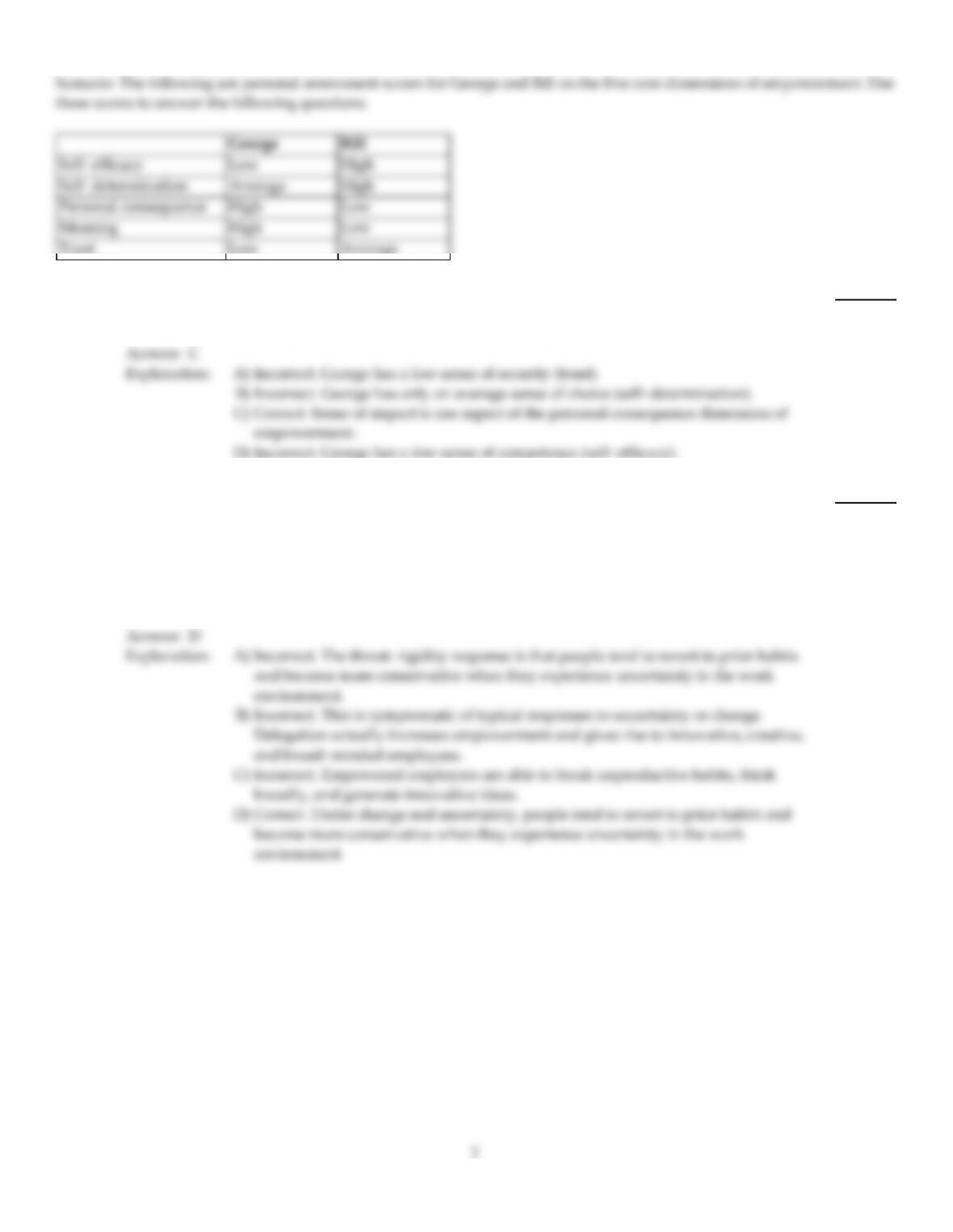
3)
Which is an accurate interpretation of the personal assessment score results?
3)
A)
George is very secure.
B)
George has a strong sense of choice.
C)
George has a strong sense of impact.
D)
George has a strong sense of competence.
4)
You notice in your company people are habitual in their behavior. They appear to be narrow
minded, and there is little innovation in their ideas. What are you most likely experiencing?
4)
A)
Experiencing uncommon behavior for changing times
B)
Experiencing the outcomes of delegation
C)
Experiencing the outcomes of empowerment
D)
Experiencing attributes that emerge in both managers and employees during times of change
and uncertainty

5)
A peer has asked you about empowerment. Which is the best summary statement to share with
your peer?
5)
A)
“Essentially, workers accomplish the tasks because of the extrinsic rewards offered to them.”
B)
“Essentially, empowerment and Theory X are the same.”
C)
“Essentially, empowerment is just a fancy word for delegate.”
D)
“Essentially, workers accomplish tasks because they are intrinsically attracted to them.”
6)
What can’t the manager delegate?
6)
A)
Prime responsibility
B)
Ultimate accountability
C)
Central accountability
D)
Prime accountability

7)
The guideline to articulate a clear vision and goals is related to which dimension(s) of
empowerment?
7)
A)
All five dimensions are related.
B)
Trust and self–efficacy are related.
C)
Self–efficacy, self–determination, and personal consequence are related.
D)
Self–determination, personal consequence, and meaningfulness are related.
E)
Trust is related.
8)
You coach high school sports. Your team has lost 37 games in a row prior to your arrival. Having
returned from an empowerment seminar, you decide what is best for your players is to model the
correct behaviors. Which is best?
8)
A)
Invite players from the 1972 state championship team to talk to your players.
B)
Demonstrate the desired behaviors yourself (you were an all–stater after all).
C)
Invite players from the 1972 state championship team to talk to your team and demonstrate
the desired behaviors yourself (you were an all–stater).
D)
Discuss with the team about going undefeated next year.
9)
If you believe that through your actions you can influence what happens, you would probably
score high on which dimension of empowerment?
9)
A)
Meaningfulness
B)
Self–determination
C)
Self–efficacy
D)
Trust
E)
Personal consequence
10)
Which is an attribute of a measurable goal?
10)
A)
Associated with challenging tasks
B)
Associated with outcome criteria
C)
Time–bound
D)
Associated with overall purposes of the organization
E)
Associated with observable behavior
11)
Your boss has droned on for hours about the importance of empowering employees. As you drift
off, she asks you to offer your insights on the consistency of delegation. Which is an appropriate
response?
11)
A)
“It means you delegate tasks continuously, not just when overworked, and you delegate both
pleasant and unpleasant tasks.”
B)
“It means to be consistent by treating everyone on the team fairly.”
C)
“It means you delegate tasks on a need–to–know basis and you delegate both pleasant and
unpleasant tasks.”
D)
“It means you delegate tasks continuously not just when overworked, and you delegate
pleasant tasks.“
12)
You are the CEO of Sugar Land Light & Power. In reading the Wall Street Journal, you notice the
editors have forecasted an unstable and unpredictable environment for the utility industry for the
next 10 years. You also suspect a lot of change. What should you do?
12)
A)
Maintain control and issue top–down mandates regarding strategy and direction.
B)
Revisit company policies with both management and employees.
C)
Empower your employees, arrange for more self–managing work teams, and broaden
participation and accountability.
D)
Do nothing; wait until problems surface.
13)
You have noticed that Hillary has maintained a consistently high level of work performance for the
past five years. What can you most likely deduce about Hillary?
13)
A)
She has a strong sense of job security.
B)
She has a strong sense of trust.
C)
She has a strong sense of self–determination.
D)
She has a strong sense of personal control.

14)
In providing adequate support for engaging employees, you have decided to furnish employees
with information on where they may acquire needed resources. Is this a good idea or a bad idea?
14)
A)
Bad idea, employees learn more when they have to find their own resources
B)
Good idea
C)
It depends on whether you have time or not.
15)
The intrinsic value of the job is directly tied to which dimension of empowerment?
15)
A)
Trust
B)
Self–determination
C)
Meaning
D)
Personal consequence
E)
Self–efficacy
16)
Which answer best completes the following sentence? If managers competently engage employees,
the results can produce the following for employees: a sense of competence,…
16)
A)
meaningfulness, and trust.
B)
choice, meaningfulness, personal consequence, and trust.
C)
choice, and meaningfulness.
D)
choice, and personal consequence.
E)
None of the answer choices is correct.
17)
You are the leader of a work team. Having returned from a seminar on empowerment, you wonder
if empowerment would work for your team. Which dimension listed is considered to be the most
important in determining whether empowerment will work?
17)
A)
Personal control
B)
Meaningfulness
C)
Trust
D)
Self–determination
E)
Self–efficacy
18)
Your boss states, “Engaging employees usually refers to the assignment of a task, it is work focused.
Empowerment, on the other hand, focuses on individuals’ feelings.” How should you respond?
18)
A)
You should disagree. Your boss is describing competence and motivation.
B)
You should disagree. Your boss has the definitions reversed.
C)
You should agree.
19)
You are looking for a team player, a person who will try to get along with others on the team.
Which dimension of empowerment would demonstrate this trait best?
19)
A)
Self–determination
B)
Meaningfulness
C)
Self–efficacy
D)
Trust
E)
Personal consequence
20)
You understand the importance of two–way communication during the process of engaging
employees. What does this mean?
20)
A)
That you, as the manager, provide information on a need to know time frame
B)
That you, as the manager, remain available for consultation and idea exchange
C)
That you, as the manager, empathize totally with the process
D)
That you, as the manager, should answer every detailed question and provide continual
advice
21)
You have recently been promoted. In looking through the prior supervisor’s records, you note that
she had regular meetings with her employees both individually and as a team. The meetings
seemed to focus on how important the individual’s and the team’s efforts were to the organization‘s
objective. What was this supervisor good at?
21)
A)
Providing information
B)
Efficient with her time
C)
Providing resources
D)
Providing support
22)
A co–worker recently returned from a management seminar. She notes that empowerment is
nothing more than giving employees autonomy. How should you respond?
22)
A)
“I believe empowerment improves team building through centralized decision making.“
B)
“I believe empowerment relates to both self–efficacy and task accomplishment.”
C)
“I agree.”
D)
“I disagree; power isn’t about autonomy, it is about an individual’s capacity to accomplish a
task.”
23)
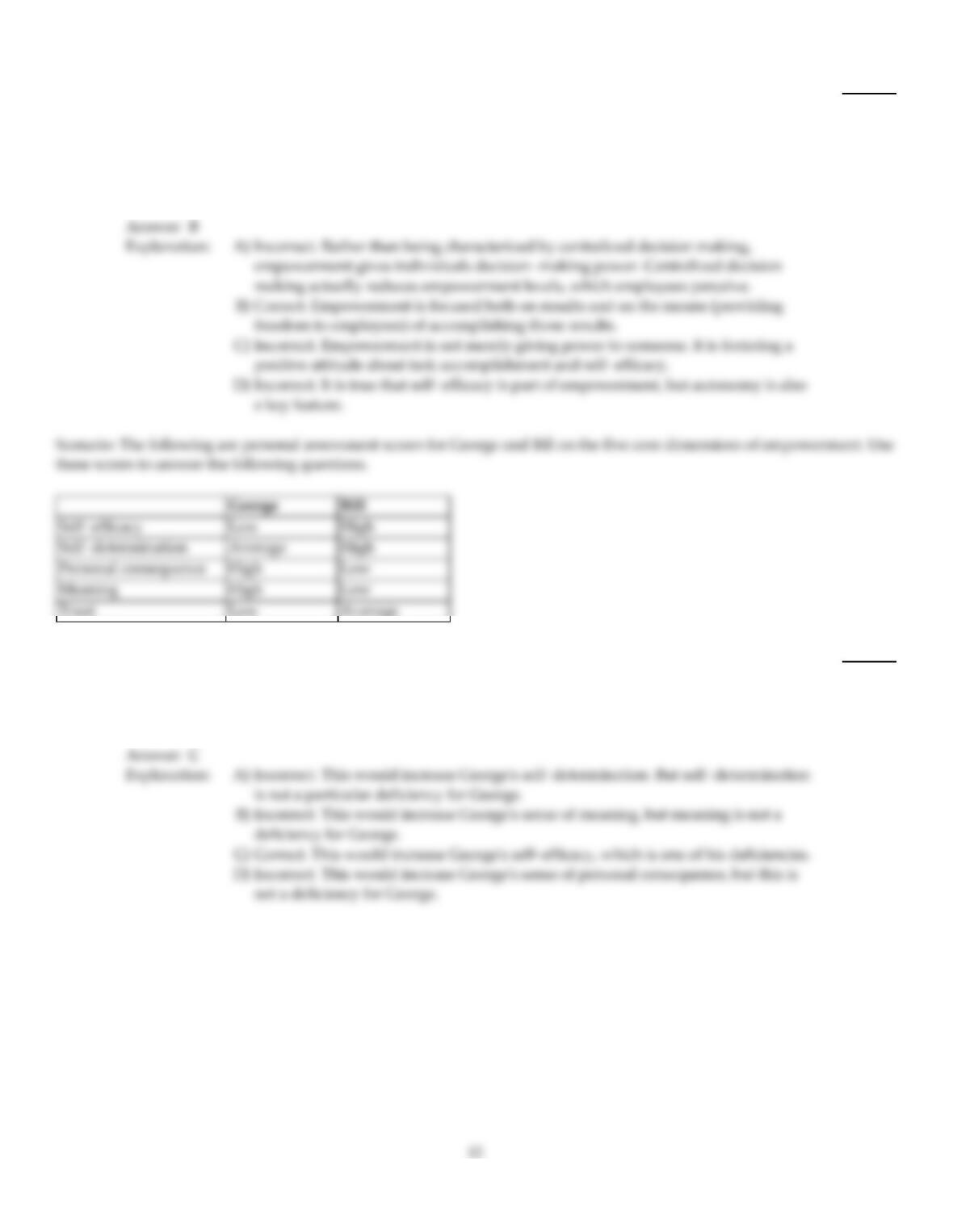
Which of the following is a good way to increase George’s sense of empowerment?
23)
A)
Give him the opportunity to make more choices about how he does his work.
B)
Help him see the impact that his work has in benefiting other people.
C)
Help him feel more confident in his work.
D)
Help him see how his work connects with his deeply held values.
24)
You have decided to keep the work climate fun and use superlatives in providing feedback. Also,
you plan to highlight the important impact that your employees’ work will produce and you plan
to try to foster activities that encourage friendships. You are doing what?
24)
A)
Providing needed support
B)
Arousing positive emotions
C)
Providing information
D)
Arousing personal mastery
25)
The guideline to model the behaviors you want others to achieve is related to which dimension(s)
of empowerment?
25)
A)
Self–efficacy and self–determination are related.
B)
All five dimensions are related.
C)
Self–efficacy and trust are related.
D)
Self–efficacy and meaningfulness are related.
E)
Only self–efficacy is related.
26)
Many managers and employees are reluctant to accept empowerment, but they are even more
reluctant to offer empowerment. If a rationale offered by management is, “I’m willing to empower
my people, but they just won’t accept the responsibility,” what is the inhibitor?
26)
A)
Attitudes about subordinates
B)
Incompetent empowerment
C)
Need for control
D)
Personal insecurities
27)
After attending a management seminar on empowerment, you have decided to issue a memo
telling your employees they are now empowered. Will this work?
27)
A)
No, most people want to avoid the responsibilities associated with empowerment.
B)
Yes, you can give someone empowerment.
C)
No, a manager cannot empower others, but he can help them empower themselves.
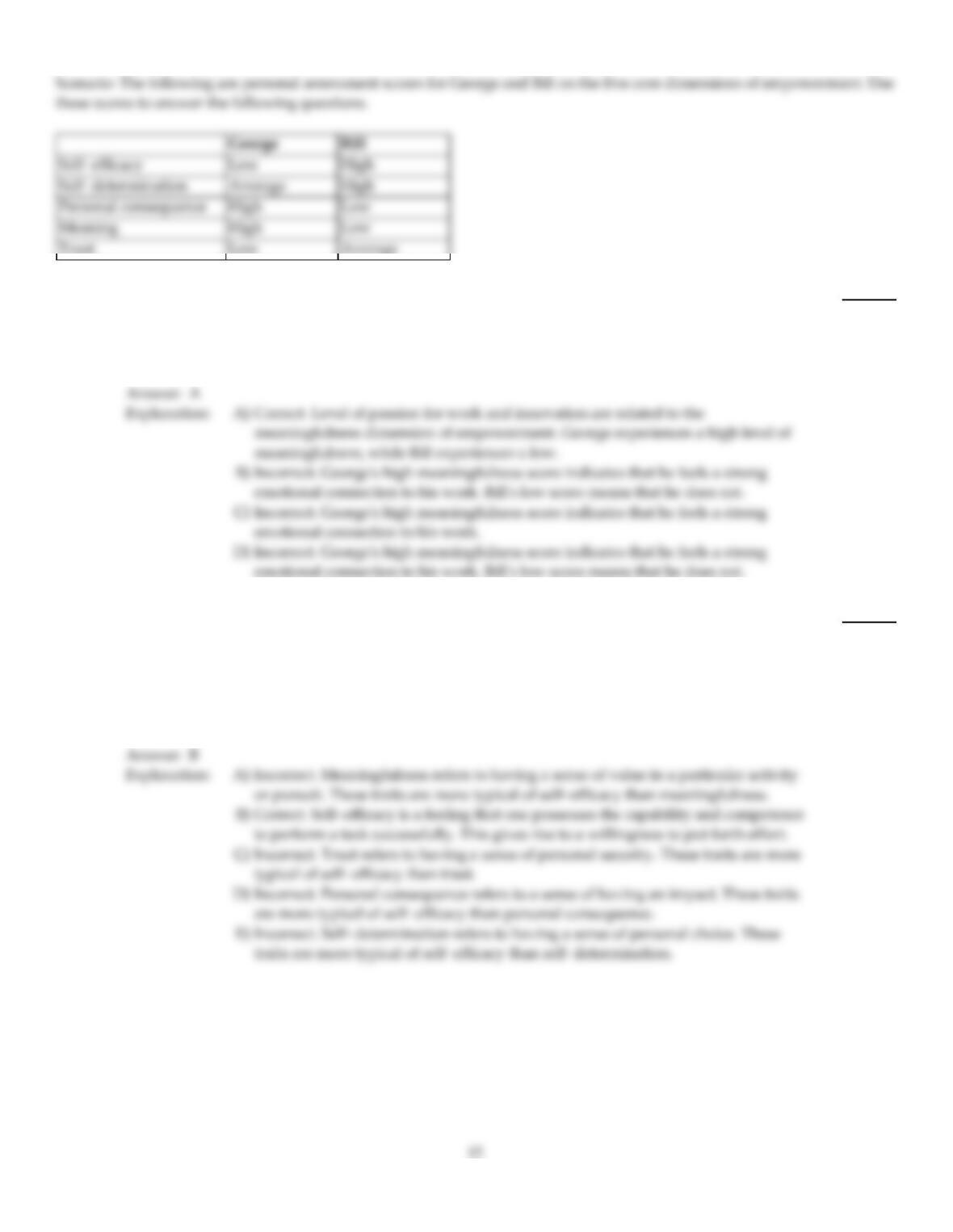
28)
Which is an accurate interpretation of the personal assessment score results?
28)
A)
George feels more passion for his work and is more innovative than Bill.
B)
Bill feels more passion for his work and is more innovative than George.
C)
Neither is passionate about their work.
D)
Both are passionate about their work.
29)
If you have a basic level of competence, a willingness to put forth effort to accomplish a task, and
the absence of overwhelming inhibitors to success, then which would you probably score high in?
29)
A)
Meaningfulness
B)
Self–efficacy
C)
Trust
D)
Personal consequence
E)
Self–determination
30)
If your employees believe you are fair, dependable, caring, and honest, what empowerment
dimension will increase?
30)
A)
Self–determination
B)
Self–efficacy
C)
Personal consequence
D)
Meaningfulness
E)
Trust
31)
Your boss prefers that you act on your own initiative and report to her when the final results have
been accomplished. Which initiative does your boss practice?
31)
A)
Recommend, then take action
B)
Wait to be told
C)
Act, then report
D)
Ask what to do
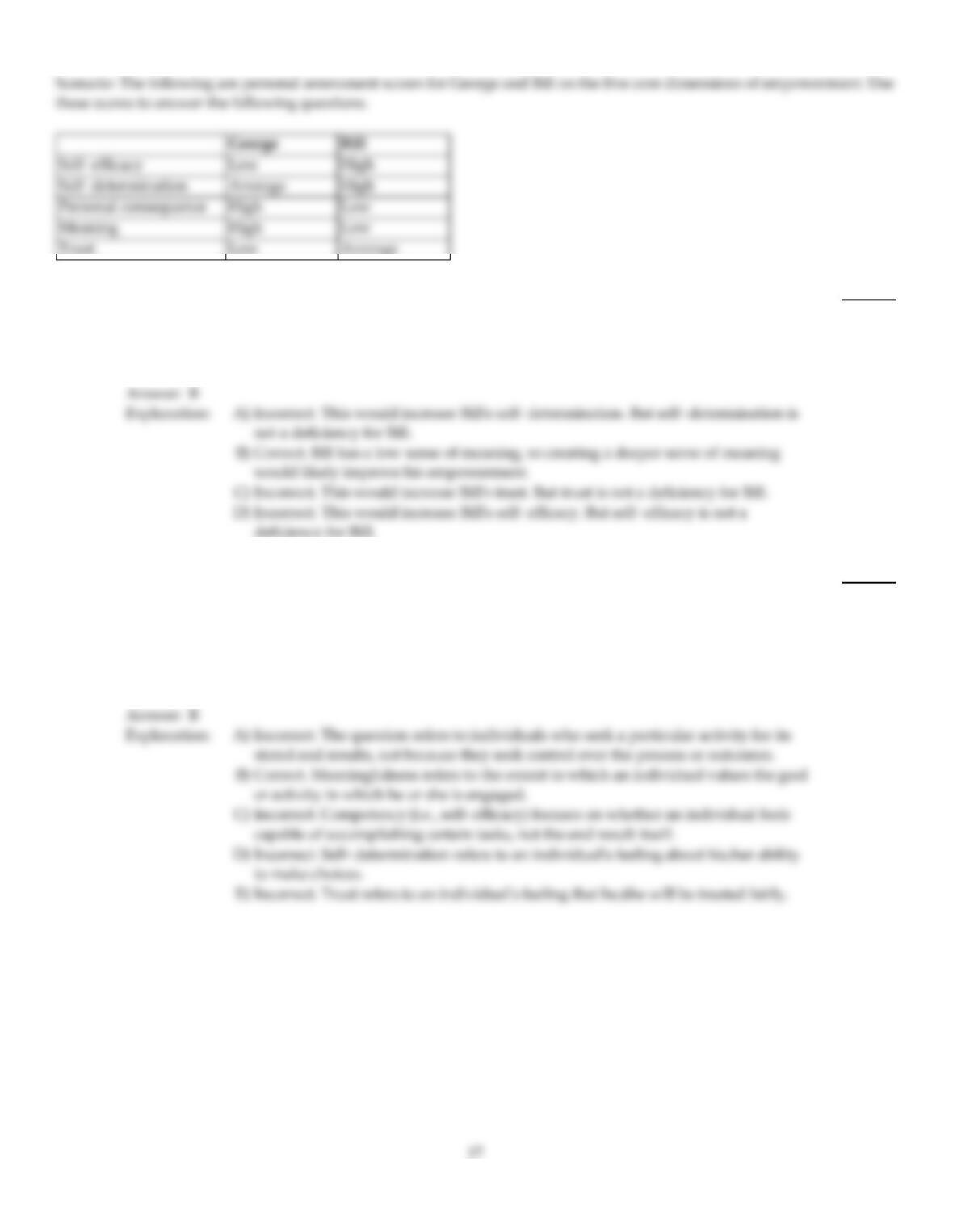
32)
Which of the following is a good way to increase Bill’s sense of empowerment?
32)
A)
Give him the opportunity to make more choices about how he does his work.
B)
Help him see how his work connects with his deeply held values.
C)
Create a better relationship with him so that he knows he can count on you.
D)
Help him feel more confident in his work.
33)
Which dimension of empowerment would most likely be experienced by people who join the Peace
Corps in order to help poor people in the world live a better life?
33)
A)
Control
B)
Meaningfulness
C)
Competency
D)
Self–determination
E)
Trust
34)
Many managers and employees are reluctant to accept empowerment, but they are even more
reluctant to offer empowerment. If a rationale offered by management is “I’m willing to empower
people, but they require clear directions and a set of guidelines; otherwise, the lack of instruction
leads to confusion,” what is the inhibitor?
34)
A)
Personal insecurities
B)
Willingness to embrace change
C)
Lack of trust
D)
Need for control
E)
Attitudes about subordinates
35)
If you provide employees a budget that allows them the discretion to spend money on activities
they consider important for completing the job successfully, you have utilized which guideline for
developing empowerment?
35)
A)
Providing information
B)
Modeling
C)
Providing support
D)
Providing resources
Explanation:
Explanation:
36)
Empowerment is a concept that is likely to be more acceptable in cultures with which strong
orientations?
36)
A)
Particularism, individualism, diffuseness, and achievement
B)
Particularism, collectivity, diffuseness, and achievement
C)
Universalism, neutrality, diffuseness, and achievement
D)
Particularism, affectivity, specificity, and ascription
37)
Suppose an employee comes to you after you have delegated an assignment and says, “We (the
team) have a problem. Some people within the team are not trying, there is just no effort. What
should I or the team do?” How should you reply?
37)
A)
“Do you want me to talk to the group?”
B)
“Well, I think I would penalize the team members somehow. What do you recommend?”
C)
“Gee, I am not sure. Let me think about it and I’ll get back to you.”
D)
“What do you think the team should do?”
D
B
38)
The guideline that fosters activities to encourage the formation of friendships and keeps the
workplace environment fun and interesting is related to which dimension(s) of empowerment?
38)
A)
All five dimensions are related.
B)
Meaningfulness is related.
C)
Personal consequence is related.
D)
Self–efficacy and meaningfulness are related.
E)
Trust is related.
39)
A manager remarks to you, “Empowerment means providing freedom for people to do successfully
what you, the manager, want them to do.” How should you respond?
39)
A)
You should disagree.
B)
You should agree.
C)
You should wait before you respond.