Chapter 8
Investments in Equity Securities
MULTIPLE CHOICE QUESTIONS
1. Equity investments are:
a. investments in bonds of a corporation.
b. investments that pay dividends, not interest.
c. classified as long-term liabilities.
d. marketed by the SEC to any investor who wishes to buy bonds of a public company.
2. Investments in equity securities are current assets if:
a. they are readily marketable and management plans to convert to cash within 1 year.
b. the fair market value can’t be determined.
c. management intends to convert them into common stock within one year.
d. management owns less than 50% of the outstanding stock.
3. Income from passive investments in equity securities is recognized when:
a. dividends are received from the investee due to the uncertainty of payment.
b. dividends are declared by the investee.
c. adjusting entries are made to record fair value adjustments.
d. the investee reports profits for the accounting period.
4. When a company accounts for an investment under the purchase method of accounting,
a. the book value of the subsidiary’s assets is added to the parent company‘s assets.
b. the book value of the subsidiary’s liabilities is added to the parent company’s
liabilities.
c. the company owns more than 50% of the stock of the investee.
d. a year-end adjustment is made to increase or decrease the carrying value of the
investment to fair market value.

8-2 Test Bank – Chapter 8 – Investments in Equity Securities
5. Passive investments in equity securities are:
a. readily marketable investments that management intends to hold for extended
periods.
b. always long-term investments.
c. current assets that require the equity method of accounting for investments.
d. investments with no influence on the investee.
6. Passive investments in equity securities are:
a. actively ‘traded’ on the open market, but can’t be sold until they mature.
b. nonmarketable investments that management intends to sell for short-term profits.
c. always long-term investments in common stock.
d. adjusted to fair value at yearend.
7. Passive investments in equity securities
a. are reported on the balance sheet at market value.
b. may have unrealized gains or losses in other comprehensive income.
c. are always listed as long-term assets.
d. Both a and b are correct.
8. Benson Incorporated owns 32% of Denver Company’s outstanding voting stock. Benson
Incorporated should account for its investment in Denver using the:
a. fair value method.
b. cost method.
c. consolidation procedure.
d. equity method.
9. Dewey Inc. owns 64% of Felicity Corporation’s outstanding voting stock. Dewey should
account for its investment in Felicity using :
a. the fair value method.
b. the cost method.
c. consolidated financial statements.
d. the mark-to-market method

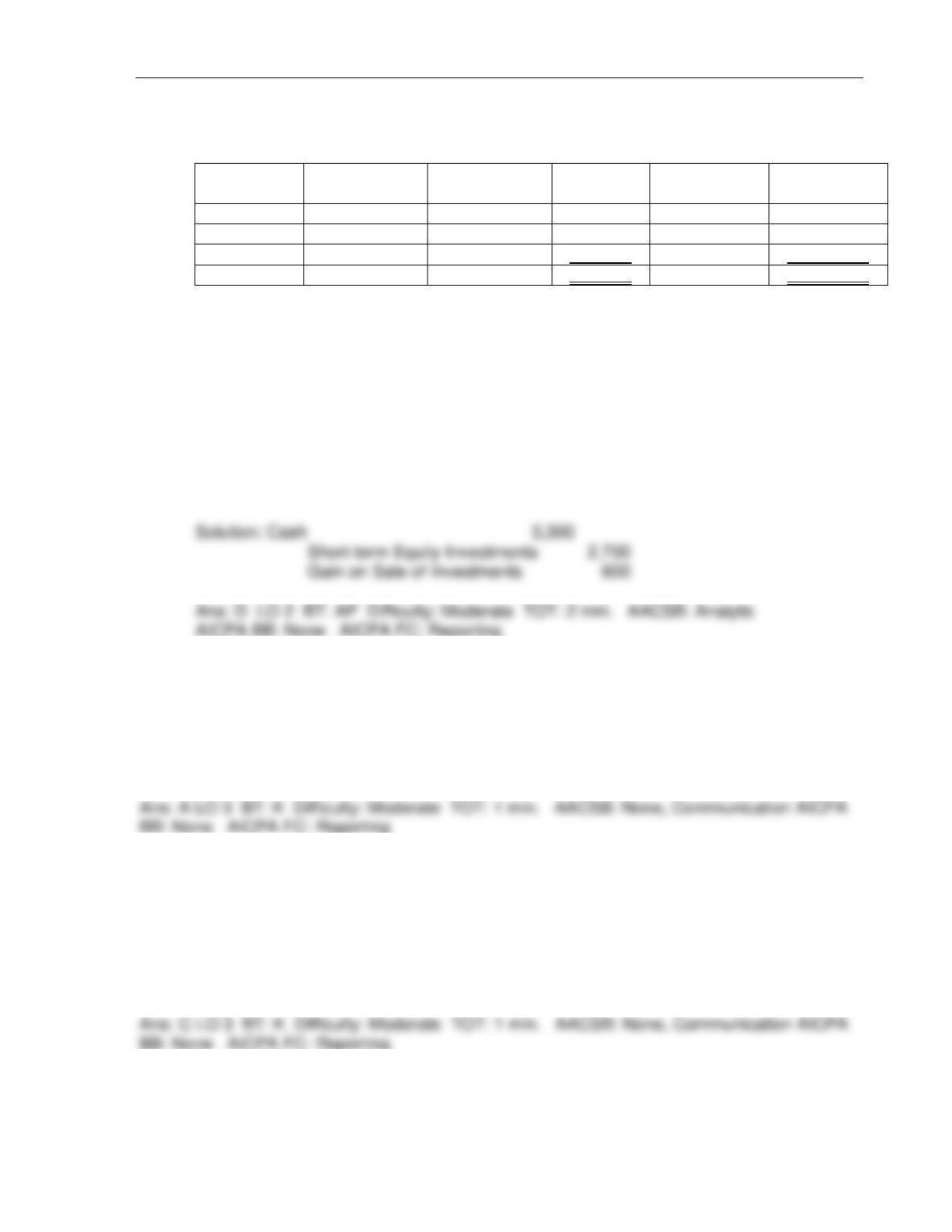
Test Bank – Chapter 8 – Investments in Equity Securities 8-3
10. During 2017, the market price of a short-trmpassive investment in equity securities
declined. Which one of the following correctly reflects the effects on the financial
statements as a result?
a. Current ratio and earnings per share decrease.
b. Current ratio and earnings per share increase.
c. Current ratio is unchanged and earnings per share increases.
d. Current ratio increases and earnings per share are unchanged.
11. Passive investments in equity securities
a. are reported on the balance sheet at original cost.
b. may have unrealized price increases or decreases, which affect shareholders’ equity
but not the income statement.
c. are reported in the shareholders’ equity section of the balance sheet at fair value.
d. may have unrealized gains or losses on the income statement associated with price
increases or decreases.
12. When a company recognizes unrealized losses on short-term passive investments in
equity securities, its earnings per share:
a. decreases.
b. increases.
c. is not affected.
d. may increase or decrease depending on the related market value.
13. Torborg Corp. purchased short-term passive investments in equity securities on
December 23 for $3,000. On December 31, the market value of those securities is
$3,600. Which one of the following journal entries is appropriate on December 31?
a.
Short-term Equity Investments
3,600
Unrealized Gain
3,600
b.
Short-term Equity Investments
600
Unrealized Gain
600
c.
Short-term Equity Investments
600
Unrealized Price Increase
600
d.
No entry is required.
8-4 Test Bank – Chapter 8 – Investments in Equity Securities
14. Equity securities of Sanchez Inc. were purchased as a short-term passive investment by
Hayden Company on December 14 for $1,000. On December 31, the market value of
those securities is $1,300. Which one of the following adjusting journal entries is
appropriate at December 31?
a.
Short-term Equity Investments
1,300
Unrealized Gain
300
Cash
1,000
b.
Short-term Equity Investments
300
Unrealized Gain
300
c.
Short-term Equity Investments
300
Securities Revenue
300
d.
No entry is required.
15. On November 10, 2017, Clark Inc. purchased, as a short-term passive investment,
shares of Landon Corp. for $100,000 and shares of Norris Incorporated for $50,000. At
the end of 2017, the fair market value of the stock of Landon was $80,000 and for Norris
Incorporated was $65,000. How should Clark Inc. recognize these changes in market
price?
a. As a net unrealized loss of $20,000.
b. As a net unrealized gain of $15,000.
c. As a net unrealized loss of $5,000.
d. No adjustment required since the total fair value is higher than the total original cost.
16. Which one of the following is true of the equity method?
a. The income recognized by the investor is based on the percentage of stock
ownership and the amount of earnings reported by the investee.
b. Market value adjustments are made at yearend.
c. The receipt of dividends increases net income on the investor’s financial statements.
d. The percent of ownership must be greater than 50% to apply this method.

Test Bank – Chapter 8 – Investments in Equity Securities 8-5
17. The recognition of unrealized gains on passive equity investments
a. increases the current ratio.
b. decreases the current ratio.
c. does not affect the current ratio.
d. increases the current ratio if the investment is classified as current, otherwise it has
no effect.
18. An investor owns passive equity investments in Noah Company. Noah Company
declared dividends of $300 during July. What entry is required in August when the
dividends are received?
a.
Cash
300
Dividends Receivable
300
b.
Dividends Receivable
300
Short-term Equity Investments
300
c.
Dividends Receivable
300
Dividend Revenue
300
d.
Cash
300
Trading Securities
300
19. Which one of the following journal entries is appropriate for an investor who owns, as a
passive investment, equity securities when dividends of $500 have been declared on
those equity securities?
a.
Cash
500
Dividends Receivable
500
b.
Dividends Receivable
500
Short-term Equity Investments
500
c.
Cash
500
Short-term Equity Investments
500
d.
Dividends Receivable
500
Dividend Revenue
500
20. Which one of the following correctly reflects the effects on the financial statements
caused by the increase in the market price of long-term passive equity investments?
a. Current ratio is unchanged and earnings per share increases.
b. Current ratio and earnings per share increase.
c. Current ratio and earnings per share are unchanged.
d. Current ratio is unchanged and earnings per share decreases.

8-6 Test Bank – Chapter 8 – Investments in Equity Securities
21. A passive investment in equity securities was purchased on April 1 for $900. On
December 31, the market value of those securities is $700. Which of the following is part
of the adjusting entry necessary on December 31?
a. Debit Unrealized Loss for $700
b. Debit Realized Loss on for $200
c. Credit Short-term Equity Investments for $200
d. Credit Unrealized Loss for $200
22. A small long-term investment in equity securities was purchased on May 2 for $1,000.
On December 31, the market value of those securities is $1,100. Which of the following
is part of the adjusting entry necessary on December 31?
a. Debit Unrealized Gain for $1,100
b. Debit Realized Gain for $100
c. Credit Short-term Equity Investments for $100
d. Credit Unrealized Gain for $100
23. The recognition of unrealized losses on a current investment:
a. decreases the quick and current ratios.
b. increases the quick and current ratios.
c. does not affect the quick ratio, but decreases the current ratio.
d. does not affect the current ratio, but decreases the quick ratio.
24. Which of the following correctly reflects the effects on the financial statements caused by
the increase in market price of a current investment in equity securities?
a. Current ratio and earnings per share decrease.
b. Current ratio and earnings per share increase.
c. Current ratio is unchanged but earnings per share decrease.
d. Current ratio decreases and earnings per share are unchanged.
25. The recognition of realized losses on short-term equity securities
a. increases the current ratio.
b. decreases working capital.
c. decreases comprehensive income.
d. decreases the debt/equity ratio.

Test Bank – Chapter 8 – Investments in Equity Securities 8-7
26. Which one of the following is an area of subjectivity which opens the incentive of window
dressing to management as it relates to investments?
a. The timing of when an investment is sold.
b. The proclamation of the intention to sell an investment within the next year.
c. The determination of the percentage of stock acquired.
d. Whether management has available cash to acquire investments.
27. The mark-to–market method of accounting for long-term equity investments is typically
used when:
a. between 20% and 50% of the investee company is owned.
b. over 50% of the investee company is owned.
c. at least 20% of the investee company is owned.
d. less than 20% of the investee company is owned.
28. Which one of the following correctly reflects the effects on the financial statements
caused by dividends declared on passive investments owned by a firm?
a. Current ratio decreases.
b. Earnings per share increases.
c. Current ratio is unchanged.
d. Earnings per share is unchanged.
29. The equity method of accounting for long-term equity investments is typically used when:
a. less than 20% of the investee company is owned.
b. between 20% and 50% of the investee company is owned.
c. over 50% of the investee company is owned.
d. any amount over 20% is acquired.
30. The consolidation procedure of accounting for long-term equity investments is typically
used:
a. when less than 20% of the investee company is owned.
b. in situations when over 50% of the investee company is owned.
c. only when 100% of the investee company is owned.
d. when between 20% and 50% of the investee company is owned.

8-8 Test Bank – Chapter 8 – Investments in Equity Securities
31. Walsh Company purchased, as a passive investment, 1,000 shares of Pierce Company
for $20 per share. At the end of the year, the fair market value of the investment was $23
per share. How should Walsh recognize this change?
a. Debit the investment account by $23,000.
b. Credit the investment account by $3,000.
c. Report an unrealized gain on the income statement.
d. Show an unrealized loss on the balance sheet.
32. Which one of the following correctly reflects the effects on the financial statements
caused by a decrease in the market price of a 30% interest long-term equity security
investment?
a. Current ratio decreases.
b. Earnings per share increases.
c. Current ratio increases.
d. Earnings per share remains unaffected
33. The treatment of unrealized gains on equity securities:
a. depends on the ownership percentage in the investee.
b. causes net income to increase regardless of the situation.
c. causes earnings per share to increase regardless of the situation.
d. is a primary concern under the equity method.
34. Which one of the following must be met prior to classifying an investment as current?
a. It must be an equity security accounted for under the equity method.
b. The percentage of ownership must be greater than 50%.
c. The investment must be readily marketable.
d. Management must intend to hold the investment for an undetermined time period.
35. Equity securities intended to be held for a short time period are held primarily for the
purpose of:
a. anticipated increases in value over extended time periods.
b. increasing the current ratio.
c. window dressing the balance sheet.
d. generating profits on short-term price increases.

Test Bank – Chapter 8 – Investments in Equity Securities 8-9
36. Which one of the following correctly reflects the effects on the financial statements of the
investor caused by dividends declared on securities held as a passive investment?
a. Current ratio increases
b. Working capital decreases
c. Revenue and assets decrease
d. Assets increase and shareholders’ equity decreases
37. Camber Corp. owns 10% of Nova Corp’s outstanding voting stock. Camber should
account for its long-term equity investment in Nova Corp. using:
a. the equity method.
b. consolidated financial statements.
c. mark-to-market method.
d. amortization method.
38. Which one of the following is evidence of a ready market?
a. The stock was purchased at a negotiated price from an outside party.
b. The security is actively traded on a public stock exchange.
c. A privately held corporation issued the stock.
d. The stock was purchased from an outside investor.
39. An unrealized gain or loss that relates to a passive investment represents:
a. an undervalued investment.
b. the profit or loss made when the trading securities were sold.
c. the total dividends received from the investee company during the year.
d. the extent to which an investor’s wealth increased or decreased due to holding the
investment.
40. A controlling interest in another company:
a. exists whenever the relationship between the investor and investee gives the
investor significant influence.
b. requires the parent to prepare consolidated financial statements.
c. is evidence that a merger will soon occur.
d. can be as low as 20 percent.

8-10 Test Bank – Chapter 8 – Investments in Equity Securities
41. Why might chief executives react very positively to current goodwill accounting?
a. Goodwill increases in value.
b. Goodwill is amortized creating expenses that reduce net income, enabling a
company to pay less income tax.
c. Its amortization increases earnings per share.
d. Goodwill is no longer amortized so income is greater than prior accounting
requirements.
42. James Corporation purchased 100% of the common stock of Rashaad Corporation for
$50 million. James must account for this investment as:
a. a passive investment.
b. an acquisition that requires consolidation accounting.
c. a “mark–to–market” investment.
d. an equity method investment with no consolidation.
43. Decuzzi, Inc. paid $10,000 for a passive stock investment. On December 31, 2017, the
company appropriately recognized an unrealized gain of $3,000. The stock is reported
on Decuzzi’s balance sheet at December 31, 2017 at:
a. $10,000.
b. $13,000.
c. $7,000.
d. Not enough information to determine.
44. Multinational US companies usually have a number of foreign subsidiaries with financial
statements expressed in foreign currency. When the consolidated financial statements
are prepared, to combine the financial statements of the US parent and all of its
subsidiaries, the consolidation process involves multiple steps. Which of the following
statements about the combining process and the resultant consolidated financial
statements is always true for multinational US companies?
a. The foreign subsidiaries are separated into three categories, each of which receives
different treatment.
b. The foreign entity’s financial statements are converted into dollars.
c. Foreign currency translation adjustments have no effect on cash flows.
d. The foreign currency translation adjustments are included in consolidated income.
Test Bank – Chapter 8 – Investments in Equity Securities 8-11
45. Which of the following statements about Special Purpose Entities (SPEs) is not true?
a. SPEs cannot take on various legal forms.
b. It can be difficult to determine who actually controls an SPE.
c. Management can structure a transaction using an SPE in such a manner that the
accounting treatment fails to reflect the economic substance of the transaction.
d. SPEs have been used to mislead investors.
46. Carmen Corporation purchased a 40% interest in Sahara Inc. on January 1, 2017,
paying $200,000 for 40% of the outstanding voting stock of Sahara Inc. For its year
ended December 31, 2017, Sahara Inc. reported net income of $40,000. On December
31, 2017, Carmen received a dividend payment from Sahara in the amount of $1,000.
As a result of its ownership interest in Sahara, the financial statements for Carmen
Corporation for the year ended December 31, 2017 will reflect which of the following:
a. An asset in the amount of $200,000.
b. Revenue of $1,000.
c. Cash flows from operations of $1,000.
d. Revenue of $16,000.
47. Before adjusting its current investments in equity securities, Caldwell Company has total
current assets and current liabilities of $45,000 and $15,000, respectively. During the
current year, Caldwell has net income of $243,750 with 75,000 shares of common stock
outstanding. This amount excludes the effects of yearend adjustments related to the
investments. Included in current assets are equity securities recorded at their original
cost of $13,000. However, the current market value of those securities is $4,000 at
yearend. If Caldwell properly accounts for equity securities, what is Caldwell’s current
ratio before and after the investment adjustment?
a. 3.0 and 2.1
b. 3.0 and 3.3
c. 3.0 and 3.6
d. 3.0 and 2.4
8-12 Test Bank – Chapter 8 – Investments in Equity Securities
48. Before adjusting its current investments in equity securities, Caldwell Company has total
current assets and current liabilities of $45,000 and $15,000, respectively. During the
current year, Caldwell has net income of $243,750 with 75,000 shares of common stock
outstanding. This amount excludes the effects of yearend adjustments related to the
investments. Included in current assets are equity securities recorded at their original
cost of $13,000. However, the current market value of those securities is $4,000 at
yearend. If Caldwell properly accounts for equity securities, what is Caldwell’s earnings
per share amount before and after the investment adjustment, respectively?
a. $3.25 and $3.00
b. $3.25 and $3.13
c. $3.25 and $3.37
d. $3.25 and $2.77
Solution:
49. On January 2, 2017, Pfizer Co. purchased 22% of Wiley Company’s voting stock for
$150,000. During 2017, Wiley recorded income of $102,000 and paid total dividends of
$27,000. Pfizer uses the equity method to account for this investment. What is Pfizer’s
income from the Wiley investment?
a. $27,000
b. $28,380
c. $22,440
d. $33,000
Solution:
50. On January 2, 2017, Pfizer Co. purchased 22% of Wiley Company’s voting stock for
$150,000. During 2017, Wiley recorded income of $102,000 and paid total dividends of
$27,000. Pfizer uses the equity method to account for this investment. What is the
December 31, 2017, balance sheet value of its long-term equity investment in Wiley?
a. $178,380
b. $225,000
c. $150,000
d. $166,500
Solution:
Test Bank – Chapter 8 – Investments in Equity Securities 8-13
51. If Howard Company’s balance sheet amount of goodwill is $20,000 and the fair market
value of the goodwill is estimated to be $25,000, which of the following entries would be
recorded in Howard’s books?
a. Goodwill 5,000
Goodwill Gain 5,000
b. Goodwill Gain 5,000
Goodwill 5,000
c. Impairment Loss 5,000
Goodwill 5,000
d. No entry will be made.
52. On December 31, 2017, short-term equity securities with an original cost of $15,000
have a carrying value on the balance sheet equal to their market value of $20,000. On
January 5, 2018, those securities are sold for $18,000. Which of the following would be
part of the appropriate entry to record the sale of the securities?
a. A debit to Loss on Sale of Investments for $2,000.
b. A debit to Unrealized Gain for $3,000.
c. A debit to Unrealized Gain for $5,000.
d. A credit to Short-term Equity Investments for $15,000.
Solution:
53. On January 2, 2017, Dellgate Corp. purchased 27% of Galaxy Corporation’s voting stock
for $125,000. During 2017, Galaxy recorded income of $214,000 and paid total
dividends of $17,000. What is the December 31, 2017, balance sheet value of Dellgate’s
long-term equity investment in Galaxy?
a. $125,000
b. $178,190
c. $187,370
d. $86,940
Solution:
8-14 Test Bank – Chapter 8 – Investments in Equity Securities
54. The following information is related to the short-term passive investments of Solo
Company. Securities held on December 31, 2016, are described in the table below.
Securities
No. of
Shares
Cost/Share
Total
Cost
Value/Share
Total Market
Value
AAA
100
$29
$2,900
$34
$3,400
BBB
250
30
7,500
28
7,000
CCC
150
16
2,400
20
3,000
$12,800
$13,400
Early in 2017, Solo sold all of its investment in AAA securities for $36 per share.
The journal entry to record the sale in 2017 will include:
a. A debit to Short-term Equity Investments for $3,400.
b. A credit to Unrealized Loss for $200.
c. A credit to Loss on Sale of Investments for $200.
d. A credit to Gain on Sale of Investments for $200.
55. The following information is related to the short-term passive investments of Solo
Company. Securities held on December 31, 2016 are described in the table below.
Securities
No. of
Shares
Cost/Share
Total
Cost
Value/Share
Total Market
Value
AAA
100
$29
$2,900
$34
$3,400
BBB
250
30
7,500
28
7,000
CCC
150
16
2,400
20
3,000
$12,800
$13,400
Early in 2017, the company sold 50 shares of BBB for $26 per share.
The journal entry to record the sale in 2017 will include:
a. A credit to Short-term Equity Investments for $1,400.
b. A credit to Unrealized Loss for $100.
c. A credit to Loss on Sale of Investments for $100.
d. A debit to Gain on Sale of Investments for $100.
Test Bank – Chapter 8 – Investments in Equity Securities 8-15
56. The following information is related to the short-term passive investments of Solo
Company. Securities held on December 31, 2016 are described in the table below.
Securities
No. of
Shares
Cost/Share
Total
Cost
Value/Share
Total Market
Value
AAA
100
$29
$2,900
$34
$3,400
BBB
250
30
7,500
28
7,000
CCC
150
16
2,400
20
3,000
$12,800
$13,400
Early in 2017, the company sold 50 shares of BBB for $26 per share. During 2017, Solo
received dividends of $3 per share on the remaining 200 shares of BBB, and dividends
of $2.50 per share were declared, but not yet received on the 150 shares of CCC stock.
The per-share market values of BBB and CCC on December 31, 2017, were $24 and
$18, respectively. During 2018, Solo sold the remaining 200 shares of BBB stock for
$26 per share and the 150 shares of CCC for $22 per share.
The journal entries to record the dividends received on the BBB securities and the
dividends declared on the CCC stock in 2017 will include:
a. A credit to Dividend Revenue for $975.
b. A credit to Dividend Payable for $375.
c. A credit to Cash for $600.
d. A debit to Dividend Expense for $375.
8-16 Test Bank – Chapter 8 – Investments in Equity Securities
57. The following information is related to the short-term passive investments of Solo
Company. Securities held on December 31, 2016 are described in the table below.
Securities
No. of
Shares
Cost/Share
Total
Cost
Value/Share
Total Market
Value
AAA
100
$29
$2,900
$34
$3,400
BBB
250
30
7,500
28
7,000
CCC
150
16
2,400
20
3,000
$12,800
$13,400
Early in 2017, the company sold 50 shares of BBB for $26 per share. During 2017, Solo
received dividends of $3 per share on the remaining 200 shares of BBB. The per-share
market value of BBB on December 31, 2017, was $24. During 2018, Solo sold the
remaining 200 shares of BBB stock for $26 per share.
The journal entry to record the sale of 200 shares of BBB stock in 2018 is:
a. Cash 5,200
Short-term Equity Investments 4,800
Unrealized Gain 400
b. Cash 5,200
Unrealized Loss 400
Trading Securities 4,800
c. Cash 5,200
Short-term Equity Investments 4,800
Gain on Sale of Investments 400
d. Short-term Equity Investments 6,000
Gain on Sale of Investements 800
Cash 5,200
Test Bank – Chapter 8 – Investments in Equity Securities 8-17
58. The following information is related to the marketable security investments of Solo
Company. Securities held on December 31, 2016 are described in the table below.
Securities
No. of
Shares
Cost/Share
Total
Cost
Value/Share
Total Market
Value
AAA
100
$29
$2,900
$34
$3,400
BBB
250
30
7,500
28
7,000
CCC
150
16
2,400
20
3,000
$12,800
$13,400
During 2017, Solo received word that dividends of $$2.50 per share were declared, but
not yet received on the 150 shares of CCC stock. The per-share market value of CCC
on December 31, 2017, was $18. During 2018, Solo sold 150 shares of CCC for $22
per share.
The journal entry to record the sale of 150 shares of CCC stock in 2018 would include:
a. A debit to Cash for $3,000.
b. A debit to Unrealized Gain for $300.
c. A debit to Unrealized Gain for $900.
d. A credit to Gain on Sale of Investments for $600.
59. Under GAAP, market values based on quoted prices in active markets for identical
securities are called:
a. Level 1 measurements
b. Level 2 measurements
c. Level 3 measurements
d. None of the above
60. Under GAAP, market values based on less reliable, unobservable inputs for securities are
called:
a. Level 1 measurements
b. Level 2 measurements
c. Level 3 measurements
d. None of the above
8-18 Test Bank – Chapter 8 – Investments in Equity Securities
61. On January 2, 2017, NIU purchased 100% of Huskie Corp. for $128,000. The book
value of the Huskie’s assets is $120,000, and the book value of its liabilities is $60,000.
The fair market value of the net assets is $80,000. Goodwill should be reported at
a. $20,000.
b. $40,000.
c. $48,000.
d. $60,000.
62. On January 2, 2017, NIU purchased 100% of Huskie Corp. for $128,000. The book
value of the Huskie’s assets is $120,000, and the book value of its liabilities is $60,000.
The fair market value of the net assets is $80,000. Inventory is recorded in Huskie’s
financial statements at $20,000, but has a fair market value of $30,000. NIU should
report inventory at
a. $20,000.
b. $25,000.
c. $30,000.
d. cannot determine from information given.
63. On January 2, 2017, NIU purchased 80% of Huskie Corp. for $128,000. The book value
of the Huskie’s assets is $120,000, and the book value of its liabilities is $60,000. The
fair market value of the net assets is $80,000. Inventory is recorded in Huskie’s financial
statements at $20,000, but has a fair market value of $30,000. NIU should report
inventory at
a. $20,000.
b. $25,000.
c. $30,000.
d. cannot determine from information given.