College Physics: A Strategic Approach, 3e (Knight)
Chapter 8 Equilibrium ad Elasticity
8.1 Conceptual Questions
1) If the sum of the external forces on an object is zero, then the sum of the external torques on it
must also be zero.
A) True
B) False
2) If the sum of the external torques on an object is zero, then the sum of the external forces on it
must also be zero.
A) True
B) False
3) If the sum of both the external torques and the external forces on an object is zero, then the
object must be at rest.
A) True
B) False
4) If an object remains at rest, then the sum of both the external torques and the external forces
on the object must be zero.
A) True
B) False
5) When a car is weighed, it is driven slowly on a horizontal floor over a scale that records a
reading as the front wheels go over the scale, and then records a second reading as the rear
wheels go over the scale. The weight of the car is equal to
A) the weight under the front wheels.
B) the weight under the rear wheels.
C) the average of the two weights.
D) the sum of the two weights.
E) the difference of the two weights.
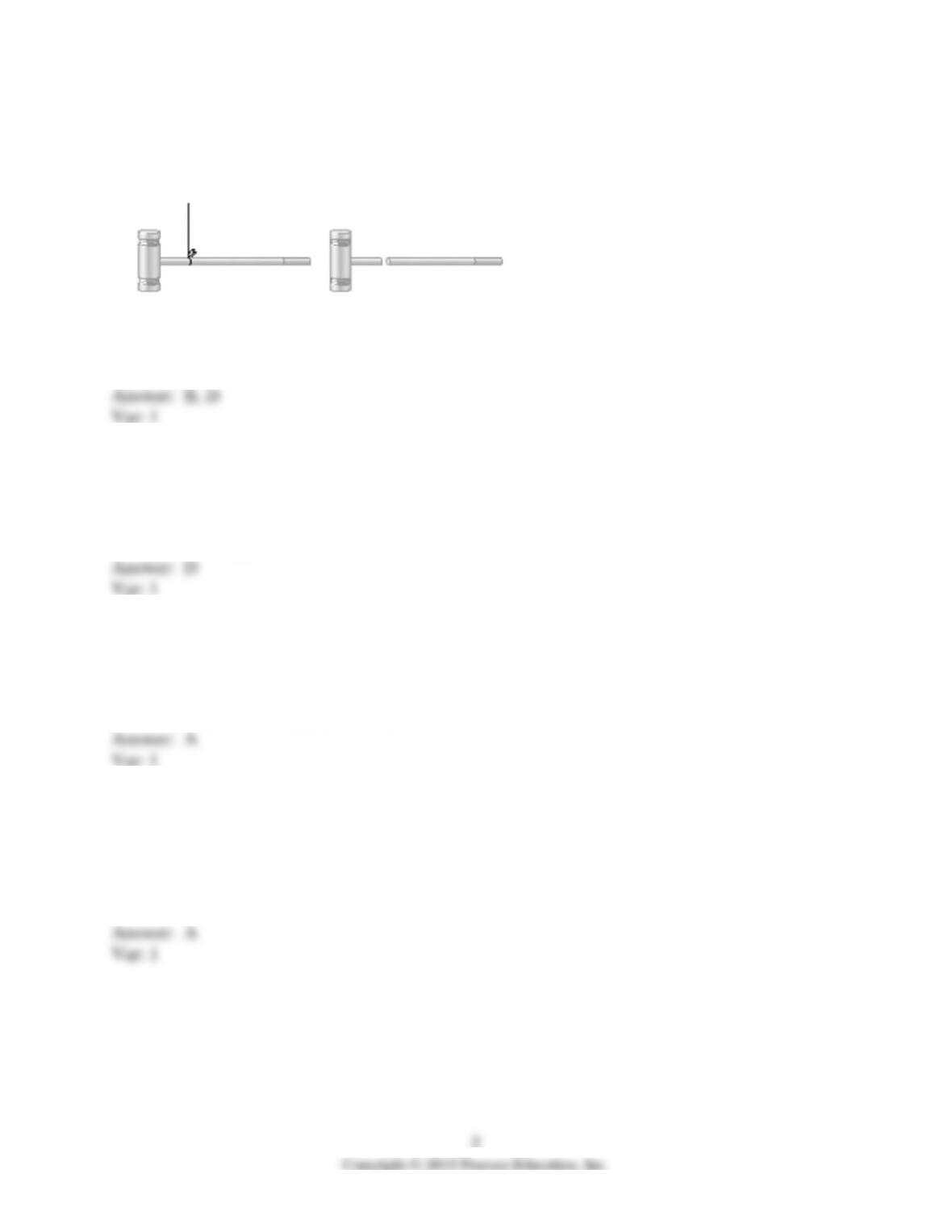
6) A croquet mallet balances when suspended from its center of mass, as shown in the left part of
the figure. If you cut the mallet into two pieces at its center of mass, as shown in the right part of
the figure, how do the masses of the two pieces compare? (There could be more than one correct
choice.)
A) The masses are equal.
B) The piece with the head of the mallet has the greater mass.
C) The piece with the head of the mallet has the smaller mass.
D) It is impossible to tell.
7) Tensile stress is
A) the strain per unit length.
B) the same as force.
C) the ratio of the change in length.
D) applied force per cross-sectional area.
8) Tensile strain is
A) the ratio of the change in length to the original length.
B) the stress per unit area.
C) the applied force per unit area.
D) the ratio of stress to elastic modulus.
9) Which one of the following is an accurate statement?
A) The ratio of tensile stress to tensile strain is called Young’s modulus.
B) “Strain” has a meaning very close to “force.”
C) “Stress” has a meaning very close to “stretch.”
D) Tensile stress is measured in newtons.
E) Tensile strain is measured in meters.
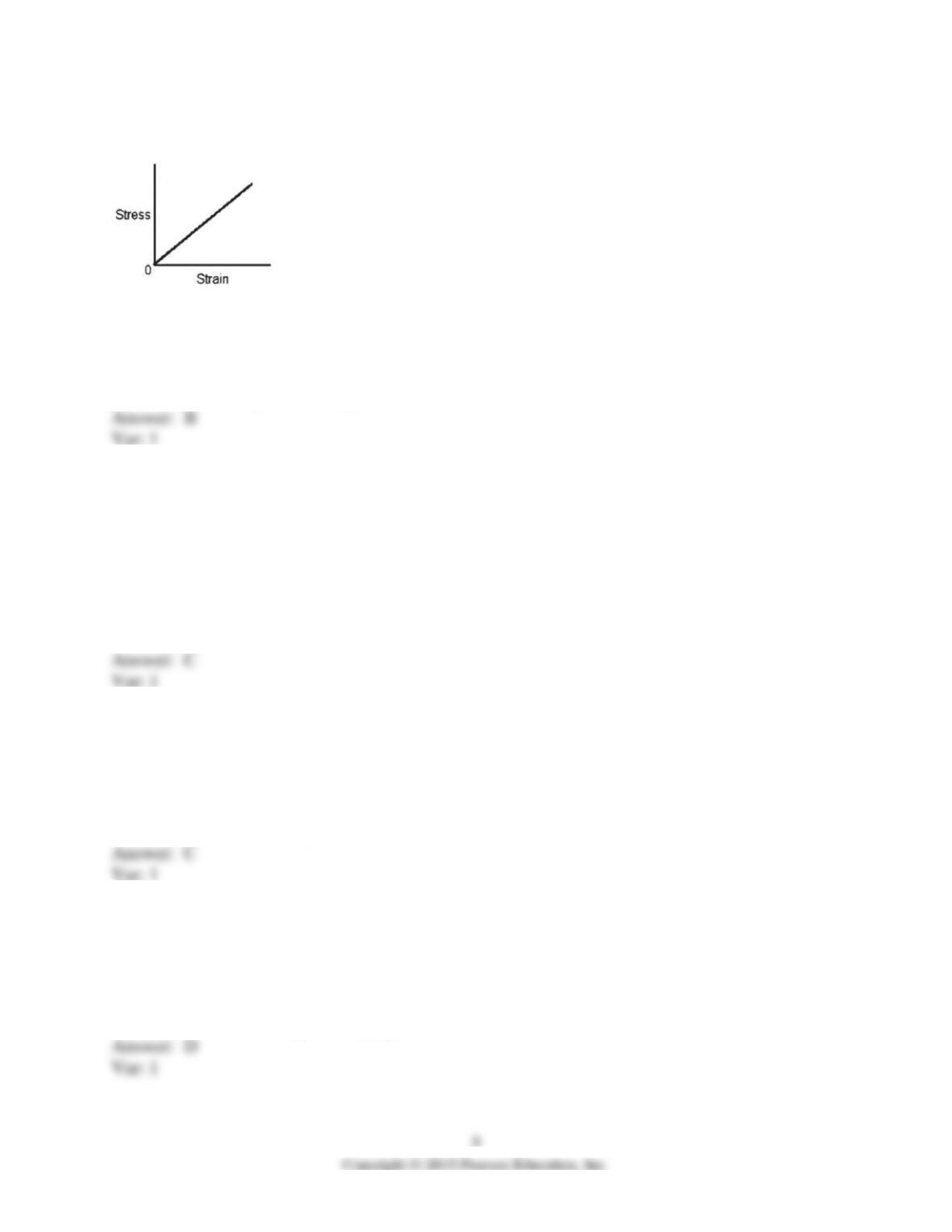
10) The graph in the figure shows the tensile stress as a function of the tensile strain in a certain
wire. What does the slope of this graph give us for this wire?
A) the pressure in the wire
B) Young’s modulus for the material of the wire
C) the tensile stress in the wire
D) the tension in the wire
E) the percent change in the length of the wire
11) A large 75-kg lighting fixture can be hung from wires of identical size and shape made of
aluminum, brass, or copper. The values of Young’s modulus for these metals are 0.70 × 10¹¹ Pa
(aluminum), 0.91 × 10¹¹ (brass), and 1.1 × 10¹¹ (copper). Which wire would stretch the least
distance?
A) aluminum
B) brass
C) copper
D) They will all stretch the same distance.
12) A 25-kg piece of equipment can be hung by steel wires of length 1.00 m, 2.00 m, or 3.00 m.
If all the wires have the same diameter, which one will stretch the greatest distance?
A) the 1.00-m wire
B) the 2.00-m wire
C) the 3.00-m wire
D) They will all stretch by the same distance.
13) A 25-kg piece of equipment can be hung by steel wires of length 1.00 m, 2.00 m, or 3.00 m.
If all the wires have the same diameter, which one will stretch the greatest percent?
A) the 1.00-m wire
B) the 2.00-m wire
C) the 3.00-m wire
D) They will all stretch by the same percent.
14) Two wires are made out of the same metal, but one wire is twice as long as the other wire.
Which wire will have the greatest elastic modulus?
A) the shorter wire
B) the longer wire
C) It will be the same for both wires.
15) Which of the following are SI units of Young’s modulus? (There could be more than one
correct choice.)
A) N/m ∙ s2
B) kg/m2
C) kg ∙ m/s2
D) kg/m ∙ s2
E) kg ∙ m2/s2
16) As one stretches a metal wire, which condition is reached first?
A) the elastic limit
B) the breaking point
C) the proportional limit
1) An ornament of mass 40.0 g is attached to a vertical ideal spring with a force constant (spring
constant) of 20.0 N/m. The ornament is then lowered very slowly until the spring stops
stretching. How much does the spring stretch?
A) 0.00200 m
B) 0.0196 m
C) 0.0816 m
D) 0.800 m
E) 0.200 m
2) A force of stretches a very light ideal spring from equilibrium. What is the force
constant (spring constant) of the spring?
A) 41 N/m
B) 22 N/m
C) 34 N/m
D) 46 N/m
3) A very light ideal spring stretches by when it is used to hang a 135-N object. What is
the weight of a piece of electronic equipment that would stretch the spring by if you hung
the equipment using the spring?
A) 289 N
B) 63 N
C) 176 N
D) 405 N
4) An object attached to a spring is pulled across a horizontal frictionless surface. If the force
constant (spring constant) of the spring is 45 N/m and the spring is stretched by 0.88 m when the
object is accelerating at what is the mass of the object?
A) 28 kg
B) 24 kg
C) 31 kg
D) 36 kg
5) A 3.0-kg brick rests on a perfectly smooth ramp inclined at 34° above the horizontal. The
brick is kept from sliding down the plane by an ideal spring that is aligned with the surface and
attached to a wall above the brick. The spring has a spring constant (force constant) of 120 N/m.
By how much does the spring stretch with the brick attached?
A) 360 cm
B) 240 cm
C) 14 cm
D) 24 cm
E) 36 cm
6) A very light ideal spring having a spring constant (force constant) of 8.2 N/cm is used to lift a
2.2-kg tool with an upward acceleration of 3.25 m/s2. If the spring has negligible length when it
us not stretched, how long is it while it is pulling the tool upward?
7) A very light ideal spring with a spring constant (force constant) of 2.5 N/cm pulls horizontally
on an 18-kg box that is resting on a horizontal floor. The coefficient of static friction between the
box and the floor is 0.65, and the coefficient of kinetic friction is 0.45.
(a) How long is the spring just as the box is ready to move?
(b) If the spring pulls the box along with a constant forward velocity of 1.75 m/s, how long is the
spring?
(c) How long is the spring if it pulls the box forward at a constant 2.75 m/s?
8) A very light ideal spring of spring constant (force constant) 2.5 N/cm is 15 cm long when
nothing is attached to it. It is now used to pull horizontally on a 12.5-kg box on a perfectly
smooth horizontal floor. You observe that the box starts from rest and moves 96 cm during the
first 1.6 s of its motion with constant acceleration. How long is the spring during this motion?
9) A 15-kg child is sitting on a playground teeter-totter, 1.5 m from the pivot. What is the
magnitude of the minimum force, applied 0.30 m on the other side of the pivot, that is needed to
make the child lift off the ground?
A) 75 N
B) 740 N
C) 23 N
D) 44 N
E) 66 N
10) A 15-kg child is sitting on a playground teeter-totter, 1.5 m from the pivot. What is the
minimum distance, on the other side of the pivot, such that a 220-N force will make the child lift
off the ground?
A) 1.0 m
B) 1.5 m
C) 0.10 m
D) 9.8 m
E) 2.4 m
11) An 82-kg painter stands on a long horizontal board 1.55 m from one end. This 27-kg board is
uniform, 5.5 m long, and supported at each end by vertical posts.
(a) What is the magnitude of the total force provided by both posts?
(b) With what force does the post that is closest to the painter push upward on the board?
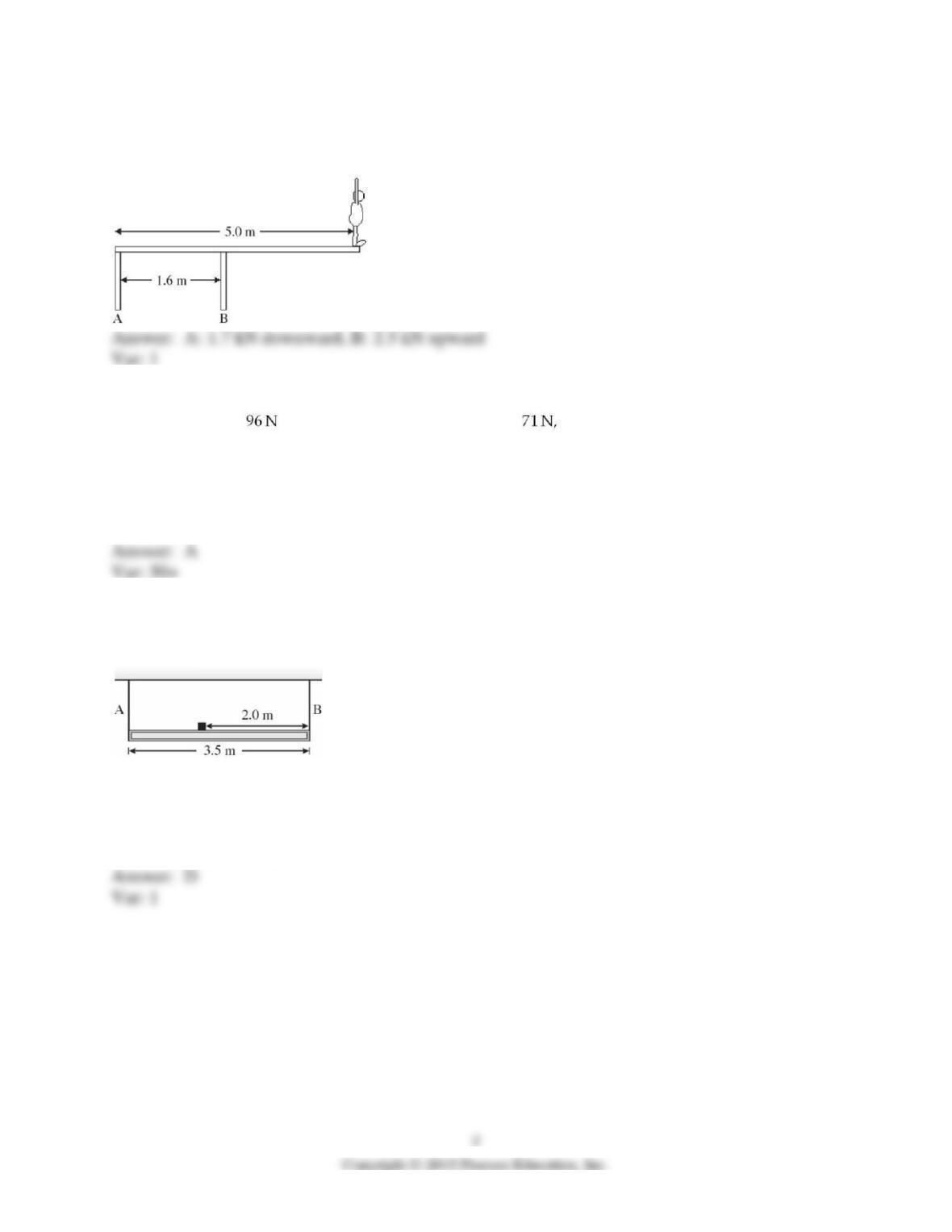
12) An 82-kg diver stands at the edge of a light 5.0-m diving board, which is supported by two
vertical pillars that are 1.6 m apart, as shown in the figure. Find the magnitude and direction of
the force exerted by each pillar.
13) An irregularly shaped object that is 10 m long is placed with each end on a scale. If the scale
on the right reads while the scale on the left reads how far from the left end is the
center of gravity of this object?
A) 5.7 m
B) 7.4 m
C) 4.3 m
D) 14 m
14) A uniform 1200-N piece of medical apparatus that is 3.5 m long is suspended horizontally by
two vertical wires at its ends. A small but dense 550-N weight is placed on the apparatus 2.0 m
from one end, as shown in the figure. What are the tensions, A and B, in the two wires?
A) A = 880 N, B = 880 N
B) A = 840 N, B = 910 N
C) A = 9000 N, B = 8200 N
D) A = 910 N, B = 840 N
E) A = 8200 N, B = 9000 N
15) A meter stick balances at the 50.0-cm mark. If a mass of 50.0 g is placed at the 90.0-cm
mark, the stick balances at the 61.3-cm mark. What is the mass of the meter stick?
A) 127 g
B) 178 g
C) 89.7 g
D) 32.6 g
E) 73.4 g
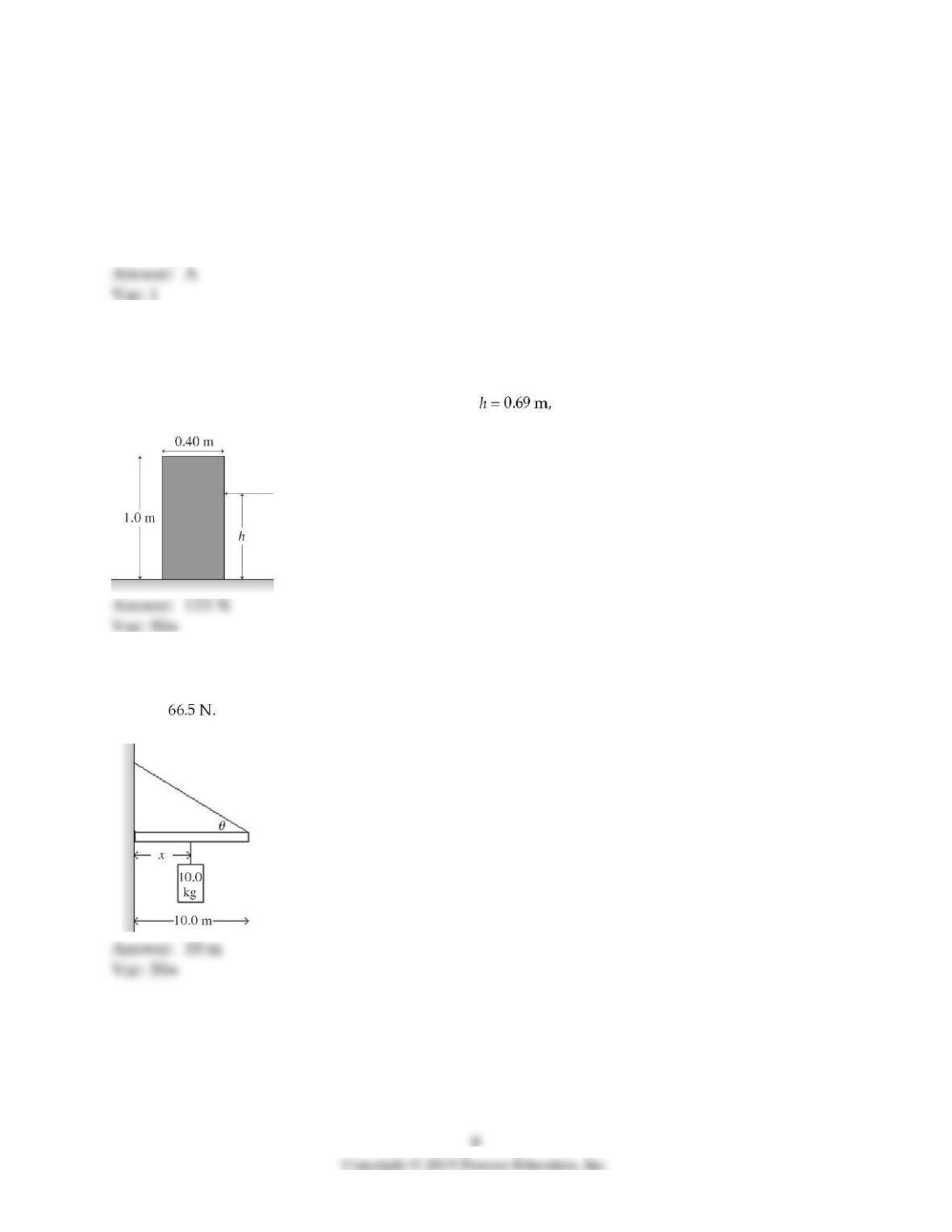
16) As shown in the figure, a uniform rectangular crate 0.40 m wide and 1.0 m tall sits on a
horizontal surface. The crate weighs 460 N, and its center of gravity is at its geometric center. A
horizontal force of magnitude F is applied at a distance h above the floor. Friction at the floor is
great enough to prevent the crate from sliding. If what minimum value of F is required
to make the crate start to tip over?
17) As shown in the figure, a 10.0 m long bar is attached by a frictionless hinge to a wall and
held horizontal by a light rope that makes an angle θ = 49° with the bar. The bar is uniform and
weighs What distance x from the hinge should a 10.0 kg mass be suspended for the
tension in the rope to be 177 N?
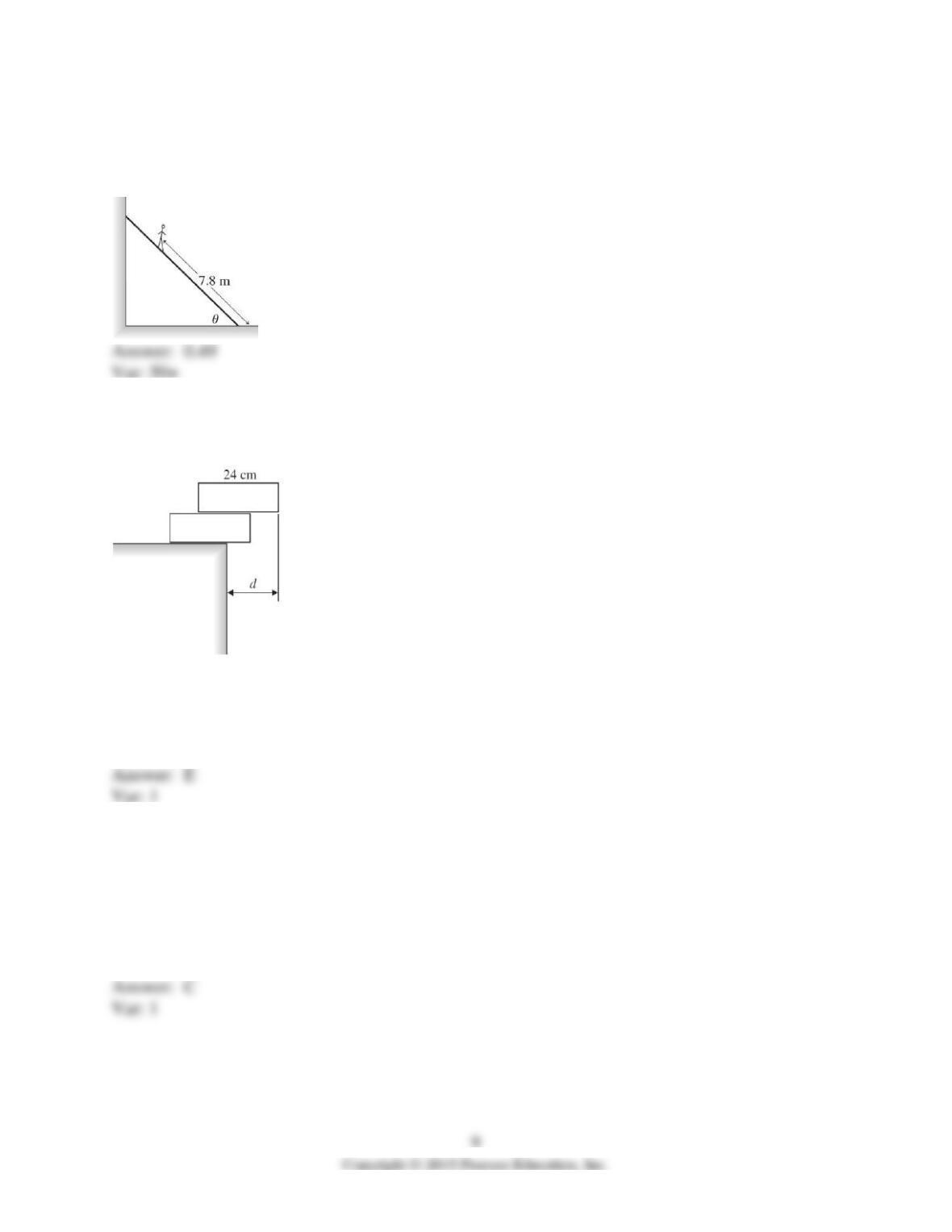
18) A uniform ladder 12 meters long rests against a vertical frictionless wall, as shown in the
figure. The ladder weighs 400 N and makes an angle θ = 51° with the floor. A man weighing
874 N climbs slowly up the ladder. When he is 78 m from the bottom of the ladder, it just starts
to slip. What is the coefficient of static friction between the floor and the ladder?
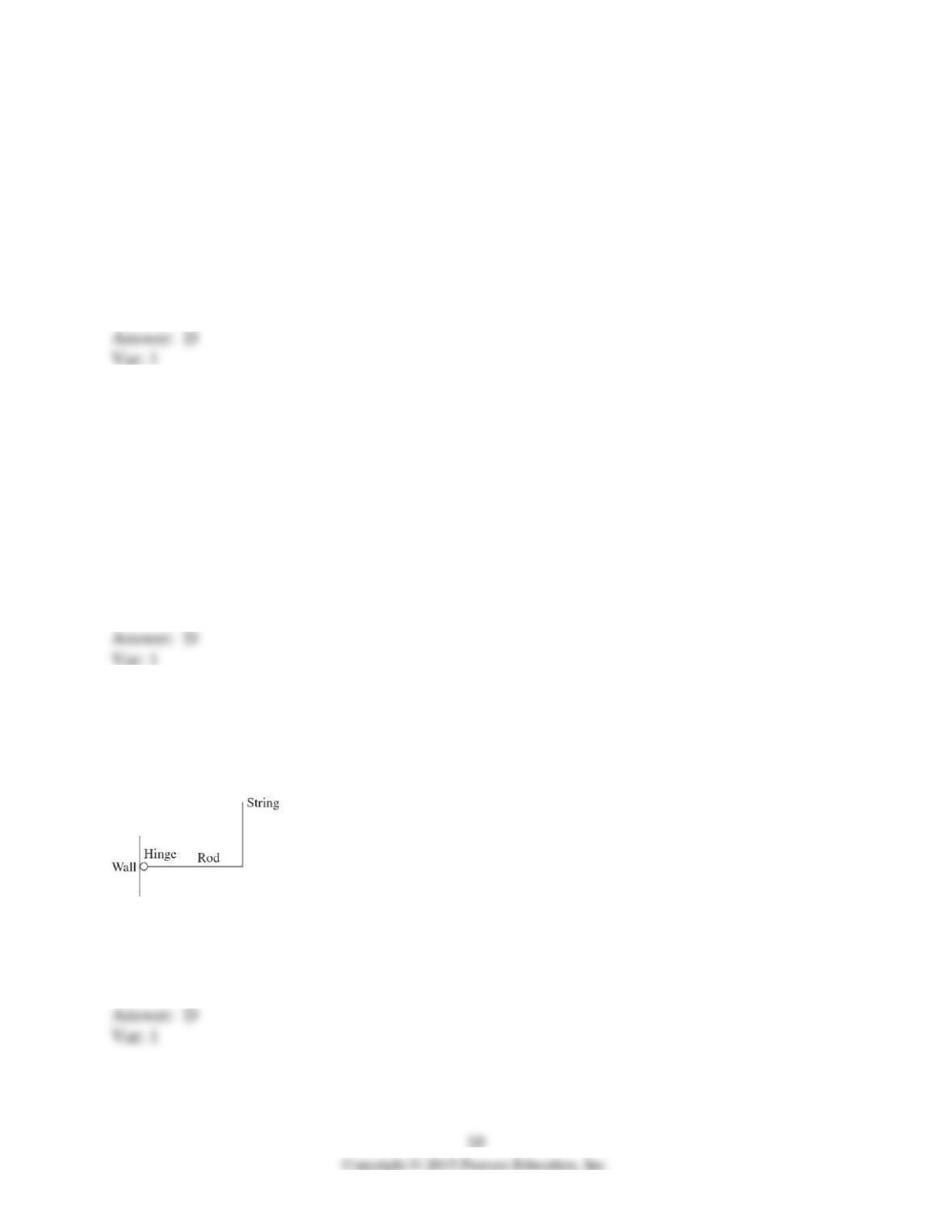
19) A child is trying to stack two uniform bricks, each 24 cm long, so they will protrude as far as
possible over the edge of a table without tipping over, as shown in the figure. What is the
maximum possible overhang distance d?
A) 10 cm
B) 12 cm
C) 14 cm
D) 16 cm
E) 18 cm
20) A uniform 40-N board supports two children weighing 500 N and 350 N. If the support is at
the center of the board and the 500-N child is 1.5 m from its center, how far is the 350-N child
from the center?
A) 1.1 m
B) 1.5 m
C) 2.1 m
D) 2.7 m
21) To determine the location of the center of mass (or center of gravity) of a car, the car is
driven over a scale on a horizontal floor. When the front wheels are over the scale, the weight
recorded by the scale is 5800 N, and when the rear wheels are over the scale, the scale reads
6500 N. The distance between the front and rear wheels is measured to be 3.20 m. How far
behind the front wheels is the center of mass located?
A) 0.845 m
B) 1.50 m
C) 1.59 m
D) 1.69 m
E) 1.72 m
22) A 120-kg refrigerator that is 2.0 m tall and 85 cm wide has its center of mass at its
geometrical center. You are attempting to slide it along the floor by pushing horizontally on the
side of the refrigerator. The coefficient of static friction between the floor and the refrigerator is
0.30. Depending on where you push, the refrigerator may start to tip over before it starts to slide
along the floor. What is the highest distance above the floor that you can push the refrigerator so
that it will not tip before it begins to slide?
A) 0.71 m
B) 1.0 m
C) 1.2 m
D) 1.4 m
E) 1.6 m
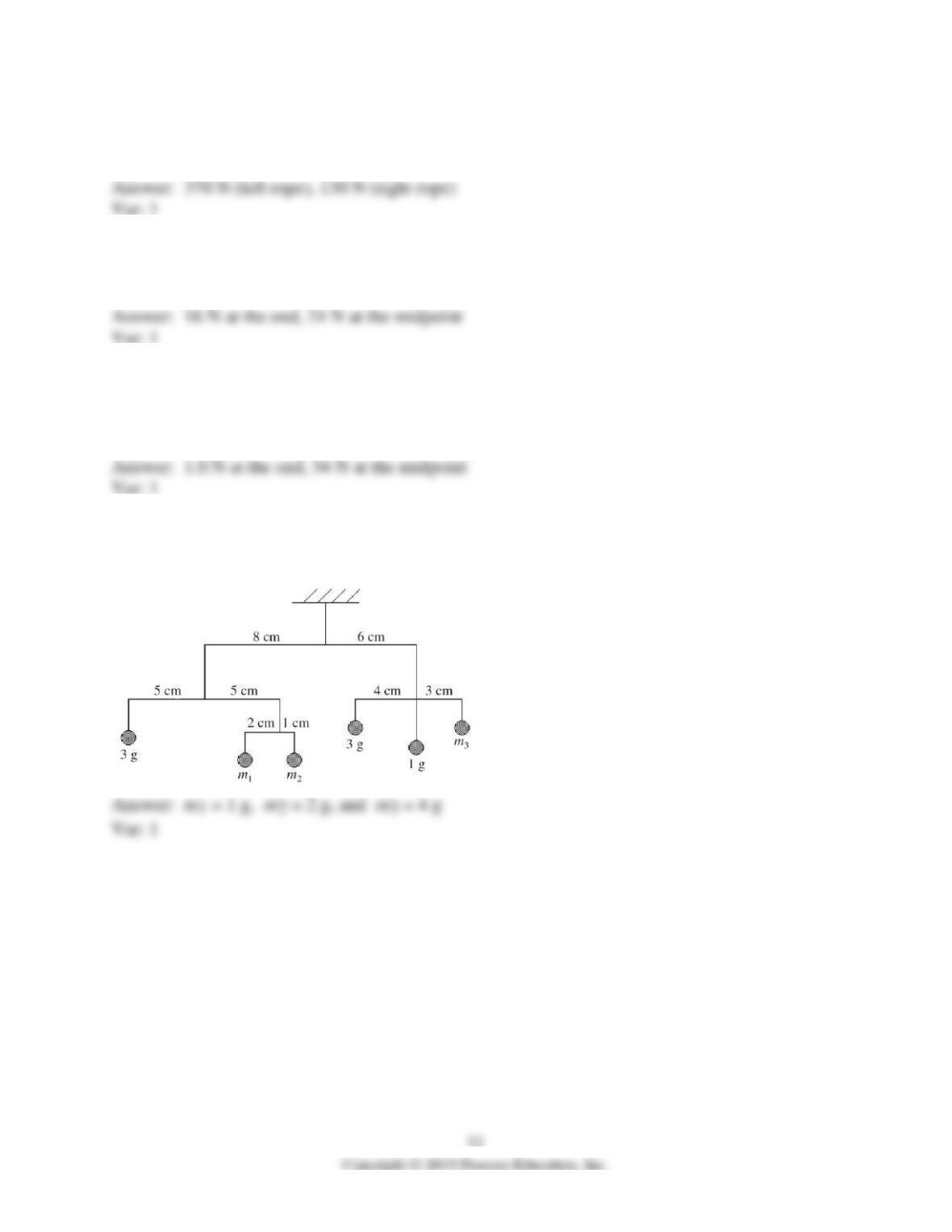
23) A uniform rod weighs 40 N and is 1.0 m long. It is hinged to a wall at the left end, and held
in a horizontal position at the right end by a vertical string of negligible weight, as shown in the
figure. What is the magnitude of the torque due to the string about a horizontal axis that passes
through the hinge and is perpendicular to the rod? The hinge is very small with negligible
friction.
A) 40 N ∙ m
B) 10 N ∙ m
C) 5.0 N ∙ m
D) 20 N ∙ m
E) 30 N ∙ m
24) A 10-m uniform beam weighing 100 N is supported by two vertical ropes at its ends. If a
400-N person sits at a point 2.0 m from the left end of the beam, what is the tension in each
rope?
25) A light board that is 10 m long is supported by two sawhorses, one at one end of the board
and a second at the midpoint. A 40-N weight is placed between the two sawhorses, 3.0 m from
the end and 2.0 m from the center. What magnitude forces do the sawhorses exert on the board?
26) A light board that is 10 m long is supported by two sawhorses, one at one end of the board
and a second at the midpoint. A 40-N object is placed between the two sawhorses, 3.0 m from
the end and 2.0 m from the center. A second object, with a weight of 15 N, is placed on the
supported end. What magnitude forces do the sawhorses exert on the board?
27) The mobile shown in the figure is perfectly balanced, and the horizontal supports have
insignificant masses. What must be the masses of the suspended objects m1, m2, and m3 to
maintain balance?