CHAPTER 8
Providing Formative Feedback
ITEMS
1. It is possible for feedback to have no effect on student learning.
(a) True
(b) False
2. What aspect of the content of feedback is important for helping students improve?
(a) Praise for good quality work
(b) Reinforcement for trying hard
(c) Information about students’ understanding
3. Which of the following is NOT a potential source of feedback for students?
(a) Teacher
(b) Self
(c) Books
(d) Technology
(e) All of the above are potential sources of feedback.
4. Which of the following comments is an example of descriptive feedback?
(a) Good job! Awesome.
(b) B+ May be revised for additional credit.
(c) Nice use of the cloud images!
(d) None of the above.
5. Which of the following comments is an example of self-referenced feedback?
(a) Check with Patrice. You may get some good ideas from her report.
(b) This is the best report you have done yet. Can you tell me how you did that?
(c) Your report is complete, and it includes some excellent data tables.
(d) None of the above.
6. For most formative assessments, the best feedback includes
(a) a prediction of the grade the student’s work would get.
(b) a description of the work and suggestions for improvement.
(c) an evaluation of the work and the amount of effort shown.
7. Which of the following comments is an example of cognitive feedback?
(a) You missed a lot of the problems about subtracting mixed numbers.
(b) Nicely done! This is tremendous work.
(c) You got a B. I’m sure you’ll get an A next time.
8. Why is evaluative feedback less useful than descriptive feedback?
(a) Evaluative feedback makes students feel bad.
(b) Evaluative feedback contains less information for improvement than descriptive
feedback.
(c) Evaluative feedback contains less information about the grade than descriptive feedback.
9. Which of the following levels or kinds of comments do NOT make for effective feedback?
(a) Comments about the task or work product
(b) Comments about the process of doing the work
(c) Comments about the student’s self-regulation
(d) Comments about the student as a person
10. Immediate feedback works best for learning all different kinds of knowledge and skills.
(a) True
(b) False
11. Which of the following approaches is at the right level of specificity for a student who has a few
errors in comma usage on a one-page composition?
(a) “Watch commas!”
(b) Mark each place where a comma is needed and ask the student to write a “good copy” of
the paper.
(c) “See if you can find and fix three comma faults in this paper.”
12. A student is having trouble using your feedback to revise work. You are sure the feedback is
clearly written. What should you do?
(a) Help the student clarify the learning target.
(b) Give the student more time to work on the revisions.
(c) Encourage the student to try harder.
13. Mr. Smith is giving back first drafts of a writing assignment, with feedback, to his students at the
beginning of class. How should he ask them to use the feedback?
(a) He should ask students to look at their feedback and make revisions as part of the same
lesson.
(b) He should ask students to look at their feedback and make revisions for homework.
(c) He should ask students to use what they learn from their feedback in their next writing
assignment.
14. Feedback is maximally effective in a classroom environment where mistakes are viewed as
opportunities to learn.
(a) True
(b) False
15. A middle school science class constructed terrariums, and students are writing reports on their
observations of their terrariums. Which of these scenarios uses timing most effectively?
(a) Students get feedback on final, graded reports.
(b) Students get feedback on a first draft of their final reports.
(c) Students get feedback on their observational notes.
16. What is a common problem teachers face when giving feedback to struggling students?
(a) Teachers hardly know where to begin writing feedback.
(b) Feedback looks like a long list of things to “fix.”
(c) The students are not bright enough to use the feedback.
17. For what type of student is reminder feedback usually most appropriate?
(a) Struggling students
(b) Regular students
(c) Successful students
18. How should you approach giving English Language Learners feedback?
(a) Give students feedback on the subject matter content of their work only.
(b) Give students feedback about their use of the English language.
(c) Both (a) and (b)
19. A student in your class has turned in very poor work that shows she does not understand the
learning target and shows no evidence of intended knowledge and skills. What should you do?
(a) Reteach.
(b) Give very brief feedback.
(c) Give extended feedback.
20. Ms. Galecky teaches fifth grade. She has assigned pairs of students to give each other peer
feedback on their first drafts of a report on The Thirteen Colonies. During the class peer
feedback lesson, she finds her students are mostly joking around. What should she do?
(a) Reprimand misbehaving students and deduct points from their grades.
(b) Stop the lesson and teach students how to give peer feedback.
(c) Stop the lesson and move on to something else.
21. Which of the following are useful tools for supporting peer feedback?
(a) Statements of ground rules
(b) Rubrics for the work
(c) Statements of the learning target(s)
(d) All of the above are useful tools for supporting peer feedback.
(e) (b) and (c) only
22. Students who receive peer feedback on written work must make suggested changes before they
turn in their finished assignment.
(a) True
(b) False
23. Providing feedback in online learning environments is very different from providing feedback in
face-to-face classrooms.
(a) True
(b) False
24. In general, what kind of feedback in computer-based instruction leads to the most improvement in
learning?
(a) Knowledge of response (right/wrong)
(b) Answer until correct
(c) Elaborative feedback
25. When you are evaluating a computer-based instructional program, it is important to check and see
what kind of feedback it provides.
(a) True
(b) False
CHAPTER 8
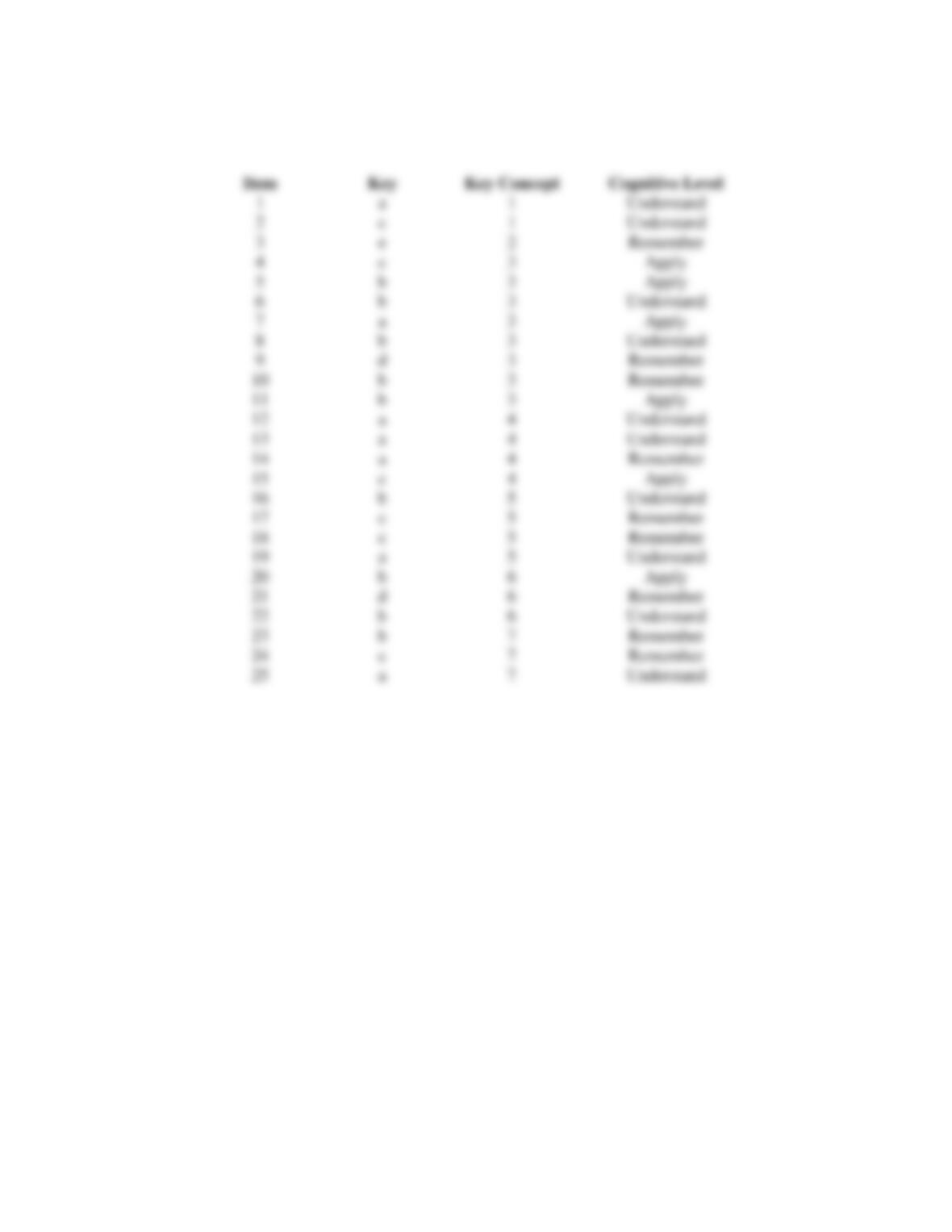
Answers and Classification of Items