8-5
Chapter 08 Profit Planning Answer Key
True / False Questions
1. The production budget is typically prepared prior to the sales budget.
2. One benefit of budgeting is that it coordinates the activities of the entire organization.
3. Both planning and control are needed for an effective budgeting system.
4. One difficulty with self-imposed budgets is that they are not subject to any type of review.
8-6
5. The master budget is a network consisting of many separate budgets that are
interdependent.
6. Planning and control are essentially the same thing.
7. Sales forecasts are drawn up after the cash budget has been completed because only then
are the funds available for marketing known.
8. A sales budget is a detailed schedule showing the expected sales for the budget period;
typically, it is expressed in both dollars and units of product.
8-7
9. Both variable and fixed manufacturing overhead costs are included in the manufacturing
overhead budget.
10. In the selling and administrative budget, the non-cash charges (such as depreciation) are
added to the total budgeted selling and administrative expenses to determine the expected
cash disbursements for selling and administrative expenses.
Multiple Choice Questions
11. Which of the following represents the normal sequence in which the indicated budgets are
prepared?
8-8
12. Which of the following is not a benefit of budgeting?
13. Self-imposed budgets typically are:
14. Which of the following represents the correct order in which the indicated budget
documents for a manufacturing company would be prepared?
Level: Medium
8-9
15. National Telephone company has been forced by competition to put much more emphasis
on planning and controlling its costs. Accordingly, the company’s controller has suggested
initiating a formal budgeting process. Which of the following steps will NOT help the
company gain maximum acceptance by employees of the proposed budgeting system?
16. A continuous (or perpetual) budget:
8-10
17. Which of the following statements is not correct?
18. Budgeted production in units are determined by:
8-11
19. The budgeted amount of raw materials to be purchased is determined by:
20. Which of the following is not correct regarding the manufacturing overhead budget?
8-12
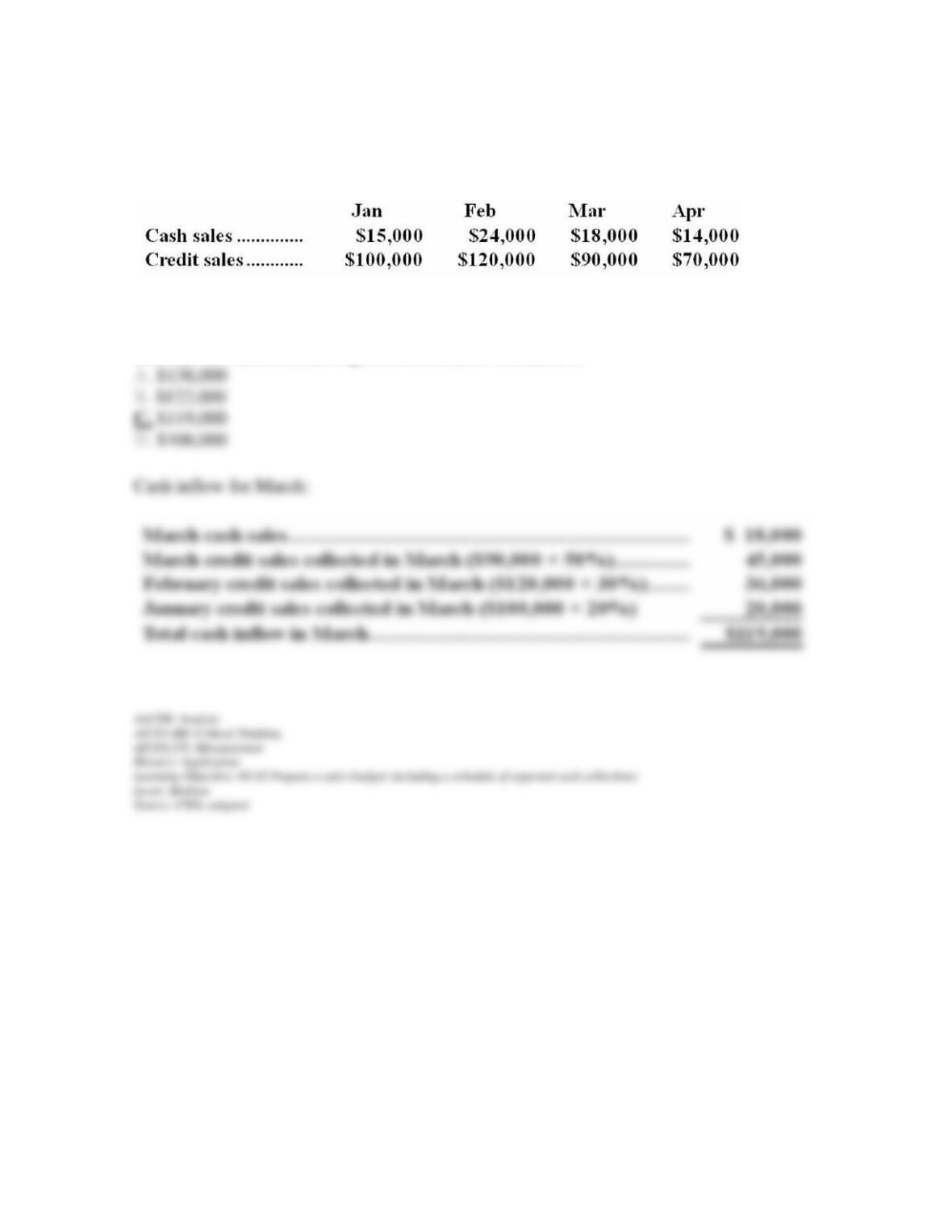
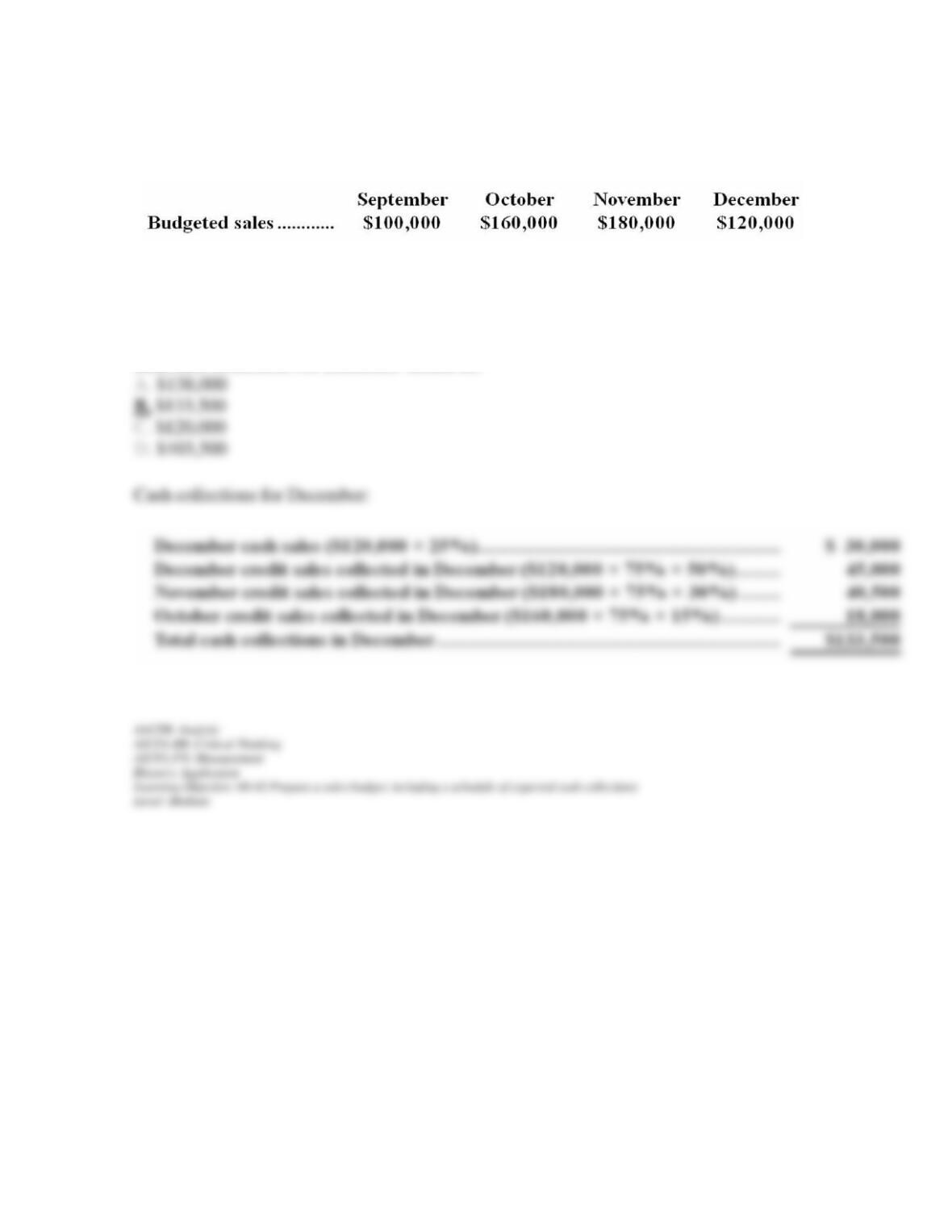
21. Shown below is the sales forecast for Cooper Inc. for the first four months of the coming
year.
On average, 50% of credit sales are paid for in the month of the sale, 30% in the month
following sale, and the remainder are paid two months after the month of the sale. Assuming
there are no bad debts, the expected cash inflow in March is:
8-13
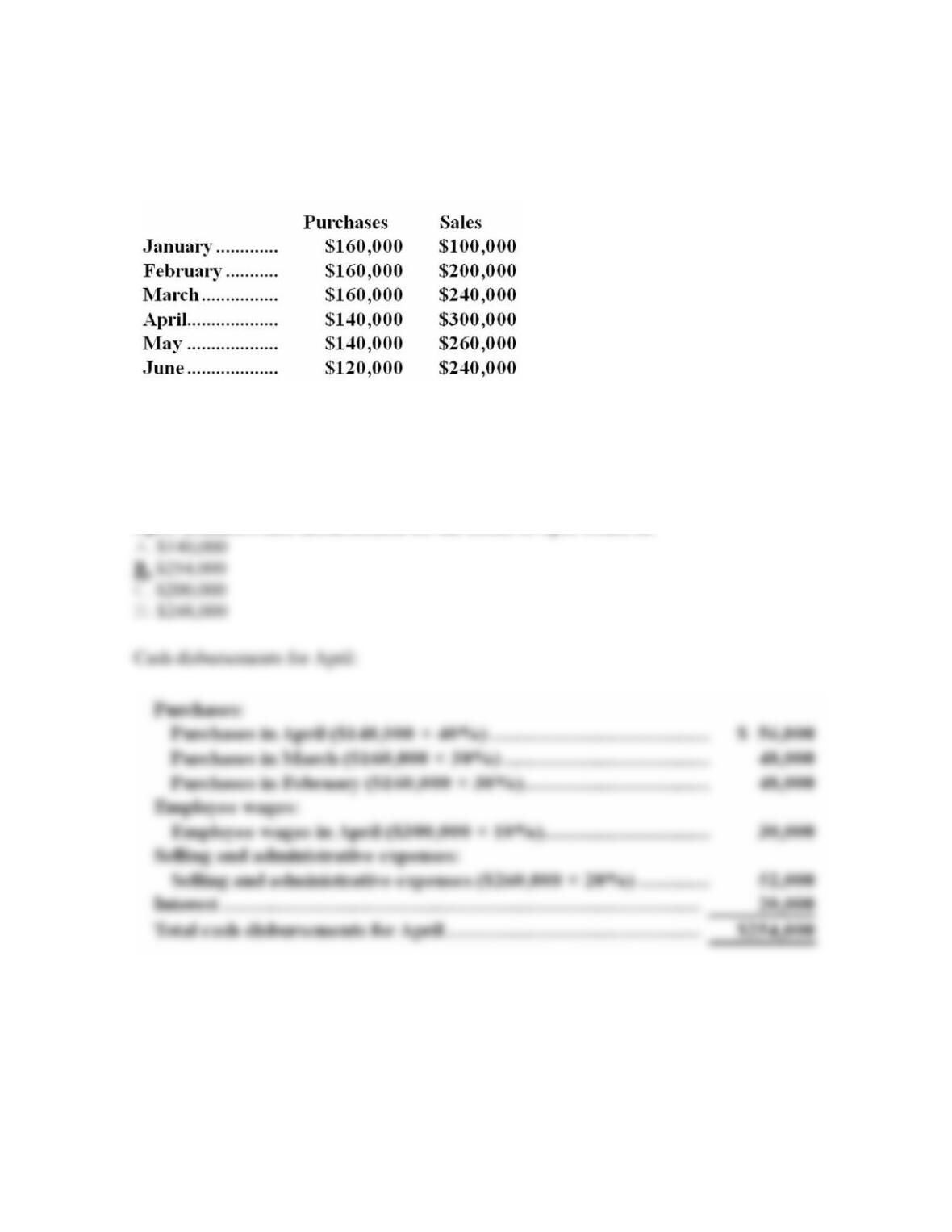
22. Budgeted sales in Allen Company over the next four months are given below:
Twenty-five percent of the company’s sales are for cash and 75% are on account. Collections
for sales on account follow a stable pattern as follows: 50% of a month’s credit sales are
collected in the month of sale, 30% are collected in the month following sale, and 15% are
collected in the second month following sale. The remainder are uncollectible. Given these
data, cash collections for December should be:
8-14
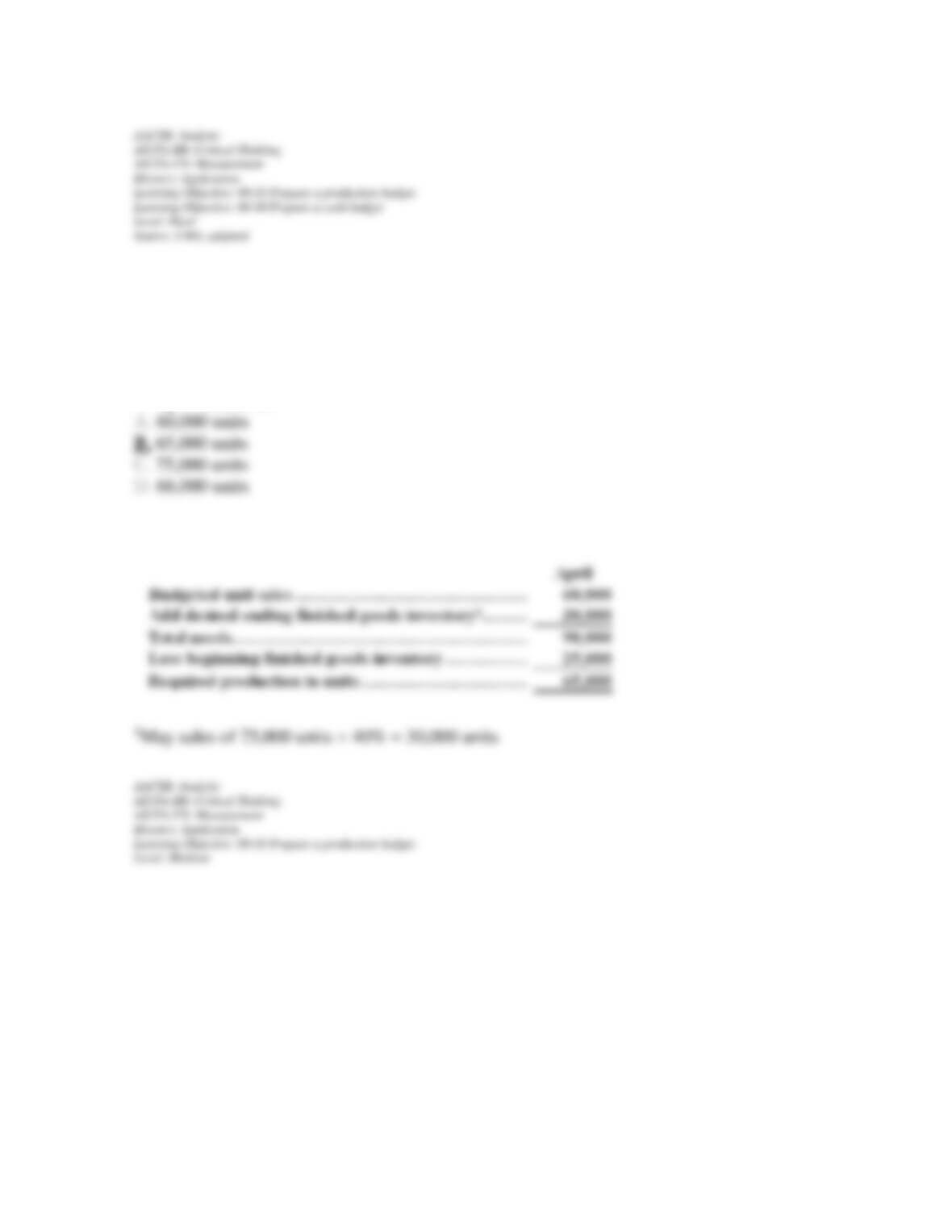
23. The following data have been taken from the budget reports of Brandon company, a
merchandising company.
Forty percent of purchases are paid for in cash at the time of purchase, and 30% are paid for
in each of the next two months. Purchases for the previous November and December were
$150,000 per month. Employee wages are 10% of sales for the month in which the sales
occur. Selling and administrative expenses are 20% of the following month’s sales. (July sales
are budgeted to be $220,000.) Interest payments of $20,000 are paid quarterly in January and
April. Brandon’s cash disbursements for the month of April would be:
8-15
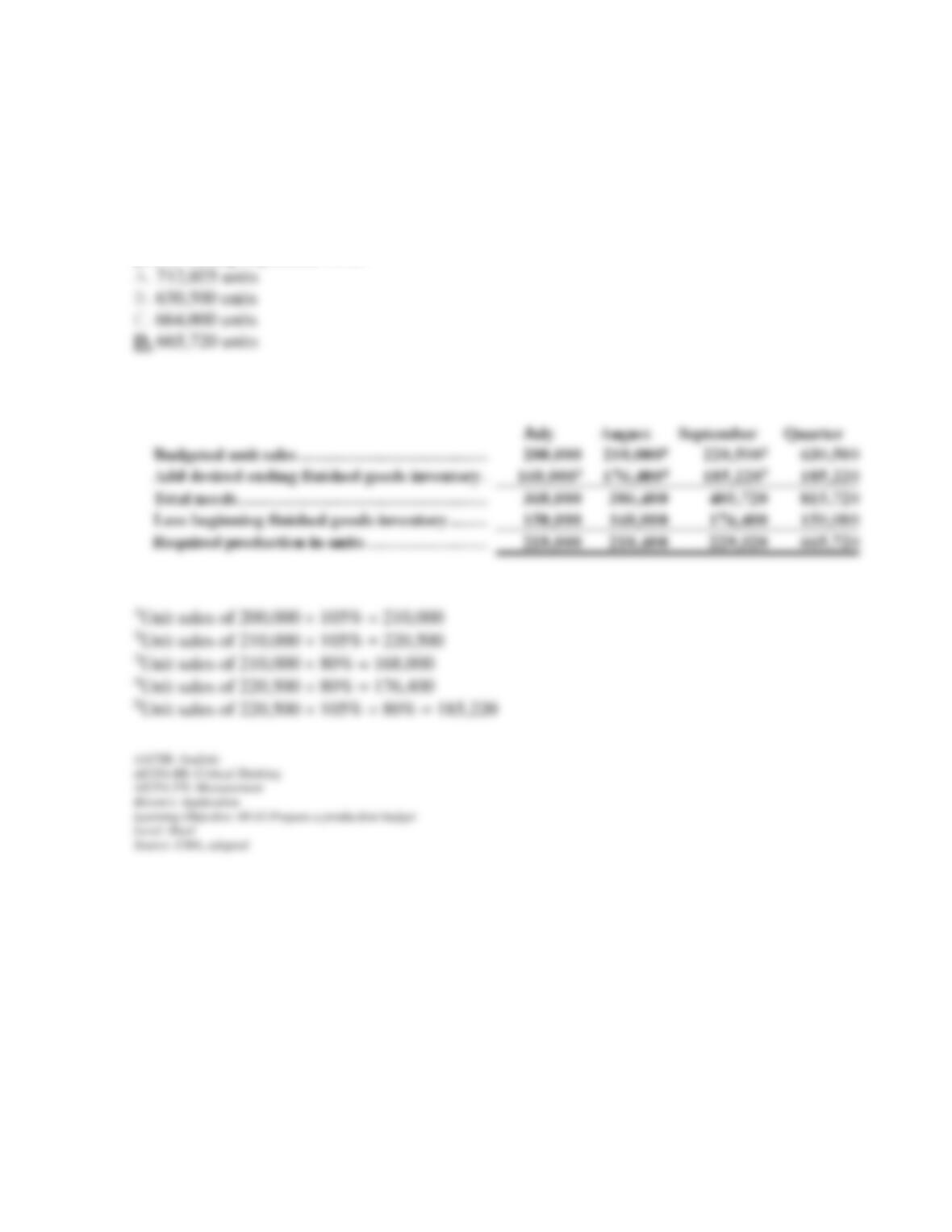
24. Walsh Company expects sales of Product W to be 60,000 units in April, 75,000 units in
May and 70,000 units in June. The company desires that the inventory on hand at the end of
each month be equal to 40% of the next month’s expected unit sales. Due to excessive
production during March, on March 31 there were 25,000 units of Product W in the ending
inventory. Given this information, Walsh Company’s production of Product W for the month
of April should be:
8-16
25. Berol Company plans to sell 200,000 units of finished product in July and anticipates a
growth rate in sales of 5% per month. The desired monthly ending inventory in units of
finished product is 80% of the next month’s estimated sales. There are 150,000 finished units
in inventory on June 30.
Berol Company’s production requirement in units of finished product for the three-month
period ending September 30 is:
8-17
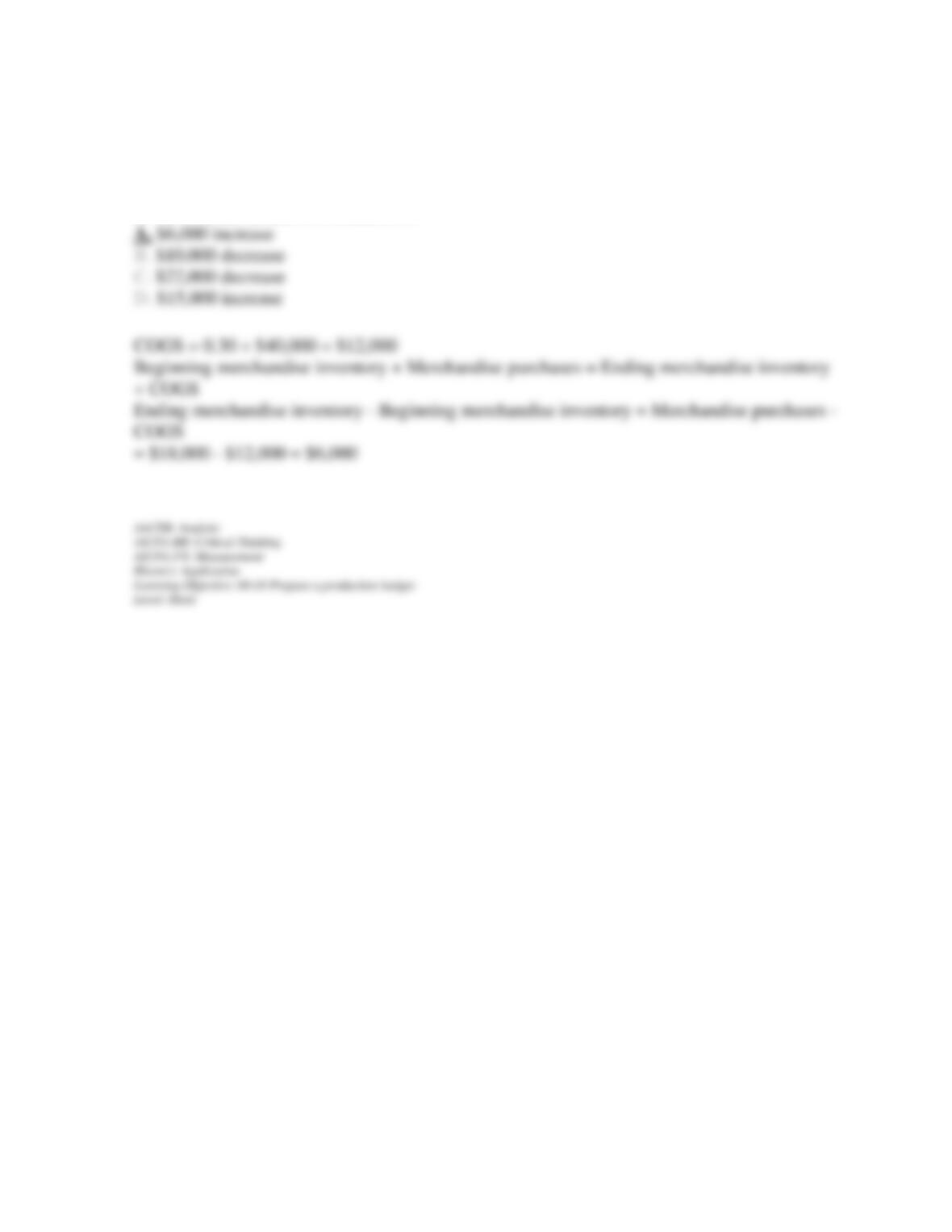
26. The Willsey Merchandise Company has budgeted $40,000 in sales for the month of
December. The company’s cost of goods sold is 30% of sales. If the company has budgeted to
purchase $18,000 in merchandise during December, then the budgeted change in inventory
levels over the month of December is:
8-18
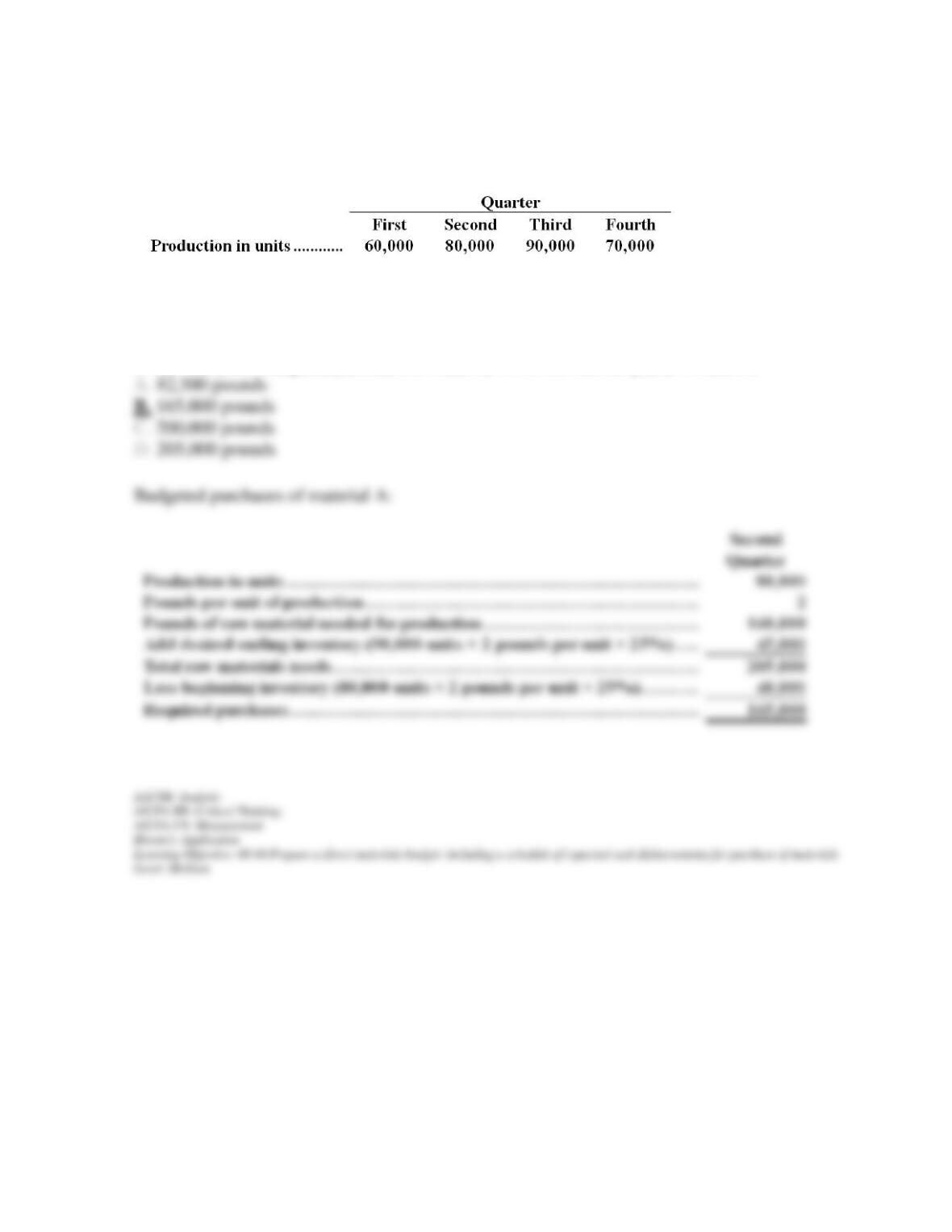
27. Prestwich Company has budgeted production for next year as follows:
Two pounds of material A are required for each unit produced. The company has a policy of
maintaining a stock of material A on hand at the end of each quarter equal to 25% of the next
quarter’s production needs for material A. A total of 30,000 pounds of material A are on hand
to start the year. Budgeted purchases of material A for the second quarter would be:
8-19
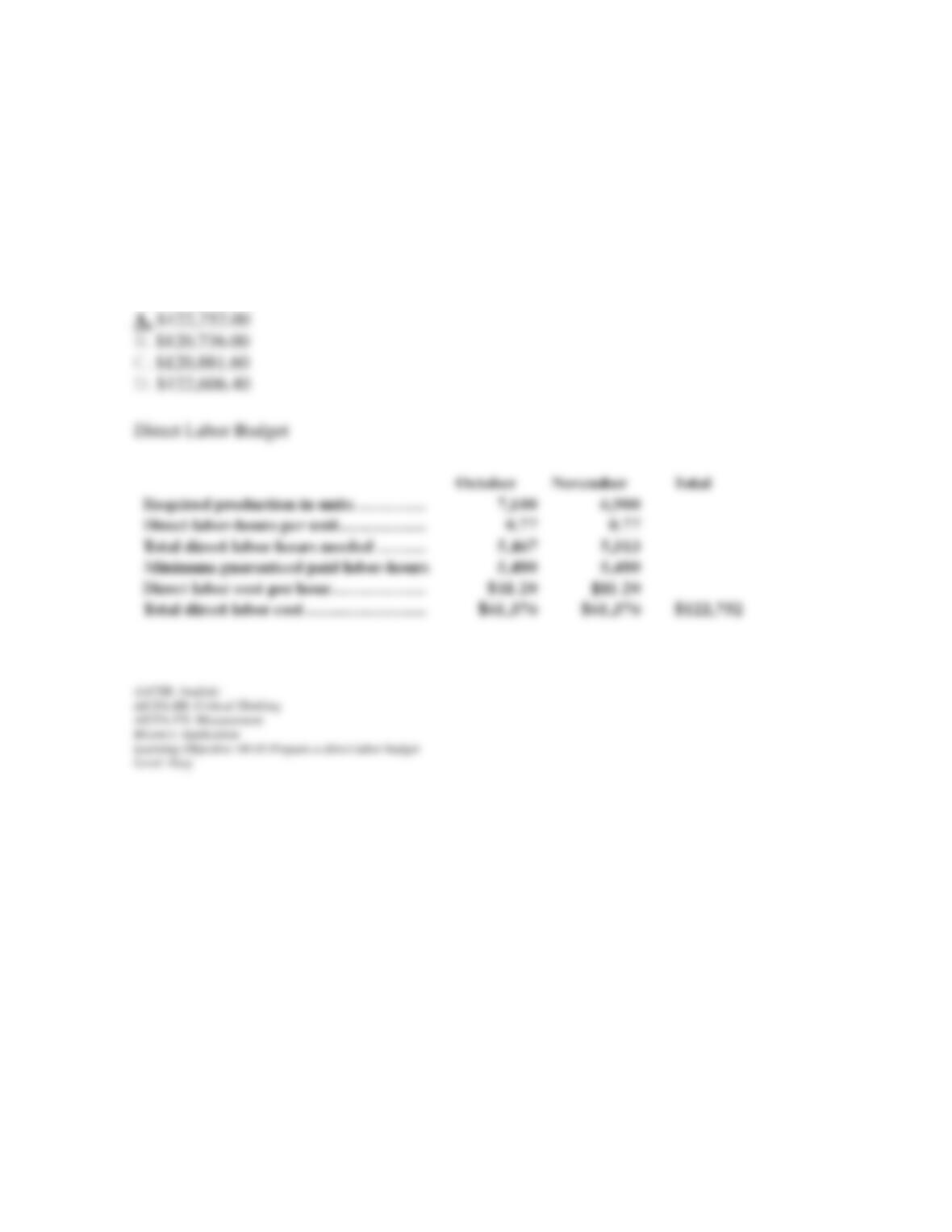
28. Veltri Corporation is working on its direct labor budget for the next two months. Each unit
of output requires 0.77 direct labor-hours. The direct labor rate is $11.20 per direct labor-
hour. The production budget calls for producing 7,100 units in October and 6,900 units in
November. The company guarantees its direct labor workers a 40-hour paid work week. With
the number of workers currently employed, that means that the company is committed to
paying its direct labor work force for at least 5,480 hours in total each month even if there is
not enough work to keep them busy. What would be the total combined direct labor cost for
the two months?
8-20
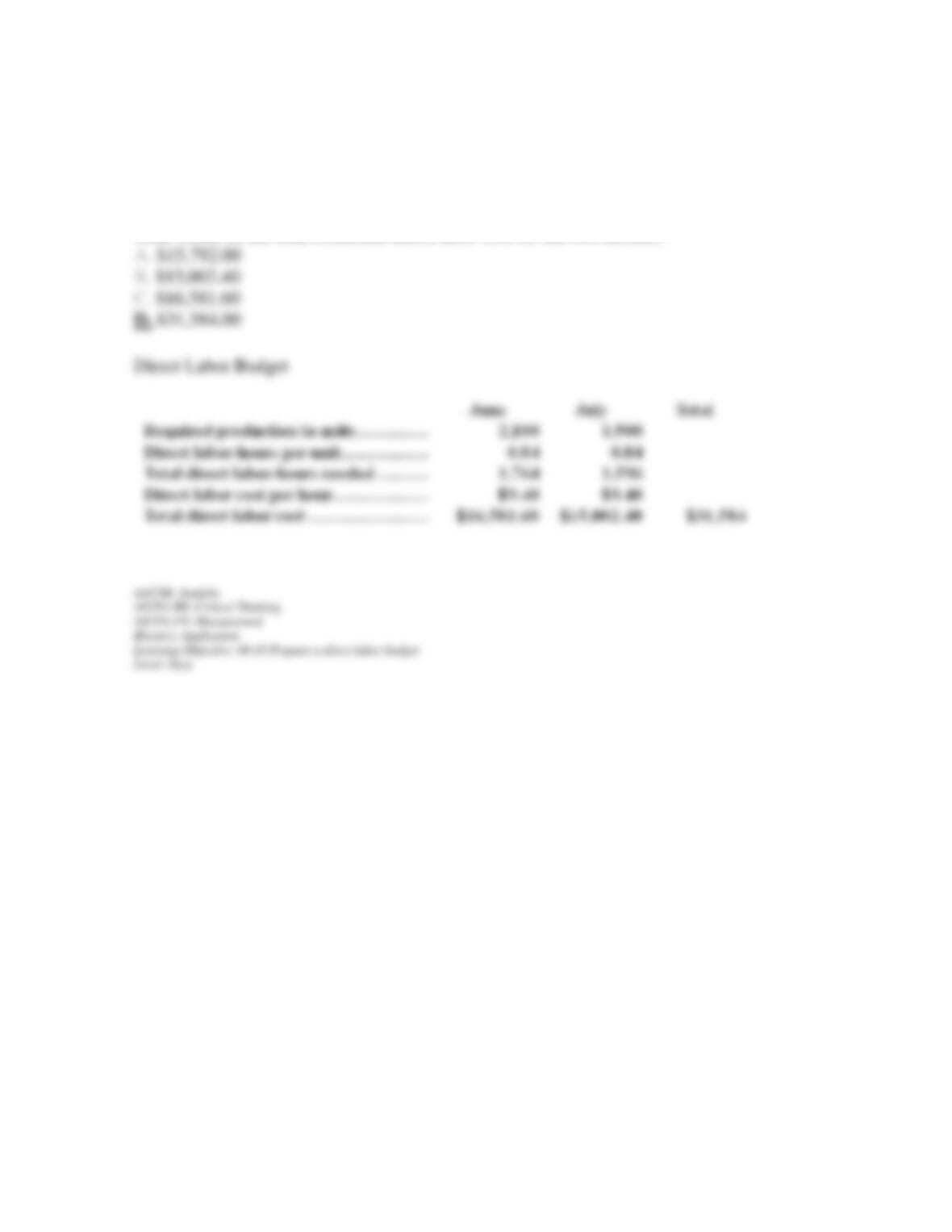
29. Hagos Corporation is working on its direct labor budget for the next two months. Each
unit of output requires 0.84 direct labor-hours. The direct labor rate is $9.40 per direct labor-
hour. The production budget calls for producing 2,100 units in June and 1,900 units in July. If
the direct labor work force is fully adjusted to the total direct labor-hours needed each month,
what would be the total combined direct labor cost for the two months?
8-21
30. Shuck Inc. bases its manufacturing overhead budget on budgeted direct labor-hours. The
direct labor budget indicates that 8,100 direct labor-hours will be required in May. The
variable overhead rate is $1.40 per direct labor-hour. The company’s budgeted fixed
manufacturing overhead is $100,440 per month, which includes depreciation of $8,910. All
other fixed manufacturing overhead costs represent current cash flows. The May cash
disbursements for manufacturing overhead on the manufacturing overhead budget should be:
8-22
31. The manufacturing overhead budget at Latronica Corporation is based on budgeted direct
labor-hours. The direct labor budget indicates that 7,100 direct labor-hours will be required in
August. The variable overhead rate is $8.60 per direct labor-hour. The company’s budgeted
fixed manufacturing overhead is $132,770 per month, which includes depreciation of
$24,850. All other fixed manufacturing overhead costs represent current cash flows. The
company recomputes its predetermined overhead rate every month. The predetermined
overhead rate for August should be:
8-23
32. Avitia Inc. bases its manufacturing overhead budget on budgeted direct labor-hours. The
direct labor budget indicates that 3,700 direct labor-hours will be required in September. The
variable overhead rate is $5.70 per direct labor-hour. The company’s budgeted fixed
manufacturing overhead is $48,100 per month, which includes depreciation of $5,550. All
other fixed manufacturing overhead costs represent current cash flows. The company
recomputes its predetermined overhead rate every month. The predetermined overhead rate
for September should be:
8-24
33. The manufacturing overhead budget at Cutchin Corporation is based on budgeted direct
labor-hours. The direct labor budget indicates that 2,800 direct labor-hours will be required in
September. The variable overhead rate is $7.00 per direct labor-hour. The company’s
budgeted fixed manufacturing overhead is $43,120 per month, which includes depreciation of
$3,640. All other fixed manufacturing overhead costs represent current cash flows. The
September cash disbursements for manufacturing overhead on the manufacturing overhead
budget should be: