Exam
Name___________________________________
SHORT ANSWER. Write the word or phrase that best completes each statement or answers the question.
Provide the proper response.
1)
A student wishes to take the integral over all real numbers of f(x) =
x2 if x < 0
1
x, if x > 0 , and
claims this is zero because –+ equals zero. What is wrong with this thinking?
1)
2)
A student claims that
b
a
f(x) dx always exists, as long as a and b are both positive. Refute
this by giving an example of a function for which this is not true.
2)
3)
A student needs
–
1
ex dx . Is this integral the same as 2
0
1
ex dx , and if so, why?
3)
4)
A student wishes to find the integral
0
f(x) dx of a function that has the property limit
lim
x f(x) = 1. Why can this not be done?
4)
MULTIPLE CHOICE. Choose the one alternative that best completes the statement or answers the question.
The function represents the rate of flow of money in dollars per year. Assume a 10–year period and find the present
value.
5)
f(x) = 0.5x at 3% compounded continuously
5)
A)
$41.04
B)
$267.46
C)
$1090.59
D)
$20.52
Find the average value of the function on the given interval.
6)
f(x) =x + 2; [1, 19]
6)
A)
5.058
B)
3.194
C)
3.372
D)
3.459
Solve the problem.
7)
A money market fund has a continuous flow of money at a rate of f(x) =1900x –170x2 for 10 years.
Find the final amount if interest is earned at 6% compounded continuously.
7)
A)
$27,951.67
B)
$38,333.33
C)
$50,931.26
D)
$15,340.20
Use integration by parts to find the integral.
8)
4xex dx
8)
A)
4ex– ex+ C
B)
xex– 4ex+ C
C)
4xex– 4ex+ C
D)
4ex– 4xex+ C
Use the table of integrals or a computer or calculator with symbolic integration capabilities to find the integral.
9)
x dx
1 + x
9)
A)
(x – 2) 1 + x + C
B)
2(x – 2) 1 + x
3+ C
C)
4(x – 2) 1 + x
3+ C
D)
(x – 2) 1 + x
3+ C
Evaluate the improper integral. If the integral does not converge, state that the integral is divergent.
10)
0
23xe2x dx
10)
A)
–5.75
B)
0
C)
5.75
D)
Divergent
Find the volume of the solid of revolution formed by rotating about the x–axis the region bounded by the curves.
11)
f(x) = 2x + 5, y = 0, x = 0, x =15
11)
A)
7145.83
B)
7125.00
C)
300
D)
14,250.00
Evaluate the improper integral. If the integral does not converge, state that the integral is divergent.
12)
1
x
ex dx Give your answer in exact form.
12)
A)
0
B)
2
e
C)
–1
e
D)
Divergent
Use integration by parts to find the integral.
13)
x –7 e2xdx
13)
A)
1
2(x –7)e2x +1
4e2x + C
B)
1
2(x –7)e2x –1
4e2x + C
C)
2(x –7)e2x –4 e2x + C
D)
(x –7)e2x –e2x + C
Find the area between the graph of the function and the x–axis over the given interval, if possible.
14)
f(x) =5
x – 1 for (–, 0]
14)
A)
0
B)
5
C)
–5
D)
Divergent
Solve the problem. Round your answer to the nearest whole number.
15)
The capital value of an asset is defined as
0
R(t)e–rt dt , where k is the annual rate of interest
compounded continuously and R(t) gives the annual rate at which earnings are produced by the
asset at time t. Find the capital value of an asset that produces $5000 yearly income at 7%
compounded continuously.
15)
A)
$70,000
B)
$71,429
C)
$83,333
D)
$75,000
Use integration by parts to find the integral.
16)
ln 4x dx
16)
A)
x ln 4x – x + C
B)
x ln 4x + x + C
C)
x ln 4x – 4x + C
D)
4x ln x – x + C
Use the table of integrals or a computer or calculator with symbolic integration capabilities to find the integral.
17)
4x dx
x2(1 + 4x2)
17)
A)
–2 ln 1 +2x2
x2+ C
B)
– 2 ln 1 + 4x2
x2+ C
C)
ln 1 + 4x2
x2+ C
D)
ln x2
1 +2x2+ C
Find the integral by using integration by parts or other techniques. Round the answer to four decimal places if necessary.
18)
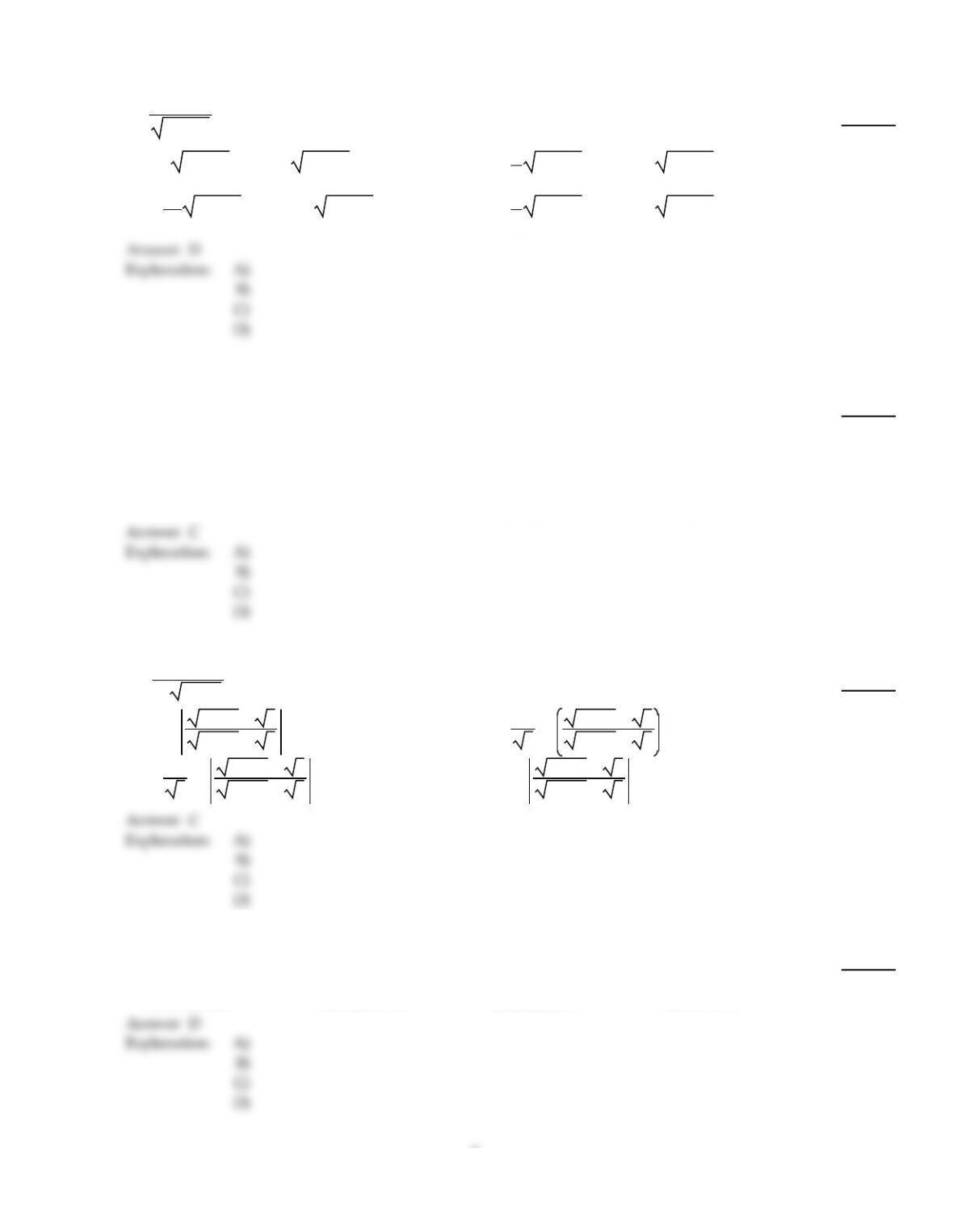
x2
x2+ 14
dx
18)
A)
x x2+ 14 – ln (x +x2+ 14) + C
B)
x
2x2+ 14 +7 ln (x +x2+ 14) + C
C)
3x
2x2+ 14 –7 ln (x +x2+ 14) + C
D)
x
2x2+ 14 –7 ln (x +x2+ 14) + C
Solve the problem. Round your answer to the nearest whole number.
19)
The capital value of an asset is defined as
0
R(t)e–rt dt , where k is the annual rate of interest
compounded continuously and R(t) gives the annual rate at which earnings are produced by the
asset at time t. Find the capital value of an asset that produces $5000 yearly income at 4%
compounded continuously.
19)
A)
$150,000
B)
$130,000
C)
$125,000
D)
$100,000
Use the table of integrals or a computer or calculator with symbolic integration capabilities to find the integral.
20)
dx
x 6+ 3x
20)
A)
ln 6+3x +6
6+3x –6
+ C
B)
1
6 ln 6+ 3x–6
6+ 3x+6
+ C
C)
1
6 ln 6+ 3x–6
6+ 3x+6
+ C
D)
ln 6+3x –6
6+3x +6
+ C
Solve the problem.
21)
The rate of a continuous money flow starts at $1000 and decreases exponentially at 4% per year for
10 years. Find the final amount if interest is earned at 2% compounded continuously.
21)
A)
$37,092.35
B)
$16,735.64
C)
$31,528.71
D)
$9184.71
5
Use the table of integrals or a computer or calculator with symbolic integration capabilities to find the integral.
22)
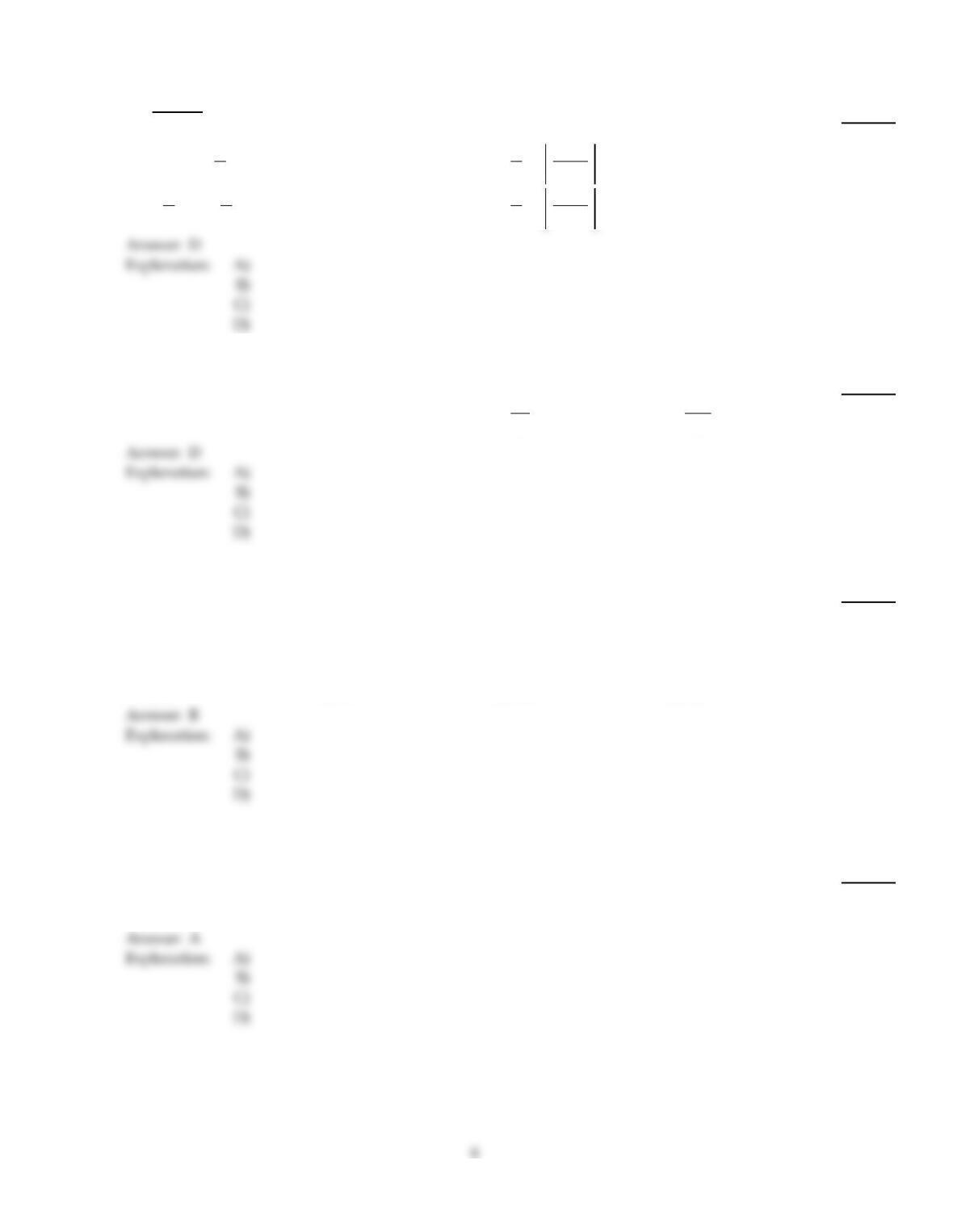
8
81 –x2 dx
22)
A)
8sin–1x
9+ C
B)
4
9 ln x –9
x +9+ C
C)
8
9tan–1x
9+ C
D)
4
9 ln x +9
x –9+ C
Solve the problem.
23)
Find the volume of a right circular cone with a height of 10 meters and a base radius of 6 meters.
23)
A)
91 cubic m
B)
120 cubic m
C)
60
3 cubic m
D)
360
3 cubic m
Solve the problem. Round your answer to the nearest whole number.
24)
Radioactive waste is entering the atmosphere over an area at a decreasing rate. Use the improper
integral
0
Pe–kt dt with P =16 to find the total amount of waste that will enter the atmosphere
for k = 0.08.
24)
A)
20
B)
200
C)
2000
D)
128
Use integration by parts to find the integral. Round the answer to two decimal places if necessary.
25)
4
2
5x ln x dx
25)
A)
33.52
B)
7.9
C)
6.70
D)
45.5
Find the area between the graph of the function and the x–axis over the given interval, if possible.
26)
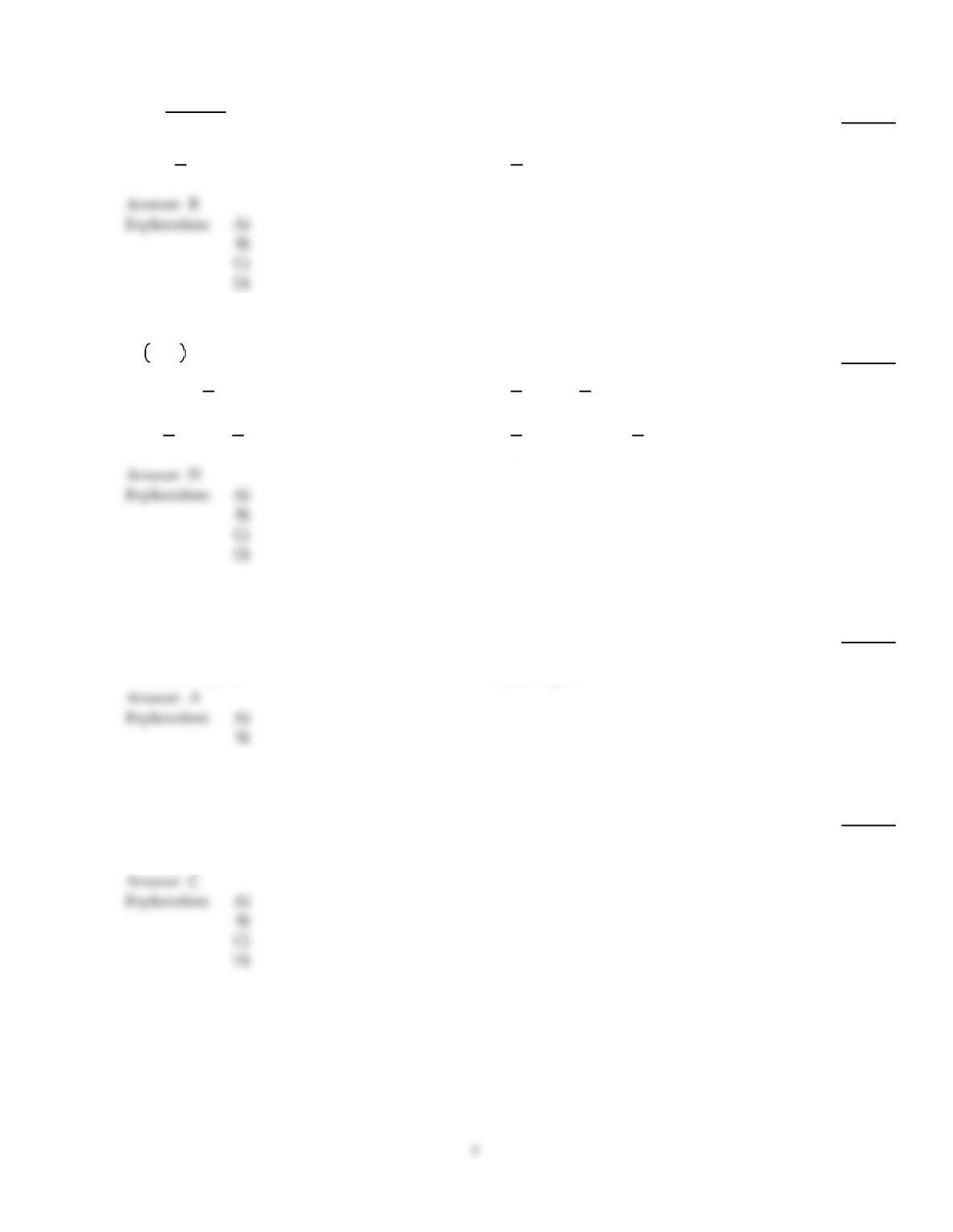
f(x) =x
(1 +x2)4 for (–, )
26)
A)
–1
6
B)
0
C)
1
6
D)
Divergent
Use integration by parts to find the integral.
27)
x – 5 ln x dx
27)
A)
ln x –1
4x2+ C
B)
1
2x2ln x –1
4x2– 5x + C
C)
1
2x2ln x –1
4x2+ C
D)
1
2x2ln x – 5xlnx –1
4x2+ 5x + C
Determine whether the improper integral is convergent or divergent.
28)
0
–
e8x dx
28)
A)
Convergent
B)
Divergent
Find the integral by using integration by parts or other techniques. Round the answer to four decimal places if necessary.
29)
3
1
(1 – x2) e2x dx
29)
A)
–1109.4292
B)
–913.2566
C)
–1111.2764
D)
–1613.7152
Use the table of integrals or a computer or calculator with symbolic integration capabilities to find the integral.
30)
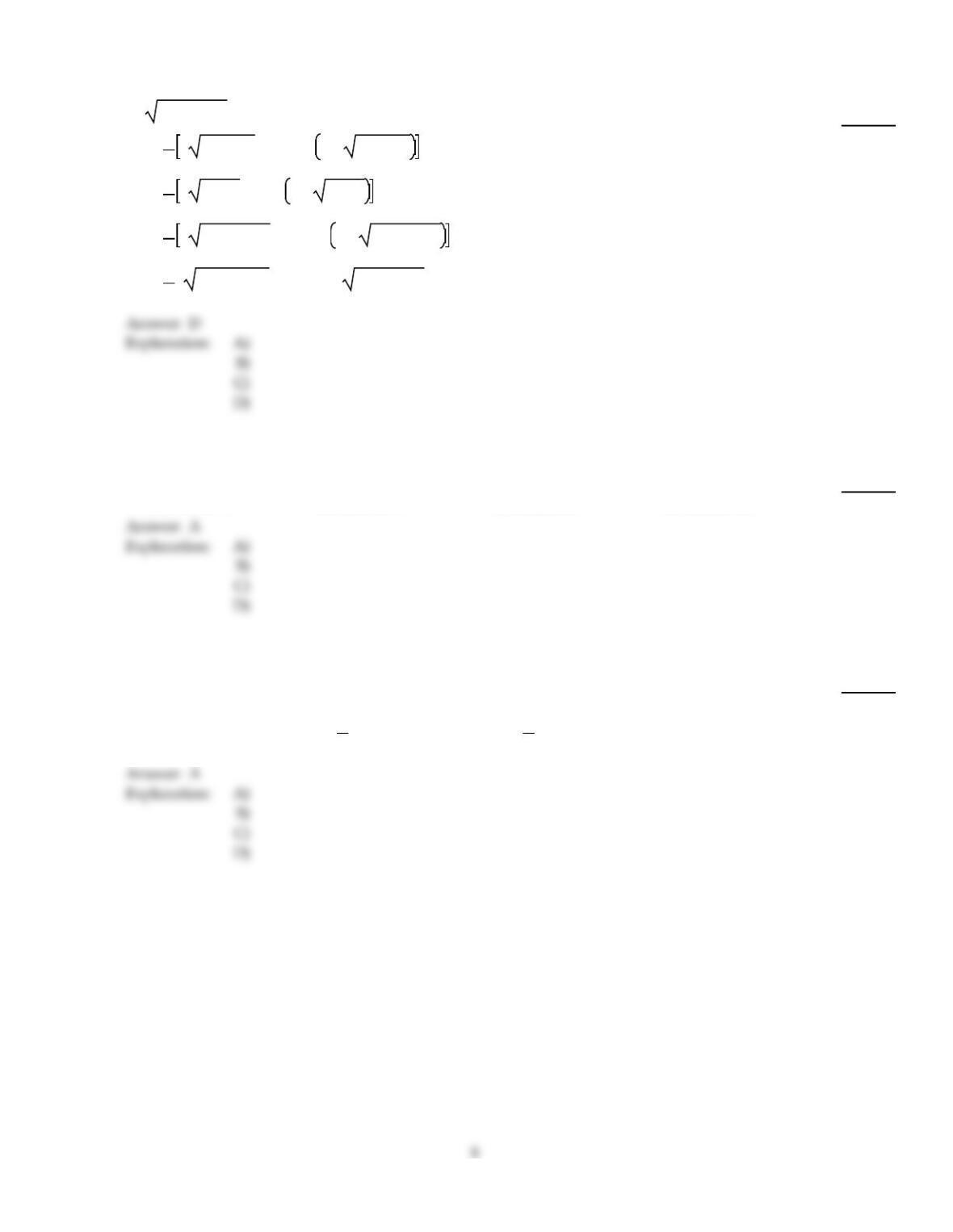
25x2+100 dx
30)
A)
5
2x x2+100 +100 ln x +x2+100 + C
B)
1
2x x2+4+4 ln x +x2+4+ C
C)
1
2x25x2+100 +100 ln x +25x2+100 + C
D)
5
2x25x2+100 +50ln(x +25x2+100) + C
The function represents the rate of flow of money in dollars per year. Assume a 10–year period and find the present
value.
31)
f(x) = 2000 at 5% compounded continuously
31)
A)
$15,738.77
B)
$25,948.85
C)
$64,261.23
D)
$24,261.23
Evaluate the improper integral. If the integral does not converge, state that the integral is divergent.
32)
–
x3e–x4 dx
32)
A)
0
B)
1
4
C)
–1
2
D)
Divergent
Find the integral by using integration by parts or other techniques. Round the answer to four decimal places if necessary.
33)
x dx
(7x2+ 3)5
33)
A)
–7
3(7x2+ 3)–4+ C
B)
–7
3(7x2+ 3)–6+ C
C)
–1
56 (7x2+ 3)–4 + C
D)
–1
14 (7x2+ 3)–6+ C
Find the area between the graph of the function and the x–axis over the given interval, if possible.
34)
f(x) =1
x2.9 for (1, )
34)
A)
29
39
B)
10
19
C)
10
39
D)
Divergent
Provide the proper response.
35)
A student knows that
a
f(x) dx converges. Does
a
–
f(x) dx also necessarily converge?
35)
A)
Yes
B)
No
Find the volume of the solid of revolution formed by rotating about the x–axis the region bounded by the curves.
36)
y =1
x, y = 0, x = 1, x =8
36)
A)
ln 8
B)
7
16
C)
1
8
D)
7
8
9
Find the integral by using integration by parts or other techniques. Round the answer to four decimal places if necessary.
37)
x2x + 15 dx
37)
A)
(15x2– 180x + 1800)(x + 15)3
105 + C
B)
(30x2– 360x + 3600)(x + 15)
105 + C
C)
(30x2– 360x + 3600)(x + 15)3
105 + C
D)
(30x2– 360x + 240)(x + 15)3
105 + C
Solve the problem.
38)
The rate of a continuous money flow starts at $500 and increases exponentially at 4% per year for
10 years. Find the final amount if interest is earned at 8% compounded continuously.
38)
A)
$46,467.07
B)
$41,501.46
C)
$13,682.20
D)
$9171.45
D)
Use integration by parts to find the integral. Round the answer to two decimal places if necessary.
39)
1
0
x
x + 1 dx
39)
A)
–2.27
B)
–1.33
C)
–0.94
D)
0.39
D)
Use the table of integrals or a computer or calculator with symbolic integration capabilities to find the integral.
40)
1
x25 +x2dx
40)
A)
1
5 ln 5+25 +x2
x+ C
B)
–1
5 ln 5+25 –x2
x+ C
C)
–1
5 ln 5+25 +x2
x+ C
D)
ln x +x2+25 + C
D)
D)
Solve the problem.
41)
A money market fund has a continuous flow of money at a rate of f(x) =0.02x +900 for 10 years.
Find the present value of this flow if interest is earned at 5% compounded continuously.
41)
A)
$28,932.83
B)
$5448.59
C)
$7083.17
D)
$5902.64
42)
The rate of growth of a microbe population is given by m'(x) = 30xe2x, where x is time in days.
What is the net growth between day 3 and day 7?
42)
A)
117,238,789
B)
222,613,533
C)
111,306,789
D)
222,613,544
Evaluate the improper integral. If the integral does not converge, state that the integral is divergent.
43)
0
–
6xe–x2 dx
43)
A)
0
B)
–3
C)
–6
D)
Divergent
Find the average value of the function on the given interval.
44)
f(x) = 3x2– 4; [0, 4]
44)
A)
12
3
B)
12
C)
13
D)
16
Solve the problem.
45)
The price per share of a stock can be approximated by the function S(t) = t(29 –4t) +19, where t is
time (in years) since the stock was purchased. Find the average price of the stock over the first 6
years.
45)
A)
$75.40
B)
$348.00
C)
$58.00
D)
$31.50
11
46)
Suppose the number of items a new worker on an assembly line produces daily after t days on the
job is given by 25 + 2t. Find the average number of items produced daily in the first 20 days.
46)
A)
45
B)
40
C)
48
D)
900
Find the integral by using integration by parts or other techniques. Round the answer to four decimal places if necessary.
47)
14xex2dx
47)
A)
7ex2+ C
B)
14ex2+ C
C)
7
2ex2+ C
D)
7x2ex2+ C
D)
Find the volume of the solid of revolution formed by rotating about the x–axis the region bounded by the curves.
48)
y =49 –x2, y = 0, x = 0, x =7
48)
A)
14
B)
1372
3
C)
686
3
D)
196
D)
Solve the problem.
49)
The intensity of the reaction to a certain drug, in appropriate units, is given by R(t) = te–0.1t, where
t is time (in hours) after the drug is administered. Find the average intensity during the 4th hour.
49)
A)
130e–0.3 –140e–0.4
B)
–0.7e–0.3 –140e–0.4
C)
140e–0.4 –150e–0.5
D)
130e–0.3 +100e–0.4
D)
D)
Use integration by parts to find the integral.
50)
ln 6x
x3 dx
50)
A)
–1
2 x–2 ln 6x –1
4 x–2+ C
B)
–1
2 x–2 ln 6x –1
2 x–1+ C
C)
–1
2 x–2 ln 6x +1
4 x–2+ C
D)
ln 6x +1
2 x–2+ C
Determine whether the improper integral is convergent or divergent.
51)
1
7x +9
3x3+5x2+ 1
51)
A)
Divergent
B)
Convergent
Find the average value of the function on the given interval.
52)
f(x) =(6x + 1)1/2 ; [0, 8]
52)
A)
38
B)
57
4
C)
25
D)
19
4
Determine whether the improper integral is convergent or divergent.
53)
7
e–4x dx
53)
A)
Convergent
B)
Divergent
Solve the problem.
54)
An investment is expected to produce a uniform continuous rate of money flow of $500 per year for
10 years. Find the present value at 4% compounded continuously.
54)
A)
$4121.00
B)
$6147.81
C)
$8379.00
D)
$20,879.00
Solve the problem. Round your answer to the nearest whole number.
55)
In an epidemiological model used to study the spread of drug use, a single drug user is introduced
into a population of N non–users. Under certain assumptions, the number of people expected to use
drugs as a result of direct influence from each drug user is given by
S = N
0
4(1 –e–kt)
ke–bt dt ,
where b and k are constants. Find the value of S.
55)
A)
4Ne–bkt
B)
N(1 –e–kt)e–bt
C)
4N/(b + k)
D)
4N/[b(b + k)]
Determine whether the improper integral is convergent or divergent.
56)
0
–
3xe–x2 dx
56)
A)
Convergent
B)
Divergent
57)
0
dx
x8/9
57)
A)
Divergent
B)
Convergent
Use integration by parts to find the integral.
58)
(7x +2) e–4x dx
58)
A)
–28x e–4x –120 e–4x + C
B)
–7
4 x e–4x –e–4x + C
C)
–7
4x e–4x –15
16 e–4x + C
D)
7
4x e–4x +15
16 e–4x + C
Use integration by parts to find the integral. Round the answer to two decimal places if necessary.
59)
4
0
xe– x dx
Give your answer in exact form.
59)
A)
–5e–4
B)
–5e–4– 1
C)
–5e–4+ 1
D)
–3e–4+ 1
The function represents the rate of flow of money in dollars per year. Assume a 10–year period and find the accumulated
amount of money flow at t = 10.
60)
f(x) = 1000e–0.04x at 2% compounded continuously
60)
A)
$37,092.35
B)
$31,528.71
C)
$9184.71
D)
$16,735.64
Solve the problem.
61)
Find the area between y = (x –2)ex and the y–axis from x =2 to x =6. Give your answer in exact
form.
61)
A)
3e6+ e2
B)
e6– e2
C)
3e6
D)
e6+ e2
62)
A person‘s metabolic rate tends to go up after eating a meal and then, after some time has passed, it
returns to a resting metabolic rate. This phenomenon is known as the thermic effect of food, and
the effect (in kJ/hr) for one individual is
F(t) = – 10.28 + 175.9te–t/1.3
where t is the number of hours that have elapsed since eating a meal. Find the total thermic energy
of a meal for the next four hours after a meal by integrating the thermic effect function between
t = 0 and t = 4.
62)
A)
186.5 kJ
B)
200.3 kJ
C)
150.1 kJ
D)
128.4 kJ
Find the average value of the function on the given interval.
63)
f(x) = x + 4; [1, 12]
63)
A)
17.045
B)
10.909
C)
10.5
D)
9.625
Determine whether the improper integral is convergent or divergent.
64)
1
x
ex dx
64)
A)
Convergent
B)
Divergent
65)
1
ln x
x dx
65)
A)
Convergent
B)
Divergent
Find the volume of the solid of revolution formed by rotating about the x–axis the region bounded by the curves.
66)
y = x +1, y = 0, x = – 1, x =6
66)
A)
24
B)
343
3
C)
49
D)
7
2
Use integration by parts to find the integral. Round the answer to two decimal places if necessary.
67)
1
0
4x +9
ex dx
67)
A)
19.46
B)
–6.25
C)
6.75
D)
8.22
16
Determine whether the improper integral is convergent or divergent.
68)
0
13ex dx
68)
A)
Divergent
B)
Convergent
Find the volume of the solid of revolution formed by rotating about the x–axis the region bounded by the curves.
69)
y =1
x, y = 0, x = 1, x =8 Give your answer in exact form.
69)
A)
8
B)
ln 8
C)
1
8
D)
1
2 ln 8
70)
f(x) =1
x +9, y = 0, x = – 8, x =12 Give your answer in exact form.
70)
A)
(ln 21 – 1)
B)
ln 21
C)
2 ( 21 – 1)
D)
ln 21
Find the area between the graph of the function and the x–axis over the given interval, if possible.
71)
f(x) =x4e–x5 for (–, )
71)
A)
0
B)
1
5
C)
–1
5
D)
Divergent
Solve the problem.
72)
A money market fund has a continuous flow of money at a rate of f(x) =1600x –180x2 for 10 years.
Find the present value of this flow if interest is earned at 6% compounded continuously.
72)
A)
$930,338.97
B)
$2,460,097.36
C)
$92,703.87
D)
$15,652.91
Use the table of integrals or a computer or calculator with symbolic integration capabilities to find the integral.
73)
2
3x 9x +7 dx
73)
A)
1
7 ln x
9x + 7 + C
B)
2
7 ln x
9x +7+ C
C)
7
81 +x
9–7
81 ln(9x +7) + C
D)
2
21 ln x
9x + 7 + C
Solve the problem.
74)
The design of an electric power generating station depends on both the peak and the average
power that it must produce. If a community uses 168 + 72t – 3t2 megawatts at time t (in hours)
during the period t = 0 to t = 24, find the average level of power consumption for that day.
74)
A)
1032 MW
B)
10,944 MW
C)
24,768 MW
D)
456 MW
Solve the problem. Round your answer to the nearest whole number.
75)
The capital value of an asset is defined as
0
R(t)e–rt dt , where k is the annual rate of interest
compounded continuously and R(t) gives the annual rate at which earnings are produced by the
asset at time t. Suppose an asset produces a perpetual stream of income with a flow rate of R(t) =
1200e0.03t . Find the capital value at an interest rate of 7% compounded continuously.
75)
A)
$30,000
B)
$17,142
C)
$40,000
D)
$12,000
Determine whether the improper integral is convergent or divergent.
76)
6
dx
x +73/2
76)
A)
Divergent
B)
Convergent
77)
8
dx
x
77)
A)
Divergent
B)
Convergent
B)
Find the area between the graph of the function and the x–axis over the given interval, if possible.
78)
f(x) =11
(x – 1)3 for (–, 0]
78)
A)
–5.5
B)
–0.5
C)
5.5
D)
Divergent
B)
The function represents the rate of flow of money in dollars per year. Assume a 10–year period and find the accumulated
amount of money flow at t = 10.
79)
f(x) = 500e0.04x at 8% compounded continuously
79)
A)
$46,467.07
B)
$13,682.20
C)
$41,501.46
D)
$9171.45
B)
Find the area between the graph of the function and the x–axis over the given interval, if possible.
80)
f(x) =11e–x for (–, e]
80)
A)
–0.726
B)
–166.694
C)
0.726
D)
Divergent
B)
Determine whether the improper integral is convergent or divergent.
81)
2
12
(x + 1)2 dx
81)
A)
Convergent
B)
Divergent
B)
Find the volume of the solid of revolution formed by rotating about the x–axis the region bounded by the curves.
82)
f(x) =5x +8 , y = 0, x = 1, x = 5
82)
A)
152
B)
92
C)
152
D)
92
Solve the problem.
83)
The amplitude of an alternating voltage V = V(t) is sometimes indicated by giving the rms (root
mean square) voltage, which is the square root of the average value of V2. Find the rms voltage if
V(t) =27,600t over the period t = 0 to t = 1/60 s.
83)
A)
153.3 V
B)
23,500.9 V
C)
265.6 V
D)
0.1 V
Find the area between the graph of the function and the x–axis over the given interval, if possible.
84)
f(x) =1
(x +4)3 for (–4, )
84)
A)
1
8
B)
4
7
C)
3
4
D)
Divergent
Determine whether the improper integral is convergent or divergent.
85)
0
–
4e5x dx
85)
A)
Divergent
B)
Convergent
Solve the problem.
86)
The voltage v (in volts) induced in a tape head is given by v = t2e3t, where t is the time (in
seconds). Find the average value of v over the interval from t = 0 to t =3. Round to the nearest volt.
86)
A)
71,327 volts
B)
6502 volts
C)
1100 volts
D)
16 volts